
Hair fibers are a cosmetic concealer, not a treatment. In a study of 40 people with alopecia, 92.5% reported satisfactory color matching and coverage after using a keratin fiber filler, but the visible fullness didn't address why their hair was being lost, as the clinical evidence shows (study details).
That distinction matters because the most popular advice about fiber for hair often stops at “sprinkle it on and look fuller.” The fuller appearance is real, immediate, and useful for many men. It can make a widening crown, visible part, or diffuse thinning look less exposed during a workday, event, or photograph. But a better-looking scalp doesn't tell you whether the cause is androgenetic alopecia, sudden shedding, alopecia areata, inflammation, or scarring.
A sensible plan treats fibers as appearance management. It treats the underlying hair loss as a separate medical question.
Table of Contents
- What Fiber for Hair Actually Means
- How Hair Fibers Attach and What They Can and Cannot Do
- Applying Hair Fibers the Right Way
- Types of Hair Fibers and Ingredients to Look For
- What the Evidence Actually Shows
- When Concealment Is the Wrong Answer
- Evidence-Based Options That Actually Address Thinning
- Putting It Together and Your Most Common Questions
What Fiber for Hair Actually Means
“Fiber for hair” usually means a topical cosmetic hair fiber, not dietary fiber. The product is a colored particle applied to existing hair to make it appear fuller. Dietary fiber belongs to nutrition and digestion, so pages that shift between these meanings are answering different questions.
Topical products commonly use keratin or another fibrous material shaped and colored to resemble natural strands. They are spread over areas that look less dense and may be secured with a styling product. The practical value is immediate visual coverage, while the medical question, why the hair is thinning, remains separate.
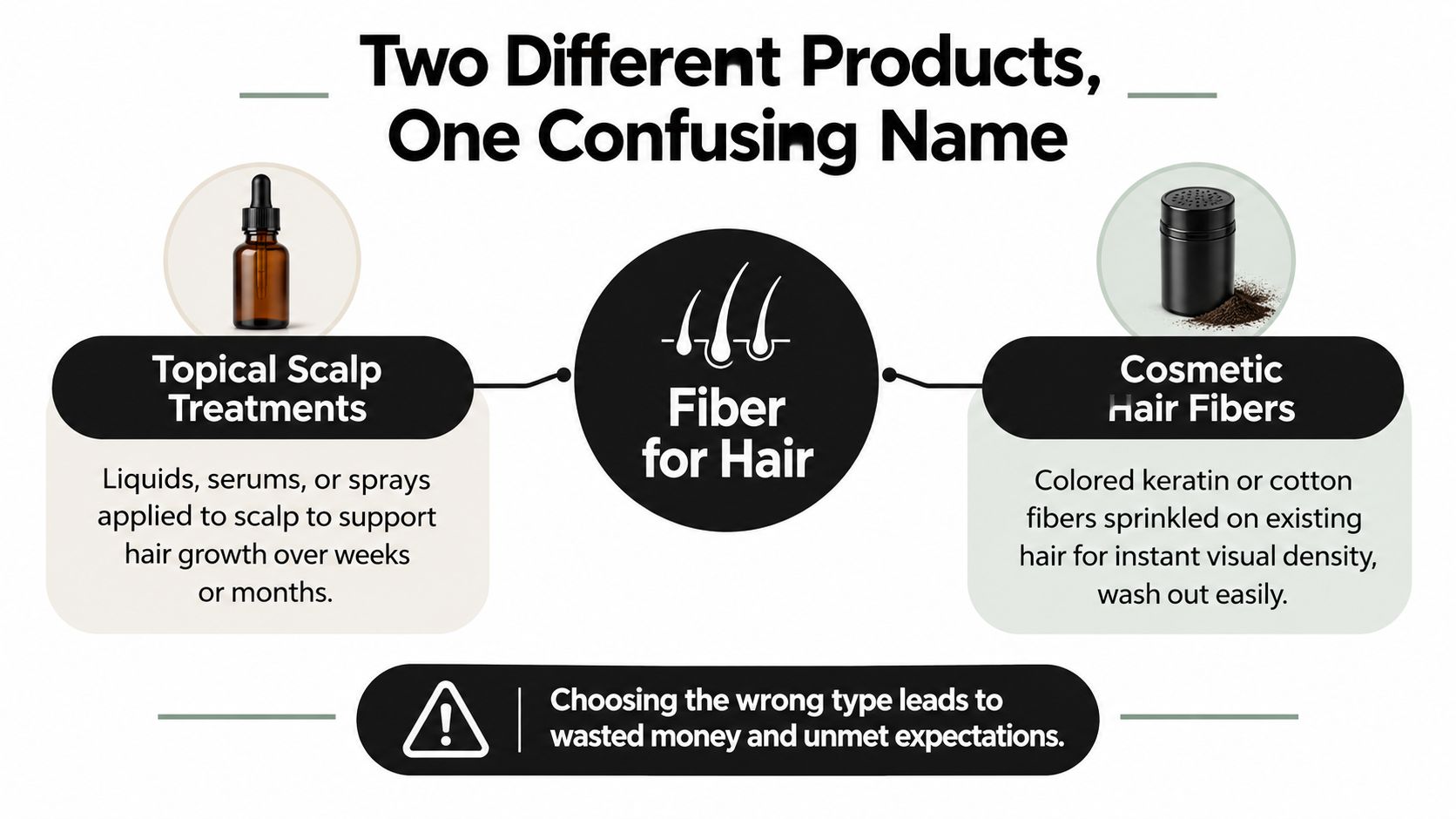
The category most buyers actually want
Natural scalp hair is typically about 50–100 micrometers in diameter. An outer cuticle surrounds the cortex, and keratin provides the principal structural protein. Those features help explain why keratin-style particles can visually blend with existing strands (hair structure reference).
The cosmetic effect comes from reducing the contrast between scalp and hair. A part, crown, or diffuse thinning area can look less exposed, but the appearance does not show that follicles have recovered.
Practical rule: An immediate increase in apparent density identifies a product as a cosmetic concealer. Treat that visual change as coverage, not proof of biological improvement.
Use the product when you still have hair in the area and want a fuller look for the day. Arrange an evaluation if loss is progressing or shedding begins suddenly, since those situations call for identifying the cause and considering suitable treatment. If you have coverage today, match the shade to the darkest hairs in the thinning zone and test it in daylight before buying a large container.
How Hair Fibers Attach and What They Can and Cannot Do
Hair fibers work with hair that is already present. Natural strands have a protective cuticle and an inner cortex that provides much of their strength. Commercial fibers are designed to resemble the scale and appearance of hair, allowing them to settle among existing strands rather than form a flat layer across the scalp.
Their attachment is partly electrostatic. Positively charged fibers are drawn toward terminal hairs and fine vellus hairs, much like a balloon clinging to a wall after static builds up. The particles also catch around the hair shaft, helping distribute them through the styled area.
What happens during application
The process has four practical stages:
- Fibers meet existing hair. A hair shaft or visible vellus hair gives the particles something to support them.
- Static attraction helps them cling. The charge draws fibers toward strands instead of leaving every particle loose on the scalp.
- The particles reduce visual contrast. Gaps look less exposed because the eye sees more colored material among the hair.
- A setting product improves hold. A light mist can help keep the fibers in place during ordinary grooming.
This explains both the cosmetic benefit and its boundary. Fibers can increase the apparent diameter, density, and fullness of hair that remains. They do not restore lost structure or treat the process causing hair loss. That distinction matters when thinning is progressing, shedding starts suddenly, or the scalp shows a new, sharply defined area.
Completely bare areas are difficult. If no vellus hairs are visible under bright light, skip fibers for that patch and book an evaluation instead of layering on more product. A surface tint or loose particles may add color, but they will not provide the natural support that diffuse thinning or a partially visible crown can offer.
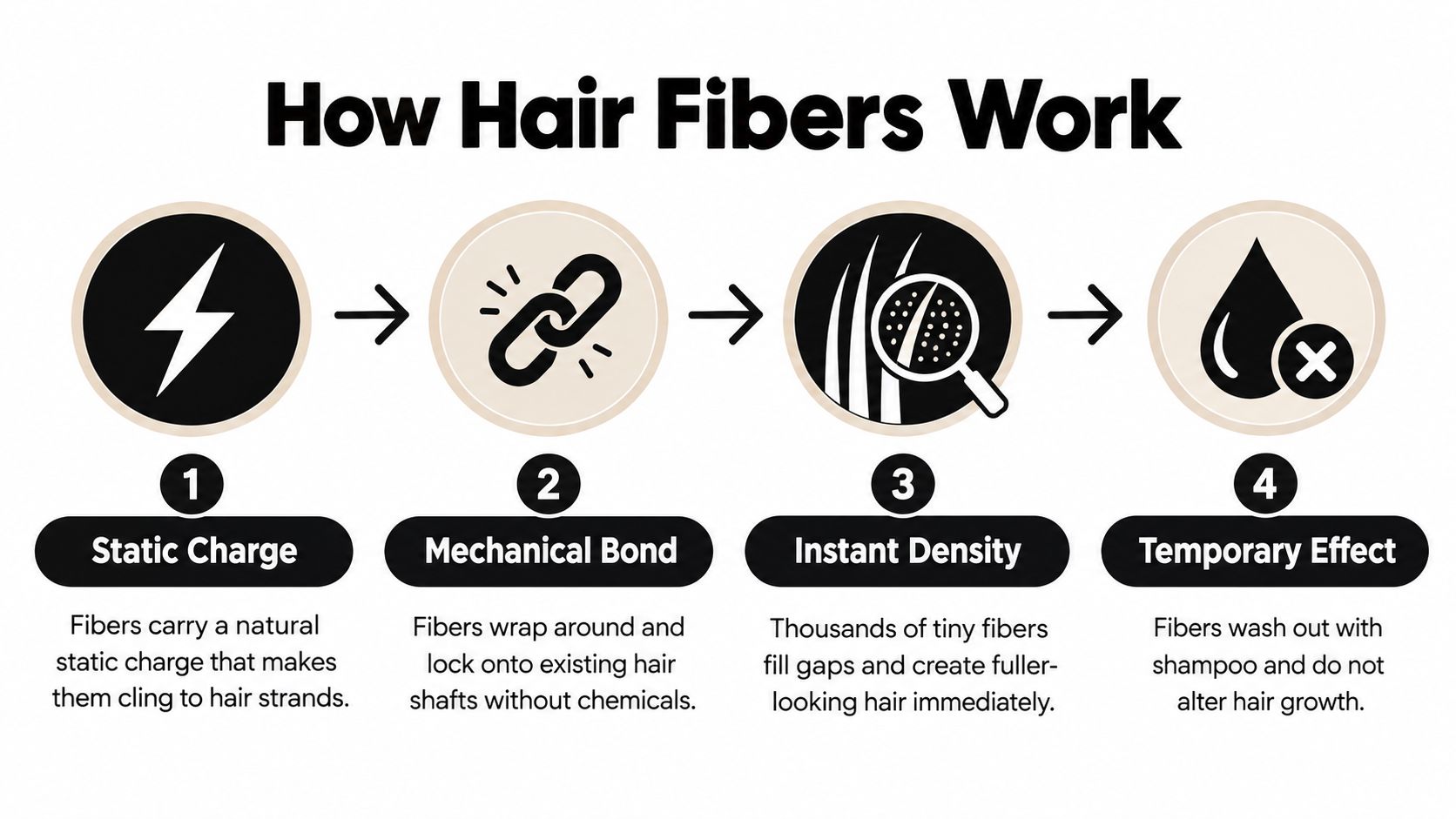
Hair fibers are temporary by design. Washing removes them, so the cosmetic effect must be reapplied when wanted. That trade-off is the reason they can change appearance immediately without functioning as medical treatment.
Applying Hair Fibers the Right Way
Start with completely dry, styled hair. Dampness, oil, and heavy styling residue make particles clump and reduce the natural separation between strands. Style the hair into its final shape first, because applying fibers and then aggressively reshaping everything usually creates uneven coverage.
Choose a shade by looking at the darkest individual hairs in the thinning area, not only at the overall tone seen from a distance. A slightly blended result is generally less conspicuous than a stark shade sitting on top of lighter surrounding strands. If you're unsure, test a small amount in ordinary indoor and outdoor light before committing to a full application.
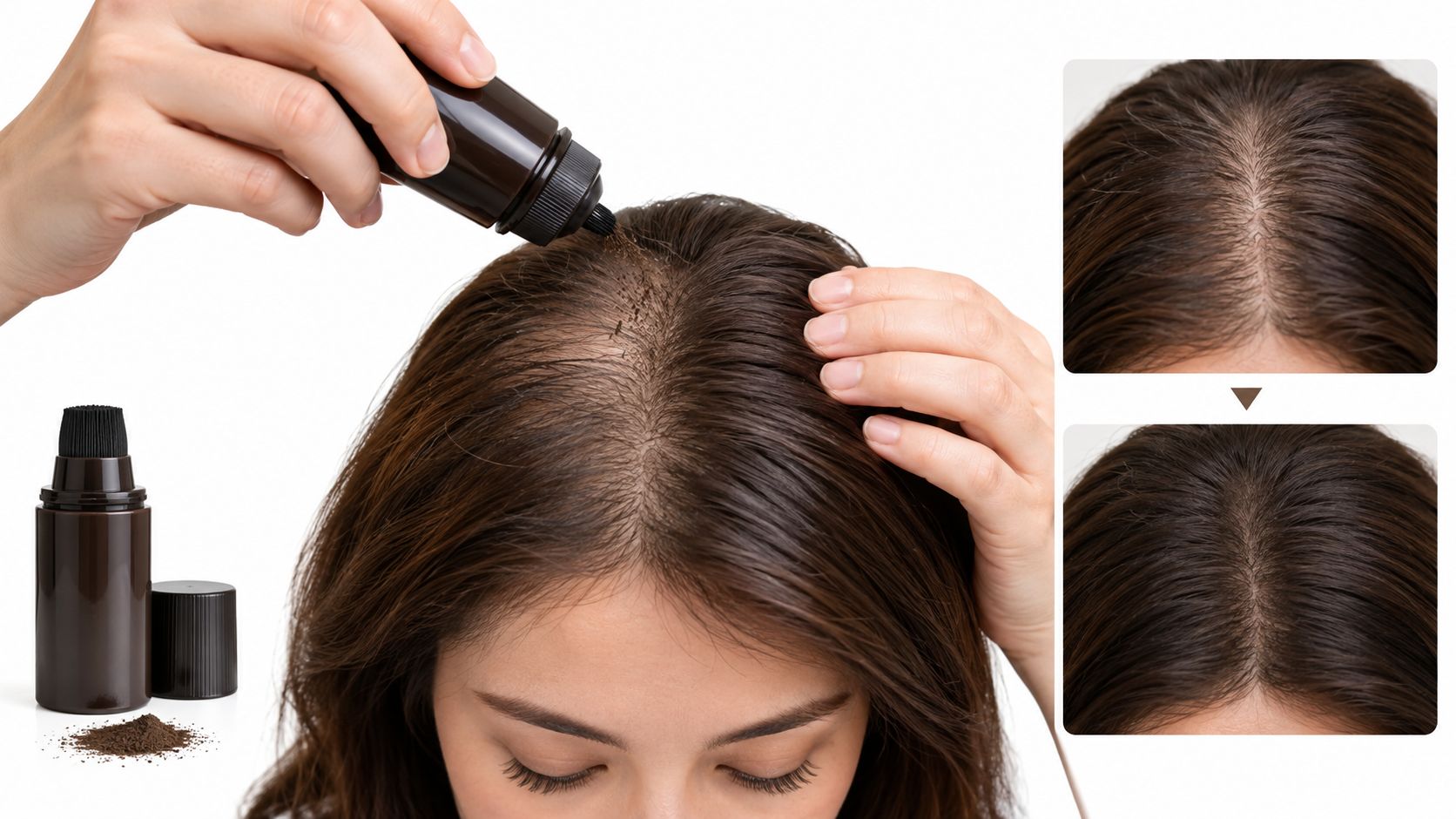
Hold the applicator above the target area and sprinkle lightly, usually working from the front toward the crown. Build coverage in thin passes. A single heavy pour tends to sit on top of the hairstyle, while light layers can settle between strands and preserve movement.
Small adjustments make the result less obvious
Use your fingertips or a suitable applicator to pat rather than rub. Rubbing pushes particles onto the scalp, creates dark patches, and can disturb the shape you just styled. Once the distribution looks even, use a light mist of holding spray from a reasonable distance. The goal is to set the fibers, not saturate the hair.
The common failure points are predictable:
- Damp or oily hair: Fibers clump and look dusty.
- Too much product: Heavy coverage can look like a solid patch instead of added density.
- Rubbing: Friction moves the particles away from the strands they need to support.
- Skipping the setting step: Loose particles transfer more easily to hands, hats, and bedding.
- Touching the area immediately: Fingers can create visible gaps before the product has settled.
A natural application should soften the contrast of thinning, not draw attention to the product itself.
For a visual demonstration of the application sequence, this video shows the general technique:
Types of Hair Fibers and Ingredients to Look For
The material affects how the product behaves, but application and color matching still determine much of the final appearance. Keratin fibers are the most familiar option. Many are derived from wool-based keratin and are designed to cling electrostatically to existing hair. They can give a convincing result when the thinning area still has enough strands to support the particles.
Rayon or cotton-based fibers offer a plant-origin alternative for people who prefer to avoid animal protein. Their behavior varies by formulation, so don't assume that “natural” automatically means better hold or a more realistic finish. Assess the actual texture, granularity, and color match.
Colored sprays and powders work differently. They're often useful for very early thinning, scalp contrast, root touch-up, or hairline definition. Because they coat rather than behave exactly like loose fibers, they may provide less strand-like texture but more direct color control.
Comparing the main options
| Fiber type | Main material | Best for | Limitations |
|---|---|---|---|
| Keratin fibers | Keratin or another animal-derived fibrous material | Existing hair with diffuse thinning or a visible crown | Not suitable for people avoiding animal-derived materials, and poor on smooth bare scalp |
| Rayon or cotton fibers | Plant-origin or cellulose-based fibers | Users seeking an alternative to keratin-style products | Performance depends heavily on formulation, texture, and setting |
| Colored sprays or powders | Pigmented cosmetic coating | Early thinning, scalp contrast, and root touch-up | Can look more like surface color than added strands if overapplied |
Read the label beyond the color swatch
Look for a shade range that includes your hair's undertone. Black, brown, gray, and mixed shades can behave very differently under direct light, so a color that looks right in a product photograph may not match your hair in person.
Scalp sensitivity deserves equal attention. Review the ingredient list for pigments, fragrances, preservatives, and dyes that have caused irritation for you before. A product marketed as lightweight can still cause discomfort if your scalp reacts to one of its components.
Finally, inspect the physical product when possible. Good fibers should remain reasonably granular rather than forming damp clumps in the container. If the label includes sensitivity warnings, follow them, and stop using the product if you develop persistent itching, redness, scaling, or pustules.
What the Evidence Actually Shows
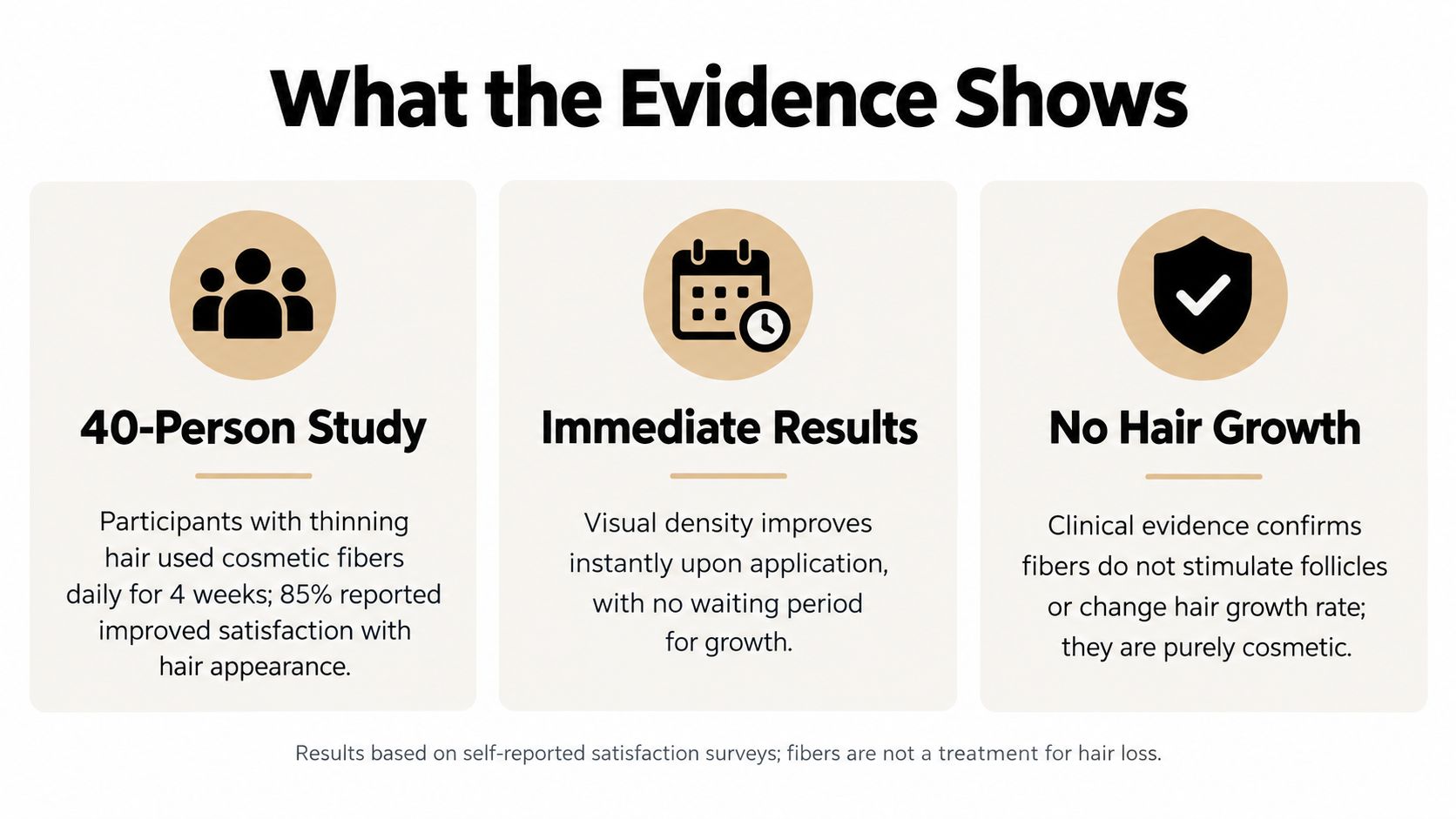
The useful evidence places hair fibers in a narrow role: short-term camouflage, not regrowth treatment. An academic tertiary dermatology-center study followed 40 people with alopecia, 20 men and 20 women, who used a keratin hair-fiber filler matched to their natural color and were assessed after 90 days. The clinical study summary describes appearance, satisfaction, and tolerability rather than follicle recovery.
For practice, the reported 92.5% means color matching is usually solvable. If coverage still looks poor, the more likely problems are too little existing hair for attachment or an incorrect shade, not necessarily product failure. Participants also reported better perceived volume, confidence, and attractiveness, showing that the cosmetic benefit mattered to users.
The safety findings were favorable during the study period. 97.5%, or 39 of 40 participants, reported no scalp erythema, scaling, or pustules. One participant, 2.5%, experienced inflammation.
What the study doesn't prove
The study was small and short-term. It measured patient-reported satisfaction, appearance, confidence, and tolerability, but it did not show follicle regrowth, increased biological density, or any change in the cause of alopecia.
That distinction matters clinically. A satisfied user has confirmed improved appearance and experience, not recovered follicles. Fibers can cover thinning while the underlying process continues unnoticed.
Educational material from Cost Plus TRT's blog should be read with the same distinction in mind. Cosmetic success and medical treatment are separate outcomes, so a product may work well for appearance without changing the course of hair loss.
When Concealment Is the Wrong Answer
Fibers are reasonable when thinning is gradual, the scalp is otherwise calm, and enough hair remains for the particles to attach. They're the wrong sole response when the pattern suggests an active or potentially scarring process.
Pause cosmetic experimentation and arrange a dermatology assessment if you notice:
- Sudden shedding: Hair loss that develops quickly over weeks deserves a cause-based evaluation rather than a new concealer.
- Patchy bare areas: Distinct round or irregular patches can occur with conditions such as alopecia areata.
- A smooth scalp with no visible follicles: Fibers have little structure to grip, and a completely bare patch needs diagnosis rather than repeated application.
- Redness, scaling, pain, or scarring: Inflammation or scarring can damage follicles, so covering the surface may delay useful care.
- Eyelash, eyebrow, or body-hair loss: Hair loss outside the scalp changes the clinical picture and shouldn't be dismissed as ordinary male-pattern thinning.
A worsening hairline or crown can still justify an appointment even without these warning signs. The purpose of evaluation is to identify the pattern and decide whether treatment could slow progression or support regrowth.
If you're also researching hormone-related concerns, don't use cosmetic hair coverage as a substitute for individualized medical advice. Questions about testosterone therapy and fertility, for example, belong in a clinical discussion such as the information provided by Cost Plus TRT's TRT and fertility guide, not in a hair-fiber product review.
Fibers can remain part of your grooming routine after evaluation. The important boundary is that they shouldn't be the only response to a new, inflammatory, patchy, or rapidly changing problem.
Evidence-Based Options That Actually Address Thinning
Once a clinician identifies the pattern, treatment can target the biology rather than only the reflection. For male-pattern loss, topical minoxidil is commonly discussed as a scalp treatment, while oral minoxidil may be considered by a qualified clinician when appropriate. These options require consistent use and medical judgment, particularly because oral treatment has systemic considerations.
For androgen-driven thinning in men, clinicians may discuss finasteride or dutasteride. They're not cosmetic products, and they aren't suitable for everyone. A prescriber needs to review medical history, risks, benefits, and monitoring before recommending them.
Other approaches occupy different places in a treatment plan:
- Low-level laser therapy: A device-based adjunct that some patients explore alongside established care.
- Platelet-rich plasma: A procedure using the patient's blood components, typically delivered through a clinical protocol.
- Hair transplantation: A surgical option for selected people with stable donor hair and realistic expectations.
- Peptide and hormone discussions: Some men explore these through a men's health clinic, but the treatment should remain diagnosis-led rather than driven by a promise of guaranteed regrowth.
These approaches address different mechanisms and have different evidence, costs, risks, and time requirements. None should be sold as a miracle. Biological change generally takes patience, which is precisely why men often reach for fibers while waiting for a treatment plan to show its effect.
The two categories can work together. A man with diagnosed pattern loss might use a medical treatment consistently while using fibers for immediate coverage at the crown. Cost Plus TRT offers telemedicine care for men's health and also describes a compounded 1% GHK-Cu scalp solution for once-daily leave-on scalp application, so anyone considering it should discuss whether it fits their diagnosis and broader treatment plan with a licensed provider.
Hair fibers improve what people see now. Medical treatment, when appropriate, addresses what may happen next.
Putting It Together and Your Most Common Questions
Use fibers if you want immediate visual fullness and still have enough existing hair for the particles to attach. Seek evaluation if loss is sudden, patchy, inflamed, scarring, or affecting eyelashes or eyebrows. In many cases, combining cosmetic coverage with appropriate medical care makes more sense than choosing only one.
How long does an application last? It can remain present through an ordinary day when applied to dry, styled hair and set appropriately, but hold varies with handling and conditions.
Will wind, rain, or exercise remove it? Loose particles are more vulnerable to moisture, friction, and vigorous activity. A setting product may improve hold, but fibers are still temporary and shouldn't be treated as permanently waterproof.
How should I wash them out? Use your normal shampooing routine and avoid aggressive scrubbing. The fibers are designed to wash away, while gentle handling helps protect the underlying hair.
Can I use fibers with minoxidil? Discuss timing and application with your clinician. Applying a topical product to a scalp covered with fibers can affect distribution, so follow the instructions for both products rather than layering them casually. More general questions can be directed to the Cost Plus TRT FAQ.
Cost Plus TRT provides telemedicine consultations for men's health, including TRT and related physician-supervised treatments, with transparent pricing and home delivery where available. If hair thinning is part of a broader hormone or health concern, visit Cost Plus TRT to review your options with a licensed provider, while keeping cosmetic fibers in their proper role as temporary camouflage.