

Most routine Quest blood work becomes available within 2 to 5 days after collection, while complex testing can take 14 days or more. Those windows describe when testing is finished, and that's not always the same moment a result becomes visible to you or ready for a clinician to act on.
That gap is where most confusion starts. You can have a finished lab value, a portal that hasn't shown it yet, and a provider who hasn't reviewed the full panel, all at the same time. Understanding Quest turnaround time for blood work means separating those steps instead of treating the wait as one clock.
Table of Contents
- The Wait After the Needle
- What Quest Turnaround Time Actually Means
- Routine vs Complex Tests on a TRT Panel
- How to Check Status in MyQuest
- Quest vs Uploading Labs for TRT Care
- Habits That Actually Shorten Your Personal Timeline
- Why Two Patients Can Wait Different Amounts
- Putting It All Together
The Wait After the Needle
You leave the draw site with a small bandage, get in your car, and check your phone before you've even left the parking lot. Nothing. You check again that evening, then the next morning, refreshing MyQuest while you make coffee.
A quiet inbox starts to feel like a message in itself. You wonder whether no news means everything's normal, whether something abnormal is being held back, or whether your sample got lost somewhere between the chair and the lab.
Why Silence Feels Louder Than It Should
For TRT patients, the stakes feel personal in a way a routine cholesterol check doesn't. You're often waiting to learn whether you qualify to start treatment, whether a dose needs adjusting, or whether a value like hematocrit means your clinician will pause and reassess. Every extra day can feel like a day your plan is stalled.
That feeling is understandable, but silence usually isn't a verdict on your results. It's more often a sign that your sample is moving through transport, analysis, reporting, and review, and each of those stages has its own pace.
A missing result doesn't mean a bad result. Most of the time, it means the order simply isn't finished yet.
What helps is a working mental model. Once you can picture where your sample is and which clock you're waiting on, you can judge whether a delay is normal, whether it's worth a message to your clinic, and what you can do next time to shorten your personal timeline.
What Quest Turnaround Time Actually Means
Turnaround time sounds like a single measurement, but you're really living through three separate clocks. Keeping them apart is the fastest way to stop guessing when a result is slow to appear.
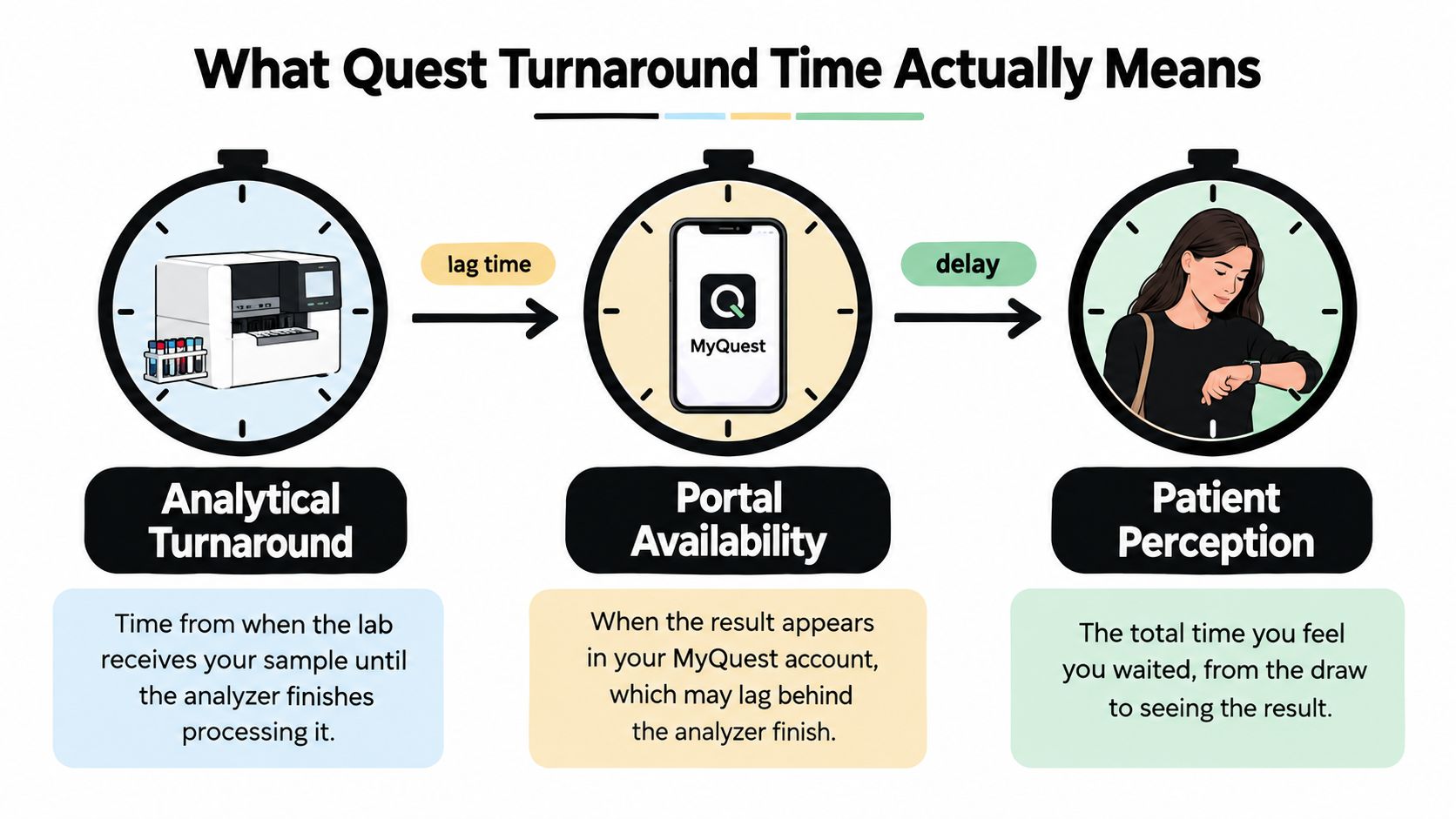
The Three Clocks You're Actually Watching
- Analytical turnaround: This is the lab's clock. It covers the time needed to receive, process, and analyze your specimen and produce a result.
- Portal availability: This is when the result appears in your MyQuest account. Quest states results are posted progressively as testing completes, and Quest's guidance on result timing and progressive MyQuest posting puts most routine results at 2 to 5 days, with complex testing at 14 days or more.
- Clinician review: This is when your ordering provider reads the results in context and decides what happens next. A result can be visible to you before anyone has interpreted it.
That third clock explains a lot of frustration. Quest releases completed results to the ordering physician as soon as testing is complete, but a treatment decision still depends on the provider reviewing the full picture, not just glancing at the first number that posts.
Putting a Delay in the Right Bucket
If nothing has appeared at all, you're probably still on the first or second clock. If you can see results but haven't heard from your clinic, you're likely on the third. Those are different problems with different fixes, and messaging the lab about a clinician's review queue won't speed either one up.
This distinction also explains why a friend might swear his labs took two days while yours feel like a week. He may be remembering the first partial result, while you're waiting for the complete order and a provider's decision.
Routine vs Complex Tests on a TRT Panel
A TRT panel isn't one test. It's a bundle of separate assays, and they don't all move at the same speed. That's why results often arrive in pieces.
Quest distinguishes routine automated testing, such as common chemistry, hematology, and hormone panels, from tests requiring specialized instrumentation, batch processing, or confirmatory analysis, and Quest's description of routine versus specialized testing places the specialized category at 14 days or longer.
Typical Quest Windows for Common TRT-Related Tests
| Test Group | Examples | Typical Quest Window |
|---|---|---|
| Routine automated | CBC, comprehensive metabolic panel, lipids | 2 to 5 days for most routine results |
| Routine hormone panels | Total testosterone, estradiol, PSA, SHBG | Often within the routine window, depending on method |
| Complex or confirmatory | Specialized assays needing batch processing or confirmation | 14 days or longer |
Use the table as a planning guide, not a promise. Turnaround varies by test, and the exact method your clinician ordered matters more than the name of the analyte alone.
Why Partial Results Are Normal
Your CBC and metabolic numbers might post while a hormone value is still pending. That isn't a glitch. It's progressive posting working as intended, with each component appearing as its own testing finishes.
The catch is perceived completion. You may receive the "all done" signal only when every item in the order is finished, so one slow specialty test can make an otherwise usable panel feel stuck. Quest's MyQuest FAQ on order completion and process delays explains that an email arrives when all testing in an order is complete, which means a single pending item can hold that notification back.
Practical rule: Ask which specific analyte is still pending, not just whether your labs are "back." The first question gets you a useful answer.
That question matters for TRT decisions. Your clinician may want testosterone, estradiol, CBC, PSA, and metabolic results together before adjusting anything, even if several values posted early.
How to Check Status in MyQuest
Refreshing the app at random gives you anxiety, not information. MyQuest tells you quite a lot if you know where to look.
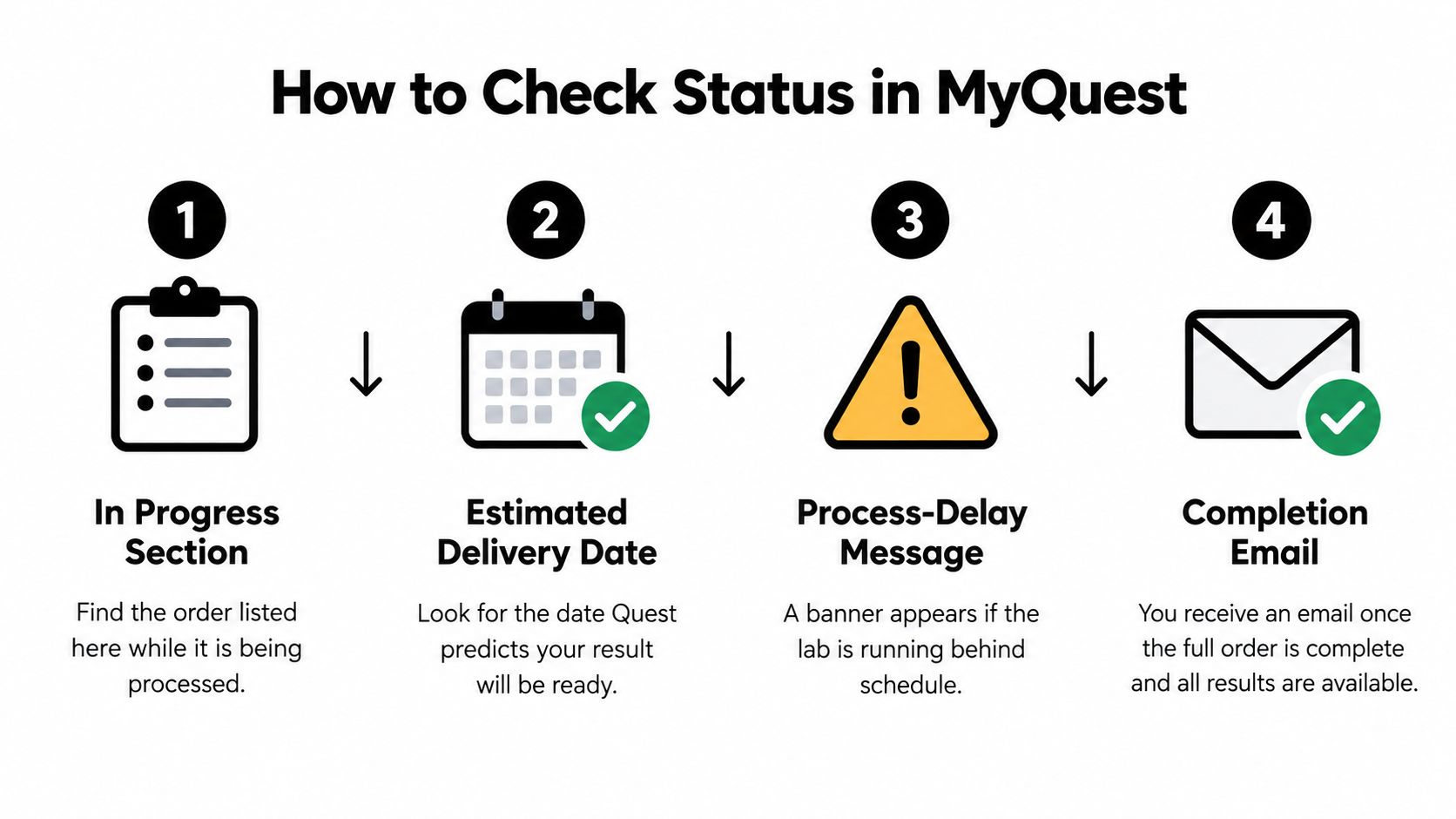
What Each Signal in the Portal Means
- Check the In Progress section: Your order lives here while processing. Seeing it listed means the lab has it, which rules out the "lost sample" worry in most cases.
- Read the estimated delivery date: This is Quest's current best estimate, not a guarantee. It can move.
- Watch for a process-delay message: If the lab is running behind, a notice can appear and the estimate can shift with it.
- Wait for the completion email: That message signals the full order is finished, which is different from the first result posting.
Treat the estimated date as a forecast. Quest's notes on estimated delivery dates and account population say the date can change if a processing delay occurs, so a date that moves by a day is the system updating, not evidence something went wrong with your sample.
A Trap for Transfer Patients
If you've just created or verified a MyQuest account, your history won't appear instantly. The same Quest guidance notes newly verified users may begin seeing historical results within 24 hours, but populating all results can take up to a full week.
That matters if you're gathering old labs for a consultation. Keep the PDF or the report your previous clinician gave you rather than assuming the portal will surface everything on day one. A completed report can exist even while your account is still filling in.
Quest vs Uploading Labs for TRT Care
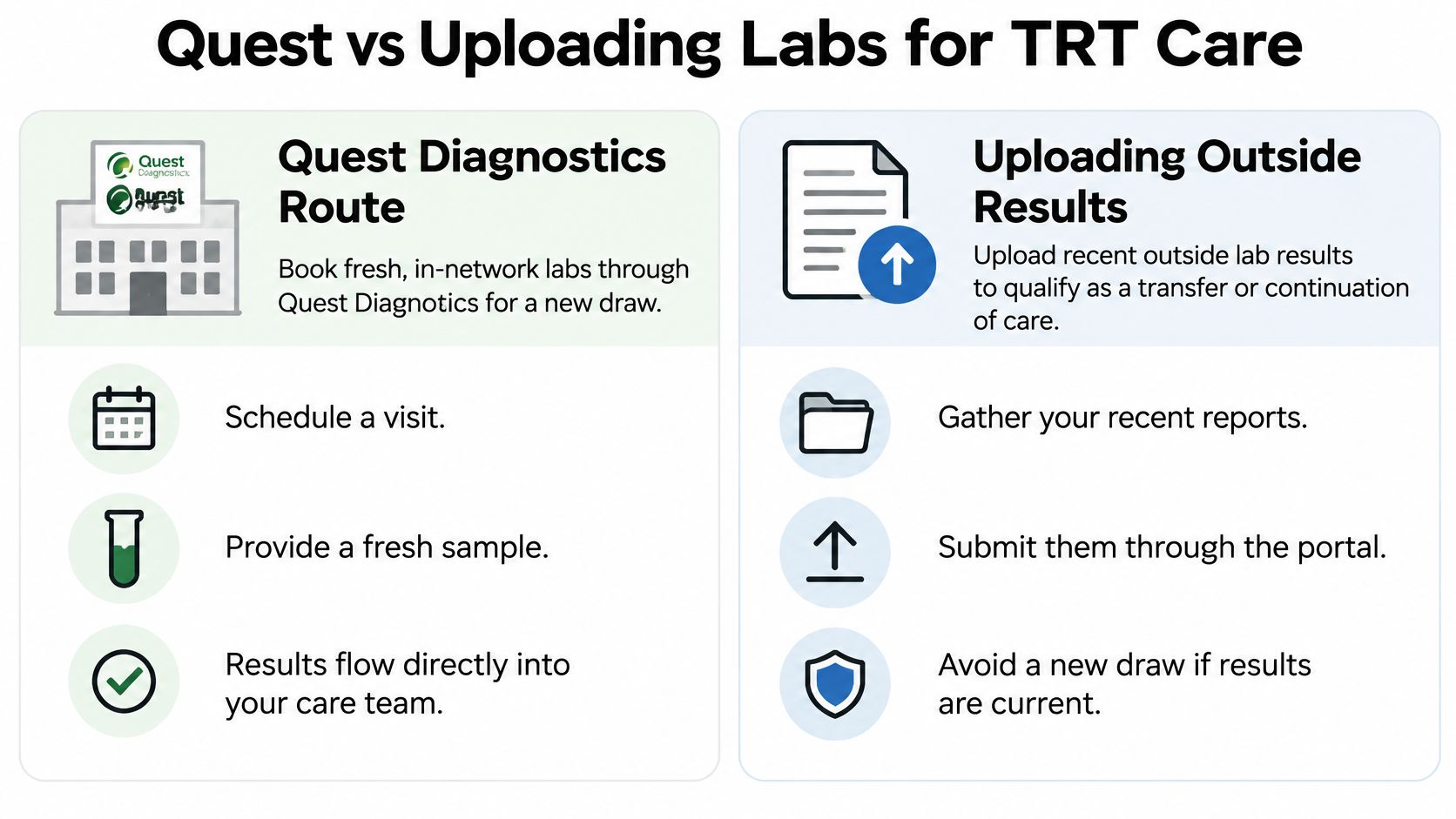
If you're starting or transferring TRT care, you generally have two ways to get labs in front of a provider. Each one changes your calendar differently.
The Fresh Draw Through Quest
Booking a new draw gives your care team current numbers ordered exactly the way they want them. The trade-off is time. You schedule, you fast if instructed, you wait through the routine window, and only then does clinician review begin.
This route fits new patients with no recent labs, or anyone whose last panel is missing analytes a provider needs. It's the slower start, but it produces a clean, complete baseline.
The Upload What You Already Have Route
If you've had recent, complete labs elsewhere, uploading them can skip the draw and the laboratory wait entirely. Your timeline then depends on gathering readable reports and on provider review, not on Quest turnaround time for blood work.
One example is Cost Plus TRT, which offers its TRT program and lab pathways for new and transfer patients with cost-plus pricing starting at $89 per month for transfer patients who bring their own labs. That offering includes pharmaceutical-grade testosterone cypionate, injection supplies, 2-day shipping, and ongoing provider consultations, with approved prescriptions shipped in about five business days.
The friction here is paperwork. Screenshots with cut-off reference ranges, missing pages, or portal histories that haven't populated can stall review just as effectively as a slow assay.
The fastest route is the one where your labs are both recent and complete. Speed you gain by skipping a draw disappears if a missing value forces one anyway.
Habits That Actually Shorten Your Personal Timeline
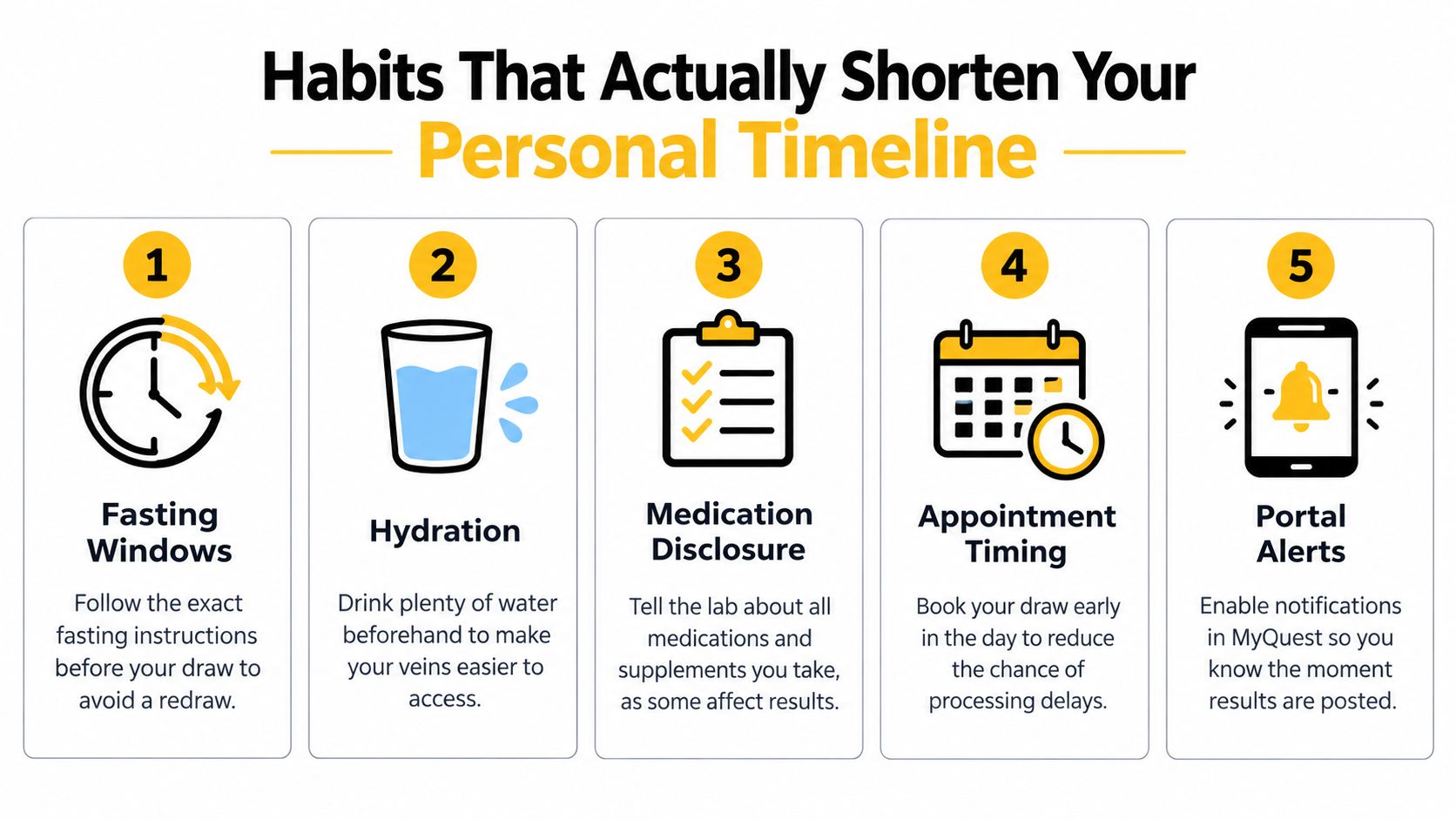
You can't make an analyzer run faster. You can, however, prevent the avoidable problems that turn a routine wait into a redraw and a second, longer wait.
Most of those problems happen before analysis. A clinical laboratory study of outpatient preanalytical turnaround and rejection causes found preanalytical turnaround averaged 62.3 minutes, with delayed transport a major contributor and rejection causes including insufficient volume and hemolysis, while whole-blood specimens may need centrifugation within two hours of venipuncture.
A Short Pre-Draw Checklist
- Follow fasting instructions exactly: Some tests require fasting for 8 to 12 hours, and eating anyway can mean recollection.
- Arrive hydrated: Easier draws lower the chance of a difficult stick and a damaged specimen.
- Skip vigorous exercise if your clinician advises it: Hard training before a draw can distort values your provider is trying to interpret cleanly.
- Schedule early in the week: A Monday or Tuesday draw gives transport and processing room to run before the weekend interrupts the calendar.
- Confirm the order at check-in: Ask whether every ordered analyte is being collected, and whether your identification and ordering details match.
Each habit targets a specific failure. A hemolyzed, clotted, underfilled, or mislabeled specimen doesn't produce a slower result. It produces no result, and your clock restarts at zero with a new appointment.
That's the argument for preparation. The days you save don't come from the laboratory working harder. They come from never giving the process a reason to repeat itself.
Why Two Patients Can Wait Different Amounts
Two men can have the same panel drawn on the same morning and see their results on different days. It feels unfair, and it invites suspicion that one of them got bad news. Usually, the explanation is more boring.
State Release Holds Change Portal Timing
Quest notes that in California, Kentucky, Maryland, and Pennsylvania, legally required result holds may apply before results are released to patients, and those holds can be built into the estimated delivery date. In plain terms, the analysis can be finished while portal visibility is still waiting on a legal clock.
That means your clinician might be able to discuss a result that you can't yet see in your own account. Geography, not your health, created the gap.
Before you assume a sample is lost, ask whether the missing item is still in testing, legally held, or simply not part of the order. Those are three different situations.
Asking the Question That Resolves It
When you contact your clinic, be specific. Name the analyte you're missing and ask which of those three buckets it falls into. Vague questions like "are my labs back" tend to produce vague answers that leave you refreshing the app anyway.
For common questions about lab pathways, transfers, and what happens after results arrive, the clinic's answers to frequently asked questions about getting started and labs can clarify what the care team needs from you. Knowing that in advance keeps a portal delay from turning into a review delay as well.
Putting It All Together
A realistic calendar looks like this. You book early in the week, prepare properly, and treat the following several days as laboratory time rather than decision time. Results begin posting progressively, the full order finalizes, and then your provider reviews everything together before anything ships or changes.
The habits with the highest return are confirming the complete order at check-in and following preparation instructions so you never face a redraw. If you already have recent, complete labs, uploading them may remove the laboratory wait entirely. You can review your options and begin the intake process when your labs are ready.
If your labs are current, or you're ready to schedule a fresh Quest draw, Cost Plus TRT offers transparent cost-plus pricing starting at $89 per month for transfer patients with bring-your-own labs, including testosterone cypionate, injection supplies, fast shipping, and ongoing provider consultations. Upload your recent results or book your draw, meet with a licensed provider online, and have an approved prescription shipped to your door.