
“Pharmaceutical grade” sounds like a promise that methylene blue is safe to take. It isn't. The term can describe controls over a product's identity, strength, sterility, and manufacture, but it doesn't mean every formulation or route is appropriate for you.
The FDA-labeled product is an injectable medicine for acquired methemoglobinemia, not a general-purpose supplement for energy or cognition. Its safety also depends on factors that a quality label can't resolve, including your medications and medical history. Understanding what the label verifies, and what it leaves unanswered, is essential before considering any use.
Table of Contents
- Why Pharmaceutical Grade Is Not Just a Purity Label
- How Methylene Blue Went From Dye to Emergency Drug
- What Pharmaceutical Grade Verifies
- Pharmaceutical vs Research vs Industrial Grades
- The One FDA-Approved Clinical Use
- Safety Risks Even a Prescription Cannot Remove
- How Clinicians Source and Verify Quality
- What This Means for Your Next Conversation With a Provider
Why Pharmaceutical Grade Is Not Just a Purity Label
A well-made medicine can still be the wrong medicine for the person receiving it. Quality and suitability are different questions, much like checking that a key is accurately cut and checking that it fits your lock. Manufacturing standards address the product; clinical assessment addresses the patient, the intended use, and the route of administration.
That distinction helps explain what a prescription-grade vial offers. Its identity, concentration, formulation, and, for an injectable preparation, sterility need to be verified together. Purity alone cannot answer all those questions.
What the label can and cannot tell you
“Pharmaceutical grade” is useful when it points to documented controls over the material and the finished preparation. Identity establishes what substance is present. Measured strength establishes its concentration. Manufacturing records document how the product was made and checked. Sterility addresses a separate requirement for an injectable medicine, rather than serving as another word for purity.
These checks belong together, but their scope has limits.
A formulation is designed for a particular route. An injectable vial should not be treated as interchangeable with an oral, sublingual, or compounded preparation because each contains methylene blue. Concentration, excipients, manufacturing controls, and intended use may differ. Verification therefore needs to match the actual preparation being prescribed, rather than relying on the compound's name.
The FDA-labeled injectable treats acquired methemoglobinemia, which affects hemoglobin's ability to carry oxygen. That indication does not establish effectiveness for wellness goals or safety for oral or sublingual use. The FDA prescribing information warns about serotonin syndrome with serotonergic medicines and identifies glucose-6-phosphate dehydrogenase deficiency as a safety concern. Psychiatric medications therefore belong in the prescribing conversation, even when the product's quality is documented.
Practical rule: Ask what the preparation contains, how it is meant to be administered, and whether it fits your medication list and health history.
For telemedicine patients, those questions remain necessary without an in-person appointment. A prescription still requires a clear treatment purpose and a complete medication history; the compound's reputation or appearance cannot replace that assessment.
How Methylene Blue Went From Dye to Emergency Drug
Methylene blue's medical history began with a practical industrial purpose. It was introduced as a synthetic textile dye in 1876, then adopted as a biological stain that helped scientists and physicians see cells and tissues under a microscope. By 1891, it had been investigated for malaria treatment, making it one of the earliest synthetic compounds used therapeutically. Harvard Health's overview of methylene blue describes this long transition from dye to medicine.
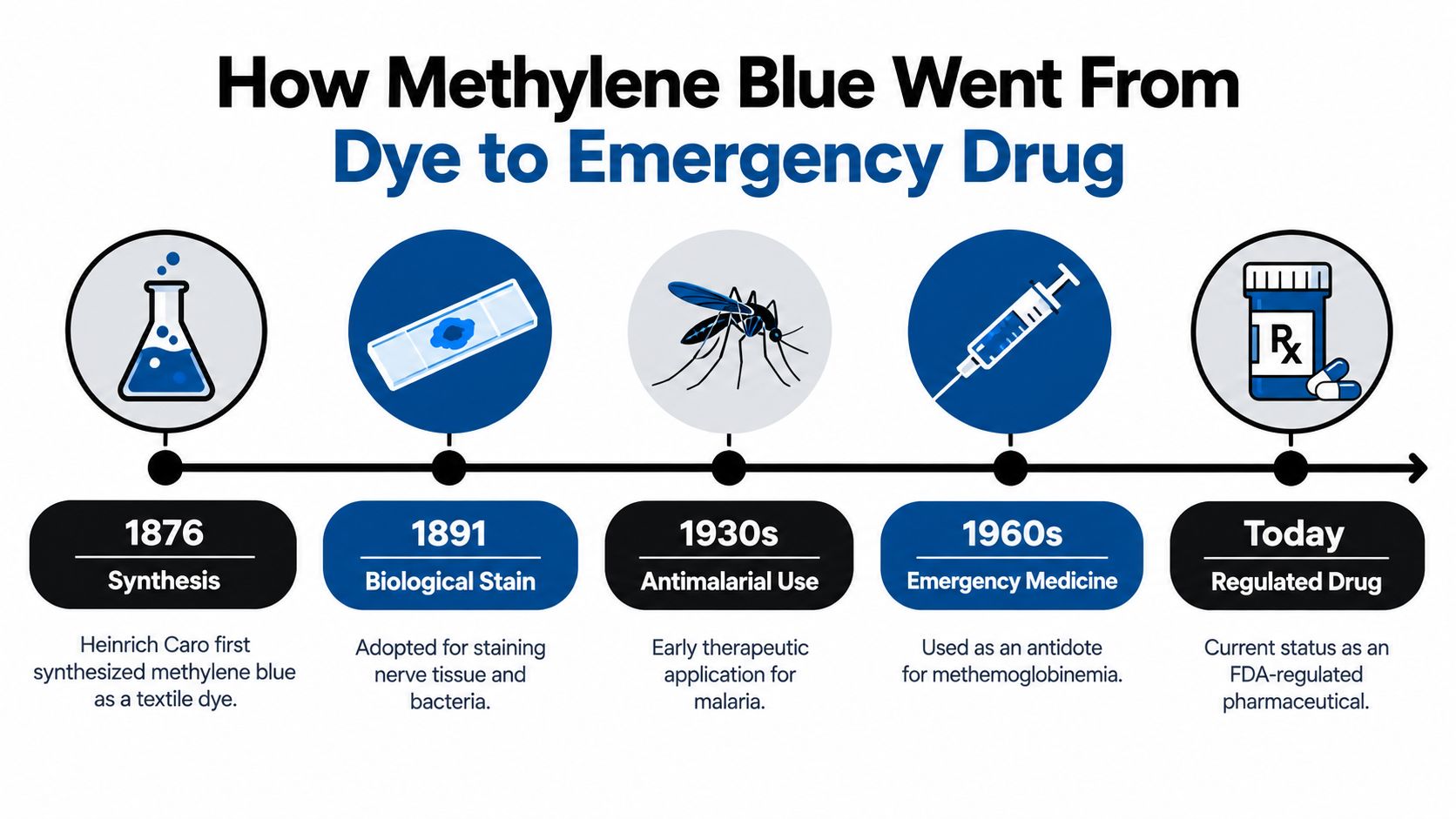
From stain to treatment
The same property that made the dye useful in the laboratory also made it medically interesting: methylene blue participates in chemical reactions involving the transfer of electrons. In acquired methemoglobinemia, some hemoglobin iron changes from a form that carries oxygen effectively to one that doesn't. Pharmaceutical methylene blue can be reduced by an NADPH-dependent process into leucomethylene blue, which helps return methemoglobin to functional hemoglobin.
A simple analogy is a hand-off between two coworkers. Methylene blue receives an electron through the body's reduction pathway, then helps pass it along so hemoglobin can return to a working state. The analogy isn't the whole chemistry, but it captures the essential point: the medicine's effect depends on a specific redox process in the body, not just on the dye's color.
Why a chemical name isn't enough
The clinical story is a progression from laboratory tool to therapeutic compound, and then to a regulated emergency medicine. That progression doesn't mean every bottle bearing the same chemical name is made to medical standards. Industrial or laboratory dye can look like pharmaceutical material while lacking the formulation controls needed for human use.
For clinical treatment, identity alone isn't enough. The product also needs the right strength, suitable formulation, reliable manufacturing, and the intended route. Physicians must consider whether the patient's condition calls for the medicine and whether treatment risks are acceptable. The history is a reminder that the molecule's appearance doesn't tell you whether a particular vial is suitable for a patient.
What Pharmaceutical Grade Verifies
“Pharmaceutical grade” describes a bundle of product checks, each answering a different question. For methylene blue, verification covers what the substance is, how much is present, and whether the finished formulation meets standards for its intended route. These checks work like separate locks: passing an identity test does not establish sterility or confirm concentration.
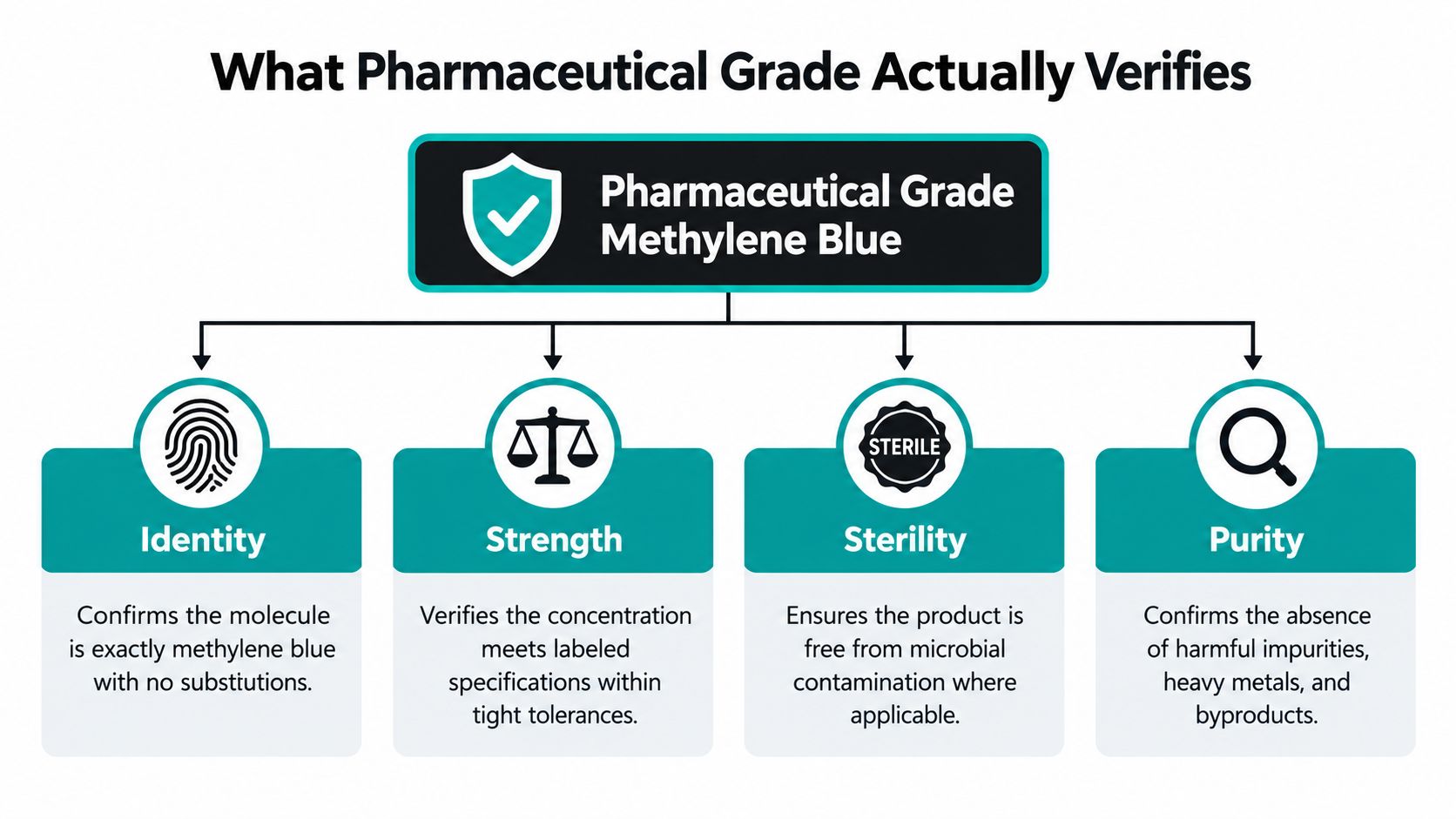
The four checks in practical terms
- Identity: Testing should establish that the active ingredient is methylene blue, rather than a substitute or incorrectly identified material.
- Strength: Manufacturing controls should support the concentration stated on the label. The name alone cannot tell you how much a measured volume contains.
- Sterility, where required: Injectable medicines need controls suited to injection. High chemical purity cannot make a nonsterile powder or liquid appropriate for that route.
- Formulation quality: Water, excipients, pH, and other characteristics help determine whether the finished preparation matches its intended use.
The product labeling on DailyMed specifies 5 mg/mL (0.5%) methylene blue USP in water for injection, an acidic pH of 3.0–4.5, and osmolality of approximately 10–15 mOsm/kg for the FDA-labeled injectable.
Those specifications describe a particular formulation and route, not a universal standard for every methylene blue preparation.
Why concentration control matters
Concentration connects the amount of medicine to the volume measured. At 5 mg/mL, a 50 mg amount corresponds to 10 mL. Misreading the concentration or measuring inaccurately changes the amount delivered. This illustrates product control, not a dosing recommendation.
Product review therefore includes the USP designation, stated concentration, storage instructions, sterility where applicable, and intended route. Lot documentation should connect the batch identifier with its specifications and test results, allowing those checks to be traced to the product in hand.
These controls establish product characteristics, not suitability for every patient or use. A controlled injectable and an oral or sublingual preparation are not therapeutically interchangeable because they contain methylene blue.
Pharmaceutical vs Research vs Industrial Grades
The word “grade” can obscure the most important practical question: what was this product made and tested for? Pharmaceutical, research, and industrial materials may share a chemical name, but they aren't interchangeable products. The label and documentation should make the intended use clear.
| Criterion | Pharmaceutical | Research/Laboratory | Industrial |
|---|---|---|---|
| Intended use | A defined medical product or preparation | Laboratory work and research procedures | Industrial processes such as dyeing or other technical uses |
| Identity and strength | Controlled to the product's stated specifications | May be characterized for laboratory use, not patient treatment | May be specified for industrial applications |
| Sterility | Required when the formulation and route call for it | Not assured for human administration | Not assured for human administration |
| Route information | Product labeling identifies the intended route | Not necessarily labeled for patient administration | Not intended to guide a medical route |
| Human-use suitability | Depends on the specific product, indication, and prescriber assessment | Not established by a laboratory grade claim | Not suitable as a substitute for a human medicine |
Why headline purity isn't enough
A research reagent can be useful for experiments without meeting the requirements of a medicine. An industrial dye can perform its intended technical role without being made or tested for human exposure. Even a high chemical-purity claim doesn't by itself establish sterility, the absence of all relevant contaminants, or suitability for a particular route.
That's why a nonsterile laboratory or industrial product isn't an acceptable substitute for a pharmaceutical preparation. The risk isn't limited to whether the active molecule is present. It also includes how accurately the material was identified and measured, what else may be in it, and whether the finished product was prepared for the way someone plans to use it.
The category names also don't answer whether methylene blue is appropriate for you. A pharmaceutical product can still carry interaction risks and may be intended only for a specific clinical use. Treat the grade as one part of verification, then ask separately about route, purpose, medication screening, and prescriber oversight.
The One FDA-Approved Clinical Use
The strongest FDA-reviewed evidence for pharmaceutical methylene blue concerns acquired methemoglobinemia. In this condition, hemoglobin's iron is oxidized into a form that can't carry oxygen normally. Methylene blue acts through a redox pathway that helps restore hemoglobin's functional state, rather like assisting an impaired component to regain its working form.
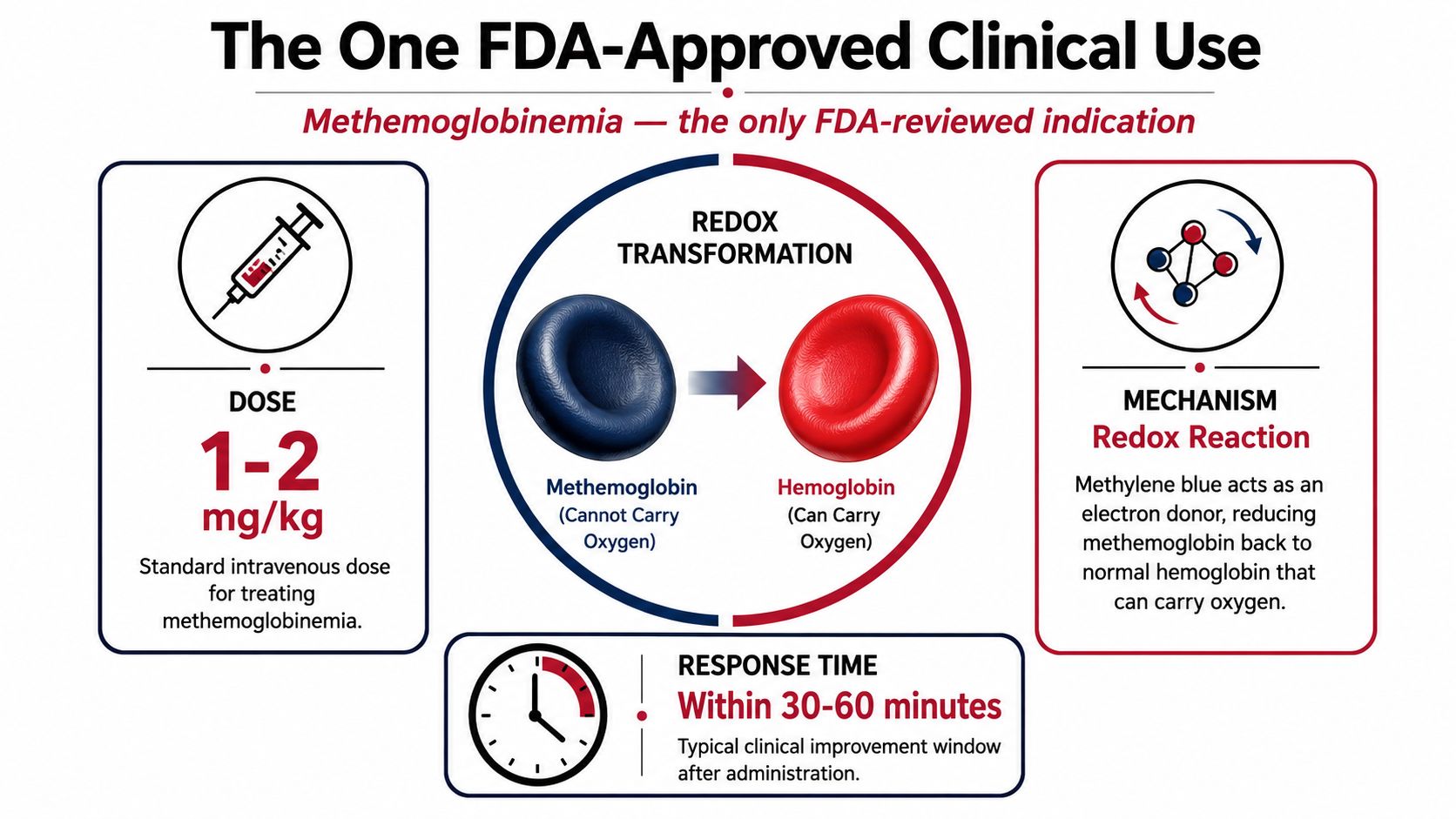
What the clinical evidence shows
In an FDA-reviewed combined analysis of 47 intravenously treated patients, a reduction of at least 50% in methemoglobin within 1 hour occurred in 15 of 17 patients given 1 mg/kg, 12 of 13 given 2 mg/kg, and 16 of 17 patients given another dose or an unreported dose. These are results from a specific clinical indication and treatment setting, not a dosing guide for self-treatment. The FDA-reviewed drug information provides the underlying evidence and safety details.
A separate prospective observational registry included 24 adults. Among the 22 with post-treatment methemoglobin measurements, 21 (95.5%) had at least a 50% reduction at the first assessment after baseline. These findings support rapid red-cell redox activity in acquired methemoglobinemia. They don't show that methylene blue works for unrelated goals.
What those results don't establish
Evidence for an approved indication can't be carried over automatically to wellness, cognitive, sexual-health, or peptide applications. Those are different claims, involving different goals and potentially different formulations and routes. The clinical response data above don't establish that oral, sublingual, or compounded preparations produce the same effects as the labeled injectable.
A treatment can have a clear medical role and still be the wrong choice for a particular person or purpose.
The indication also doesn't make the drug risk-free. Before a clinician considers treatment, they need to assess interactions and contraindications. That safety review is part of prescribing, not an optional extra.
Safety Risks Even a Prescription Cannot Remove
A prescription-grade vial can still be the wrong medicine for the person receiving it. Product verification and patient assessment work like separate checkpoints: one checks the preparation, while the other checks how it fits your health history and medications.
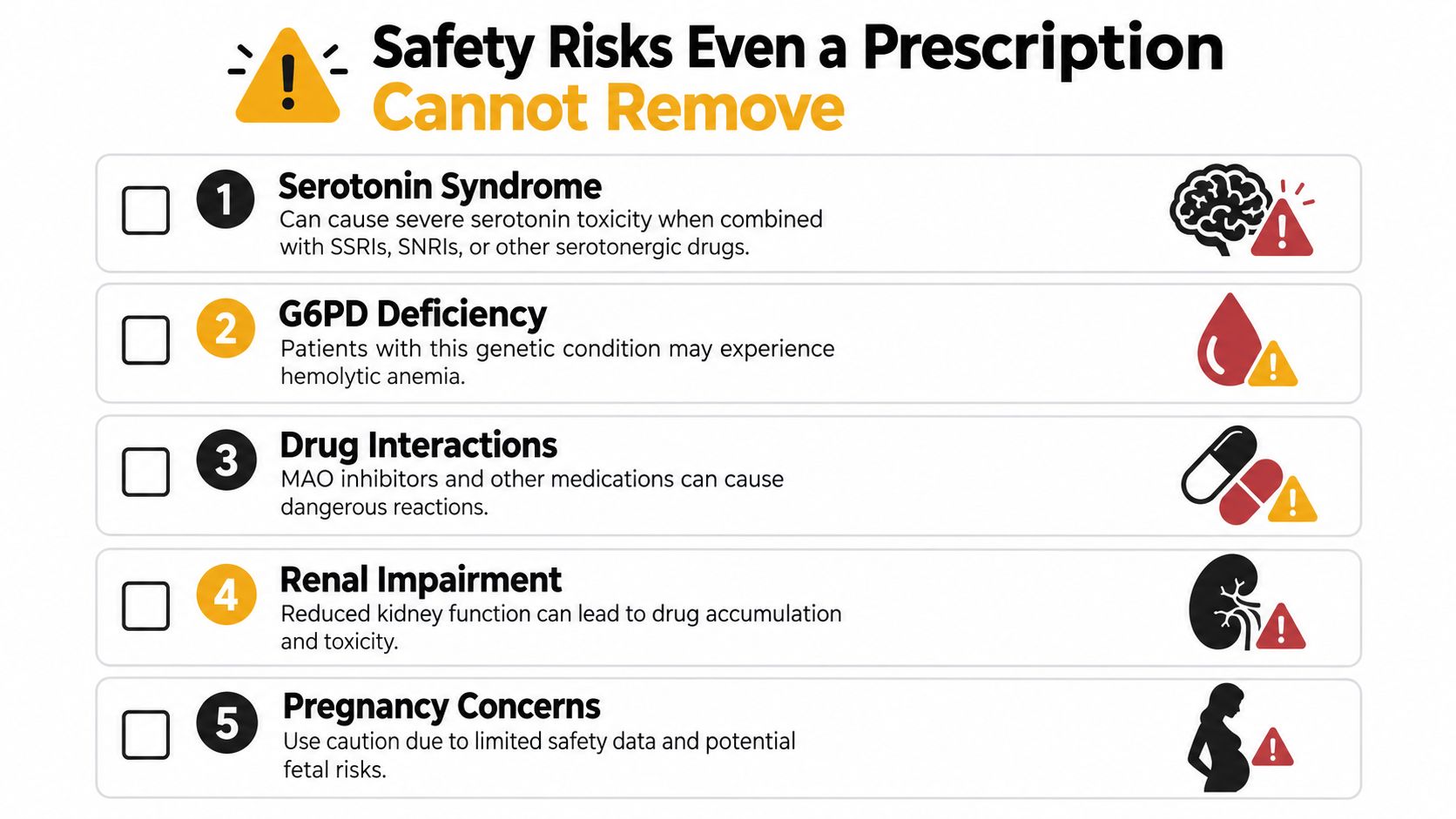
Methylene blue can contribute to serotonin syndrome, a potentially serious reaction, when combined with serotonergic medicines. These include common psychiatric treatments such as SSRIs, SNRIs, and MAO inhibitors, as well as certain opioids and dextromethorphan found in some cough products. The FDA label also identifies glucose-6-phosphate dehydrogenase deficiency as a contraindication. Prescription-grade sourcing does not establish that off-label oral or sublingual use is safe with these medications.
Reconcile the full medication list
Medication reconciliation means checking what you take, including products that may be absent from a clinic's records. Before any methylene blue exposure, share prescription medicines, over-the-counter products, supplements, and other treatments with the prescriber.
Don't stop a psychiatric medication yourself.
The clinician needs to assess the combination and decide whether treatment is appropriate, rather than leaving you to adjust existing care.
A practical review can include:
- List every medicine: Include antidepressants, pain medicines, cough and cold products, and prescriptions from other clinicians.
- Name the exact products: Bring medication bottles or a current written list so the review doesn't depend on memory.
- Mention relevant diagnoses: Report known G6PD deficiency and other conditions the prescriber should consider.
- Describe the proposed product: Specify whether it's injectable, compounded oral, sublingual, or another formulation.
- Ask who will monitor treatment: Identify the clinician responsible for reviewing interactions and responding to concerns.
Make remote care a complete conversation
Telemedicine can provide access to care, but the prescriber may not know about medicines obtained elsewhere. Share those details even if they seem unrelated to the reason for your appointment.
A verified vial and a verified medication list are separate checks; both belong in the decision about your care.
The following video offers another overview of medication-related risks to discuss with a clinician.
How Clinicians Source and Verify Quality
Clinicians and pharmacies need more than a supplier's claim that a product is pure. They need documentation connecting the ingredient, finished preparation, concentration, and intended route. That discipline helps distinguish a controlled medicine from a product that merely shares its chemical name.
A practical verification checklist
- Confirm the designation: Check whether the active ingredient is specified as methylene blue USP and whether the finished preparation is labeled for its intended use.
- Review the batch record: Ask whether lot identification and documentation allow the material to be traced.
- Match concentration to route: Confirm that the amount per unit or volume is clear and appropriate for the preparation being prescribed.
- Check sterility where applicable: Injectable products require route-appropriate sterility controls. Don't infer sterility from a purity statement.
- Follow storage instructions: The product's specified storage conditions matter; verify them through the dispensing pharmacy.
- Keep prescribing oversight in place: The clinician should determine whether the product fits the indication, medication profile, and health history.
The FDA-labeled injectable is a specific formulation for intravenous administration. An oral or sublingual preparation, including a compounded one, shouldn't be assumed to be therapeutically interchangeable with it. A prescriber and dispensing pharmacy should explain what the preparation is, how it's meant to be used, and what evidence supports the intended purpose.
When evaluating a compounded option, ask who prescribed it, which pharmacy prepared it, what formulation and route were ordered, and what documentation is available for the ingredient and finished product. Cost Plus TRT offers physician-supervised peptide therapies, including compounded methylene blue preparations; discuss any proposed use and medication interactions directly with a qualified clinician rather than choosing a product on your own.
What This Means for Your Next Conversation With a Provider
Bring the discussion back to five practical questions: What condition or goal is being treated? Which route is intended? What concentration and formulation will be used? Have my medications and relevant health conditions been reviewed? What product and batch documentation can the prescriber or pharmacy provide?
These questions connect product quality to personal suitability. A controlled manufacturing process matters, but it can't determine whether a medicine is right for you. Before taking or ordering methylene blue, ask your provider to review the indication, route, formulation, and full medication list with you.
If you're considering methylene blue, arrange a physician-supervised conversation and bring a complete medication list before making any decision. Cost Plus TRT offers telemedicine care that includes physician-supervised peptide therapies, and you can learn more or request a consultation through Cost Plus TRT.