
You're probably staring at the scale, wondering why the barbell is moving up while the number on the bathroom scale is barely budging. That's the wrong scoreboard. How to lose weight doing weights is really about changing your body composition, keeping strength, and dropping fat in a way that doesn't leave you smaller, softer, and weaker.
Lifting changes the outcome because it changes what you lose. A 2021 systematic review and meta-analysis of 58 studies found that resistance training reduced body-fat percentage by 1.46 percentage points and lowered visceral fat versus non-training controls, even though the scale doesn't always tell that story right away study. If you want the mirror to improve, your waist to tighten, and your training numbers to stay up, the plan has to be built around that reality.
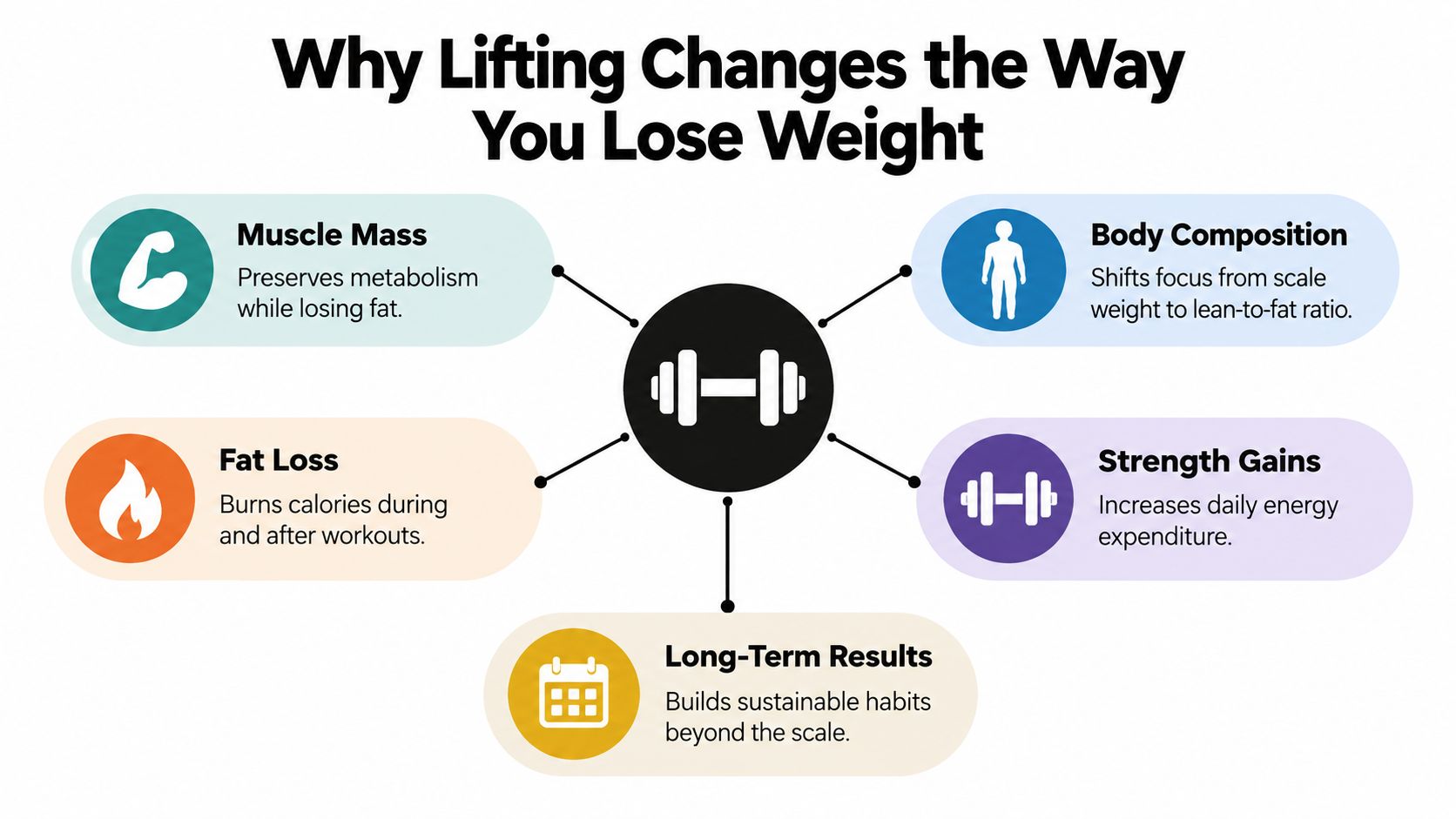
Table of Contents
- Why Lifting Changes the Way You Lose Weight
- Building Your Weekly Lifting Program
- Setting the Calorie Deficit and Macros That Protect Muscle
- Adding Cardio and Daily Movement Without Burning Out
- Tracking Progress and Breaking Through Plateaus
- When Hormones and TRT Enter the Picture
- Your First-Week Fat-Loss Checklist
Why Lifting Changes the Way You Lose Weight
You can add weight to the bar for a month, tighten your belt by a notch, and still see almost no change on the scale. Men read that as stalled fat loss all the time. In practice, it usually means the process is working differently than they expected.
Lifting changes weight loss because it changes what your body fights to keep. During a calorie deficit, your body can lose fat, muscle, glycogen, and water. Resistance training gives it a reason to hold onto muscle and strength, which matters if you want to look better at the end of the cut instead of just ending up smaller.
A stronger body often weighs the same, or a little more, while looking noticeably leaner. That is recomposition at work. The mirror, your waist, and your training log often show progress before the scale does.
What the scale misses
The scale only reports total body weight. It does not separate fat loss from muscle gain, and it definitely does not account for short-term water shifts from hard training, higher-carb meals, poor sleep, or soreness. That is why a man can look sharper through the shoulders and chest, measure smaller at the waist, and still assume nothing is happening because his morning weigh-in is flat.
Practical rule: if the waist is shrinking, the lifts are holding, and the weekly average weight is stable or slowly falling, the program is working.
This is the mindset shift a lot of men need. Use body-composition markers, not scale emotion. Waist measurements, progress photos, gym performance, how your shirts fit through the midsection, and how you look in consistent lighting tell you far more than one number taken after a bathroom trip.
Why the plan has to be strength first
Diet hard without lifting, and the body often gives up tissue you wanted to keep. You lose fullness in the chest, back, shoulders, and legs. The result is a lighter body that still does not look athletic.
A strength-first fat-loss phase protects the frame underneath. It helps keep muscle on your body while fat comes off around the waist, which is why men who lift through a cut usually look better than men who only chase calorie burn.
Hormones matter here too. If testosterone is low, holding muscle and recovering well gets harder, which can make fat loss feel slower and less predictable. TRT can matter for the right patient, but it fits into the bigger picture after training, food, recovery, and honest tracking are in place.
Ask a better question: how much fat can you lose while keeping your strength and shape? That answer changes the whole approach.
Building Your Weekly Lifting Program
A fat-loss lifting plan should be simple enough to repeat and hard enough to matter. Most men do best with 2 to 4 full-body sessions per week, because that covers the major movement patterns without piling on so much soreness that recovery starts to slip protocol. You do not need fancy exercise selection to make this work.
If you want more training guides, see the Cost Plus TRT blog library for programming and recovery topics.
A clean full-body template
Start with the movement patterns that give the most return for the time invested. Use a squat or leg press, a hip hinge, a horizontal push and pull, a vertical push and pull, plus loaded carries or trunk work. That gives you a complete training week without turning the gym into a circus.
| Day | Movement Pattern | Exercise Example | Sets x Reps |
|---|---|---|---|
| Monday | Squat | Barbell squat or leg press | 2–4 sets of 6–12 reps |
| Monday | Horizontal push | Bench press or dumbbell press | 2–4 sets of 6–12 reps |
| Monday | Horizontal pull | Row variation | 2–4 sets of 6–12 reps |
| Wednesday | Hip hinge | Romanian deadlift or trap-bar deadlift | 2–4 sets of 6–12 reps |
| Wednesday | Vertical push | Overhead press | 2–4 sets of 6–12 reps |
| Wednesday | Core or carry | Farmer carry or plank variation | 2–4 sets |
| Friday | Repeat weak points | Your least-developed lifts | 2–4 sets of 6–12 reps |
The working target is 2 to 4 sets per movement with 6 to 12 controlled reps, stopping with about 1 to 3 reps in reserve protocol. That leaves enough in the tank to recover while still giving you a strong training stimulus.
How to progress without guessing
Progression should be boring. Add a rep or a little load only after every set in the target range feels clean and controlled. If you hit the top of the rep range across all sets, move the weight up next time and start again near the lower end.
Keep a logbook. Write down the exercise, the load, the reps, and how hard the final set felt. If you do not track it, you will drift, repeat the same sessions, and wonder why nothing changes.
Train hard enough to keep strength, not so hard that every workout turns into a recovery problem.
An upper-lower split can also work, but the rules stay the same. Keep the same rep range, the same proximity to failure, and the same steady progression. More days in the gym only help if you can still recover and perform.
Setting the Calorie Deficit and Macros That Protect Muscle
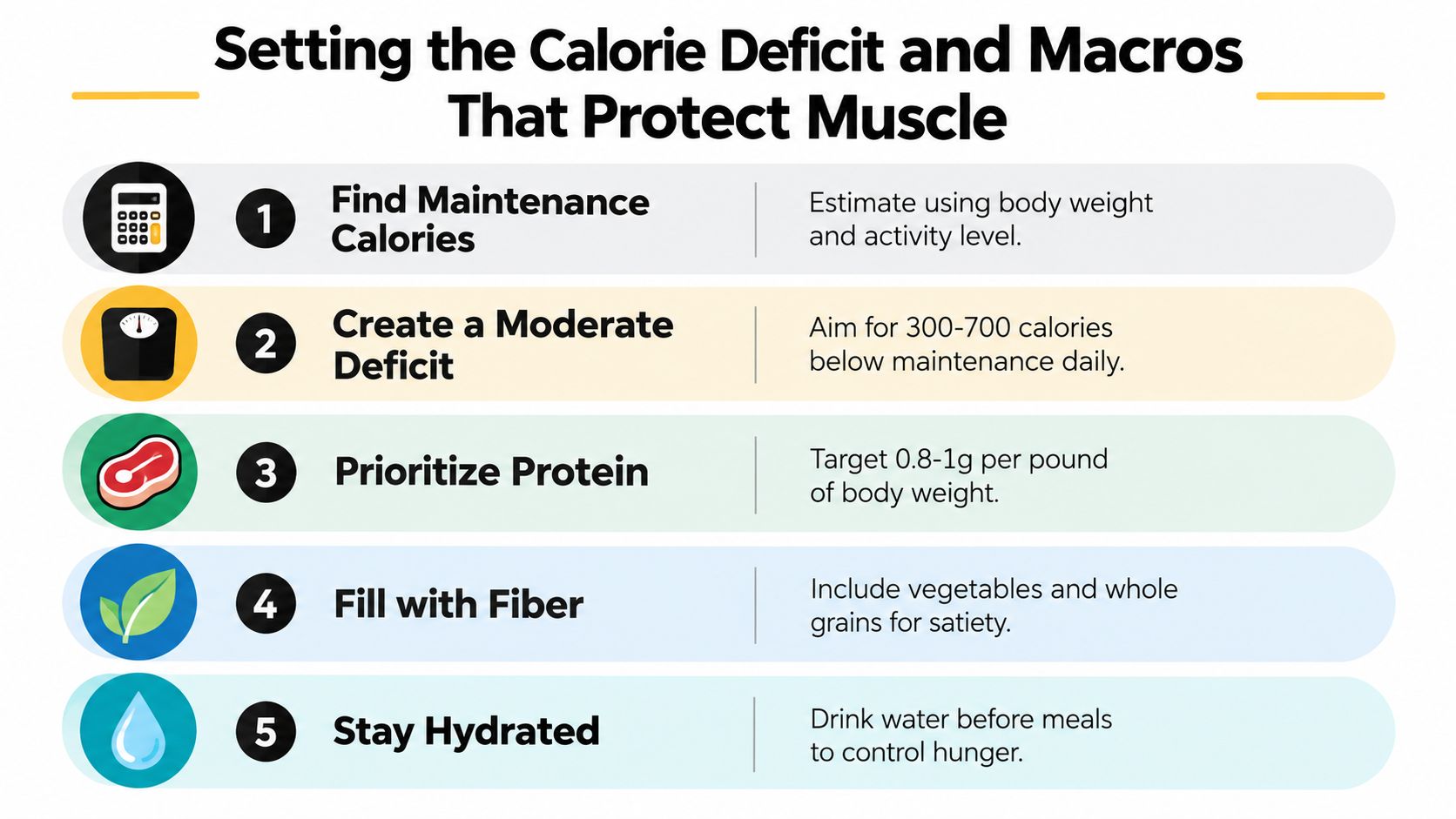
Weights do not override energy balance. If body fat is going to come down, intake still has to be lower than output. The point is to create a moderate deficit, not an aggressive crash diet that makes every lift feel awful and strips away lean tissue.
A useful start is to estimate maintenance calories, then reduce intake by about 300 to 500 kcal per day. That usually gives enough room for steady fat loss without dragging training performance into the floor. The exact number matters less than whether your weekly trend is moving in the right direction.
Protein comes first
Protein is your insurance policy when you're dieting and lifting. The practical target for many men is about 1.6 to 2.2 grams per kilogram of body weight, spread across 3 to 5 meals so each feeding gives your body a chance to support muscle retention. That matters because the training stimulus is only half the story, food has to support the adaptation.
The evidence is clear that resistance training helps preserve lean tissue during dieting. A 2021 umbrella review found that resistance training reduced lean-mass loss by approximately 0.8 kg during weight loss, and that combining resistance training with calorie restriction produced larger body-fat reductions than lifting alone umbrella review. That's the practical case for pairing the gym with the plate.
Carbs, fats, and meal timing
Put more carbs around training if performance matters. You'll usually lift better when some of your carbs land before and after your session. Keep dietary fat high enough to make meals satisfying, but don't let it crowd out protein or push calories above target.
Aggressive cutting is the fastest way to make the program feel broken. Strength drops, recovery worsens, and men often respond by blaming the weights instead of the deficit. If the goal is to lose fat and keep muscle, the deficit should support training, not sabotage it.
If weight and waist trend don't move after 2 to 3 weeks, adjust intake modestly. Don't slash calories on day four because a weekend meal made the scale jump. Use trend data, not emotion.
Adding Cardio and Daily Movement Without Burning Out
Treat cardio as a supporting tool. Daily movement does much of the quiet work because it is easy to recover from and repeat. Walking also suits a busy schedule better than trying to live on the treadmill.

Make walking part of the day. A steady step target, combined with ordinary movement, increases calorie expenditure without battering your legs or draining your motivation. Your cardio should support the lifting that protects muscle during fat loss, not leave you too tired to squat well.
If you want extra conditioning, keep it short and focused. Two easy weekly sessions, such as incline walking, a relaxed bike ride, or brief intervals after lifting, will cover the needs of many men. Place harder work on days when your lower body has recovered, rather than stacking it onto a demanding leg session.
Keep conditioning from competing with strength
Use your main lifts as the check. If cardio begins reducing performance in the squat, hinge, press, or row, your current recovery cannot support that workload. Increase daily movement first, then add conditioning only if fat loss has stalled.
Walking, lifting, and a modest amount of conditioning work better for many men than trying to out-train their food intake. The routine stays easier to repeat, helping fat loss continue while strength and muscle remain priorities. Build a schedule that survives work, family, and tired days, not just a motivated Monday.
Tracking Progress and Breaking Through Plateaus
The fastest way to quit is to read the scale like it's a verdict. It isn't. When men train hard, hold or gain muscle, and lose fat at the same time, body weight can stay flat even while the mirror changes.
That happened in a randomized trial of previously inactive men with obesity. Resistance exercise reduced fat mass by 4.39% and increased lean mass by 2.12% with no significant change in total body weight, while aerobic and combined training reduced body and fat mass more than resistance training alone trial. The lesson is simple, the scale can lag behind the actual body change.
Use the right measurements
Weigh yourself daily if you can handle the data, then average it across seven days. That smooths out water swings, soreness, sodium, and normal noise. One bad morning doesn't mean the program failed.
Also measure your waist and take progress photos each week. Use the same lighting, the same time of day, and the same relaxed posture. If the waist is shrinking and the photos look better, you're moving in the right direction even if the mirror feels stubborn.
Coach's rule: if your gym numbers are holding, your waist is smaller, and your seven-day average is drifting down, keep going.
What to do when progress stalls
If the average weight and waist haven't changed for 2 to 3 weeks, make one small change, not five. Drop calories slightly, add a bit more daily movement, or insert one short conditioning session. Then hold the rest of the plan steady long enough to judge the effect.
Don't cut protein, and don't chase fatigue with more volume. Men often stall because they turn a fat-loss plan into a punishment plan. Keep lifting intensity up, keep recovery sane, and let the data guide the next move.
When Hormones and TRT Enter the Picture
Sometimes a man does the work and still feels off. Fat loss is slow, energy is low, and libido, mood, or drive aren't where they should be. That's when the hormone question becomes relevant, but it still needs to be handled carefully.
A 2025 review reports that clinically significant weight loss can substantially reverse obesity-related reductions in serum testosterone, and one cited meta-analysis estimated roughly a 1-nmol/L rise in total testosterone per 5 kg of weight lost in men with obesity-related functional hypogonadism review. That doesn't mean weights are a guaranteed testosterone treatment. It means fat loss itself can matter a lot.
What lifestyle can do, and what it can't
Resistance training should be part of the foundation, but it's not the whole hormonal story. Sleep, calorie balance, body-fat reduction, and overall activity all influence how a man feels and what his labs show. Combined aerobic and resistance exercise may offer more benefit than weights alone when the goal is restoring testosterone-related health markers.
Persistent symptoms still deserve proper evaluation. If a man has ongoing low-energy, libido, or recovery problems, he shouldn't guess based on the gym. He should get labs and a clinician's interpretation.
For men who want physician-supervised evaluation with transparent pricing, Cost Plus TRT is one telemedicine option to review alongside other care paths. The key is supervision, not self-diagnosis from the barbell.
Your First-Week Fat-Loss Checklist
Your first week should make the plan repeatable, not test your willpower. Set the basics, record what happens, and give the process enough time to show a pattern. Daily scale changes reflect water, food volume, and training stress, so one weigh-in cannot judge fat loss.
- Choose your lift days: Schedule 3 full-body sessions before the week begins.
- Cover the big patterns: Include a squat or leg press, hinge, horizontal push, horizontal pull, vertical push, and core work or carries.
- Set your effort level: Use the 6 to 12 rep range and finish most sets with about 1 to 3 reps in reserve.
- Set your calories: Estimate maintenance, then create a deficit of roughly 300 to 500 kcal per day.
- Anchor protein: Reach your daily protein target across 3 to 5 meals.
- Move every day: Add walking before adding more gym volume.
- Track useful signals: Log scale weight, waist measurement, photos, and gym performance.
Keep the first week deliberately manageable. If your lifts collapse, hunger becomes difficult to control, or recovery worsens, the deficit or training load needs adjustment. If the scale stalls while your waist shrinks and your strength holds, body recomposition may be working even without dramatic weight loss.
Consistency across 8 to 12 weeks matters more than heroic workouts followed by missed sessions. Before starting, review what TRT actually costs month to month so the hormone question does not catch you off guard later.
If you are lifting, reducing fat, and still experiencing unexplained symptoms, Cost Plus TRT offers physician-supervised telemedicine evaluation for TRT and related men's health options. Use clinical assessment, not the scale or gym performance alone, to decide whether hormones belong in the conversation.