
You notice your chest in the mirror after a shower, while changing at the gym, or under a fitted shirt. One side may look fuller than the other, the area behind a nipple may feel sore, or your whole chest may seem softer after weight gain. Then the worry starts: why do I have man breasts, and does this mean my testosterone is low?
That question is understandable, but breast enlargement by itself doesn't provide the answer. The first useful step is to determine whether you're feeling glandular breast tissue, chest fat, or another type of lump. From there, a clinician can assess hormones, medications, health conditions, and symptoms instead of jumping straight to testosterone treatment or surgery.
Table of Contents
- Understanding Male Breast Enlargement
- Gynecomastia vs Pseudogynecomastia
- Hormonal Imbalance and Breast Tissue Growth
- Signs Red Flags and When to Seek Care
- How Clinicians Diagnose Gynecomastia
- Treatment Options from Watchful Waiting to Surgery
- Testosterone Low T and Telemedicine Evaluation
Understanding Male Breast Enlargement
A shirt may fit your shoulders but pull across your chest, or you may notice fullness while changing after exercise. You might check the area repeatedly, wondering whether it is fat, a lump, or a sign of a hormone problem. That uncertainty is understandable. Chest appearance alone cannot identify the cause, so the useful starting point is to ask what kind of tissue has changed.
Male breast enlargement is often linked to gynecomastia, a benign increase in glandular breast tissue. It develops when estrogen and testosterone have a relatively different effect within the breast. This does not automatically mean that your body produces no testosterone or that you have confirmed testosterone deficiency. The balance may shift when testosterone decreases, estrogen activity rises, breast tissue becomes more sensitive, or another health condition changes how hormones act.

Gynecomastia can occur at several stages of life. In newborn boys, temporary enlargement is reported in approximately 60–90% of cases, partly because maternal hormones can remain in an infant's circulation, as described in the Mayo Clinic's overview of gynecomastia causes. During puberty, hormonal fluctuations may cause tender tissue that often begins around ages 10–12, peaks at approximately 13–14, and commonly regresses within about 18 months, according to the same clinical reference.
Why the experience feels confusing
“Man breasts” describes an appearance, not a diagnosis. Similar-looking chests can reflect different changes. One person may have diffuse fat associated with weight gain, another may have glandular tissue beneath the nipple, and some people have both. The visual impression gives you a reason to investigate, not an answer about testosterone or treatment.
Gynecomastia becomes more common in older men. Estimates for men aged 50–80 range from 24% to 65%, depending on the population and diagnostic criteria used, according to the same clinical reference. Alcohol, anabolic steroids, certain medicines, liver or kidney disease, thyroid disorders, and testicular or pituitary conditions may also contribute.
The important first question isn't “Should I take testosterone?” It's “What type of tissue is causing the enlargement?”
That question helps direct the next decision. Breast enlargement alone does not establish low testosterone or show that testosterone replacement therapy is appropriate. A clinician can combine the timeline, symptoms, medicines, medical history, physical findings, and laboratory results when indicated to identify what needs attention.
Gynecomastia vs Pseudogynecomastia
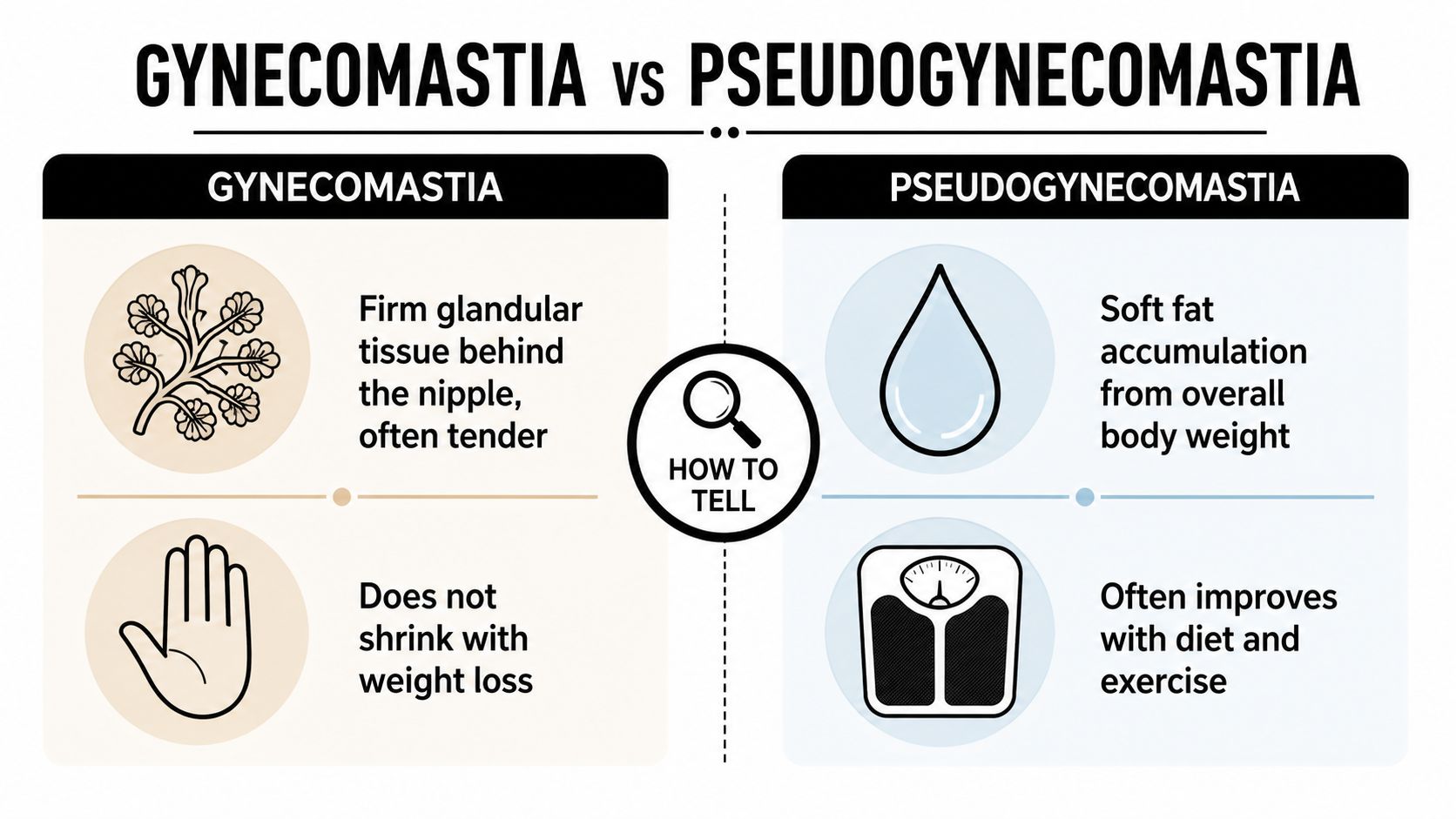
You notice fullness in your chest while changing clothes. Before assuming it means low testosterone or deciding that you need treatment, identify the tissue involved. Gynecomastia and pseudogynecomastia can look alike through a shirt, but they are different physical changes.
Gynecomastia is an increase in glandular breast tissue. It often feels like a firm or rubbery, movable disk beneath the nipple, similar to a small button under the skin. Recent growth may be tender. It can occur on one side or both, and the two sides may differ in size.
Pseudogynecomastia is fat distributed across the chest, without enlargement of the breast glands. It usually feels softer and more diffuse, with no clearly defined disk centered behind the nipple. It often accompanies overall weight gain, although body shape and fat distribution vary.
What you may notice at home
A gentle self-check can help you describe the change to a clinician. It cannot confirm the diagnosis. Notice whether fullness is spread across the chest or concentrated beneath the nipple. Also note tenderness, how quickly it appeared, and whether the area feels soft, firm, fixed, or mobile.
| Feature | Gynecomastia | Pseudogynecomastia |
|---|---|---|
| Main tissue | Glandular breast tissue | Fatty tissue |
| Texture | Firm or rubbery disk | Soft, diffuse fullness |
| Usual location | Directly beneath the nipple | Spread across the chest |
| Tenderness | Can be present, especially when recent | Less characteristic |
| Effect of weight loss | Established glandular tissue may remain | Chest fat may decrease |
Weight loss can reduce pseudogynecomastia because it reduces overall body fat. It often will not remove established glandular tissue, although a lower body-fat level can make the chest appear smaller. Some men have both conditions, with diffuse fat overlying a firmer glandular area. The appearance alone cannot show whether one or both are present.
Clinical reviews report a broad prevalence range for gynecomastia, about 32–65%, while autopsy studies have found evidence in roughly 40% of men, as summarized in Endotext's clinical discussion of gynecomastia. The variation reflects differences in examination methods, age groups, and diagnostic definitions.
Why self-checking has limits
A soft chest is not automatically harmless, and a firm area is not automatically gynecomastia. A lipoma, cyst, infection, breast cancer, or endocrine problem can also cause a lump or change in appearance. Arrange a medical assessment for a new or unusual mass instead of repeatedly pressing the area and trying to settle the diagnosis yourself.
Hormonal Imbalance and Breast Tissue Growth
A man can develop breast tissue even when he has no obvious signs of a hormone disorder. The male body normally produces both testosterone and estrogen. Testosterone supports muscle development, sexual health, bone maintenance, and sperm production. Estrogen also has normal functions in men, including effects on bone and other tissues. Breast tissue may enlarge when estrogen activity becomes stronger relative to testosterone activity, or when breast tissue reacts more strongly to a hormonal shift.
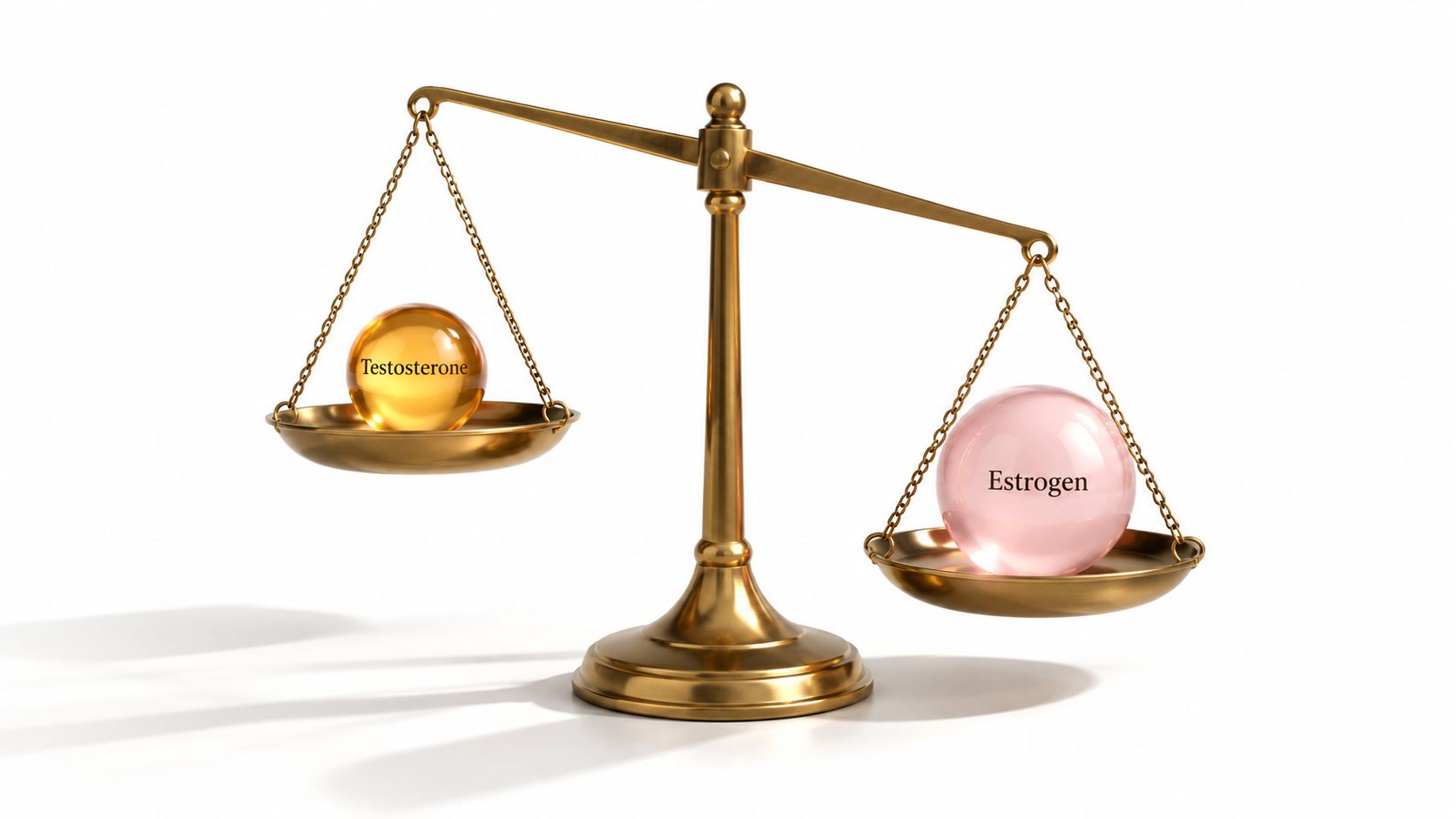
This is a relative imbalance, not necessarily a complete lack of testosterone. Testosterone production may fall, estrogen activity may rise, or breast tissue may become more sensitive to either change. The result can occur in men with different body types, ages, and health histories. The appearance of your chest cannot identify which mechanism is involved.
How body composition can matter
Fat tissue contains aromatase, an enzyme that helps convert testosterone into estrogen. Gaining body fat can therefore contribute to greater estrogen activity, but chest fullness alone does not prove that a hormone disorder exists. Body composition is one possible part of the explanation, not a diagnosis.
Some men have glandular enlargement and fatty fullness together. Fat can broaden the chest while a firmer area remains beneath the nipple. Weight reduction may improve the fatty component, while established glandular tissue may remain. A clinician may need to examine the tissue and review your history to separate these possibilities.
Life stages and common triggers
Puberty can temporarily make breast tissue enlarged or tender. In many adolescents, this tissue regresses on its own within 6 months to 2 years. Aging can alter testosterone production and the balance between testosterone and estrogen, which helps explain why gynecomastia becomes more common later in life.
Medicines and substances can also affect hormone activity. Recognized contributors include anabolic steroids, alcohol, some prescription medicines, and conditions involving the liver, kidneys, thyroid, testes, or pituitary gland. Do not stop or change a medicine without medical guidance. Bring a complete list of medicines, supplements, and recreational substances to your appointment.
Clinical reviews describe gynecomastia as a common finding, although reported frequency varies with the population studied, examination method, and diagnostic definition, as discussed in Endotext's gynecomastia review.
This short video offers a visual explanation of the relationship between male hormones and breast tissue:
Hormones may be involved, but chest appearance cannot identify the specific cause. A reasoned clinical assessment should guide any testing rather than a guess based only on appearance.
Signs Red Flags and When to Seek Care
Most male breast enlargement is not an emergency, but a new lump deserves attention if its pattern doesn't fit typical gynecomastia. You shouldn't feel embarrassed about making an appointment. Clinicians examine breast and chest changes routinely, and an early assessment can replace weeks of uncertainty with a clear plan.
Typical gynecomastia often feels like a firm, rubbery, concentrically located disk beneath the nipple. Diffuse, soft fullness is more consistent with fat. These descriptions can guide a conversation, but only a physical examination can determine whether the finding matches that pattern.
Symptoms that need prompt assessment
Contact a qualified clinician promptly if you notice:
- A hard or irregular mass: This is more concerning than a soft, mobile area and needs examination.
- One-sided rapid enlargement: A change that grows quickly or is clearly confined to one side shouldn't be assumed to be ordinary gynecomastia.
- Fixation: Tissue that seems attached to surrounding structures requires assessment.
- Nipple changes: Retraction, discharge, or new skin changes are warning signs.
- Skin dimpling: Indented or puckered skin over a mass should be checked.
- Enlarged armpit nodes: Swelling in the armpit can provide an important clinical clue.
- A testicular mass: This may point to an underlying condition requiring targeted evaluation.
- Severe or persistent pain: Pain doesn't diagnose the cause, especially if it accompanies a rapidly changing lump.
The European Academy of Andrology guidance on gynecomastia evaluation recommends discussing onset, progression, previous episodes, medicines, recreational substances, alcohol use, and systemic symptoms. A clinician may examine the breasts and genitalia and consider testicular ultrasound or targeted hormone and tumor-marker testing when the findings justify it.
Don't use the absence of pain as proof that a lump is safe, and don't use pain as proof that it is cancer. The pattern needs professional interpretation.
Recent, painful enlargement, particularly within roughly six months, may have a greater chance of improving after the trigger is treated or a specialist-directed medicine is considered. Long-standing tissue can become fibrotic and less responsive to medication, which may lead to a surgical consultation. Don't start testosterone, estrogen blockers, or supplements on your own.
If you're unsure where to begin, you can use the Cost Plus TRT contact page to request information about a medical consultation. Regardless of the provider you choose, seek care sooner rather than waiting for embarrassment to pass.
How Clinicians Diagnose Gynecomastia
A good evaluation begins with your story. Tell the clinician when you first noticed the change, whether it has progressed, whether one side is different, and whether the area feels tender. Mention nipple symptoms, testicular symptoms, recent weight change, and any illness that began around the same time.
Bring every medicine and supplement you use, including products that seem unrelated to hormones. The clinician may specifically ask about spironolactone, certain antipsychotic medicines, antiandrogens, anabolic steroids, recreational drugs, and alcohol. Don't omit a substance because you think it could be judged. Accurate information helps identify a reversible cause.
What to document before hormone testing
A short written record can make the appointment more useful:
- Timeline: Write down when you first noticed fullness, pain, or a lump.
- Distribution: Note whether it affects one side or both.
- Texture: Describe soft diffuse tissue versus a firm area behind the nipple.
- Symptoms: Record tenderness, discharge, skin changes, or testicular concerns.
- Body changes: Include recent weight gain, weight loss, or major changes in training.
- Exposure history: List anabolic steroids, recreational substances, alcohol, medicines, and supplements.
The clinician then performs an examination of the chest, nipples, lymph nodes, abdomen, and genitalia. The aim isn't merely to confirm gynecomastia. It is to distinguish glandular tissue from fat and to look for signs of breast cancer, endocrine disease, or a testicular cause.
When tests or imaging help
Blood tests may evaluate hormones and other markers when your history or examination suggests an underlying cause. The specific tests depend on the pattern of symptoms rather than a universal panel for every patient. Imaging may also be appropriate when the physical findings are unusual, one-sided, hard, fixed, or otherwise concerning.
The clinical review on gynecomastia and its differential diagnosis emphasizes that breast enlargement isn't automatically evidence of testosterone deficiency. It can reflect medication effects, thyroid, liver, or kidney disease, anabolic-steroid withdrawal, tumors, or a relative change between estrogen and testosterone activity.
This is why requesting “a testosterone test” without documenting the context may provide an incomplete answer. A low result, if found, still needs interpretation alongside symptoms, repeat testing when appropriate, and the rest of your health history.
Treatment Options from Watchful Waiting to Surgery
If your chest change is mild, recent, and not concerning on examination, observation may be the safest starting point. Treatment depends on cause, duration, discomfort, tissue type, severity, and personal preference. The plan should match what is actually enlarged, whether that is fat, glandular tissue, loose skin, or a combination.
| Approach | Best For | Typical Duration |
|---|---|---|
| Watchful waiting | Mild or recent enlargement when examination is reassuring | Clinician-guided follow-up |
| Treating an underlying cause | Medicine-related, substance-related, or health-related enlargement | Depends on the cause and response |
| Weight management and exercise | Pseudogynecomastia and overall chest fat | Ongoing lifestyle change |
| Specialist-directed medication | Selected recent gynecomastia cases | A clinician determines the course |
| Surgery | Persistent fibrotic tissue or substantial enlargement | Planned procedure and recovery |
Weight loss can reduce chest fat, while established glandular tissue may remain. Strength training can improve muscle tone and body composition, but it does not reliably remove a firm glandular disk. Exercise still has value. It cannot correct every type of enlargement.
Removing the suspected trigger may help. A clinician might review a medicine, substance, or health condition before recommending another treatment. Prescription medicines may suit selected patients, particularly when enlargement is recent and painful. Medicines such as tamoxifen or aromatase inhibitors have different uses, limitations, and potential adverse effects, so they should not be treated as interchangeable with over-the-counter “estrogen blockers.”
Surgery may be considered when tissue persists, becomes fibrotic, causes substantial discomfort, or affects quality of life. Liposuction is generally suited to excess fatty tissue, while gland excision is used when a firm glandular mass remains. Some patients need both techniques, especially when glandular tissue and fat occur together. A surgeon also assesses loose skin and the final chest contour.
Surgical planning should follow evaluation of the cause, not replace it. If you are considering testosterone treatment, review TRT and fertility considerations before making assumptions about hormone therapy. Self-starting testosterone can worsen an unrecognized hormonal problem, and estrogen-blocking supplements can create their own risks.
Testosterone Low T and Telemedicine Evaluation
Gynecomastia and low testosterone can occur together, but one does not establish the other. Low testosterone becomes more plausible when breast enlargement appears with reduced sexual desire, erectile difficulty, low energy, reduced muscle strength, or other symptoms a clinician can assess. Symptoms alone cannot confirm the diagnosis, because several conditions can produce similar changes.
Start with the chest change and its timeline. Note whether the enlargement is one-sided, whether the tissue feels tender or firm, and whether your weight has changed. Prepare a complete list of medicines, supplements, anabolic steroids, recreational substances, and alcohol use. Report nipple symptoms, testicular changes, and any recent illness. These details help a clinician distinguish glandular growth from fat and identify possible hormonal or medication-related causes.
What a responsible evaluation may involve
A clinician may:
- review your symptoms, timeline, and medical history
- examine the breast and genital tissue
- assess medicines and substances that can affect hormone levels
- order targeted hormone testing when indicated
- consider other laboratory tests or imaging based on the findings
- discuss observation, treatment of an underlying cause, medication, or surgery
Telemedicine can support the initial discussion, review of laboratory results, and planning when an immediate in-person examination is not necessary. It should not replace an examination of a hard, fixed, rapidly growing, or otherwise concerning mass. Those findings need prompt in-person assessment.
Testosterone replacement therapy is appropriate only for selected men with a clinically supported diagnosis of testosterone deficiency and supervision from a qualified provider. It is not a general treatment for chest fat and may not remove established glandular tissue. Identifying the cause should come before choosing hormone treatment.
Telemedicine platforms such as Cost Plus TRT can provide remote clinician consultations for men whose symptoms may involve low testosterone. For men who qualify, information about telemedicine testosterone evaluation can help explain how supervised assessment works. A remote consultation does not remove the need for an in-person examination when the chest findings require it.