

You've probably already done the same thing a lot of men do. You search for enclomiphene, find a few clinics, a few pharmacy pages, and a few shady-looking sellers, then realize the market doesn't behave like a normal retail medication aisle. In the U.S., that confusion is real, because enclomiphene is prescription-only, many chain pharmacies don't stock it, and the lowest prices you'll see are often tied to channels that are not interchangeable with a legitimate pharmacy product (CFS Pharmacy, Push Health, Hims).
That's why the question isn't just where to buy enclomiphene. The better question is where to buy it safely, legally, and from a source you can verify. If you care about fertility, quality control, and staying inside the lines, the sourcing decision matters as much as the medication itself.
Table of Contents
- Why Finding Enclomiphene Is Harder Than It Should Be
- Prescription Requirements and Legal Pathways
- Three Channels for Obtaining Enclomiphene
- How to Verify a Compounding Pharmacy or Telemedicine Provider
- The Research Chemical Market and Why It Carries Real Risk
- Expected Costs and What Drives the Price Spread
- Enclomiphene in the Context of Fertility-Preserving Treatment Options
Why Finding Enclomiphene Is Harder Than It Should Be
A man can spend an evening reading forum posts, click a pharmacy page, then hit a wall on the next tab. One vendor asks for a prescription, another sells a capsule labeled for research, and a third says the medication is available through compounding only. That's the current enclomiphene market in plain English, fragmented and inconsistent, not a neat retail chain with one obvious checkout path.
The access problem starts with pharmacy reality
The practical issue is simple. One pharmacy page says compounded enclomiphene capsules are dispensed only by prescription, while a separate patient guide says most large chain pharmacies don't carry it and that it's typically available only through compounding pharmacies (CFS Pharmacy). That means a patient usually can't treat enclomiphene like a shelf item at CVS or Walgreens.
Practical rule: if a site makes enclomiphene look like a normal OTC supplement, treat that as a warning sign rather than a convenience.
The friction is partly regulatory and partly commercial. Prescription-only medications often become underserved when demand is niche, compounding is required, or the product sits in a gray area between common pharmacy stocking and specialty fulfillment. For buyers, that creates a strange reality, the legitimate path exists, but it's often less visible than the questionable one.
Why the low-price options create confusion
Price listings deepen the confusion. Research-chemical sellers advertise enclomiphene far below pharmacy prices, but a low price says nothing about pharmacy standards, medical oversight, or whether the product is appropriate for human use.
The result is a market where the cheapest path is often the least legitimate, and the most legitimate path isn't always the easiest to find. That's why buyers need a sourcing strategy, not just a search term.
Prescription Requirements and Legal Pathways
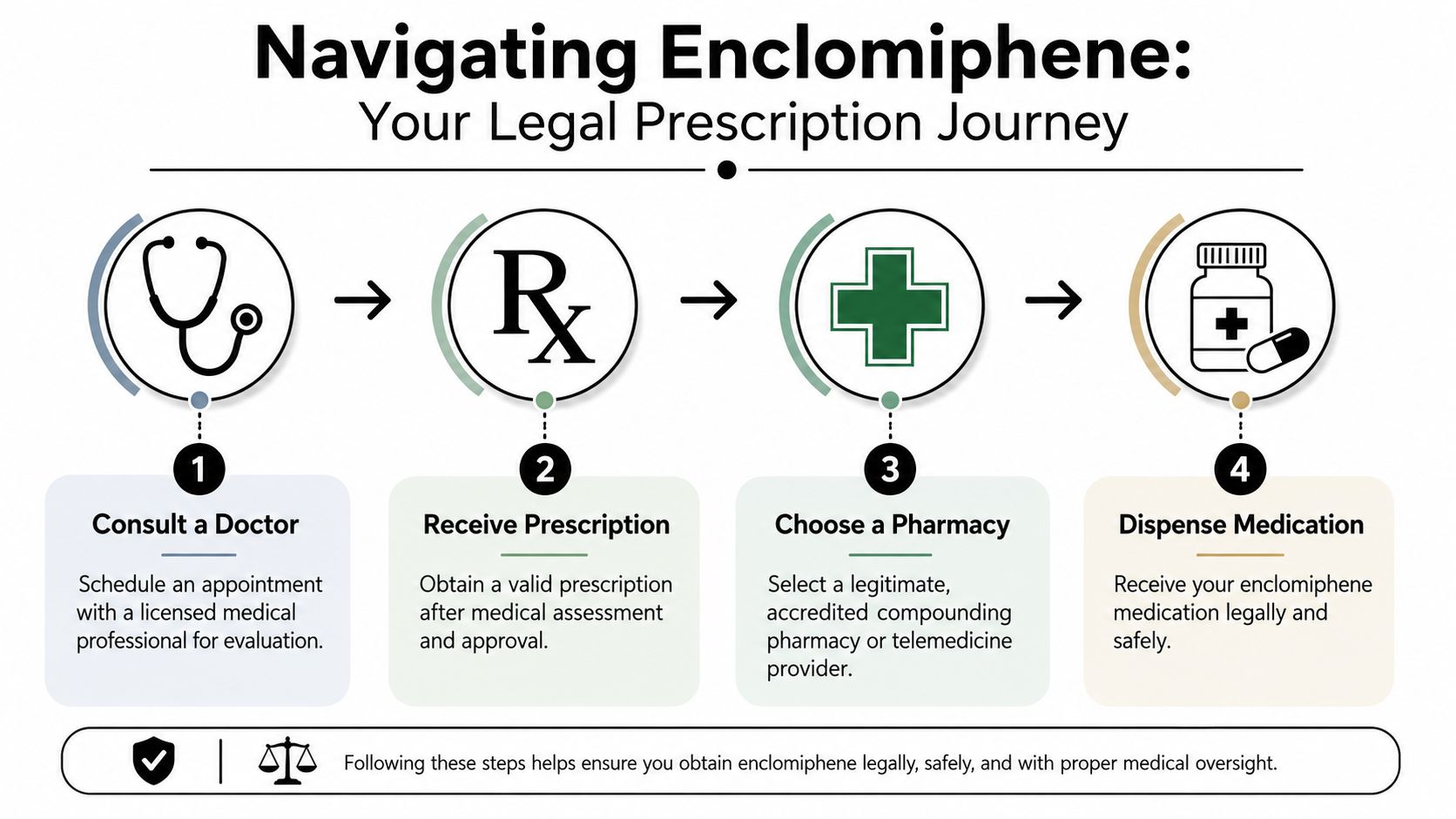
In the U.S., enclomiphene is a prescription-only medication for pharmacy dispensing, and that's the legal line that matters most. The technically correct buying path is a licensed prescriber plus a dispensing pharmacy, not an over-the-counter checkout or a no-question checkout screen (Push Health). If a seller says you can buy it without a valid prescription, that offer isn't a legitimate U.S. pharmacy dispensing pathway.
What the legal route actually looks like
The first step is a medical evaluation. A licensed clinician reviews symptoms, goals, and history, then decides whether enclomiphene fits the picture. If the provider agrees, they write the prescription and send it to a pharmacy that can dispense or compound it.
The second step is fulfillment. That may happen through a specialty pharmacy or a compounding pharmacy, depending on the provider's workflow. In some cases, telemedicine clinics bundle the consultation and pharmacy coordination together, which is why many men end up using online care rather than trying to find their way through the market alone.
A prescription requirement isn't a hurdle invented by the industry, it's the safeguard that separates medical treatment from unverified product sales.
Where telemedicine fits
Telemedicine works best when you already know you want clinician-guided care and don't want to chase separate pieces. A legitimate online provider usually collects a symptom history, reviews labs, and then decides whether to prescribe. Some clinics use recent labs you already have, others arrange testing before treatment begins. The key point is that the prescription comes from a real medical assessment, not a shopping cart.
If you're comparing online options, the intake process matters as much as the medication page. A provider that won't explain who the prescriber is, how the prescription is handled, or what pharmacy fills it is asking you to trust a black box.
Three Channels for Obtaining Enclomiphene
People run into three different sourcing channels, and they are not equivalent. Telemedicine clinics, compounding pharmacies, and the research chemical market may all use the same name, enclomiphene, but they work under very different rules. Those differences show up in safety, accountability, and cost.
| Channel | Prescription Required | Typical Monthly Cost | Quality Oversight | Convenience |
|---|---|---|---|---|
| Telemedicine clinic | Yes | Commonly about $50–$150 per month out of pocket (Hims) | Higher, because care is tied to clinician review and pharmacy dispensing | High, because consultation and fulfillment are often bundled |
| Compounding pharmacy through a prescriber | Yes | Commonly about $50–$150 per month out of pocket | Higher than gray-market sources, but it depends on pharmacy licensure and testing practices | Moderate, especially if you already have a prescription |
| Research chemical vendor | No legitimate U.S. prescription path | Often far below pharmacy prices | Lowest, because quality control and medical oversight are not the same as pharmacy dispensing | High at checkout, but poor if you need legitimate treatment |
Telemedicine clinics
Telemedicine is usually the cleanest route for men who want the medical and logistical pieces handled in one place. A legitimate clinic coordinates the visit, reviews symptoms and labs, and sends the prescription to a dispensing partner. The price can look higher than a bare pharmacy fill, but that often reflects the clinical layer around the medication and the fact that someone is reviewing whether enclomiphene fits the case.
The legitimacy check matters here. A clinic that explains who is prescribing, how the prescription is handled, and what pharmacy fills it is operating in the open. A site that hides those details is asking you to trust branding instead of care. For a good example of how a telehealth consent workflow should be presented, see this telehealth consent overview.
Compounding pharmacies
A compounding pharmacy is the more direct path if you already have a prescriber who is comfortable using enclomiphene. You bring the prescription, the pharmacy compounds or dispenses the medication, and you skip the noise of marketplace listings. The trade-off is coordination, because you have to be more involved in checking whether the pharmacy is licensed, whether it requires a valid prescription, and whether its handling practices look like real pharmacy work.
This route can be a good fit for patients who already know their clinician and want the fill done through a pharmacy they can verify. It is also the point where quality differences become visible. Two pharmacies may both say they fill enclomiphene, but only one may give clear answers about licensure, sourcing, and whether they compound in-house or dispense through a partner.
Research chemical vendors
This channel exists because some buyers want the lowest headline price and are willing to tolerate regulatory ambiguity. That is a different thing from a medical sourcing path. The product may be labeled enclomiphene, but it is not the same as a prescribed pharmacy medication, and you do not get the same oversight, traceability, or accountability if something goes wrong.
The practical trade-off is simple. A lower checkout price can be wiped out fast if the product is misrepresented, the vendor is inconsistent, or the shipment never becomes a legitimate treatment option. That is why the research chemical market may look attractive on price alone, yet still be the weakest choice for anyone trying to buy enclomiphene as part of actual care.
How to Verify a Compounding Pharmacy or Telemedicine Provider
Many stop at “do they require a prescription?” That's the bare minimum. A better question is whether the clinic or pharmacy is set up to dispense a legitimate product with enough oversight that you'd feel comfortable repeating the process six months from now.
Start with licensure and address
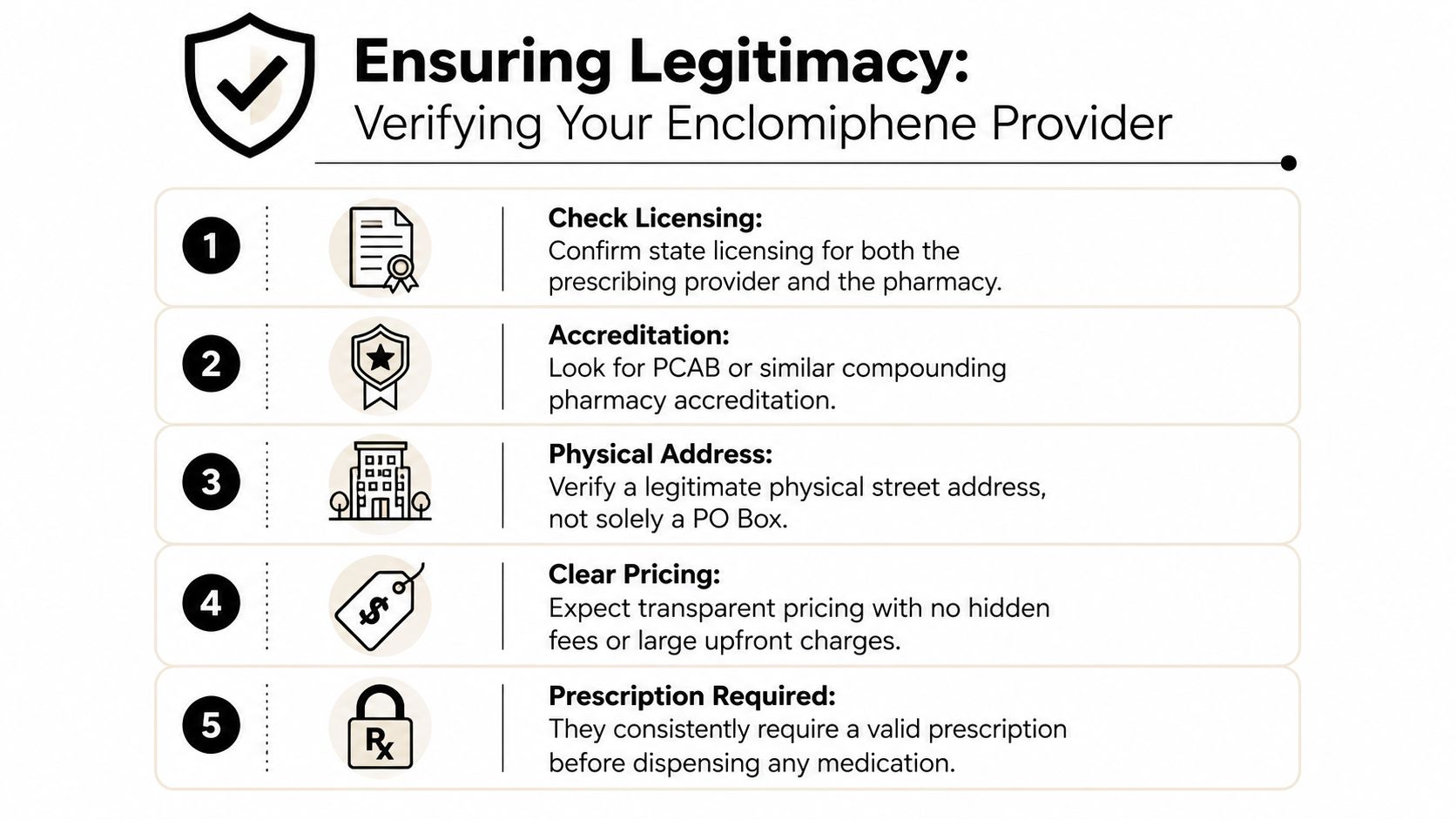
Ask who the prescriber is and where they're licensed. For telemedicine, the clinician should be licensed in your state if they're treating you there. For pharmacies, verify the physical business location and state pharmacy board status, not just a glossy website and a contact form.
The reason this matters is simple. Real medical businesses leave a paper trail. If you can't identify the pharmacy, the prescriber, and the dispensing state, you're not evaluating a clinic, you're guessing.
Then check accreditation and prescribing discipline
Look for recognized compounding pharmacy accreditation such as PCAB when available, and confirm that the pharmacy requires a valid prescription before dispensing. That prescription requirement should appear in the workflow, not as a fine-print footnote after checkout. If the site seems eager to move payment before medical review, that's a problem.
Useful filter: if a provider can't explain how it verifies prescriptions, it probably isn't built to protect patients.
Watch the pricing and lab setup
Transparent pricing is a good sign. Hidden fees, vague membership language, or pressure to buy a large supply upfront can indicate a sales-first model rather than a clinical one. For telemedicine, the lab partnership matters too. A legitimate provider should be able to explain whether it uses your existing labs, arranges new testing, or coordinates a reliable lab network.
For a practical intake example, review this telehealth consent process and compare it with any clinic you're considering. The point isn't to use one company's workflow as the standard, it's to see whether the provider you're evaluating is equally clear.
You can also ask three direct questions before paying anything. Who writes the prescription. Which pharmacy fills it. What happens if the medication or lab work doesn't match the original plan. A legitimate provider answers those questions without hesitation.
The Research Chemical Market and Why It Carries Real Risk
A low-priced enclomiphene listing can look appealing because it seems straightforward. No consultation, no prescription discussion, no medical gatekeeping. The trade-off is clear, the simplicity comes from giving up the safeguards that make pharmacy dispensing and clinician oversight worth paying for.
What the low price really buys
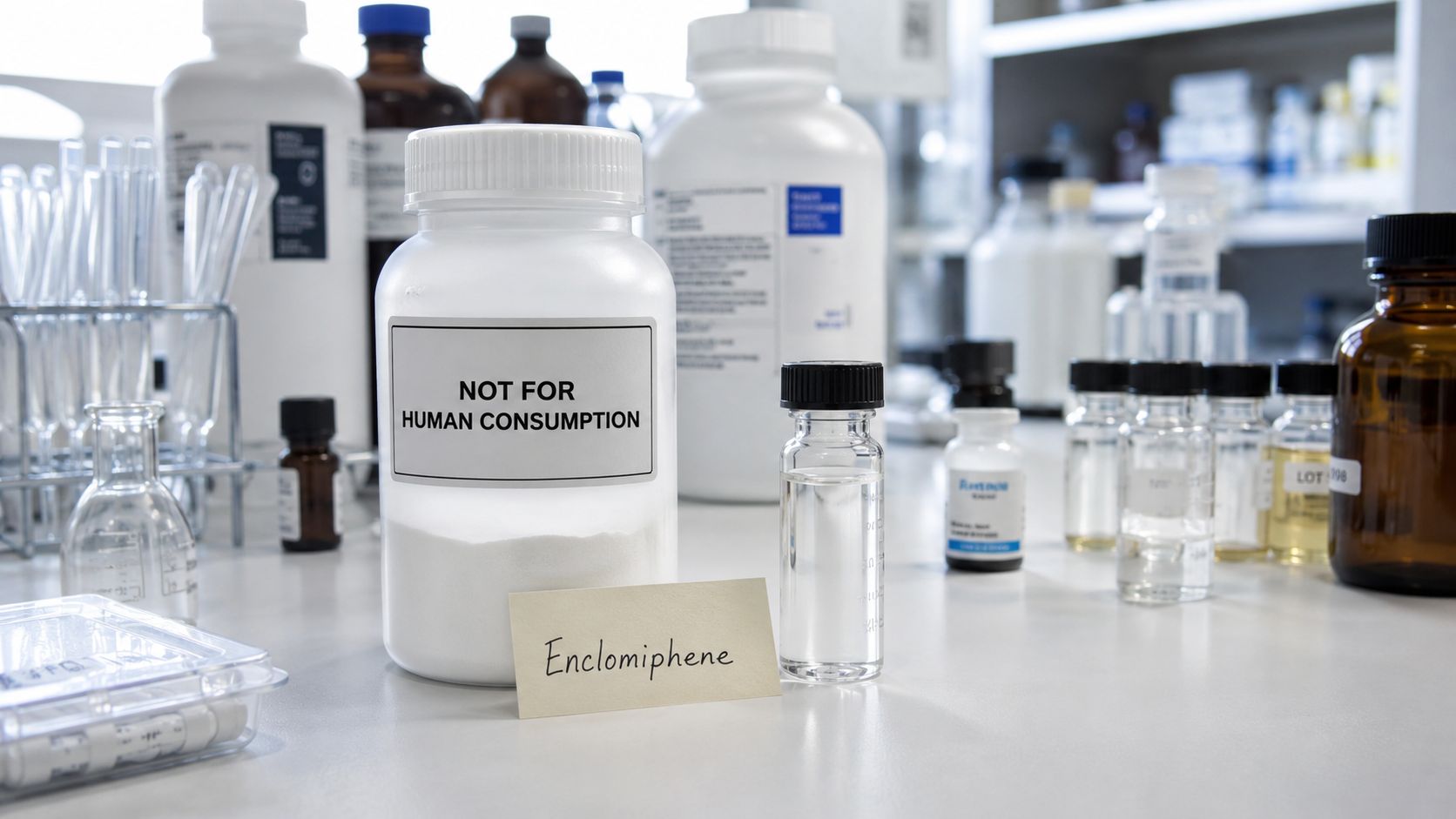
A research chemical listing is not the same as a prescribed medication. A seller may label a product for research use, but that label does not create the same quality-control environment you would expect from a legitimate pharmacy product. The lower price usually reflects the fact that the seller is not carrying the same medical, regulatory, and dispensing burden.
That is why a very low tracked price should be read as a market signal rather than a treatment option. It tells you the gray market exists. It does not tell you that the product is suitable for self-treatment. For a broader look at how legitimate treatment costs are usually structured, see this breakdown of TRT pricing.
Why the risk is not just theoretical
Guidance around enclomiphene repeatedly warns that sites offering it without a prescription may be counterfeit or unsafe, and public discussion often shows confusion about whether a source is domestic, cross-border, specialty, or research-only. The common thread is uncertainty. If the seller will not operate like a pharmacy, there is little reason to assume pharmacy-level testing, storage, or accountability.
The practical risk is straightforward. You may receive something mislabeled, underdosed, contaminated, or not what the listing claims. You also lose the ability to tie the medication to a prescriber who can review labs, side effects, and treatment response.
The legal and health trade-off
People sometimes justify the research route by pointing to speed or convenience. That trade-off is weaker than it looks, because the money saved can disappear the moment the product is unusable or the treatment plan becomes guesswork. If the goal is hormone therapy, fertility preservation, or a monitored men's health protocol, the research channel is the wrong place to optimize.
Expected Costs and What Drives the Price Spread
The price spread for enclomiphene makes more sense once you separate the medication from the services wrapped around it. Some providers bundle consultation, labs, and follow-up into one figure. Others quote the compound first, then add the rest later. Two offers can look similar at a glance and still leave you with very different total costs.
What usually sits inside the bill
The main cost drivers are consultation, lab work, the medication itself, shipping, and ongoing monitoring. A telemedicine clinic often folds those pieces into one price, so the plan can look higher before you compare it with a pharmacy-only fill. A patient who already has a prescription may pay only the pharmacy and shipping charges.
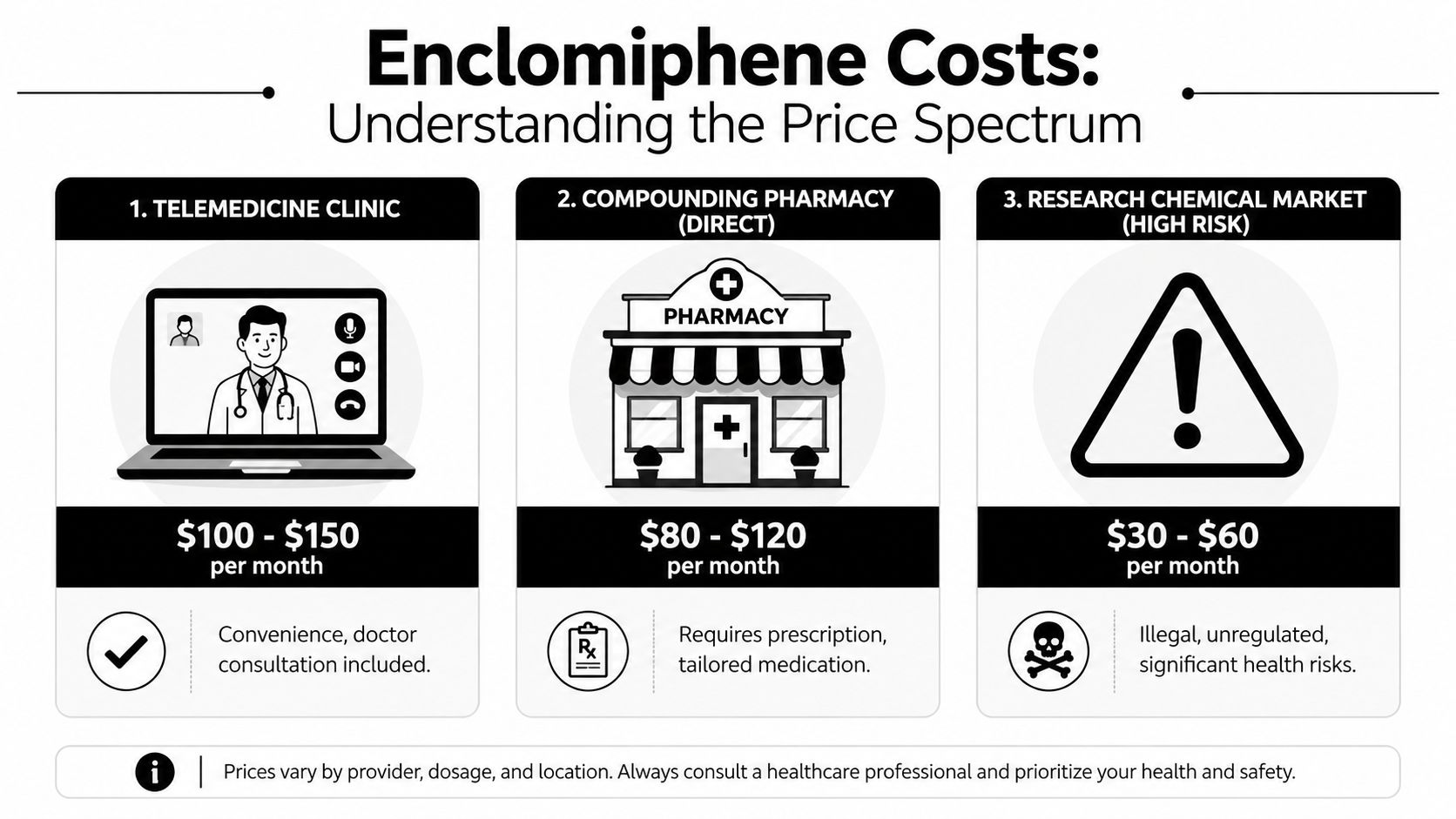
Out-of-pocket enclomiphene commonly runs about $50–$150 per month, while bundled online plans have been described as starting at $99 per month for a 10-month program plus a $94 initial lab kit. That range is wide because the service design is wide, and because some providers are selling access to care, not just capsules. For a broader frame on how men's health pricing is often assembled, see this TRT cost breakdown.
Budgeting rule: compare the full treatment path, not the first checkout screen.
Why cheap and expensive can both be legitimate
A lower monthly cost is not automatically better, and a higher one is not automatically inflated. A direct pharmacy fill can be relatively lean if the prescriber and labs are already in place. A telemedicine package can cost more because it includes evaluation, monitoring, and the practical work that would otherwise be split across separate appointments.
Transparency matters more than the headline number. If a provider separates lab fees, consultation fees, and refill costs, you can budget with some confidence. If it does not, hidden charges usually show up after you have already committed.
The market also stays fragmented, which is why a comparison chart can help anchor your expectations. The monthly cost comparison for enclomiphene across telemedicine, compounding pharmacies, and the research market makes the trade-off plain, the cheapest route is usually the least accountable, while the most structured route tends to carry more service overhead.
A clean way to judge value is to ask what you are paying for. Medication-only pricing, monitored telemedicine care, and pharmacy compounding are different purchases, even if they all start with the same active ingredient.
Enclomiphene in the Context of Fertility-Preserving Treatment Options
Most men looking for enclomiphene aren't shopping for a molecule in isolation. They're trying to address low testosterone or symptoms that feel like low testosterone while keeping fertility in mind. That's where enclomiphene earns attention, because it sits in a different lane from traditional testosterone replacement therapy, which can suppress the body's own production.
Where it fits and where it doesn't
Enclomiphene is often discussed as a fertility-preserving option because it works through signaling pathways rather than replacing testosterone directly. That makes it attractive for men who want symptom relief without immediately stepping into a fertility-hostile regimen. If fertility is not a concern, some providers may still consider it, but the decision should be based on labs, symptoms, and treatment goals, not on marketing language.
The better conversation with a clinician is not “Can I get enclomiphene?” It's “Does enclomiphene fit my hormone pattern, my fertility goals, and my tolerance for ongoing monitoring?” That question usually leads to a much cleaner treatment decision.
Other options may make more sense in some cases
Some men need a different fertility-preserving approach, such as hCG-based protocols or gonadorelin-based strategies, depending on the clinical picture and the prescriber's experience. Others may be better served by a full testosterone plan and a separate fertility discussion later. The right choice depends on what the labs show, what symptoms are driving the visit, and whether preserving sperm production is a priority.
If you want the downside of TRT explained in direct terms, this overview of fertility impact is worth reading before you commit to any hormone plan.
The clearest takeaway is simple. Where to buy enclomiphene matters, but it matters less than buying it through the right clinical pathway for your goals. If you're comparing treatment options, use the sourcing question as the start of the conversation, not the end of it.
If you want a clinician-guided option that treats men's health seriously, Cost Plus TRT offers transparent telemedicine care with clear pricing, physician oversight, and home delivery. Visit Cost Plus TRT to compare how a legitimate online treatment pathway works when you want clarity on cost, labs, and prescription fulfillment.