

Telemedicine in healthcare means getting clinical care at a distance through technology, including video visits, phone calls, secure messaging, and remote monitoring, not just webcam appointments. It's now mainstream care: in a 2022 WHO European Region survey, 77% of responding countries offered telemedicine or remote patient monitoring, and by 2025 78% of Member States in the region directly addressed telehealth in national policies or strategies (WHO regional findings).
You're probably here because you've had one of those ordinary healthcare moments that suddenly becomes inconvenient. You need a follow-up. Maybe a refill review. Maybe you want to ask about low testosterone symptoms, erectile dysfunction treatment, lab results, or whether a side effect is worth worrying about. The problem isn't always the medical issue. It's the logistics around it.
Taking time off work for a routine check-in can feel like using a moving truck to carry a backpack. That mismatch is where telemedicine makes sense. For the right problems, it lets a clinician do the parts of care that depend on conversation, history, decision-making, review of data, and follow-up, without requiring the patient to sit in a waiting room.
Telemedicine is best understood as a care-delivery method, not a specialty. It changes where and how care happens. It doesn't automatically change what good care requires.
That distinction matters. Some health concerns fit beautifully into remote care. Others still need hands-on exams, imaging, procedures, or urgent in-person evaluation. The confusion starts when people use one word to describe all of it.
Table of Contents
- Introduction to Telemedicine in Modern Healthcare
- What Telemedicine Means and How It Differs From Telehealth
- How Telemedicine Evolved Into Mainstream Care
- How Telemedicine Works and the Technology Behind It
- Where Telemedicine Is Used and What It Does Best
- Privacy Security and Payment Rules You Should Know
- How to Choose a Telemedicine Provider and Get Started
Introduction to Telemedicine in Modern Healthcare
A patient books a lunch-break appointment from his office because he needs to go over recent labs. He doesn't have chest pain, severe shortness of breath, or a new injury. He needs clinical judgment, not a parking pass. In that setting, telemedicine is often the right tool.
What is telemedicine in healthcare? It's the delivery of medical care when the patient and clinician are in different places, using communication technology to assess symptoms, review information, make treatment decisions, monitor progress, and arrange follow-up.
Why it matters now
People sometimes still think of telemedicine as a pandemic workaround. That view is outdated. Health systems now treat it as part of routine care infrastructure, and patients use it for common, low-to-moderate complexity needs.
In practical terms, telemedicine helps with problems that are heavy on information and lighter on physical procedures. Medication management is a good example. So are review visits for chronic conditions, many mental health encounters, some primary care follow-ups, and parts of men's health care such as TRT follow-up conversations, prescription review, and ED treatment discussions.
Where readers usually get stuck
Most confusion comes from three places:
- What counts as telemedicine: Many people assume it only means video.
- What it can safely handle: Some expect too much from it. Others dismiss it too quickly.
- What rules apply: Coverage, privacy, licensing, and prescribing rules aren't identical everywhere.
Think of telemedicine less like a single visit type and more like a set of workflows. Sometimes it's live. Sometimes it's delayed. Sometimes it's continuous. Once you see those three patterns clearly, the whole topic gets easier to understand.
What Telemedicine Means and How It Differs From Telehealth
The terms get mixed together constantly, and that's not just a public misunderstanding. The OECD notes that telemedicine is an umbrella term with varying definitions, while the CDC distinguishes telehealth from telemedicine and highlights different regulatory gaps around privacy, licensing, reimbursement, and liability (OECD report on telemedicine definitions and policy variation).
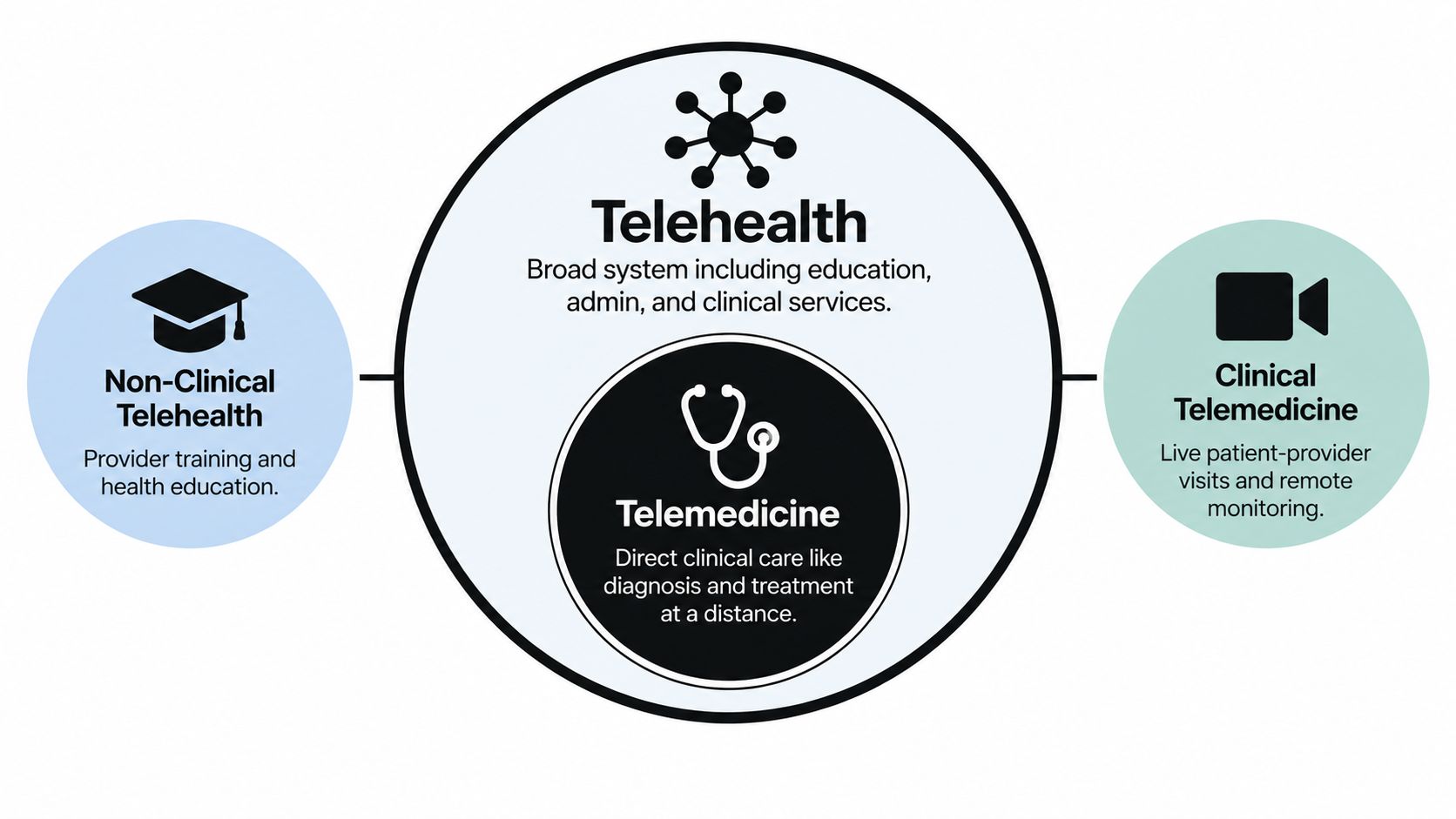
The simplest way to separate them
A useful analogy is this:
- Telehealth is the whole vehicle.
- Telemedicine is the clinical engine inside it.
Telehealth can include non-clinical activities such as provider education, administrative coordination, digital patient education, and system communication. Telemedicine refers more specifically to direct clinical services delivered at a distance.
If a doctor evaluates your symptoms, reviews your labs, adjusts your medication, or creates a treatment plan remotely, that's telemedicine. If a health system uses digital tools for scheduling, training, or public education, that may be telehealth without being telemedicine.
Telemedicine is not just a video call
Many patients get tripped up. A live video visit is only one format. Telemedicine can also include:
- Secure messaging: You send symptoms, questions, or updates through a portal.
- Store-and-forward review: You upload forms, photos, or lab results for a clinician to review later.
- E-consults: One clinician asks another clinician for specialist input without the patient being present in real time.
- Remote monitoring: Devices collect health data outside the clinic.
That matters because patients often ask practical questions that sound simple but aren't. Does a phone call count? Is messaging enough for follow-up? Does insurance treat remote monitoring the same way as video? The answer depends on the service, the setting, and local rules.
Mental model: Telehealth is the broad digital health ecosystem. Telemedicine is remote clinical care. If diagnosis, treatment, prescribing, or monitoring is happening, you're usually in telemedicine territory.
Consent is part of that clinical territory too. If you want a concrete example of how practices explain remote-care permissions and expectations, a telehealth consent form shows the kinds of issues patients are typically asked to acknowledge before care starts.
How Telemedicine Evolved Into Mainstream Care
A patient finishes work at 6 p.m., uploads recent lab results, answers a symptom questionnaire about TRT side effects, and gets a treatment update the next morning. Another patient has a same-day video visit for new ED symptoms. A third uses a home device that sends blood pressure readings to a clinic over time. Those three moments show how telemedicine stopped being a side service and became part of ordinary care.
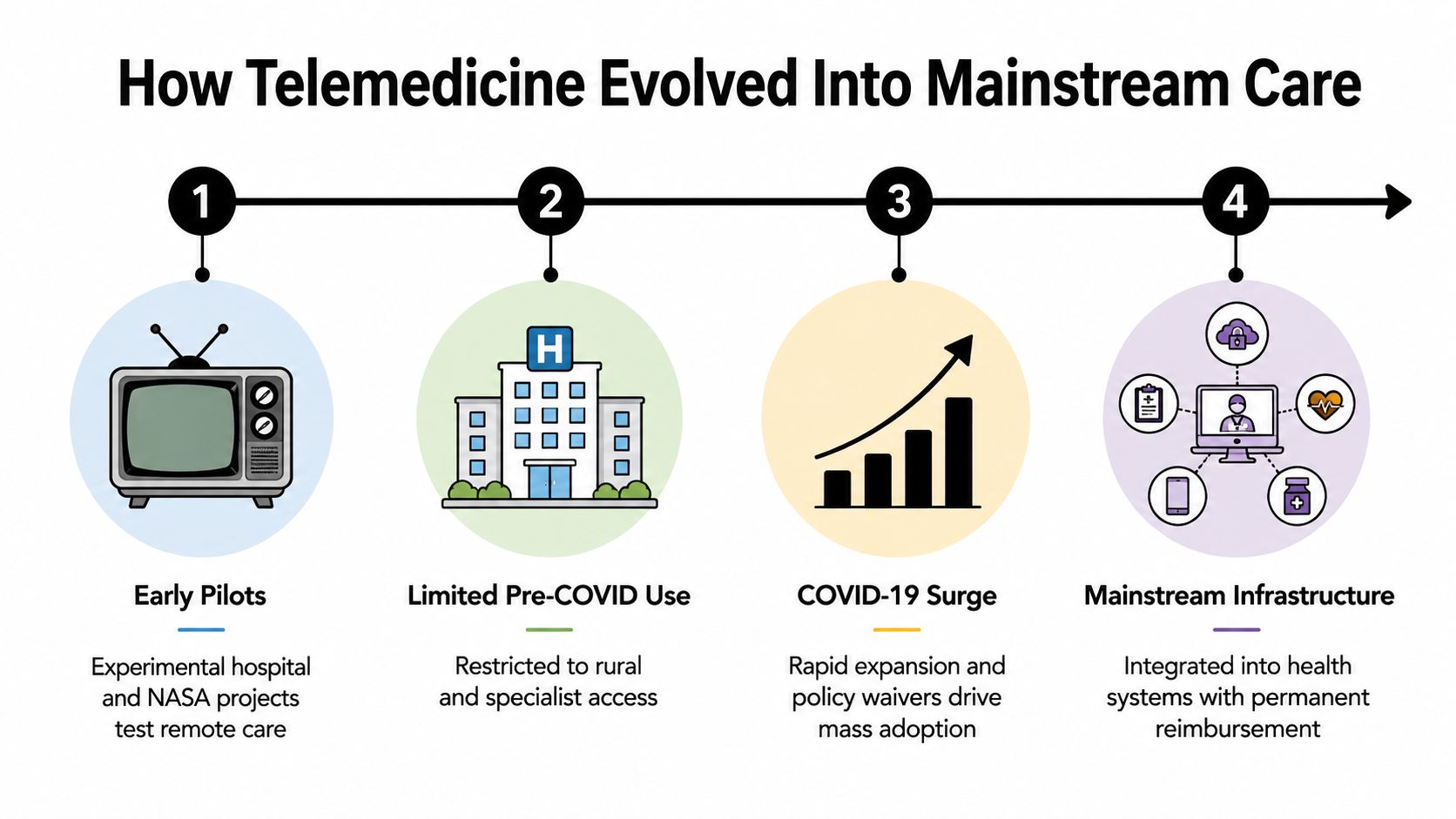
From pilot projects to formal services
Before it became routine, telemedicine often lived in narrow use cases. Rural follow-up. Specialist outreach. After-hours questions. It worked more like an extra lane added to a crowded road than a road the whole system was built to use.
The shift into mainstream care happened when health systems started treating remote care as an actual service line, with policies, payment rules, and clinical processes behind it. In a 2022 WHO European Region survey, 77% of responding countries (37 of 48) offered telemedicine or remote patient monitoring. Within that group, 35% (17 countries) had established services and 42% (20 countries) were still in pilot or informal phases. By 2025, 78% of Member States in the European Region directly addressed telehealth in national policies or strategies, as noted earlier.
That kind of change matters because clinical care only scales when the plumbing exists. A video platform alone is not a care model. Clinics also need scheduling rules, documentation standards, consent processes, prescribing workflows, and a way to get paid.
The post-2019 acceleration
Use expanded quickly after 2019. A 2025 JMIR article estimated that about 116 million people had access to digital doctor consultations worldwide in 2024, compared with about 57 million in 2019 (JMIR analysis of global digital doctor consultation access).
The practical change was bigger than "more video visits." The health system started using three remote workflows more deliberately. Real-time visits helped with conversations that depend on back-and-forth history taking, such as ED treatment discussions or medication follow-up for TRT. Asynchronous care made room for forms, lab review, refill questions, and clinician review that did not require both people online at once. Remote monitoring fit problems that need trends rather than a single snapshot, such as blood pressure tracking or follow-up data collected between visits.
That is one reason telemedicine now feels more normal. It matches different clinical jobs to different tools, instead of forcing everything into a live call.
Why availability still feels uneven
Mainstream does not mean identical everywhere.
Patients still run into uneven availability because adoption happened at different speeds across states, health systems, and specialties. A men's health clinic focused on TRT follow-up may build strong asynchronous lab-review workflows. A primary care office may use mostly synchronous visits. Another practice may avoid remote monitoring because it lacks staffing to review incoming data consistently.
Measurement is part of the problem too. WHO's 2025 regional report noted that only 47% of Member States were systematically collecting telemedicine-usage data, as noted earlier. In plain English, many systems built the service before they built a clean way to count how often, where, and how well it was being used.
So the patient experience can feel inconsistent even when telemedicine is firmly inside mainstream care. The model is established. The execution still varies.
How Telemedicine Works and the Technology Behind It
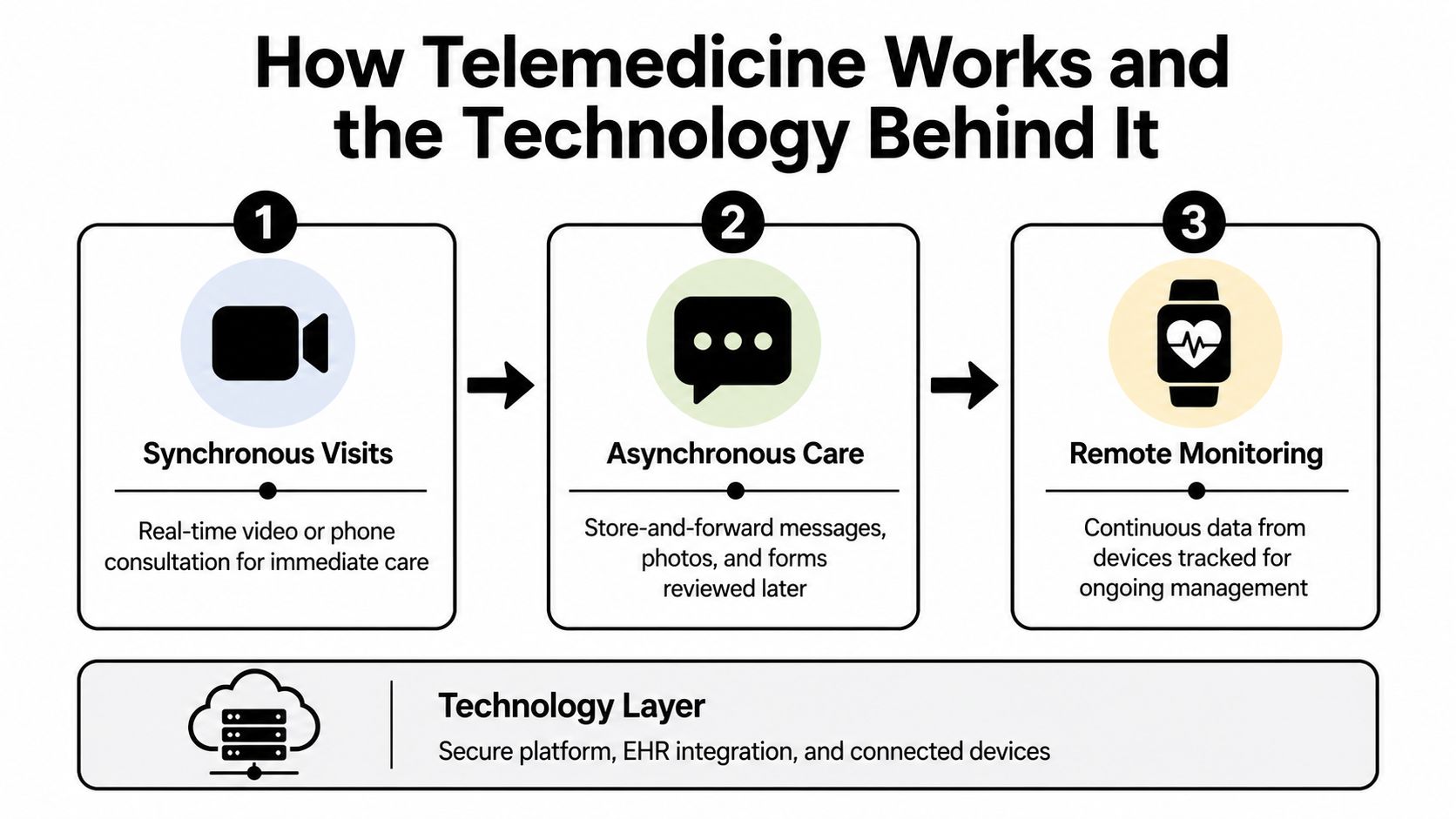
If telemedicine seems vague, it's usually because people lump very different workflows into one bucket. In practice, there are three distinct ways remote clinical care happens. Once you separate them, telemedicine becomes much easier to evaluate.
Synchronous care
This is the format many already know. Synchronous telemedicine means the patient and clinician interact in real time, usually by video or phone.
A typical example is a follow-up visit for TRT symptoms, medication questions, or review of side effects. The clinician asks targeted questions, looks at prior notes and labs, checks for red flags, and decides whether the current plan still makes sense. For ED care, a synchronous visit can work well when the main task is history-taking, risk review, medication selection, and counseling.
This is the closest remote equivalent to a standard office conversation.
Asynchronous care
Asynchronous telemedicine happens when information is sent, then reviewed later. No one has to be online at the same moment.
Examples include intake questionnaires, symptom updates through a portal, lab uploads, photo review, refill requests, or clinician-to-clinician e-consults. In men's health, this can be useful when a patient uploads recent testosterone labs, completes a symptom history, and asks whether a scheduled follow-up needs to happen now or later. It can also support ED medication renewals when the clinical picture is stable and the practice has a safe protocol.
Asynchronous care is less like a phone call and more like a structured clinical inbox.
Remote patient monitoring
Remote patient monitoring is the most continuous of the three. Data from devices is collected outside the clinic and reviewed as part of ongoing care.
That might involve blood pressure readings, glucose data, weight trends, symptom tracking, or other device-generated information. In a men's health setting, a clinician might not use a wearable for every TRT or ED case, but remote monitoring principles still matter whenever care relies on repeated data points collected away from the office.
Here's a short explainer before the workflow gets more concrete.
What a telemedicine visit actually involves
The technology matters, but the workflow matters more. Good telemedicine usually follows a pattern like this:
Intake and consent
The patient completes forms, symptoms, medication history, and consent documents.Triage
The practice decides whether the problem fits remote care or needs in-person evaluation.Clinical encounter
The clinician reviews history, asks focused questions, and may observe visible signs on video when relevant.Decision and documentation
The clinician documents the visit, makes a plan, and orders tests, medications, or follow-up if appropriate.Escalation when needed
If the issue exceeds what remote care can safely handle, the patient is directed to urgent or in-person care.
Practical rule: Good telemedicine doesn't try to replace every office visit. It uses structured triage to decide which problems belong online and which ones don't.
The technology layer underneath all this usually includes a secure platform, clinical documentation system, scheduling tools, messaging, and in some cases device integration. But from the patient's perspective, the question is simpler: can the system collect the right information, support a safe decision, and create a clear next step?
Where Telemedicine Is Used and What It Does Best
Telemedicine works best when the main clinical value comes from talking, reviewing, deciding, and following up, rather than from physically examining, imaging, or performing a procedure.
That's why it's often a strong fit for primary care questions, chronic disease check-ins, mental health care, medication management, and many men's health follow-ups. It's less useful when the clinician needs to palpate an abdomen, listen to lungs in a high-risk situation, drain an abscess, repair a laceration, or evaluate a possible emergency.
What the evidence suggests
A systematic review found telemedicine reduced all-cause hospitalizations by 18 per 1,000 patients and condition-related hospitalizations by 37 per 1,000 patients. The same review also reported mean reductions of 50 fewer all-cause hospitalizations per 1,000 patients and 110 fewer condition-related hospitalizations per 1,000 patients, along with shorter hospital stays and lower hospitalization risk (systematic review on telemedicine and hospitalization outcomes).
That kind of effect makes sense clinically. When teams can follow patients earlier and more consistently, they can catch worsening issues before they become hospital-level problems.
A separate systematic review across clinical settings found outcomes comparable to in-person care for many primary care and mental health use cases, especially for low-to-moderate complexity encounters and chronic disease management when paired with structured triage and escalation pathways. It also noted that digital access barriers can widen inequities when device access, connectivity, or digital literacy are weak (systematic review on telemedicine fit, outcomes, and equity limits).
Men's health examples that fit well
For readers thinking specifically about TRT or ED care, here's the practical mapping:
- TRT follow-up visits: Often a good telemedicine fit when the visit is about symptoms, lab review, dosing discussion, refill planning, and side-effect monitoring.
- ED care evaluation: Often suitable when the key work is history-taking, medication review, risk screening, and treatment discussion.
- Lab interpretation: Frequently well-suited to remote care because the important task is clinical interpretation and plan adjustment.
- Ongoing medication support: Good fit when the patient is stable and the clinician has a reliable process for follow-up and escalation.
Cases become less appropriate for telemedicine when symptoms suggest something urgent, when the diagnosis is uncertain in a way that requires a hands-on exam, or when a procedure is needed.
When Telemedicine Fits Best vs When to Choose In-Person Care
| Care Scenario | Best Fit | Why |
|---|---|---|
| Routine medication follow-up | Telemedicine | The key work is history, review, and treatment planning |
| Stable TRT check-in with lab review | Telemedicine | Labs and symptoms often drive decisions more than physical exam |
| ED medication discussion | Telemedicine | Care often depends on medical history, risk review, and counseling |
| Anxiety or depression follow-up | Telemedicine | Many encounters are conversation-based |
| New severe chest pain | In-person care | This may require urgent testing and immediate physical assessment |
| Sudden one-sided weakness or trouble speaking | In-person care | Possible emergency that needs rapid hands-on evaluation |
| New testicular pain or swelling | In-person care | Physical exam may be critical |
| Procedure or injection training complication | In-person care | Safety may require direct observation or intervention |
Telemedicine is strongest when the bottleneck is access to clinical thinking, not access to a procedure room.
Its weakness is equally important. A patient without reliable internet, a private space, a device, or comfort with digital tools may not experience telemedicine as convenient at all. In those cases, a technically available service can still be practically inaccessible.
Privacy Security and Payment Rules You Should Know
The medical part of telemedicine is usually easier to understand than the rules around it. Patients often assume that if a service exists online, any clinician can provide it anywhere and insurance will sort out the rest. That's not how it works.
Privacy and platform security
Telemedicine still involves protected health information. The platform should be built for healthcare use, not casual consumer chat. Patients should expect consent forms, identity verification, secure messaging, and clear documentation practices.
If you want to understand the privacy side in plain terms, a HIPAA privacy overview can help clarify what medical practices generally need to protect and how patient information is handled.
Why state lines matter
Licensing is one of the biggest practical constraints. In many settings, clinicians must be licensed where the patient is located during the visit, not just where the clinician works. That's why a doctor who treated you while you were at home may not be able to see you if you're traveling in another state.
Liability rules and prescribing rules also vary. So do payer rules. A service that qualifies as covered telemedicine under one plan may be treated differently by another plan, especially if the visit type changes from live video to messaging or remote monitoring.
Payment is routine, but not uniform
Telemedicine is established enough to be a normal access channel, but use still shifts. FAIR Health reported that the share of patients with a telehealth claim fell nationally from 14.9% in January 2025 to 14.5% in February 2025, with further regional declines in March (FAIR Health telehealth trends from January through March 2025).
That's a useful reality check. Telemedicine isn't rising in a straight line. Utilization responds to payer rules, specialty patterns, geography, and local habits. A service can remain routine while monthly use fluctuates.
Questions to ask before you book
- Is the clinician licensed where I'll be during the visit? This avoids last-minute cancellations.
- What type of visit is this? Video, phone, messaging, and monitoring may follow different rules.
- How are labs, prescriptions, and follow-up handled? Smooth systems separate from confusing ones.
- What happens if my issue needs an exam? The answer should be clear before the visit starts.
- What will I pay if insurance doesn't cover it? Ask for specifics, not assumptions.
If a telemedicine provider can't explain privacy, licensure, prescribing, and follow-up in plain language, that's a warning sign.
How to Choose a Telemedicine Provider and Get Started
Choosing a telemedicine provider is less about glossy branding and more about workflow reliability. You're not just choosing a website. You're choosing a clinical process.
A provider checklist that actually helps
Look for these features:
- Licensure clarity: The practice should clearly state where its clinicians can legally treat patients.
- Scope of care: Make sure the service handles your actual need, whether that's TRT management, ED care, lab review, or ongoing medication follow-up.
- Lab process: Good providers explain whether you'll use local labs, upload outside results, or both.
- Prescription workflow: Ask how prescriptions are approved, filled, and delivered.
- Follow-up structure: Stable treatment still needs review points and a path for questions between visits.
- Escalation plan: The provider should tell you when they'd send you for in-person care.
- Technology simplicity: If the platform is hard to use, the clinical experience usually suffers too.
- Pricing transparency: You should understand the cost before committing.
A practical example for men's health
In men's health, the most efficient telemedicine models usually combine online intake, lab coordination, virtual clinician review, and home medication delivery. One example is getting started with Cost Plus TRT, where patients can handle labs by uploading recent results or arranging them through Quest Diagnostics, then meet with a licensed physician online if the service is available in their state.
That kind of setup can work well for adults seeking structured TRT follow-up or ED medication management, as long as the provider also has clear rules about when remote care isn't enough.
Before your first visit
Have these ready:
- Your medication list
- Recent labs if you have them
- A brief symptom timeline
- Your pharmacy details
- A private place for the visit
- Questions you don't want to forget
If your symptoms suggest an emergency, skip telemedicine and get urgent in-person care. Remote care is a strong tool, but it isn't the right first stop for every problem.
If you're looking at telemedicine specifically for TRT or related men's health care, Cost Plus TRT offers online physician visits, lab coordination options, and prescription fulfillment built around remote care workflows. If that model fits what you need, visit Cost Plus TRT to see how their process works and whether service is available in your state.