

You may be doing a lot right already. You train, you try to eat well, you sleep when work and family allow it, and you may even be on testosterone therapy. But you still feel a step behind. Recovery drags. Libido is inconsistent. Energy looks fine on paper but doesn't feel reliable in real life.
That's usually when men start asking what is peptide therapy, and whether it's a real medical option or just another online trend dressed up as science. The honest answer is that peptide therapy can be useful, but only when you match the right peptide to the right problem and stop treating the category like magic. In men's health, peptides are better understood as targeted signaling tools inside a broader plan that may also include TRT, sleep work, body composition changes, and treatment for erectile dysfunction.
Table of Contents
- Is Peptide Therapy the Missing Piece of Your Health Puzzle?
- How Peptides Give Your Body Specific Instructions
- A Look at Common Peptides for Men
- Understanding the Evidence and Safety of Peptides
- How Peptide Therapy is Administered and Monitored
- Setting Realistic Expectations for Your Results
- Frequently Asked Questions About Peptide Therapy
Is Peptide Therapy the Missing Piece of Your Health Puzzle?
A lot of men come in with the same frustration. They're functioning, but not performing the way they used to. They're not looking for a miracle. They want to know why their body isn't responding the same way to training, stress, sleep, or sex.

That's where peptide therapy enters the conversation. It is the use of short chains of amino acids to send specific biological signals. Instead of trying to overwhelm the body, peptides aim to nudge a defined pathway. In practice, that can matter for men who are dealing with poor recovery, sexual symptoms, body composition issues, or a mismatch between how healthy they look and how they feel.
Why this isn't fringe medicine
Peptide therapy is often talked about as if it appeared out of nowhere. It didn't. Peptide drugs are part of mainstream medicine. A review in PubMed Central notes that 33 non-insulin peptide drugs had been approved worldwide since 2000, and the same review highlights major GLP-1 drugs with large retail sales, including Trulicity ($4.39 billion), Victoza ($3.29 billion), and Rybelsus ($1.68 billion), which shows how established peptide-based therapeutics have become in clinical care (PubMed Central review of approved peptide drugs and GLP-1 sales).
That doesn't mean every peptide being marketed to men is proven. It means the field itself is legitimate. The mistake is assuming that because some peptide drugs are foundational in medicine, every peptide sold online deserves the same trust.
Clinical reality: “Peptide therapy” is not one treatment. It's a category. The right question isn't “Do peptides work?” It's “Which peptide, for which goal, with what evidence, and under whose supervision?”
Where peptides fit in men's health
In a men's health setting, peptides usually make the most sense when the goal is specific. Not “anti-aging.” Not “optimization.” Specific.
That might mean:
- Recovery support: when training tolerance or sleep-related recovery feels poor
- Sexual function targeting: when libido or arousal issues don't map neatly to testosterone alone
- Adjunct care: when TRT has fixed one problem but left others untouched
Used that way, peptides can be valuable. Used as a catch-all solution, they usually disappoint.
How Peptides Give Your Body Specific Instructions
A man starts TRT, his testosterone improves, and some symptoms get better. Energy is up. Body composition may improve. But libido still feels inconsistent, recovery is still poor, or a specific issue remains unchanged. That is usually the point where peptides come into the conversation. Not as a replacement for TRT, and not as a cure-all, but as a more targeted way to work on a pathway testosterone does not fully address.
Peptides are short chains of amino acids that act as signaling molecules. Their main job is communication. They help the body regulate processes like hormone release, appetite, tissue repair, inflammation, and sexual response by binding to receptors and triggering a defined effect.
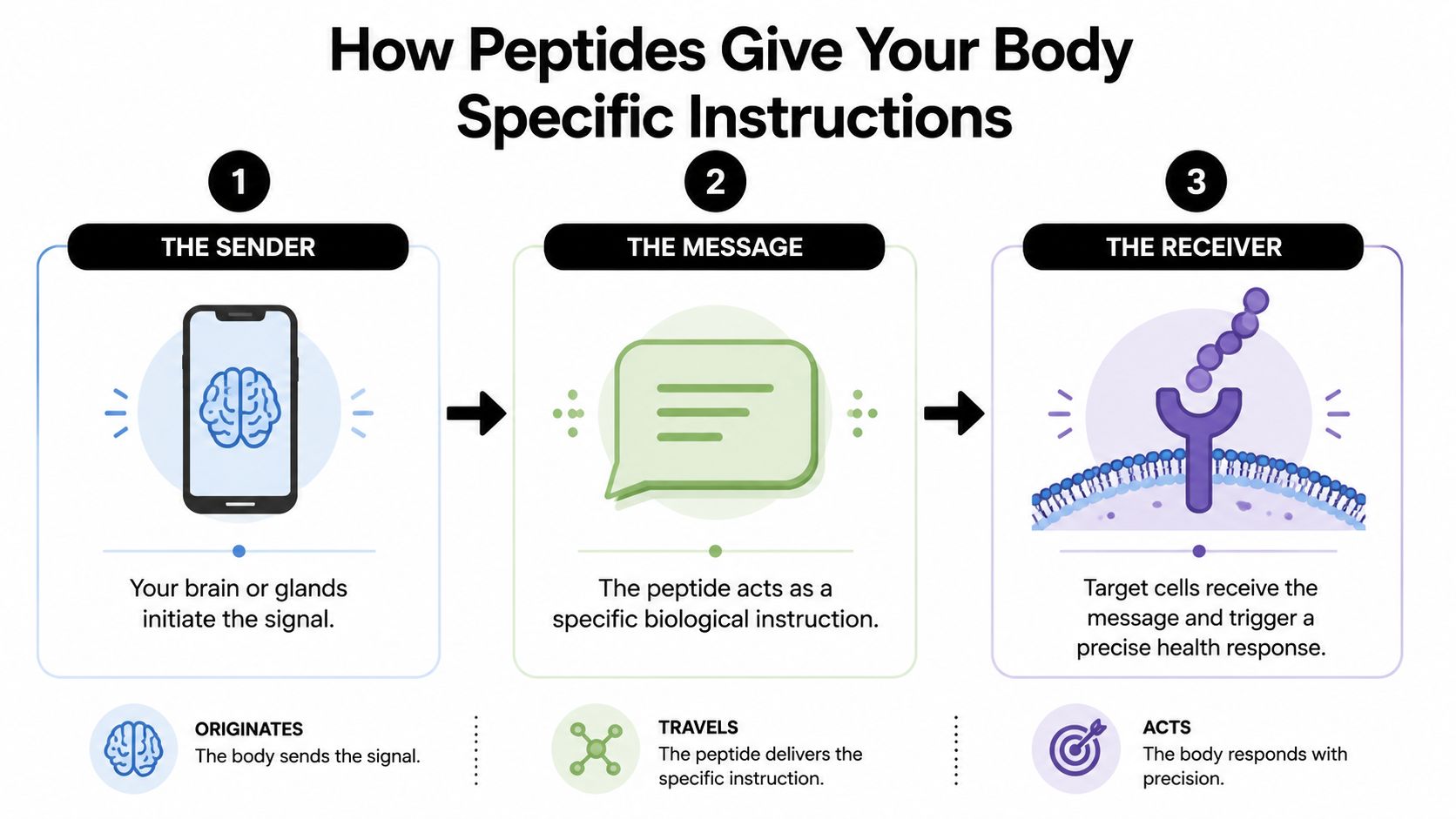
How targeted signaling works
In practice, peptides are usually narrower in scope than testosterone. TRT changes a broad hormonal environment across multiple tissues. A peptide often aims at one receptor family or one signaling route. The better comparison is a routed instruction sent to a specific office, not a building-wide announcement.
A useful way to picture the process:
- A gland or signaling center releases a signal
- The peptide carries that signal to a receptor
- The receptor activates a specific biologic response
That targeted action is why peptides can be useful in men's health. If the goal is specific, the treatment can be specific too. If the goal is vague, results are usually vague as well.
A short visual helps make that easier to picture:
How this differs from TRT
Men often get misled by marketing in this regard.
TRT replaces testosterone when lab values and symptoms support treatment. Many peptides do not replace anything. They stimulate or modulate a pathway. That difference affects what they can realistically do.
If a man has true hypogonadism, peptide therapy is not a substitute for testosterone replacement. If testosterone is already in range and a narrower problem remains, such as arousal, recovery, or growth hormone signaling, a peptide may be worth discussing as an adjunct.
A peptide only makes sense when the symptom, the receptor target, and the treatment goal match.
That is also why medical peptide treatment options should be evaluated in the context of the full plan, including labs, symptoms, current TRT status, and what has already been addressed successfully.
Why route and formulation matter
Peptides are delicate molecules. Many break down quickly in the digestive tract or bloodstream, which is why the delivery method can determine whether the drug reaches its target in a usable form.
For patients, that has a practical consequence. The route is not a minor detail. It affects absorption, consistency, convenience, and how likely someone is to follow the protocol correctly. A peptide that looks promising on paper can underperform if the formulation or administration method does not fit how that compound behaves in the body.
A Look at Common Peptides for Men
Once you move past the buzzwords, peptide therapy becomes much easier to understand. Each compound should be judged by its intended function, how it's given, and what goal it's supposed to address. In men's health, the conversation usually centers on a small handful of options rather than a giant catalog.
Three examples men ask about most
Sermorelin is commonly discussed in clinics that focus on recovery, sleep quality, and body composition. It's generally positioned as a way to stimulate the body's own signaling related to growth hormone release rather than replacing growth hormone directly. That distinction matters for men who want a more physiologic approach and for men who assume it will behave like testosterone. It won't.
If you're comparing clinic protocols, Sermorelin therapy options are typically framed around recovery-oriented goals, not instant body transformation. In practice, this is the kind of treatment where patience and monitoring matter more than hype.
PT-141 is different. Men usually ask about it because they're dealing with libido or erectile issues that don't respond the way they expected from testosterone, PDE5 medications, or lifestyle changes alone. PT-141 is discussed as a targeted sexual health tool rather than a muscle or recovery peptide. That narrower role is exactly why it can be useful in selected patients.
**NAD ** gets grouped into peptide conversations all the time, even though it's often marketed in a way that blurs categories. In men's health settings, it's usually discussed around cellular energy and recovery support. The practical issue is that a lot of men hear “energy” and assume that means a direct fix for low testosterone symptoms, poor sleep, burnout, or depression. It doesn't work that way. If the root problem is hormonal, sleep-related, vascular, or psychological, no amount of category confusion will make a non-equivalent treatment act like the one you need.
Common Peptides for Men's Health at a Glance
| Peptide | Primary Function | Main Goal | Common Administration |
|---|---|---|---|
| Sermorelin | Stimulates signaling tied to the body's own growth hormone release | Recovery, sleep support, body composition support | Injection |
| PT-141 | Targets pathways related to sexual arousal | Libido and erectile support in selected men | Injection or nasal delivery, depending on protocol |
| NAD+ | Supports cellular energy processes | Energy and recovery support | Injection or infusion, depending on protocol |
What this comparison actually tells you
These compounds are not interchangeable. A man who needs help with sexual function shouldn't assume a recovery-focused peptide will solve that problem. A man with documented hypogonadism shouldn't treat a signaling peptide like a substitute for testosterone. And a man chasing “more energy” needs a workup before assuming the answer lives in any injectable.
The best peptide protocol usually looks boring on paper. It matches one treatment to one clear goal.
That's also why blanket promises tend to fail. The more symptoms someone tries to fix with one peptide, the less likely the treatment plan is grounded in real medicine.
Understanding the Evidence and Safety of Peptides
This is the part that matters most. The phrase “peptide therapy” sounds unified, but the evidence is not unified at all. Some peptides are tied to established pharmaceutical use. Others are prescribed off-label with varying levels of support. Others still are mostly discussed in animal research, online forums, or wellness marketing.

Not all peptides belong in the same bucket
A good way to think about safety is to sort peptides into practical categories:
- Established peptide drugs: These are part of conventional medicine and have recognizable clinical use.
- Reasonable off-label candidates: These may have a defensible rationale in selected patients, but they still require judgment and monitoring.
- Research-heavy compounds: These are the ones that often generate excitement online before they've earned much trust in humans.
A physician review published on KevinMD puts it plainly. The clinical evidence for peptide therapy is highly molecule-specific. Some peptides have established utility in metabolic disease and oncology, while others are dominated by animal data with limited human trials. The same review argues that physician supervision is essential to decide whether a given peptide has a defensible rationale and adequate bioavailability for the condition being treated (physician review on molecule-specific peptide evidence).
What usually goes wrong
Most peptide problems don't start with the molecule alone. They start with bad matching, bad sourcing, or bad expectations.
Common failure points include:
- Wrong indication: using a peptide for a symptom it isn't designed to address
- Weak evidence: relying on animal data and influencer language as if it were human clinical proof
- Poor product quality: buying from unregulated sellers with questionable purity
- No monitoring: continuing treatment without assessing response, side effects, or whether the original diagnosis was even correct
If a treatment sounds broad enough to fix everything, it usually hasn't been defined well enough to trust.
Safety depends on the whole system
Safety is not just “Is this molecule dangerous?” It's also: Was the diagnosis sound? Is the compound appropriate? Is the dosing supervised? Is the product coming from a legitimate pharmacy channel? Is the delivery method capable of achieving the intended effect?
Those questions matter more than marketing labels like regenerative, anti-aging, or performance-enhancing. In actual practice, peptide therapy should feel more like medication management than supplement shopping.
How Peptide Therapy is Administered and Monitored
A common scenario in clinic is a man who is already considering TRT, or already doing well on it, but hesitates when peptides enter the conversation because he assumes the process will be complicated. In practice, administration is usually straightforward. The harder part is choosing the right peptide, using the right route, and tracking whether it is doing anything useful.

Why injections are so common
Many peptides are proteins or short amino acid chains that do not tolerate the digestive tract well. If you swallow them, stomach acid and enzymes can break them down before they ever reach the target tissue in a meaningful amount. That is why subcutaneous injection is often the default.
For most men, this means a small insulin-type needle and a brief self-injection into abdominal fat or another approved site. After proper teaching, the mechanics are usually easier than expected. The trade-off is simple. Injections are less convenient than a pill, but they often give more reliable delivery.
This matters even more in men's health, where the goal is usually specific. If a man is on TRT and we add a peptide, we are usually trying to address one narrow problem, not replace the whole plan. Poor delivery can make a reasonable peptide look ineffective.
Other routes and why they exist
Some peptides are used through other routes when the molecule and the goal support it. Common options include:
- Subcutaneous injection: often used when steady, predictable systemic absorption matters
- Nasal delivery: sometimes used when fast mucosal absorption fits the intended effect
- Clinic-based administration or infusion: reserved for selected compounds and selected settings
Route changes outcome. It affects how much drug gets in, how quickly it acts, and how consistent the response will be from week to week.
A good example is sexual health treatment. A peptide used for arousal support may be prescribed differently from one used for recovery or body composition goals. If that is the specific issue being addressed, men often ask about PT-141 for sexual health support, which highlights how peptide choice and delivery are tied to a very specific symptom target.
What monitoring should look like
Monitoring should look like medication management, not guesswork. Before starting, the patient needs a baseline. That includes symptoms, current medications, relevant labs when appropriate, and a clear definition of what success would look like.
From there, follow-up should answer a few practical questions:
- Was the peptide matched to the right problem?
- Is the dose appropriate for the goal and the route?
- Has the patient noticed a meaningful benefit, not just a vague impression?
- Are there side effects, injection issues, or signs the treatment should be stopped?
Men already on TRT need an extra layer of discipline here because it is easy to credit or blame the wrong treatment. If testosterone, sleep, training load, body weight, and a new peptide are all changing at once, it becomes hard to tell what is helping. The cleanest approach is to make one logical adjustment at a time and reassess before piling on another intervention.
That is how peptide therapy fits into a men's health plan responsibly. It should be targeted, supervised, and easy to discontinue if the response is weak or the original rationale does not hold up.
Setting Realistic Expectations for Your Results
A lot of disappointment can be prevented by understanding this. Peptides are not a shortcut around fundamentals, and they are not a replacement for TRT when a man has true hypogonadism.
A common point of confusion in men's health is that peptides and testosterone both get talked about as “optimization” tools. They are not doing the same job. Peptides typically stimulate the body's own signaling pathways rather than replacing a hormone, which is why they're often an add-on rather than a substitute for evidence-based testosterone treatment in men with low testosterone (medical discussion of peptides versus TRT in men's health).
When peptides make sense beside TRT
A man can have well-managed testosterone levels and still have unresolved issues. That's the practical opening for peptides.
Examples include:
- Sexual symptoms that persist: TRT may improve libido for some men, but it doesn't solve every arousal or erectile issue
- Recovery goals: a peptide may be considered when a man wants targeted support around sleep or training recovery
- Specific symptom targeting: when the goal is narrow enough that a signaling-based approach is reasonable
That's where treatments such as PT-141 for sexual health support may come into the conversation. Not as a replacement for correcting low testosterone. As a separate tool for a separate mechanism.
What peptides won't do
They won't erase poor sleep, bad diet, heavy alcohol intake, unmanaged stress, overtraining, relationship problems, or untreated sleep apnea. They also won't turn vague symptoms into a diagnosis.
A realistic peptide plan starts with one question: what exact problem are we trying to solve?
The right mindset
The best results usually come from men who think in terms of targets, not fantasies. Better recovery. Better arousal response. Better alignment between symptoms and treatment. Those are reasonable goals.
“Fix everything” is not.
Frequently Asked Questions About Peptide Therapy
Is peptide therapy legal?
Peptide therapy can be legal when it's prescribed and managed appropriately through a licensed medical process. The problem is that the peptide market also includes products sold in loosely regulated channels. That's where quality, purity, and dosing become much less reliable.
Are peptides safe?
Some are used in mainstream medicine. Some are reasonable only in carefully selected off-label situations. Some are still far more experimental than the marketing suggests. Safety depends on the exact molecule, the diagnosis, the source, and the delivery method.
Can peptides replace TRT?
Usually no, not when a man has actual low testosterone that needs hormone replacement. Peptides and TRT do different things. They can sometimes be used together, but one should not be mistaken for the other.
Do I need injections?
Often, yes. Many peptides are delivered that way because the route helps the treatment survive long enough to have a useful effect. Some compounds may use other delivery methods depending on the protocol.
How do I know if a peptide is worth trying?
Use a simple filter:
- Clear goal: know the symptom or function you're trying to improve
- Reasonable evidence: ask what human support exists for that specific peptide
- Medical oversight: make sure someone is monitoring fit, response, and safety
Can peptide therapy fit into a broader men's health plan?
Yes, in the right patient. The strongest use case is usually as one part of a larger strategy that may also include lab evaluation, TRT when indicated, ED treatment, sleep correction, nutrition, and training changes.
If you're trying to sort out whether peptide therapy belongs in your plan, Cost Plus TRT offers physician-supervised men's health care that includes TRT, ED treatment, and peptide options. The practical next step is simple. Get evaluated, define the actual problem, and choose treatment based on evidence and fit rather than marketing.