

You've finally made the decision to start TRT. Maybe you've been dragging through work, skipping the gym because recovery feels terrible, or wondering why your sex drive and motivation don't feel like they used to. Most men at this point want one simple answer: how long until I feel better?
The honest answer is that TRT doesn't arrive all at once. It tends to unfold in phases. Some changes show up early and feel subjective, like libido, mood, or a better sense of well-being. Others take longer and show up in more objective ways, like body composition, lab trends, and longer-term tissue changes.
That's why the TRT results timeline matters so much. It keeps you from making two common mistakes. The first is expecting a full transformation in a couple of weeks. The second is quitting too early because your six-week experience doesn't yet match your six-month goals. If you're just getting oriented, a basic overview of testosterone replacement therapy treatment options can help put the timeline into context before you judge whether your plan is working.
Table of Contents
- Starting TRT? Here's What to Expect
- The Complete TRT Results Timeline from Week 1 to Year 1
- Why Your TRT Timeline Might Be Different
- Timelines for Injections, Gels, and Pellets
- Monitoring Your Progress with Lab Work
- Potential Side Effects and When to Report Them
- How to Maximize Your TRT Results
Starting TRT? Here's What to Expect
A new TRT patient usually comes in with a mix of relief and impatience. Relief because there's finally a plan. Impatience because he wants to know whether he'll feel different next week, next month, or six months from now.
That mindset is completely normal. Men don't start treatment because they're curious about hormone theory. They start because something feels off. They want their energy back, better workouts, better erections, a more stable mood, and a clearer head. The challenge is that the body doesn't upgrade every system on the same schedule.
The most useful way to think about TRT is as a staged response. Early benefits tend to be the things you feel first. Later benefits tend to be the things you can measure more clearly. That means a man may notice a change in libido or motivation before he sees any meaningful change in the mirror.
Practical rule: Judge TRT in chapters, not in one moment.
That matters because men often compare themselves to internet stories that leave out context. One guy feels a lift quickly. Another feels almost nothing for a while, then starts noticing better recovery, more stable energy, and stronger training sessions later. Neither experience is automatically wrong.
A smarter expectation looks like this:
- Early phase: shifts in interest, mood, and daily drive may appear first
- Middle phase: gym performance, recovery, and body-composition changes begin to become more obvious
- Longer phase: deeper physiologic changes keep developing well past the first few months
If you keep that framework in mind, the timeline feels less confusing. You stop asking, “Why don't I feel everything yet?” and start asking the better question, “What should be happening at this stage?”
The Complete TRT Results Timeline from Week 1 to Year 1
A common real-world scenario goes like this. A man starts TRT, feels a small lift in libido in the first few weeks, then gets frustrated by week six because he does not look different yet. Another man notices almost nothing early, then starts sleeping better, training harder, and feeling more like himself by month three. Both timelines can be normal.
The reason is simple. TRT changes different systems on different schedules, and the average timeline is only a starting point. A review in PubMed Central on the time course of testosterone effects found that sexual interest may improve after about 3 weeks and often levels off by 6 weeks, quality-of-life changes often show up within 3 to 4 weeks, depressive symptoms may improve after 3 to 6 weeks with fuller benefit taking much longer, and changes in fat mass, lean mass, and strength usually emerge over 12 to 16 weeks and continue developing for months.
That pattern matters because men often expect one switch to flip. TRT rarely works that way.
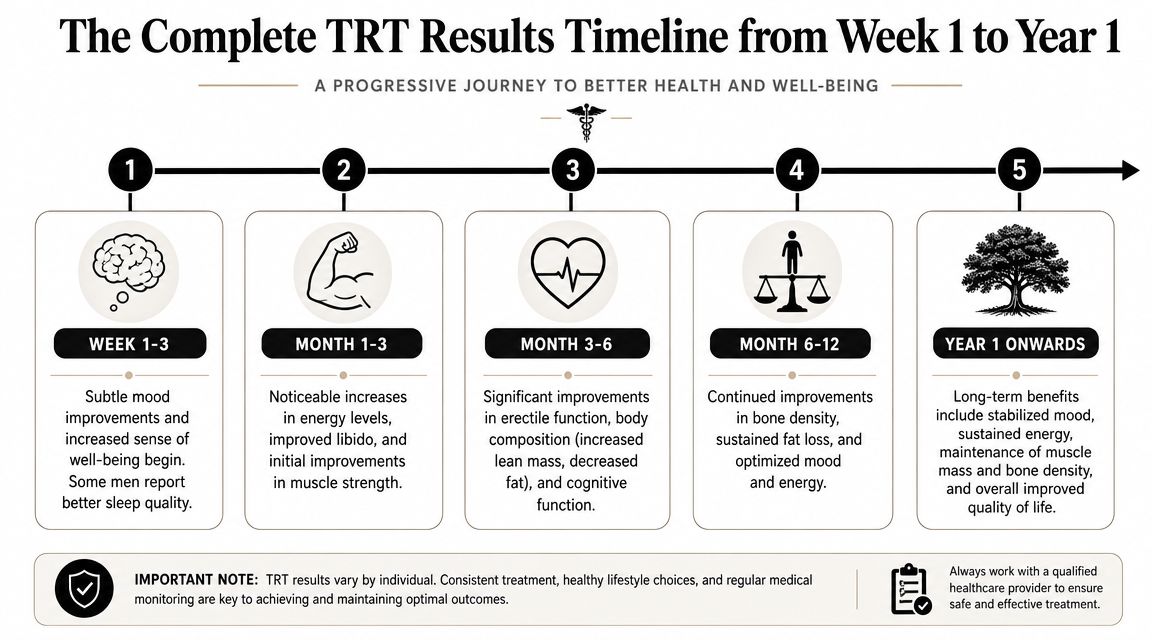
Weeks 1 through 4
The first month is usually about stabilization, not transformation.
Some men notice an early shift in libido, morning energy, motivation, or general well-being. Others notice almost nothing they can clearly point to. That does not tell you much yet about whether the protocol is right long term. Testosterone levels can change before sleep, body composition, erection quality, and gym performance catch up.
What tends to show up first:
- Libido: often the earliest change
- Mood: less flat, less irritable, or more steady for some men
- Energy: daily fatigue may start to ease
- Recovery and sleep: some men sleep better or wake up less drained
This is also where expectations need to stay realistic. If you started with very low testosterone, you may feel a clearer shift sooner. If your starting level was borderline low, or if sleep, stress, alcohol, and body fat are still working against you, the first month can feel underwhelming.
A short explainer may help if you want the basics in video form.
Months 2 through 3
At this point, the timeline usually becomes easier to judge.
By now, men often have a better sense of whether they are trending in the right direction. Energy may be more consistent. Libido and erections may be more reliable. Training recovery may improve enough that workouts feel productive again instead of draining. If nutrition and activity are in place, early body-composition changes may start to become noticeable.
This is also the point where the practical trade-offs show up. A man using smaller, more frequent injections may report steadier energy and fewer ups and downs. Another man on a less frequent schedule may feel good for a few days, then notice a drop before the next dose. Neither case means TRT is failing. It means the setup may need adjustment.
By the end of this window, useful signs include:
- Better workout recovery
- More stable training output
- Improved erection quality
- Early fat-loss or waistline changes if lifestyle supports them
At three months, the question is usually whether the trend is right, not whether every benefit has arrived.
Months 4 through 12
TRT starts to separate men who are taking testosterone from men who are getting the full benefit of treatment.
The longer window matters because muscle gain, fat-loss trends, red blood cell changes, and broader metabolic effects all take more time. This is also where consistency pays off. Men who stay on schedule with treatment, train regularly, sleep enough, and show up for labs usually have a clearer, more durable response than men who expect the medication to carry the whole process.
Later changes often include:
- Lean mass and strength improving more noticeably
- Fat-mass reduction becoming easier to see
- Mood and motivation feeling more stable
- Longer-term physiologic effects continuing through much of the first year
Bone-related changes and some metabolic improvements can take even longer. That is one reason I tell patients not to judge TRT by mirror changes alone in the first few months. Good treatment is not just about how fast you feel something. It is also about whether the result is stable, safe, and worth maintaining.
TRT results summary timeline
| Timeframe | Expected Results (Libido, Energy, Mood) | Expected Results (Muscle, Fat, Erections) | Expected Results (Labs, Bone Density) |
|---|---|---|---|
| Week 1 to 4 | Early shifts in libido, quality of life, mood, and daily energy may begin | Physical changes are usually limited and subtle | Major long-term markers are usually still too early to judge |
| Month 2 to 3 | Benefits often feel more noticeable and consistent | Body composition changes may become measurable, erections and sexual function often improve | Early lab response helps guide dose adjustments |
| Month 4 to 6 | Mood effects may continue building | Lean mass, strength, and fat-mass changes are more apparent | Hematologic and metabolic effects continue developing |
| Month 6 to 12 | Benefits often feel more established | Body composition changes tend to stabilize over time | Longer-term markers continue evolving, with bone effects taking longer |
Why Your TRT Timeline Might Be Different
Averages are useful, but they don't treat patients. Individual biology does. Two men can start TRT in the same month, take the same testosterone compound, and still have noticeably different timelines.
That's not mysterious. It's how hormone therapy works in real life.
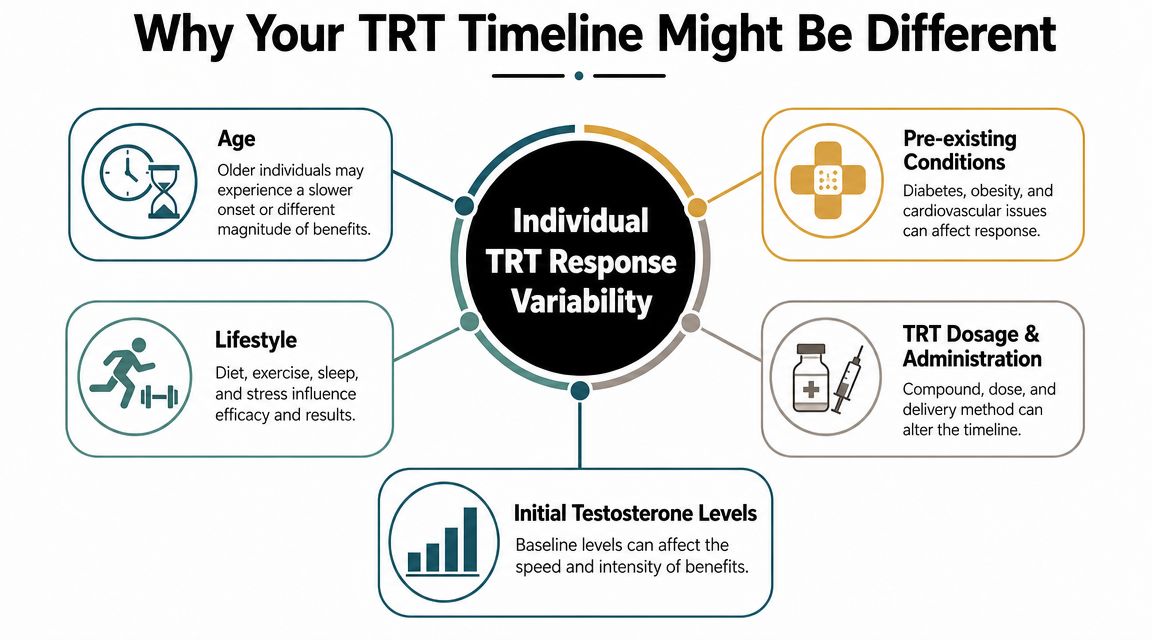
Your body isn't a copy of the average patient
Think of TRT like tuning an engine. Testosterone is only one part of the system. The final result depends on how the rest of the machine is set up.
A practical summary from GameDay Men's Health on the TRT 12-week timeline explains that the lag between normalizing hormone levels and seeing results is biologically expected, because downstream outcomes depend on dose, formulation, receptor sensitivity, and cumulative training and nutrition effects. It also notes that a 6 to 8 week check-in is useful for dose optimization, but full efficacy shouldn't be judged until at least 3 months.
That matches what clinicians see every day. Timeline differences often come from factors like:
- Starting testosterone status: Men who begin treatment feeling profoundly low may notice certain subjective improvements quickly, while others notice slower, steadier changes.
- Dose and frequency: A regimen that fits one patient may leave another with more fluctuation than benefit.
- Body weight and overall health: If sleep is poor, stress is high, and recovery is weak, results usually look flatter.
- Medication response: Some men convert, absorb, and metabolize treatment differently.
What you can control
The positive aspect is that not everything is random. Several timeline variables are modifiable.
Here's what tends to help:
- Consistent administration: Taking testosterone on schedule matters more than chasing dramatic peaks.
- Better sleep: Low-quality sleep can blur the benefits you're expecting from TRT.
- Resistance training: TRT supports adaptation. It doesn't replace training stimulus.
- Nutrition: If calories, protein, and recovery are chaotic, body-composition progress usually is too.
- Patience with data: Early tweaks are common. Constant self-adjusting without supervision usually backfires.
Some men don't have a slow response. They have an inconsistent protocol, poor recovery, or expectations that are ahead of biology.
A man on a well-structured plan with strong habits often feels like TRT “works faster,” even when the biology is following the same general timeline. That's the key difference between reading an average and living your own outcome.
Timelines for Injections, Gels, and Pellets
The delivery method changes the experience, even when the goal is the same. Men often assume testosterone is testosterone, so the timeline should feel identical no matter how it's given. In practice, the path can feel different because absorption patterns differ.
Injections
Injections are common because they're direct and predictable when prescribed well. Many men like them because they feel clear changes and can follow a structured routine. The trade-off is that some regimens feel smoother than others.
If injections are spaced too far apart for the individual, he may notice stronger ups and downs. If the schedule is better matched to his metabolism and symptom pattern, the experience usually feels steadier. For some men, that means they notice benefit earlier because they're not riding as much fluctuation.
Gels
Gels offer daily dosing and avoid needles, which makes them appealing to some patients. The main practical issue is that absorption can vary from person to person. One man gets stable symptom relief. Another applies it carefully and still gets uneven results.
That doesn't make gels ineffective. It means they require good technique, consistency, and realistic expectations. Men who want day-to-day simplicity may do well with them, but they need follow-up that focuses on both symptoms and lab response.
Pellets
Pellets aim for long, steady release. Some men prefer that because it reduces day-to-day management. The trade-off is reduced flexibility. If the dose feels off or side effects show up, you can't adjust as quickly as you can with a shorter-acting approach.
A simple way to compare them:
| Method | What it often feels like in real life | Main trade-off |
|---|---|---|
| Injections | Direct, structured, easier to fine-tune | Can feel uneven if timing or dose isn't ideal |
| Gels | Needle-free and routine-based | Absorption can be less predictable |
| Pellets | Low-maintenance once placed | Slower to adjust if the response isn't right |
The best method isn't the one that sounds easiest online. It's the one you'll use correctly, tolerate well, and monitor consistently.
Monitoring Your Progress with Lab Work
A common early mistake is judging TRT too fast. A man starts treatment, has one better week or one frustrating week, and assumes the plan is either perfect or failing. Lab work keeps that reaction in check. It shows whether your treatment is landing where it should and whether the pace of change matches your starting point, dose, and delivery method.
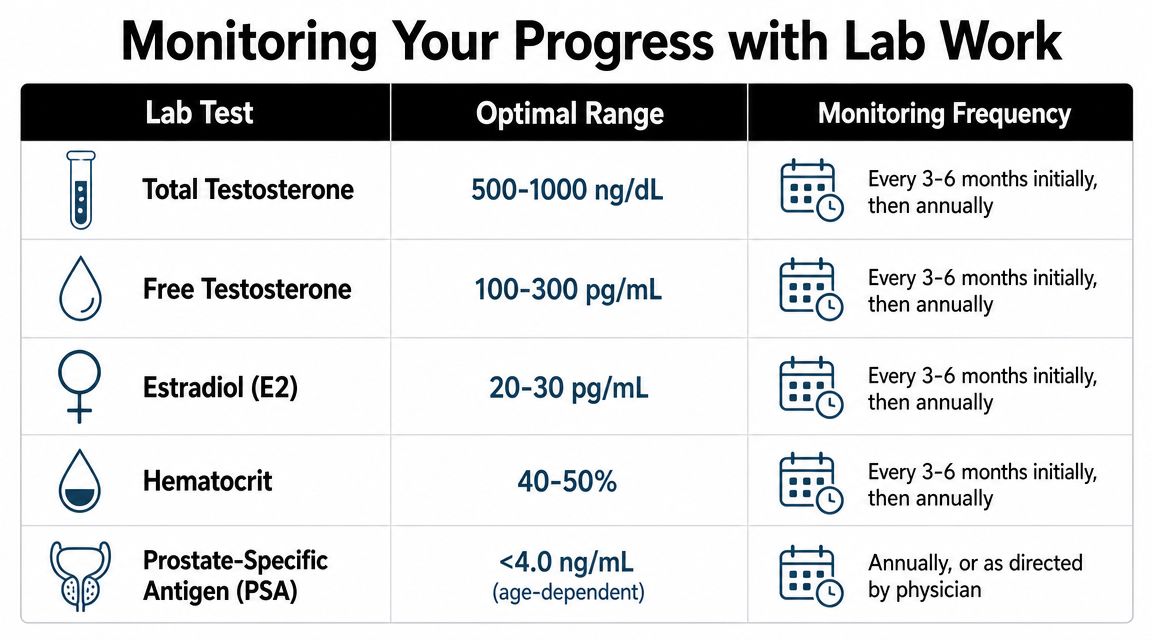
What the early follow-up is really for
Early follow-up is a checkpoint, not a final verdict. Some benefits can show up relatively soon, while other changes take much longer. That matters because the first round of labs is usually about adjusting the plan, not declaring success or failure.
In practice, I use early lab work to answer a simple question: is this patient responding the way I would expect given his baseline levels, symptoms, and treatment method? If the answer is no, the next step is not guesswork. It is a dose, timing, or delivery adjustment based on what we see.
A practical monitoring rhythm often looks like this:
- Baseline labs before treatment: show where you are starting and help rule out obvious issues that could confuse the picture later
- Early follow-up: checks whether the regimen is producing the intended response and whether symptoms and lab values are lining up
- Ongoing follow-up: confirms that improvements are holding and that safety markers remain in a good range over time
If you are new to treatment, this TRT FAQ covering common follow-up questions can help you understand what usually gets monitored and why.
What your provider is looking for
Good follow-up is not just about whether testosterone went up. A provider is looking at whether the whole plan makes sense for your body and your response.
Common categories include:
- Testosterone markers: confirm whether you are reaching an appropriate treatment range for your protocol
- Estradiol context: helps explain certain symptoms when conversion appears to be part of the picture
- Hematologic response: tracks red blood cell production, which can rise on TRT in some men
- Other safety markers: may include additional labs based on age, medical history, and individual risk factors
Timing matters here. A man injecting more frequently may have a different lab pattern than someone using a gel, even if both are technically "on TRT." A man starting with very low testosterone may also feel and test differently from someone who began near the lower end of normal. That is why good monitoring looks at trends, not isolated numbers.
Labs don't replace symptoms, and symptoms don't replace labs. You need both.
The best decisions come from combining three things: how you feel, how you function, and what the labs show over time. That approach keeps the process steady and prevents the constant protocol changes that make TRT harder than it needs to be.
Potential Side Effects and When to Report Them
TRT shouldn't be approached with fear, but it also shouldn't be treated casually. Most issues are easier to manage when patients report them early and stick to follow-up instead of trying to fix everything on their own.
What often shows up early
The initial adjustment period is when men are most likely to notice minor annoyances. These can include things like oily skin, acne, a puffy feeling, shifts in mood, or a sense that they're retaining water. Some men notice nothing at all. Others notice changes that settle down once the dose and schedule are dialed in.
Fertility is a separate issue and deserves direct discussion before starting treatment, especially if you may want children. If that's a concern, read about how TRT can affect fertility before assuming it's a small detail you can figure out later.
A good rule is simple: if a side effect is new, persistent, or escalating, tell your provider. Don't wait for it to become disruptive.
When to contact your provider
What deserves a message or a call? Anything that feels clearly out of proportion to the expected adjustment phase.
Examples include:
- Rapid symptom swings: especially if you feel noticeably worse after starting or after a dose change
- Persistent swelling or pressure-type symptoms: particularly if they don't settle
- Significant mood changes: not just a bad day, but a clear pattern
- Sleep problems that worsen: especially if breathing or rest quality seems worse than before
- Symptoms that suggest your regimen may be too aggressive or poorly tolerated: these need clinical review, not internet guesswork
Here's what doesn't help:
- Self-lowering or self-raising your dose without guidance
- Adding extra medications because a forum recommended them
- Judging your whole treatment by one rough week
Report patterns early. Most TRT problems become harder when patients go silent and start improvising.
Safe TRT usually looks boring. Regular check-ins. Thoughtful dose changes. Clear communication. That's exactly what you want.
How to Maximize Your TRT Results
The men who do best on TRT usually don't treat it like a magic fix. They treat it like one part of a larger system. Testosterone can improve the environment. You still have to give the body a reason to perform.
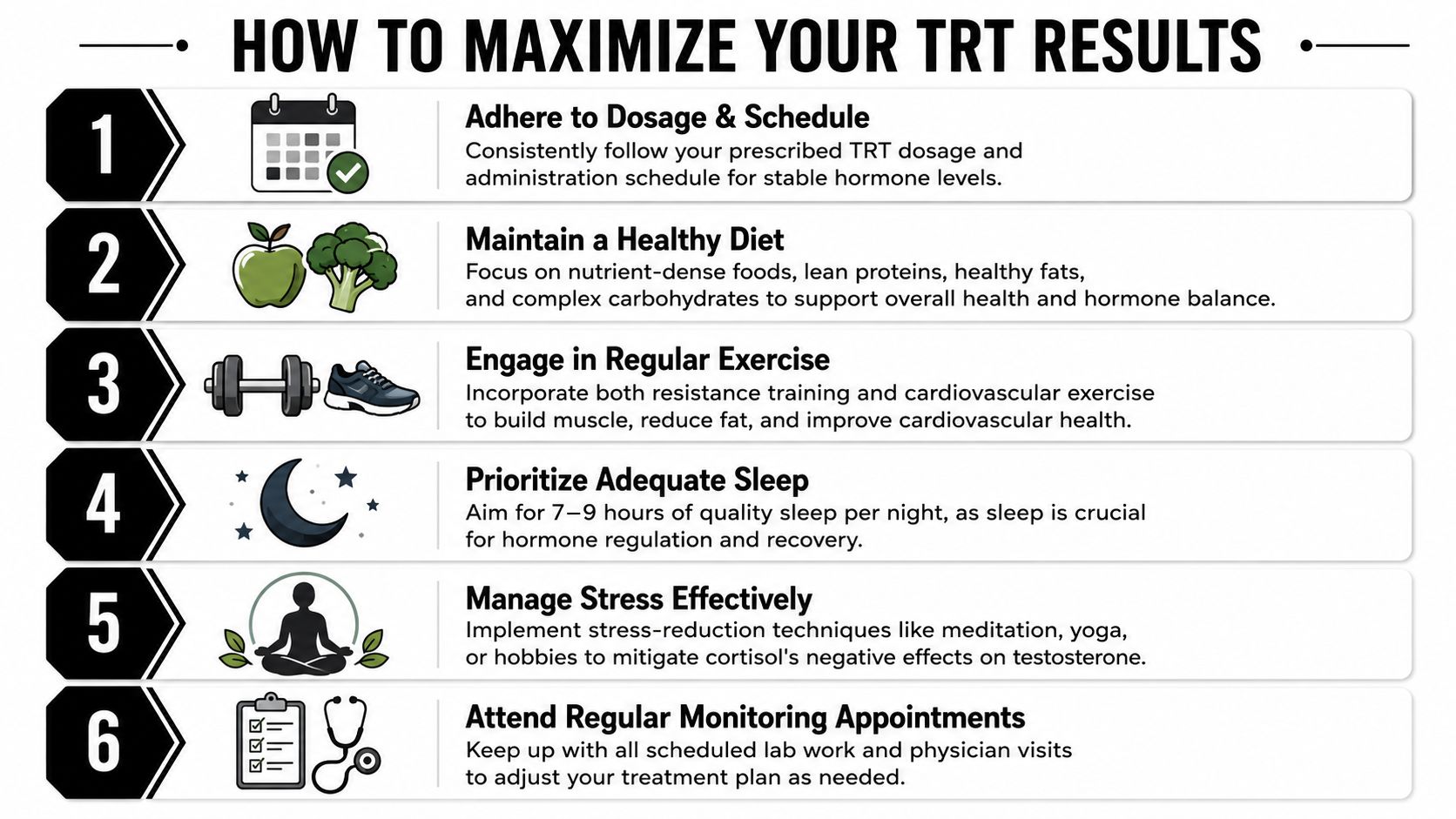
The habits that actually move the needle
If you want the best possible TRT results timeline, focus on the controllables that compound.
- Stay consistent with your schedule. Missed doses, random timing, or frequent unsupervised changes create noise. Stable routines make it easier to feel stable outcomes.
- Train with purpose. Resistance training gives TRT something to build on. Without a training stimulus, many of the physique and performance benefits stay limited.
- Eat like recovery matters. Prioritize adequate protein, overall diet quality, and a pattern you can maintain. Extreme restriction and weekend chaos rarely pair well with hormone optimization.
- Protect sleep. If your sleep is poor, your energy, recovery, appetite control, and mood usually stay worse than they need to.
- Manage stress realistically. High stress doesn't erase TRT, but it can blunt how good you feel on it.
- Keep your appointments. Good follow-up catches the problems patients miss and confirms progress patients can't always see clearly.
A strong TRT plan usually looks less dramatic than people expect. It's regular medication use, regular training, regular sleep, and regular follow-up. That's not flashy, but it works.
The biggest mindset shift is this: don't ask whether TRT can change your life by itself. Ask how much better your results get when the medication, your habits, and your monitoring all line up.
If you want a simpler, transparent way to manage TRT online, Cost Plus TRT offers physician-guided care, clear pricing, and home delivery built for busy men who want consistent treatment without the usual clinic friction.