

You've been dragging through the afternoon, sleeping badly, losing strength in the gym, and wondering whether age, stress, or low testosterone is behind it. You search “TRT replacement near me” and get a confusing mix of hormone clinics, med spas, subscription programs, and online ads that all promise an easy answer.
The practical question isn't just which provider is closest. It's who will diagnose you correctly, monitor you consistently, explain the trade-offs, and keep medication and lab logistics simple. In 2026, “near me” often means the right care model, not a clinic within driving distance.
Table of Contents
- Why Searching TRT Replacement Near Me Feels Harder Than It Should
- Understanding Low Testosterone and the Diagnosis Standard
- Local Clinic vs Telemedicine TRT Compared
- The Provider Checklist You Should Run Before Paying Anyone
- What TRT Actually Costs in 2026
- How to Transfer Existing Labs or Care to a New Provider
- Your First Week on a New TRT Program
Why Searching TRT Replacement Near Me Feels Harder Than It Should
A busy professional can spend weeks tolerating low energy before doing anything about it. He finally searches for TRT, opens several websites, and finds very different offers. One clinic wants frequent office visits. Another sells a membership with limited pricing details. A telemedicine company promises delivery to his home but says little about who reviews his bloodwork.
That confusion has three causes. First, direct-to-patient marketing is aggressive, and many programs lead with convenience before explaining diagnosis or monitoring. Second, telehealth prescribing requirements and available services can vary by state. Third, the market blurs legitimate medical practices with cash-only wellness businesses that may frame testosterone as a lifestyle product rather than a treatment requiring clinical oversight.
The practical reframing: “Near me” should mean easy access to qualified care and reliable follow-up, not merely a nearby street address.
A local clinic can be a sensible choice if you want physical examinations, face-to-face injection instruction, or staff available in person. It can also become inconvenient if every lab draw, dose question, and prescription renewal requires another visit. A remote program can remove travel, but only if it has a real prescribing clinician, proper laboratory review, and a dependable way to handle side effects or abnormal results.
The right comparison is therefore operational. Ask how the provider confirms low testosterone, where you complete bloodwork, who reads the results, how quickly you can reach the clinical team, how prescriptions arrive, and what happens when your numbers or symptoms change.
A provider that avoids those questions is selling convenience without showing you the care system behind it. You don't need another list of clinic names. You need a way to reject weak options quickly and choose a service you can realistically maintain.
Understanding Low Testosterone and the Diagnosis Standard
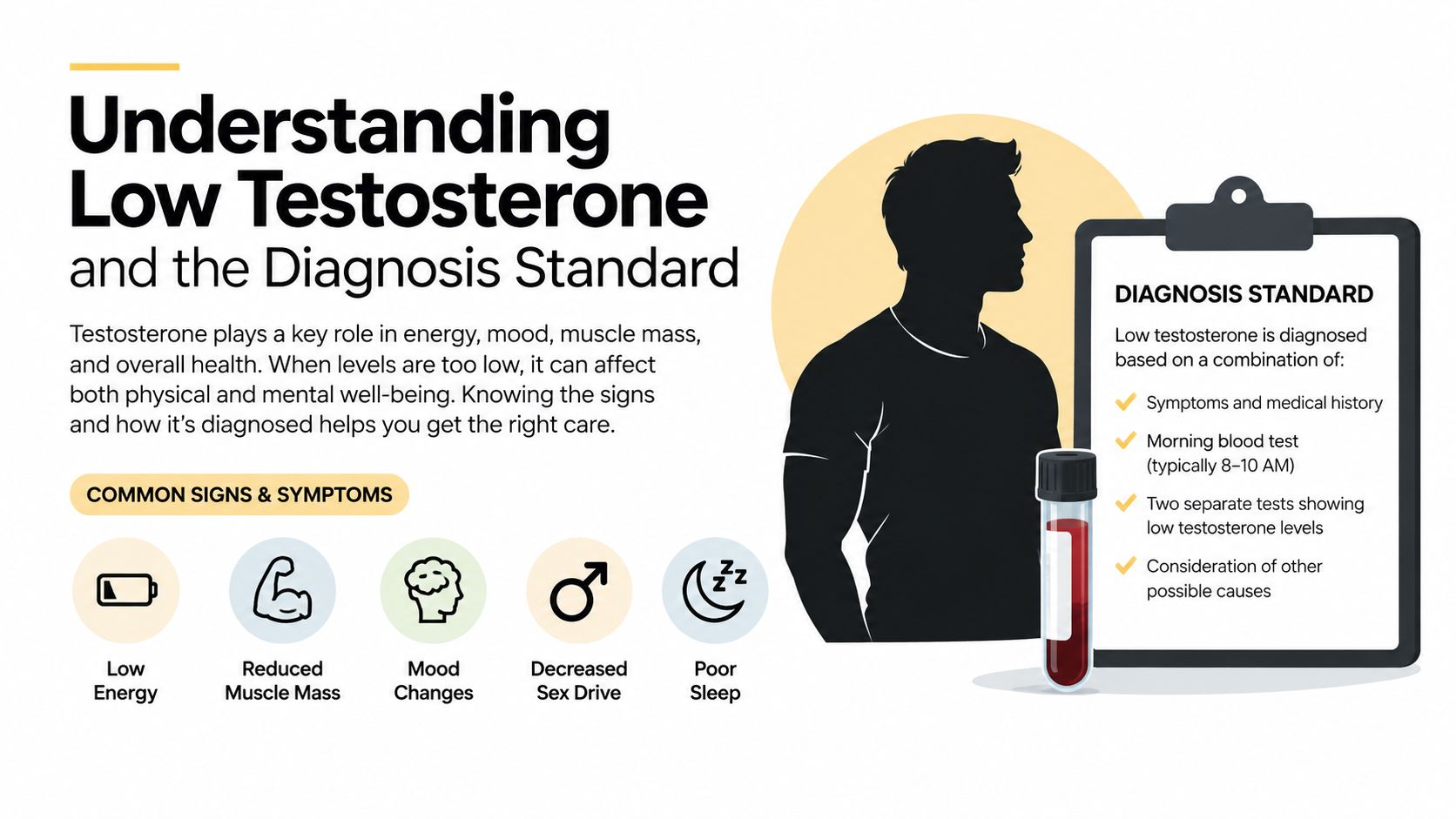
Low testosterone can look like ordinary burnout. Men often report persistent fatigue, reduced libido, weaker erections, flatter mood, poor concentration, loss of training recovery, and changes in body composition. None of those symptoms proves testosterone deficiency. Sleep problems, thyroid disease, depression, medication effects, excess weight, and other health conditions can create a similar pattern.
Start with symptoms, then verify the biology. The Cleveland Clinic Journal of Medicine review of testosterone deficiency notes that the American Urological Association uses total testosterone below 300 ng/dL as a diagnostic cutoff and that prevalence varies substantially by age and definition. The same review reports that testosterone levels decline by about 1% per year after the fourth decade of life, but aging alone isn't a diagnosis.
The testing sequence matters
A responsible provider won't prescribe based on one random blood draw. Major urology guidance calls for symptoms consistent with hypogonadism plus two separate early-morning total testosterone tests, ideally fasting and performed with a reliable assay. The European Association of Urology guidance on male hypogonadism describes this repeat-testing approach and also uses 300 ng/dL as a reasonable threshold in the appropriate clinical context.
Morning testing matters because testosterone changes during the day. A result taken later can misrepresent your usual level, while a single abnormal result may reflect poor sleep, acute illness, heavy training, or another temporary factor.
Expect the clinician to review more than total testosterone. The exact panel depends on your history, but a serious evaluation may include free testosterone, SHBG, LH, FSH, estradiol, a complete blood count, metabolic testing, lipids, and prostate-related assessment when clinically appropriate. The purpose is not to order an impressive list. It's to determine whether testosterone is low, why it may be low, and whether treatment is appropriate.
Don't skip the fertility conversation
Exogenous testosterone can suppress the body's own reproductive signaling and reduce sperm production. That matters particularly for men who may want children. NPR's reporting on testosterone therapy and current guidance highlights fertility suppression as a major concern for younger men and emphasizes that treatment should follow symptoms plus consistently low results on separate tests.
If a provider never asks whether you want to preserve fertility, the intake is incomplete. Ask what alternatives or specialist referrals may be appropriate before starting TRT.
Local Clinic vs Telemedicine TRT Compared
Local and remote care can both work. The better option depends on what you need repeatedly, not how attractive the first consultation looks.
An in-person clinic usually handles the evaluation inside its office, with staff available for physical examinations, blood draws, and injection teaching. That format suits men who want hands-on support or feel uneasy managing injections alone. The trade-off is travel, appointment availability, and the possibility that routine follow-up becomes a recurring interruption.
A full telemedicine program moves much of the process online. Depending on the provider and your location, you may use a partner laboratory or an approved home collection method, then meet a licensed clinician by video. Medication may be sent to your home, which removes trips to a clinic and pharmacy. Before enrolling, review the program's telemedicine consent information and confirm exactly what services are included.
Compare the workflow, not the sales pitch
| Factor | Local Clinic | Telemedicine TRT |
|---|---|---|
| Initial evaluation | Office consultation and possible physical examination | Online consultation supported by laboratory results |
| Bloodwork | Often arranged through the clinic or an affiliated lab | Usually completed through a partner lab or approved home collection |
| Follow-up | Office visits, phone contact, or portal messaging | Video visits, secure messaging, and remote review |
| Medication logistics | Pickup, local pharmacy, or office administration | Prescription sent to a pharmacy or shipped where permitted |
| Injection support | In-person teaching and supervised administration may be available | Remote instructions, written guidance, and clinician support |
| Convenience | Stronger for face-to-face care | Stronger for travel, scheduling, and home delivery |
| Main risk | Repeated visits may become burdensome | Weak programs may provide inadequate access or monitoring |
Telemedicine isn't automatically better, and local care isn't automatically safer. Both models should explain the diagnosis, identify contraindications, track laboratory markers, and make a clinician available when your symptoms or results change.
Choose local care if you need physical help. Choose telemedicine if you value fewer trips and can manage the remote parts of treatment responsibly.
Ask whether the program coordinates lab orders, how results reach the prescriber, and what happens if the lab shows an abnormal hematocrit or prostate-related result. Also ask how injection supplies are provided and whether the provider supports your specific medication format.
The decisive question is simple: Which system will you use for every follow-up? A theoretically convenient clinic that you avoid is a poor choice. So is a low-friction online program that disappears after collecting payment.
The Provider Checklist You Should Run Before Paying Anyone
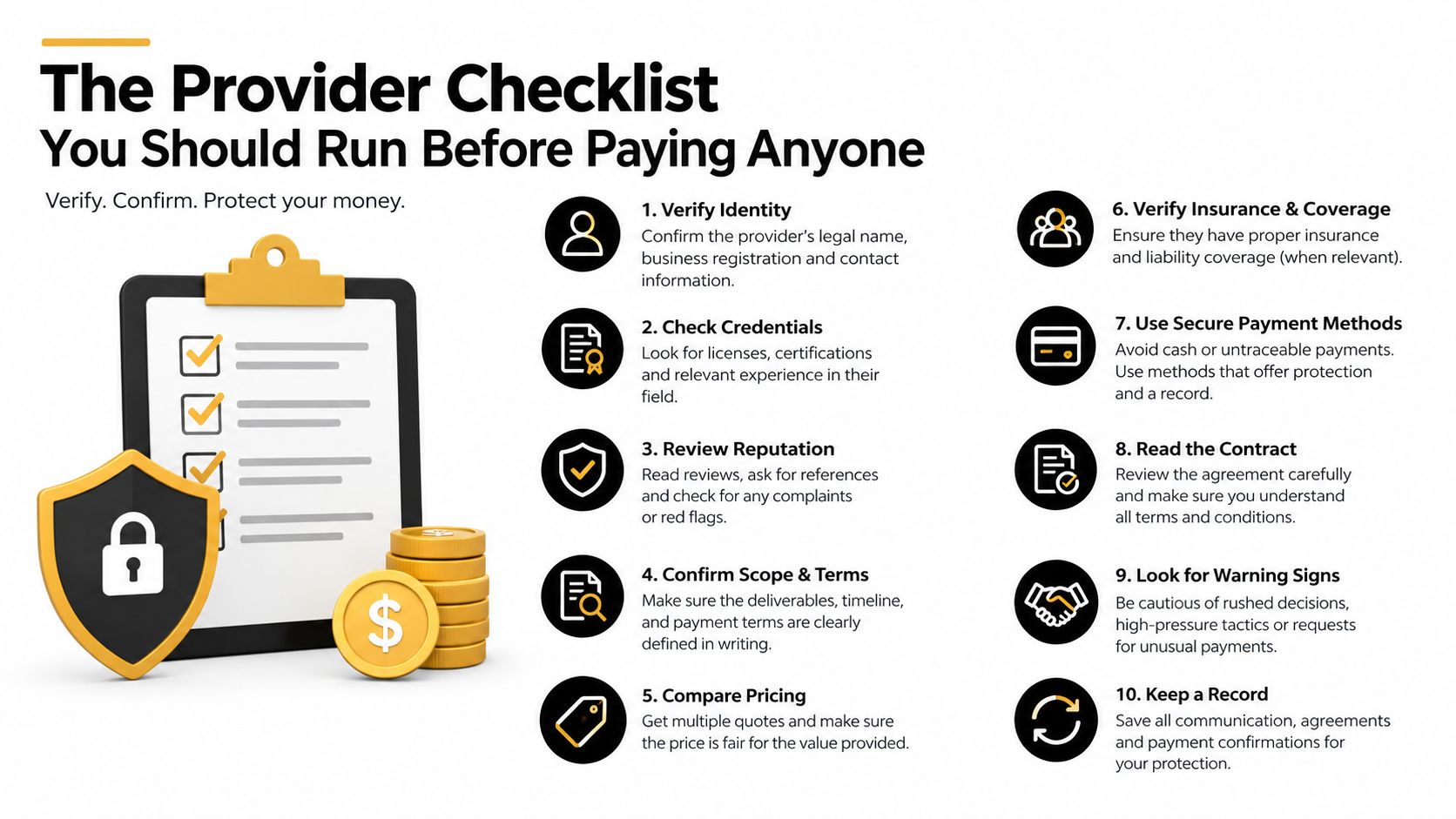
Don't pay a setup fee until the provider answers basic operational questions in writing. A polished website proves nothing about clinical quality.
Use this filter during the consultation:
Licensing: Confirm that the prescribing clinician is licensed to practice in your state and that the service explains who will manage your care.
Laboratory quality: Ask where baseline and follow-up tests are processed. The provider should identify its laboratory partner and explain how results are reviewed.
Complete monitoring: Confirm that the plan addresses testosterone, hematocrit or hemoglobin, PSA when appropriate, and other tests justified by your history. A program focused only on testosterone levels is incomplete.
Lab interpretation: Ask who reviews the results and how you'll receive them. You should not have to guess whether a number requires action.
Medication source: Verify that the prescription comes from a licensed pharmacy and ask which testosterone formulation is being prescribed.
Supplies and administration: If injections are part of the plan, confirm that the service explains needles, syringes, injection technique, sharps disposal, storage, and missed doses.
Dose changes: Request the written process for changing a dose. A provider shouldn't increase medication because you still feel tired without reviewing timing, adherence, sleep, and laboratory results.
Fertility and alternatives: Ask how the clinician handles fertility goals, reversible causes, and referrals when TRT isn't the right first move.
Pricing: Demand an itemized fee schedule. It should identify medication, labs, consultations, shipping, supplies, follow-up, and cancellation terms separately.
The monitoring schedule should be explicit. Expert guidance recommends testosterone, hematocrit, and PSA assessment at baseline and again during early follow-up, then annually when stable. The NCBI clinical overview of testosterone therapy monitoring identifies hematocrit above 54% as a widely used threshold for stopping or adjusting treatment and describes PSA changes that warrant repeat testing and possible urologic evaluation.
A clinician should also explain when blood should be drawn relative to injections. Poorly timed testing can make levels look falsely high or low and encourage bad dosing decisions.
This video can help you identify the practical questions to raise before enrollment.
What TRT Actually Costs in 2026
The cheapest monthly headline isn't necessarily the lowest total cost. One provider may include medication and routine consultations, while another advertises a small membership fee and adds charges for labs, supplies, dose changes, or pharmacy services.
Local clinics commonly structure care around office visits and may bundle medical oversight with blood draws or injection administration. Telemedicine programs often combine remote consultations, prescription handling, and medication delivery into a recurring fee. Neither structure is automatically good or bad. The issue is whether you can see the complete cost before you commit.
Compare the line items
| Cost Component | Local Clinic | Telemedicine |
|---|---|---|
| Initial evaluation | May include an office consultation and separate testing | May include an online consultation and an initial lab pathway |
| Medication | Pharmacy or clinic-dispensed charge | Pharmacy or shipped prescription charge |
| Bloodwork | May be bundled with a visit or billed separately | May require a partner-lab fee or use uploaded results |
| Follow-up | Office appointments or additional consultation charges | Video or messaging access under the program terms |
| Supplies | May be separate | May be included, depending on the program |
| Dose changes | Ask whether a new visit is required | Ask whether clinical review is included |
| Cancellation | Review notice periods and membership rules | Review renewal, cancellation, and shipping terms |
Request the total expected cost for the care cycle, not just the first payment. Ask whether labs are included, whether a repeat test creates another charge, whether shipping varies by location, and whether a consultation is required for every dose adjustment.
A transparent program should tell you what happens when you upload existing labs, miss an appointment, need a prescription clarification, or require a repeat blood test. If the answer is buried in a long agreement, ask for a plain-language summary.
You can review one example of an itemized telemedicine structure through the Cost Plus TRT pricing page, then compare its inclusions with at least one local provider. Don't treat any advertised fee as a universal market rate. Treat it as a prompt to ask what the fee covers.
Budgeting rule: Compare the full service, not the membership label. A low entry price can become expensive when every clinical decision creates another charge.
How to Transfer Existing Labs or Care to a New Provider
Switching TRT providers should be a controlled handoff, not a restart from zero. The new clinician needs your treatment history, response, side effects, and monitoring record before approving the next prescription.
Gather these records before the intake appointment:
- Recent laboratory reports: Send complete panels with reference ranges, collection dates, and the timing of each test relative to your injection.
- Prescription details: Record the testosterone ester, concentration, dose, frequency, and delivery method.
- Clinical notes: Include prior dose changes, symptoms, adverse effects, blood pressure concerns, hematocrit and PSA results, and discussions about estradiol.
- Fertility information: State your current goals and provide any semen testing or reproductive consultation records.
- Pharmacy details: List the dispensing pharmacy, refill status, remaining medication, and supplies at home.
Request the full chart through your former provider's portal or by signing its release form. A screenshot of one testosterone result is not enough. The new prescriber needs the surrounding context, including whether the sample was collected at the right point in your dosing schedule.
Prevent a medication gap
Contact the new program while you still have medication available. Ask whether it accepts outside laboratory results, requires a new panel, and can legally serve your state. Upload the records before the consultation so the clinician can review your history instead of opening an empty file.
Do not let two providers manage the same prescription independently. Tell both offices that care is transferring, then follow the new clinician's instructions about the final dose under the old plan. This avoids duplicate prescriptions, conflicting advice, and uncertainty about who handles monitoring.
If records are incomplete or outdated, the new provider may repeat testing. That can be appropriate. Current results may be needed to confirm your status and establish a safe baseline before treatment continues.
A successful transfer ends with one written care plan. Confirm who prescribes, who orders labs, which pharmacy fills the medication, when the next review occurs, and where to report side effects. For a “near me” search, those follow-up arrangements matter more than the clinic's distance from your home. Local access helps only if monitoring is consistent and responsibilities are clear.
Your First Week on a New TRT Program
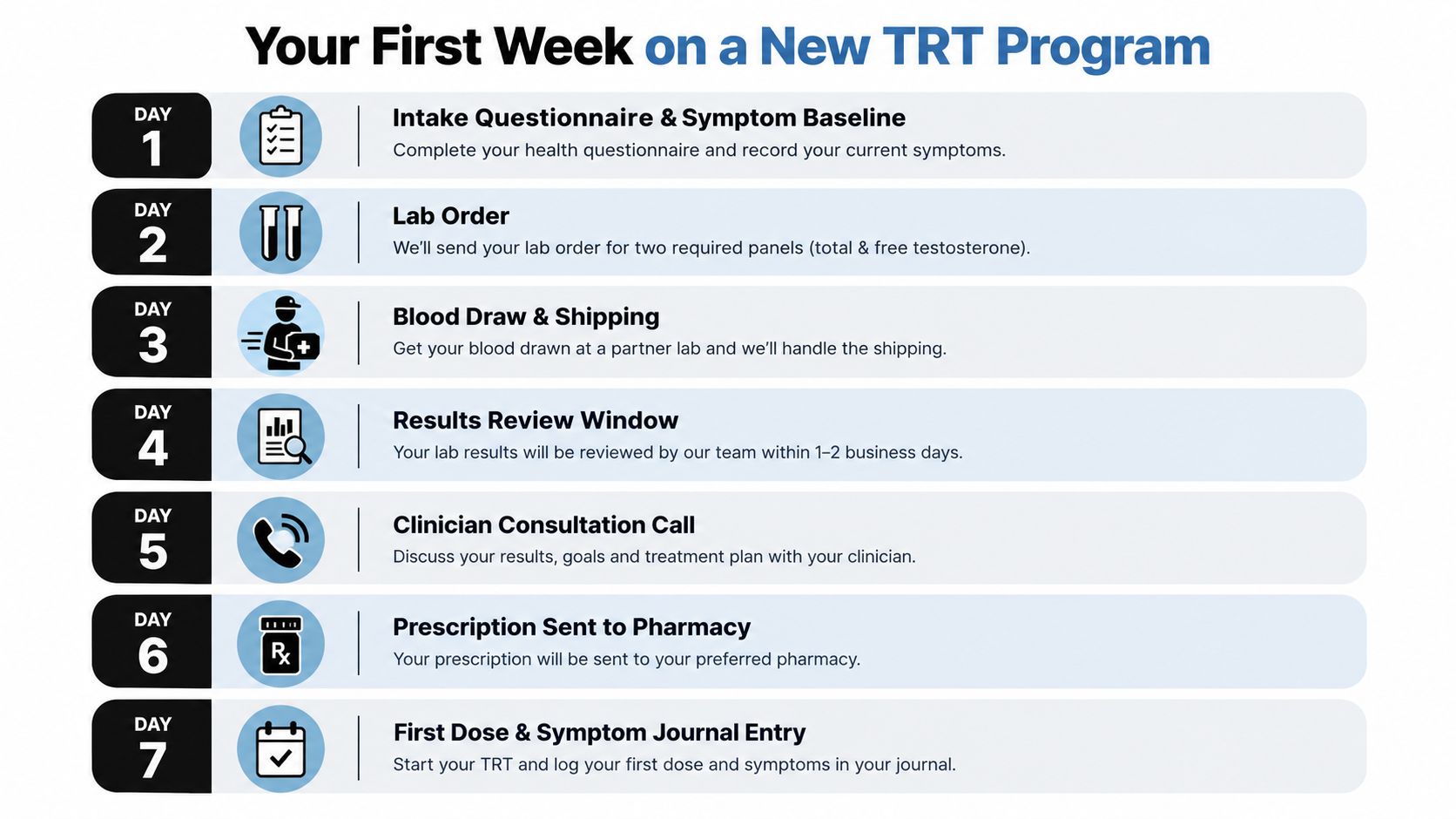
By the end of your first week, you should know what you are taking, why you are taking it, how it will be monitored, and who answers questions. A nearby office does not make a program safe. Clear instructions, reliable lab access, and timely follow-up do.
Build an honest baseline
Complete the intake questionnaire carefully. Record libido, erectile function, energy, sleep quality, mood, exercise performance, recovery, current medications, alcohol use, and relevant medical history. Keep a short symptom journal, because your baseline matters more than a vague impression after treatment begins.
Describe the pattern, duration, and effect of your symptoms. Do not exaggerate to qualify, and do not minimize problems to appear tough. The clinician needs accurate information to judge whether testosterone treatment fits the situation.
Complete testing correctly
Follow the laboratory instructions exactly. Major guidance calls for two separate early-morning total testosterone tests before treatment begins. The clinician may also order tests to investigate the cause of low testosterone or identify treatment risks.
Ask when the sample should be collected in relation to fasting, sleep, illness, and any testosterone dose you already use. Bring every result to the consultation, including results that seem unrelated. Thyroid markers, blood counts, metabolic measures, lipids, reproductive hormones, and prostate-related testing can affect the treatment decision.
Use the consultation to test the plan
Ask which formulation the clinician recommends and why it suits your schedule. Get specific instructions for injection technique, site rotation, storage, missed doses, refill timing, laboratory timing, and symptoms that require a call. If fertility matters, raise it before the first prescription. Testosterone therapy can affect fertility, so postponing that discussion creates avoidable problems.
The provider should define the treatment target and explain follow-up. Monitoring generally aims for the mid-normal testosterone range, with early review of symptoms and adverse effects, followed by periodic checks once treatment is stable, as described in the European Association of Urology monitoring guidance. Injectable treatment may require blood collection at a consistent point between injections so the result can be interpreted correctly.
Track your response after the first dose
Follow the prescribed route and dose. Do not change the schedule because results feel slow, and do not add an estrogen-blocking medication without a clinician's assessment. Log the administration date, dose, injection site, sleep, mood, libido, erections, energy, acne, swelling, headaches, and unusual symptoms.
Early check-ins should review symptoms alongside laboratory results. A dose adjustment needs a clear reason, such as persistently low levels, adverse effects, poor blood-draw timing, or a change in your clinical situation. More medication is not the automatic answer to a bad week.
Seek prompt medical guidance for chest pain, severe shortness of breath, fainting, sudden neurological changes, severe headache, or significant swelling. Contact the provider about persistent mood changes, marked acne, breast symptoms, urinary changes, or other effects that appear after treatment starts.
If you are comparing remote programs, review Cost Plus TRT's online intake pathway. Apply the same checks you would use for a local clinic, especially clinician access, laboratory review, prescription details, and follow-up.
Cost Plus TRT provides physician-supervised telemedicine TRT with online visits, lab-based evaluation or uploaded results, prescription testosterone cypionate, injection supplies, follow-up support, and home delivery where available. Compare those details with local options at Cost Plus TRT, then judge every program by its medical process and price transparency. In 2026, “near me” is mainly a service-model question. Choose the setup that makes monitoring and follow-up practical enough to sustain.