
Most advice about TRT and peptides gets the core issue wrong. Peptides are not a natural substitute for testosterone replacement therapy. They're a separate set of tools with separate jobs.
That distinction matters because men often come in asking for “something more natural” when what they need is a clear diagnosis. If a man has clinically diagnosed hypogonadism, TRT is the established treatment. If he wants help with recovery, sleep, body composition, or a narrow performance goal, certain peptides may have a role. Those are two different conversations.
The confusion has grown because the market has grown. In the United States, TRT prescriptions increased from 7.3 million in 2019 to over 11 million annually in 2024, a rise of about 50%, according to Global Market Insights reporting on TRT market growth. As TRT became mainstream, peptide marketing followed right behind it. The result is a lot of men hearing that peptides can “boost testosterone” when many of the most talked-about peptides don't do that.
Table of Contents
- Beyond TRT The Rise of Peptide Therapy in Mens Health
- TRT Replaces Hormones Peptides Send Signals
- How Peptides Can Complement a TRT Protocol
- A Profile of Common Peptides for Men on TRT
- Safety Monitoring and Finding a Reputable Source
- Making Peptide Therapy Accessible with Telemedicine
- Building Your Integrated Mens Health Strategy
- Frequently Asked Questions About TRT and Peptides
Beyond TRT The Rise of Peptide Therapy in Mens Health
Most of the marketing around peptides gets one thing wrong. Peptides are not a natural substitute for testosterone replacement.
Men usually start this search because something still feels off. Energy is inconsistent. Recovery lags behind training. Libido drops. Sleep stops feeling restorative. Some have true hypogonadism and need testosterone replacement. Others have testosterone handled, but still want to improve a narrower problem that TRT does not directly solve.
That is why interest in peptide therapy options for men keeps growing. In the clinic, I see the appeal. A peptide can be useful when the target is specific and the expectation is realistic. It can also be oversold to men who really need a proper hormonal workup, better sleep, weight loss, treatment for sleep apnea, or a cleaner TRT protocol.
Optimization starts after the baseline is fixed
TRT can correct low testosterone. It does not automatically fix poor recovery, fragmented sleep, excess body fat, erectile dysfunction from vascular disease, or fertility concerns.
That distinction matters.
A man may have excellent testosterone levels on paper and still struggle with body composition, training tolerance, appetite, or sexual performance. Those cases are where peptide discussions usually become productive. The right use case is targeted. The wrong use case is treating peptides like a cure-all.
Peptides work best as specialized tools. They should match a defined clinical goal, not a vague promise of optimization.
Why the hype keeps growing
Peptides sound precise, and sometimes they are. They act on signaling pathways rather than replacing testosterone itself. For the right patient, that can be helpful. For the wrong patient, it becomes an expensive detour.
The practical framework is simple:
- TRT replaces a deficient hormone: It gives the body testosterone directly.
- Peptides send instructions: They stimulate receptors, glands, or downstream pathways.
- They solve different problems: A man with confirmed testosterone deficiency still needs treatment for low testosterone, not a peptide marketed as a workaround.
That is the filter I recommend using with every ad, clinic pitch, and online protocol. Start with the diagnosis. Then match the treatment to the problem.
TRT Replaces Hormones Peptides Send Signals
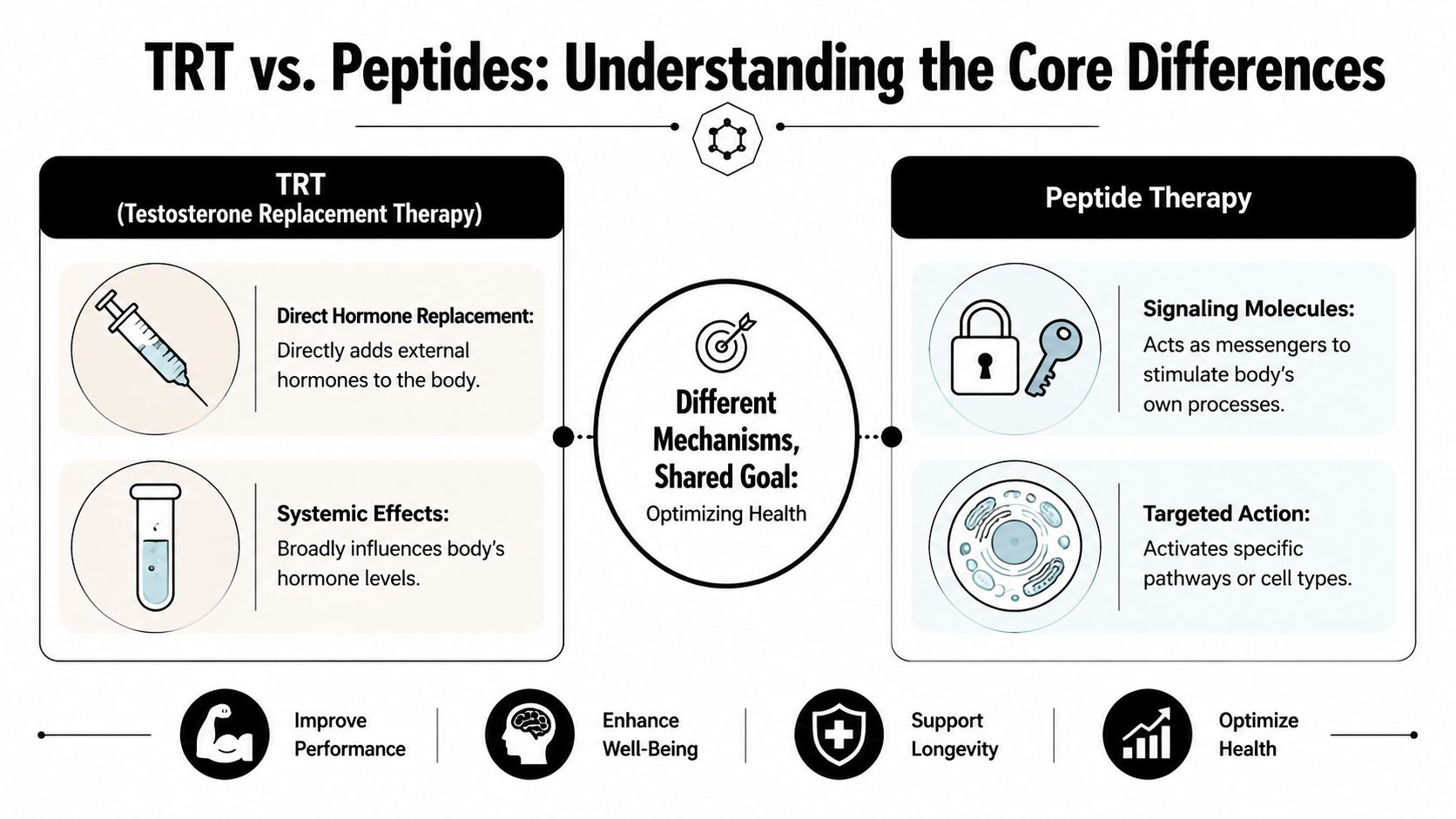
TRT and peptide therapy are often discussed together, but they work in very different ways. TRT is replacement. Peptides are signaling.
Think of TRT like filling a fuel tank that's running low. You are putting testosterone into the system directly. A peptide is closer to sending a message to a control center. The body then decides what to release downstream, and the final effect depends on how responsive that system is.
What TRT actually does
TRT raises circulating testosterone by bypassing the normal hypothalamic-pituitary-gonadal feedback loop. That's why it tends to be predictable. In men with confirmed low testosterone, it can restore levels into the physiological range and improve the classic symptom cluster tied to deficiency.
If you want the direct treatment path for low testosterone, online TRT care is built around that replacement model. The key point is mechanism. TRT works because it adds the hormone itself.
What peptide therapy actually does
Most peptides discussed in men's health are not testosterone drugs. They are short amino acid chains that act more like biochemical instructions. Some stimulate growth hormone release. Some affect central sexual arousal pathways. Some are marketed for recovery despite limited human evidence.
Widely discussed compounds such as BPC-157, CJC-1295, and ipamorelin are not FDA-approved drugs for testosterone deficiency or general hypogonadism, and the evidence base behind many of them is much thinner than the decades of data supporting TRT. That's one of the biggest gaps between online enthusiasm and medical reality.
The myth that causes the most confusion
The phrase “natural TRT” sounds good and means almost nothing.
A growth hormone secretagogue may raise growth hormone and IGF-1 signaling. That does not make it a testosterone replacement. A peptide may improve sleep or recovery, and a patient may then feel better overall. That still doesn't mean his testosterone deficiency has been corrected.
Clinical shortcut: If the treatment does not directly replace testosterone or stimulate the specific reproductive hormones involved in testosterone production, it should not be described as a TRT equivalent.
That's why any serious discussion of TRT and peptides has to separate them by mechanism first, then by outcome second.
How Peptides Can Complement a TRT Protocol
A well-run TRT protocol still leaves some men with obvious gaps. Testosterone can correct low androgen symptoms and still leave poor sleep, slow recovery, stubborn body composition issues, or a mismatch between libido and erectile response. That does not mean TRT failed. It means testosterone was only one part of the problem.
Peptides can help in that setting, but only if the goal is specific. They are adjuncts, not a second version of TRT, and certainly not a “natural” substitute for it.
Complementary pathways, different jobs
TRT supplies the hormone that is missing. Peptides act more like signals that push a particular pathway. In practice, that matters because the expected result has to match the mechanism.
A man on TRT may have normal testosterone levels and still complain that he sleeps lightly, feels beat up after training, or is not recovering the way his labs suggest he should. In those cases, support aimed at the growth hormone and IGF-1 axis may be worth discussing. For men exploring that route, Sermorelin therapy for GH-axis support is one example of a targeted peptide strategy.
The simplest way to explain it is this. TRT replaces fuel. Certain peptides send instructions. If the problem is low testosterone, instructions are not enough. If testosterone is already in range and the remaining issue is recovery, sleep architecture, or a narrow aspect of sexual function, the right signal can sometimes help.
Where combination therapy makes practical sense
In clinic, the better use cases are narrow and outcome-based:
- Sleep and recovery support: Some men reach stable testosterone levels but still wake up unrefreshed, plateau in the gym, or feel sore longer than expected.
- Body composition work: TRT can improve muscle retention and training drive, but it does not guarantee easy fat loss. A second pathway may help selected patients, especially when lifestyle fundamentals are already in place.
- Tissue repair concerns: Men with heavy training loads or chronic overuse issues often want better recovery, not more testosterone.
- Sexual function nuance: Desire, arousal, and erection quality overlap, but they are not the same problem. A peptide used for central arousal pathways serves a different role than testosterone replacement.
That distinction keeps treatment rational. It also keeps expectations realistic.
What usually goes wrong
The most common mistake is using peptides to avoid treating true hypogonadism. A man with low testosterone and classic symptoms usually needs a proper evaluation and, when indicated, testosterone replacement or another evidence-based strategy directed at the reproductive axis. A peptide aimed at growth hormone signaling will not reliably fill that gap.
The second mistake is stacking compounds because each one sounds promising online. More moving parts can mean more side effects, more cost, and less clarity about what is actually helping. I usually get better outcomes by solving one problem at a time, measuring response, and stopping anything that does not produce a meaningful clinical benefit.
Men do best when peptides are treated like specialty tools. Use them for a defined job, monitor the response, and do not confuse symptom improvement in one domain with actual treatment of testosterone deficiency.
A Profile of Common Peptides for Men on TRT
When men ask about peptides, they usually aren't asking for a chemistry lesson. They want to know what each option is for, what it might help, and what expectations are realistic. That's the right way to evaluate them.
One point needs to stay fixed throughout this discussion. Growth hormone secretagogues raise GH and IGF-1, not testosterone. Clinical data and physiological reviews have made that distinction clear. If a man reports a libido lift on a GHS peptide, that effect is understood as secondary to better sleep, reduced fluid retention, and improved skin or muscle health, not direct hormonal replacement.
Peptide Therapy at a Glance
| Peptide | Primary Function | Best For | Onset of Action |
|---|---|---|---|
| Sermorelin | Stimulates GH signaling and downstream IGF-1 activity | Sleep support, recovery, body composition goals | Gradual, usually over months |
| PT-141 | Acts on central pathways involved in sexual arousal | Men with libido or erectile response concerns despite adequate testosterone | Variable, typically situational rather than cumulative |
| NAD+ | Used in wellness settings for cellular energy support | Men focused on energy, resilience, and recovery support | Variable by individual and protocol |
| Methylene Blue | Used selectively in performance and wellness contexts | Men seeking cognitive or cellular support under physician oversight | Variable by individual and protocol |
Sermorelin
Sermorelin is the peptide that gets mislabeled most often as “testosterone boosting.” It isn't. Its role is tied to growth hormone signaling, which can influence sleep quality, recovery, and gradual body composition change through the GH and IGF-1 axis.
That distinction matters because men sometimes stop TRT, start Sermorelin, and expect their testosterone symptoms to stay controlled. In a man with real hypogonadism, that's usually the wrong expectation.
A better way to frame Sermorelin is this:
- What it may help: Recovery, sleep quality, gradual shifts in body composition
- What it does not do: Replace testosterone in men who are deficient
- Best fit: A man already on TRT who wants support in areas TRT doesn't fully address
PT-141
PT-141 belongs in a very different category. It isn't trying to replace testosterone or mimic growth hormone signaling. It is used more specifically for sexual arousal and erectile response, which makes it relevant for men whose testosterone is adequate but whose sexual performance still isn't where they want it.
That's an important clinical distinction. Testosterone can improve libido, but libido, arousal, erection quality, and performance confidence are not the same thing.
Some men don't need “more hormone.” They need a more targeted tool for the exact symptom still getting in the way.
NAD+
NAD+ sits more on the wellness and recovery side of the conversation. Men usually ask about it when they feel mentally flat, physically drained, or less resilient under work and training stress.
The practical message here is restraint. NAD+ may be used as a supportive therapy in physician-guided programs, but it should not be sold as a replacement for correcting hormone deficiency, poor sleep habits, under-recovery, or basic metabolic issues. It's an adjunct, not a foundation.
Methylene Blue
Methylene Blue also requires careful framing. It shows up in performance, cognitive, and longevity-oriented discussions, but that doesn't make it a general male hormone treatment.
For men on TRT, the relevant question is not whether Methylene Blue is interesting. It's whether it addresses a clearly defined problem and whether a physician has a reason to include it. Used that way, it may have a role. Used casually, it becomes another bottle in a crowded drawer.
Safety Monitoring and Finding a Reputable Source
The safest TRT and peptide plans usually look less glamorous than the ones advertised online. They involve diagnosis, baseline labs, follow-up labs, and adjusting treatment based on objective data rather than hype.
That matters because TRT and peptide therapies create different risks and need different monitoring.
What needs to be monitored
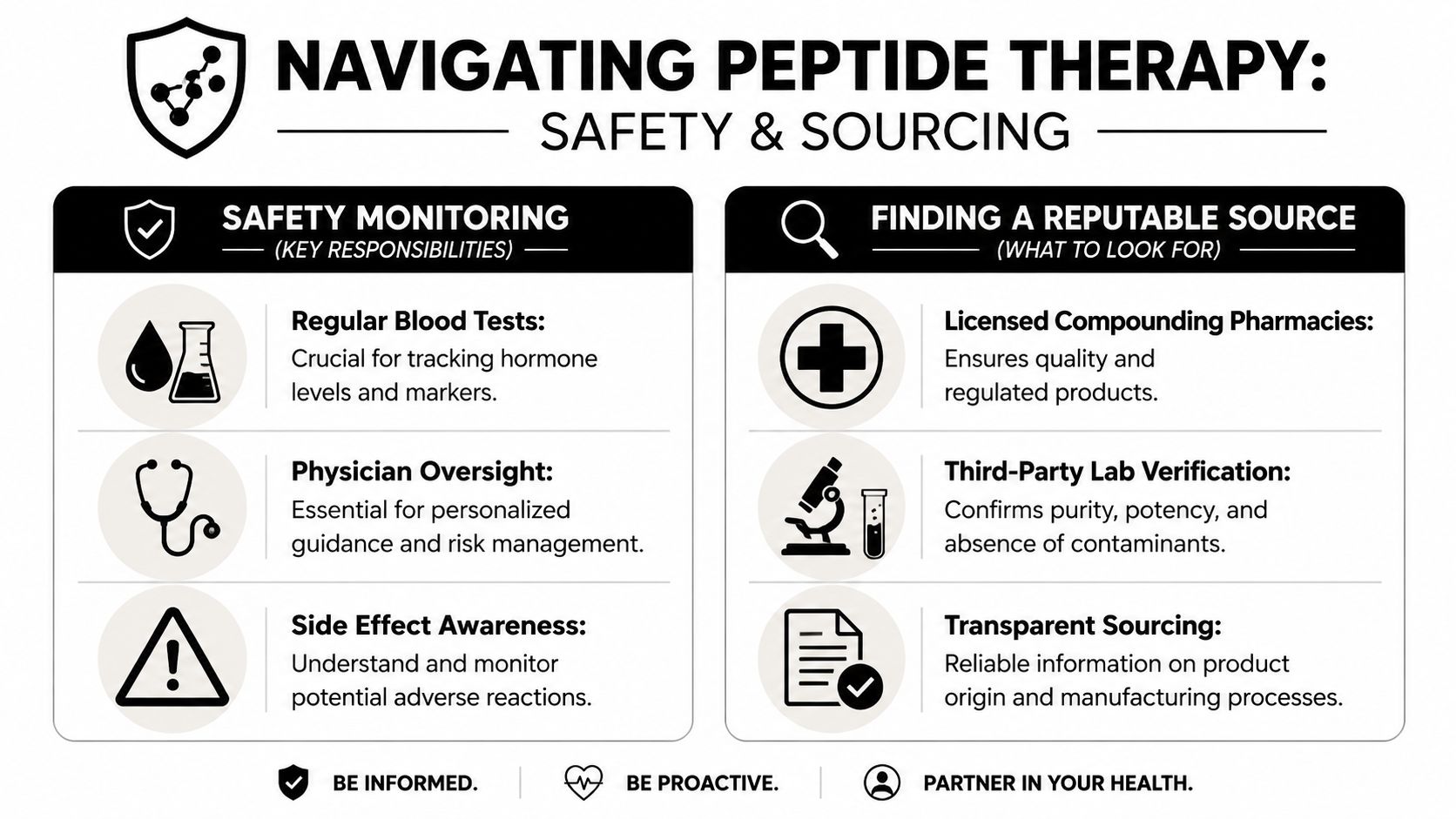
TRT requires baseline and ongoing monitoring of estradiol, hematocrit, PSA, and lipids, while growth hormone secretagogue protocols such as Sermorelin primarily call for monitoring fasting glucose, HbA1c, and IGF-1, as reviewed in this PMC discussion of hormone therapy monitoring and risk. Those aren't interchangeable lab panels.
TRT can raise hematocrit and requires attention to erythrocytosis risk. Estradiol can also shift in ways that matter clinically. Growth-hormone-directed peptides raise a different concern set, especially around glucose handling and excessive IGF-1 response.
What a reputable source looks like
Men get into trouble when they buy “research peptides” online and assume the label tells the truth. It may not. Purity, dosing accuracy, sterility, and storage all matter.
Look for these basics:
- Physician oversight: Someone should review symptoms, history, and lab work before a protocol starts.
- Pharmacy-grade sourcing: The medication should come from legitimate pharmacy channels, not a gray-market peptide seller.
- Follow-up built into care: If no one is checking response and side effects, it isn't a medical program.
- Clear treatment purpose: Every peptide in the plan should have a reason to be there.
Safety reality: The more “customized” a peptide stack sounds, the more important it is to ask who is monitoring it and what they are measuring.
Fertility is a separate discussion
One of the biggest blind spots in online content is fertility. TRT can suppress LH and FSH, which can reduce sperm production and lead to testicular atrophy. Men who want to preserve fertility need a very specific discussion about agents such as hCG or GnRH-based support, not vague advice about “adding peptides.”
That is one of the clearest examples of why precision matters. Growth hormone peptides are not the fertility lever. They act on a different axis.
Making Peptide Therapy Accessible with Telemedicine
Convenience is useful. Convenience without clinical discipline is how men end up on the wrong drug, the wrong dose, or a peptide stack that sounds impressive but does not match the problem.
Telemedicine can work very well here because most of the decision-making in hormone care happens through history, labs, symptom patterns, and follow-up. A video visit does not lower the standard. It changes how the care is delivered.
What good telemedicine solves
A good telemedicine program reduces wasted time and keeps the medical parts intact. Men can complete an evaluation from home, use local lab options, and receive treatment through legitimate pharmacy channels if they are appropriate candidates. That matters for men with demanding schedules, frequent travel, or limited access to a local clinician who is comfortable managing both TRT and selected peptides.
The practical standard is still the same:
- A real intake: Symptoms, medical history, current medications, fertility plans, and prior treatment all need review.
- Lab-based decisions: Treatment should follow actual lab data, not a symptom quiz alone.
- Clear goals: Each medication should have a defined purpose, such as testosterone replacement, fertility support, body composition support, or erectile function.
- Planned follow-up: Dose changes and peptide selection should be based on response and side effects, not trial and error without supervision.
Cost Plus TRT is one example of a telemedicine model offering TRT and physician-supervised peptide options with transparent pricing and pharmacy fulfillment. That format is useful because it separates real medical care from the common online pattern of selling men a prebuilt protocol.
Why this matters for peptide therapy
Peptides create more confusion than testosterone because they are often marketed as if they were a shortcut around diagnosis. They are not. A man on TRT may still benefit from a peptide, but only if the target is specific and the choice fits the mechanism.
Telemedicine makes that kind of targeted care easier to access. It does not change the fact that the clinician still has to decide whether the goal is fertility preservation, sexual performance, recovery, or another narrow outcome, and whether a peptide is the right tool.
That distinction matters. The best telemedicine programs do not sell peptides as a natural substitute for TRT. They use them selectively, with a reason, a monitoring plan, and an exit strategy if the treatment is not helping.
Building Your Integrated Mens Health Strategy
The cleanest way to think about TRT and peptides is this. TRT is the foundation when a man has true testosterone deficiency. Peptides are precision tools for narrower goals.
If testosterone is low and symptoms fit, start by treating that correctly. If recovery is still poor, sleep is still shallow, body composition progress is still lagging, or sexual performance still needs a more targeted intervention, then peptide therapy may make sense. But it should be chosen based on mechanism, not marketing language.
Men get better results when they stop looking for one magic compound and start building a strategy. Diagnose the deficiency. Match the treatment to the pathway. Monitor what matters. Keep fertility, long-term safety, and real-life goals in view.
A careful consultation with a qualified clinician is the right next step if you're considering either therapy, especially if you're trying to decide whether you need TRT, a peptide, or both.
Frequently Asked Questions About TRT and Peptides
Can peptides replace TRT?
Usually not if you have clinically confirmed hypogonadism. TRT is the guideline-backed treatment for testosterone deficiency. Many peptides discussed in men's health act on other pathways and do not directly restore testosterone.
Do growth hormone peptides raise testosterone?
The key growth hormone secretagogues discussed in this space raise GH and IGF-1, not testosterone. If a man feels better on them, that may come from better sleep, recovery, or body composition rather than direct testosterone correction.
Can you use TRT and peptides together?
Yes, in some cases. The best use of combination therapy is targeted. TRT handles testosterone deficiency. A peptide may be added for a separate goal such as sleep support, recovery, or a specific sexual function issue.
What about fertility?
That requires a separate plan. TRT can suppress sperm production. Men who want to preserve fertility should discuss hCG or GnRH-based support with a physician rather than assuming any “peptide” will solve the issue.
How fast do results show up?
TRT often improves libido and erectile function within a few weeks. Growth-hormone-directed peptides tend to work more gradually, often over months.
If you want a medically supervised way to evaluate whether TRT, peptide therapy, or a combined protocol fits your goals, Cost Plus TRT offers online physician consultations, lab-based treatment review, and pharmacy-supplied men's health therapies through a telemedicine model.