

Could the dose that gives another man a firm erection be unsafe for you? That question exposes the gap in much of the online discussion about Trimix injections for ED. Trimix isn't a single standardized product, and an injection volume that looks small says little about the actual dose unless you know the prescribed concentration, your vascular response, and the instructions from your clinician.
Trimix can be a practical option when oral medicines don't work well, cause unacceptable effects, or can't be used. It can also create prolonged erections, bruising, pain, and penile scarring when the formulation, dose, or technique isn't managed carefully. The useful question isn't whether Trimix works. It's whether your formulation, starting dose, injection method, and emergency plan have been chosen for your risk profile.
Table of Contents
- Understanding Why Trimix Exists
- How Trimix Works Inside the Body
- Trimix vs Oral Medications and Other Options
- Safety Profile and Real Risks
- From Consultation to Home Injection
- Cost, Access, and Telemedicine Options
- Navigating Compounded Medication Quality
Understanding Why Trimix Exists
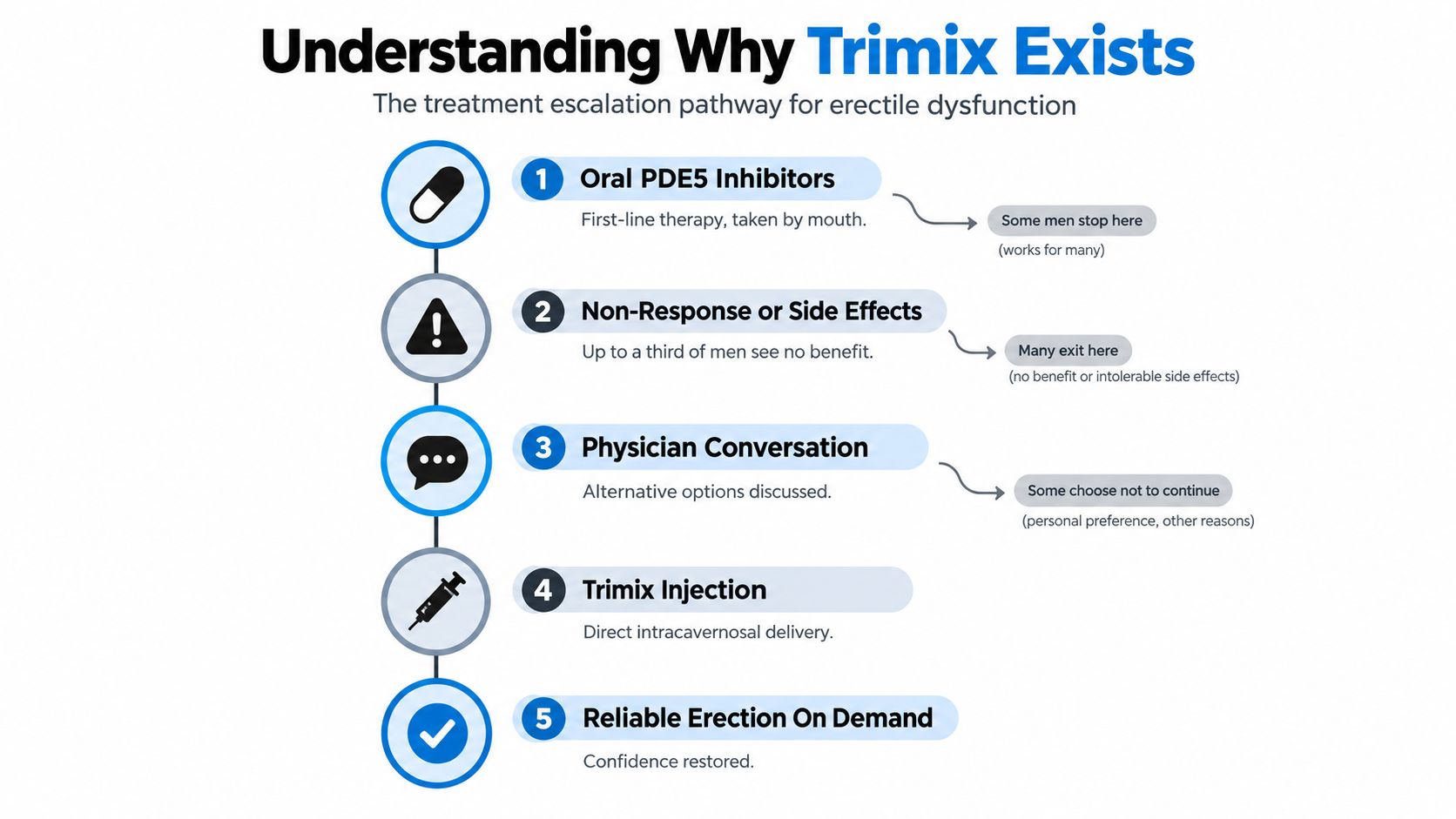
Why did Trimix become a standard option for erectile dysfunction when oral drugs already existed? The answer is practical. ED treatments do not all act at the same point in the erection process. Oral PDE5 inhibitors depend on a functioning signaling pathway and systemic absorption, while an intracavernosal injection delivers vasoactive medication directly into erectile tissue. That direct route is why Trimix earned a place in treatment, rather than serving as a stronger version of a pill.
Injection-based ED treatment developed quickly after early 1980s research showed that vasoactive drugs could produce erections without sexual stimulation. A historical study found that papaverine at 30 mg/mL combined with phentolamine at 1 mg/mL produced a response in 72% of 250 patients, and 97 continued the combination at home, as described in this review of intracavernosal therapy history.
Why combinations became important
The early evidence also explained why clinicians started combining agents. In a prospective study of 15 men, 13 achieved a full erection with papaverine plus phentolamine, compared with 6 using papaverine alone and 1 using phentolamine alone. Among 32 men who had not achieved an erection with the two-drug combination, 62% achieved a rigid erection after receiving the three-drug formulation, according to that same historical review.
That history matters because men who move to Trimix are often not starting from zero. They may have tried oral medication correctly and still had an inconsistent response, or they may have conditions that make oral treatment unsuitable. Direct delivery can bypass some of those limits, but it replaces systemic convenience with accurate dosing and hands-on instruction.
Long-term outcomes in follow-up data
Trimix is not automatically a permanent solution. In a 1998 study of 189 men followed for an average of 10.25 months, 48% remained on self-injection therapy. The same study reported penile fibrosis in 5.3% and prolonged erections in 3.7%. Those findings show both the value of treatment and the reason follow-up cannot be treated as optional.
Practical rule: Trimix should be treated as a prescribed medical protocol, not as a product to experiment with after watching an injection video.
The historical record supports Trimix as an established option. It does not support borrowing a partner's or friend's vial, estimating dose from injection volume alone, or increasing the amount because the first response was not immediate.
How Trimix Works Inside the Body
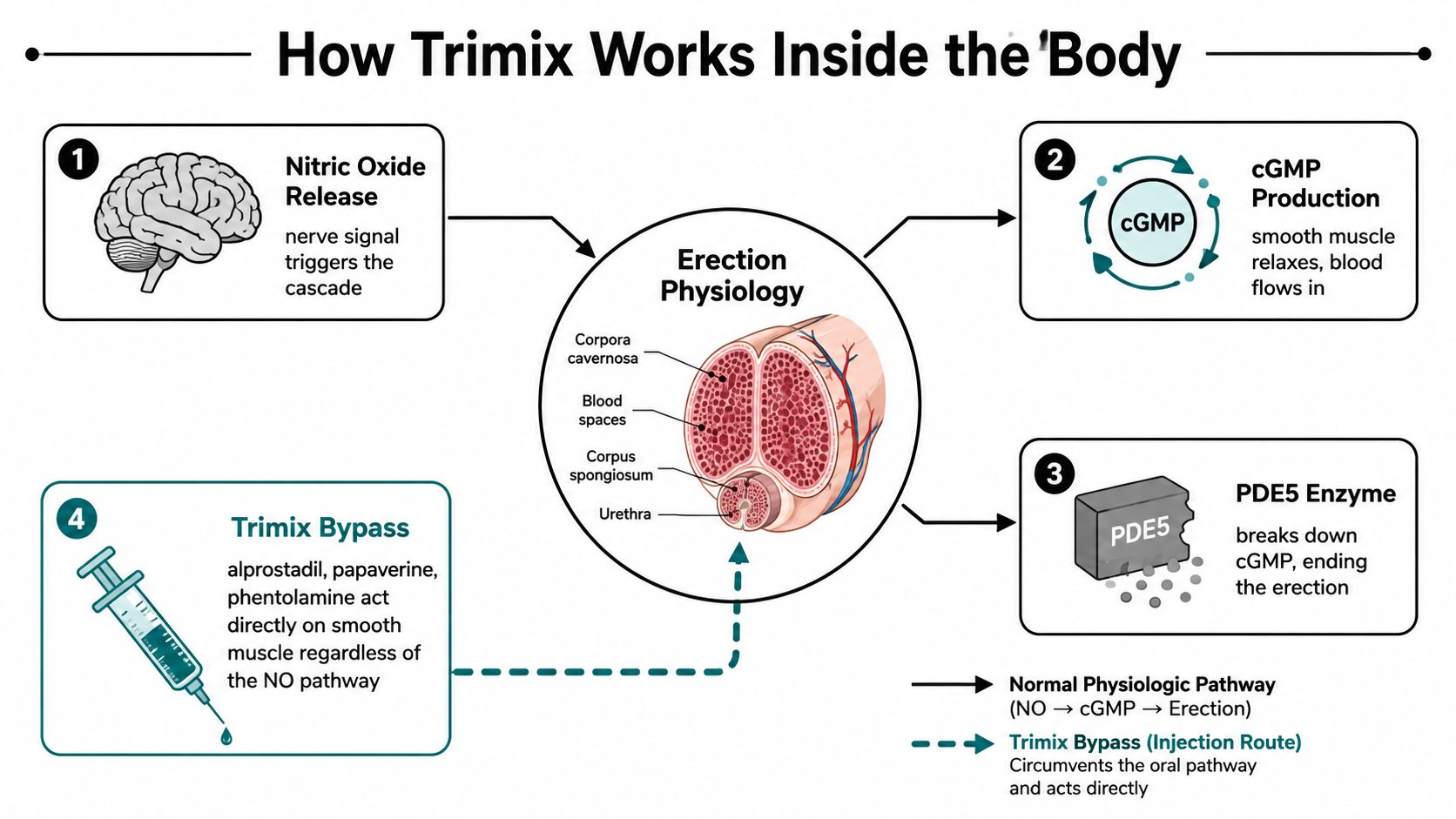
How does an erection happen when the usual nerve-signaling pathway is unreliable or too weak to produce firmness? Trimix addresses that problem by delivering medication straight into the corpora cavernosa, where the response needs to occur.
A normal erection still depends on coordinated blood flow, smooth-muscle relaxation, and enough pressure within the erectile bodies to limit venous outflow. Trimix changes the route, not the basic physics. Instead of relying on an oral drug to support one part of the process, it places three active agents directly into penile tissue.
Papaverine and alprostadil promote intracellular signaling that relaxes cavernosal smooth muscle. Phentolamine blocks alpha-adrenergic vasoconstriction, which reduces one of the signals that keeps penile vessels tightened. In practice, that combination can produce an erection even when PDE5 inhibitors have been used correctly and still have not delivered dependable rigidity.
Why the prescription concentration matters
The part many men never hear about is that "Trimix" is not one fixed formula. The European Association of Urology lists commonly used ranges of approximately 8–16 mg papaverine, 0.2–0.4 mg phentolamine, and 10–20 micrograms of alprostadil per injection. It also gives a benchmark concentration of 30 mg/mL papaverine, 1 mg/mL phentolamine, and 10 micrograms/mL alprostadil in its guideline discussion of ED management.
Those numbers are a reference point, not a universal dosing map. Compounding pharmacies prepare different concentrations, so injection volume alone does not tell you how much medication was delivered. Two patients can both inject 0.2 mL and receive very different amounts of each drug.
Reported efficacy can be high, and using less alprostadil than alprostadil monotherapy may reduce penile pain. The trade-off is real. Papaverine-containing regimens carry a higher risk of corporal fibrosis, reported at roughly 5–10% depending on cumulative dose, according to that same European urology guidance.
That mechanism is why Trimix can work so well at home, and also why home use can go wrong when men focus on volume instead of formulation, timing, and response. More drug can mean a longer erection, more pain, or an erection that lasts long enough to cause injury.
Trimix vs Oral Medications and Other Options
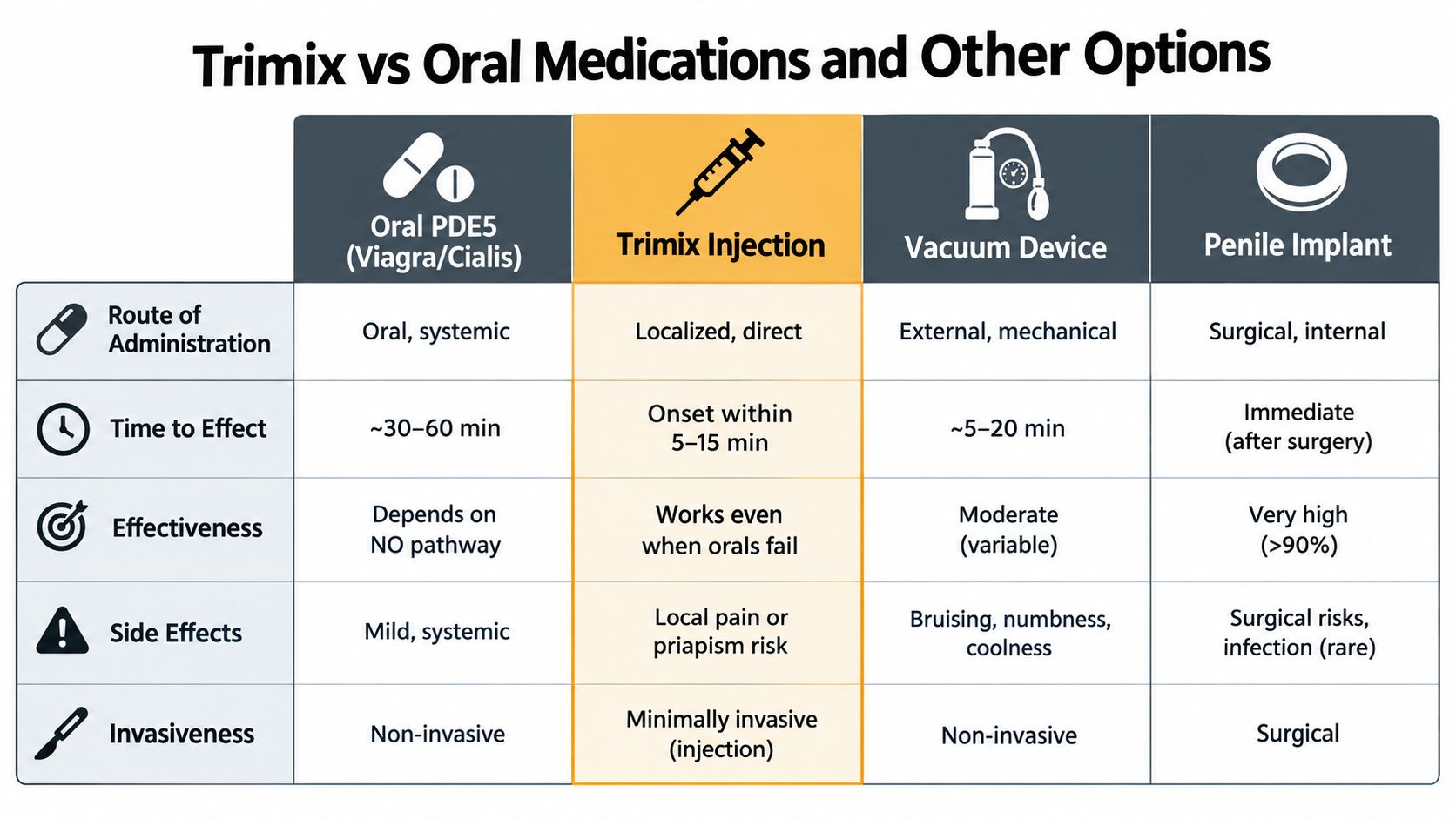
Could an oral medication meet your needs, or does your treatment history point toward injections? For many men, a PDE5 inhibitor such as sildenafil or tadalafil remains the simplest starting point. These medicines are taken by mouth and avoid needles, sterile handling, and an injection schedule. Their limitation is physiological: they depend on an adequate response through the nitric oxide and cyclic-GMP pathway, and firmness may remain insufficient despite correct use.
Trimix uses a different route. It delivers medication directly into erectile tissue, which can help when oral treatment has produced an inadequate response. The trade-off is a more involved routine, local injection risks, and greater dependence on the exact compounded formulation. Two pharmacies may prepare different concentrations, so the prescribed volume and the actual drug amounts must be understood together.
How patients transition in practice
Clinical follow-up data show that combination injections are commonly used within injection therapy. In a 2011 study, 85% of men were using Trimix at final follow-up, compared with 10% using Bimix, 2% using papaverine, and 3% using prostaglandin E1 alone, according to the American Urological Association ED guideline.
The same study reported a shift in ED severity. Before treatment, 14% had mild ED, 47% moderate ED, and 39% severe ED. During treatment, those proportions were 32%, 6%, and 0%, while 62% reached scores consistent with no ED. A separate outcomes review found that 89% of Trimix users were capable of sexual intercourse, as summarized in that same AUA guideline.
These findings support injections as a reasonable progression for men whose response to oral therapy is inadequate. They do not make Trimix the right choice for every patient, particularly when injection technique, formulation consistency, or priapism planning has not been addressed.
- Oral medication: Convenient and needle-free, but it may provide limited benefit when the relevant signaling pathway or vascular response is impaired.
- Trimix: Direct and adjustable, but it requires training, a prescription-specific concentration, and clear instructions for prolonged erections.
- Vacuum devices: Non-drug and noninvasive, although some men dislike the equipment, pressure, or mechanical sensation.
- Penile implants: A surgical option for selected men seeking a durable mechanical solution after other approaches are unsuitable.
Men comparing sildenafil, tadalafil, and other oral treatments can review prescription ED medication options. The decision should account for medical history, cardiovascular considerations, prior treatment response, the pharmacy's compounded formulation, and personal preference.
Safety Profile and Real Risks
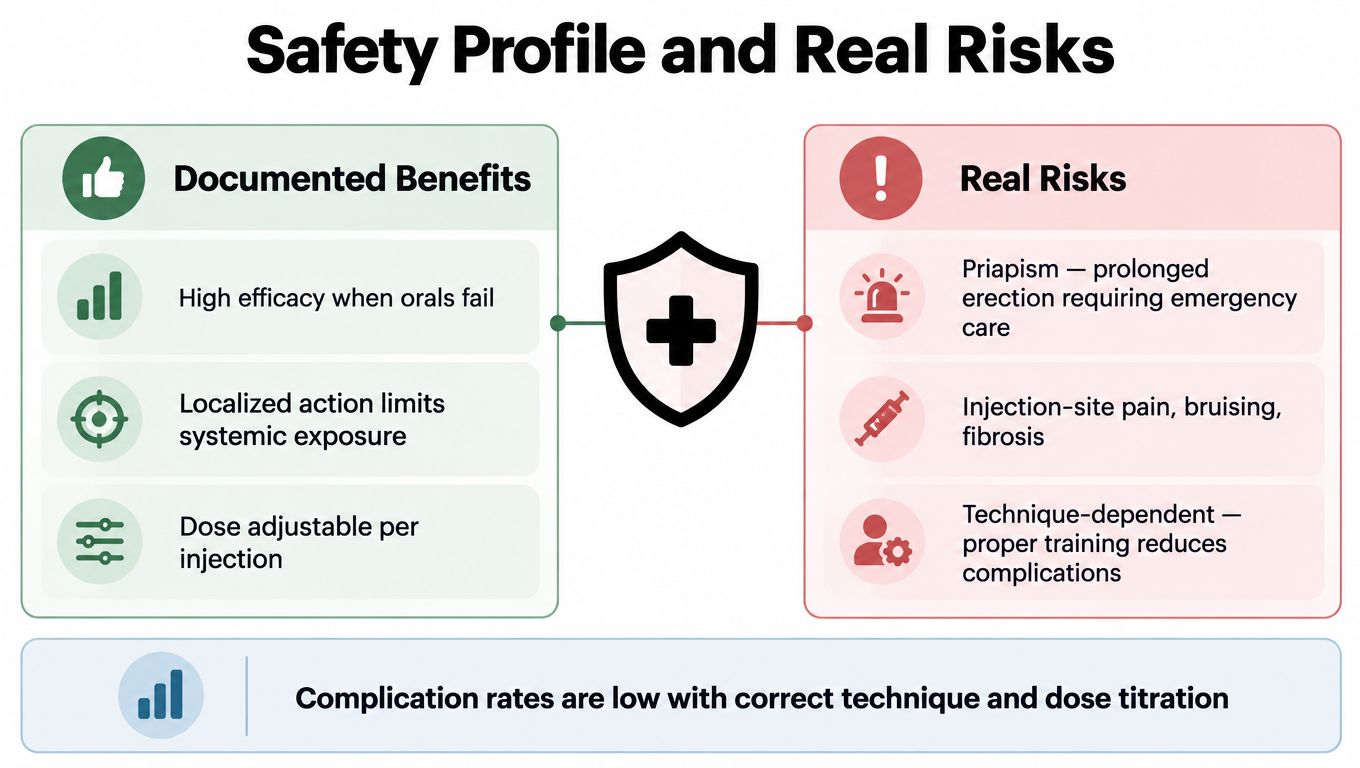
Can Trimix work well and still be unsafe for a particular patient? Yes. Its direct, potent effect makes dose selection, injection technique, formulation consistency, and an emergency plan part of treatment, not afterthoughts. The risk can also change between compounded preparations because concentrations and handling standards may differ.
Across studies of papaverine plus phentolamine, the AUA ED guideline reports mean injection pain of 14.43% and injection-site hematoma or inflammation averaging 14.46%. Reported priapism rates for papaverine-based therapy ranged from 0% to 15.2%, with a mean of 7.14% in papaverine studies. These figures describe study populations and formulations, so they should not be treated as a personal prediction.
The complication that changes the plan
Priapism is the most serious risk because prolonged ischemia can permanently injure erectile tissue. Clinical literature summarized in the AUA injection therapy guidance reports priapism at around 1% for intracavernosal therapy overall. Comparative experience also indicates that Trimix may produce longer-lasting erections than prostaglandin E1 alone, with a potentially higher priapism risk.
Penile fibrosis or plaque has been reported across injection medications at approximately 4.5–13%, also reported in that same AUA guideline evidence. Repeated trauma, injecting the same area, excessive dosing, and continuing despite tissue changes can increase management problems. Different compounded concentrations make volume alone an unreliable guide to dose.
A firm therapeutic erection is different from ischemic priapism. An erection approaching or exceeding four hours requires emergency care. Do not repeat the dose, increase the volume without authorization, or rely on home remedies while waiting.
Bruising, bleeding, pain, and curvature also deserve discussion. Men taking anticoagulants or living with a bleeding disorder, sickle-cell disease, leukemia, significant penile fibrosis, or a history of prolonged erections need individualized review before treatment. Ask the prescribing clinician how these factors affect the formulation, starting dose, monitoring plan, and emergency instructions.
From Consultation to Home Injection
Safe home use begins before the first home injection. The American Urological Association recommends an in-office test injection so the clinician can observe the response and establish a starting dose. That appointment should produce more than a prescription. You should leave knowing the concentration, measured dose, injection site, timing expectations, maximum permitted amount, and after-hours emergency plan.
A 2024 single-center study followed 233 men who began Trimix after penile Doppler evaluation, and 15 developed priapism during testing or subsequent home use. Higher Trimix dose during the Doppler procedure, lower cavernosal-artery end-diastolic velocity, and lower HbA1c were associated with priapism, as reported in the study abstract on Trimix-related priapism.
What the clinical process should include
A clinician may describe titration beginning around 0.2 cc, with cautious increases and a usual maximum of 1 cc, but those figures aren't substitutes for individualized prescribing. A compounded formulation's concentration can differ, so the same volume doesn't guarantee the same delivered dose.
- Review your risk profile. Discuss prior prolonged erections, vascular disease, diabetes, anticoagulants, bleeding disorders, sickle-cell disease, leukemia, and penile fibrosis.
- Test the response in the office. The clinician can assess firmness and duration instead of asking you to discover your personal dose alone.
- Learn the route and landmarks. The injection belongs in the lateral penile shaft, not the dorsal midline. Avoid visible vessels and follow the exact training provided.
- Rotate sides. Alternating injection sites helps limit repeated local trauma. Apply firm pressure afterward to reduce bruising.
- Follow the frequency instruction. Don't inject more often than prescribed, and don't repeat a dose early because the response seems slower than expected.
What I want patients to understand: the syringe measures volume, but the vial's concentration determines the medication dose.
A written emergency plan should tell you exactly whom to call and where to go. If your erection is approaching four hours, seek emergency care rather than waiting for it to resolve. You can review a clinician-led intake pathway through online ED treatment support, but any provider should assess your history and explain emergency procedures before prescribing.
Cost, Access, and Telemedicine Options
Access problems can push men toward unsafe shortcuts. A clinic may be difficult to reach, a specialist appointment may take time, or a patient may feel uncomfortable discussing injections in person. Telemedicine can reduce some of those barriers, but convenience only helps when the service preserves clinical assessment, prescription accuracy, and follow-up.
Cost Plus TRT offers prescription ED medications that include sildenafil capsules and troches, tadalafil chewables and capsules, and options such as Trimix injections. For TRT, its one plan is $119 a month and includes lab work, provider visits, testosterone cypionate, injection supplies, and shipping.
What to verify before choosing a provider
A telemedicine intake shouldn't amount to a checkbox exercise. Ask whether a licensed physician reviews your medical history, whether the first dose can be supervised appropriately, and whether the clinician explains what to do if the erection lasts too long.
Use transparent ED treatment pricing to examine the financial side, then ask practical questions that pricing pages may not answer:
- Formulation details: Can you see the exact ingredients and concentrations on the prescription?
- Training: Does a clinician explain injection location, site rotation, storage, and dose changes?
- Follow-up: Can you reach the medical team when the response is weak, too strong, painful, or unusually long?
- Emergency planning: Do you receive clear instructions for an erection approaching four hours?
- Pharmacy handling: Are shipping conditions, refrigeration, beyond-use dates, and replacement procedures explained?
A lower-friction pathway is useful only if the medical safeguards remain visible. The right service makes it easier to access care, not easier to bypass it.
Navigating Compounded Medication Quality
Trimix is a compounded medication, so every vial labeled Trimix should not be assumed to contain the same concentration. The name refers to papaverine, phentolamine, and alprostadil, while the prescribed strengths, storage requirements, beyond-use date, and pharmacy procedures may vary by prescription and jurisdiction.
That variation affects dosing. If one vial is more concentrated, the same injection volume could deliver a different amount of medication. Treat each refill as a new supply to verify, rather than automatically repeating the volume used with an earlier vial.
Regulatory status isn't a quality verdict
Trimix is not FDA-approved as a combination ED product in the United States, and the Canadian Urological Association notes that it is not approved by Health Canada. These regulatory facts support individualized clinician supervision for initiation and dose adjustment. They do not, on their own, establish whether a particular pharmacy prepared or handled your prescription correctly.
A clinical reference on intracavernosal therapy notes that Trimix may be more efficacious than alprostadil alone, with an acceptable side-effect profile and less penile pain, while emphasizing individualized dosing. Patients should discuss the formulation and regulatory context with the prescriber, especially because compounded products can differ in strength and handling.
Before using a compounded vial, confirm the following with your clinician or pharmacy:
- Ingredient strengths: Record each component's concentration, not only the injection volume.
- Sterility and handling: Ask how the pharmacy prepares, packages, and ships the medication.
- Storage: Follow the supplied refrigeration and transport instructions.
- Beyond-use date: Check the date on the current vial and ask what to do if delivery conditions are uncertain.
- Training and support: Confirm that you have technique instruction and a direct route for clinical questions.
- Replacement policy: Know the process for a vial that arrives damaged, warm, leaking, or past its usable date.
Alternative formulations still require the same scrutiny. A 2025 study of intracavernosal aviptadil plus phentolamine reported pain in the broader ICI literature at about 12% and priapism around 1%. Its own study reported ischemic priapism in 0.3%, according to that same clinical reference on injection alternatives. These findings may matter for selected patients, but they do not make an alternative a universal replacement for Trimix.
Cost Plus TRT offers physician-supervised access to ED medications, including prescription Trimix injections, through online consultations and discreet fulfillment for eligible patients. Review transparent ED treatment pricing and visit Cost Plus TRT to discuss whether a clinician-guided formulation and dosing plan fit your medical history.