

Trimix dosing is individualized rather than fixed. A common supervised starting point is around 0.05 to 0.1 mL, titrated upward in small steps, with a widely used ceiling near 0.5 mL for standard-strength formulations.
You may be looking at a small vial and an insulin syringe, wondering whether the correct dose is 5 units, 10 units, or something higher. The answer depends on more than the mark on the barrel. The vial's formulation strength determines how much medication each milliliter contains, so the same volume can produce very different drug exposure in two patients.
This guide explains how clinicians approach Trimix injections dosage, how to read the label, why formulation changes require caution, and when an erection becomes an emergency. It's educational information, not a prescription. Follow the exact instructions from your prescriber and compounding pharmacist.
Table of Contents
- What Trimix Dosing Actually Looks Like in Practice
- Why Trimix Uses Three Drugs Instead of One
- Reading the Vial Label and Converting mL to Syringe Units
- Common Trimix Concentration Strengths Compared
- Starting Dose and Titration Protocol Step by Step
- Injection Technique That Affects Your Effective Dose
- Safety Ceilings, Priapism Risk, and Side Effects to Watch
- When to Call Your Provider Instead of Self-Adjusting
- Trimix Quick-Reference Dosing Chart
- Trimix Dosing Questions Patients Ask Most
What Trimix Dosing Actually Looks Like in Practice
At a urology appointment, the first Trimix discussion often starts with a vial, a syringe, and a question that sounds simple: “How much do I inject?” The practical answer is usually a starting volume selected by the clinician, followed by careful adjustments based on firmness, duration, pain, and side effects.
Trimix isn't dosed like a tablet with one standard milligram amount for everyone. It's a volume in milliliters drawn from a vial with a specific concentration. A commonly referenced supervised starting range is 0.05 to 0.1 mL, with gradual increases of about 0.05 mL under clinical guidance, as described in this Trimix dosing and storage guide.
The endpoint matters more than the number
The clinician isn't trying to find the largest dose you can tolerate. The aim is the lowest effective volume that produces an erection firm enough for intercourse, commonly described in patient guidance as roughly 70% to 80% rigidity, without excessive duration. A practical target is an erection that lasts about 30 to 60 minutes and then subsides without intervention.
That process may take several attempts. If the first dose produces little response, the prescriber may authorize a small increase at the next attempt. If it produces prolonged firmness or significant discomfort, the dose may be reduced or the concentration reassessed.
Practical rule: Treat every dose as information. Firmness, onset, duration, pain, bruising, and technique all help the prescriber decide what to change.
The published evidence behind Trimix-style dosing also supports an individualized approach. A 2005 randomized study enrolled 180 men in 9 equal groups and compared different combinations of papaverine, phentolamine, and prostaglandin E1, demonstrating why ingredient concentrations matter alongside injection volume (International Journal of Impotence Research study).
Why Trimix Uses Three Drugs Instead of One
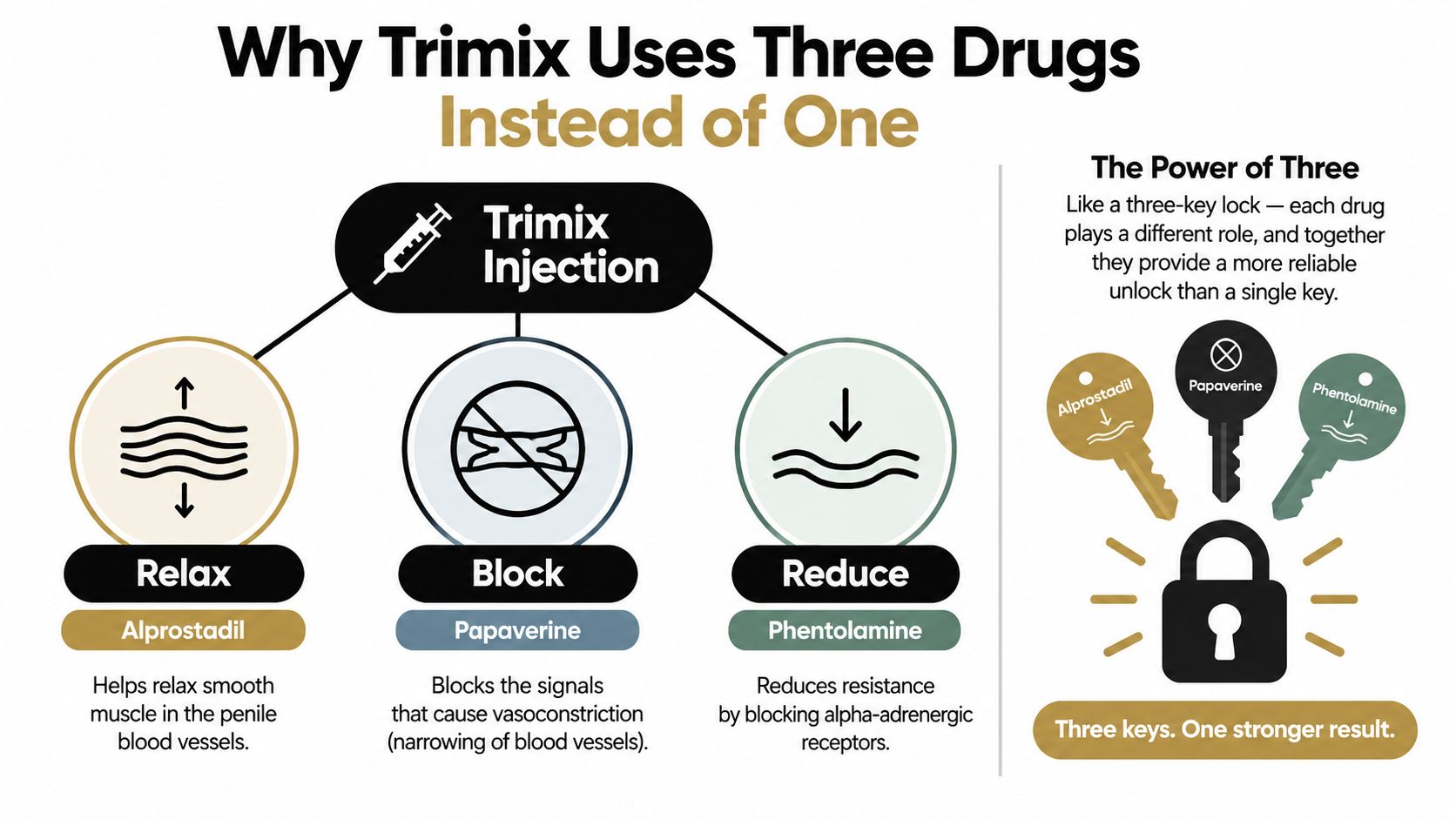
Trimix combines alprostadil, papaverine, and phentolamine because each component supports penile smooth-muscle relaxation through a different mechanism. The combination works like a three-key lock. One medication may help, but the blend can address several parts of the erectile response at once.
Alprostadil, a prostaglandin E1 analog, increases cyclic AMP and promotes smooth-muscle relaxation. Papaverine acts as a nonspecific phosphodiesterase inhibitor, helping maintain that relaxed state. Phentolamine blocks alpha-adrenergic receptors, reducing signals that constrict blood vessels.
Together, these effects increase arterial inflow and help blood remain trapped within the corpora cavernosa. That mechanism explains why Trimix can work locally when oral medicines haven't produced a sufficient response. For broader context on prescription ED treatment options, see the ED medication options from Cost Plus TRT.
Why the combination changes dosing decisions
A small change in concentration can change the amount of active medication delivered by the same volume. For example, 0.1 mL from a stronger vial isn't equivalent to 0.1 mL from a weaker vial, even though the syringe markings look identical.
That's why switching from one compounded formulation to another may require re-titration from a lower volume. Carrying an old syringe number over to a new vial without checking the label can produce an unintended increase in drug exposure.
Reading the Vial Label and Converting mL to Syringe Units
Start with the label, not the syringe. A compounded Trimix vial should identify the ingredients, each ingredient's concentration per milliliter, total volume, beyond-use date, and storage instructions. Those details define what the prescribed volume delivers.
Many patients use a 0.5 mL or 1 mL insulin syringe marked in increments corresponding to 0.01 mL. On a commonly used U-100-style barrel, the 10 mark corresponds to 0.1 mL, but you must confirm the calibration with your pharmacist. The syringe is measuring liquid volume. It isn't automatically telling you the dose of Trimix medication.
A simple conversion example
For a standard-strength example containing papaverine 30 mg/mL, phentolamine 1 mg/mL, and alprostadil 10 mcg/mL, a 0.1 mL injection contains one-tenth of the amount listed per milliliter. The medication amount changes if the vial contains a different concentration, even when the volume stays at 0.1 mL.
| Trimix Volume (mL) | Syringe Marking on 0.5 mL Barrel | Approximate Drug Dose (standard strength) |
|---|---|---|
| 0.05 mL | 5 mark | Papaverine 1.5 mg, phentolamine 0.05 mg, alprostadil 0.5 mcg |
| 0.10 mL | 10 mark | Papaverine 3 mg, phentolamine 0.1 mg, alprostadil 1 mcg |
| 0.20 mL | 20 mark | Papaverine 6 mg, phentolamine 0.2 mg, alprostadil 2 mcg |
| 0.30 mL | 30 mark | Papaverine 9 mg, phentolamine 0.3 mg, alprostadil 3 mcg |
| 0.50 mL | 50 mark | Papaverine 15 mg, phentolamine 0.5 mg, alprostadil 5 mcg |
The table illustrates volume conversion, not a personal dosing plan. Before injecting, compare the prescription instructions with the vial label and syringe calibration. If either is unclear, stop and ask the prescribing clinician or pharmacist.
Common Trimix Concentration Strengths Compared
Compounding pharmacies may prepare Trimix at different strengths. The terms standard, mid-strength, and super can be useful shorthand, but they aren't universal product standards. The exact formulation on your vial takes priority over any online chart.
A standard formulation is often used when a patient is beginning supervised titration. A mid-strength blend may be considered when the patient has an incomplete response to standard strength and the prescriber wants more medication delivered in a smaller volume. A super-strength formulation is generally reserved for more difficult cases after other approaches haven't provided adequate results.
Higher concentration doesn't mean a patient should inject a higher volume. It often means the prescriber can deliver a similar or greater medication amount with less liquid. That can help when volume becomes uncomfortable or when a patient approaches the usual volume ceiling, but the change must come from the prescriber.
| Tier | Papaverine (mg/mL) | Phentolamine (mg/mL) | Alprostadil (mcg/mL) | Typical Patient Profile | Volume Ceiling |
|---|---|---|---|---|---|
| Standard | 30 | 1 | 10 | New titrators or patients starting supervised testing | Near 0.5 mL for standard-strength protocols |
| Mid-strength | 30 | 2 | 20 | Partial responders requiring formulation adjustment | Prescriber-defined, commonly below the standard ceiling |
| Super | 30 to 40 | 2 to 4 | 20 to 30 | Refractory ED requiring specialist-directed treatment | Prescriber-defined |
These ranges reflect commonly referenced compounded families, not a universal pharmacy formula. Some pharmacies use different names, ingredient ratios, or alternatives such as Bimix-style preparations. A formulation change can alter both efficacy and adverse-effect risk, so don't self-escalate from standard to mid-strength or super strength.
Starting Dose and Titration Protocol Step by Step
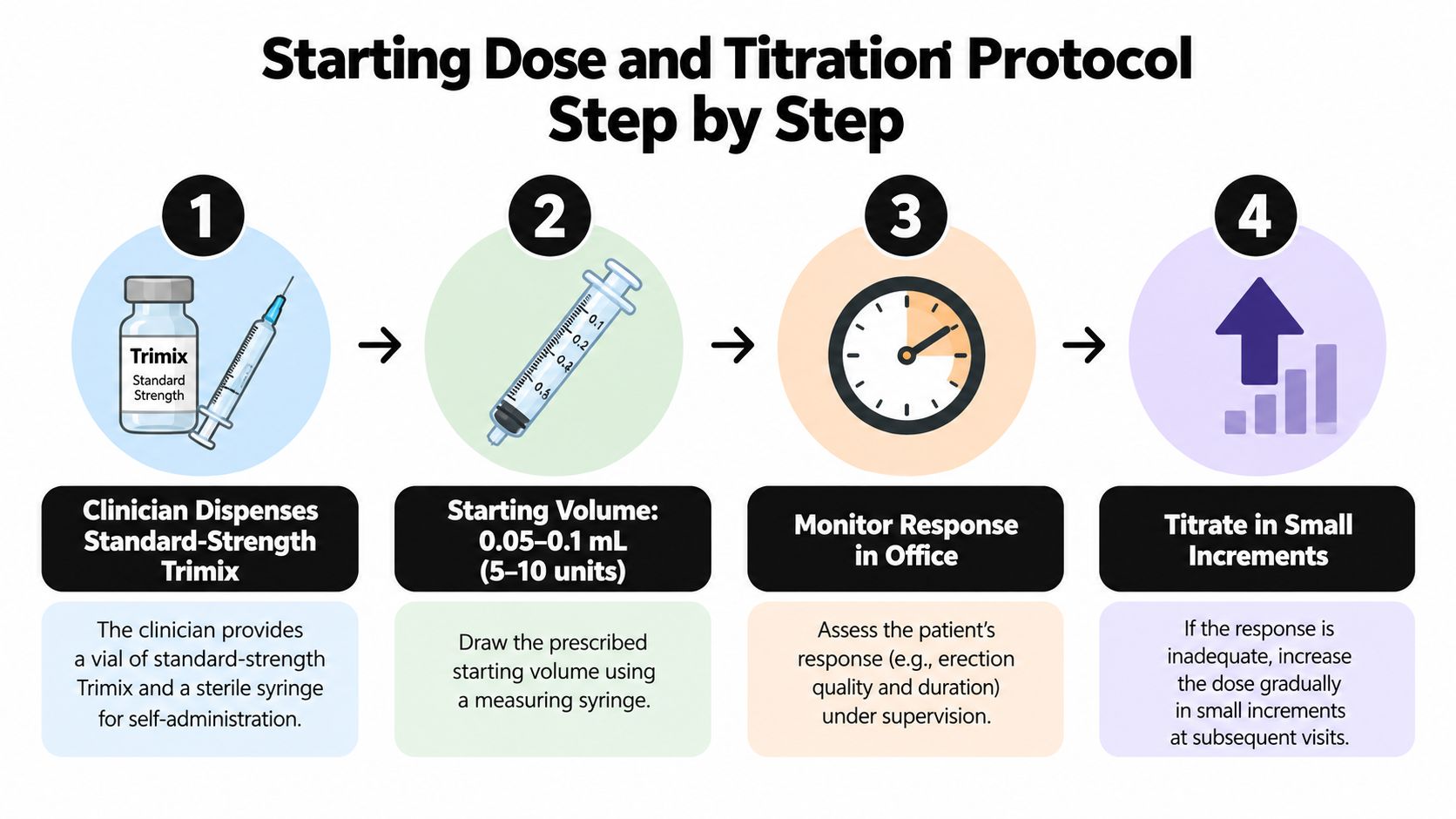
A safe Trimix plan usually begins under supervision. The clinician confirms the formulation, chooses a conservative volume, teaches injection technique, and observes the response before authorizing home titration.
Begin with the prescribed volume. A commonly referenced starting point is 0.05 to 0.1 mL, equivalent to 5 to 10 syringe units when the syringe is calibrated so that 1 unit equals 0.01 mL. Some clinicians choose the lower end for a sensitive or post-prostatectomy patient and a higher starting point for someone with prior injection experience.
Monitor the response. Record how quickly firmness develops, how firm the erection becomes, how long it lasts, and whether pain or dizziness occurs. The purpose isn't to chase maximum rigidity. It's to identify a useful response without excessive duration.
Leave time between attempts. Published patient guidance describes successive trial doses such as 0.1, 0.2, 0.3, 0.4, and 0.5 mL, with at least 24 hours between attempts (patient titration guidance). Your prescriber may use a different schedule.
Increase only in small steps. Increments of 0.025 to 0.05 mL are commonly used because Trimix has a narrow therapeutic window. A small change can improve firmness, but it can also increase the chance of a prolonged erection.
Stop when the response is adequate. Once the erection is suitable for intercourse and resolves normally, stay at that volume unless your prescriber changes the plan.
If the erection becomes excessively prolonged, painful, or otherwise abnormal, don't take another dose to compensate for an earlier poor response. Contact the prescriber for specific instructions.
Injection Technique That Affects Your Effective Dose
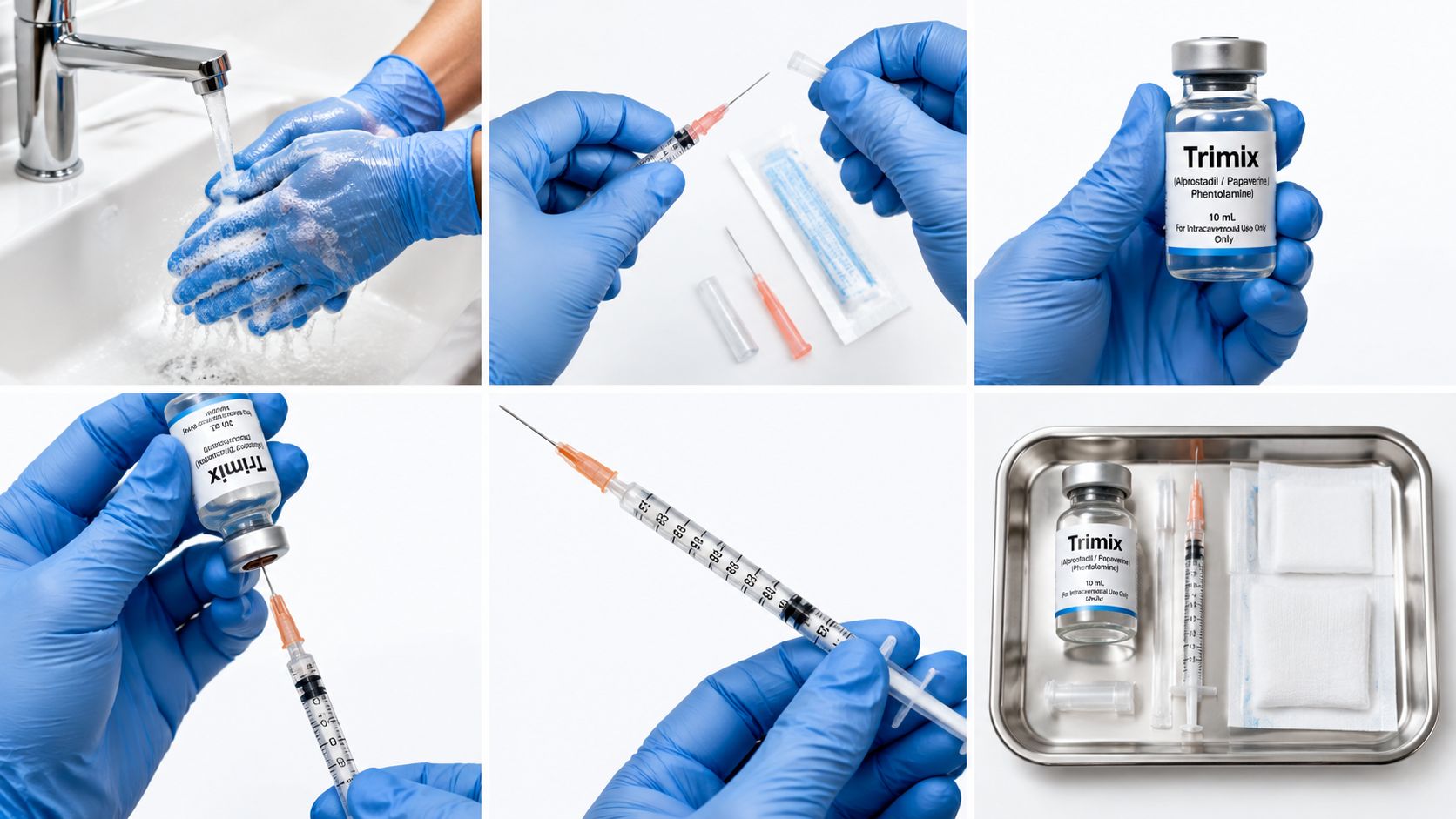
A prescription can be correct and still appear ineffective if the medication doesn't enter the intended tissue. Wash your hands, use a new sterile syringe, and draw the prescribed volume by aligning the leading edge of the plunger with the correct marking. Remove visible air bubbles without losing an uncertain amount of medication.
The usual teaching point is to inject into the lateral penile shaft, around the 10 or 2 o'clock positions, while avoiding the 12 o'clock midline and visible superficial veins. Alternate sides and locations to reduce repeated trauma. Your clinician should demonstrate the exact site and angle for your anatomy.
Technique problems that mimic an inadequate dose
The needle should enter the erectile tissue rather than remain in superficial fat. Leaking from the puncture site, injecting into scarred tissue, or using an incorrect angle can reduce the amount reaching the corpus cavernosum. Increasing the volume after a poorly placed injection can create unnecessary risk without correcting the underlying problem.
Inject slowly, withdraw carefully, and apply brief pressure afterward. Follow your clinician's instructions about distributing the medication and handling the syringe. This instructional injection video can supplement, but not replace, hands-on training from a qualified professional.
Safety Ceilings, Priapism Risk, and Side Effects to Watch
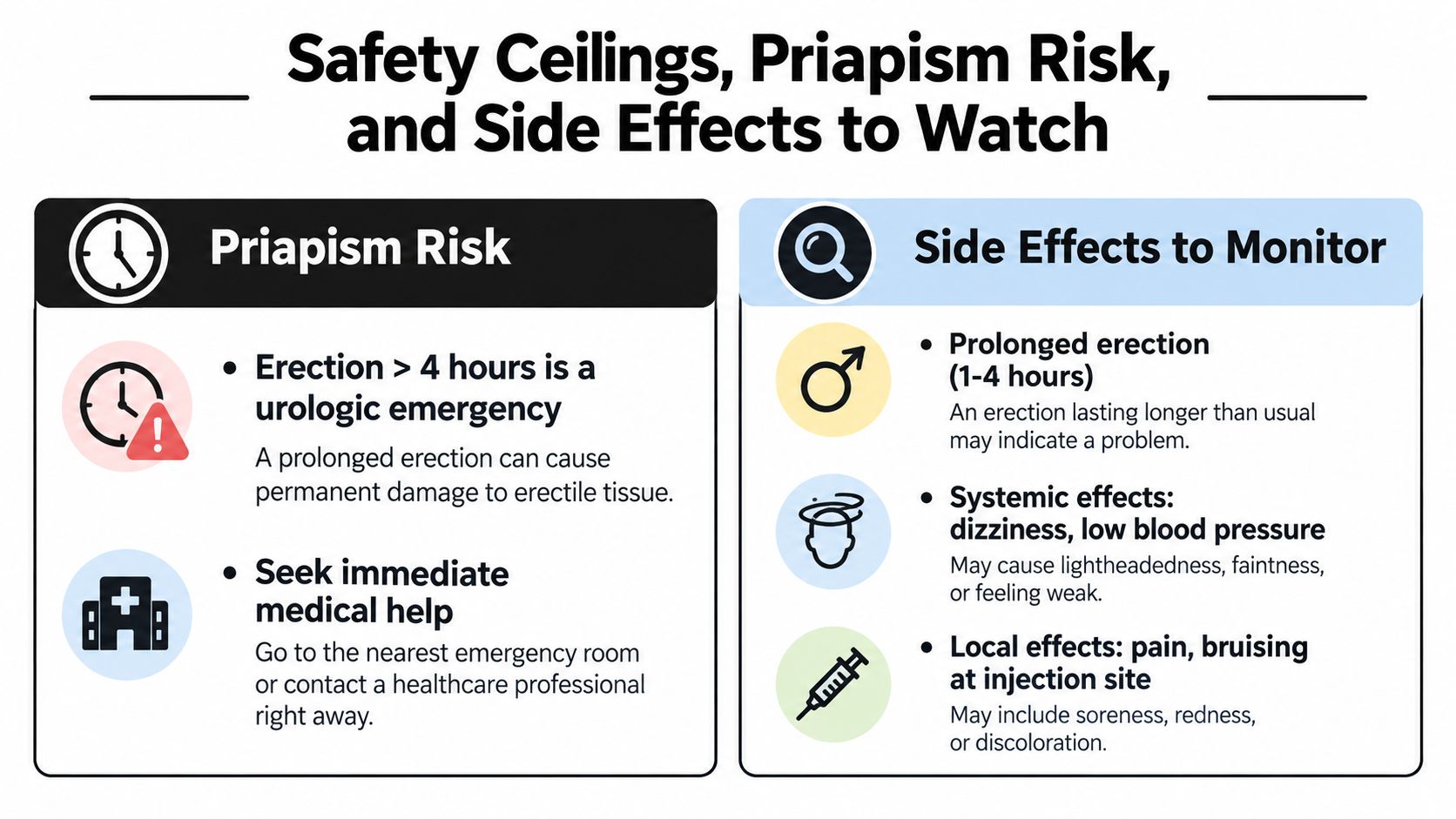
The major safety concern is priapism, a rigid erection that persists beyond 4 hours. That is a urologic emergency because prolonged trapped blood can damage erectile tissue. Don't wait for it to resolve on its own if it reaches that threshold.
A prolonged erection below that point still deserves attention, particularly if it's painful or isn't gradually subsiding. Other possible problems include penile pain, bruising, swelling, dizziness, low blood pressure, and fibrosis or scarring from repeated injections in the same area.
Why volume ceilings exist
Several patient protocols cap regular-strength Trimix at 0.5 mL, or 50 units, and the recurring ceiling reflects a cautious upper boundary in common practice (Trimix dosing reference). The rationale is straightforward. Increasing the volume increases the delivered amount of each ingredient, while the benefit may stop improving at the same rate and the risk of excessive erection or systemic vasodilation can rise.
| Warning sign | What to do |
|---|---|
| Rigid erection lasting more than 4 hours | Seek emergency medical care immediately |
| Painful or prolonged erection before that point | Contact the prescriber urgently for the established reversal plan |
| Dizziness, faintness, or unusual weakness | Sit or lie down and seek medical advice promptly |
| Repeated bruising, swelling, nodules, or curvature | Stop self-adjustment and contact the prescriber |
Don't use a decongestant or other reversal medication unless your prescriber has specifically told you what to use and how to use it. Emergency clinicians may treat priapism with medication and aspiration or irrigation, depending on the situation. Never re-dose within 24 hours or increase the volume without prescriber direction.
When to Call Your Provider Instead of Self-Adjusting
Trimix titration is supervised treatment, not an experiment conducted alone. Contact the prescriber rather than changing the volume, concentration, or frequency when the response falls outside the plan.
Seek emergency care immediately for an erection that reaches 4 hours. Call the prescribing team promptly for a painful prolonged erection, faintness or marked dizziness, repeated bruising, swelling, or an injection that may have entered a visible vein.
Specific reasons to pause the plan
- No response after two consecutive prescribed attempts: Don't keep escalating without a review of technique, vial strength, timing, and medical factors.
- A new nodule or curvature: Report it to the prescriber, ideally within 24 hours, because repeated injection-site trauma can contribute to fibrosis.
- Medication interaction concerns: Discuss nitrates, PDE-5 inhibitors, blood-pressure medicines, and other treatments before combining them with Trimix.
- A formulation change: Ask for a new titration plan whenever the pharmacy or prescriber changes concentration.
- A possible product issue: Keep the vial, label, beyond-use date, and compounding pharmacy lot number available for clinical review or any product investigation.
For a supervised evaluation, you can review the Cost Plus TRT getting-started process, while remembering that eligibility, prescribing, and formulation decisions require clinician assessment.
Trimix Quick-Reference Dosing Chart
The chart below organizes the dosing logic into a reference framework. It isn't a prescription, and the concentration listed on your vial may differ from these common compounded families.
| Concentration Tier | Starting Volume | Typical Working Range | Max Per Dose | Min Interval |
|---|---|---|---|---|
| Standard | 0.05 to 0.1 mL | Titrated upward in small steps | Near 0.5 mL in common protocols | At least 24 hours |
| Mid-strength | Lower volume selected by prescriber | Formulation-specific titration | Prescriber-defined | At least 24 hours |
| Super | Specialist-selected low volume | Formulation-specific titration | Prescriber-defined | At least 24 hours |
The 0.5 mL ceiling applies to commonly referenced standard-strength protocols, not automatically to every stronger formulation. A higher-concentration vial can deliver more medication at a lower volume, so copying a syringe number from an older prescription can be unsafe.
Trimix Dosing Questions Patients Ask Most
How long should an erection last?
The practical target is an erection firm enough for intercourse that lasts roughly 30 to 60 minutes and then resolves. A rigid erection lasting more than 4 hours is an emergency, while a painful or unusually prolonged erection before then requires prompt clinical guidance.
What if the first injection does nothing?
Don't immediately repeat the injection or take extra Trimix. The cause may be technique, timing, inadequate stimulation, vial concentration, or the need for a carefully authorized adjustment. Report the result and follow the prescriber's next-step instructions.
Can I use Trimix several times a week?
Use only the frequency your prescriber authorizes. Leave at least 24 hours between attempts under commonly used guidance, and rotate injection sites to limit local injury and scar formation.
Should the dose change over time?
It can. Changes in health, circulation, medications, technique, vial strength, and sensitivity can alter the response. A change in effect calls for reassessment, not automatic escalation.
Can a stronger formulation fix poor technique?
No. A stronger vial may increase medication exposure without correcting a shallow injection, leakage, air-bubble error, or scarred injection site. Ask for a technique review before changing concentration.
Do alcohol or PDE-5 inhibitors affect dosing?
They can affect safety and response, particularly when combined with medicines that influence blood pressure or erectile function. Discuss alcohol use and every ED medicine, including sildenafil and tadalafil, with the prescriber before combining treatments.
The Cost Plus TRT FAQ can help you prepare questions, but it doesn't replace individualized medical advice or emergency care.
Cost Plus TRT offers physician-supervised ED treatment options, including Trimix injections, through an online care process with medication delivery when prescribed. Visit Cost Plus TRT to review eligibility and discuss a dosing plan based on your formulation, medical history, and treatment goals.