

The most common Trimix reactions are local, including bruising, mild pain, and temporary swelling. Priapism and scarring are less common, but they're the main reasons clinicians monitor dose, injection technique, and erection duration.
You may be reading this with a vial on the counter, a syringe in your hand, and one practical question: what should feel normal after a Trimix injection, and what means you need help? Most reactions involve the penis and settle without lasting trouble. The important exceptions are an erection that doesn't go away, worsening pain, infection, or changes that build after repeated injections.
A 2024 analysis of 26,104 in-office intracavernosal injections reported priapism in 4.0% of patients, while a 2012 review found an extremely low rate of 0.5% in its clinical dataset. These figures come from different populations and protocols, so they shouldn't be treated as a personal forecast. They do show why time tracking, careful titration, and an emergency plan matter. The contemporary analysis and broader Trimix safety evidence place priapism among the uncommon but clinically important complications of injection therapy.
Table of Contents
- What Trimix Is and Why It Is Injected
- How the Three Drugs in Trimix Work
- Common Local Reactions After a Trimix Injection
- Priapism, Fibrosis, and Other Serious Risks
- Systemic Side Effects and Cardiovascular Signals
- Managing Side Effects and Knowing When to Seek Help
- Telemedicine and Safe Sourcing Considerations
- Key Takeaways for Safer Trimix Use
What Trimix Is and Why It Is Injected
A man preparing his first injection may notice that Trimix looks more complicated than a standard prescription tablet. The vial contains a compounded combination of alprostadil, papaverine, and phentolamine, and the syringe delivers the medication directly into the erectile tissue.
Trimix is used when oral erectile dysfunction medicines haven't worked well enough, aren't suitable, or can't be used safely for a particular patient. Tablets rely partly on intact nerve signaling and sexual stimulation. Intracavernosal therapy works more directly on the smooth muscle and blood vessels inside the corpora cavernosa, so an erection can occur even when nerve signaling or arousal is limited.
Trimix is commonly described as taking effect within 5 to 15 minutes, but the actual response depends on the formulation, dose, technique, and individual physiology. The prescriber should establish the starting dose and adjust it gradually rather than having the patient experiment at home. You can learn more about prescription ED treatment options through ED medications from Cost Plus TRT.
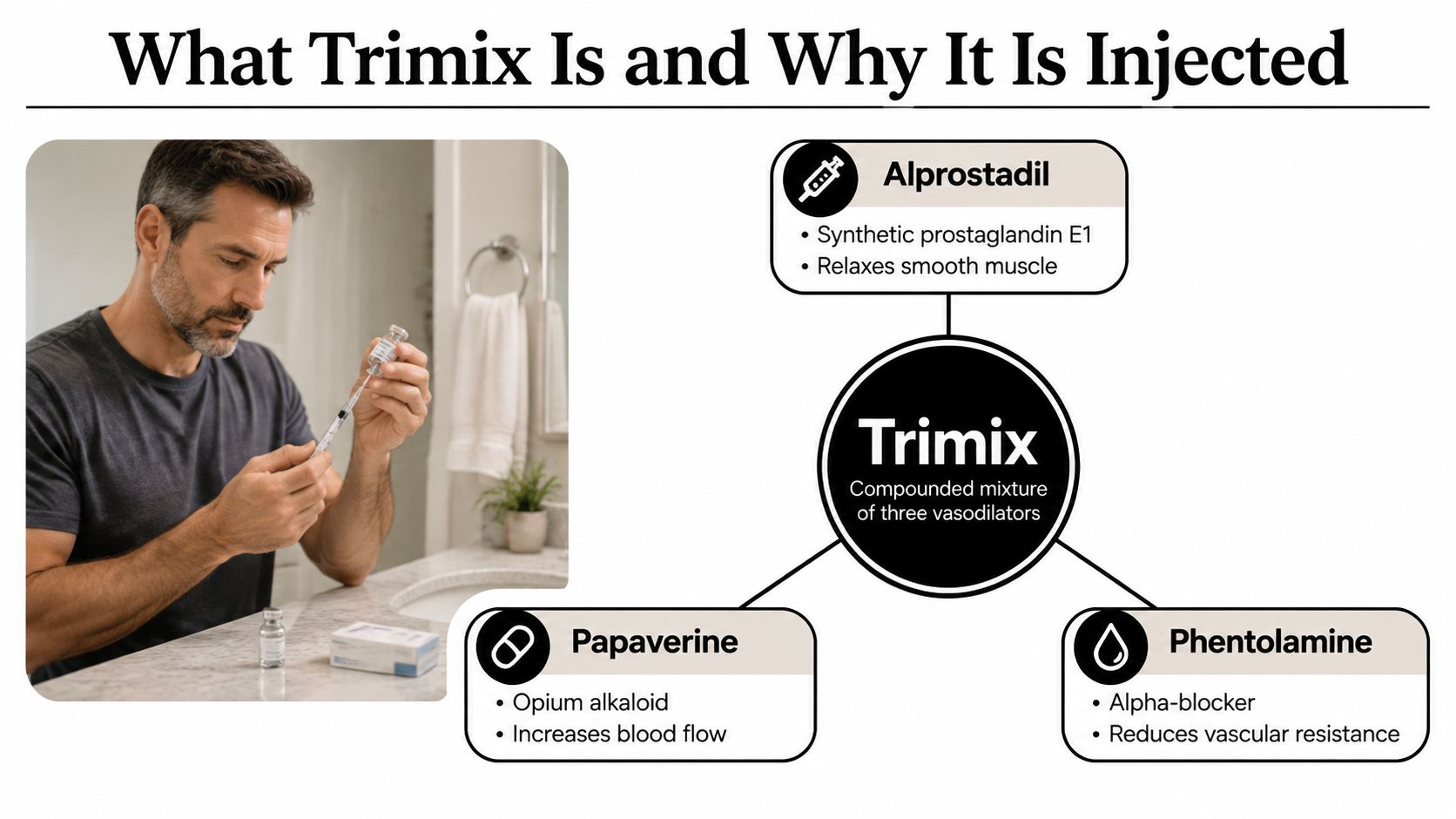
Why the injection goes into the penis
Direct delivery bypasses the digestive system and places the drugs near the tissue they're intended to affect. That helps explain why the most noticeable reactions are usually pain, bruising, bleeding, swelling, or firmness at the injection site, rather than whole-body symptoms.
It also creates a dosing responsibility. The medicine reaches the erectile chambers quickly, and too much can produce an erection that lasts longer than intended. Your prescription should specify the concentration, volume, maximum dose, and what to do if the erection doesn't subside.
The rest of the risk discussion becomes easier if you separate two categories:
- Immediate nuisance effects, such as a small bruise or brief ache.
- Potentially damaging effects, such as ischemic priapism or progressive scarring.
That distinction keeps ordinary injection irritation from sounding like an emergency, while still giving prolonged erections the urgency they deserve.
How the Three Drugs in Trimix Work
Each Trimix ingredient contributes to the same outcome, increased blood flow and smooth-muscle relaxation, but the drugs reach that outcome through different pathways. Those differences help explain why one person notices burning, another develops lightheadedness, and another has an erection that lasts too long.
Alprostadil is a prostaglandin E1 medicine. It relaxes cavernosal smooth muscle and is the component most often associated with a localized burning or aching sensation. Broader references on intracavernosal alprostadil identify priapism at about 4% and fibrosis at about 8%, although those figures describe alprostadil safety references rather than every Trimix formulation. StatPearls' alprostadil reference also lists dizziness, hypotension, headache, bruising, penile pain, infection, and prolonged erection among recognized adverse effects.
Papaverine relaxes smooth muscle through phosphodiesterase-related effects. In practical terms, it helps keep blood vessels open inside the penis. It also contributes to the concern about an erection that becomes too firm or lasts too long, particularly when the total formulation or dose is stronger than the patient needs.
Phentolamine blocks alpha-adrenergic activity. That reduces the vessel-tightening signals that can oppose an erection. Because alpha-adrenergic pathways also influence vascular tone elsewhere in the body, phentolamine may contribute to dizziness or blood-pressure changes if enough medication reaches the systemic circulation.
| Drug | Mechanism | Primary risk |
|---|---|---|
| Alprostadil | Relaxes cavernosal smooth muscle through prostaglandin-related signaling | Local burning or aching, prolonged erection, priapism |
| Papaverine | Promotes smooth-muscle relaxation and increased penile blood flow | Prolonged erection and longer-term fibrosis concerns |
| Phentolamine | Blocks alpha-adrenergic vasoconstriction | Lightheadedness or blood-pressure changes |
Why the mixture needs personalization
The drugs can work together, which is why a compounded combination may produce a strong response at individually adjusted concentrations. That same interaction makes a standard internet dose unreliable. A formulation that works gently for one patient may be excessive for another, particularly when the patient has neurogenic ED, psychogenic ED, vascular disease, or prior sensitivity to injection therapy.
A 2025 systematic review and meta-analysis found higher rates of priapism and pain with Trimix formulations, with the strongest signals when alprostadil concentrations were at least 10 micrograms and papaverine doses were at least 20 milligrams. The systematic review in the Journal of Sexual Medicine supports a cautious approach to concentration and dose changes.
Common Local Reactions After a Trimix Injection
The first few minutes after an injection can feel unfamiliar without being dangerous. A small spot of blood, mild bruising, temporary swelling, or a dull ache can result from the needle entering tissue or a superficial blood vessel.
University of Utah Health describes temporary penile skin swelling when the needle is misplaced, bleeding or bruising when pressure is inadequate or a superficial vein is punctured, and penile or glans pain in about 10% of men, particularly those with neurogenic ED. These reactions generally resolve on their own within minutes to days. University of Utah Health's Trimix injection guidance offers patient-facing instruction on these local effects.
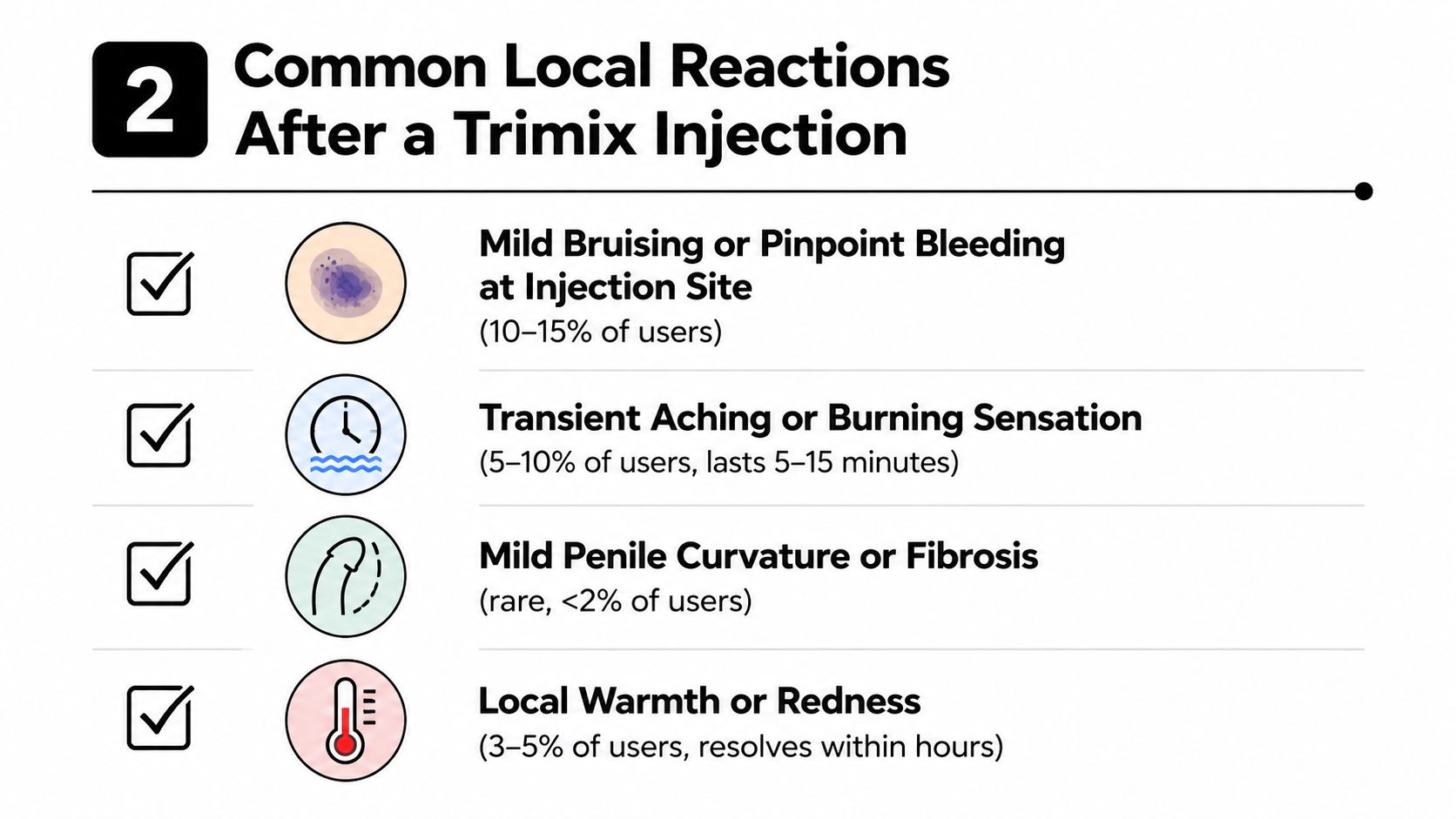
What usually falls within the expected range
A small bruise at the puncture point is usually an injection-site issue, especially if it stays localized and doesn't rapidly expand. Pinpoint bleeding should stop with firm, continuous pressure using clean gauze.
A mild ache or burning feeling can come from alprostadil. It should be tolerable and should fade as the erection subsides. A little warmth or redness may also occur, but the skin shouldn't become increasingly hot, swollen, or tender over time.
The key test is the direction of change. A minor reaction should stabilize and improve. It shouldn't become more painful, spread across the shaft, or leave a hard area that remains after repeated injections.
Practical rule: Mild tenderness can be watched. Worsening pain, spreading discoloration, or a persistent hard nodule deserves a call to the prescriber.
Technique can reduce local trauma
Use the needle and injection method taught by your clinician. The usual teaching emphasizes the lateral erectile tissue, avoiding visible veins and sensitive structures, then applying pressure afterward to limit bleeding and bruising.
Don't inject through a bruise, a hardened area, or a site that's still sore. Rotating locations gives the tissue time to recover and reduces repeated trauma to one small area.
Priapism, Fibrosis, and Other Serious Risks
You inject Trimix, wait for a response, and then notice the erection is staying firm longer than expected. The immediate question is not whether every prolonged erection is an emergency. It is how long it has lasted, whether pain is increasing, and whether rigidity is continuing to build.
Priapism is an erection that does not resolve normally. For a Trimix user, the practical emergency boundary is four hours. Beyond that point, pressure inside the erectile chambers can restrict oxygen delivery, so urgent medical evaluation is required.
Rates vary by study, formulation, dose, and patient group. A contemporary in-office analysis found 4.0% priapism across 26,104 uses, while broader literature on erectile-dysfunction injections reports 1.3% to 5.3%. Trimix-specific evidence repeatedly identifies priapism as the main safety concern, particularly with stronger formulations. The 2024 analysis and systematic-review evidence puts those findings in context without implying that every user has the same risk.
The clock matters
An erection that resolves before four hours is different from an emergency, but a repeated prolonged response still signals that the dose or formulation may need review. Do not inject again because the first response seems slow. Do not increase the dose without prescriber instructions.
Seek emergency care when the erection reaches four hours, or sooner if pain is severe or the penis is becoming increasingly rigid. Tell triage staff how long it has lasted and that you used an intracavernosal medication.
| Risk | Evidence | What to watch for | Action threshold |
|---|---|---|---|
| Priapism | Reported rates vary across studies and injection therapies | Excess dose, stronger formulation, individual risk factors | Emergency evaluation at four hours |
| Injection-site pain | Reported with Trimix and alprostadil injections | Pain that is severe, persistent, or worsening | Contact the prescriber |
| Fibrosis | Recognized complication of repeated intracavernosal alprostadil injections | Firm nodules, plaques, curvature, or reduced response | Arrange a clinical assessment |
| Granuloma | Reported as an uncommon local reaction | A persistent lump or inflammatory area | Arrange a clinical assessment |
Cumulative tissue damage
Fibrosis develops differently from a bruise or brief injection ache. Repeated injury can leave firm, scar-like tissue. Over time, this may cause nodules, plaques, curvature, or a reduced response. A recent NHS patient leaflet identifies scarring or bending, progressive loss of response, and prolonged erections as recognized complications of repeated penile injections. The NHS leaflet on penile injections supports careful technique and rotating injection sites.
A hard area that persists, new curvature, or a noticeable decline in response deserves a prescriber's review. These findings are cumulative warning signs, not symptoms to ignore until the next injection.
Systemic Side Effects and Cardiovascular Signals
Trimix is injected locally, but local delivery doesn't mean zero systemic exposure. Small amounts of the ingredients can enter the circulation and may cause dizziness, headache, flushing, low blood pressure, or a racing heartbeat, particularly after a first dose or an excessive dose.
The more common Trimix experience remains local, and serious systemic reactions are not the main safety pattern described for intracavernosal therapy. Still, patients with cardiovascular disease, blood-pressure concerns, or multiple medicines that lower blood pressure should give the prescriber a complete medication list before treatment.
How to interpret lightheadedness
Mild lightheadedness that improves after you sit or lie down may reflect a temporary blood-pressure change, anxiety, or the body's response to the needle. Don't stand quickly, drive, or continue sexual activity while you feel faint.
Systemic symptoms become more concerning when they're intense, persistent, or accompanied by other warning signs. Chest pain, fainting, sustained palpitations, severe shortness of breath, or sudden vision changes warrant urgent medical assessment rather than observation at home.
Cleveland Clinic lists low blood pressure, rhythm changes, and rare serious events among reactions that need prompt attention. Its patient guidance on alprostadil injection side effects can help patients recognize symptoms, but it can't replace the individualized instructions from the prescribing clinician.
Medication review is part of safe dosing
Tell the prescriber about antihypertensives, alpha-blockers, nitrates, blood thinners, and other ED medicines. The concern isn't that every combination causes a problem. It's that overlapping effects can change blood pressure or erection duration, and the safest plan depends on the person's medical history and exact Trimix formulation.
Don't combine Trimix with another ED treatment unless the prescriber specifically approves it. A strong erection isn't evidence that the dose is appropriate if it's accompanied by dizziness, pain, or an unusually long duration.
Managing Side Effects and Knowing When to Seek Help
A symptom list is less useful than an action plan. The first question is whether the reaction is mild and improving, recurrent or persistent, or potentially urgent.
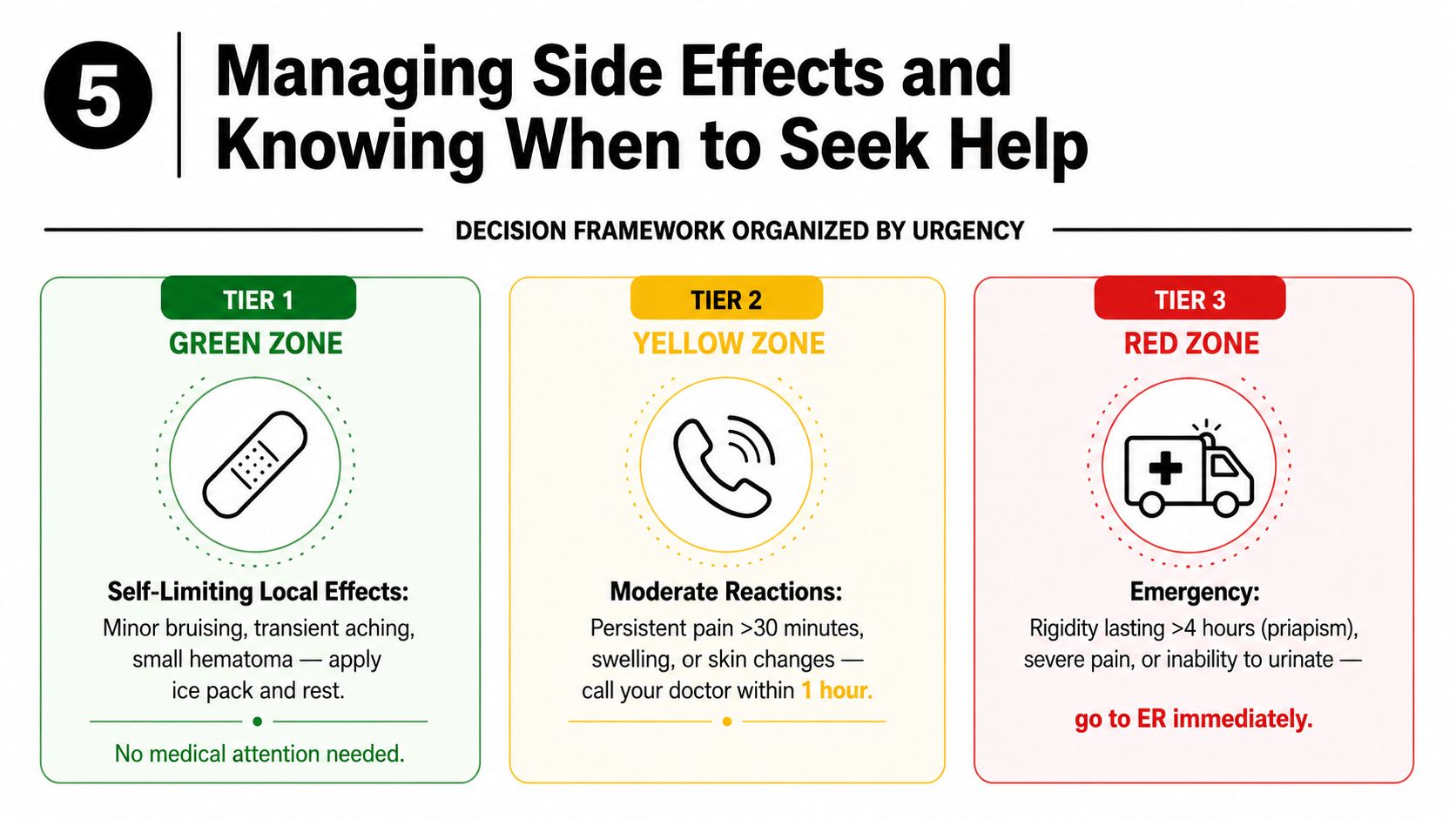
Green zone
Minor bruising, pinpoint bleeding that stops with pressure, temporary swelling, and a tolerable ache can usually be observed. Use a cold compress wrapped in cloth for short periods, avoid further injection into the area, and wait until tenderness has settled before sexual activity.
Record the dose, injection site, erection duration, pain level, and any unusual symptoms. A dose diary gives the prescriber information that memory often misses.
Yellow zone
Contact the prescribing clinician for a dose or technique review when:
- Pain keeps returning: Recurrent moderate pain may indicate sensitivity to the formulation or injection trauma.
- A firm area remains: A nodule, plaque, or new curvature should be assessed rather than ignored.
- The response changes: Repeatedly poor results or a progressive loss of response may signal technique problems, tissue changes, or a need to reassess the formulation.
- The erection runs long: An erection that repeatedly continues well beyond the expected duration deserves clinician guidance, even if it eventually resolves.
Use the clinic's written instructions and patient resources, including the Cost Plus TRT FAQ, for questions to raise during a consultation. Don't make a dose change based only on an online chart.
Red zone
Seek emergency care for:
- An erection lasting four hours: Treat this as priapism, even if pain is limited.
- Severe or rapidly worsening pain: This isn't a normal injection-site ache.
- Rapid swelling or major discoloration: Sudden tissue changes require assessment.
- Possible infection: Fever, pus, spreading redness, or worsening warmth needs medical attention.
- Cardiovascular symptoms: Chest pain, fainting, severe breathing difficulty, or sustained palpitations are urgent.
Ask your prescriber before the first home dose whether you have an approved rescue plan, including whether a decongestant such as pseudoephedrine is appropriate for you. Don't improvise medication instructions, and don't delay emergency evaluation while trying home measures. If rigidity persists, emergency clinicians may need to use medication and procedural treatment to restore blood flow.
Telemedicine and Safe Sourcing Considerations
Telemedicine can be appropriate for Trimix only when it includes real clinical oversight. A legitimate service should obtain a medical history, review allergies and current medicines, assess cardiovascular considerations, explain injection technique, and provide a written plan for an erection that lasts too long.
The first prescription should follow a clinician-directed starting dose and gradual titration. The exact volume depends on the formulation and patient, so a generic online dose isn't a safe substitute for a prescription label or supervised testing.
What responsible oversight looks like
Look for these safeguards:
- A documented consultation: A licensed clinician should review your symptoms, medical history, medicines, and treatment goals.
- Clear formulation details: The vial should identify the ingredients, concentrations, storage requirements, beyond-use information, and pharmacy details.
- Written emergency instructions: The plan should state when to call the clinic and when to go directly to emergency care.
- Follow-up access: You should be able to report pain, prolonged erections, poor response, or suspected scarring and receive a clinical answer.
- Pharmacy verification: Confirm that the dispensing pharmacy is licensed through the relevant state board or can be checked through the National Association of Boards of Pharmacy.
A vendor that ships unlabeled syringes, hides concentrations, skips the medical evaluation, or offers no emergency contact creates avoidable risk. Unusually low pricing can also signal missing quality controls, but price alone doesn't establish whether a pharmacy is legitimate.
A prescription injection should arrive with enough information for you to know exactly what you're using, how to store it, and whom to call when something feels wrong.
Read the clinic's consent materials carefully, including telehealth consent information, before agreeing to treatment. A reputable clinician may decline to prescribe until additional records, laboratory work, or cardiac clearance are available. That delay is a safety decision, not necessarily a service failure.
Key Takeaways for Safer Trimix Use
Three operating rules make Trimix safer: watch the clock, protect the tissue, and communicate early. Mild soreness and a small bruise can happen. A rigid erection that persists or a new curve that progresses should never be treated as routine.
The time rule
Track the erection from the injection, not from the start of intercourse. If rigidity continues toward the four-hour mark, follow the written plan from your prescriber. Any erection lasting four hours requires urgent medical evaluation, because delayed treatment can injure erectile tissue.
Don't re-inject because the first dose seems slow, and don't take extra medication unless your clinician has specifically instructed you to do so. Your rescue plan should be written before you need it.
The site rule
Use a new sterile syringe every time and rotate injection locations between the erectile bodies and different points along the shaft. Avoid bruised, tender, hardened, or visibly abnormal tissue.
Repeated injections in one area can produce cumulative trauma, fibrosis, nodules, plaques, and curvature. A recent review found no significant difference in pain, fibrosis, or priapism between combined and isolated intracavernosal regimens, which supports paying close attention to technique, frequency, and personalization, not only the drug mixture. The review's safety findings provide useful context for that distinction.
The communication rule
Tell your clinician about persistent nodules, a new bend, repeated bruising in the same location, faintness, recurring pain, or an erection that repeatedly lasts longer than expected. Store the vial exactly as the pharmacy label directs, wash your hands, use sterile supplies, and keep the prescribed diluent and concentration consistent.
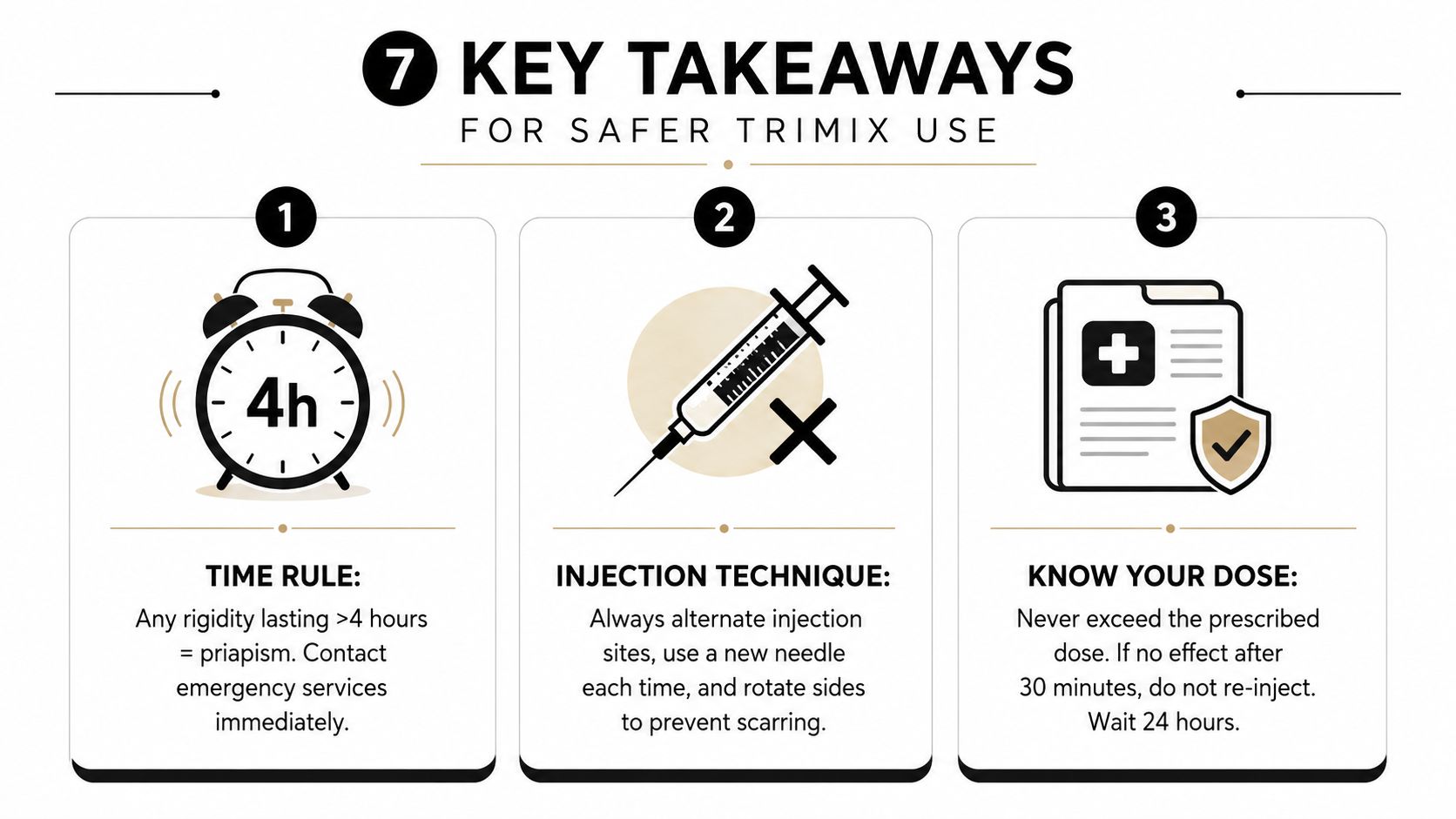
Save this checklist with your medication:
- Before injecting: Confirm the prescribed dose, vial label, storage condition, and injection site.
- After injecting: Record the time, response, pain, bruising, and erection duration.
- Call the prescriber: Report recurring pain, nodules, curvature, faintness, or repeated prolonged erections.
- Seek emergency care: Act immediately for a rigid erection lasting four hours, severe penile pain, major swelling, infection symptoms, chest pain, or fainting.
Mild local tenderness usually resolves. Priapism and progressive curvature don't belong in the “wait and see” category.
Cost Plus TRT provides physician-supervised men's health care through telemedicine, including ED treatment options and support with prescription decisions, dosing questions, and follow-up. Visit Cost Plus TRT to complete a quick questionnaire and talk with a licensed provider about a safer, clinically guided treatment plan.