

Testosterone troches are compounded oral-mucosal preparations, and the studied FDA-approved buccal system used a 30 mg tablet every 12 hours. The evidence for compounded troches is less established than for FDA-approved injections, gels, or patches.
Could a testosterone result look reassuring only because your blood was drawn soon after a troche, even if your average exposure is inadequate? That dosing-to-lab timing gap is one of the most important details men often miss.
Troches can seem appealing because they avoid injections and don't require skin application. But convenience doesn't make them pharmacokinetically simple. The formulation, dose, placement inside the mouth, dissolution pattern, swallowed saliva, and timing of laboratory testing can all change what reaches the bloodstream and how a result should be interpreted.
The practical question isn't whether a troche can raise testosterone. It can. The more useful question is whether your clinician can document hypogonadism, identify the specific product being used, interpret your levels in relation to the last dose, and respond if the exposure is inconsistent.
Table of Contents
- What Testosterone Troches Are
- How Troches Absorb Into Your System
- Comparing Troches to Other TRT Options
- The Hidden Complexity Most Men Miss
- Compounding Realities and Quality Concerns
- Getting Prescribed and Monitoring Safely
- Who Should and Should Not Try Troches
What Testosterone Troches Are
Could a testosterone troche produce a reassuring lab result while your average exposure remains inadequate? The answer depends on the formulation, how it is used, and when blood is drawn.
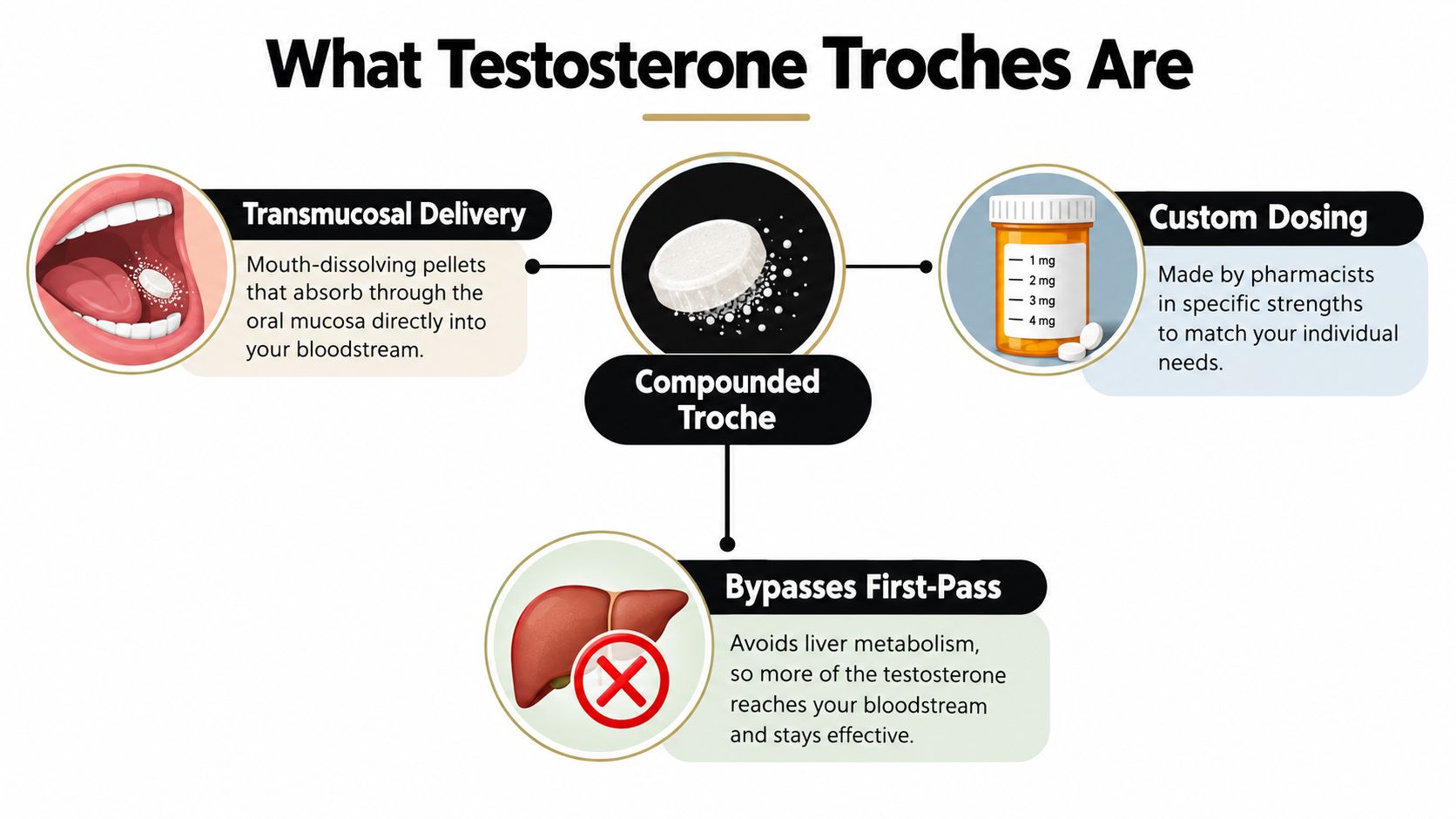
Testosterone troches are compounded tablets or lozenges intended to dissolve against the oral mucosa, commonly beneath the tongue or between the gum and cheek. The goal is for testosterone to enter systemic circulation through mouth tissues rather than relying only on the digestive tract.
A troche is not automatically a purely buccal treatment. Some dissolved material mixes with saliva and is swallowed, so the body may absorb testosterone through both oral and gastrointestinal routes. A major expert consensus review classifies troches as a form of oral testosterone therapy rather than assuming they behave like a dedicated buccal system. It also identifies variation in the concentration of compounded testosterone as a quality-control concern. The expert consensus discussion of testosterone therapy and compounded products explains why the formulation and delivery route must be assessed together.
Why the distinction matters
Testosterone absorbed through oral mucosa enters circulation through venous drainage that largely avoids hepatic first-pass metabolism. Swallowed testosterone follows a different route, and the liver extensively metabolizes it during first-pass passage. A mixed route can therefore produce a less predictable exposure pattern than the product label suggests.
That makes an individually compounded troche different from an FDA-approved injection, gel, patch, or dedicated buccal product. A prescription described only as “transmucosal” does not establish that it is interchangeable with another product using the same term.
The FDA-approved buccal system has its own clinical and pharmacokinetic record. It used a mucoadhesive tablet placed on the upper gum, where it hydrated and released testosterone through the gum and cheek. Those data support the buccal concept, but they do not establish equivalent exposure from a compounded troche with a different strength, base, adhesion, or dissolution profile.
Regulatory status also matters. Compounded troches occupy a different category from FDA-approved TRT products, so evidence, manufacturing controls, and product consistency may not be equivalent. That does not make every troche inappropriate. It does require clearer documentation and closer interpretation of results.
Practical rule: Treat “troche” as a dosage-form description, not proof of a predictable blood-level profile.
A sound prescription should state the active ingredient, strength, placement site, dosing schedule, and laboratory timing. Without those details, another clinician cannot reliably interpret a testosterone result or determine whether the treatment is providing consistent exposure.
How Troches Absorb Into Your System
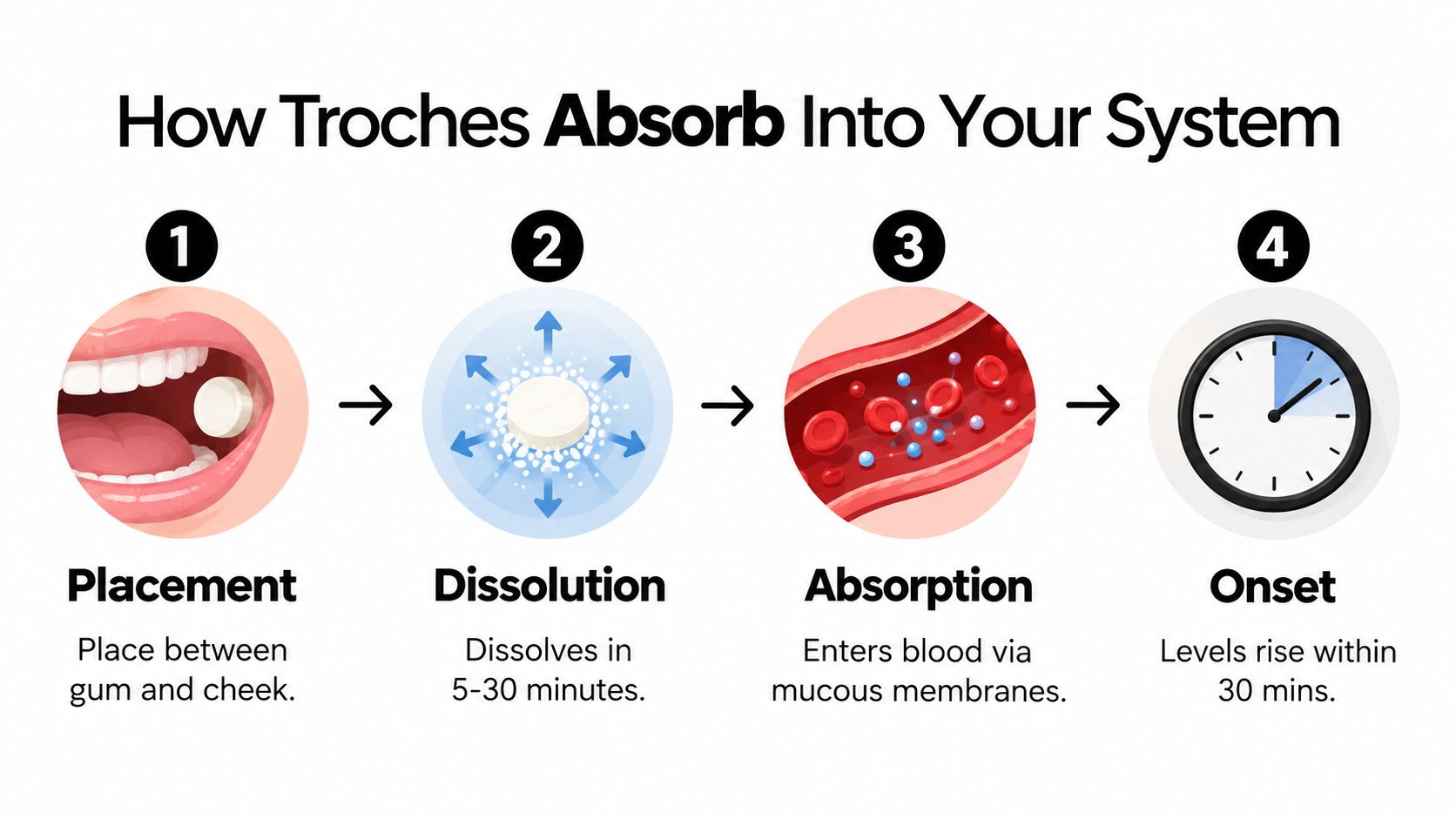
A troche can create more than one absorption pathway at the same time. First, testosterone dissolves against the mucous membrane. The local blood vessels absorb some of the hormone, and venous drainage from the mouth largely bypasses hepatic first-pass metabolism. Second, dissolved material mixes with saliva, and some of that saliva is swallowed, sending testosterone through the gastrointestinal tract.
That combination explains why two products with the same labeled milligram strength may not produce the same serum exposure. Dissolution rate, adhesion, excipients, mucosal placement, and swallowed material all influence the concentration curve.
Two concentration patterns clinicians must distinguish
The studied FDA-approved buccal system used a 30 mg mucoadhesive tablet every 12 hours. Serum testosterone reached its maximum approximately 10 to 12 hours after application, and repeated twice-daily dosing produced mean steady-state average concentrations of about 520 to 550 ng/dL. At day seven, testosterone remained within the stated physiologic range of 300 to 1050 ng/dL for approximately 84% of the 24-hour sampling interval. The pharmacokinetic review of the FDA-approved buccal system provides those findings.
That profile should not be treated as a universal troche template. A small randomized pilot study of a 10 mg buccal dose found a mean testosterone peak of 2,688 ng/dL about 30 minutes after administration, followed by a return toward baseline within 4 to 6 hours. The study also found lower total exposure than with some other testosterone preparations and no accumulation over eight weeks. The controlled pharmacokinetic study of buccal testosterone shows why a single blood result needs dose-timing context.
These findings aren't contradictory. They describe different products and delivery systems. One extended-release adhesive tablet produced a later, more sustained pattern, while a smaller buccal dose produced an early, short-lived peak. The same word, troche, can't resolve that difference.
A simple way to think about the pathway
- Placement: The troche rests against the gum, cheek, or beneath the tongue.
- Dissolution: The tablet releases testosterone into the oral environment.
- Mucosal absorption: Part of the dose crosses oral tissue into local blood vessels.
- Swallowing: Some dissolved testosterone enters saliva and follows the gastrointestinal route.
- Blood testing: The measured concentration reflects the formulation, dose, timing, and recent absorption phase.
That last step is where many treatment decisions go wrong. A result drawn soon after administration may capture a peak. A result drawn much later may reflect a trough or a declining level. Neither result can be interpreted responsibly without knowing when the last dose was taken and how the troche was administered.
The safest monitoring plan uses a repeatable relationship between dosing and blood collection. Your clinician should specify whether the sample should be taken before a dose, at a defined interval after it, or at another standardized point. The aim isn't to chase the highest number. It's to measure a comparable phase of exposure and relate it to symptoms and safety markers.
Comparing Troches to Other TRT Options
Troches occupy an unusual position among testosterone replacement options. They can avoid injections and skin transfer concerns, but they also introduce formulation variability and a more complicated relationship between administration and blood testing.
The table below describes broad clinical differences. Actual schedules and suitability depend on the prescribed product, the patient's diagnosis, and medical supervision.
Testosterone TRT options compared
| Option | Absorption Route | First-Pass Metabolism | Steady-State Reliability | Dosing Frequency |
|---|---|---|---|---|
| Compounded troches | Oral mucosa, with some swallowed material | Mixed. Mucosal absorption can bypass first pass, while swallowed material may undergo gastrointestinal and hepatic processing | Depends heavily on formulation, placement, dissolution, and adherence | Prescriber-scheduled, often requiring consistent daily use |
| Injections | Direct systemic delivery through muscle or subcutaneous tissue | Largely bypasses gastrointestinal first-pass metabolism | Usually easier to model, though levels still vary across the dosing interval | Scheduled injections |
| Gels | Absorption through the skin | Bypasses gastrointestinal first-pass metabolism | Can be consistent when applied correctly, but absorption may vary between users | Usually daily application |
| Patches | Absorption through the skin | Bypasses gastrointestinal first-pass metabolism | Designed for controlled delivery, with tolerability and adhesion affecting use | Scheduled patch changes |
| Pellets | Slow release from tissue beneath the skin | Bypasses gastrointestinal first-pass metabolism | Intended to provide prolonged exposure, with less immediate dose flexibility | Infrequent placement according to the prescriber |
What the comparison means in practice
Injections, gels, and patches are FDA-approved TRT categories with established product-specific instructions and monitoring conventions. A compounded troche may be easier for a patient who wants an oral-mucosal option, but the prescriber has to account for more variables when interpreting the response.
Pellets create a different trade-off. They reduce daily administration, but changing the dose isn't as immediate once the pellets are placed. Troches offer more theoretical flexibility because the daily prescription can be changed or stopped, yet that flexibility only helps if the formulation delivers a repeatable exposure and the patient follows the administration instructions.
The FDA-approved buccal system shouldn't be used as proof that every compounded troche behaves the same way. Its mucoadhesive design, release characteristics, gum placement, and clinical evidence are product-specific. A compounded product may use a different base or dissolve differently, and swallowed saliva may account for a different part of the dose.
Men comparing options should ask not only, “Which one is most convenient?” but also, “Which one gives my clinician the clearest way to measure and adjust treatment?” A useful TRT treatment overview can help frame that conversation, but the final decision should follow an individualized medical assessment.
The Hidden Complexity Most Men Miss
How can the same troche produce a reassuring result on one lab report and a concerning result on another? The answer often lies in the concentration measured in blood and when the sample was collected.
The pilot study's early, short-lived peak and the FDA-approved system's delayed maximum, described above, create exactly this interpretation problem. A blood draw soon after dosing may capture a temporary rise rather than exposure across the full dosing interval. A later draw may show a much lower concentration, even when the medication produced a meaningful earlier increase. The result alone cannot identify which pattern occurred.
A practical example makes the risk clear. A report marked “drawn 45 minutes after dose” may look unusually high because it was collected near the troche's early peak. Another report marked “drawn 6 hours after dose” may look low by comparison. Those values should not be treated as equivalent measures of treatment. The clinician needs the dose, formulation, administration method, symptoms, and timing before deciding whether to change therapy.

The three details that belong beside every lab result
- Time since the last dose: Record it with every test so results can be compared on similar terms.
- Product and strength: A compounded immediate-release troche should not be judged using expectations from an extended-release buccal product.
- Administration site and technique: Gum, cheek, and sublingual placement may alter absorption, particularly when the amount swallowed differs.
A “normal” testosterone result is useful only when the clinician knows what was taken, how it was taken, and when the blood was drawn.
The regulatory gray area adds another decision point. A compounded troche does not provide the same product-specific evidence or standardized instructions as an FDA-approved TRT option. Men who prioritize clearer dose adjustment and lab interpretation may prefer an approved product. A troche may remain reasonable when its practical advantages matter, provided the prescriber can standardize testing, review symptoms, and monitor safety rather than reacting to a single untimed result.
Compounding Realities and Quality Concerns
Compounding means a pharmacy prepares a medication for an individual prescription rather than dispensing a standardized, mass-manufactured product in its approved commercial form. That can allow a prescriber to select a dosage form or strength that isn't available in a conventional product.
It also creates a responsibility that patients shouldn't overlook. The formulation may differ in its base, excipients, adhesion, dissolution, and concentration. The expert consensus on testosterone therapy warns that compounded testosterone may vary in concentration and generally can't be recommended when efficacy and safety data are lacking. The consensus statement on testosterone treatment and compounded preparations is especially relevant because it separates the idea of transmucosal delivery from the evidence for a specific compounded product.
What the regulatory gray area means
The regulatory issue isn't that every compounded troche is automatically ineffective. The issue is that an individually prepared product doesn't carry the same product-specific evidence as an FDA-approved injection, gel, patch, or dedicated buccal system. Evidence from the approved buccal system can't automatically be generalized to a troche made with another formula.
That distinction affects informed consent. A responsible clinician should tell you where the evidence is strong, where it is indirect, and what will happen if the product doesn't produce a stable or interpretable response. Marketing language that treats “bioidentical,” “custom,” or “buccal” as synonyms for proven equivalence skips the most important part of the discussion.
Questions for the prescribing team
Before starting, ask:
- Which pharmacy prepares the troche, and what formulation is being used?
- What strength and release characteristics are intended?
- Should the dose sit against the gum, cheek, or beneath the tongue?
- What should you do if the troche is swallowed or fails to dissolve normally?
- How will the pharmacy and clinician handle a formulation or batch change?
- What alternative will be considered if results fluctuate or symptoms remain unresolved?
A clinic that answers these questions clearly is showing you how it manages uncertainty. A clinic that promises identical results to injections without discussing absorption and lab timing isn't giving you a complete clinical picture.
Getting Prescribed and Monitoring Safely
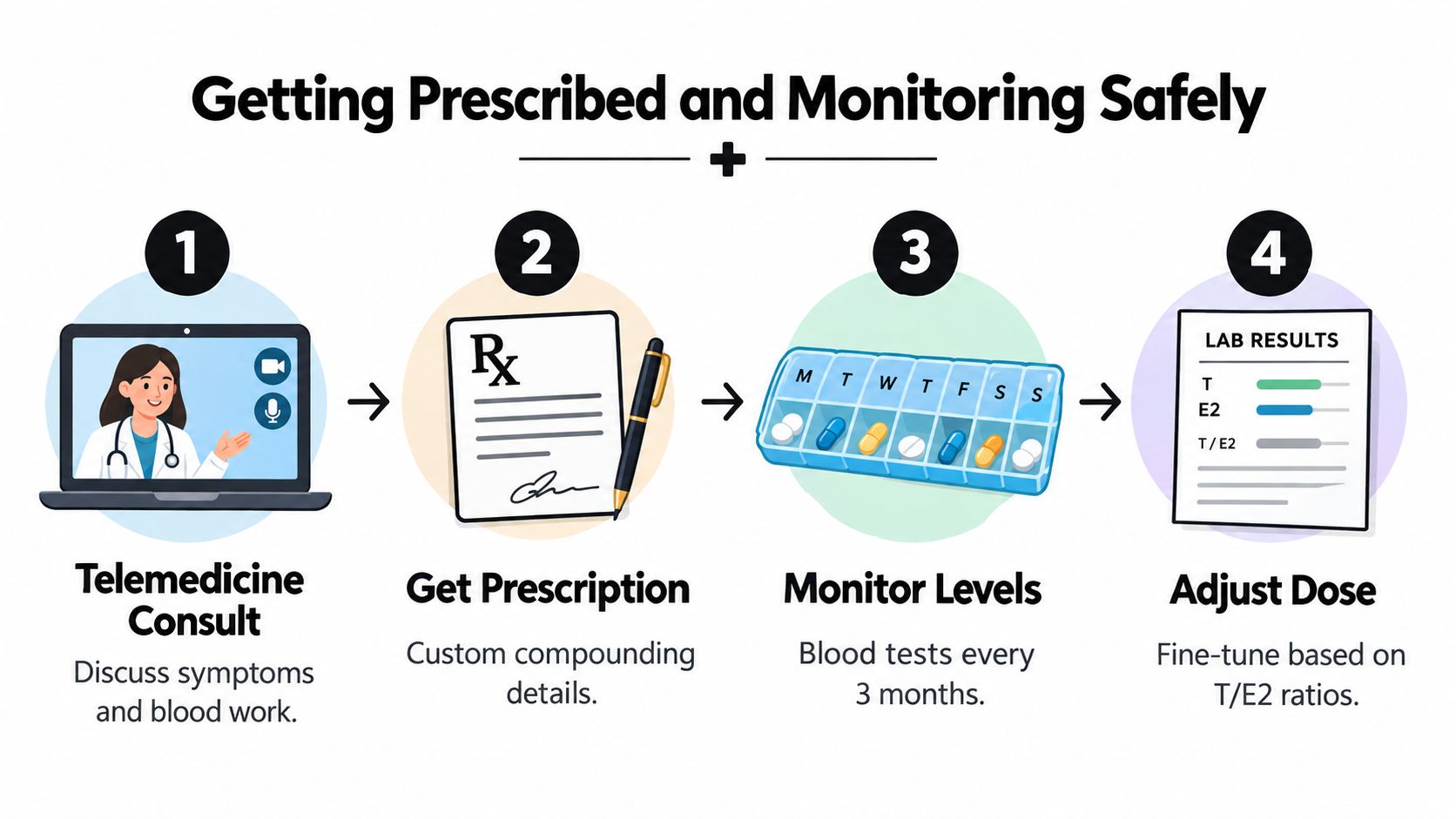
Safe treatment starts before the first troche. A clinician should establish whether your symptoms and laboratory findings support a diagnosis of hypogonadism, review relevant medical history, and document a monitoring plan. Testosterone therapy shouldn't begin on the assumption that fatigue, low mood, or reduced libido automatically proves testosterone deficiency.
Start with a reproducible baseline
Bring prior laboratory reports, a complete medication list, relevant diagnoses, and a clear description of your symptoms. The clinician should explain which baseline tests are needed for your situation and how those results affect the choice between a troche and an FDA-approved alternative.
Once treatment begins, keep the administration routine consistent. Use the prescribed site and schedule, allow the preparation to dissolve as instructed, and record the time of each dose when laboratory testing is approaching. Don't change the timing before a blood draw just to produce a more favorable result.
Make every follow-up result interpretable
Your clinician should record the product, strength, dosing schedule, administration site, and time between the last dose and the blood draw. Repeat testing under comparable conditions makes it easier to distinguish a genuine change from a difference in sampling timing.
Monitoring should include both objective data and your experience. Track symptom response, adverse effects, adherence, and any changes in the product's appearance or dissolution. If your level looks high but benefits don't last, or if symptoms remain despite a seemingly acceptable result, the correct response may be to investigate the concentration curve rather than increase the dose.
Ask your provider for a contingency plan. That plan might involve repeating a properly timed test, reviewing the pharmacy formulation, adjusting the schedule, or switching to a different delivery method. Physician oversight and standardized laboratory monitoring are more important than the label on the dosage form.
If you're ready to discuss symptoms, existing results, and treatment options with a licensed clinician, you can get started with a telemedicine evaluation. Bring the timing details with you. They can be as important as the lab value itself.
Who Should and Should Not Try Troches
Troches may be reasonable for a carefully selected man who has documented hypogonadism, understands the evidence limitations, can follow a consistent oral-mucosal routine, and has access to a clinician willing to interpret results according to dose timing. The option may appeal to someone who wants to avoid injections or topical application and values the ability to change or stop a daily preparation under medical supervision.
That doesn't make a troche the default choice. A patient who needs the clearest, most established pharmacokinetic framework may be better served by an FDA-approved option with product-specific dosing and monitoring instructions. The same is true for someone whose schedule makes administration inconsistent or whose laboratory testing can't be standardized.
A practical decision screen
A troche may fit when:
- You have a documented clinical indication for testosterone therapy.
- You understand that compounded evidence is less established than evidence for approved products.
- You can follow the prescribed placement and schedule consistently.
- Your clinician will record dose-to-lab timing and review results in context.
- You have discussed what happens if the formulation produces unstable exposure.
An alternative deserves serious consideration when:
- A clinic promises that a compounded troche is pharmacokinetically identical to an injection, gel, patch, or approved buccal system.
- Your blood tests are ordered without instructions about the last dose.
- Your symptoms are being treated without a documented evaluation for hypogonadism.
- You need a delivery method that is easier to measure and compare across visits.
- You can't maintain a predictable daily routine or frequently miss doses.
Don't make the decision from a single testosterone number. Ask your provider to explain the intended concentration pattern, the testing window, and the criteria for changing treatment. If fertility is part of your concern, discuss it before starting and review the implications with a clinician, including the information in this guide to TRT and fertility.
The most defensible path is straightforward: confirm the diagnosis, compare delivery methods, choose a product whose limitations you understand, standardize monitoring, and switch strategies if the results can't be interpreted or the treatment doesn't provide reliable benefit.
Cost Plus TRT provides physician-supervised telemedicine care for men evaluating testosterone replacement, including treatment consultations, lab review, ongoing provider support, and home delivery where available. Visit Cost Plus TRT to discuss your symptoms, existing laboratory results, and whether a compounded troche or a more established TRT option fits your clinical needs.