

You're sitting in a clinic exam room describing a 3 PM energy crash, weaker morning erections, low libido, and persistent brain fog. You searched for a testosterone therapy doctor because the symptoms feel connected, but symptoms alone don't prove testosterone deficiency. The right clinician has to determine whether low testosterone is the cause, a consequence of another condition, or an incidental lab finding.
A qualified provider evaluates suspected hypogonadism, confirms it with properly timed testing, investigates competing explanations, and manages treatment over time if the potential benefits outweigh the risks. That includes discussing fertility, prostate surveillance, red blood cell elevation, sleep apnea, medication effects, and whether treatment should be declined or discontinued.
Choosing a testosterone therapy doctor is really choosing a level of medical rigor. Your location, insurance, existing laboratory results, medical complexity, and preference for hands-on versus virtual care should determine the provider you see.
Table of Contents
- What a Testosterone Therapy Doctor Actually Does
- Types of Providers You Can See for Low-Tone
- How Diagnosis Works Before Any Prescription
- What Treatment Looks Like Once You Start
- Safety and Monitoring a Responsible Doctor Runs
- Real Costs and Where the Money Goes
- Choosing Your First Doctor or Switching to a Better Fit
- Common Questions Men Ask After Reading This
What a Testosterone Therapy Doctor Actually Does
A testosterone therapy doctor decides whether your symptoms and test results show clinically meaningful hypogonadism, then manages the consequences of treatment over time. That requires more than matching low energy or reduced libido to a prescription.
The evaluation comes before medication
The first visit should cover sexual function, erections, energy, mood, sleep, body composition, exercise, alcohol use, fertility plans, and current medications. Opioids, some psychiatric medications, finasteride, and other drugs can affect sexual function or hormone production. The examination may assess testicular size, signs of testicular disease, body habitus, breast findings, and clues to pituitary or thyroid problems.
Sleep apnea, obesity, depression, thyroid disease, chronic illness, and medication side effects can produce similar complaints. A doctor who skips those possibilities may leave the actual problem untreated.
Testing must support the diagnosis. Current guidance emphasizes symptoms plus two separate morning testosterone tests, not one isolated result, with individualized interpretation for borderline readings around 250 to 350 ng/dL (recent diagnostic guidance). The clinician should also explain what the results can and cannot establish, especially when symptoms, medical history, and laboratory findings do not align.
Treatment is longitudinal management
If treatment is appropriate, the doctor chooses a formulation, explains how to administer it, sets follow-up intervals, reviews expected effects, and changes the dose using symptoms and laboratory findings. Discuss fertility before starting. External testosterone can suppress the body's reproductive signaling and sperm production, so men planning children may need a different strategy.
Ongoing care includes testosterone and hematocrit monitoring, with prostate assessment when appropriate. A published chart review found that only 12% of men receiving an initial prescription had documented evidence meeting guideline-concordant criteria. Primary care physicians wrote 45% of prescriptions, urologists 35.5%, and endocrinologists 18% (published chart-review record).
A clinic should be able to show you who reviews results, how abnormal findings are handled, and when follow-up occurs. If TRT is sold as a one-time purchase instead of ongoing medical care, choose another clinic.
Types of Providers You Can See for Low-Tone
The best provider depends on the problem you're bringing in, not on which specialty has the most aggressive advertising. A urologist is often the right choice for prostate or sexual-function concerns. An endocrinologist fits complex hormonal disease. Primary care works well when your doctor already knows your medical history. Telemedicine is convenient for appropriate patients who can complete reliable testing and follow-up remotely.
| Provider Type | Typical Wait | Cost Structure | Lab Handling | Monitoring Style | Best Fit |
|---|---|---|---|---|---|
| Urologist | Often longer, especially with referral requirements | Usually insurance-based visits and separate lab billing | Office draw or outside laboratory | Strong focus on prostate, urinary symptoms, sexual function, and hematocrit | Men with prostate history, urinary symptoms, erectile concerns, or fertility questions |
| Endocrinologist | Frequently the longest for complex referrals | Insurance-based consultation and follow-ups | Hospital, office, or outside laboratory | Detailed hormone evaluation and investigation of secondary causes | Men with pituitary, thyroid, metabolic, testicular, or complicated endocrine conditions |
| Primary care physician | Often the easiest existing appointment | Insurance-based visit, with labs commonly billed separately | In-office or external laboratory | Integrated with blood pressure, weight, sleep, medications, and general prevention | Men with an established doctor and straightforward initial evaluation |
| Telemedicine TRT clinic | Usually faster when licensed care is available in your state | Cash consultation, monthly program, or medication-plus-care model | Bring your own results or use a partner laboratory | Protocol-driven virtual follow-up, with quality varying by clinic | Men who live far from specialists, already have labs, or need stable maintenance care |
How the trade-offs work
Specialists generally offer deeper evaluation for specific problems, but you may face referral requirements, insurance restrictions, and longer scheduling delays. A primary care doctor may be the most efficient starting point because they can review sleep, weight, depression, thyroid symptoms, blood pressure, and medication effects in the same visit.
Telemedicine removes geography from the equation, but it doesn't remove the need for sound diagnosis. Ask whether the clinic reviews two morning tests, investigates contraindications, explains fertility consequences, and schedules hematocrit and prostate follow-up. Some direct-to-consumer clinics use subscriptions, while others separate the medication, consultations, and laboratory charges.
If your case is complicated, start with endocrinology or urology. If you're stable on an established regimen and have dependable recent results, virtual care can be practical. Don't use convenience as a reason to skip evaluation.
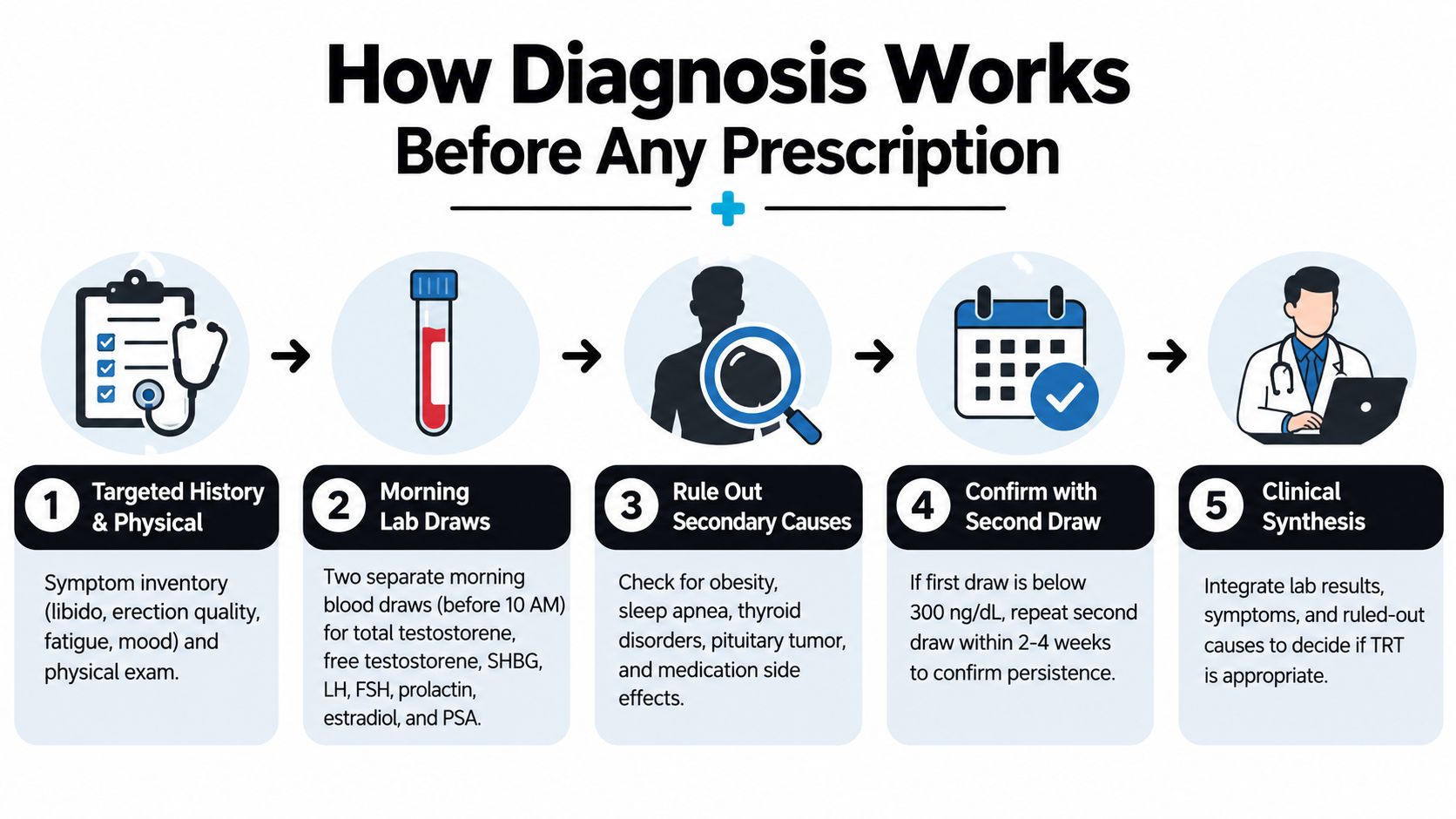
How Diagnosis Works Before Any Prescription
If you live far from a specialist, already have recent laboratory results, or want close in-person follow-up, your diagnostic path will differ. The provider should still follow the same medical logic. A legitimate diagnosis protects you from treating a temporary fluctuation, overlooking a serious cause, or starting therapy that conflicts with fertility or broader health goals.
Four checks should happen first
History and physical examination: The clinician should document reduced libido, erectile changes, fatigue, mood changes, and loss of strength. They should review medications, sleep, alcohol use, weight changes, fertility plans, and relevant medical history.
Two morning laboratory draws: Testosterone changes throughout the day, so testing should occur in the morning on separate days. One low result does not establish hypogonadism, particularly when symptoms are nonspecific. Borderline results need context, not an automatic prescription.
Cause-focused testing: LH and FSH can help distinguish testicular failure from a pituitary or hypothalamic problem. Depending on your presentation, the clinician may order prolactin, TSH, SHBG, free testosterone, estradiol, CBC, PSA, and metabolic testing.
Clinical synthesis: The doctor should combine symptoms, repeated results, examination findings, and reversible causes. Sleep apnea, significant weight-related health problems, depression, thyroid disease, and medication effects may need attention before TRT.
Why borderline results deserve a real conversation
A testosterone result near the lower end of the reference range cannot answer the question alone. Your clinician should explain how the result fits your symptoms, which complaints could plausibly relate to testosterone, and which other conditions could cause the same problems. That discussion matters because U.S. regulators added cardiovascular-risk warnings in 2015 and limited approved use to men with specific medical causes of hypogonadism, as described in this guideline and regulatory history review.
The appropriate next step may be TRT, further testing, or treatment of sleep and medication factors first. A doctor who promises testosterone after one questionnaire is selling speed, not diagnosis. Ask for the reasoning behind the plan, especially if you are using telemedicine or bringing laboratory results from another provider.
What Treatment Looks Like Once You Start
After diagnosis supports treatment, your doctor should match the delivery method to your routine, budget, comfort with self-care, and how closely you want follow-up handled. Injections are common and relatively inexpensive, but they require correct technique, storage, needle disposal, and scheduled reviews.
Choosing a delivery method
Options include injectable testosterone, topical gels, patches, buccal products, pellets, and other formulations. Injections can create noticeable peaks and troughs. Daily gels follow a different routine and require precautions to prevent transfer to other people. Pellets reduce regular handling but give you less flexibility when the dose needs to change.
Your provider should show you where to inject, how to measure the medication, how to rotate sites, and how to dispose of needles. Patients using injections usually keep syringes, alcohol swabs, and a sharps container at home.
Before you leave, get a clear follow-up plan. It should state when laboratory testing will be repeated, which symptoms require a call, and what the doctor will do if testosterone reaches the target range without improving your symptoms. A clinic that only sends refills is not managing treatment.
Early results vary. Energy, mood, and sexual interest may change gradually, while some men notice little improvement. If symptoms remain unchanged despite normalized testosterone, treatment should be reconsidered rather than escalated indefinitely, according to this TRT guidance document.
At follow-up, your clinician should review symptom response, injection timing, adverse effects, blood pressure, sleep, urinary symptoms, and fertility priorities. Dose changes should reflect the measured level and your clinical response, not a request to chase a higher number.
Safety and Monitoring a Responsible Doctor Runs
TRT safety comes down to surveillance that is scheduled, interpreted, and acted on. The two major pillars are hematocrit and prostate monitoring, with other tests selected according to your health and treatment plan.
Hematocrit is not optional
Testosterone can stimulate red blood cell production. Baseline hemoglobin and hematocrit should be checked before treatment, and guidance generally recommends withholding therapy when baseline hematocrit is above 50%. An on-treatment hematocrit of 54% or higher warrants intervention, such as dose reduction, assessment for hypoxia or obstructive sleep apnea, and, in selected cases, phlebotomy or referral (American Urological Association testosterone guideline).
Follow-up testing typically occurs around 3 to 6 months after initiation and at least annually thereafter, with more frequent checks when the value is rising. A clinic that renews medication without reviewing this marker is not providing adequate monitoring.
PSA requires context
For men who choose prostate surveillance, PSA and often a digital rectal examination are obtained before treatment, repeated within 3 to 12 months, and then continued according to age and risk-based screening guidance. A PSA increase greater than 1.4 ng/mL within a year, or a serial PSA velocity above 0.4 ng/mL per year, should prompt urologic evaluation (prostate-monitoring recommendations).
| Lab | Baseline | Follow-up Cadence | Action Threshold |
|---|---|---|---|
| Hemoglobin and hematocrit | Before treatment | Around 3 to 6 months, then at least annually | Withhold at baseline above 50%. Intervene at on-treatment hematocrit of 54% or higher |
| PSA, when monitoring is selected | Before treatment | Within 3 to 12 months, then risk-based | Rise greater than 1.4 ng/mL within a year or serial velocity above 0.4 ng/mL per year |
| Testosterone | Before treatment | After initiation and during dose changes | Interpret with symptoms, formulation, and timing of the draw |
| Additional tests | Based on history and risks | As clinically indicated | Investigate abnormal findings rather than automatically increasing dose |
If fertility matters, review the reproductive consequences before beginning treatment. A practical explanation of this issue is available in what TRT can mean for fertility.
Seek urgent medical attention for chest pain, severe headaches, vision changes, a painful erection lasting more than four hours, or a new palpable breast lump.
Real Costs and Where the Money Goes
The medication itself is often the least expensive part of TRT. The larger bill usually comes from consultations, laboratory handling, shipping, clinical oversight, and the business model used by the provider.
Traditional urology and endocrinology practices commonly bill insurance for office visits and labs, although deductibles, coinsurance, referral rules, and out-of-network charges can change your responsibility. Primary care may reduce the number of separate appointments, but outside laboratories can still generate separate bills.
Telemedicine clinics usually charge directly. Some bundle consultations and medication into a recurring program, while others separate the clinical fee from laboratory testing and supplies. Ask for the complete price before enrolling, including follow-ups, lab interpretation, shipping, syringes, and prescription renewals.
| Provider Type | Medication | Provider Fee | Labs | Typical Monthly Total |
|---|---|---|---|---|
| Urologist or endocrinologist | Often pharmacy-dispensed and insurance-dependent | Visit-based, with separate follow-ups | Usually billed separately | Varies by coverage and appointment schedule |
| Primary care physician | Pharmacy-dispensed, often insurance-dependent | Standard office visits | Commonly separate | Varies by insurance and testing needs |
| Concierge men's health clinic | May be included or separately dispensed | Recurring cash membership or bundled care | May be bundled or separate | Depends on services included |
| Telemedicine TRT clinic | May include medication and supplies | Monthly, consultation-based, or transfer pricing | Often excluded or separately arranged | Depends on medication, labs, and program structure |
The sensible comparison isn't “cheap versus expensive.” It's what care is included for the price. A low monthly charge can become costly if every lab review, dose change, and refill carries a separate fee. A higher fee may make sense if it includes meaningful physician access and careful monitoring.
Before committing, ask whether you can upload existing laboratory results, whether the provider accepts Quest Diagnostics results, and whether you're paying for a subscription you don't need. For a broader breakdown, review how much TRT costs.
Choosing Your First Doctor or Switching to a Better Fit
Start with the provider who can answer the hardest question in your case: why is testosterone low, and is replacement appropriate?
If you already have a primary care physician who knows your history, begin there when your symptoms are uncomplicated. Ask for a complete evaluation and a referral to urology or endocrinology if your results, examination, fertility plans, or medical history make the case more complex.
| Situation | Best Fit | Reason |
|---|---|---|
| Established primary care relationship and insurance coverage | Primary care physician, with referral when needed | One clinician can review sleep, weight, medications, mood, and general health |
| Prostate history, urinary symptoms, erectile concerns, or fertility questions | Urologist | The specialty directly addresses prostate and reproductive decision-making |
| Pituitary, thyroid, testicular, or complicated hormonal concerns | Endocrinologist | More focused assessment of endocrine causes |
| Remote location or difficulty accessing specialists | Telemedicine clinic | Virtual visits can reduce geography and scheduling barriers |
| Stable treatment with reliable recent records | Qualified telemedicine provider or existing specialist | Follow-up and refill care may not require repeated in-person visits |
Questions that expose weak care
Ask whether the provider requires two separate morning testosterone results, checks hematocrit before treatment, reviews prostate risk when appropriate, and discusses fertility. A clinic that skips repeat testing or a basic rule-out evaluation should not get your business.
When switching, request copies of your last two testosterone results, hematocrit, PSA, estradiol if measured, medication history, treatment dose, injection schedule, and adverse-effect notes. Give the new clinician enough information to continue safely rather than forcing them to guess what the previous clinic did.
Prioritize clinical fit before optimizing price. Once the diagnosis is sound and your monitoring is stable, convenience and cost become reasonable factors. They shouldn't determine whether you receive a prescription in the first place.
Common Questions Men Ask After Reading This
Who actually qualifies for TRT?
A suitable candidate has persistent symptoms, two separate morning testosterone results that remain low, and no untreated cause that should be addressed first. A single borderline result is not enough. The doctor should interpret the number alongside symptoms, medical history, medications, sleep, weight, and fertility plans.
Can you stop after starting?
You can stop, but your previous baseline may not return immediately. External testosterone suppresses reproductive hormone signaling, and recovery varies by person. Discuss the exit plan before treatment begins, especially if fertility matters.
What about fertility?
TRT can reduce sperm production. Men trying to conceive should say so before starting, because replacing testosterone may conflict with a plan to preserve or restore fertility.
What does responsible follow-up look like?
After treatment starts, the doctor should review testosterone levels, hematocrit, and PSA when appropriate. Abnormal findings require investigation, and treatment should be reconsidered if symptoms fail to improve despite normalized testosterone. A questionnaire followed by a prescription, with little meaningful follow-up, is poor care.
For practical answers about prescriptions, monitoring, and treatment logistics, review the Cost Plus TRT FAQ.
How quickly should symptoms change?
Some changes develop gradually, and some men experience little meaningful improvement. Do not raise the dose because results are not immediate. Reassess the diagnosis, adherence, sleep, medications, mood, and other health factors before escalating treatment.
Your doctor should make the plan clear, document the diagnosis, and schedule monitoring before the first prescription. Ask for copies of your records, confirm who reviews follow-up labs, and choose care that fits your location, available testing, and preference for hands-on visits or telemedicine.
Cost Plus TRT provides physician-supervised online TRT care, including provider consultations, testosterone cypionate and injection supplies for approved patients. Patients can upload existing labs or arrange testing through Quest Diagnostics. For a telemedicine option for initial evaluation or stable transfer care, visit Cost Plus TRT. TRT is $119 a month with labs, provider visits, medication, supplies, and shipping included.