

A direct-pay Total Testosterone test runs $35 to $59 at Quest or LabCorp, while the same test billed through a hospital or clinic visit commonly lands between $200 and $600. The billing channel is the single biggest cost driver, not the blood draw itself.
A testosterone test is one of the easiest lab orders to overpay for because the assay often doesn't change, the paperwork does. I've seen the same basic hormone workup show up as a cheap cash-pay lab order in one setting and a bloated hospital statement in another, with the markup hiding in the place most patients never look, the ordering path.
Table of Contents
- What a Testosterone Test Actually Measures
- Real Price Ranges Across Every Common Channel
- What Actually Drives the Price Up or Down
- Reading Your Lab Order and Your Bill
- Insurance Coverage and the Cash-Pay Math
- Practical Ways to Lower Your Testosterone Test Cost
- How Often to Test and What Comes Next
- Common Questions About Testosterone Test Pricing
What a Testosterone Test Actually Measures
A Total Testosterone draw is the cheapest way to start, but it's rarely the whole story. Direct-pay pricing for that test is typically $35 to $59 when you order through an online lab service, and the same analyte can be much more expensive once a clinic or hospital folds in visit fees and facility charges (Lab Test Insight).
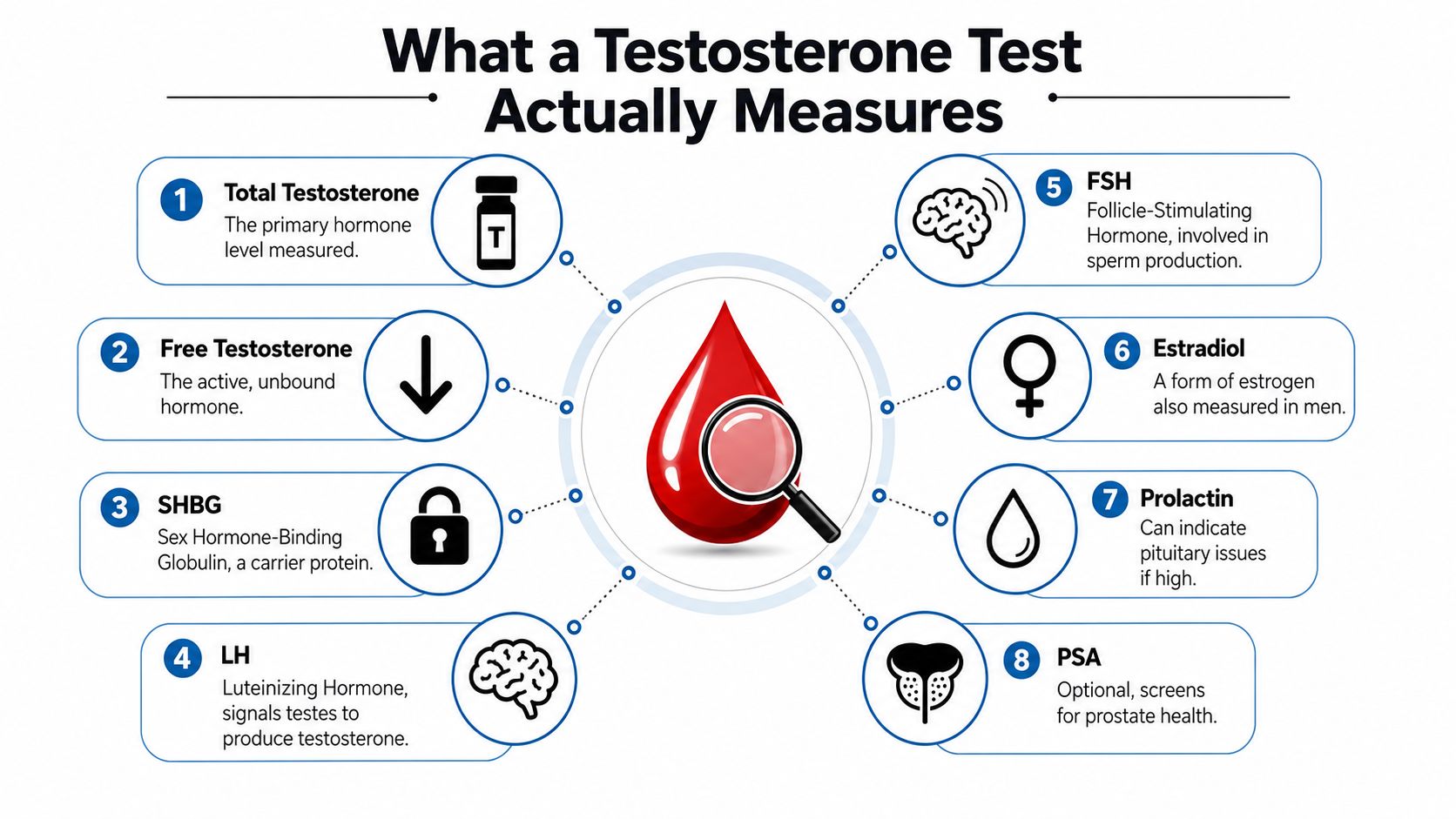
The core markers on a real low-T workup
Total Testosterone is the starting point. It measures the testosterone floating in the blood, both bound and unbound, and gives the basic screening number most clinicians use first. If that number is low or borderline, the next question is usually not “Is testosterone low?” but “Why is it low?”
Free Testosterone is the active fraction, the part not tightly bound to proteins. SHBG, or sex hormone-binding globulin, helps explain why two men with the same Total Testosterone can feel very different. When SHBG is high, free hormone can be low even if the total looks acceptable.
Then come the pituitary signals. LH and FSH tell you whether the brain is pushing the testes hard enough. Estradiol and Prolactin help look for imbalance or a pituitary issue, and PSA or hematocrit may be added when the goal is treatment safety rather than simple diagnosis. That's why a starter panel usually costs more than a single draw, but not because the lab is doing magic. It's because the clinician is ordering more analytes, and more answers cost more.
Practical rule: if the question is only “am I low?”, start with Total Testosterone. If the question is “what's driving the symptoms and is TRT safe?”, the panel needs to be broader.
Real Price Ranges Across Every Common Channel
The blood draw may be the same, but the bill is not. For a standalone Total Testosterone test, one independent guide puts direct-to-consumer pricing at $30 to $60, while hospitals and clinics may charge $80 to $200 without insurance, and the national average charge can reach $140.62 for CPT 84403 (TRT FAQ).
The bill changes with the doorway
A cash-pay order through a freestanding lab is usually the cleanest option. You pay for the draw and the assay, with little else stacked on top. The same sample may still run through the same CLIA-certified labs used in physician-ordered testing, but the office-visit markup is gone, so the final number is often much lower.
A primary care visit changes the math quickly. Now the patient may be paying for the office evaluation, the lab order, and the lab test itself. Once a hospital outpatient setting gets involved, billing can climb sharply because facility fees sit on top of the clinical charge. A routine test can start to look like a full encounter.
For the broader hormone workup, the spread remains just as wide. A combined Total + Free + SHBG panel is usually $69 to $129 direct-pay, while uninsured patients in a doctor's office may see $150 to $400 (Lab Test Insight). Independent pricing pages from direct-pay TRT clinics show the same pattern, with separate test components billed at different rates, not one flat menu price (Cost Plus TRT pricing). A review of testosterone assay pricing found an even wider lab-side spread, from $9 to $160 USD, with a mean of $35 USD (PMC review).
What each channel really includes
- Direct-to-consumer lab order: usually the test itself, with minimal overhead.
- Primary care order: the test plus the visit and the practice's administrative layer.
- Hospital outpatient order: the test plus facility billing, which is where the sticker shock often starts.
- At-home kits: convenience and no phlebotomy visit, but you're paying for the kit workflow, not just the assay.
A patient comparing quotes should ask what is being billed. The same testosterone test can be priced as a lab line item, a clinic service, or a hospital outpatient charge, and those are not the same thing. CPT 84403 usually covers the laboratory assay itself, while the visit and facility fees may appear on separate lines if the test was ordered through a clinic or hospital setting.
What Actually Drives the Price Up or Down
The first mistake patients make is assuming every testosterone test is billed the same way. It is not. Even with the same clinical question, the lab-side price can still range from $9 to $160 USD, and one 2024 analysis put the average at $35 USD.
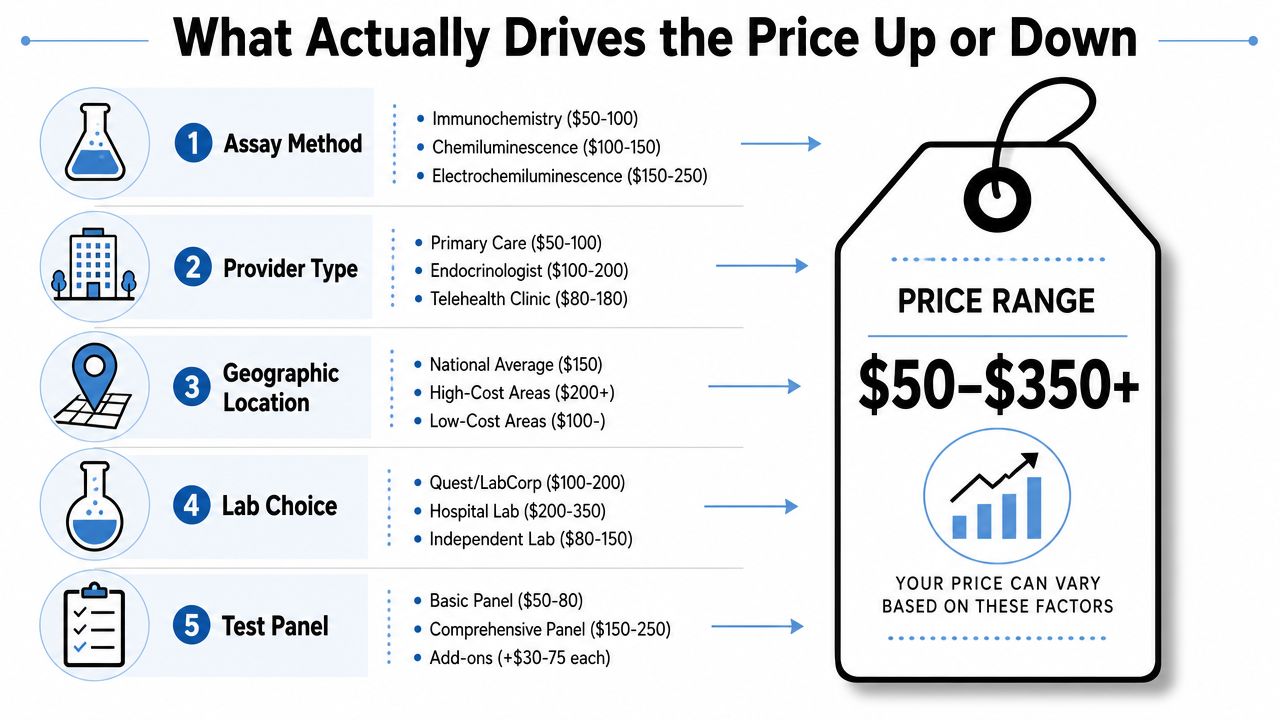
The five levers that matter most
Assay method changes the price because different lab technologies cost different amounts to run. A recent pricing analysis found immunochemistry averaged $52, while chemiluminescence averaged $35 and electrochemiluminescence averaged $32. That does not mean the cheaper method is always the wrong choice, but it does mean the assay name can move the bill in a real way.
The method also affects how the result is interpreted by the clinician who ordered it. A lower-cost assay may be perfectly fine for routine screening, while a more expensive method may be used because the lab, the ordering clinician, or the panel design calls for it.
Panel size is the next major driver. A single Total Testosterone is cheaper than a bundle that adds Free Testosterone and SHBG, and every added marker increases the total. Patients get caught here all the time because they ask for “a testosterone test” and end up with a broader hormone workup.
Billing channel usually has the biggest practical effect on what the patient pays. The same blood draw can be cheaper or more expensive depending on whether it is ordered directly, sent through a clinic, or attached to a hospital encounter. That is where the markup hides, not in the hormone itself.
Geographic region changes pricing too. Local labor costs, facility pricing, and market norms vary, so the same assay does not carry the same price everywhere. Provider visit bundling can also raise the total even when the lab component stays modest.
If the quote includes “evaluation and management” or a hospital facility fee, you are no longer paying only for the blood test.
A practical way to rank the levers is simple. Channel first, panel size second, assay method third, then geography and bundled visits. That is where patients still have some control over the number, instead of just absorbing whatever shows up on the statement.
Reading Your Lab Order and Your Bill
The bill usually hides the test behind billing language, not the word “testosterone.” What matters is the CPT code, because that is how you tell whether you were charged for one lab value or for a broader hormone workup. The common codes you may see are 84403 for Total Testosterone, 84410 for Free Testosterone, 84270 for SHBG, 82670 for Estradiol, 84146 for Prolactin, and 84153 for PSA.
The billing channel changes how those codes are priced. A direct lab order may show only the assay and the draw fee, while a clinic order can add a physician service line or specimen handling charge, and a hospital outpatient bill can layer on a facility fee that has nothing to do with the hormone itself. That markup is often the difference between a reasonable bill and a painful one.
How to decode the slip
If you see 84403, that is the basic Total Testosterone assay. If 84410 and 84270 both appear, the clinician wanted context beyond a single number, usually to understand binding proteins and how much hormone is available. 82670 and 84146 often show up when the workup is broader and the clinician is checking for other endocrine causes of the symptoms.
The wording on the quote can still be misleading. A male hormone panel may look like one neat package on the front end, then the bill breaks it into separate line items after the blood is drawn. One statement may show the lab charge, the office visit, the facility charge, and specimen handling as separate departments, even though the sample came from one draw. That is where patients get overcharged, because the price looks simple until the bill arrives.
A useful comparison is the assay method itself. Some labs run testosterone on an automated immunoassay, while others use LC-MS/MS, which is the more specific method and is often priced differently. For a plain explanation of how that sort of ordering and pricing can vary, see the Cost Plus TRT FAQ.
What to do when the bill looks inflated
- Check the CPT codes first. If you were promised only Total Testosterone but see several hormone codes, ask why they were ordered.
- Compare the line item names. “Laboratory service” is not the same thing as “hospital outpatient facility.”
- Look for duplicate charges. A draw fee, a lab fee, and a hospital fee can mean the same blood was billed more than once.
- Ask for the cash price before the draw. That is the cleanest way to avoid a surprise later.
A plain-language quote from a freestanding lab is easier to trust than a hospital statement because the hospital often hides the markup in category names. The code list tells you whether you got a minimal diagnostic test or a broader workup. If you are comparing options, keep the terminology in front of you, and the bill becomes much easier to audit.
Insurance Coverage and the Cash-Pay Math
Insurance only helps when the plan pays before the bill hits your deductible. If your deductible is high and not met, you can end up paying the negotiated rate yourself, which may still be more than a cash-pay lab quote for the same test. That's why insured doesn't automatically mean cheaper.
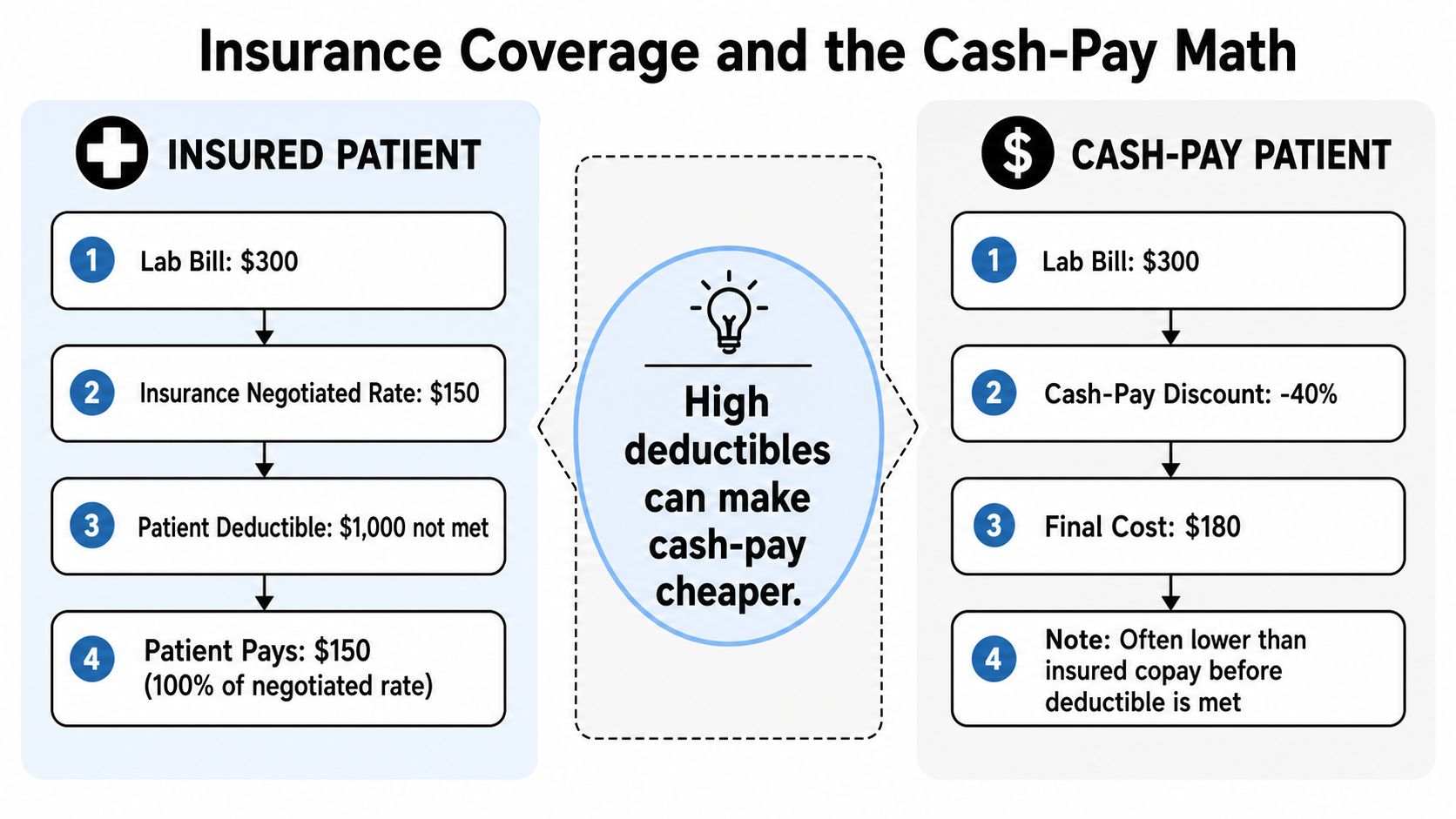
The deductible trap
The math often looks like this. The lab submits a charge, the insurer negotiates it down, and then the patient still owes most or all of that negotiated amount because the deductible hasn't been met. In that situation, the “insured” price can still behave like a cash bill, just with more paperwork.
A freestanding lab usually makes this easier to predict than a hospital. Hospital outpatient testing may be in-network on paper but still expensive in practice because the facility side gets layered in. That's where patients get blindsided, especially when the order started as a routine office visit and ended as a hospital encounter.
Practical rule: if the test is elective, routine, and your deductible is still far away, ask for the self-pay price before you run it through insurance.
HSA and FSA funds can still make a cash-pay test manageable because the money is pre-tax. Pre-authorization can matter for some plans, but don't assume it guarantees a lower out-of-pocket cost. It only tells you the plan recognizes the service, not that the patient share will be small.
If you need a clinic that structures TRT around recent labs instead of forcing a fresh retest, review the workflow at Cost Plus TRT FAQ. That kind of setup can keep you from paying twice for the same blood work.
Practical Ways to Lower Your Testosterone Test Cost
The cheapest way to lower the bill is to remove unnecessary billing layers. The second cheapest is to stop buying more markers than you need. The third is to make the lab quote before the draw, not after.
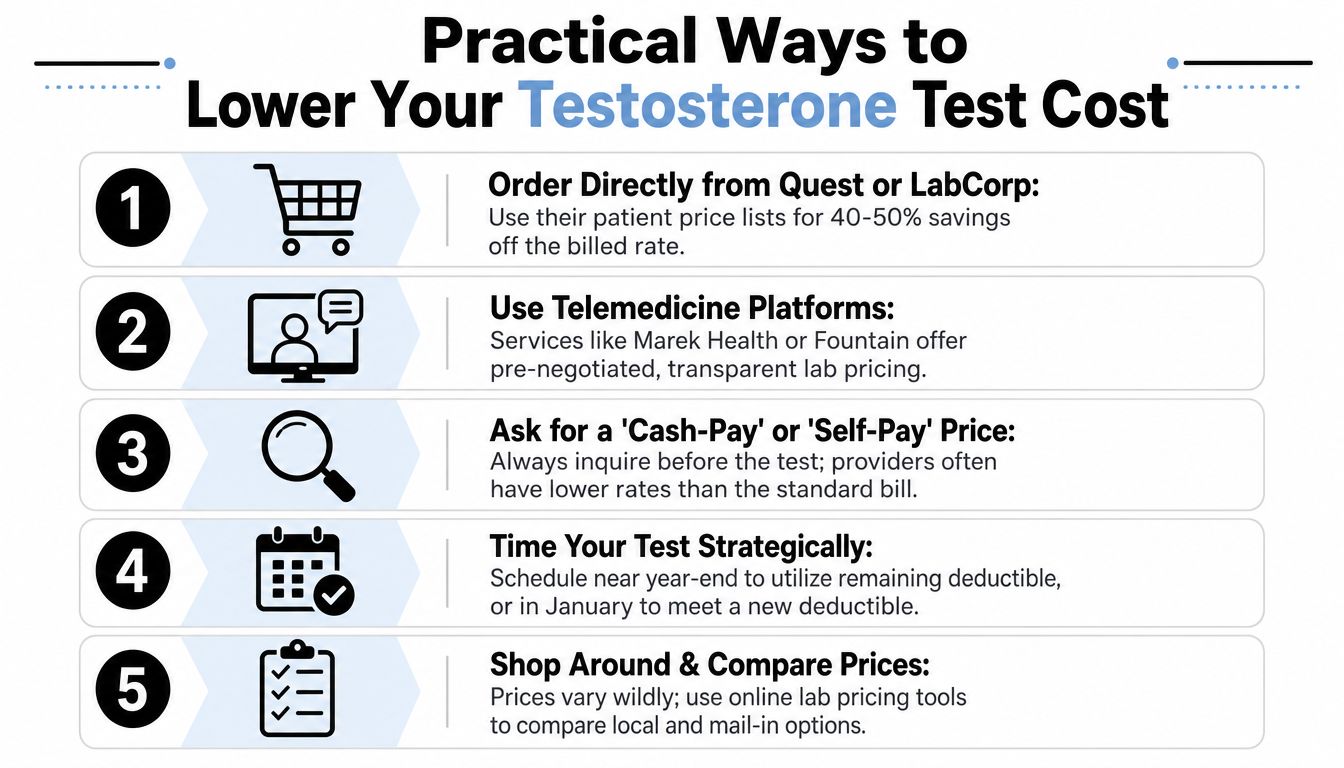
The tactics that actually work
Order directly from a freestanding lab. If you can use a cash-pay order through Quest or LabCorp, you usually avoid the office markup and facility fee layer. That's the cleanest path when you already know what you need.
Use a telemedicine clinic that supports bring-your-own-labs. Some clinics will review recent results instead of forcing a repeat draw, and that can save both money and time. Cost Plus TRT is one example of a telemedicine workflow that lets patients handle labs through Quest or upload recent results before meeting with a physician.
Ask for self-pay pricing before the sample is drawn. Don't ask after the bill arrives. Ask the front desk or the lab check-in desk what the cash price is for the exact CPT code set you're being offered.
Keep the panel tight. If the clinician only needs confirmation, a Total Testosterone draw may be enough. If symptoms are unclear or TRT safety is the concern, the broader panel makes sense, but don't pay for extras you can't explain.
Use at-home kits only when convenience matters more than clinical depth. They can be useful for screening, but they don't replace a full diagnostic conversation when the result is borderline or treatment is on the table.
The right move depends on where you are in the process. For a first look, go cheap and simple. For a treatment decision, pay for the markers that change management, not the ones that just make the bill thicker.
How Often to Test and What Comes Next
If you're only checking symptoms, one clean baseline is usually enough to decide what happens next. If you're starting or changing testosterone therapy, follow-up testing is usually done after the dose has had time to settle, then less often once things are stable. The point is to measure response, not to collect numbers for their own sake.
Match the test to the situation
A man transferring care with recent labs shouldn't automatically be sent back for a full repeat panel. If the results are recent enough for the new clinician to use, a bring-your-own-labs workflow can keep the transition simple and cheaper. That's one place where telemedicine can reduce waste instead of just shifting it around.
If you're already on TRT and your clinic asks for another round of labs, ask what decision the test will change. If the answer is dose adjustment, safety monitoring, or a confirmation of response, the draw makes sense. If the answer is “we always do this,” push for a better explanation.
For a structured treatment path that includes lab review and ongoing TRT management, see Cost Plus TRT TRT. The important part is not the branding, it's whether the clinic respects recent labs and avoids unnecessary repeats.
Don't pay twice for the same baseline if the old result still answers the question.
Common Questions About Testosterone Test Pricing
A hospital quote usually includes more overhead than a freestanding lab quote, so compare the CPT codes and the place of service before you accept it. If you already have recent labs, ask whether the new clinician will review them instead of repeating the test. And if you only need Total Testosterone, don't let anyone turn it into a full panel without telling you why.
A full male hormone panel will cost more than Total Testosterone alone because more markers are being measured, not because the diagnosis magically improved. Telemedicine clinics fit well when they let you use outside labs, since that avoids a second draw and keeps the billing path simpler.
Cost Plus TRT is built for men who want transparent pricing, recent lab review, and a direct path to TRT without the usual clinic markup. If you're comparing testosterone test cost quotes right now, visit Cost Plus TRT and see how a cash-pay workflow can keep the lab side of care simple.