

You've noticed the familiar pattern: lower libido, less reliable erections, reduced drive, or a level of fatigue that doesn't match your workload. You search for testosterone replacement therapy what to expect, and the internet gives you two unhelpful extremes, instant transformation or vague promises that “everyone responds differently.”
The practical answer is more measured. Blood testosterone can change quickly, while symptoms usually improve gradually and unevenly. Sexual desire may respond before body composition, and some complaints won't improve if testosterone deficiency wasn't their main cause. Responsible treatment also involves diagnosis, formulation choices, safety labs, fertility planning, and a clear understanding of what you're paying for.
Table of Contents
- The Initial Evaluation and Lab Testing Process
- Choosing Your Treatment Formulation and Delivery Method
- Realistic Timelines for Symptom Improvement
- Safety Monitoring and Follow-Up Blood Work
- Navigating Telemedicine Logistics and Transparent Pricing
- Fertility Considerations and Complementary Therapies
- Your First 90 Days on TRT
The Initial Evaluation and Lab Testing Process
A legitimate TRT journey starts with confirmation, not a prescription. Symptoms such as low desire, erectile difficulty, poor concentration, or reduced energy can have several causes, including sleep disorders, medication effects, depression, metabolic illness, and relationship stress. A clinician has to decide whether your symptoms fit testosterone deficiency and whether laboratory results support treatment.
What happens before the consultation
A telemedicine evaluation usually begins with a health questionnaire and a review of your medical history. Prepare a list of current medications, previous diagnoses, sleep concerns, fertility goals, urinary or prostate symptoms, and any prior testosterone treatment. Bring recent laboratory results if you have them, but make sure the provider can verify what was tested and when.
Testing should go beyond a single total testosterone result. Depending on your history, a clinician may review total testosterone, free testosterone, sex hormone-binding globulin, estradiol, blood count, and prostate-related markers. Free testosterone and SHBG can add context when total testosterone doesn't match your symptoms. Estradiol may help explain breast tenderness, fluid retention, or other treatment concerns, but it shouldn't be interpreted in isolation.
You can begin the Cost Plus TRT evaluation by completing the online intake and arranging the next steps with a licensed provider.
How the lab logistics work
If you need new testing, the clinic may coordinate a draw through Quest Diagnostics, depending on availability and location. Patients who already have appropriate results may be able to upload their own laboratory reports for review. The physician still decides whether those results are sufficient and whether additional testing is needed.
Practical rule: A lab result is evidence for a diagnosis, not a diagnosis by itself.
The consultation should end with a clear explanation of candidacy, treatment goals, risks, and alternatives. If treatment is appropriate, the provider can discuss a formulation and monitoring plan. If it isn't, a careful clinician should explain what needs further evaluation rather than treating an isolated number.
Choosing Your Treatment Formulation and Delivery Method
The formulation affects your routine, the way testosterone enters your system, and how your clinician interprets follow-up results. There isn't one universally correct option. The right choice depends on adherence, comfort with administration, skin sensitivity, exposure concerns, and how closely your levels need to be managed.
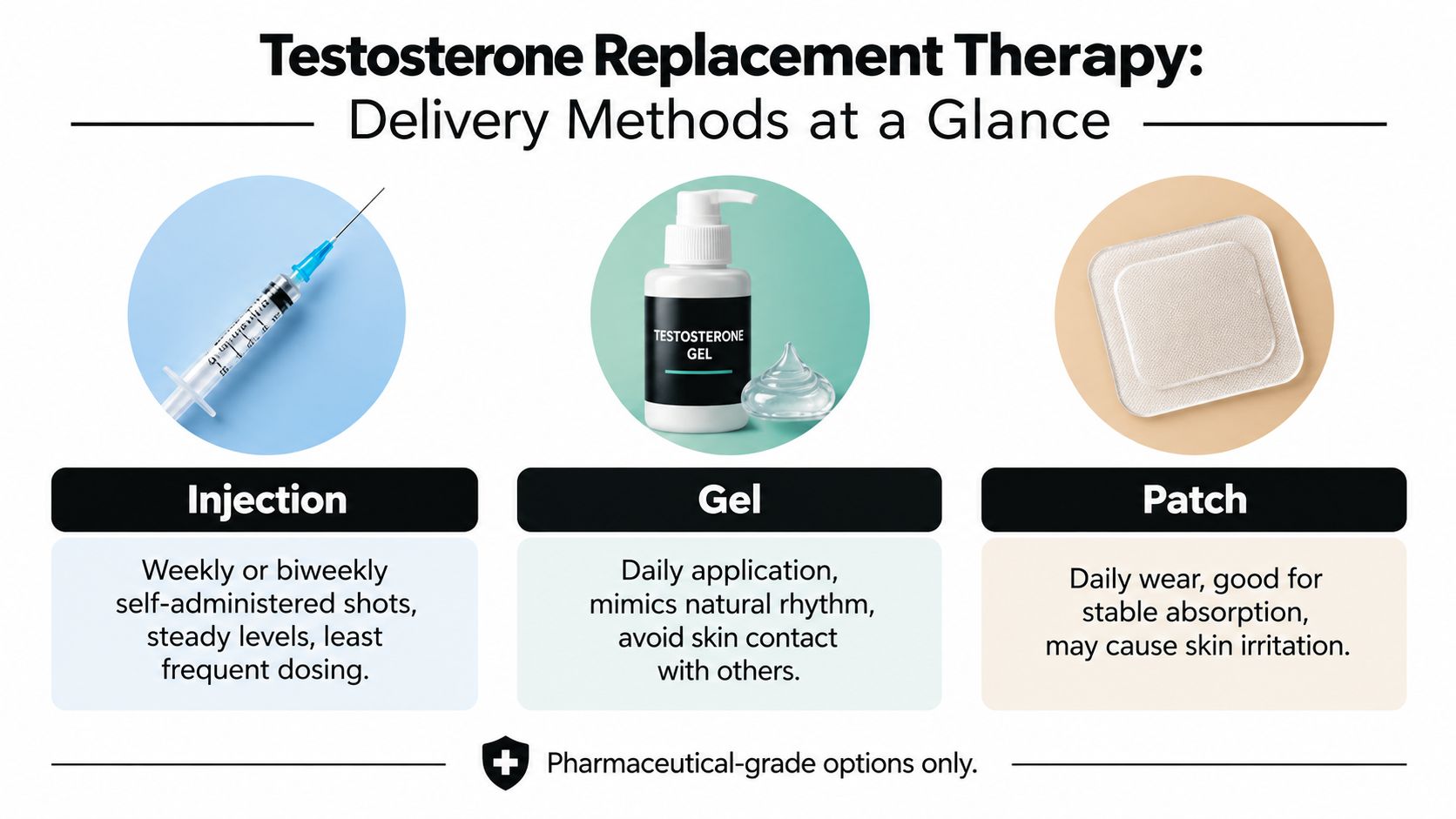
Injections compared with topical treatment
Testosterone cypionate injections are commonly selected because they don't require daily skin application. Depending on the prescribed plan, a patient may administer the medication subcutaneously or intramuscularly. The actual process involves cleaning the skin, using the prescribed needle and syringe, injecting the measured dose, and disposing of sharps safely. Your provider should demonstrate the technique and explain where to inject.
Long-acting preparations can produce larger hematocrit increases than short-acting therapies, so injectable treatment may require closer laboratory review and dose adjustments. The goal isn't to create a high peak. It's to maintain a physiologic level while limiting adverse effects, as described in this clinical review of testosterone formulation and monitoring.
Topical gels fit patients who prefer avoiding needles and can reliably apply medication every day. They may be convenient, but absorption varies, and the application site must remain covered or protected from contact with partners, children, or pets until the product is safely absorbed. Missed applications can also make levels less consistent.
Patches offer another skin-based route, although irritation can be a practical limitation. Oral and implanted options may be appropriate in selected cases, but the prescribing clinician should explain their specific monitoring and suitability rather than treating them as interchangeable.
Delivery method and follow-up
Medication and supplies may be shipped to your home after approval, with delivery timing depending on the pharmacy and shipping service. Before choosing, ask how the provider handles dose changes, refill timing, injection supplies, missed doses, and lab scheduling. A convenient formulation only works if you can use it consistently.
Realistic Timelines for Symptom Improvement
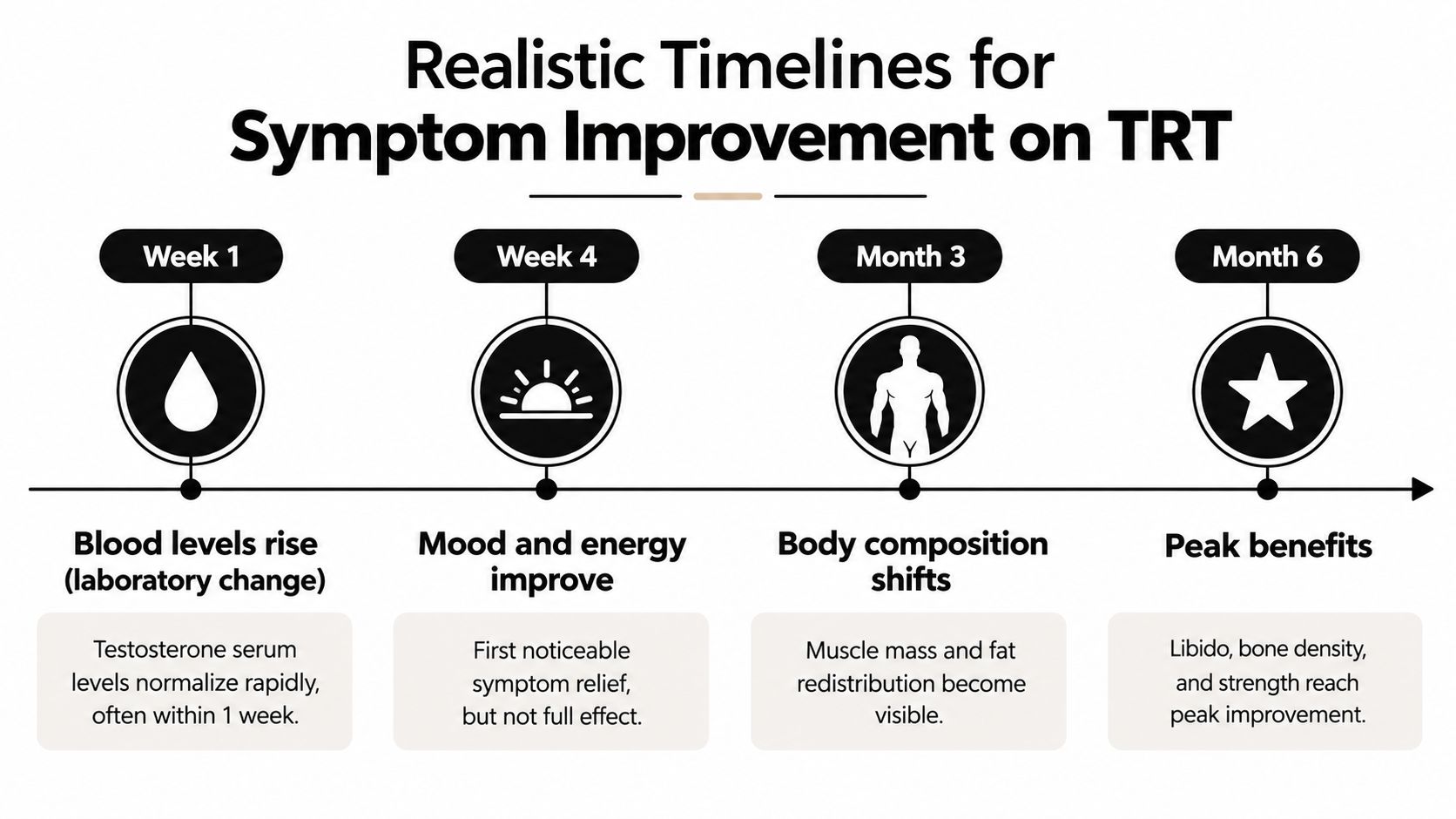
The most important distinction in testosterone replacement therapy what to expect is the difference between a laboratory response and a lived response. Serum testosterone can rise quickly after treatment begins, but your sleep, sexual function, mood, and body composition follow separate biological timelines.
Early changes are usually sexual
A 2018 evidence review found that TRT produced small but statistically significant improvements compared with placebo in libido, erectile function, and sexual satisfaction. The standardized mean differences were 0.17 for libido, 0.16 for erectile function, and 0.16 for sexual satisfaction, based on more than 1,300 participants in each endpoint analysis. The same review found no improvement in energy or mood, which is why I caution patients against expecting TRT to function as a broad wellness treatment. See the evidence review of testosterone trials for the full analysis.
In practical terms, libido may become more noticeable before erections become reliably stronger. Erectile function depends on vascular health, nerve function, medication effects, anxiety, relationship factors, and other conditions. TRT can support sexual function when low testosterone is contributing, but it isn't a stand-alone erectile dysfunction cure.
Cleveland Clinic notes that many people don't notice changes until after several weeks, while a later review places common improvements in sexual function, energy, and quality of life over 3 to 6 months, rather than immediately. The timing varies because symptoms have different causes and because the dose must be adjusted to a safe, sustainable level.
A major 2024 follow-up in older men with hypogonadism and low libido estimated an increase in sexual activity of 0.49 acts per day at 6 months and 0.47 acts per day at 12 months, with the effect maintained through 24 months. The report found better sexual desire and hypogonadal symptoms but no significant erectile-function improvement, reinforcing the need for realistic counseling. Details appear in this hospital testosterone replacement and monitoring guideline.
Later changes require patience
Body composition, strength, and bone-related effects generally take longer than a change in sexual interest. Training, nutrition, sleep, and the underlying cause of low testosterone all influence what you see. If energy or mood doesn't improve, that doesn't automatically mean the dose should increase. It may mean another condition needs attention.
Safety Monitoring and Follow-Up Blood Work
TRT requires surveillance because the medication changes more than a symptom score. The most important safety marker for many patients is hematocrit, the proportion of blood made up of red blood cells. Exogenous testosterone stimulates erythropoiesis, which can raise hematocrit and increase blood viscosity.
The monitoring schedule
Before treatment, your provider should establish baseline hemoglobin and hematocrit. Follow-up testing generally occurs around 3 to 6 months, again at 12 months, and at least annually afterward, as described in this review of testosterone therapy monitoring. A clinician may order additional testing sooner if you have symptoms, a formulation associated with stronger peaks, or a prior abnormal result.
A responsible panel may include testosterone levels, a complete blood count, and prostate-related monitoring when clinically indicated. The timing of the testosterone draw matters, especially with injections, because a result near a peak can look different from one taken near the end of the dosing interval. Ask your provider exactly when to test relative to your dose.
What happens if hematocrit rises
If hematocrit reaches 54% or higher, guidelines recommend intervention. That may involve reducing the dose, pausing therapy, changing the formulation, or evaluating contributing factors such as obstructive sleep apnea and hypoxia. Don't try to correct the result yourself by changing injections without medical guidance.
A good TRT plan protects the future benefit by responding to the lab result before a manageable issue becomes a serious one.
Follow-up should also assess whether treatment is helping the symptoms that justified it. If you have no meaningful benefit by 6 months, the diagnosis, adherence, dose, formulation, and alternative causes deserve reconsideration. TRT isn't a set-and-forget prescription.
Navigating Telemedicine Logistics and Transparent Pricing
Telemedicine can remove unnecessary travel, but it shouldn't remove clinical accountability. You should know who reviews your case, how prescriptions are issued, where medication comes from, how labs are handled, and what happens when a result requires a change.
What you're actually paying for
A transparent quote should separate the clinical service from the medication and supplies. Ask whether the price includes provider consultations, prescription management, testosterone, syringes, needles, alcohol swabs, shipping, and follow-up support. Also ask whether you're required to maintain a membership when you don't need a refill or whether lab fees are separate.
Cost Plus TRT charges $119 a month, month to month, with lab work, provider visits, medication, supplies, and shipping included. Eligibility, laboratory requirements, state availability, and the final treatment plan still need to be confirmed during medical review. A detailed discussion of treatment expenses is available in this guide to TRT cost.
Questions to ask before enrolling
Traditional men's health clinics may bundle care into recurring packages, while other services use a more itemized approach. Neither model is automatically safe or unsafe. The deciding issue is whether the pricing and medical responsibilities are clear.
- Medication source: Confirm that the prescription is for pharmaceutical-grade medication and understand how it's dispensed.
- Lab responsibility: Ask whether the clinic orders testing, accepts recent results, or requires you to arrange the draw independently.
- Dose changes: Find out how quickly a clinician reviews abnormal labs or symptoms.
- Shipping: Clarify when supplies leave the pharmacy and how replacement shipments are handled.
- State access: Telemedicine prescribing depends on where you live and the provider's licensing.
Fast logistics are useful, but speed shouldn't replace an evaluation, informed consent, or follow-up.
Fertility Considerations and Complementary Therapies
Fertility deserves discussion before the first dose, not after a semen analysis changes. Exogenous testosterone can suppress the hormonal signals that stimulate sperm production, so men who want children should tell the prescribing clinician immediately. TRT may improve libido while working against a near-term fertility goal.
The appropriate response isn't always “no treatment.” It's a fertility-focused consultation. Depending on the diagnosis and goals, a clinician may discuss alternatives or adjunctive strategies designed to preserve testicular stimulation. These decisions require individualized supervision, because the correct plan depends on baseline hormones, semen parameters, timing, and the reason testosterone is low.
Read more about the relationship between treatment and reproductive planning in this explanation of TRT and infertility.
Sexual function may need more than testosterone
Low testosterone and erectile dysfunction can overlap, but they aren't the same condition. A man can have improved desire and still need separate treatment for erection quality. Prescription options such as sildenafil and tadalafil may be considered when clinically appropriate, with screening for contraindications and medication interactions.
Some telemedicine practices also discuss physician-supervised therapies such as NAD+, Sermorelin, PT-141, or Methylene Blue. These aren't substitutes for confirming hypogonadism, and they shouldn't be added because progress feels slow. Every additional treatment should have a defined goal, known risks, and a plan for judging whether it's helping.
If preserving fertility matters, make it a treatment requirement, not an afterthought.
Your First 90 Days on TRT
The first three months should be treated as a period of observation and adjustment, not a race toward a dramatic transformation. Your job is to use the medication exactly as prescribed, track meaningful changes, and report problems early.
The first weeks
During the opening days, confirm that you understand the dose, injection route if applicable, storage instructions, and sharps disposal. If you're using an injection, practice the technique with your provider's instructions rather than improvising needle sizes or injection sites. Mild soreness can occur, but worsening redness, warmth, drainage, fever, or severe pain warrants medical contact.
Keep a simple record of administration dates and symptoms. Track libido, morning erections, sleep quality, mood, energy, acne, swelling, headaches, and injection-site reactions. Avoid changing several lifestyle or supplement variables at the same time, because that makes it harder to identify what is affecting you.
The first follow-up window
By the middle of the first three months, look for direction rather than perfection. You may notice sexual interest before physical changes. You may also notice no meaningful energy improvement, particularly if sleep apnea, depression, medication effects, or another medical issue is involved.
Before the follow-up laboratory draw, confirm the required timing relative to your last dose. Bring your symptom log and list any missed doses, side effects, or changes in other medications. Your provider can then interpret the result in context rather than reacting to a number without knowing when it was measured.
Before day 90
Use the review to answer four questions:
- Are the original symptoms improving?
- Is the testosterone level appropriate for the prescribed schedule?
- Are hematocrit and other safety markers acceptable?
- Does the formulation still fit your daily life?
Don't increase the dose because you want faster muscle gain, and don't stop abruptly without discussing it with the prescriber. If symptoms remain unchanged, the right next step may be a diagnostic review, a formulation adjustment, or evaluation for another cause rather than more testosterone.
Cost Plus TRT provides online physician evaluation, prescription management, pharmaceutical-grade testosterone cypionate, injection supplies, shipping, and ongoing consultations, subject to eligibility and medical approval. If you want a clearer plan for labs, timelines, monitoring, and treatment costs, visit Cost Plus TRT to complete the intake and request a consultation.