
You search for testosterone replacement therapy reviews, and the same pattern shows up fast. One guy says TRT gave him his life back. Another says it caused side effects he wasn't prepared for. A clinic promises an easy fix, a forum warns you to avoid everyone, and somewhere in the middle you're trying to decide what's real.
That confusion makes sense. TRT is more visible than it used to be, and more men are actively looking into it. In the United States, TRT prevalence rose sharply from 2018 to 2022, including an 86% increase among men ages 25 to 34 and a 45% increase among men ages 35 to 44, according to US Pharmacist's summary of nationwide TRT patterns. More attention brings more reviews, more marketing, and more noise.
The useful question isn't “Which clinic has the best website or the loudest testimonials?” It's “How do I judge whether a provider is safe, competent, responsive, and realistic about what TRT can and can't do?” That's the difference between choosing care and getting sold a story.
Table of Contents
- Navigating the Maze of TRT Reviews
- What Is TRT and What Results Can You Expect
- Decoding Common Themes in Patient Reviews
- How to Evaluate TRT Providers and Spot Red Flags
- Comparing Your Options Cost Labs and Care Models
- Your Pre-Consultation Checklist and Key Questions
- Making Your Final Decision with Confidence
Navigating the Maze of TRT Reviews
Most online review pages mix together very different things. Some comments are about actual symptom improvement. Others are really about billing, shipping delays, refill timing, or whether the patient could reach a clinician when they had a question. If you read them all as if they mean the same thing, you'll make a poor decision.

A good review tells you what happened, how long treatment had been going on, what the clinic did when a problem came up, and whether the patient's expectations were realistic. A weak review usually sounds absolute. “Best clinic ever.” “Total scam.” Those aren't useless, but they don't tell you enough on their own.
Practical rule: Read TRT reviews in categories, not as a pile. Separate comments about medical results from comments about service and logistics.
That matters because TRT is a medical treatment, not a supplement subscription. A provider can have friendly support staff and still prescribe carelessly. Another clinic can have a clunky website but solid medical follow-up. If you don't separate those issues, you'll overvalue convenience and undervalue safety.
When patients ask me how to use testosterone replacement therapy reviews well, I tell them to look for patterns. Repeated mentions of thoughtful dose adjustments, clear lab guidance, and accessible follow-up usually mean more than a hundred one-line testimonials. Repeated complaints about rushed prescribing, confusion around monitoring, or poor communication deserve attention even if the company markets itself well.
What Is TRT and What Results Can You Expect
A man reads a few glowing TRT reviews, starts treatment expecting a fast turnaround, and then gets discouraged when week three feels a lot like week one. That reaction is common. It usually comes from treating reviews like promises instead of clues.
TRT stands for testosterone replacement therapy. It is prescribed for men with clinical hypogonadism, which means symptoms of low testosterone are present and lab work supports the diagnosis. Used well, TRT can improve quality of life. Used casually, it creates expense, side effects, and confusion.

The Intended Candidate for TRT
The right candidate usually has symptoms such as low libido, reduced sexual performance, fatigue, lower motivation, reduced muscle mass, or a general decline in well-being, along with confirmed low testosterone on labs. A provider who skips symptoms or skips proper testing is making the decision too loosely.
If you want a plain-language summary of how diagnosis and treatment usually work, this TRT overview from Cost Plus TRT is a useful starting point. The sequence matters. Diagnosis first, treatment choice second, follow-up after that.
This is one of the first filters to apply when reading testosterone replacement therapy reviews. Ask whether the reviewer sounded like a true candidate for treatment. Reviews from men with clear symptoms and documented deficiency are more useful than reviews from men chasing better gym performance, fat loss, or a general boost.
What improvement usually looks like
Men who are good candidates often report better libido, more reliable erections, improved energy, and better day-to-day functioning over time. Some also notice easier training recovery and modest body composition changes. Those benefits are real for many patients, but they are not uniform and they are not instant.
Results also depend on what else is going on. TRT will not correct poor sleep, heavy alcohol use, untreated sleep apnea, chronic stress, relationship strain, or a calorie surplus. In practice, disappointed reviews often come from men who expected testosterone to carry the full load while the rest of the picture stayed unchanged.
A review becomes more credible when it describes timing. A patient who says sexual symptoms improved after dose adjustment and lab follow-up is giving you something useful. A patient who says “life-changing” after two injections is giving you very little to work with.
Here's a quick explainer if you prefer a visual overview before diving into provider details.
What needs monitoring
TRT comes with trade-offs. The most common mistake I see patients make is focusing only on symptom improvement and ignoring the quality of follow-up. Good clinics watch labs, adjust dose carefully, and respond when side effects show up.
One issue that often needs attention is rising hematocrit. If it climbs too high, the plan may need to change. That can mean dose adjustment, a different delivery method, or a closer look at hydration, sleep apnea, and other contributors. This is why “set it and forget it” TRT is poor medicine.
Good TRT care is diagnosis, dosing, lab review, symptom tracking, and course correction.
Use that standard when you read reviews. The most helpful reviews do not just describe results. They show whether the clinic monitored treatment well, explained trade-offs clearly, and made sensible changes when the first plan was not the right one.
Decoding Common Themes in Patient Reviews
When you read testosterone replacement therapy reviews, most comments fall into four buckets. Once you recognize them, the noise gets easier to sort.
Results comments
This is the category patients focus on first. They want to know whether libido improved, whether erections felt more reliable, whether they had better training recovery, and whether energy picked up. Good reviews in this bucket usually mention a starting problem and a clear change over time.
Weak reviews in this bucket often say only “worked great” or “did nothing.” That's too thin to guide a medical decision. A more useful comment sounds like this: symptoms improved after dose adjustment, or sexual function improved but energy didn't change much. Specificity matters.
Side effect comments
This category deserves more attention than most patients give it. Side effects don't automatically mean the clinic is bad. They may reflect dose selection, monitoring quality, or the fact that TRT isn't right for that patient.
Watch for reviews describing acne, mood changes, sleep disruption, rising hematocrit, or frustration over how side effects were handled. The key issue isn't whether a side effect happened. The key issue is whether the provider acknowledged it, explained it clearly, and adjusted the plan appropriately.
If fertility matters to you, don't rely on random forum comments. Ask directly about it and read a medical discussion focused on the issue, such as this article on whether TRT can affect fertility.
Access and communication comments
A lot of “medical” reviews are really service reviews. Patients remember whether messages were answered, whether refill requests were handled on time, and whether they could speak to someone who understood their chart instead of repeating their story to a new person every time.
Some of the best reviews aren't the most enthusiastic ones. They're the ones that describe how a clinic handled a problem.
A clinic that communicates well often earns strong reviews even when a patient needed dose changes. A clinic that disappears after prescribing tends to create anger fast, even if the medication itself was appropriate.
Process comments
This last group covers lab instructions, onboarding, pharmacy fulfillment, scheduling, shipping, and billing clarity. These issues may sound less important than symptom relief, but they shape adherence. Patients stick with treatment when the process is manageable.
A practical way to read this category is to ask whether the process feels reliable or fragile. If many reviews mention confusion around labs, refill timing, or hidden charges, that's worth taking seriously. Chronic friction makes treatment harder to sustain.
How to Evaluate TRT Providers and Spot Red Flags
A clinic can collect glowing testimonials and still provide weak medical care. That's why provider evaluation should go beyond star ratings.
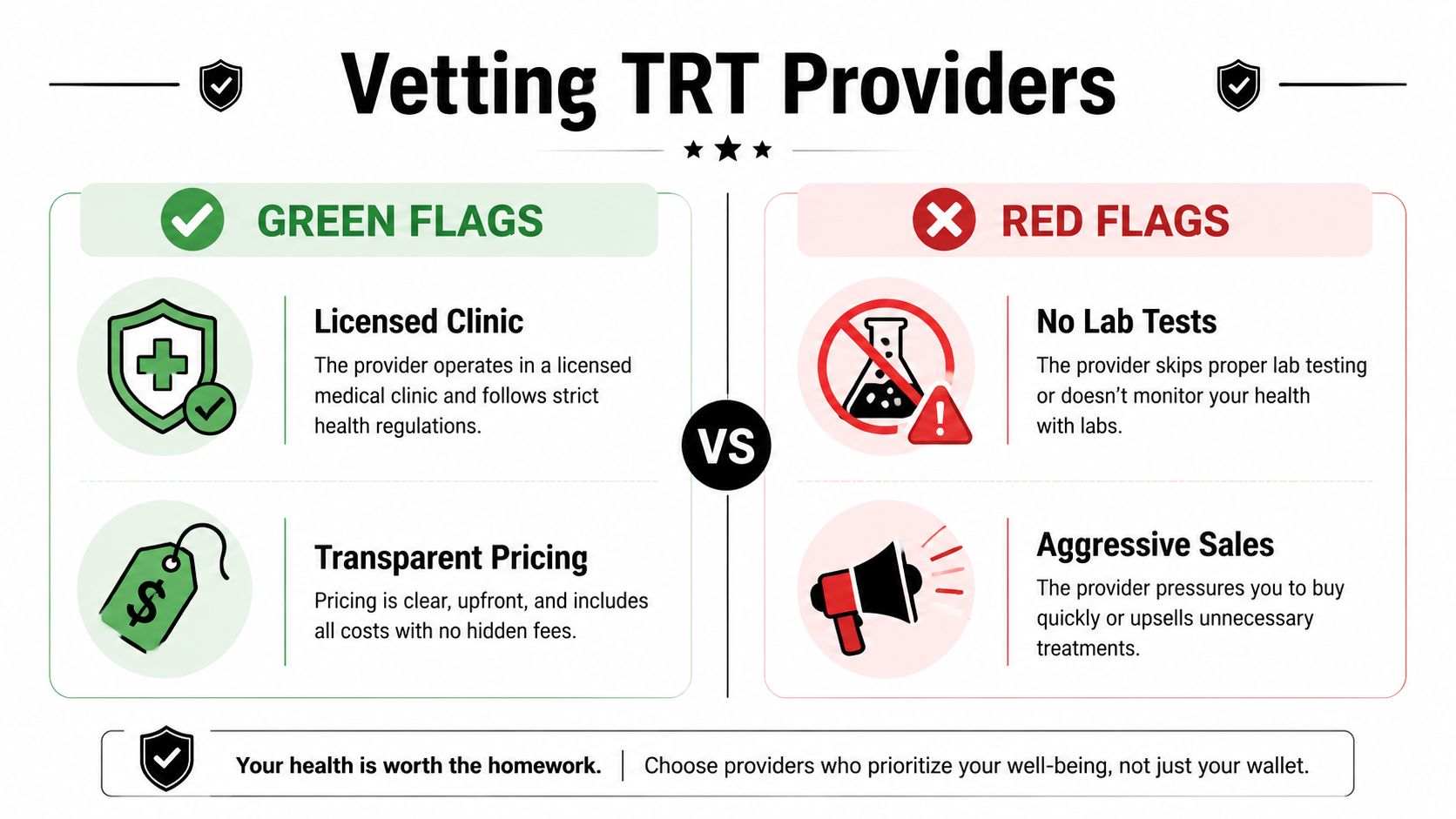
The first thing to check is whether the clinic operates like healthcare or like a sales funnel. Real care starts with medical history, symptom review, labs, discussion of risks, and a treatment plan that can be adjusted. Sales-first models rush you toward a purchase before they establish whether TRT is appropriate.
Green flags that usually matter
Use this short screen when comparing providers.
- Licensed medical care: You should know who is prescribing, what credentials they hold, and whether they're licensed where you live.
- Clear lab process: The clinic should explain what labs are needed before treatment and what follow-up monitoring looks like after starting.
- Specific dosing rationale: Good providers can explain why they chose injections, gels, or another option, and what symptoms and labs will guide changes.
- Transparent pricing: You should know what's included, what isn't, and when extra costs may appear.
- Reachable follow-up: Questions about side effects, refill timing, or symptom changes shouldn't disappear into a black hole.
Red flags that should slow you down
These signs don't always mean you must walk away, but they should make you pause.
- No meaningful lab review: A clinic that treats “low T symptoms” without careful lab confirmation is taking a shortcut.
- Aggressive promises: Be cautious if the message sounds like guaranteed fat loss, guaranteed sexual performance, or a cure for every symptom.
- One-size-fits-all dosing: Men respond differently. The safer approach is individualized treatment with adjustment based on symptoms and labs.
- Pressure to buy immediately: Medical decisions should allow room for questions, not push you toward same-call checkout.
- Vague answers about side effects: If the clinic can't explain how it monitors hematocrit, estrogen-related issues, or symptom changes, that's a problem.
A second layer of review involves the reviews themselves. Look at timing and language. A cluster of short, highly similar five-star posts can be less informative than a smaller number of detailed comments spread over time. Real patient experiences tend to sound varied. Some are enthusiastic, some mixed, some appreciative but critical.
Clinical mindset: The safest provider is rarely the one making the biggest promises. It's the one that shows its work.
Comparing Your Options Cost Labs and Care Models
Most men end up choosing between three practical paths. A traditional specialist, a local low-T clinic, or a telemedicine provider. Each can work. Each also has trade-offs.
How the common models differ
| Factor | Traditional Urologist/Endo | Local 'Low-T' Clinic | Telemedicine (e.g., Cost Plus TRT) |
|---|---|---|---|
| Cost structure | May involve insurance, copays, deductibles, and variable pharmacy pricing | Often cash pay, with clinic-specific packages that may or may not be fully transparent | Often cash pay with more direct pricing and home-delivery convenience |
| Lab process | Usually ordered through the health system, sometimes slower but familiar | Often handled in-house or through a preferred lab workflow | Commonly allows remote coordination, and some models support flexible lab submission |
| Treatment options | Broad medical options, but practice style varies a lot by doctor | Often focused on common TRT formats used by the clinic | Usually designed around remote-friendly options such as injections and standard follow-up |
| Support model | Strong for complex medical history, but access can be slower | Can be convenient locally, though quality varies widely | Convenient for busy patients, but communication quality depends on the platform |
| Best fit | Men with complicated endocrine or urologic issues | Men who want local visits and a more retail-style process | Men who value convenience, clear logistics, and remote follow-up |
Traditional urology and endocrinology practices can be excellent when the case is medically complex. The trade-off is that they may move more slowly, and some practices are less focused on the day-to-day convenience issues patients care about.
Local low-T clinics vary the most. Some are careful and experienced. Others feel more like membership businesses than medical practices. You have to vet them individually.
Telemedicine works well for men who want efficient care and don't need in-person visits for every step. Cost transparency matters a lot here, especially if you're paying cash. If you're comparing expenses, this guide on how much TRT can cost helps frame the questions you should ask.
Why treatment format matters
The treatment model and the medication format aren't the same decision, but they influence each other. In a study of 382 men on TRT, injectable formulations were the most common choice at 52.5% and had the highest patient satisfaction at 72.5%, according to this study of TRT formulation satisfaction. That doesn't mean injections are best for every man, but it does explain why many clinics use them heavily.
Some men prefer gels because they avoid needles. Others like the routine and consistency of injections. Pellets appeal to men who want fewer treatment touches, but they come with their own procedural considerations. Reviews become more useful when you notice whether the patient is praising the provider, the medication format, or both.
Your Pre-Consultation Checklist and Key Questions
A man reads a handful of glowing TRT reviews, books a consult, and expects clear answers. Then the visit turns into a fast sales call, he forgets half his questions, and leaves without knowing whether TRT is even appropriate for him.
A better consult starts before you get on the phone or walk into the office. Preparation helps you judge the clinic as much as it helps the clinician judge your case.

What to gather before the visit
Bring enough information for a real medical discussion, not a vague conversation about “low T.”
- Recent lab results: Bring any testosterone testing and related bloodwork you already have.
- Symptom notes: Write down the symptoms that matter most to you, such as low libido, erectile issues, fatigue, poor recovery, low motivation, trouble concentrating, or unwanted body composition changes.
- Medication and supplement list: Include prescriptions, over-the-counter products, performance enhancers, and any past hormone use.
- Fertility plans: Say clearly if you want children now or may want them later.
- Relevant medical history: Sleep apnea, cardiovascular disease, clotting history, polycythemia, and prostate evaluations all affect how TRT should be discussed.
Also write down your goal. Better sex drive is different from better gym recovery. More stable energy is different from wanting to improve fertility, and TRT may complicate that goal. If you can explain what success looks like for you, it becomes much easier to tell whether a provider is listening carefully or pushing a standard script.
As noted earlier, men who are good candidates can see improvement in sexual symptoms. That does not mean every symptom is caused by low testosterone, and it does not mean every clinic will set realistic expectations. Your consult should sort that out.
Questions worth asking directly
Skip broad questions like “Is TRT good?” Ask questions that show you how the clinic makes decisions and how they will manage problems if they come up.
How do you decide whether my symptoms and labs support TRT? A good answer includes symptoms, repeat morning labs when needed, medical history, and rule-outs.
What other issues would you want to rule out before starting?
This helps you spot whether the provider is thinking about sleep apnea, excess weight, thyroid issues, medication effects, stress, or other common causes of similar symptoms.What treatment do you usually start with, and why does that fit my case?
You want reasoning, not autopilot.What improvements should I expect first, and what may not improve at all?
Good clinicians give a timeline with limits. They do not promise a personality transplant in three weeks.What labs do you monitor after treatment starts, and how often?
You should hear a specific follow-up plan, including hematocrit and other standard safety markers.How do you handle side effects or a poor response?
Ask what happens if estradiol-related symptoms show up, hematocrit rises, fertility becomes a concern, or you do not feel better.What is the full monthly and yearly cost?
Ask about the consult, medication, supplies, labs, follow-ups, shipping, refill policies, and fees that start later.If TRT is not right for me, what would you recommend instead?
This question is one of the best filters. A real medical practice should be comfortable telling you no.
Write your questions down. Bring them with you. Men who do this usually leave with a clearer picture of both the treatment and the clinic.
A strong consultation should end with a plan you can explain back in plain English. You should know why TRT is or is not being recommended, what the monitoring schedule looks like, what it will cost, and what problems to watch for. If you leave with pressure, vague answers, or pricing that stays fuzzy until after you pay, keep looking.
Making Your Final Decision with Confidence
The most useful testosterone replacement therapy reviews won't tell you which clinic is universally “best.” They'll help you notice what to evaluate for yourself. That's the mindset that protects both your health and your wallet.
Start with the basics. Confirm you fit the medical picture for TRT. Read reviews by category instead of reacting to emotion. Vet the provider, not just the marketing. Compare care models based on labs, communication, treatment options, and pricing clarity. Then bring real questions into the consultation and pay attention to how they're answered.
The right provider doesn't need to oversell. They should be able to explain diagnosis, expected benefits, side effects, follow-up, and cost in plain English. They should also be comfortable saying when TRT isn't the right fit, when labs need clarification, or when another issue may be driving symptoms.
That's how you make a good decision. Not by chasing the loudest testimonial, but by choosing care that is medically grounded, practical, and transparent.
If you want a telemedicine option with transparent pricing and straightforward TRT care, Cost Plus TRT is worth a look. They focus on physician-supervised treatment, clear costs, and a simple remote process that can fit men who want affordable ongoing care without the usual clinic friction.