
You're tired by midafternoon, your waist is a little wider than it was last year, and the gym effort you used to bounce back from now seems to linger for days. Then a blood test shows low testosterone, and suddenly TRT looks like the answer to muscle loss, low drive, and the feeling that your body has stalled. That's a real and common reason men start looking into testosterone replacement therapy muscle gain, but the honest answer is more measured than the marketing.
TRT can help build lean mass in men with low testosterone, but it doesn't work like a shortcut to a bodybuilding physique. The evidence shows a real anabolic effect, yet the size of that effect depends on baseline hormone levels, delivery method, training, nutrition, sleep, and how carefully treatment is monitored. In plain terms, TRT can raise the hormonal floor, but it doesn't replace the work that shapes muscle.
Table of Contents
- Why Men Start TRT Expecting Bigger Muscles
- How Testosterone Actually Builds Muscle
- How Much Muscle TRT Realistically Adds
- Why the Delivery Method Changes the Results
- Where Most of the Muscle Gain Actually Comes From
- Monitoring Muscle Gains and Staying Safe on TRT
- What Most Men Get Wrong About TRT and Muscle
Why Men Start TRT Expecting Bigger Muscles
A man in his forties sits in clinic after months of slower workouts and stubborn weight gain. His testosterone is low, and he has seen claims that TRT can rebuild a youthful physique. He now expects the mirror to change quickly, perhaps within a few months. That expectation is understandable, but it assigns too much of the outcome to the prescription.
Low testosterone can be associated with fatigue, lower training tolerance, and a softer body composition. Restoring testosterone may improve the hormonal conditions that support training and recovery. It does not create muscle without a reason for the body to adapt. Resistance exercise provides that stimulus, while food and sleep supply much of the material and recovery needed to respond.
What the article is really trying to answer
The useful question is not whether TRT can increase lean mass. In men with low testosterone, the evidence supports a real effect. The more practical question is, how much of the gain comes from the prescription itself, and how much comes from training, protein, and sleep?
For a busy adult outside a research protocol, a realistic six-to-twelve-month outcome is gradual and variable. Some men notice better training consistency and a modest change in lean mass. Others see less visible change because their program, diet, sleep, or starting condition limits the response. TRT may raise the hormonal floor, while daily habits determine how much of that capacity becomes muscle.
The delivery method can also affect consistency and hormone exposure, so the prescription alone does not tell the whole story. Progress should be judged through symptoms, performance, body composition, and appropriate medical monitoring rather than photographs or promises.
Practical rule: If your plan is TRT without consistent training, adequate protein, or reliable sleep, expect less muscle gain than online success stories suggest.
How Testosterone Actually Builds Muscle
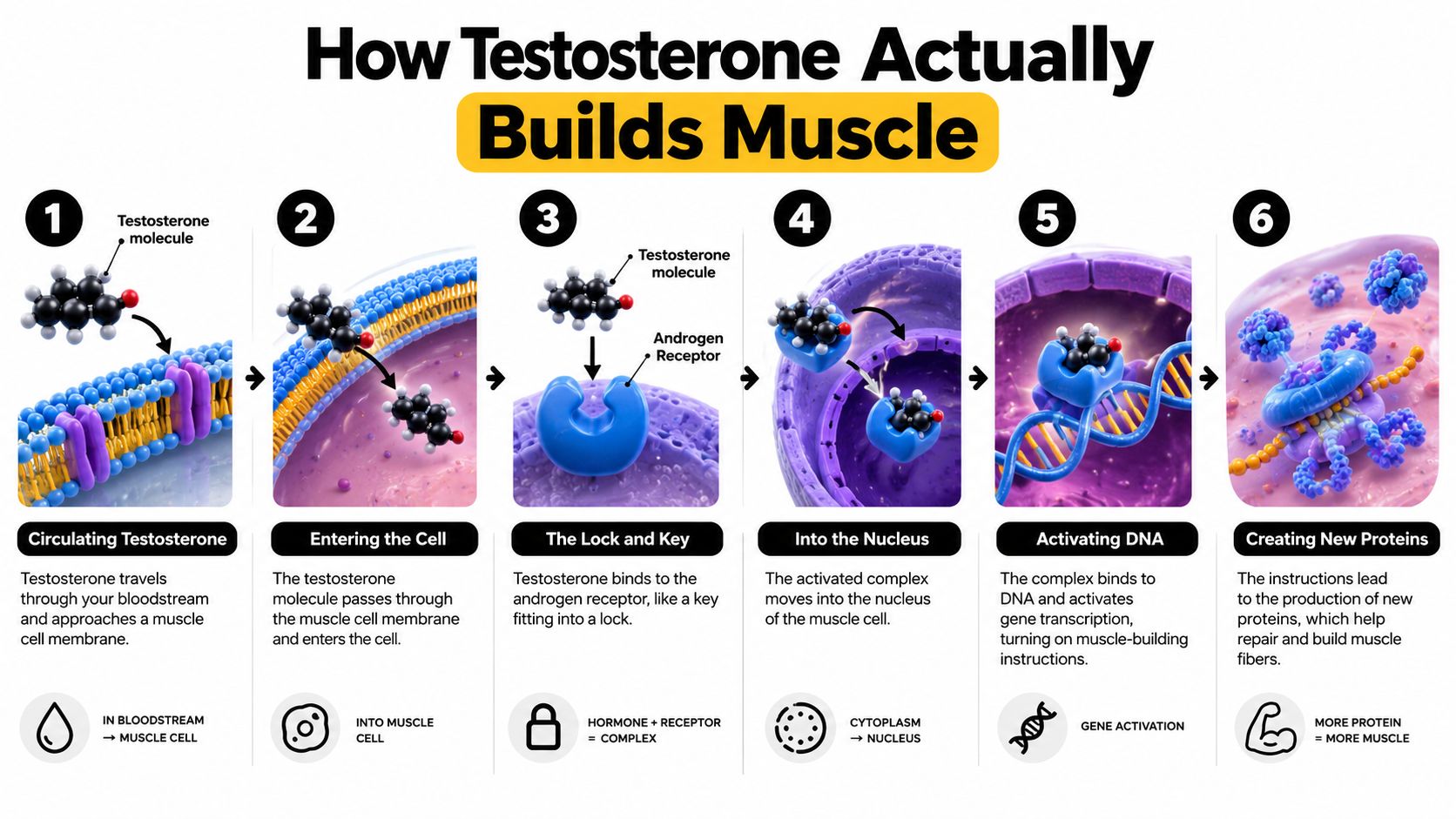
Testosterone's effect on muscle makes more sense if you treat it like a lock-and-key system. The testosterone molecule is the key, the androgen receptor inside the muscle cell is the lock, and the signal that follows is what tells the cell to support growth and repair.
The signal inside the muscle cell
First, circulating testosterone crosses into the muscle cell and binds the androgen receptor. That receptor then moves toward the nucleus, where it influences DNA programs tied to muscle protein synthesis. Resistance training matters here, because lifting weights provides the mechanical signal that tells the body where to spend that anabolic support.
Second, testosterone helps activate satellite cells, which are the repair-and-grow crew around a muscle fiber. Over time, those cells help add nuclei to muscle fibers, which supports more durable growth than a short-term pump. That process takes months, not days.
Third, testosterone modestly reduces protein breakdown and can improve recovery between sessions. That's one reason some men feel like they can train more consistently after levels are restored. The effect is real, but bounded, because TRT amplifies a signal, it doesn't generate muscle from nothing.
The limitation matters. Without mechanical tension from training, adequate protein, and enough sleep, the hormone signal doesn't have much raw material to work with. That's why men who expect TRT to replace the gym usually end up disappointed.
Testosterone supports growth, but the muscle still has to earn the signal through load, recovery, and repeated use.
How Much Muscle TRT Realistically Adds
A man can start TRT, keep his work schedule, train a few times each week, and still wonder whether the prescription is doing anything for muscle. The evidence supports a measurable increase in lean mass for men with genuine testosterone deficiency, but the result usually looks like a gradual improvement in body composition, not a research-style transformation.
The strongest pooled estimate comes from a 2022 systematic review and meta-analysis of 432 participants. TRT increased lean body mass by 2.0 kg compared with placebo, with a 95% confidence interval of 1.46 to 2.63 kg. That analysis found no comparable increase in adverse events (PubMed review). The number describes an average across studies, not a promise for every patient.
A randomized trial in 39 men aged 50 to 70 with type 2 diabetes and low bioavailable testosterone found that 24 weeks of TRT increased total lean body mass by 1.9 kg and lean leg mass by 0.5 kg compared with placebo. Fat mass fell by 1.3 kg, and leg fat mass fell by 0.7 kg (trial report). Over a realistic six-to-twelve-month period, a busy adult might notice better shape, improved training tolerance, and different clothing fit. The prescription contributes to that change, while training, protein intake, and sleep determine how much of the available signal becomes muscle.
What those numbers mean in real life
TRT often changes body composition more than scale weight. If lean mass rises while fat mass falls, total weight may barely move. Waist measurements, progress photos, strength records, and DEXA or similar testing can show progress that the bathroom scale misses.
Baseline testosterone also changes the likely response. Men with lower baseline testosterone generally have more room to benefit than men whose levels already sit in the mid-range. Restoring a clear deficiency to the physiologic range can support muscle gain. Raising an already normal level offers less predictable and often smaller returns.
| Baseline testosterone | Likely lean-mass response | Practical meaning |
|---|---|---|
| Clearly low | Modest gain, within the range seen in trials | Deficiency correction provides the clearest opportunity |
| Mid-range | Smaller or hard-to-detect change | Training and nutrition may explain more of the outcome |
| Physiologic replacement | Real but bounded increase | TRT corrects deficiency, rather than maximizes muscle |
Randomized trials also found dose- and concentration-dependent increases in skeletal muscle mass and strength, although performance results varied. In one 20-week enanthate study, skeletal muscle mass and maximal strength improved, while fatigability did not. In an older hypogonadal cohort, 3 years of TRT improved chest-press strength, muscle power, stair-climbing power, and lean body mass, but not leg-press strength (trial summary). The tested muscle group, the outcome being measured, and whether the patient trains all affect what “gaining muscle” looks like.
Why the Delivery Method Changes the Results
Two men can both receive TRT and still see different changes in muscle and body composition. The reason is partly the delivery method. Testosterone exposure varies between formulations, and a systematic review and meta-analysis found that intramuscular TRT was more effective than transdermal TRT for increasing lean body mass and muscle strength. Transdermal treatment produced smaller changes in fat-free mass and strength than intramuscular treatment (review).
That finding does not make injections the right choice for every man. It shows that the prescription label, “TRT,” does not describe an identical treatment experience.
Injections and gels are not the same experience
Injections often create a sharper rise in testosterone after dosing, followed by a decline toward the trough before the next dose. Gels and patches provide steadier daily exposure. That consistency may suit men who prefer a routine application, although absorption can vary and the muscle effect has been smaller in body-composition studies.
The same review found that transdermal therapy was associated with a 1.7% increase in fat-free mass and 2 to 5% increases in total-body and upper-extremity strength. Intramuscular TRT produced larger effect sizes, with roughly 3 to 5 times greater percentage improvements across the assessed outcomes. Gel can still work. The difference is that the delivery method may influence the size of the response.
| TRT Delivery Methods and Muscle Outcomes Compared | Typical T-Levels Achieved | Expected Lean-Mass Change at 12 Months | Key Pros | Key Cons |
|---|---|---|---|---|
| Intramuscular injections | Physiology-dependent, often with higher peaks | Generally larger gains in lean mass and strength | Strong anabolic effect, flexible dosing | More lab monitoring, peaks and troughs can matter |
| Transdermal gel or patch | Steadier daily exposure | Smaller lean-mass changes in many studies | Convenient, noninvasive | More variable absorption, smaller anabolic edge |
| Other medically supervised protocols | Depends on dosing and adherence | Variable | Can be adjusted to the patient | Outcome depends on consistency and monitoring |
The practical choice depends on more than potential muscle gain. Fertility goals, hematocrit response, adherence, and daily convenience all affect whether a man can use the treatment consistently and safely. Men comparing formulations can review this TRT information page for a general overview before discussing options with a clinician. For a busy adult, the method that fits his routine may produce a more dependable six-to-twelve-month result than a theoretically stronger option he uses inconsistently.
Where Most of the Muscle Gain Actually Comes From
A man may start TRT expecting his prescription to create visible muscle on its own. In practice, TRT provides the hormonal support, while training, protein, sleep, and recovery determine how much of that potential becomes muscle.
TRT opens the door, training creates the change
TRT opens the door by restoring a healthier hormonal environment. Resistance training provides the signal through mechanical tension, telling muscle tissue to adapt. Protein, sleep, and recovery supply the materials and time needed to repair and build that tissue.
The prescription supports the process. It does not replace the process.
A busy adult who takes TRT but rarely trains may notice better energy or function before seeing a change in the mirror. Those improvements can make workouts more productive, but body composition usually follows months of repeated effort. Adjusting the prescription cannot substitute for progressive resistance training.
The main source of visible change is usually the combination of:
- Training consistently, with gradually increasing demands.
- Eating enough protein to support repair and growth.
- Sleeping and recovering well enough to repeat the work.
- Using TRT to correct low testosterone when medically appropriate.
A man who follows those habits can reasonably expect gradual recomposition over 6 to 12 months. Early lean-mass changes may appear well before the one-year mark, as the 24-week trial cited earlier showed. Results vary with age, starting body composition, training history, nutrition, and adherence, so a research setting should not be treated as a personal guarantee.
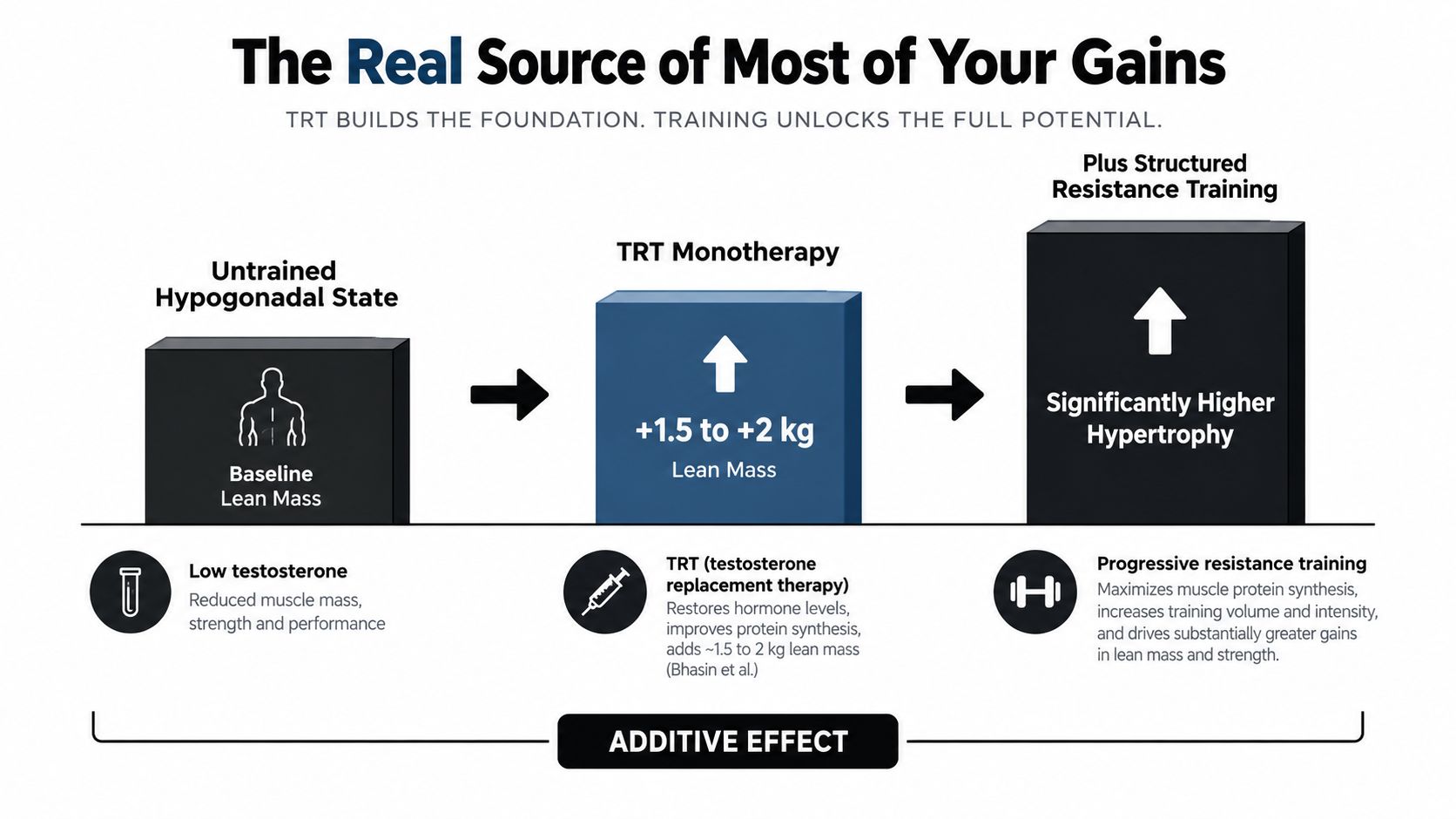
Realistic outcome: TRT can help a hypogonadal man feel and function better, but progressive lifting and consistent recovery usually account for the largest visible change.
Monitoring Muscle Gains and Staying Safe on TRT
A patient may report stronger lifts and a fuller look after starting TRT, yet the scale may also reflect fluid changes. A safe review separates genuine tissue gain from temporary shifts and checks whether treatment is helping without creating new problems.
What clinicians actually watch
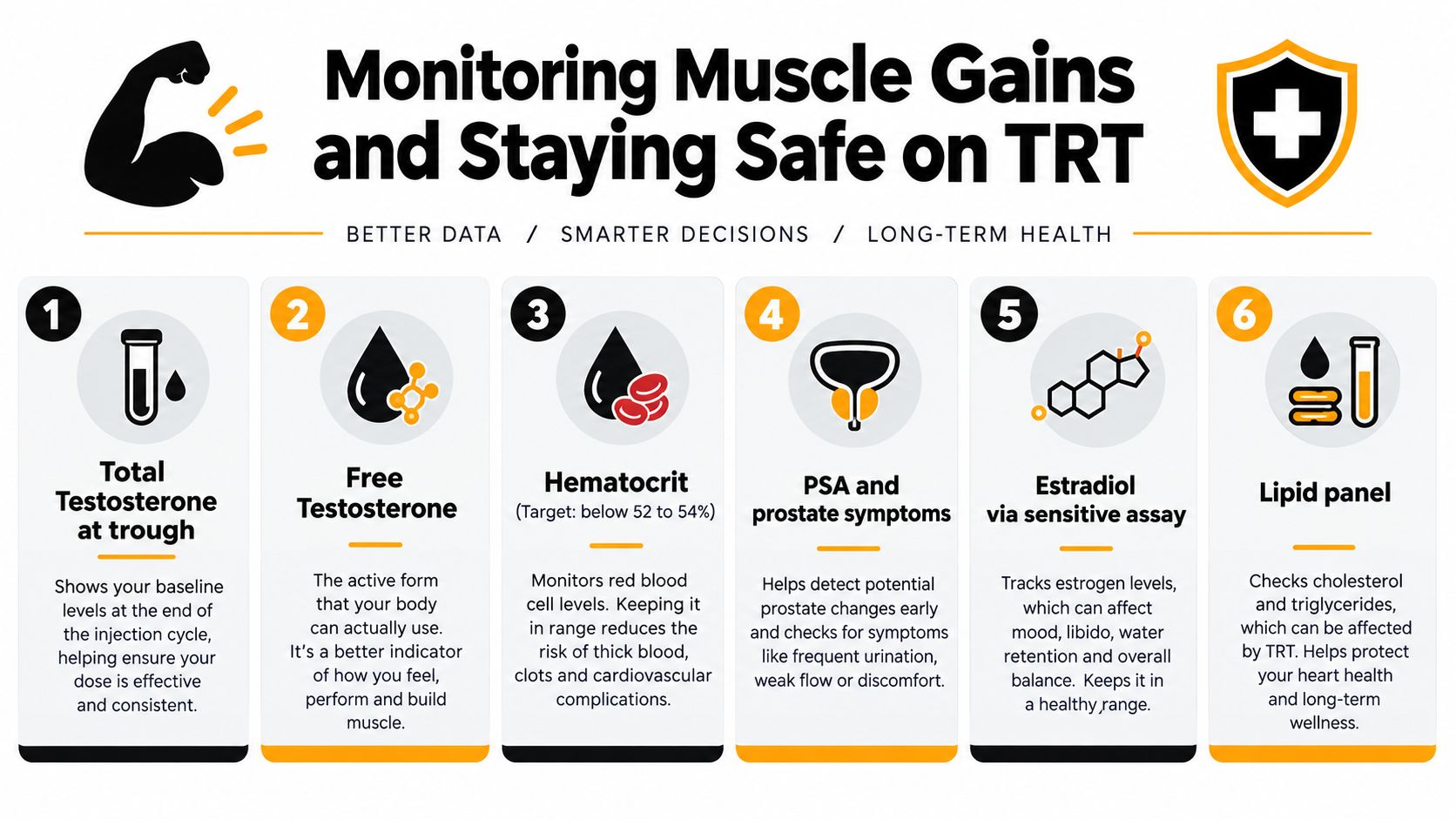
The main laboratory checks are total testosterone and free testosterone, measured at the appropriate point in the dosing cycle. Clinicians also review hematocrit, PSA and prostate symptoms, estradiol via a sensitive assay, lipid panel, and blood pressure. Each marker answers a different question. Testosterone shows exposure, hematocrit shows how the blood is responding, and the prostate, cardiovascular, and metabolic checks look for treatment-related concerns.
Hematocrit deserves particular attention. If it rises too much, the clinician may need to change the dose or dosing frequency, which can also affect how steady the patient feels. Estradiol helps explain another common source of confusion: excess water retention can make early scale weight look like new muscle.
A practical follow-up schedule includes 6 weeks, 3 months, 6 months, and 12 months, with body-composition testing when available. DEXA is more informative than a mirror because it separates lean tissue from fat and gives some context for water shifts. Strength can improve before measurable tissue changes appear, so one lifting session or one weigh-in cannot establish the result.
If muscle is improving but hematocrit is climbing too fast, the safest move is often a dose or route adjustment, not a chase for even higher testosterone.
Symptoms and laboratory trends may point to a change in delivery method. Some patients need a different route, tighter injection spacing, or a lower total dose. Others need closer attention to recovery habits. Fertility plans also change the discussion, so patients should review how TRT affects fertility and what options exist before treatment decisions are settled.
What Most Men Get Wrong About TRT and Muscle
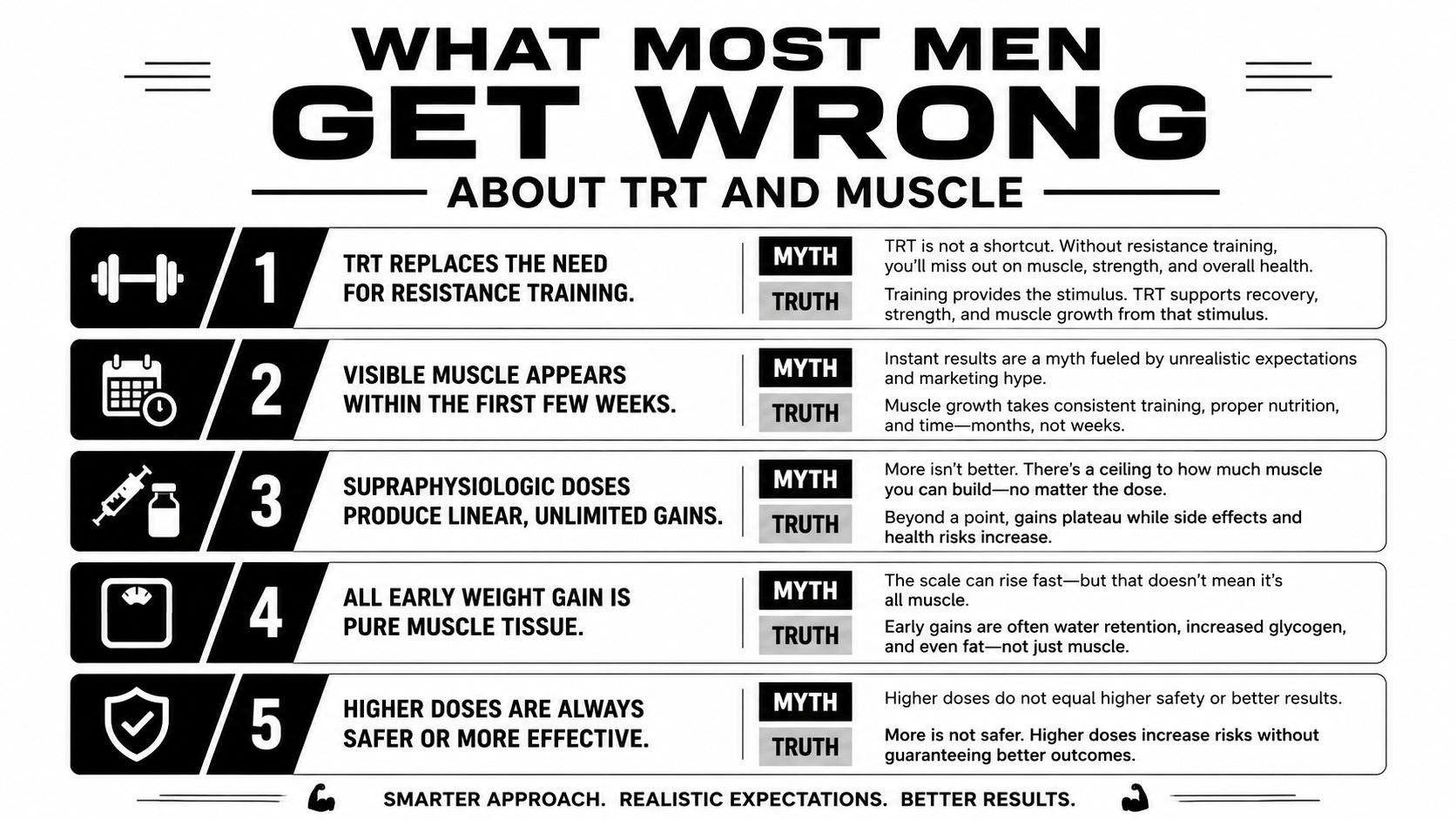
A busy man starts TRT, trains when work allows, eats more protein, and expects the mirror to reveal a new physique within weeks. At the first refill, he may notice better energy or fuller muscles, but the prescription has not replaced the work that creates tissue. Testosterone can correct a hormonal deficit. Resistance training supplies the repeated mechanical signal that tells muscle to adapt.
The first mistake is expecting a rapid transformation. Lean-mass change develops over months, not a few weeks. A realistic 6-to-12-month outcome depends on the starting level of testosterone, training consistency, protein intake, sleep, age, and body-fat changes. TRT may provide part of the improvement, but it is difficult to separate that contribution from the habits that make the prescription useful.
The second mistake is assuming that more testosterone means proportionally more muscle. Correction of deficiency can produce a meaningful response, especially in men who begin with low levels. Raising exposure beyond physiologic replacement does not create an unlimited staircase of gains and can increase avoidable safety concerns.
The third mistake is treating every increase on the scale as new muscle. Water retention, glycogen, and body-fat changes can move body weight before measurable tissue changes occur. A mirror offers context, but body-composition checks, waist measurements, strength records, and consistent photos provide a more reliable picture.
The fourth mistake is believing a higher starting testosterone level guarantees a better result. Men who begin lower have more room to improve. Someone already in the mid-range may experience a smaller visible change, even with appropriate treatment.
Use this checklist to separate the prescription's contribution from the habits doing most of the building:
- Confirm the diagnosis correctly. Use two morning labs before calling testosterone low.
- Choose the lowest effective dose with a clinician. The aim is physiologic correction, not maximum elevation.
- Lift with structure. Resistance training 3 to 4 days per week turns the hormonal change into a repeated growth signal.
- Hit protein consistently. A daily target around 1.6 g/kg is a sensible anchor for adding or preserving lean mass.
- Protect sleep and stress recovery. Poor sleep reduces training output and can make progress appear slower.
- Recheck body composition and blood markers at 3, 6, and 12 months. Those checkpoints keep expectations tied to measurable results.
For a plain-language explanation of treatment organization, the TRT FAQ provides a useful starting point.
The honest summary is simple. TRT can add lean mass in hypogonadal men, but training, protein, and recovery usually determine how much of the 6-to-12-month result becomes visible. Cost Plus TRT provides physician-supervised testosterone treatment and ongoing monitoring for men who want those factors considered together.