

If you're reading about TRT right now, there's a good chance you feel off but can't tell what information to trust. One site says low testosterone explains everything. Another says treatment is risky. A forum tells you to chase the highest number possible. A clinic ad makes it sound as simple as filling out a form and waiting for a package.
That confusion is common. Good care is usually much less dramatic than the internet makes it sound. It starts with a proper diagnosis, uses a treatment plan matched to your goals and health history, and follows a monitoring schedule that catches problems early.
For patients, the most useful thing to know is this: testosterone replacement therapy guidelines aren't red tape. They're the guardrails that separate supervised medical treatment from guesswork. If you're trying to get help through an affordable telemedicine clinic, those guardrails matter even more because convenience only helps if the care is still disciplined.
Table of Contents
- Decoding TRT Guidelines and Why They Matter
- Who Qualifies for TRT Under Current Guidelines
- Recommended TRT Treatment Regimens and Routes
- The TRT Monitoring Schedule Your Safety Checklist
- Safety Contraindications and Fertility Considerations
- How to Navigate TRT via Telemedicine and Transfer Care
- Taking Control with Guideline-Based TRT Care
Decoding TRT Guidelines and Why They Matter
A lot of men first encounter TRT through frustration. Energy is lower. Recovery is slower. Sex drive drops. Focus isn't what it used to be. Then they search online and get pulled between two bad extremes: hype that promises a total transformation, and fear that makes all treatment sound reckless.
Clinical guidelines exist to cut through that noise.
They give providers a framework for answering the questions that matter. Does this patient have testosterone deficiency? Is treatment appropriate for him? Which route makes sense? What labs need to be checked? When should therapy be adjusted, paused, or stopped?
Why the rules are practical, not arbitrary
Good testosterone replacement therapy guidelines are built around trade-offs. Testosterone can help the right patient, but it also changes more than one lab value. It affects red blood cell production, can influence PSA monitoring, and requires follow-up that is specific to the way the medication is delivered.
That means quality care doesn't look like this:
- Fast prescribing without a full workup
- Dose escalation because symptoms linger for a few weeks
- Lab checks done at random times
- No plan for fertility, prostate monitoring, or hematocrit follow-up
It looks like a structured chronic-care model instead.
Practical rule: If a clinic can't clearly explain how it diagnoses low testosterone, when it repeats labs, and what would make it change your dose, you're not looking at guideline-based care.
What guidelines change for a patient
For patients, the benefit is clarity. You know what should happen before treatment starts. You know what follow-up should look like. You know that if something drifts out of range, there is a plan.
That matters in person and online. Telemedicine can make TRT more affordable and easier to maintain, but convenience doesn't replace standards. It should make the standard process easier to access.
The rest of this guide translates the formal side of testosterone replacement therapy guidelines into plain language: who qualifies, how treatment is selected, what monitoring protects you, where fertility fits in, and how to move through telemedicine without cutting corners.
Who Qualifies for TRT Under Current Guidelines
A common visit starts the same way. A man in his 30s, 40s, or 50s has been dragging for months, his sex drive is down, workouts feel flat, and an online ad makes TRT sound like the obvious answer. Sometimes it is. Often, the first job is sorting out whether low testosterone is the problem.
Symptoms matter, but they are only half of the diagnosis. Fatigue, low libido, poor concentration, reduced recovery, and low mood can also show up with poor sleep, excess body fat, depression, heavy alcohol use, medication side effects, or untreated sleep apnea. I tell patients this clearly because good TRT care starts with accuracy, not speed.
Symptoms and labs have to match
Current guidelines are built around two findings at the same time. You need symptoms that fit testosterone deficiency, and you need lab results that confirm it.
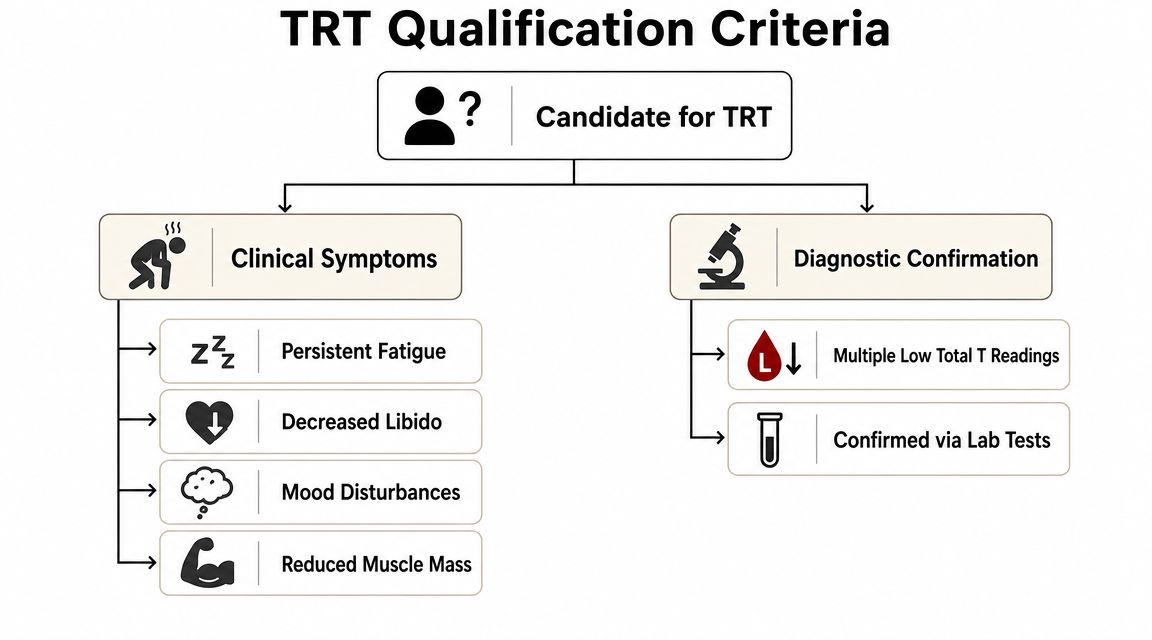
A proper evaluation usually includes:
- A symptom review: sexual symptoms, energy, strength, cognition, mood, and physical changes
- Morning testosterone testing: testosterone should be checked early in the day and confirmed if low
- A review of contributing factors: sleep, body weight, alcohol use, medications, stress, and other medical conditions
- Baseline labs: enough information to judge whether treatment is appropriate and safe
That last point matters more than many patients expect. A single low result does not automatically mean you should start TRT. Testosterone levels can shift with illness, poor sleep, calorie restriction, and timing of the blood draw. Repeating and confirming the finding protects you from being treated for the wrong problem.
Age alone does not establish eligibility
Another rule patients should understand is that feeling older is not, by itself, a diagnosis. In the U.S., testosterone prescribing has long drawn a line between confirmed testosterone deficiency and age-related decline without a clear underlying disorder. In practice, that means a responsible clinician should be able to explain why your symptoms and lab pattern support treatment, rather than treating normal aging as enough reason to prescribe.
That does not exclude older men. It raises the standard. The question is not your age. The question is whether you meet clinical criteria and whether the benefits of treatment are likely to outweigh the downsides in your case.
Good TRT clinics confirm a medical diagnosis first, then discuss treatment options.
Telemedicine can help if it is done correctly. Remote care can make the process less expensive and easier to maintain, but the medical standard should stay the same. You should still expect intake forms, review of symptoms, lab confirmation, and a discussion about risks, alternatives, and follow-up. If you're seeking online TRT care with a medical screening process, the visit may be more convenient, but it should still feel like real clinical care.
The men who run into trouble are usually trying to force the diagnosis. They assume testosterone must be the answer and skip over sleep apnea, obesity, thyroid issues, medication effects, or fertility plans that could change the decision. Careful providers slow that process down for a reason. It protects safety, prevents bad prescribing, and gives you a clearer path if TRT is the right next step.
Recommended TRT Treatment Regimens and Routes
Once a patient qualifies, the next decision is practical: how should testosterone be delivered?
Most men think only in terms of "shots versus gel," but the better question is which route fits your physiology, schedule, budget, and tolerance for maintenance. The right answer isn't the same for everyone.
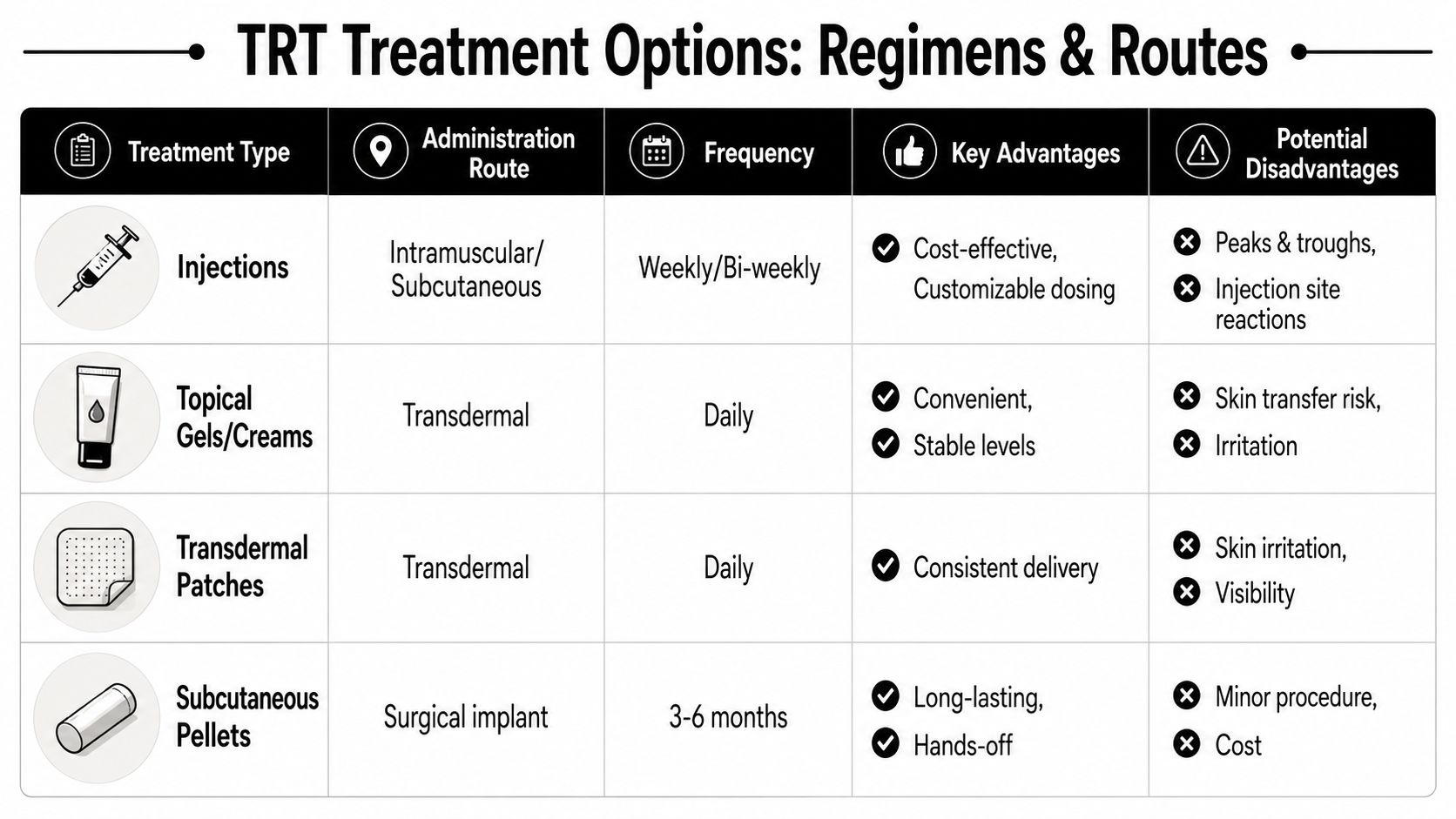
How providers choose a route
Across major guidelines, the treatment target isn't "higher testosterone." The target is the mid-normal physiologic range, typically about 450 to 600 ng/dL, with timing of follow-up adjusted to the product being used. The AUA guidance also notes that gels and patches are checked after 2 to 4 weeks, while short-acting injections are checked after 3 to 4 cycles because serum levels behave differently by formulation, as described in the AUA testosterone deficiency guideline.
That matters because bad timing creates bad decisions. A lab drawn at the wrong point after an injection can make a dose look too low or too high when it isn't.
What works well for different lifestyles
Here is how the common options usually compare in everyday care.
| Treatment type | What patients often like | What patients often dislike |
|---|---|---|
| Injections | Flexible dosing, often cost-conscious, no daily application | Peaks and troughs can be noticeable, some men dislike needles |
| Topical gels or creams | Simple daily routine, steadier delivery for some men | Transfer risk to partners or children, skin mess or irritation |
| Patches | Predictable daily application | Skin irritation, visibility, patch adherence issues |
| Pellets | Less frequent hands-on dosing | Procedure required, less flexibility if side effects appear |
A few real-world patterns show up often:
- Injections fit men who want control. They're often a good match for patients comfortable with self-administration and dose adjustments under supervision.
- Gels fit men who value steadier daily routines. They can work well when a patient wants to avoid injection peaks.
- Patches fit a smaller group well. They are simple in theory, but skin tolerance decides whether they remain practical.
- Pellets appeal to men who want less frequent dosing. The trade-off is reduced flexibility once inserted.
Chasing the highest possible testosterone level usually creates more problems than benefits. Good prescribing aims for symptom improvement with the minimum dosing needed to stay in a physiologic range.
What doesn't work well is choosing a route based only on online hype. A man bothered by fluctuating mood may do poorly on a schedule that produces obvious peaks and troughs. Another man with children at home may not like the transfer concerns that come with topical medication. Someone who travels constantly may prefer a route that doesn't require daily application.
The conversation should shift to a personal focus. The best regimen is the one you can follow consistently, monitor correctly, and tolerate over time.
The TRT Monitoring Schedule Your Safety Checklist
A common telemedicine scenario goes like this: a man starts TRT, feels better for a few weeks, then has no clear plan for labs, dose checks, or what happens if hematocrit climbs. That is where good care separates itself from casual prescribing. TRT works best when follow-up is scheduled from the start, not improvised after a problem shows up.
Monitoring protects two things at the same time. It helps confirm that treatment is improving symptoms, and it helps catch safety issues early enough to adjust the plan before they turn into bigger problems.
What should be checked and when
Guidelines from major endocrine and urology groups follow the same basic pattern. Get baseline labs before the first dose. Recheck early after treatment starts or after a dose change. Once levels, symptoms, and safety markers are stable, spacing follow-up out to routine intervals is reasonable. A useful summary of that approach appears in the CMAJ review of testosterone therapy guidelines.
In practice, the schedule usually looks like this:
| Timeline | Required labs | Purpose |
|---|---|---|
| Before treatment | Testosterone, complete blood count, PSA, and other baseline labs your clinician orders | Confirm the diagnosis and look for issues that could change the treatment plan |
| Early follow-up | Testosterone and hematocrit, with additional testing based on symptoms, route, and baseline risk | Check whether the dose is appropriate and whether side effects are appearing |
| Ongoing stable care | Repeat testosterone and safety labs at routine intervals | Keep treatment in range and catch drift over time |
Timing matters.
A testosterone level drawn at the wrong point in an injection cycle can make a reasonable dose look too high or too low. The same problem happens in telemedicine when patients order labs on their own without being told when to test. Good clinics give specific instructions for lab timing based on the medication form you use, because that is how dose decisions stay accurate and affordable instead of turning into repeated trial and error.
Why hematocrit gets close attention
Hematocrit deserves special attention because testosterone can increase red blood cell production. If it rises too far, blood can become too concentrated, and the plan may need to change. That can mean lowering the dose, changing the dosing schedule, switching formulations, pausing treatment, or looking for contributing issues such as dehydration, sleep apnea, or smoking.
This is one of the clearest markers of clinic quality. If no one is checking hematocrit, the follow-up plan is not strong enough.
Patients do better when they know what each checkpoint is for:
- Testosterone level: shows whether replacement is too low, appropriate, or excessive
- Hematocrit: screens for erythrocytosis and helps guide dose or formulation changes
- PSA and prostate review: helps monitor prostate-related risk in appropriate patients
- Symptom review: keeps treatment tied to real outcomes such as energy, libido, recovery, and sexual function
A good follow-up visit answers two practical questions. Are you getting the benefit you started TRT for? Are the labs still supporting safe treatment?
That second question matters more than many men expect. Fatigue after starting TRT does not always mean the dose is too low. It may reflect poor sleep, excess alcohol, untreated sleep apnea, stress, thyroid issues, or expectations that testosterone was never going to fix. Monitoring helps sort out what is happening, which prevents unnecessary dose escalation.
This also matters for fertility planning. Men who may want children should raise that early, before treatment starts, because monitoring alone does not solve the fertility issue. If that concern applies to you, review how TRT can affect fertility and what options may preserve it before locking into a long-term plan.
For patients using telemedicine, the practical standard is simple. You should know which labs are due, when to draw them, where to complete them locally, and what result would trigger a dose change or a follow-up visit. If a clinic cannot explain that clearly, the treatment plan is incomplete.
Safety Contraindications and Fertility Considerations
Safety isn't just about repeat labs. It's also about knowing when TRT needs extra caution and when a different plan makes more sense.

When TRT needs caution or may not be appropriate
Some men are excellent candidates for testosterone therapy. Others need a slower, more careful review because the risk profile is more complicated.
The Endocrine Society's guidance emphasizes that TRT should be reserved for men with compatible symptoms and unequivocally low morning testosterone, and that treatment should be individualized based on risk factors. It also highlights hematocrit monitoring before treatment, at 3, 6, and 12 months, and then annually, as summarized in the Endocrine Society recommendations on testosterone prescribing.
In practice, caution is especially important when a patient has:
- Prostate-related concerns: these need review before treatment starts.
- Marked baseline cardiometabolic risk: the plan should be individualized, not automatic.
- Sleep apnea concerns: untreated sleep problems can mimic or complicate low testosterone symptoms.
- Prior clotting or erythrocytosis issues: these deserve serious discussion before prescribing.
Patients often hear "contraindication" and assume it means a hard no forever. Sometimes it does. Often it means slow down, investigate further, and decide carefully.
Why fertility can change on TRT
This is the part many younger men are never told clearly enough. TRT can suppress your body's own testosterone signaling and reduce sperm production. If you want children now or in the future, that conversation needs to happen before the first prescription, not after months of therapy.
Here's the practical version. External testosterone can signal the body to reduce its own hormonal stimulation of the testes. When that happens, sperm production may fall. That doesn't mean every man becomes permanently infertile, but it does mean fertility planning can't be treated as an afterthought.
For men who want to preserve fertility, providers may discuss alternatives or add-on strategies such as hCG or clomiphene citrate rather than relying on testosterone alone. If this is your concern, it helps to review a plain-language explanation of whether TRT can affect fertility before your consultation so you know what to ask.
One practical rule is simple: tell your provider if future fertility matters, even if you're not trying to conceive right now.
A short clinical overview may help if you're weighing that decision:
If fertility matters to you, don't let anyone describe TRT as routine without also discussing sperm production.
The men who do best long term usually aren't the ones who rushed into treatment. They're the ones who matched therapy to their actual goals, including family plans.
How to Navigate TRT via Telemedicine and Transfer Care
Telemedicine works well for TRT when the clinic applies the same standards you would expect in an office. The process should feel efficient, not casual.
For a new patient, that usually means symptoms are reviewed online, labs are ordered or uploaded, a licensed clinician evaluates the results, and treatment is prescribed only if the diagnosis and safety picture fit. For a transfer patient already on therapy, the goal is continuity without losing the monitoring discipline that keeps treatment on track.
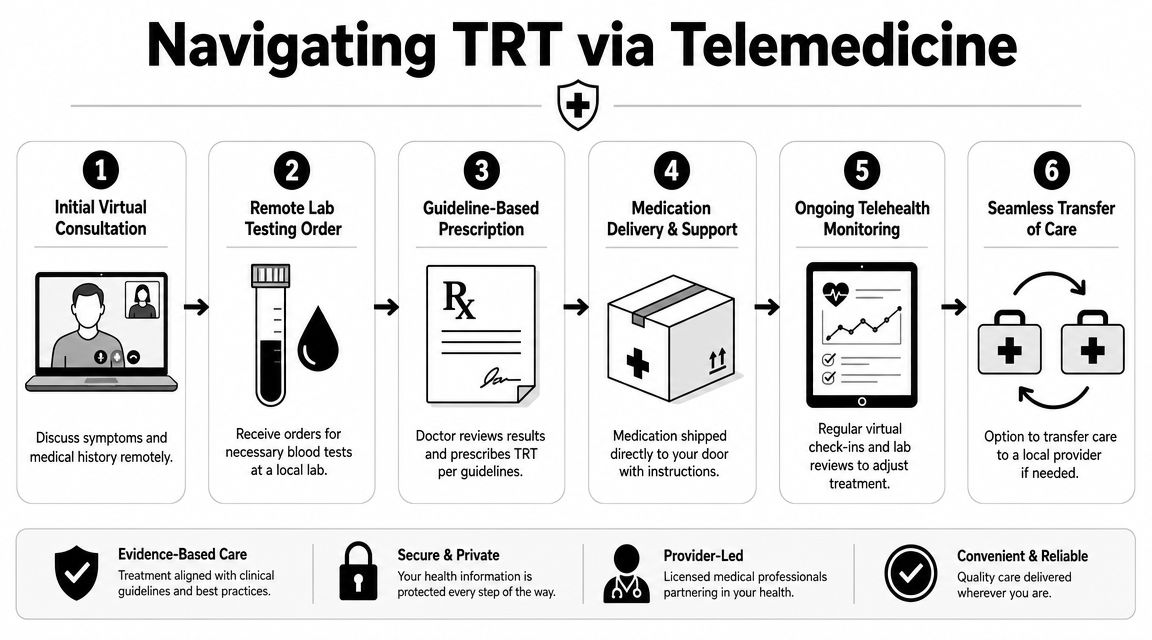
What a telemedicine process usually looks like
A well-run remote TRT workflow is straightforward:
Initial virtual consultation
You discuss symptoms, medical history, prior treatment, medications, and goals.Lab collection
The clinic either sends lab orders to a local draw site or reviews recent outside results if they're current and complete enough.Clinical review
The provider decides whether you're a candidate, whether another cause of symptoms needs attention first, and which formulation fits your situation.Prescription and follow-up plan
Medication starts only with a monitoring schedule already in place.
For patients, one useful sign of quality is paperwork. Telemedicine should include formal consent, expectations around follow-up, and clear communication about responsibilities. If you want to see what that looks like in practice, a standard telehealth consent process for TRT care should make the remote workflow understandable before treatment starts.
How transfer patients avoid treatment gaps
Transfer care is often simpler than men expect, but only if records are organized. Bring your recent lab results, current dose, formulation, frequency, prior medication list, and any notes about side effects or dose changes. If a provider can see what you've been using and how your labs have behaved, the handoff is much smoother.
What usually creates delays?
- Missing lab dates
- Unclear dosing history
- No record of current formulation
- Recent symptoms without updated monitoring
Telemedicine is especially useful here because it can reduce the friction of staying in care. You don't need to drive across town to review straightforward labs or renew a stable regimen. But the principle stays the same: convenience should support guideline-based care, not replace it.
Taking Control with Guideline-Based TRT Care
The best way to think about testosterone replacement therapy guidelines is simple. They protect you from sloppy diagnosis, bad dosing, and missed safety issues.
If you remember only a few points, remember these:
- TRT starts with diagnosis, not marketing. Symptoms matter, but labs and context matter too.
- Treatment should target a physiologic range. More testosterone isn't automatically better treatment.
- Monitoring is part of the therapy. If follow-up is weak, the care is weak.
- Fertility needs a direct conversation early. Don't assume it will sort itself out later.
- Telemedicine can work very well. It just has to follow the same clinical standards as in-person care.
Most men don't need more internet noise. They need a clear process and a provider who can explain the trade-offs in plain English. That's what good TRT care looks like. It isn't flashy. It's accurate, individualized, and consistent.
If you've been feeling off and trying to decide whether testosterone is appropriate, use these guidelines as your filter. Ask how diagnosis is confirmed. Ask how dosing is adjusted. Ask what is monitored and when. Those questions will tell you a lot about the clinic in front of you.
If you want an affordable telemedicine option, Cost Plus TRT offers online evaluation, lab review, home delivery, and ongoing TRT follow-up with a guideline-based model.