

You've got the prescription in hand, the vial or pharmacy notice is on the way, and one question keeps circling in your head: Is this the right dose?
That's a normal place to start. Most men expect testosterone replacement therapy doses to work like a fixed instruction, almost like an antibiotic. Take this amount, on this schedule, and you're done. TRT usually doesn't work that way. The first number on your prescription is a starting point. The key is finding the dose and schedule that give you steadier energy, better libido, clearer thinking, and fewer side effects.
In practice, good TRT care looks less like choosing one “magic” number and more like careful titration. You start with a reasonable protocol. You track symptoms. You review labs. You adjust. That process matters more than whether your first prescription says weekly, twice weekly, or a different interval.
A lot of frustration in TRT comes from treating dosing as static when it's dynamic. Men compare milligrams online, assume more must be better, or worry that a conservative starting dose means weak treatment. Usually, it means your provider is giving your body room to respond before pushing the dose higher than needed.
Table of Contents
- Your First TRT Prescription and What It Means
- The True Goal of TRT Dosing Stability Not Just Numbers
- Typical Starting Doses for Different TRT Methods
- How Injection Frequency Affects Your Results
- Using Lab Work to Find Your Optimal TRT Dose
- Notes for Telemedicine and Patient Transfers
- Frequently Asked Questions About TRT Dosing
Your First TRT Prescription and What It Means
A new TRT patient often looks at the label and sees only the milligrams. He doesn't yet see the full plan behind it. He may be thinking, “Why this number? Why this schedule? What if it's too low? What if it's too high?”
That reaction makes sense because the dose feels personal. It is personal. But it's not personal in the sense that one number defines how well you'll do. It's personal because your response defines the plan.
I explain it this way in clinic. Your first prescription is a testable hypothesis. It reflects your symptoms, your starting labs, your medical history, and the delivery method you chose. It is not a lifetime sentence. If you feel better but not stable, the plan can change. If your labs improve but side effects show up, the plan can change. If the total dose is fine but the timing is wrong, the plan can change.
Practical rule: Don't judge TRT by the first prescription alone. Judge it by how well the protocol can be adjusted to fit your body.
That mindset lowers a lot of unnecessary anxiety. You don't need to “guess right” on day one. You need a provider who knows how to titrate responsibly and a patient who reports symptoms accurately.
A good treatment plan also respects trade-offs. Push too aggressively and some men feel overstimulated, irritable, or inconsistent. Start too timidly and some men stay symptomatic longer than they should. The sweet spot usually comes from collaboration, not guesswork.
The True Goal of TRT Dosing Stability Not Just Numbers
A common clinic scenario goes like this. A patient starts TRT, sees his testosterone rise, and expects every symptom to improve right away. Then he notices a pattern. He feels strong for a day or two after an injection, then flatter, more tired, or less focused before the next dose. The problem is often not the prescription itself. It is that the protocol has not been tuned yet.
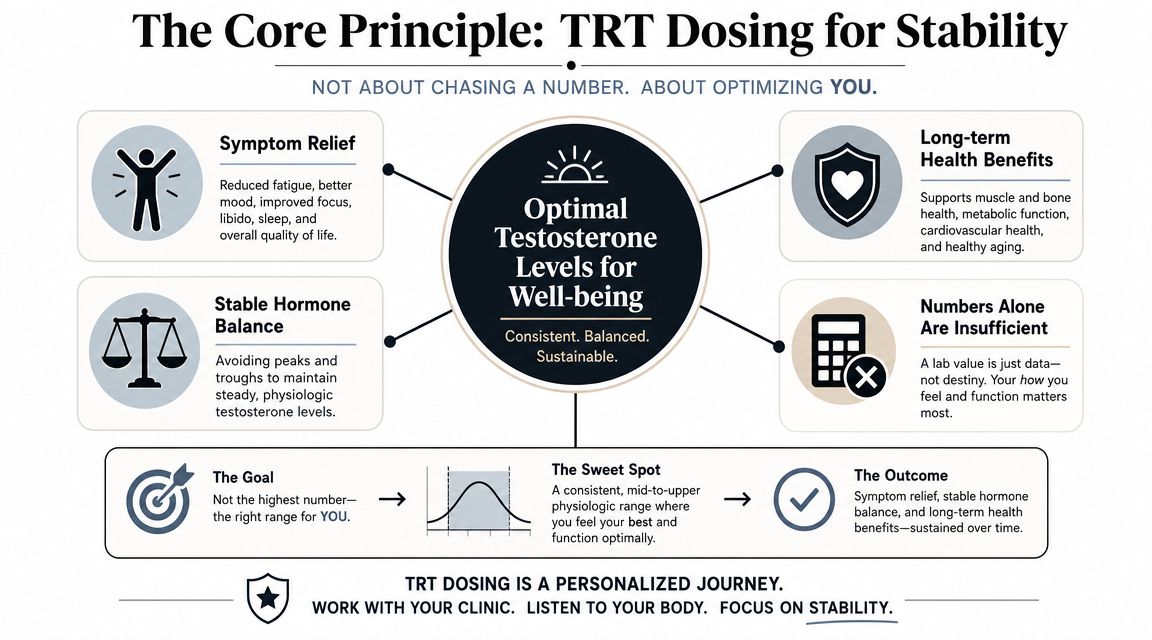
A good TRT dose does more than raise a lab value. It creates hormone exposure your body can live with week after week. That usually means steadier energy, more predictable libido, better focus, and fewer swings in mood or physical drive.
Why stability matters
Men do not experience testosterone as a single number. They experience it as a pattern over time.
If the dose is too aggressive for the schedule, some men feel a surge early in the week and a drop later. If the total dose is too conservative, symptoms may improve only partially. If the weekly amount is reasonable but the spacing is off, labs can look acceptable while day-to-day results still feel uneven. This is why dosing is a titration process, not a one-time decision.
In practical terms, providers are watching for a few things:
- Peak level: how high you rise after a dose
- Trough level: where you sit before the next dose
- Symptom consistency: whether energy, mood, libido, and focus stay steady through the week
- Side effect pattern: whether acne, fluid retention, irritability, sleep issues, or high hematocrit start showing up as dose exposure climbs
Those trade-offs matter. Chasing a stronger peak can give a man a brief sense that the treatment is “working,” but it may also create more fluctuation, more side effects, and a rougher comedown before the next dose.
The goal is physiologic not extreme
TRT works best when it restores a healthy physiologic range and keeps you functioning well in daily life. It is not a contest to see how high a number can go. In practice, the better question is simple: does this protocol give reliable symptom relief without creating extra problems to manage?
That standard changes how dose decisions get made. A man with good symptom control, stable mood, decent libido, and acceptable safety markers may not need a higher dose just because a higher number sounds appealing. Another man may need an adjustment even if his total testosterone looks “fine” on paper, because his schedule is producing too much up-and-down variation.
This is especially important in telemedicine, where patients often focus on the vial strength or the weekly milligrams and assume that number should tell them everything. It does not. A well-run telemedicine TRT treatment plan includes follow-up, symptom review, and dose refinement so the protocol fits the patient, not the other way around.
The target is a protocol you can live on comfortably, predictably, and safely.
That usually takes a little calibration. Good TRT care is not about forcing one “perfect” dose onto every patient. It is about adjusting the amount and the schedule until the benefits hold steady and the friction stays low.
Typical Starting Doses for Different TRT Methods
The phrase testosterone replacement therapy doses usually makes people think of injections, especially testosterone cypionate. That's fair. Injections are common, flexible, and relatively straightforward to adjust. But they're not the only option, and each method handles dosing differently.
A practical starting point by formulation
Here's a simple reference table for how providers typically think about starting protocols. For injections, the numbers below reflect guideline-supported ranges. For non-injection methods, it's better to think in terms of delivery style and ongoing titration than a universal starting number.
| Formulation | Typical Starting Dose | Frequency |
|---|---|---|
| Testosterone cypionate IM | 75 to 100 mg weekly | Weekly |
| Testosterone cypionate IM | 150 to 200 mg | Every 2 weeks |
| Testosterone gel | Individualized | Daily |
| Testosterone pellets | Individualized | Periodic insertion |
For patients comparing clinics or trying to understand how home delivery fits into treatment logistics, Cost Plus TRT's TRT care model is one example of a telemedicine setup built around prescribed testosterone cypionate and provider oversight.
Why old injection schedules often felt rough
A lot of men still hear about the older protocol of testosterone cypionate 200 mg every 2 weeks. That schedule has a long history, and it was widely used. The problem is that it often produces a roller-coaster pattern.
A pharmacology review noted that with this historical pattern, serum testosterone is often supratherapeutic 4–5 days after the dose and subtherapeutic by day 14. The same review states that FDA labeling allows a broad starting range of 50 to 400 mg IM every 2 to 4 weeks, while the Endocrine Society suggested 75 to 100 mg weekly or 150 to 200 mg every 2 weeks to maintain levels more consistently. In practical terms, the review concluded that 100 mg once weekly or 200 mg every 2 weeks keeps serum testosterone within the therapeutic range by the end of the dosing interval, as described in the review of testosterone therapy preparations.
That explains a common modern shift. Providers often prefer smaller, more frequent injections because the body usually tolerates steadier exposure better than a large pulse followed by a drop.
Here's how I'd frame the main trade-offs:
- Injections offer flexibility. They're easy to split into different intervals if symptoms or labs suggest the schedule needs refinement.
- Gels simplify needles. They avoid injections, but daily use and consistent application matter.
- Pellets reduce routine dosing decisions. They can be convenient, but they don't offer the same quick fine-tuning as injections.
If your starting protocol doesn't feel perfect, that doesn't mean the treatment method is wrong. It may mean the dose, interval, or both need adjustment.
How Injection Frequency Affects Your Results
Two men can take the same total weekly amount of testosterone and have very different experiences. The reason is often injection frequency.
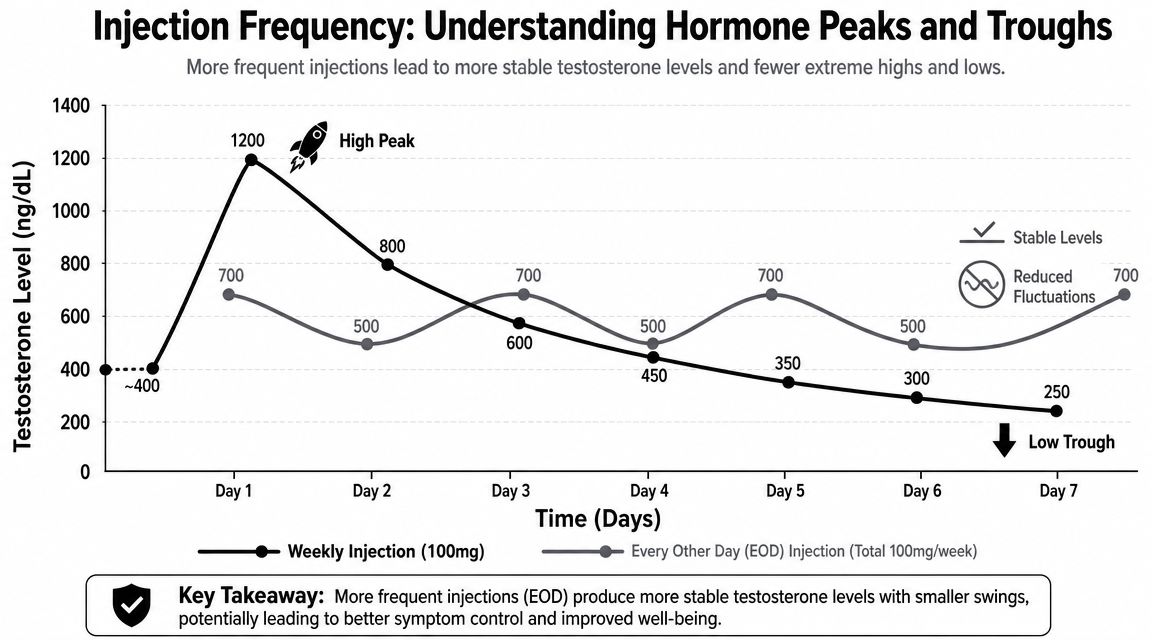
A simple way to think about it is food intake. One very large meal can leave you overly full, then hungry again later. Smaller meals spread out more evenly can feel steadier. Testosterone dosing can behave in a similar way.
Same weekly amount different experience
Suppose your total weekly dose is unchanged. You could take it all at once, or you could divide it into smaller injections. Pharmacokinetic studies show that more frequent dosing of testosterone cypionate reduces peak-trough swings and produces steadier serum testosterone exposure even when the total weekly dose is unchanged, which is why many modern TRT protocols favor smaller, more frequent injections, according to this summary of testosterone injection dosing and frequency.
That matters because men don't live on a lab report. They live through the week. They notice whether they're calm or edgy, focused or flat, sleeping well or tossing and turning, interested in sex or not. Frequency can shape that experience.
This short video gives a useful overview of how schedule changes can affect outcomes:
When more frequent injections help
Not every patient needs a very frequent schedule. Some do well on weekly injections. Others feel much better when the same total amount is split into smaller doses. The cases where frequency becomes especially important are usually the ones where men report inconsistency.
Common clues include:
- Early-week highs and late-week drop-offs: You feel sharp after the shot, then noticeably worse before the next one.
- Mood variability: Irritability, restlessness, or a sense that your week has a hormonal rhythm.
- Side-effect pressure: You may not need less testosterone overall. You may need a smoother delivery pattern.
- Sensitive responders: Some men feel fluctuations more than others.
Lowering the swing is sometimes more useful than raising the dose.
That's why I tell patients not to focus only on “How many milligrams am I taking?” Ask, “How often am I taking them?” In many cases, optimization happens by adjusting timing rather than increasing the total weekly amount.
Using Lab Work to Find Your Optimal TRT Dose
A common visit goes like this. A patient tells me his numbers look better, but he still feels off. Another tells me he feels stronger and more motivated, yet his hematocrit is climbing. Both cases matter because TRT dosing is not a trophy number. It is a process of titration. The goal is to find a protocol that improves daily function, stays safe to maintain, and holds up over time.
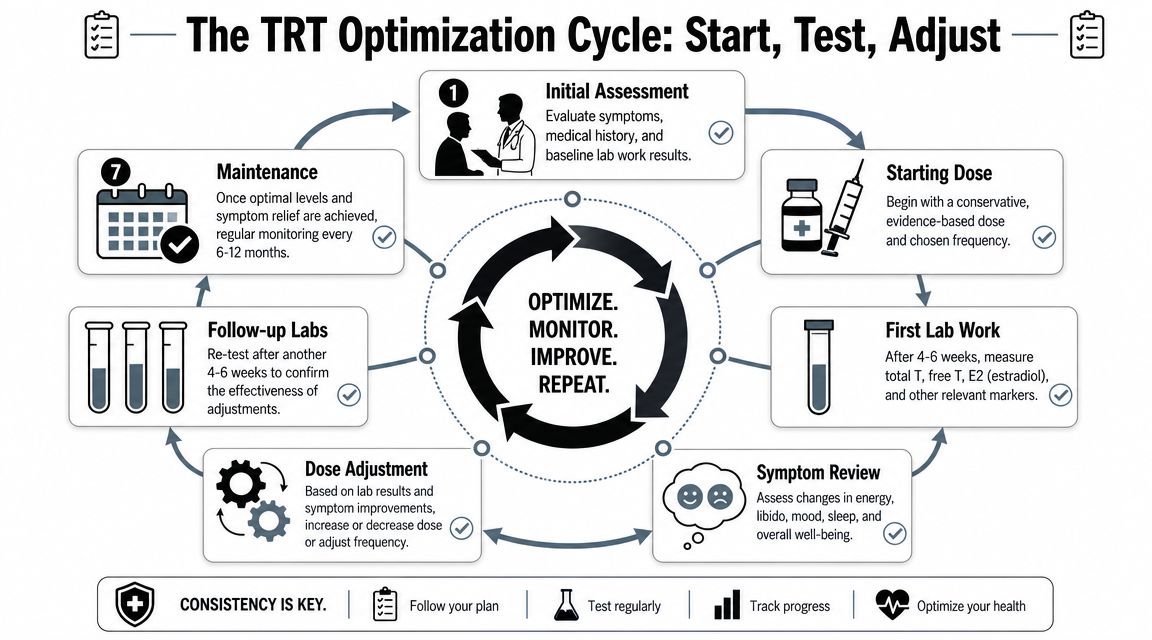
Lab work gives the structure for that process. Symptoms give it meaning.
If I only follow symptoms, I can miss a safety issue or misread a short-term placebo effect. If I only follow lab values, I can leave a patient with a protocol that looks fine on paper but feels inconsistent, overstimulating, or flat in real life. Good TRT management uses both.
The markers that drive decisions
A practical dose review usually centers on a small group of markers and a clear symptom history:
- Total testosterone: Helps show whether the current protocol is producing a reasonable overall level.
- Free testosterone: Useful when total testosterone looks acceptable but the patient's response does not match.
- PSA: Part of standard monitoring during treatment.
- Hemoglobin and hematocrit: Help identify whether the protocol is increasing red blood cell production more than we want.
- Symptom tracking: Energy, libido, erection quality, mood, sleep, exercise recovery, and mental focus all count.
Many clinicians use a mid-normal testosterone range as a practical reference point, along with routine monitoring of PSA and blood counts, as noted earlier in the article. That range is a guide, not the finish line. Some men feel well before they reach the middle of the reference range. Others need a different schedule, not a higher weekly dose.
This matters for telemedicine patients in particular. Lab timing, injection timing, and written symptom notes make remote dose adjustments much more accurate. If you are preparing for online care, the clinic's telehealth consent information for TRT patients helps clarify how monitoring and follow-up are usually handled.
The Process of Changing Doses
Dose changes work best when they are deliberate.
- Start with a reasonable protocol. The first prescription should give enough room for symptom improvement without creating avoidable side effects.
- Wait long enough to judge the response. Early changes in mood, energy, or libido can be misleading if you react before the protocol settles.
- Review the pattern, not just the headline. Better sex drive with worse sleep means something different than better sex drive with stable sleep and mood.
- Interpret labs in the right context. A result means more when you know where it falls in relation to the injection or application schedule.
- Change one main variable at a time. If you adjust dose and frequency together, it becomes harder to tell which change solved the problem.
That is how optimization stays clean. It is easier to repeat what works when the path is clear.
A few patterns come up often:
| What you see | What it may mean |
|---|---|
| Good symptom response, stable labs | Keep the current plan and continue monitoring |
| Symptoms improve, but the week feels uneven | Adjust frequency before assuming the dose is wrong |
| Lab markers move in the wrong direction | Reduce dose, change delivery pattern, or tighten monitoring |
| Testosterone levels look acceptable, but benefits are weak | Recheck diagnosis, adherence, sleep, stress, and protocol fit |
The best dose is the one that gives steady benefits with acceptable trade-offs.
Patients who do well with TRT usually give very specific feedback. “Low energy by Thursday.” “Good libido, but more irritability.” “Better workouts, but sleep became lighter.” That level of detail lets a provider fine-tune the plan instead of guessing. Over time, that is what gets you to an optimal dose. Not chasing the highest number, but building a protocol you can feel good on week after week.
Notes for Telemedicine and Patient Transfers
Telemedicine works well for TRT when the patient arrives organized. The biggest delays usually don't come from medicine. They come from missing information.
What to bring to your first online visit
If you're starting care online, gather the essentials before the appointment:
- Your recent labs: Upload the actual reports, not just screenshots of a portal summary if you can avoid it.
- Your current or recent protocol: Include the exact medication, dose, concentration, and frequency.
- Your symptom history: Write down what improved, what didn't, and whether your week feels stable or uneven.
- Your medication list: Include anything that could affect treatment decisions or monitoring.
If you're reviewing clinic requirements or consent steps before care begins, the telehealth consent information for patients gives a clear picture of what an online treatment framework can involve.
How to make a transfer go smoothly
Transfer patients often know something important that a new provider can't see from labs alone. They know how a protocol feels in real life. Bring that history with you.
A useful transfer summary might include:
- What you were prescribed
- How long you were on it
- When you felt best in the injection cycle
- What side effects showed up
- Whether the issue was dose, timing, or both
This prevents a common mistake. A new clinic sees an old dose and repeats it without understanding the pattern behind it. That's not continuity of care. That's copying.
For telemedicine patients, home delivery also changes the practical side of adherence. Keep supplies organized, know your injection day, and communicate early if something about the protocol isn't working. Online care goes smoothly when the medical plan and the household routine support each other.
Frequently Asked Questions About TRT Dosing
What if I miss an injection?
Don't panic and don't overcorrect on your own. A single missed dose doesn't mean your treatment has failed. Take the next step based on your prescriber's instructions and contact your clinic if the schedule needs to be reset.
Is splitting doses into smaller injections worth it?
For many men, yes. If your current protocol leaves you feeling strong right after the injection and flat later, splitting the same total amount into more frequent injections may create a smoother week. It's not automatically necessary, but it's often worth discussing.
Can side effects mean my dose is too high?
Sometimes. Side effects can reflect too much testosterone, the wrong injection interval, or a mismatch between your labs and your symptoms. This is why monitoring matters. If PSA, hemoglobin, or hematocrit move in the wrong direction, or if you don't feel well on the protocol, the dose may need to come down or the schedule may need to change.
Is my TRT dose ever final?
Usually not in a permanent sense. Stable patients may stay on the same plan for long periods, but body composition, stress, adherence, age, sleep, and other health factors can all change how a dose feels over time. TRT is better viewed as an ongoing management plan than a one-time calculation.
Where can I read more about common TRT questions?
If you want practical answers on treatment logistics, monitoring, and common patient concerns, the Cost Plus TRT FAQ page is a useful reference.
If you're trying to make sense of your current protocol or want a more practical plan for testosterone replacement therapy doses, Cost Plus TRT offers telemedicine-based evaluation, physician oversight, home delivery of testosterone cypionate, and options for patients who already have recent labs and want to transfer care efficiently.