

If you're reading this, there's a good chance you've already spent months, or years, wondering whether low testosterone is behind the way you feel. Energy isn't what it used to be. Workouts don't respond the same way. Libido is down. Recovery is slower. You may also be stuck on a practical problem: you want treatment, but you don't want your life revolving around clinic visits.
That's where testosterone replacement therapy at home starts to make sense. For the right patient, home-based TRT can be safe, organized, and much easier to stay consistent with than an office-based model. The key is doing it the right way. That means getting properly evaluated, using a real monitoring plan, learning correct injection technique, and knowing what to do if you're transferring from another clinic instead of starting from scratch.
Table of Contents
- Is At-Home TRT the Right Choice for You
- Finding a Provider and Getting Initial Labs
- Your Prescription, Supplies, and Delivery Timeline
- Mastering Safe Self-Injection Technique
- Long-Term Monitoring and Follow-Up Care
- Understanding Costs and Watching for Red Flags
Is At-Home TRT the Right Choice for You
At-home TRT fits men who want medical supervision without repeated office visits. In practice, that often means busy professionals, shift workers, frequent travelers, fathers with packed family schedules, or men who value privacy. It also fits men who don't want treatment delayed by the logistics of getting across town for every appointment and injection.
Testosterone replacement therapy is approved for hypogonadism, which involves low testosterone along with symptoms such as decreased libido, erectile dysfunction, fatigue, reduced body hair, and muscle loss. Those symptoms are easy to dismiss for a long time. That's one reason access matters.

A useful reality check comes from a UK survey of men on testosterone deficiency treatment. 85% reported TRT as effective or very effective, yet 86% delayed care for at least a year and 24% waited more than five years, which shows how access barriers can keep men untreated far longer than they should be, as summarized in this review of nationwide testosterone replacement patterns.
Who usually does well with home treatment
At-home care works best when a patient is comfortable with routine and follow-through. You don't need to be a medical expert. You do need to be willing to:
- Follow instructions carefully and use medication exactly as prescribed
- Show up for labs when your provider orders them
- Track symptoms accurately, including benefits and side effects
- Ask for help early if something feels off
If that sounds manageable, telemedicine is often a strong fit.
Practical rule: Home TRT should make treatment easier to continue, not easier to ignore.
What home TRT does better than the old clinic model
The biggest win is friction reduction. No recurring drive time. No waiting room. No trying to fit a shot into the middle of a workday. That matters because TRT only works well when dosing and follow-up stay consistent.
Home treatment also gives you more control over timing and privacy. Many men prefer handling injections on their own schedule rather than repeatedly coordinating in-office administration. If you still have questions about eligibility, logistics, or common concerns, a structured TRT FAQ page can help you pressure-test whether the model fits your life.
Where the trade-offs are real
At-home TRT isn't for everyone. Some men don't want to self-inject. Others do better with in-person teaching at the start. Some need hands-on support because they struggle with needles, medication routines, or follow-up compliance.
Delivery method matters too. Injections are commonly used in telemedicine because they tend to be straightforward to dose and monitor. But they aren't the only option. Gels, creams, and troches may suit men who want to avoid injections, although each route brings its own issues around convenience, absorption, handling, and daily adherence.
If you want the short version, at-home TRT is a strong option when you want convenience without lowering the standard of care. It tends to work poorly when a patient wants the benefits of treatment but not the responsibilities that come with it.
Finding a Provider and Getting Initial Labs
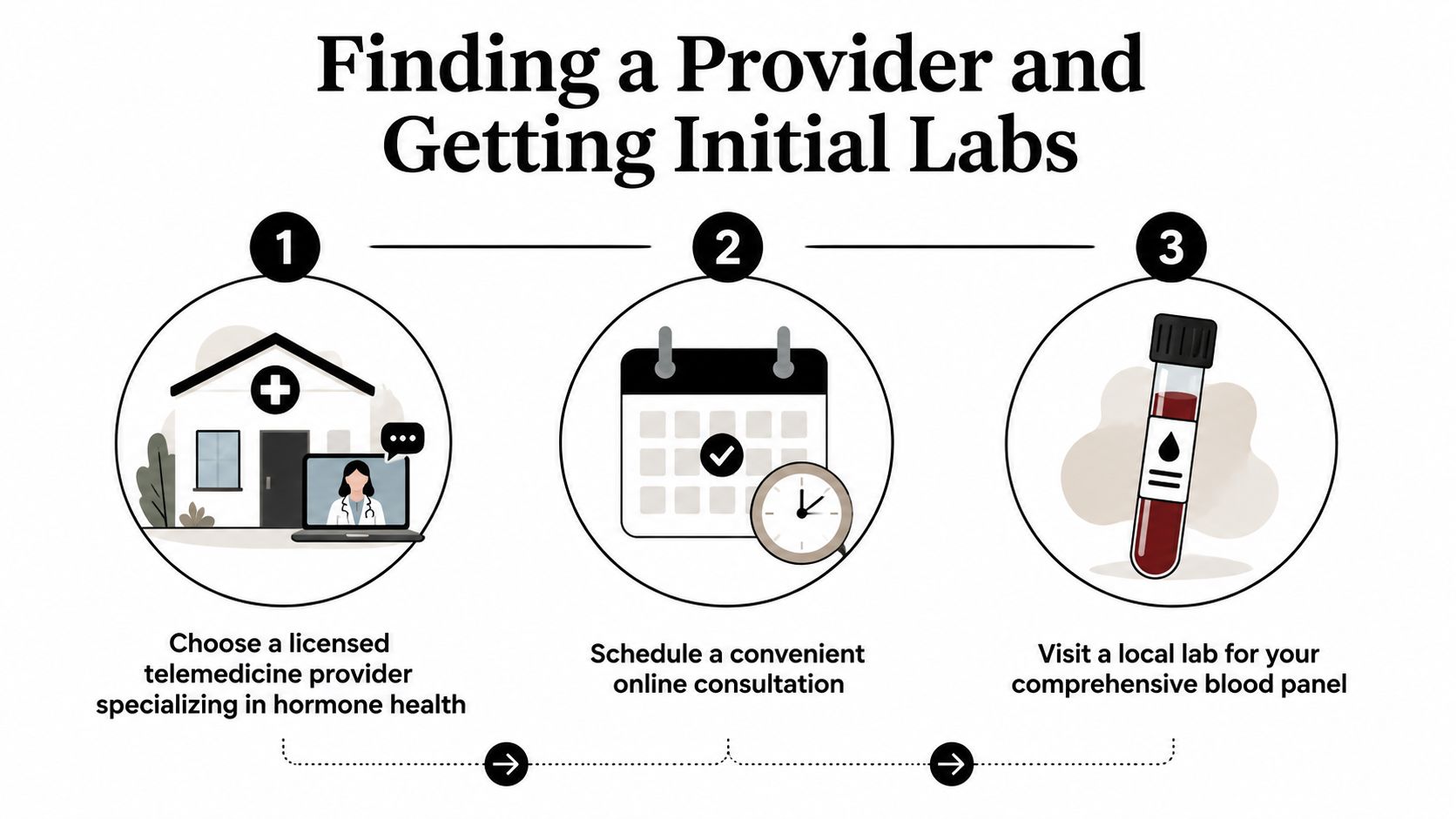
Choosing a TRT provider isn't about slick branding. It's about whether the clinic can evaluate you responsibly, review labs in context, prescribe only when appropriate, and stay involved after treatment starts. The first appointment should feel like a medical decision, not an online checkout flow.
A well-run telemedicine model can improve access substantially. In a major UK at-home rollout, Ally Health reported more than 2,000 at-home appointments, 100+ home visits completed every month nationwide since launch in November 2023, an approximately 85% reduction in appointment waiting times, and a 113% increase in patient uptake on average, according to this report on at-home testosterone replacement therapy rollout outcomes. Faster access is useful only if the evaluation is still thorough.
What to look for in a provider
A legitimate clinic should make a few things obvious before you commit.
- Licensed medical oversight. You should know who is evaluating your case and who manages follow-up.
- Clear process for labs. If a clinic talks about treatment before talking about bloodwork, that's a problem.
- Transparent paperwork. You should be able to review core patient documents, including telehealth consent information, before moving ahead.
- Ongoing monitoring. TRT is not a one-visit service. The provider needs a repeat-lab and follow-up plan.
- A transfer pathway. Men already on TRT shouldn't have to restart the entire process if they have current documentation and recent labs.
Two ways most patients get started
Men usually enter home TRT through one of two routes.
New patients starting from scratch
If you've never been on TRT, your provider will usually order baseline labs before making a recommendation. The exact panel can vary by clinic, but the goal is consistent: confirm whether testosterone is low, check whether your symptoms line up with that result, and make sure there aren't safety issues that change the plan.
You should expect the doctor to review both numbers and symptoms. Low energy alone doesn't prove low testosterone. Neither does poor sleep, high stress, or weight gain. Good medicine sorts those apart before treatment starts.
Transfer patients already on treatment
If you're already self-injecting or coming from another clinic, the path is often simpler. Many telemedicine practices can review recent labs, your current dose, your medication history, and your symptom response to decide whether care can be transferred safely.
That matters because men frequently want a better long-term setup, not a brand-new diagnosis. They may be looking for more convenient follow-up, more consistent communication, or easier medication delivery. A good provider should be able to review what you've already done and tell you plainly whether your current plan makes sense.
Bring your last labs, current prescription details, dosing schedule, and any notes about side effects. Transfer visits go much faster when the clinical picture is complete.
The main question your labs need to answer
Your labs aren't there to "qualify" you for a product. They're there to answer a medical question: does your hormone pattern, together with your symptoms, support treatment, and can treatment be monitored safely over time?
That's the standard that protects patients. It also keeps you from chasing testosterone when the underlying issue may be something else.
Your Prescription, Supplies, and Delivery Timeline
Once your consultation is done and the provider approves treatment, the process becomes practical. The prescription is sent for fulfillment, the medication is packaged with the needed supplies, and your first shipment is prepared for delivery. This is the stage where most men stop worrying about whether TRT is possible and start asking what their routine will look like.

What usually arrives in a home TRT kit
Most injection-based TRT shipments include the medication and the basic tools required to use it safely. That often means:
- Your prescribed testosterone medication, commonly testosterone cypionate
- Drawing needles, which are larger and make it easier to pull medication from the vial
- Injection needles, which are smaller and intended for administration
- Syringes and alcohol swabs
- A sharps container or instructions for proper sharps disposal
The exact packaging differs from clinic to clinic. Some provide a more complete starter setup. Others expect patients to source some supplies separately. That's worth clarifying before you pay.
Why injections are common, but not the only route
Most online discussions about testosterone replacement therapy at home focus on injections because they're commonly used and familiar to telemedicine practices. That doesn't mean every patient should use them. Clinics are increasingly offering creams and troches, which points to a broader move toward individualized treatment based on lifestyle, cost, and monitoring burden, as discussed in this overview of at-home testosterone therapy options.
If a man values dose consistency and doesn't mind needles, injections often make sense. If he strongly prefers needle-free treatment, a topical or dissolvable option may fit better. Convenience is only one factor. Privacy at home, handling precautions, daily routine, and how easy it is to stay consistent all matter.
What a normal timeline feels like
The exact timeline depends on state rules, provider workflow, pharmacy processing, and whether your labs are already complete. In general, delays happen for predictable reasons: missing paperwork, incomplete lab history, refill coordination, or questions about dose selection.
A smooth process usually depends on the patient doing a few simple things well:
- Upload complete records if you're transferring care.
- Respond quickly to messages about labs, consent, or verification.
- Check your shipment when it arrives so missing supplies don't become a last-minute problem on injection day.
One factual example from the market is Cost Plus TRT, which offers telemedicine TRT with testosterone cypionate, injection supplies, and doorstep delivery as part of its at-home model. The useful takeaway isn't the brand name. It's that a well-run home program should make fulfillment predictable instead of confusing.
Mastering Safe Self-Injection Technique
The first injection is usually the part men worry about most. The good news is that the process is learnable, repeatable, and far less intimidating once you've done it correctly a few times. Safe technique matters more than speed.
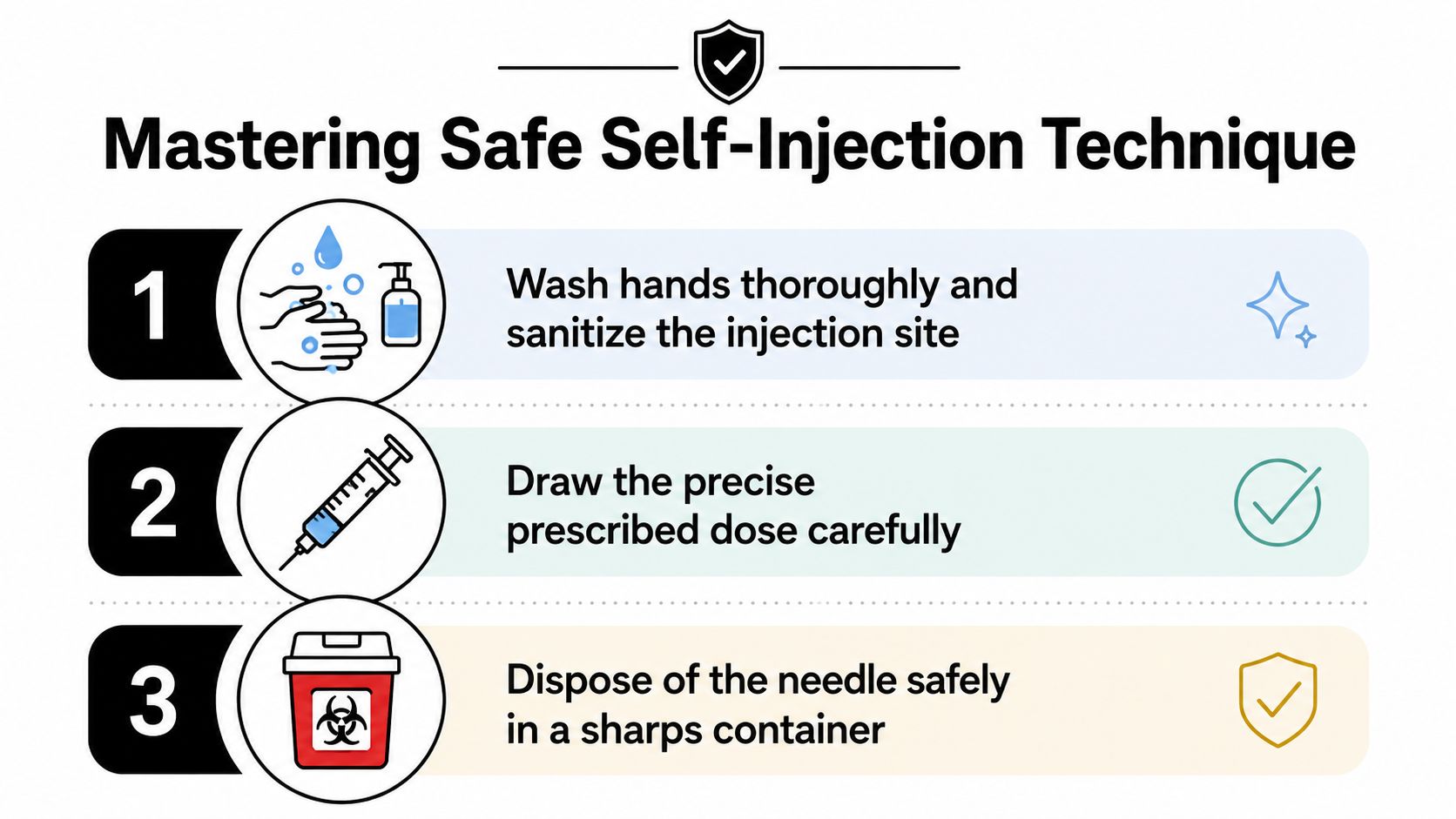
Start with the basics and don't skip them. Set up a clean surface. Wash your hands. Check the vial label and expiration date. Make sure the medication looks as expected and that your supplies are ready before you begin.
The standard workflow that keeps patients safe
A practical at-home injection routine generally follows the same sequence used in urology patient education. That guidance specifies drawing with an 18G needle, switching to a smaller 21G to 22G needle for administration, and rotating injection sites to help prevent discomfort and scarring, as outlined in this urology guide to testosterone at-home injection steps.
Here is the process in plain language:
- Inspect the vial. Confirm the medication and expiration date.
- Wash your hands well.
- Disinfect the vial top with an alcohol swab.
- Use the larger draw needle to pull the prescribed amount into a syringe.
- Remove visible air bubbles carefully.
- Swap to the smaller injection needle before administration.
- Clean the injection site.
- Inject into the prescribed site using the technique your clinician taught you.
- Dispose of all sharps immediately in a proper sharps container.
That sequence doesn't need to be fancy. It needs to be consistent.
For a visual walkthrough, this short demonstration helps many first-time patients settle their nerves before trying it themselves.
Site rotation matters more than most men realize
Men often focus on the needle and forget about site care. Repeated injections into the same exact spot can create soreness and local tissue irritation over time. Rotation is one of the simplest ways to keep injections tolerable.
- Alternate sides rather than always using the same thigh or glute.
- Avoid irritated areas that are bruised, tender, or already sore.
- Keep your routine organized by noting where the last injection went.
If an injection site keeps bothering you, don't just push through it. Bring it up with your prescriber and review technique.
Common mistakes that make injections harder
Most problems come from rushing.
Some men forget to switch from the draw needle to the smaller administration needle. Others inject before the alcohol has dried. Others try to use awkward body positioning and create unnecessary tension. The best fix is to slow down and follow the same order every time.
A calm routine beats a fast routine. Once the process becomes familiar, confidence usually follows.
Long-Term Monitoring and Follow-Up Care
Starting TRT is only the opening phase. The more important work is what happens after the first month, when initial excitement wears off and the treatment has to prove it can be managed safely over time. Good home-based care makes that part straightforward, not vague.
This issue matters because home use is already common. In one study of men treated for testosterone deficiency, 93.1% administered injections at home and 81.4% preferred telemedicine video follow-up over in-person visits, which supports the need for clear long-term remote monitoring, especially for men transferring care, as reported in this study on at-home administration and telemedicine follow-up preferences.
What follow-up is actually for
Monitoring isn't busywork. It answers three practical questions:
- Is the dose working for your symptoms?
- Are your blood levels landing where your clinician expects?
- Are there side effects or safety issues developing that require adjustment?
That means follow-up is based on both labs and lived experience. A patient can have a number that looks acceptable on paper and still feel off. The reverse can also happen. Responsible care looks at both.
What changes after the first month
The first few weeks often bring a lot of attention to short-term effects. Men may notice changes in energy, libido, recovery, mood, or sleep. Some notice very little at first. Neither response automatically means the dose is right or wrong.
What matters is pattern, not one unusually good week or one flat week. That's why I tell patients to watch trends in a few simple areas:
- Energy through the day, not just one morning after an injection
- Sexual function and libido
- Gym recovery and body composition changes
- Mood, focus, and irritability
- Sleep quality and fluid retention
- Any acne, breast tenderness, headaches, or unusual shortness of breath
The men who do best on TRT usually track symptoms in plain language. A few notes before each follow-up visit are more useful than trying to remember two months of changes from memory.
Transfer care needs an organized monitoring handoff
This is the piece most basic guides skip. If you're already on TRT and moving to a new clinic, your new provider needs a clean clinical handoff. That usually includes your current medication, dose and schedule, recent labs, prior dose changes, and any side effects you've had.
Without that history, a transfer visit becomes guesswork. With it, the doctor can often tell whether your current plan is reasonable, whether your lab timing was appropriate, and whether changes should happen now or after the next check-in.
If you're using biweekly injections, one practical benchmark from urology guidance is to draw labs 7 to 10 days after the last injection and 5 to 7 days before follow-up, which helps standardize interpretation around peak and trough variability. That timing point was covered in the earlier injection section's source material and is one reason your provider may ask very specific questions about when blood was drawn relative to your last dose.
What doesn't work long term
A few patterns reliably create problems:
- Changing your dose on your own
- Skipping labs because you feel fine
- Judging treatment by the first two weeks alone
- Transferring clinics without sending records
- Treating side effects as something to "wait out" without telling your provider
TRT is usually easiest when the system is boring. Medication arrives. You dose on schedule. Labs are done when ordered. Adjustments happen for a reason, not on impulse.
Understanding Costs and Watching for Red Flags
TRT costs can feel confusing because many clinics bundle everything into a monthly subscription without showing what you're paying for. Others separate medication, supplies, labs, and visits. Neither structure is automatically wrong. The problem is opacity.
A simple way to evaluate cost is to ask one question: what exactly is included, and what will trigger extra charges later? If a clinic can't answer that clearly, expect friction.
TRT At-Home Cost Comparison
| Cost Component | Typical Subscription Clinic | Transparent Pricing (e.g., Cost Plus TRT) |
|---|---|---|
| Medication | Often bundled into one monthly fee | Listed separately or clearly included |
| Injection supplies | Sometimes included, sometimes extra | Usually stated up front |
| Provider follow-up | May be included on paper but limited by plan terms | Usually defined in advance |
| Labs | Frequently separate | Usually explained before checkout |
| Shipping | May be built in or added later | Should be disclosed clearly |
| Price changes | Harder to spot inside a bundle | Easier to track when costs are itemized |
For a closer look at how patients compare fee structures, medication expenses, and lab-related charges, this guide on how much TRT costs is a useful reference point.
Red flags in the clinic model
Some warning signs show up before treatment even begins.
- No real lab review. If the clinic acts like symptoms alone are enough, be careful.
- Pressure to start immediately. Medical decisions shouldn't feel rushed.
- Vague refill policies. You need to know how refills, missed follow-ups, and monitoring requirements work.
- No transfer workflow. Clinics that can't review outside records often create unnecessary delays.
- No clear answer on who manages side effects. Someone needs to own follow-up care.
Red flags in your body
Call your provider promptly if you develop symptoms that suggest the treatment needs review. That includes significant headaches, unusual shortness of breath, allergic-type reactions, breast tenderness, troublesome swelling, or symptoms that feel markedly different from your normal response.
Some side effects are mild and manageable. Others need dose adjustment, repeat labs, or a broader reassessment. The mistake is staying quiet because you assume every issue is "just part of TRT."
Home treatment works well when convenience doesn't replace oversight. You want fewer barriers, not fewer safeguards.
If you want a simpler way to manage testosterone replacement therapy at home, Cost Plus TRT is one telemedicine option that supports new and transfer patients with online physician review, lab coordination, medication delivery, and transparent pricing.