
A patient sits in my office doing the math out loud. If one option means injecting several times a week and the other usually means a simpler routine, he wants to know which plan he can live with six months from now, not just which vial has the better sounding profile.
That is the starting point in a testosterone propionate vs cypionate discussion. The choice affects adherence, travel, comfort with self-injection, how quickly dose changes show up, and how much day-to-day treatment effort a person is willing to carry.
For long-term TRT, I usually frame this as a fit question. The best ester is the one that matches your physiology, your schedule, and your ability to stay consistent without burning out on the process. I also caution patients against swapping esters on their own, because dose equivalence, timing, and symptom response are not interchangeable just because both products contain testosterone.
The snapshot below summarizes the practical differences. Values in the table come from a single published comparison of the two esters, referenced here once: pharmacokinetic comparison of testosterone cypionate and propionate.
| Feature | Testosterone Propionate | Testosterone Cypionate |
|---|---|---|
| Basic profile | Short-acting ester | Longer-acting ester |
| Half-life | 0.8 to 4.5 days | 8 days |
| Typical injection pattern | Daily or every other day | Weekly, or split into less frequent recurring injections depending on the plan |
| Time to steady serum levels | 2 to 3 days | 4 to 5 weeks |
| Active testosterone per 100 mg | About 84 mg | About 69 mg |
| Best practical fit | Short-term adjustments, faster feedback, selected cases where tighter control is useful | Long-term TRT, convenience, adherence, lower injection burden |
Those numbers matter, but the lived experience matters more. A short ester can be useful when a clinician wants faster adjustment and faster feedback. A longer ester is often easier to sustain, which is one reason cypionate is the usual starting point in routine TRT care.
Table of Contents
- Understanding Testosterone Esters a Simple Primer
- Pharmacokinetics The Science Behind the Schedule
- Patient Experience and Side Effect Management
- Clinical Use Cases Why Your Doctor Might Choose One
- Switching Esters A Warning on Patient Safety
- Making the Right Choice for Your TRT Journey
- Frequently Asked Questions
Understanding Testosterone Esters a Simple Primer
Most patients hear "propionate" or "cypionate" and assume they're different hormones. They aren't. The testosterone molecule is the same. What's different is the ester, which acts as the delivery attachment that changes how quickly the body releases the medication after injection.
A simple way to think about it is this. The ester is like the packaging around the hormone. One package opens quickly. The other opens slowly. That packaging determines how often you need injections, how quickly levels rise, and how smooth or uneven the treatment experience feels.
The ester changes the release speed
Short esters release faster. Long esters release more slowly.
That sounds like a minor technical detail, but it shapes almost everything about TRT. A shorter ester tends to act faster and clear faster. A longer ester tends to build more gradually and stick around longer. The testosterone is still testosterone. The patient experience changes because the timing changes.
Practical rule: Don't choose an ester by name alone. Choose the one that matches the schedule you can realistically follow.
A common pitfall for many men is focusing on milligrams and ignoring the release pattern. In clinic, that usually leads to one of two problems. Either a man picks a fast ester and gets tired of injecting, or he expects a long ester to feel immediate and becomes impatient before the treatment has had time to stabilize.
Why the schedule becomes the treatment
TRT only works well when the plan is sustainable. The best protocol on paper fails if the patient can't stick with it.
That's why ester choice isn't just a pharmacology issue. It's a lifestyle decision. If you travel often, work long hours, or already struggle with consistency around medications, a frequent injection schedule may create friction from the start. If you need quick adjustments for a specific clinical reason, a shorter ester can be useful, but it asks more from you.
A good TRT plan should feel manageable enough that you can still follow it on a normal week, a stressful week, and a busy month. If it only works under perfect conditions, it usually won't work for long.
Pharmacokinetics The Science Behind the Schedule
A common clinic scenario goes like this. A patient starts on the shorter ester because he wants to feel changes quickly. Two months later, the underlying problem is not the testosterone. It is the schedule. He is trying to fit frequent injections around work, travel, family, and missed mornings, and the protocol starts to break down.
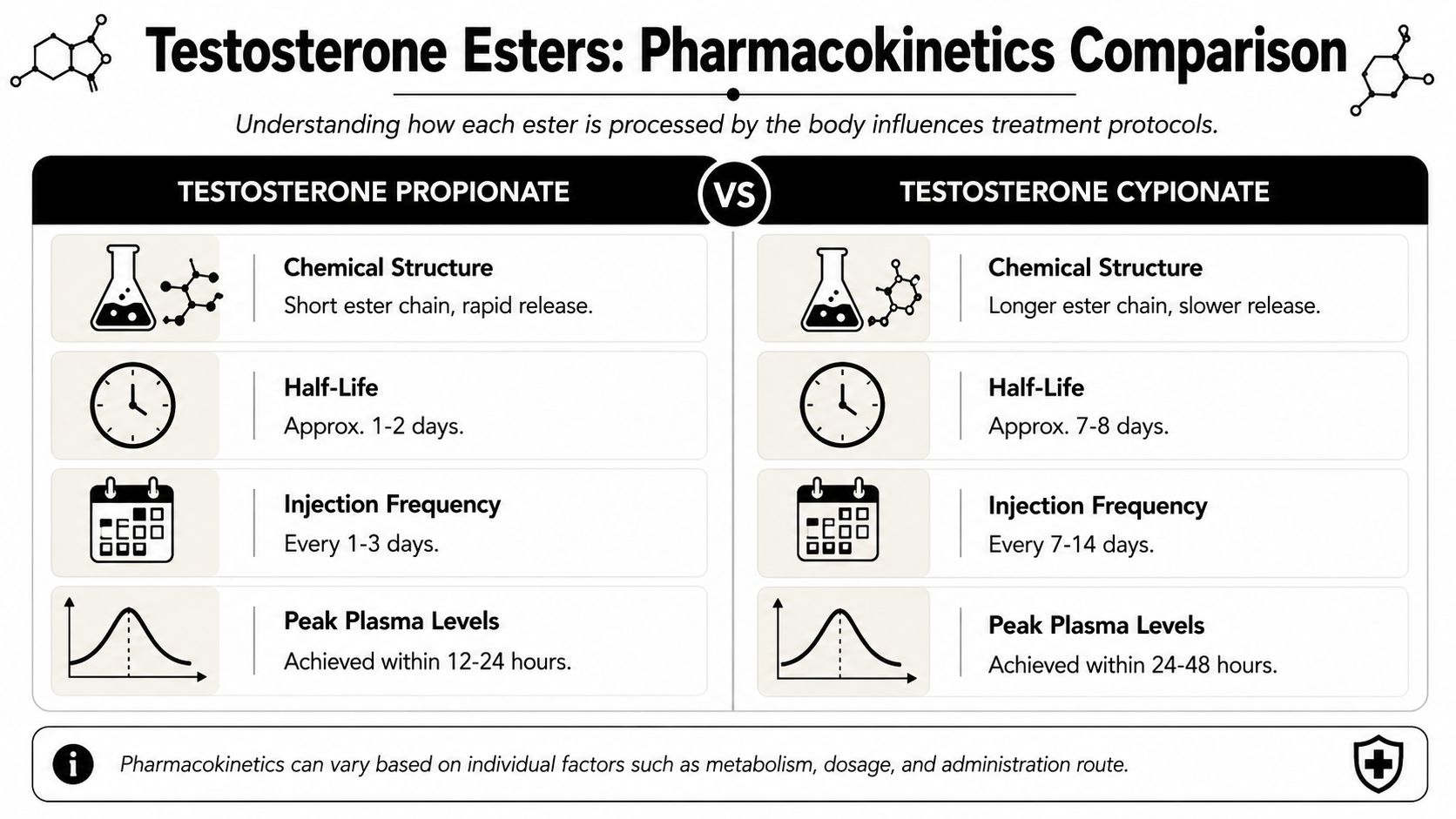
The pharmacology matters because it changes how forgiving the treatment is. Propionate enters and leaves the system faster. Cypionate releases more gradually and gives a wider margin for normal life. Patients often focus on speed. Clinicians usually focus on consistency, because a protocol only works if the patient can keep doing it month after month.
That is the practical meaning of pharmacokinetics. It is not just a chart about half-life. It is a question of how sensitive your treatment will be to a late dose, a skipped dose, or a week that does not go to plan.
In practice, the shorter ester gives a physician faster feedback. If a man is unusually sensitive to dose changes, or if we need to adjust quickly based on symptoms and labs, propionate can be useful because the effects of a change show up sooner and wash out sooner. The trade-off is that the same fast turnover leaves less room for inconsistency. Miss a shot, and patients may notice it.
Cypionate is usually easier to live with. It builds more gradually, so patience matters early on, but it tends to fit long-term replacement better for men who want a stable routine with fewer treatment interruptions. For many patients, that reliability matters more than getting an earlier signal from the medication.
Here is how that difference shows up in real care:
- Dose timing matters more with propionate: small delays can create more noticeable swings in symptoms and serum levels.
- Cypionate is more forgiving: the longer release pattern gives patients more room for real-world scheduling problems.
- Propionate can help with faster protocol adjustments: that can be useful during titration, but only if the patient can follow the schedule closely.
- Cypionate often supports long-term adherence better: fewer injections usually means fewer chances to fall off plan.
I tell patients not to substitute one ester for the other on their own, even if the weekly milligram number looks similar. The release pattern changes the clinical effect, the monitoring plan, and sometimes the side effect profile. A self-directed switch can leave you chasing symptoms, misreading labs, or overdosing relative to what your body is seeing over time.
For men comparing options, the better question is not which ester looks stronger on paper. It is which one matches your routine closely enough that you can follow it safely. A medically supervised TRT treatment plan should account for that from the start.
Patient Experience and Side Effect Management
The lab profile matters, but adherence usually comes down to how treatment feels after the novelty wears off.

What treatment feels like in real life
Men on propionate often like the idea of a faster-moving medication. The problem is that a fast-moving medication usually demands a fast-moving routine. That can be fine for a short stretch. It can become irritating over months.
Injection fatigue is real. It's not just physical soreness. It's the mental load of having to think about your protocol over and over each week. Frequent injections also create more opportunities to miss doses, delay doses, or start improvising.
Common patient-reported differences include:
- Routine burden: Propionate tends to feel more intrusive because the schedule comes around quickly.
- Travel hassle: Packing supplies and keeping your timing consistent is harder with a frequent protocol.
- Psychological drag: Some men get tired of feeling tethered to injections.
- Comfort at the injection site: Many patients report that propionate can feel harsher, which matters when you're repeating injections often.
A lot of men also worry about fertility once they start TRT. If that concern is on your mind, it's worth reading a clear overview of whether TRT can affect fertility before making decisions based on gym lore or forum advice.
Where side effect management gets easier or harder
Side effects on TRT are rarely just about the ester itself. They're often about how steady or unsteady your levels are and how well the protocol matches your body and habits.
Propionate can be useful when a clinician wants a shorter feedback loop. If a patient is sensitive to hormonal shifts, the fact that propionate clears faster can make adjustments easier. But that advantage disappears if the dosing pattern becomes erratic. Fast in, fast out cuts both ways.
Cypionate usually feels smoother for long-term treatment because it doesn't force as many decision points into the week. That can simplify management of issues like mood fluctuation, fluid retention, or general ups and downs. Not because cypionate is magical, but because stable routines support stable treatment.
A good TRT protocol should fade into the background of your life. If you're constantly negotiating with the schedule, the plan needs work.
For most men, the "best" ester is the one that creates the least friction while still giving the doctor enough control to manage symptoms and labs sensibly.
Clinical Use Cases Why Your Doctor Might Choose One
No thoughtful doctor chooses an ester randomly. The choice usually reflects a trade-off between convenience, speed of adjustment, and the patient's ability to stick with the plan.

Why cypionate is usually the default
In everyday TRT practice, cypionate is usually the workhorse. The reason is simple. It fits real life better.
A longer-acting ester gives the provider a protocol that most patients can maintain. It usually works better for men with demanding jobs, family obligations, travel, or a history of inconsistent medication use. Fewer injections also mean fewer opportunities for technique problems, missed doses, and burnout.
This is also why many established TRT programs center care around cypionate-based treatment plans, including online TRT care built around physician-supervised testosterone therapy. The practical logic is strong. Long-term success depends on consistency more than novelty.
When propionate can make sense
Propionate still has a place. It just tends to be a narrower one.
A doctor might consider propionate when the clinical priority is rapid adjustment, shorter carryover after dose changes, or close observation during a more specialized phase of treatment. Some patients also prefer it because they want quicker shifts after a protocol change, knowing that the trade-off is a more demanding schedule.
Situations where propionate may be reasonable include:
- Short-term fine-tuning: When a clinician wants a faster read on response to a new dose.
- Sensitivity concerns: In patients who don't tolerate prolonged exposure well and may benefit from quicker washout after changes.
- Specialized planning: Temporary use when a provider wants tighter short-interval control before settling into a longer-term protocol.
What usually doesn't work is choosing propionate for a long-term patient who already struggles with consistency. In that setting, the protocol often looks good in theory and fails in ordinary life.
Switching Esters A Warning on Patient Safety
A common scenario in clinic goes like this. A patient feels flat at the end of the week, reads about propionate online, then assumes he can swap esters and keep the same dose on a different schedule. That is how avoidable problems start.

Why substitution is unsafe
Testosterone propionate and cypionate are not interchangeable. They should not be swapped casually, and they should not be converted milligram-for-milligram without a prescriber recalculating the plan.
FDA labeling warns against treating these products as simple substitutes because the esters change how testosterone is released over time. A switch without dose and schedule adjustment can produce poor symptom control, high peaks, low troughs, or side effects, as summarized in this review discussing FDA warnings on cypionate and propionate substitution.
In practice, I want patients to understand one point clearly. Changing the ester means changing the protocol. It affects timing, symptom pattern, follow-up, and sometimes the patient's willingness to stay consistent with treatment.
Online advice causes a lot of confusion here. Men see the same active hormone, testosterone, and assume the ester is a minor detail. Clinically, it is not. The ester changes the release pattern and changes what a safe, effective schedule looks like.
What a safe switch actually requires
A safe transition starts with a clear reason for the change. Side effects, injection tolerance, schedule burden, or difficulty keeping levels stable can all justify revisiting the plan. Curiosity, impatience, or advice from a forum usually should not.
The prescriber then has to recalculate the dose, set a new injection frequency, consider when the last dose was taken, and decide when labs and symptom review should happen after the change. Some patients also need counseling on what to expect during the first few weeks, because the transition period can feel different even when the switch is medically appropriate.
Concerns have also been raised that mismanaged TRT transitions could contribute to more urgent care and emergency visits in coming years. Even without treating that as an established trend, the warning is reasonable. Patients should not self-convert between esters.
If a switch is on the table, these are the right questions to ask:
- Why are we switching, and what problem are we trying to solve?
- What exact injection schedule replaces the old one?
- How is the new dose being calculated for this ester?
- When should labs, estradiol review, hematocrit review, and symptom follow-up happen?
- What should I do if I feel worse during the transition?
What fails most often is informal substitution. A patient runs out of one ester, gets access to another, keeps the old milligram number, and hopes for the best. That can lead to acne, mood swings, fluid retention, return of low testosterone symptoms, or a cycle of constant adjustments that never settles. Safe TRT works best when changes are deliberate, supervised, and built around real life rather than guesswork.
Making the Right Choice for Your TRT Journey
For most men, the answer in testosterone propionate vs cypionate comes down to one word. Adherence.
Propionate offers speed. It can be useful when a clinician wants faster adjustment and tighter short-term control. But that benefit comes with a demanding injection pattern and a treatment experience that many patients don't want to maintain over time.
Cypionate usually fits long-term TRT better because it asks less from the patient. Less scheduling. Less injection fatigue. Less day-to-day disruption. In practice, those advantages often matter more than how quickly a protocol starts moving.
If you're trying to decide what makes sense for your situation, focus on questions that affect success:
- Can you follow the injection schedule consistently?
- Do you want rapid adjustment, or long-term simplicity?
- Are you likely to resent frequent injections after the first few weeks?
- Are you making the decision with a prescriber, not a message board?
Cost matters too, but it should be evaluated in the full context of supplies, follow-up, and long-term sustainability. If you're comparing options broadly, this guide on how much TRT costs can help frame the financial side of treatment.
The best TRT protocol is the one that keeps you safe, keeps levels manageable, and still fits your actual life six months from now.
Frequently Asked Questions
Patients usually ask the same few questions after they understand the basics. The answers are short, but they matter.
Quick Answers to Common TRT Questions
| Question | Answer |
|---|---|
| Can I switch from cypionate to propionate on the same dose? | No. These esters should not be substituted without physician recalibration because the release pattern and practical dosing schedule are different. |
| Is propionate stronger than cypionate? | Per milligram, propionate delivers more active testosterone. That doesn't automatically make it better for TRT. Convenience and adherence often matter more. |
| Which one is better for long-term TRT? | For most patients, cypionate is the more practical long-term option because the schedule is easier to maintain. |
| Which one works faster? | Propionate reaches steady levels faster. Cypionate builds more gradually. |
| Does faster mean better? | Not usually. Faster can help in select situations, but long-term TRT usually works best when the plan is stable and sustainable. |
| Can I mix advice from forums with my prescription plan? | That's risky. Online discussions often ignore ester-specific dosing and switching safety. |
A final practical point. Men often overestimate how much complexity they'll tolerate once treatment becomes routine. The right choice usually isn't the one that sounds most aggressive. It's the one you'll still follow correctly when work is busy, sleep is off, and life isn't cooperating.
Cost Plus TRT offers physician-supervised TRT care with transparent pricing, online visits, and home delivery for eligible patients. If you're already on treatment or considering starting, it's a straightforward way to discuss your symptoms, review labs, and build a protocol that fits your schedule instead of fighting it.