

You got the prescription, picked up the vial, and saw the instructions: inject every two weeks. On paper, that sounds simple. In real life, a lot of men feel good for a few days, then flat, irritable, tired, or oddly off before the next shot is due.
That doesn't always mean TRT is failing. More often, it means the testosterone injection frequency doesn't match how your body feels and functions on treatment. The schedule matters just as much as the total weekly dose, because symptom control depends on stability.
The goal isn't to chase the highest number on a lab report. It's to create a steady baseline where energy, libido, mood, recovery, and mental clarity stop swinging around. That's where a personalized protocol becomes more important than a generic prescription.
Table of Contents
- Your TRT Prescription and The Frequency Question
- The TRT Rollercoaster Why Injection Frequency Matters
- Comparing Common Testosterone Injection Schedules
- Clinical Tradeoffs Balancing Symptoms and Side Effects
- Lab Monitoring How and When to Check Your Levels
- Your Action Plan Sample Schedules and Next Steps
- Frequently Asked Questions
Your TRT Prescription and The Frequency Question
A standard testosterone prescription often starts with simplicity, not precision. Many men are told to inject on a fixed schedule without much discussion of why that frequency was chosen, what symptoms to watch for, or how to tell whether the timing itself is the problem.
That's where confusion starts. A man can follow the prescription exactly, keep every appointment, and still feel inconsistent. He may notice strong energy early after the shot, then fading motivation, poorer workouts, low libido, or a short temper before the next dose. Those swings are frustrating because they make treatment feel unreliable.
In practice, the better question isn't just “How much testosterone am I taking?” It's “How often am I taking it, and how stable do I feel between doses?”
What the prescription doesn't always tell you
The vial label doesn't explain the lived experience of a dosing schedule. It doesn't tell you whether you're likely to feel steady, whether your mood may shift over the week, or whether side effects may show up when levels spike too high after one larger injection.
It also doesn't tell you that protocol design is often a moving target. A starting plan is just that. A starting plan.
Practical rule: If you feel noticeably different at different points in your injection cycle, frequency deserves a closer look.
Many men who are trying to make sense of that question start with a basic overview of TRT treatment options and protocols, then realize the key issue isn't whether TRT can help. It's whether their current schedule is built for symptom stability.
The real objective
A good protocol does three things at once:
- Relieves symptoms: You should feel better consistently, not only right after injection day.
- Limits volatility: Stable levels usually create a more predictable week.
- Supports safer monitoring: Lab interpretation gets clearer when the schedule makes physiologic sense.
When frequency is wrong, men often think they need a higher dose. Sometimes they do. But often they need a smoother schedule, not a bigger shot.
The TRT Rollercoaster Why Injection Frequency Matters
The easiest way to understand testosterone injection frequency is to stop thinking about the shot as a one-time event. Think about what happens after it. Your body absorbs the medication, levels rise, then they gradually fall.
If the dose is large and the interval is long, the curve gets steep. You get a high peak, then a noticeable drop. That's the rollercoaster.
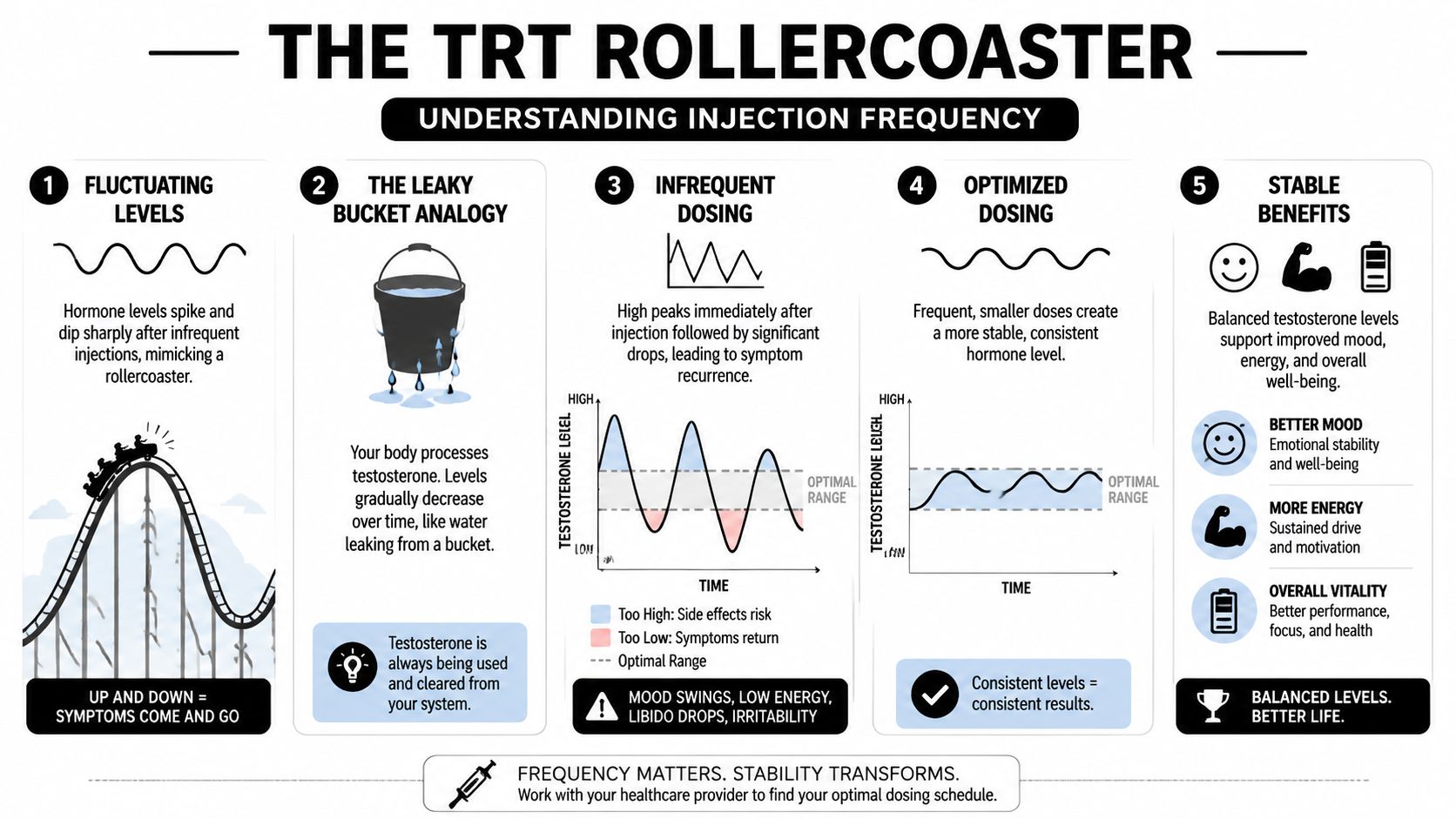
The leaky bucket analogy
A useful analogy is a bucket with a slow leak. Every injection fills the bucket. Your body then gradually processes and clears testosterone over time. If you dump a lot in at once and wait too long to refill it, the level swings from overflowing to nearly empty.
Smaller, more frequent refills keep the bucket steadier.
That matters because symptoms often track the curve more than the dose on paper. A man may feel overstimulated, puffy, or edgy during the peak, then dull and depleted during the trough. Same medication. Same total amount. Very different experience.
What the clinical data shows
Clinical pharmacology data reviewed in the testosterone therapy pharmacology literature shows that traditional 2-week dosing intervals can create major hormonal fluctuations. Testosterone levels become supratherapeutic 4 to 5 days after the dose and fall to subtherapeutic by day 14.
That pattern explains why men on older bi-weekly schedules often report a good stretch followed by a crash. It isn't imaginary, and it usually isn't poor compliance. It's the expected shape of the curve.
Stable TRT should feel boring in the best way. No dramatic highs, no countdown to the next injection.
Why stability wins
The practical goal of TRT isn't to hit a dramatic peak. It's to maintain a usable baseline that supports the same man on Monday, Wednesday, and Sunday.
More frequent dosing tends to help by:
- Reducing large spikes: Smaller injections generally create less of a post-shot surge.
- Lifting the low point: The trough before the next dose is often less severe.
- Improving day-to-day predictability: Men often care less about the absolute peak and more about whether they feel normal all week.
This is why many modern protocols move away from the old every-two-weeks model and toward weekly, twice-weekly, or microdosed schedules. The body usually responds better to steadiness than to big swings.
Comparing Common Testosterone Injection Schedules
Different schedules can all work. The question is which one fits your metabolism, symptom pattern, side-effect profile, and daily life. A protocol that looks convenient on paper can feel terrible in practice if the interval is too long.
Below is the schedule comparison I use most often when patients are trying to understand their options.
Testosterone Injection Frequency Comparison
| Frequency | Hormone Stability | Side Effect Risk (E2, Hematocrit) | Convenience | Best For |
|---|---|---|---|---|
| Bi-weekly | Lowest | Higher when peaks are pronounced | High on paper, often poor in real life | Men with limited options or legacy prescriptions |
| Weekly | Moderate | Moderate | Simple and workable | Men who want a straightforward schedule |
| Twice-weekly | Strong | Lower when compared with larger single injections | Good balance | Men seeking steadier symptom control |
| Daily or EOD microdosing | Highest for some men | Often easier to manage when peaks are minimized | Requires planning | Men sensitive to fluctuations or injection side effects |
Bi-weekly injections
Bi-weekly schedules are still prescribed because they're familiar, simple, and sometimes tied to older habits or insurance workflows. But they often produce the least stable patient experience.
The main advantage is fewer injections. The main disadvantage is that fewer injections usually mean bigger swings. Men on this schedule commonly describe feeling the protocol, not just feeling better.
This setup can still have a place when access is limited, adherence is a concern, or a patient strongly prefers fewer injections. But for symptom consistency, it's usually not where I want someone to stay long term if they're reporting obvious ups and downs.
Weekly injections
Weekly dosing is a major step up for many men. It's easier to remember, easier to travel with, and usually more stable than bi-weekly injections.
For some men, weekly is enough. They feel steady, labs make sense, and side effects are manageable. If that's the case, there's no prize for making a schedule more complicated than it needs to be.
The weakness of weekly dosing is that some men still feel the rise and fall, especially near the end of the interval. They may not crash hard, but they notice a “better half” and a “worse half” of the week.
Twice-weekly injections
Twice-weekly dosing is often the sweet spot. It tends to smooth the curve without becoming burdensome. Many men who feel uneven on weekly injections feel much more consistent when the same total weekly dose is split into two smaller injections.
That's why this schedule is commonly favored in private TRT practice. It addresses the rollercoaster without requiring daily commitment.
Clinical takeaway: When symptoms and side effects both improve after splitting the same weekly dose, frequency was the issue more than the total amount.
Typical candidates for twice-weekly dosing include:
- Men with end-of-week crashes: They feel good early, then flat before the next shot.
- Men with side effects after larger injections: They notice water retention, irritability, or libido swings after injection day.
- Men who want balance: This schedule often offers the best mix of stability and practicality.
Daily or every-other-day microdosing
Microdosing takes the same principle further. Instead of one or two larger injections, the dose is divided into very small, frequent administrations. This approach is often done subcutaneously rather than intramuscularly.
A 2022 NIH study on subcutaneous testosterone therapy found that smaller weekly subcutaneous doses can achieve therapeutic serum levels comparable to intramuscular injections while reducing the peaks and troughs associated with larger intramuscular dosing.
That makes microdosing attractive for men who are very sensitive to hormonal fluctuations, dislike intramuscular injections, or want the flattest curve possible. The downside is obvious. It requires consistency, supplies, and comfort with a more frequent routine.
Clinical Tradeoffs Balancing Symptoms and Side Effects
Frequency isn't just about convenience. It changes how a patient feels and how the labs tend to behave. When I adjust schedule in practice, I'm usually trying to improve one of two things. Symptom control or side-effect pressure. Often both.

Symptom control is the real target
Men don't start TRT because they want a number. They start because they feel worn down, disconnected, less resilient, less driven, or less interested in sex than they used to. If the protocol creates a brief lift followed by a slump, it hasn't solved the problem.
More frequent dosing often helps the following pattern:
- Mood swings after injection day
- Energy fading before the next shot
- Libido that comes and goes instead of staying reliable
- Brain fog that improves briefly, then returns
This is why I push patients to describe the rhythm of their week, not just whether they feel “better.” Timing matters. If you only feel good for part of the cycle, the schedule is sending a signal.
Estradiol and hematocrit respond to peaks
Large testosterone peaks can create more downstream problems than many men realize. In practice, the men who struggle most with estradiol-related symptoms or rising hematocrit are often the same men who are getting hit with bigger post-injection surges.
That doesn't mean frequency alone fixes every issue. It does mean schedule is one of the cleanest variables to adjust before chasing side effects with extra medications.
Common reasons a clinician may split the dose more often include:
- Estradiol-sensitive symptoms: Water retention, breast tenderness, emotional volatility, or a generally “off” feeling after larger injections.
- Hematocrit concerns: Avoiding pronounced peaks may help reduce pressure on red blood cell production over time.
- General side-effect minimization: Smaller doses tend to be easier for some men to tolerate.
Men who are also thinking about fertility should discuss the bigger treatment plan early, since TRT and fertility questions deserve their own conversation. A separate review on whether TRT can affect fertility is useful before making broader medication decisions.
Why SHBG changes the plan
SHBG is one of the most overlooked factors in protocol design. Some men can do well on straightforward weekly injections. Others feel unstable on the same schedule even when the dose looks reasonable on paper.
Men with high SHBG above 50 nmol/L may metabolize testosterone in a way that creates a rollercoaster effect even with standard weekly dosing, and they often need more frequent adjustments such as twice-weekly or every-other-day injections, according to this clinical dosing discussion on SHBG and frequency.
That's why generic advice falls short. Two men can take the same medication and the same total weekly amount, yet one feels smooth and the other feels erratic. The answer isn't always “increase the dose.” Sometimes it's “respect the binding profile and shorten the interval.”
Lab Monitoring How and When to Check Your Levels
A good TRT protocol is built from symptoms plus labs, not one without the other. If you only follow how you feel, you can miss side effects. If you only follow numbers, you can miss the fact that the patient still feels terrible.
The most useful lab strategy is simple, repeatable, and tied to your schedule.
What to check
For injection-based TRT, the core markers usually include:
- Total testosterone: Gives the broad overview.
- Free testosterone: Helps show what's available for tissue effect.
- Estradiol using a sensitive assay: Useful when symptoms suggest conversion issues.
- SHBG: Adds context when a schedule seems right on paper but feels wrong in practice.
- Complete blood count with hematocrit: Important for tracking red cell response over time.
Some clinicians will add other markers depending on age, history, and the rest of the treatment plan. But the list above is the practical core for frequency discussions.
When to draw blood
Timing changes interpretation. That's where many men get confused.
For injections, the most practical check is usually on trough day, meaning the day you're due for your next injection, before you take it. That gives the most honest look at your low point within the cycle.
If you test right after an injection, the result may look impressive while telling you almost nothing about why you feel worn down later in the week.
Bring your exact injection schedule to the lab review. “I inject twice weekly” is less useful than “Monday morning and Thursday evening.”
How to use the results
Lab interpretation should answer three questions:
- Are you adequately replaced at the low point of the cycle?
- Are side-effect markers pushing in the wrong direction?
- Does the schedule match the symptom pattern you're reporting?
A common mistake is changing both dose and frequency at the same time without a clear reason. When possible, adjust one variable, then reassess. That makes it easier to understand what improved things.
Telemedicine has made this process much easier for busy patients because labs, follow-up visits, and protocol reviews can happen without turning every adjustment into an office-day project. That doesn't replace judgment. It just removes friction.
Your Action Plan Sample Schedules and Next Steps
If you're trying to make sense of your current protocol, don't start by asking whether you need more testosterone. Start by asking whether your schedule fits your symptoms.
A practical plan begins with one rule. Never change your dose or frequency on your own without your prescribing clinician. Small changes in schedule can make a big difference, and they need to be paired with follow-up symptoms and labs.

Simple schedule examples
Here's how schedule splitting works in practice:
- If your prescribed weekly dose is 120 mg once weekly, a twice-weekly version is 60 mg every 3.5 days, such as Monday morning and Thursday evening.
- If your prescribed weekly dose is 100 mg once weekly, a twice-weekly version is 50 mg every 3.5 days.
- If your prescribed weekly dose is 150 mg once weekly, an every-other-day plan would divide that total into smaller repeated injections across the week.
- If you use subcutaneous microdosing, the total weekly amount is still the main anchor. The difference is how evenly it's spread.
The point isn't math for its own sake. The point is reducing the size of each hormonal wave.
What to discuss before changing frequency
Bring specific observations to your visit. Don't just say “I don't feel great.”
Instead, say things like:
- Energy pattern: “I feel best for two days after injection, then I fade.”
- Mood rhythm: “I'm more irritable early in the week and flat later.”
- Libido timing: “Sex drive improves after the shot, then drops before the next one.”
- Side-effect timing: “Water retention or flushing shows up right after injection.”
Those details help a clinician decide whether you need a dose change, a schedule change, or both.
A quick explanation from a clinician can also help make the schedule options easier to visualize:
The men who do best long term usually treat TRT like an iterative medical protocol, not a one-time prescription. They track how they feel, monitor labs at the right time, and make careful changes instead of reactive ones.
Frequently Asked Questions
Can I switch from IM to SubQ injections
Often, yes. Many men do well switching from intramuscular to subcutaneous injections, especially when using smaller, more frequent doses. The main appeal is comfort and smoother delivery. Any switch should be supervised, because technique, syringe choice, and follow-up labs all matter. If you have logistics questions, a TRT patient FAQ resource can help frame what to ask your clinician.
Will injecting more often hurt more
Not necessarily. More frequent injections are usually done with smaller volumes, and many patients find that easier to tolerate than larger shots. Technique matters more than frequency alone. Needle size, injection depth, site rotation, and medication volume all affect comfort.
How long should I stay on a new schedule before judging it
Give a new frequency enough time to settle unless you're having a clear adverse reaction. In practice, many clinicians reassess after several weeks, because the body needs time to reflect the change in both symptoms and labs. Changing schedules too quickly makes it hard to tell what's helping.
If your current TRT plan feels inconsistent, it may not be the dose. It may be the schedule. Cost Plus TRT offers physician-guided telemedicine care built around practical protocol adjustments, transparent pricing, home delivery, and ongoing follow-up so you can dial in a testosterone injection frequency that fits your symptoms and your life.