

Testosterone cypionate itself is inexpensive, often $20 to $54 per vial with coupons, but total monthly TRT costs typically range from $89 to $400+ once provider fees, labs, and supplies are included. The medication may be the smallest part of your bill, especially when a clinic bundles it with subscriptions, shipping, monitoring, and other services.
The most popular advice is to search for the cheapest vial. That's useful, but incomplete. A low pharmacy price doesn't tell you what you'll pay for medical evaluation, follow-up care, blood testing, syringes, delivery, or dose changes.
As a practitioner, I tell new TRT patients to treat the vial as one line in a larger financial plan. The smart question isn't only, “How much does testosterone cypionate cost?” It's, “What will safe, supervised treatment cost me from the first lab through ongoing follow-up?”
Table of Contents
- Why Testosterone Cypionate Costs More Than You Think
- Breaking Down Every Cost Component
- Pharmacy vs Clinic vs Telemedicine Pricing
- Insurance Coverage and Legal Considerations
- Real Monthly Cost Scenarios for Different Patients
- Proven Strategies to Lower Your TRT Expenses
- Making the Right Choice for Your Budget and Health
Why Testosterone Cypionate Costs More Than You Think
The vial is often the least surprising part of a TRT bill. The hidden layers are clinical review, laboratory monitoring, supplies, shipping, and recurring membership charges. A transparent cost-plus model makes those layers visible, while some low advertised prices move them into separate fees.
GoodRx's testosterone cypionate pricing page lists a 1 mL vial of 200 mg/mL at an average retail price of $21.19, with a coupon price of $20.03. It also lists a 10 mL vial of 200 mg/mL at $185.36 retail and $53.70 with a coupon. Another common 10 mL vial appears at $99.63 retail and $22.86 with a coupon. GoodRx reports access as low as $24.00, compared with an average retail price of $48.91 for the most common version.
The effective vial cost can therefore differ by more than seven times. Package size, manufacturer, pharmacy, and discount eligibility all affect the amount you pay. Comparing only the cheapest advertised vial can produce a misleading budget.
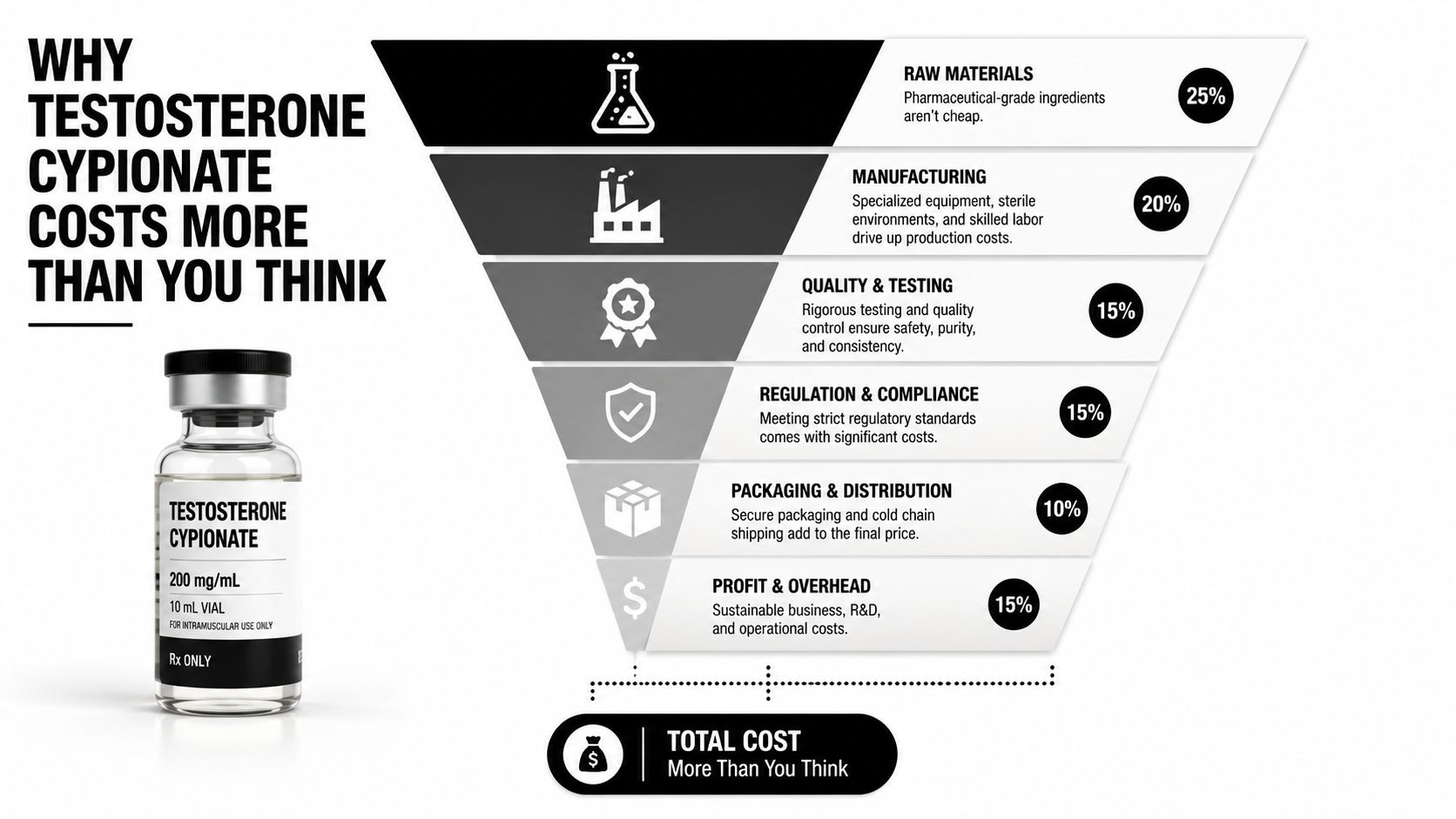
The medication is only one layer
Your complete treatment cost may include:
- Provider evaluation: A licensed clinician reviews symptoms, medical history, and laboratory results before prescribing.
- Monitoring labs: Follow-up testing checks whether treatment remains appropriate and safe.
- Injection supplies: Syringes, needles, alcohol swabs, and a sharps container add recurring expenses.
- Shipping: Mail-order and compounded pharmacy arrangements may charge for delivery.
- Membership fees: Some clinics bill monthly even when no new consultation is needed.
- Bundled add-ons: Supplements, peptides, erectile dysfunction medication, or other hormonal products may be presented as required package components.
Wholesale figures show why the retail experience may feel disproportionate. NDC List pricing information reviewed by HealthRx reports a wholesale NADAC price for a 10 mL multi-dose vial around $2.04269 per milliliter, with an observed range from $1.97480 to $2.70900 per unit over the period listed. For a 1 mL vial from another manufacturer, the listed wholesale price is $11.59285 per milliliter, with a range from $10.59711 to $14.55784. These figures do not represent your final price, because dispensing, clinical care, fulfillment, and overhead still require payment.
Practical rule: Compare like with like. A pharmacy quote covers medication, while a clinic fee may include clinical labor, administration, fulfillment, and business overhead.
Why “cheap TRT” advertising can mislead
An inexpensive testosterone price may sit beside a required consultation, lab package, subscription, or shipping charge. Those additions can raise the actual monthly cost substantially, even when the medication line looks attractive.
Request a written quote that separates the medication, provider care, labs, supplies, shipping, renewal terms, and cancellation policy. That breakdown lets you compare a pharmacy, clinic, or telemedicine plan on its real cost rather than its headline price.
Breaking Down Every Cost Component
A realistic TRT budget starts with the entire treatment stack, not just the vial. Medication is the most visible charge, yet recurring expenses often come from laboratory monitoring, clinical care, supplies, shipping, and subscription terms.
Package size can change the economics substantially. As shown in the pricing examples above, a 1 mL, 200 mg/mL vial and a 10 mL, 200 mg/mL vial contain the same concentration but may have very different cash prices. Compare the amount of medication, manufacturer, formulation, and dispensing terms before deciding that one quote is cheaper.
The recurring cost stack
Medication: Generic testosterone cypionate is usually the first line on a quote. Confirm the vial size, concentration, total quantity, manufacturer, and whether the product is a commercial FDA-approved medication or a compounded preparation. A transparent cost-plus model separates the pharmacy cost from the clinical fee, making any retail markup easier to identify.
Laboratory monitoring: Testing may be required before treatment and during follow-up. Your out-of-pocket cost depends on insurance benefits, deductible status, the tests ordered, and whether the clinic adds a markup. “Labs included” may refer only to a limited panel or a particular visit, not every test throughout treatment.
Provider care: The initial evaluation, prescription management, dose review, and follow-up messages all involve clinical time. Some providers bill per visit. Others charge a monthly membership or subscription, which may continue even when no medication shipment is due.
Supplies: Patients who inject at home may need syringes, needles, alcohol swabs, and a sharps container. A clinic that ships a complete kit may include these items in its recurring fee, sell them separately, or provide only the medication. Ask for the supply list rather than assuming the bundle covers everything.
Shipping and fulfillment: Mailed medication can carry a delivery or fulfillment charge. Confirm whether that fee applies to every shipment, only the first order, or orders below a stated purchase threshold. A low medication price can lose its advantage once repeated shipping and handling charges are added.
| Cost Component | Retail Pharmacy | Compounded Pharmacy | Telemedicine Clinic | Traditional Clinic |
|---|---|---|---|---|
| Medication | Prescription pickup, discount pricing may apply | Preparation and fulfillment through the pharmacy | May be shipped or sent to a local pharmacy | Often bundled with clinic services |
| Provider care | Usually arranged separately | Usually arranged separately | Remote consultation and follow-up | In-person visits and office overhead |
| Labs | Patient coordinates testing | May be ordered separately | Often coordinated digitally | Frequently arranged through the clinic |
| Supplies | Usually purchased separately | May be included or sold separately | May be shipped with medication | May be supplied during visits or billed |
| Shipping | Usually none for local pickup | May apply | May be included or itemized | Usually not relevant for in-office care |
| Pricing risk | Several separate vendors | Pharmacy and provider charges may be separate | Bundles can hide individual costs | Packages and contracts may obscure totals |
How to audit a quote
Before paying, request a written breakdown that answers these questions:
- Medication details: What concentration, vial size, formulation, and quantity are included?
- Clinical access: Does the fee cover the initial evaluation, follow-ups, prescription renewals, and dose adjustments?
- Laboratory scope: Which tests are required, how often are they ordered, and who pays for them?
- Fulfillment: Are shipping, injection supplies, and replacement items included?
- Contract terms: Is there auto-renewal, a cancellation fee, or a minimum commitment?
The clearest comparison places pharmacy cost, provider care, labs, supplies, and fulfillment on separate lines. That format does not determine whether a program is medically appropriate, but it exposes hidden charges and shows whether the advertised price reflects the actual recurring cost.
Pharmacy vs Clinic vs Telemedicine Pricing
The right purchasing path depends on how much responsibility you want to manage yourself. A local pharmacy can minimize the medication transaction, while a clinic can consolidate care. Telemedicine sits between those models, but its value depends heavily on what the monthly fee includes.
A retail pharmacy route generally works best for a patient who already has a prescribing clinician, can arrange laboratory testing, and is comfortable managing injection supplies. The pharmacy price may be low with a discount card, but the prescription, lab orders, follow-up appointments, and dose decisions remain separate responsibilities.
A traditional men's health clinic may offer a more hands-on experience. That can be useful for patients who need in-person assessment or prefer office-based injections, but bundled fees can make it difficult to identify the true medication cost. A high monthly price isn't automatically evidence of better care, just as a low price isn't proof of poor care.
Telemedicine can reduce travel and coordinate prescriptions, lab orders, and follow-up online. Some programs charge a monthly subscription, while others use a flat fee or separate each service. Read the terms carefully, especially when the advertised medication price excludes provider management or laboratory monitoring.
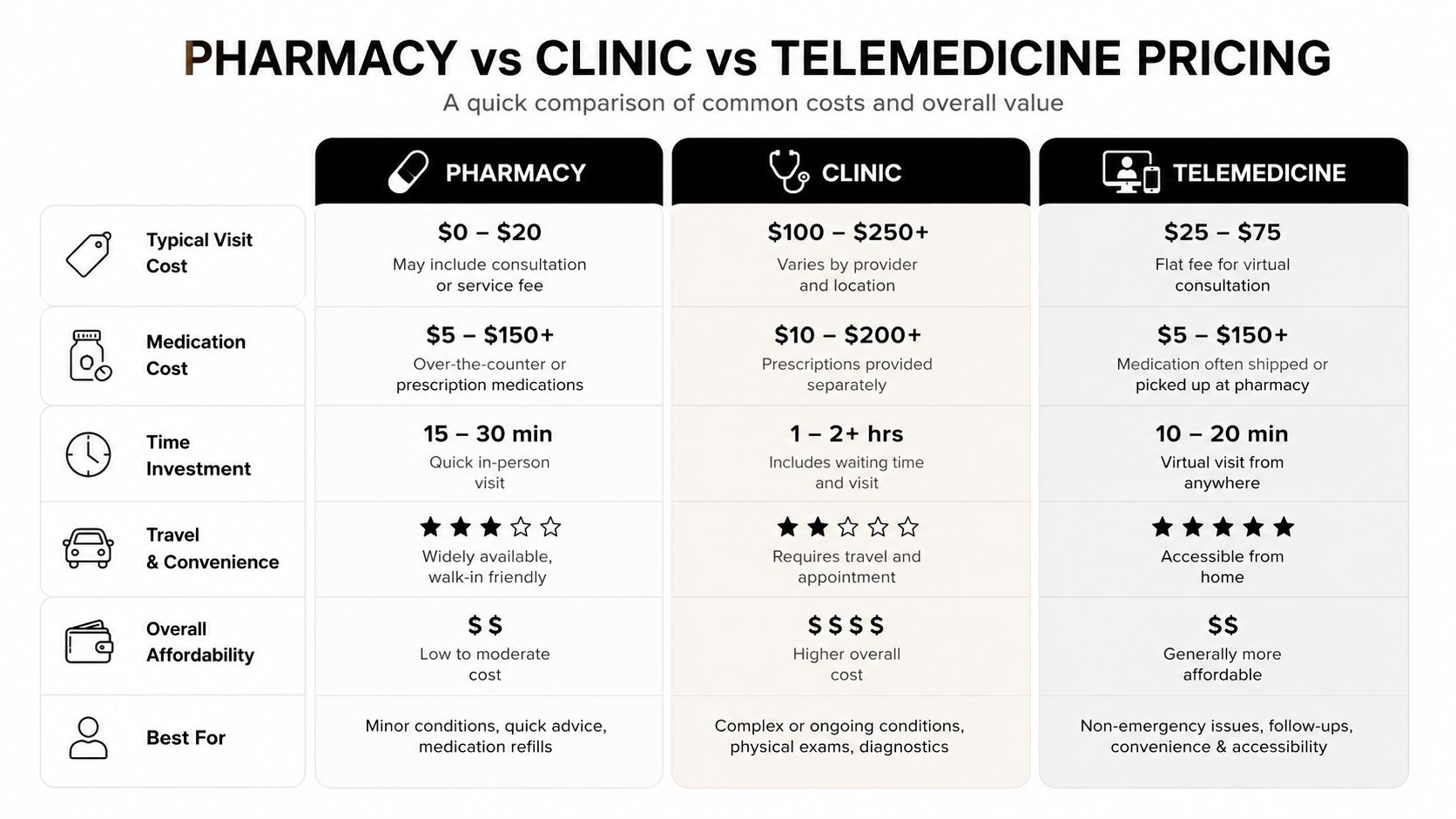
Compare the full arrangement
| Route | Main advantage | Main trade-off | Questions to ask |
|---|---|---|---|
| Retail pharmacy | Potentially low medication cost | You coordinate more of the care | Who orders labs and manages dose changes? |
| Traditional clinic | In-person access and centralized services | Bundled pricing may be difficult to audit | Is medication separated from office and monitoring fees? |
| Telemedicine | Remote access and home delivery | Quality and pricing transparency vary | Are consultations, labs, supplies, and shipping included? |
Warning signs include mandatory long-term commitments, automatic renewal without clear notice, and wellness products that you didn't request. A provider should explain what is medically necessary, what is optional, and what happens if you cancel.
You can review one example of an itemized telemedicine pricing approach through Cost Plus TRT's pricing information. Treat any advertised price as a starting point, then confirm eligibility, included services, laboratory responsibility, and renewal terms before enrolling.
The delivery model matters less than the clinical process. A remote provider still needs appropriate medical history, relevant laboratory review, licensed prescribing, follow-up, and a clear way to address side effects or abnormal results.
Insurance Coverage and Legal Considerations
Insurance can reduce your out-of-pocket responsibility, but coverage isn't automatic. Plans may require documentation of an appropriate diagnosis, specific laboratory evidence, prior authorization, or use of a preferred product. Compounded formulations may be treated differently from commercially manufactured prescriptions.
Start with your plan's formulary and medical policy. Ask whether testosterone cypionate is covered for your diagnosis, whether the pharmacy benefit or medical benefit applies, and whether your prescriber must submit prior authorization.
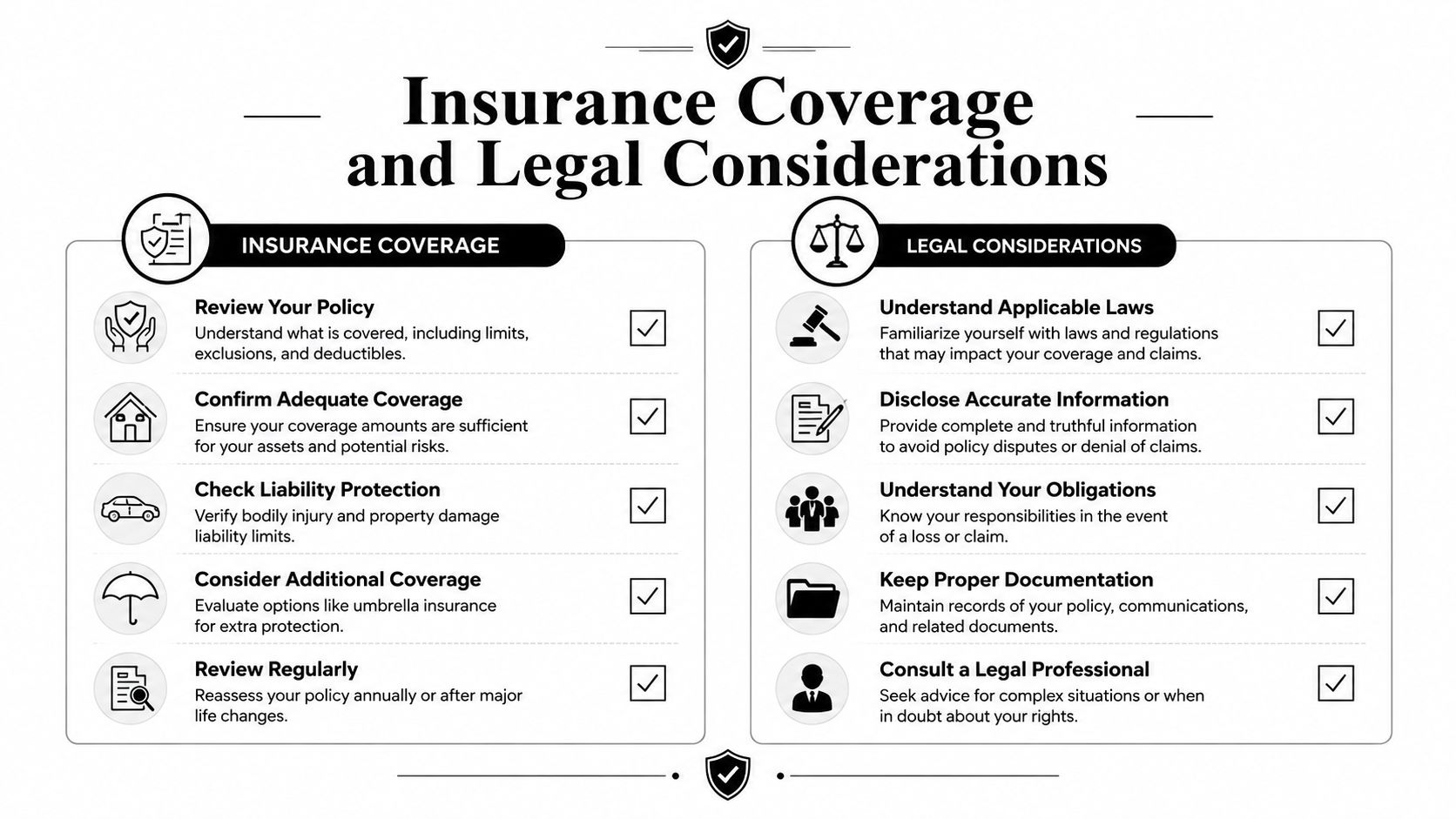
Steps to take after a denial
- Request the denial reason in writing. You need the exact coverage rule, not a vague statement that the medication isn't covered.
- Ask your prescriber for supporting documentation. This may include symptoms, medical history, laboratory results, and the rationale for the prescribed formulation.
- Check the appeal deadline. Your insurer's notice should explain how and when to appeal.
- Ask about alternatives. A covered commercial product may be treated differently from a compounded preparation.
- Confirm pharmacy requirements. Some plans limit coverage to specific pharmacies or require a specialty pharmacy.
Use Cost Plus TRT's telehealth consent information to review the type of remote-care relationship being offered before submitting personal information or completing enrollment.
Prescription legality matters
Testosterone is a controlled prescription medication. You should receive it through a licensed healthcare provider and a legitimate pharmacy, with the provider authorized to prescribe in the state where you receive care. A website offering testosterone without a prescription isn't a safe shortcut. Product identity, concentration, sterility, storage, and legal sourcing may all be uncertain.
Verify the provider's license, identify the dispensing pharmacy, and ask whether the product is commercially manufactured or compounded. Don't send payment to a seller that refuses to provide a prescription pathway, pharmacy information, or clear clinical oversight.
Insurance savings shouldn't come at the expense of legitimate care. If your plan won't cover treatment, compare lawful cash-pay options and ask for an itemized estimate before beginning.
Real Monthly Cost Scenarios for Different Patients
Monthly TRT spending depends on who provides the care and which services the quoted price includes. These profiles are planning examples, not patient case studies or promises. Actual totals vary with prescription details, laboratory requirements, insurance, location, and provider policy.
Budget-Conscious Ben already has a prescriber, uses a local pharmacy discount, injects at home, and arranges his own testing. As noted in the earlier pricing breakdown, his medication may fall near the coupon examples discussed there. His complete budget still needs to cover injection supplies and periodic laboratory expenses. His monthly total depends on his coupon price, supplies, and how often labs are due.
Ben's lower recurring bill comes with more personal administration. He must track refills, testing dates, supplies, and appointments rather than paying one program to coordinate them.
Convenience-First Carlos prefers remote appointments, mailed medication, digital lab coordination, and one recurring payment. His monthly price may sit in the middle of the broader market, but the quote is useful only when it states whether supplies, shipping, follow-up visits, and laboratory testing are included. A total near $250 to $350 per month can be reasonable when those services are clearly listed and clinically relevant. A subscription that bundles unnecessary services can cost more without improving his care.
Care Chris chooses in-person monitoring and has additional health concerns that require more clinician involvement. His monthly equivalent may exceed $400 when office care, expanded laboratory evaluation, and administration are included. The higher bill may reflect additional clinical work, but Chris should ask which services are medically necessary and which are optional.
| Cost Component | Budget-Conscious Ben | Convenience-First Carlos | Comprehensive Care Chris |
|---|---|---|---|
| Medication | Discounted local pharmacy price | Shipped medication through the program | Medication included in a clinic arrangement |
| Provider care | Separate established prescriber | Remote management and follow-up | In-person consultations and monitoring |
| Labs | Patient schedules and pays according to coverage | Clinic coordinates, inclusion varies | Clinic may order expanded testing |
| Supplies | Purchased separately | May arrive with medication | May be used or provided during visits |
| Shipping | Usually avoided through pickup | May be included or itemized | Usually not applicable |
| Budget pattern | Lower recurring cost, more self-management | Mid-range cost, greater convenience | Higher cost, more hands-on support |
Use the scenario that matches your behavior
Ben's model suits patients who can manage appointments, laboratory timing, refills, and supplies. Carlos pays for coordination, which may help when travel, scheduling, or missed follow-up creates practical problems. Chris should confirm that in-person monitoring addresses a real clinical need rather than adding comfort or marketing extras.
Compare equivalent categories across providers: medication, clinical care, labs, supplies, and shipping. Then estimate the months when laboratory work, renewals, or delivery charges are due. A medication-only quote can look inexpensive beside an all-inclusive plan, while the reverse may be true after hidden fees are added. A transparent cost-plus quote should make the medication markup and service charges easier to evaluate.
Proven Strategies to Lower Your TRT Expenses
The safest savings usually come from removing unclear charges, not reducing medical oversight. Request a written estimate that separates testosterone, clinical care, laboratory work, supplies, shipping, and recurring fees. This exposes the cost layers that medication-only quotes often hide.
A transparent cost-plus arrangement also helps. As the wholesale benchmarks show above, listed acquisition prices can sit well below consumer cash prices, particularly across multi-dose and single-dose vial formats. That gap does not automatically make a pharmacy or clinic charge improper. Staffing, storage, compliance, dispensing, and fulfillment all add costs. Ask which part of your bill pays for medication and which part pays for care.
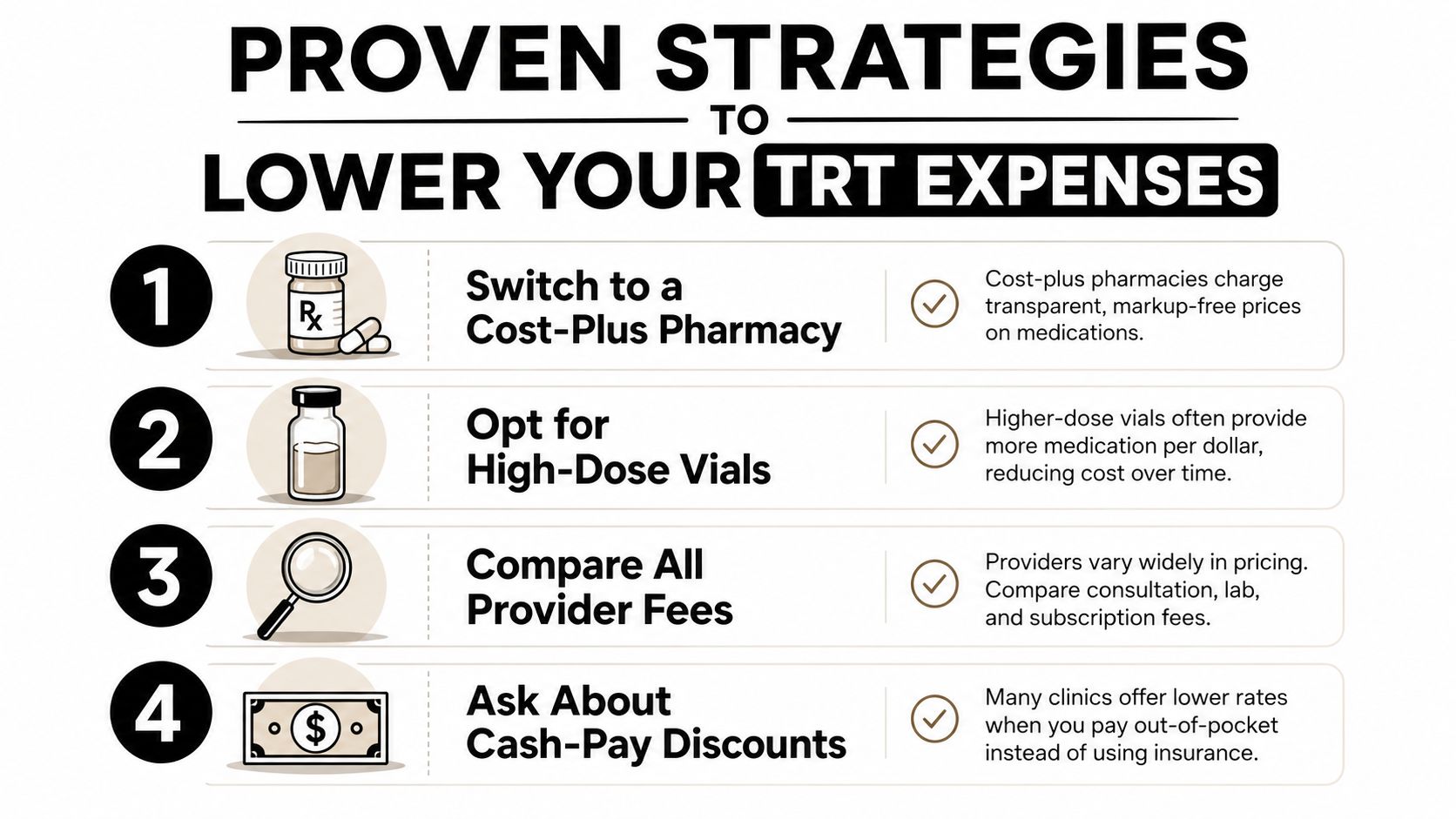
Practical ways to control the bill
- Compare vial formats: Ask whether a larger multi-dose vial fits your prescription and how the pharmacy handles storage and beyond-use dates. A larger package may cost more if part of it expires or is wasted.
- Check discount channels: Compare the pharmacy's cash price with a GoodRx coupon and other legitimate discount programs. Pricing can differ by pharmacy, package size, and manufacturer.
- Shop for labs separately: Ask whether your insurance, a local laboratory, or a direct-pay service can provide the required testing instead of accepting a marked-up panel.
- Audit subscriptions: Confirm what the recurring fee covers, including clinician contact, prescription renewals, and dose review. Cancel or avoid membership tiers you do not use.
- Reject mandatory extras: Supplements, peptides, and unrelated wellness products should not be required without a clear medical reason from your clinician.
- Use eligible healthcare funds: Ask your benefits administrator whether prescribed treatment, laboratory work, and supplies qualify for your HSA or FSA. Eligibility depends on the plan and applicable rules.
- Reduce fulfillment charges: Ask whether pickup, combined shipping, or a longer dispensing interval is available and medically appropriate.
A cheaper vial helps only when treatment remains properly prescribed, monitored, and supplied.
Do not change your dose, injection frequency, or laboratory timing solely to lower the bill. Discuss cost concerns with the prescribing clinician. Financial improvisation can create medical and compliance problems.
Making the Right Choice for Your Budget and Health
Testosterone cypionate is a relatively inexpensive generic medication, but the treatment relationship around it determines your real cost. Choose the model that matches the amount of coordination and clinical support you need.
- Choose a retail pharmacy path if you already have appropriate medical care and can manage labs, supplies, refills, and follow-up independently.
- Choose telemedicine if remote visits and delivery solve practical problems, provided the program discloses its clinical, laboratory, and fulfillment fees.
- Choose an in-person clinic if physical examinations, office administration, or more involved monitoring are important for your care.
The lowest advertised price isn't always the lowest total cost. Travel, missed work, separate lab bills, subscription renewals, and unclear add-ons can change the calculation. Conversely, an all-inclusive package isn't automatically good value if it includes services you don't need.
Before you commit, request an itemized estimate and compare each line against the medication and wholesale benchmarks cited earlier. Ask who prescribes, who reviews labs, which pharmacy dispenses the medication, what supplies arrive, whether shipping is included, and how cancellation works. You can review Cost Plus TRT's TRT program as one example of a telemedicine model, then compare its stated inclusions with other legitimate providers.
Cost Plus TRT offers telemedicine-based TRT for $119 a month, month to month, with lab work, provider visits, testosterone cypionate, injection supplies, and shipping included. Recent labs you already have can be reviewed, and the price is the same either way. Visit Cost Plus TRT to review the program before enrolling.