

You're probably not searching for testosterone cypionate before and after because you want a glamour photo. You're searching because something feels off. Energy is lower than it used to be. Work feels heavier. Training doesn't give back what it once did. Libido is less reliable. You may even feel like yourself on paper, but not in your own body.
That's the actual “before” state most men bring into clinic. Not dramatic collapse. More often, it's a slow drift.
Online, you'll find transformation pictures that make testosterone cypionate look like a switch you flip. In practice, that's not how well-run TRT works. The meaningful before and after is built from symptoms, lab work, dose timing, follow-up, and whether you can stay on treatment long enough to benefit from it. A good outcome isn't one impressive month. It's a stable, safe protocol you can live with.
Table of Contents
- The Reality of Testosterone Before and After Pictures
- Establishing Your Baseline The Critical Before Snapshot
- A Realistic Timeline of Expected TRT Results
- Monitoring Your Progress with Labs and Symptoms
- Navigating Potential Side Effects and Risks Safely
- How to Start TRT Affordably and Correctly
The Reality of Testosterone Before and After Pictures
A man in his forties comes in saying he's “not terrible, just not right.” He still goes to work. He still gets through the day. But by late afternoon he's running on fumes, and the version of him that used to initiate workouts, sex, projects, and plans has gone quiet. That's a much more common starting point than the dramatic stories you see online.

The problem with many testosterone cypionate before and after images is that they collapse a long medical process into a single visual comparison. They usually don't show whether the man had confirmed hypogonadism, whether his dose was adjusted, whether he retained water early on, or whether he could afford to stay on therapy. Those details matter more than the camera angle.
Before and after is a process, not a reveal
TRT is closer to tuning an engine than pressing a turbo button. Testosterone cypionate is one of the most common injectable options because it's practical and reliable in physician-guided care. But the “after” isn't one moment where everything suddenly locks into place.
A medically honest after-picture looks like this:
- Symptoms improve in stages: Energy, mood, libido, and erections may not improve on the same schedule.
- Labs and symptoms have to agree: A higher number alone doesn't guarantee you feel better.
- The dose may need refinement: Early treatment often involves adjustment rather than instant perfection.
- Lifestyle still matters: Sleep, alcohol intake, training, nutrition, and stress can either support or blunt the response.
The best TRT outcomes rarely look dramatic week to week. They look steady, boring, and sustainable.
What works and what doesn't
What tends to work is simple. Start with proper diagnosis. Use a consistent injection schedule. Recheck labs and symptoms. Adjust with intention. Stay patient.
What doesn't work is chasing a bodybuilding fantasy, changing too many variables at once, or assuming that every good day means the protocol is perfect. Testosterone cypionate can be effective, but it rewards consistency more than impatience.
If you're evaluating your own before and after, use a wider lens. Ask whether you're thinking more clearly, recovering better, showing up with more motivation, and living with fewer crashes. That's the transformation most men want.
Establishing Your Baseline The Critical Before Snapshot
The first injection isn't the beginning. The beginning is the baseline.
If you skip that step, the whole process becomes guesswork. You can't judge whether testosterone cypionate is helping if you never defined what “before” looked like in a structured way.
Symptoms matter but labs make the diagnosis
A good baseline starts with the story. Not just “I'm tired,” but when the fatigue shows up, whether sleep is restorative, whether libido dropped gradually or suddenly, whether erections changed, whether body composition shifted, and whether mood, focus, or motivation have become unreliable. That interview matters because low testosterone symptoms overlap with sleep apnea, depression, thyroid problems, medication effects, heavy alcohol use, and chronic stress.
Then come the labs. In practice, a thorough starting panel often includes markers such as total testosterone, free testosterone, estradiol, SHBG, PSA, and blood count measures, along with other safety and context labs your clinician considers appropriate. The exact panel can vary by provider, but the principle doesn't. You need an objective snapshot before treatment starts.
A patient who wants to transfer care or review options can compare how clinics handle this process through TRT treatment details. What matters is not just getting a prescription, but having a plan built around symptom review, baseline data, follow-up, and access to clinician input if the first protocol needs refinement.
Why cypionate timing affects interpretation
Testosterone cypionate is an intramuscular depot ester, which means it's designed to release over time rather than all at once. One clinical source notes that serum levels may peak around 10 to 12 hours after injection in some cases, while other cases peak 2 to 3 days later, and it's commonly dosed about once weekly with adjustments based on blood work and response, as described in this testosterone cypionate injection overview.
That matters because lab timing can distort the story. A blood draw taken close to peak may look very different from one drawn near trough. If your clinician doesn't know when you injected, the number may be harder to interpret.
Here's the practical takeaway:
| Baseline question | Why it matters |
|---|---|
| What symptoms are most disruptive | It gives treatment a target beyond the lab value |
| When was the blood drawn | Testosterone levels vary depending on timing |
| What is the injection schedule | Stable routines make follow-up data more meaningful |
| What other health factors are present | Sleep, weight, alcohol, medications, and stress affect outcomes |
Practical rule: If you want a useful before-and-after comparison, keep your lab timing and injection timing consistent from one check-in to the next.
Without a solid baseline, men often misread normal ups and downs as proof that treatment is or isn't working. With a good baseline, you can make calm decisions instead of emotional ones.
A Realistic Timeline of Expected TRT Results
A common first follow-up goes like this: week two, a man feels a little better, sleeps more soundly for a few nights, then wonders why the mirror looks the same. That pattern is normal. Testosterone cypionate usually changes how you feel before it changes how you look, and good care depends on knowing the difference.
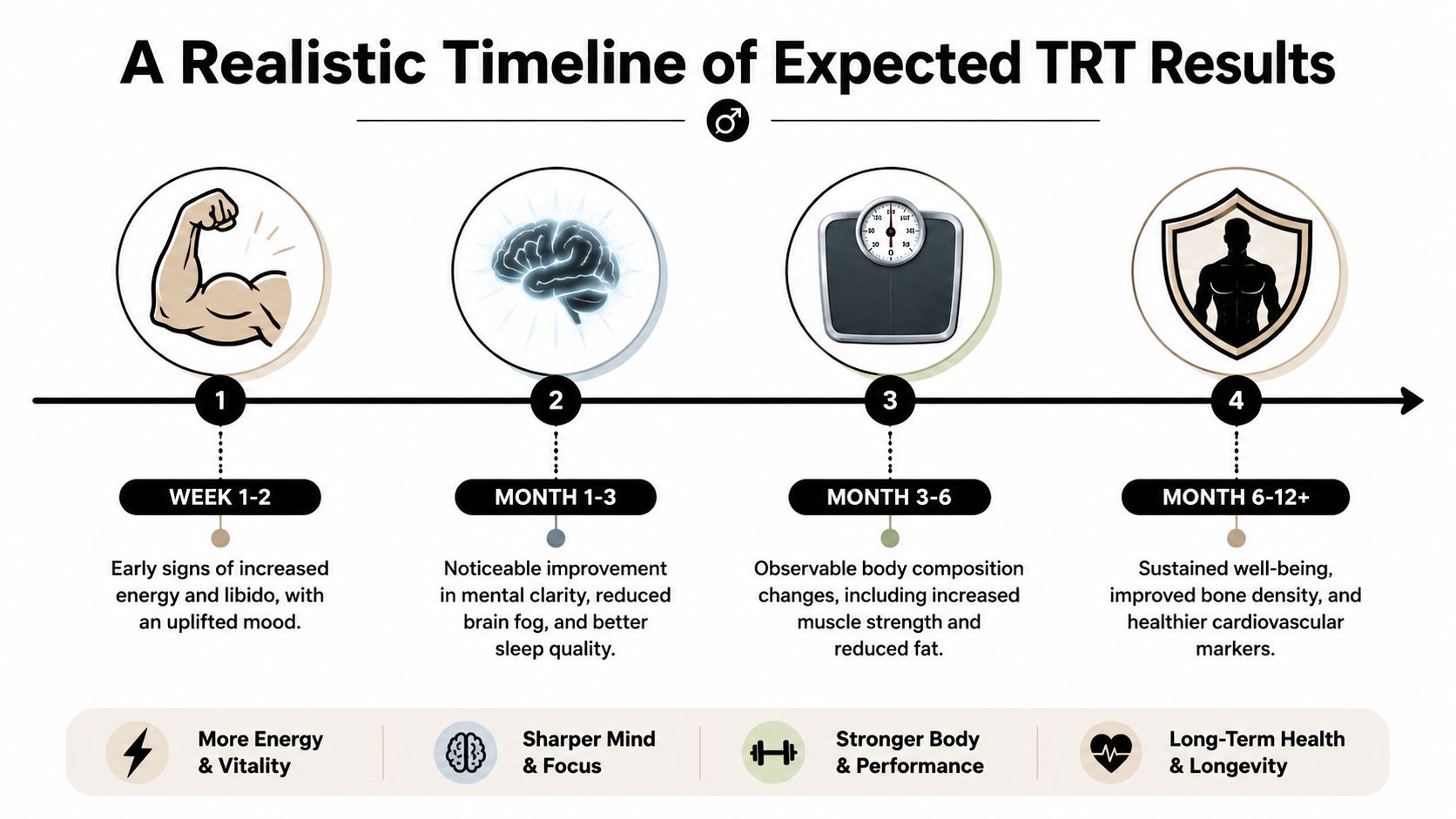
Published research on testosterone therapy shows that some effects can begin within weeks, while body composition and broader stabilization take much longer, as summarized in this review of testosterone therapy timelines. That timing fits what I see in practice. Early changes are often internal and functional. Later changes are the ones people notice in photos, clothing fit, strength logs, and waist size.
What often improves first
During the first several weeks, the most useful question is not “Do I look different?” It is “Do I function better across an ordinary day?”
Early progress may include:
- More stable energy
- Better morning drive and libido
- Improved erectile consistency
- Less mental drag
- Better workout recovery
These shifts can be subtle at first. Some men feel a clear lift quickly. Others describe a gradual return to baseline, as if the engine stops misfiring rather than suddenly getting a turbocharger. That is still progress.
An office-based TRT timeline from Gameday Men's Health makes the same general point, noting that many men notice changes in the first few weeks and that full results take months, according to this TRT week-by-week timeline.
Later in the section, it helps to hear this explained visually.
What usually takes longer
Muscle gain, fat loss, and visible recomposition are slower. That is one reason dramatic before and after photos can mislead men who are starting treatment for medical reasons. The hormone helps create a better operating environment for recovery, protein synthesis, training output, and body composition. It does not bypass sleep, nutrition, movement, or time.
In practical terms, many men notice the first meaningful physical changes over months, not days. Waist measurements may improve before the mirror catches up. Strength may rise before body weight changes. Some men feel substantially better well before they look different, which is why a responsible TRT program follows symptoms, labs, and adherence together instead of chasing a fast cosmetic transformation.
A realistic pattern looks like this:
| Time period | More likely to change | Less likely to change |
|---|---|---|
| First few weeks | Libido, erections, energy, mood, recovery | Visible muscle gain, major fat loss |
| First few months | Sexual function, steadier performance, training tolerance | Dramatic physique changes |
| Later months | Strength trends, body composition, symptom stability | Sudden week-to-week transformation |
How to evaluate your own before and after
Early TRT can be noisy. A strong week can reflect better sleep, lower stress, or the normal rise after an injection. A flat week does not mean the treatment failed. Testosterone works more like setting the thermostat in a large house. The signal changes first, and each room catches up on its own timeline.
Use a simple scorecard:
- Track symptoms weekly
- Separate libido from erection quality
- Note energy across the full day
- Record recovery from training and soreness
- Compare photos and measurements monthly, not constantly
This matters for more than patience. It affects treatment decisions. Men who expect instant visual change often push for dose increases too early, which can create side effects, higher costs, and harder-to-interpret follow-up labs. A steady, affordable telemedicine plan usually works better because it gives enough time to assess one protocol, make measured adjustments, and keep treatment sustainable month after month.
The most useful early “after” is often simple. You get through the day with less friction, more interest, and a more dependable sense of yourself. The mirror usually catches up later.
Monitoring Your Progress with Labs and Symptoms
A common early follow-up goes like this. A patient says, “My number went up, but I still do not feel like myself every day,” or, “I feel better, but my labs are not where I expected.” Both comments can be true at the same time. Testosterone cypionate monitoring works best when we track labs and day-to-day function together.
That is the difference between taking testosterone and managing testosterone therapy well.
The two scoreboards that matter
The first scoreboard is clinical. I want to know what your mornings feel like, how stable your energy is by late afternoon, whether libido is returning, whether erections are more reliable, and whether recovery from training or physical work is improving. Those details matter because treatment is supposed to improve your life, not just change a lab sheet.
The second scoreboard is laboratory data. Follow-up labs help your clinician see whether the dose, injection schedule, and timing of blood draws match the response you are reporting. They also help us watch safety markers instead of staring at total testosterone alone.
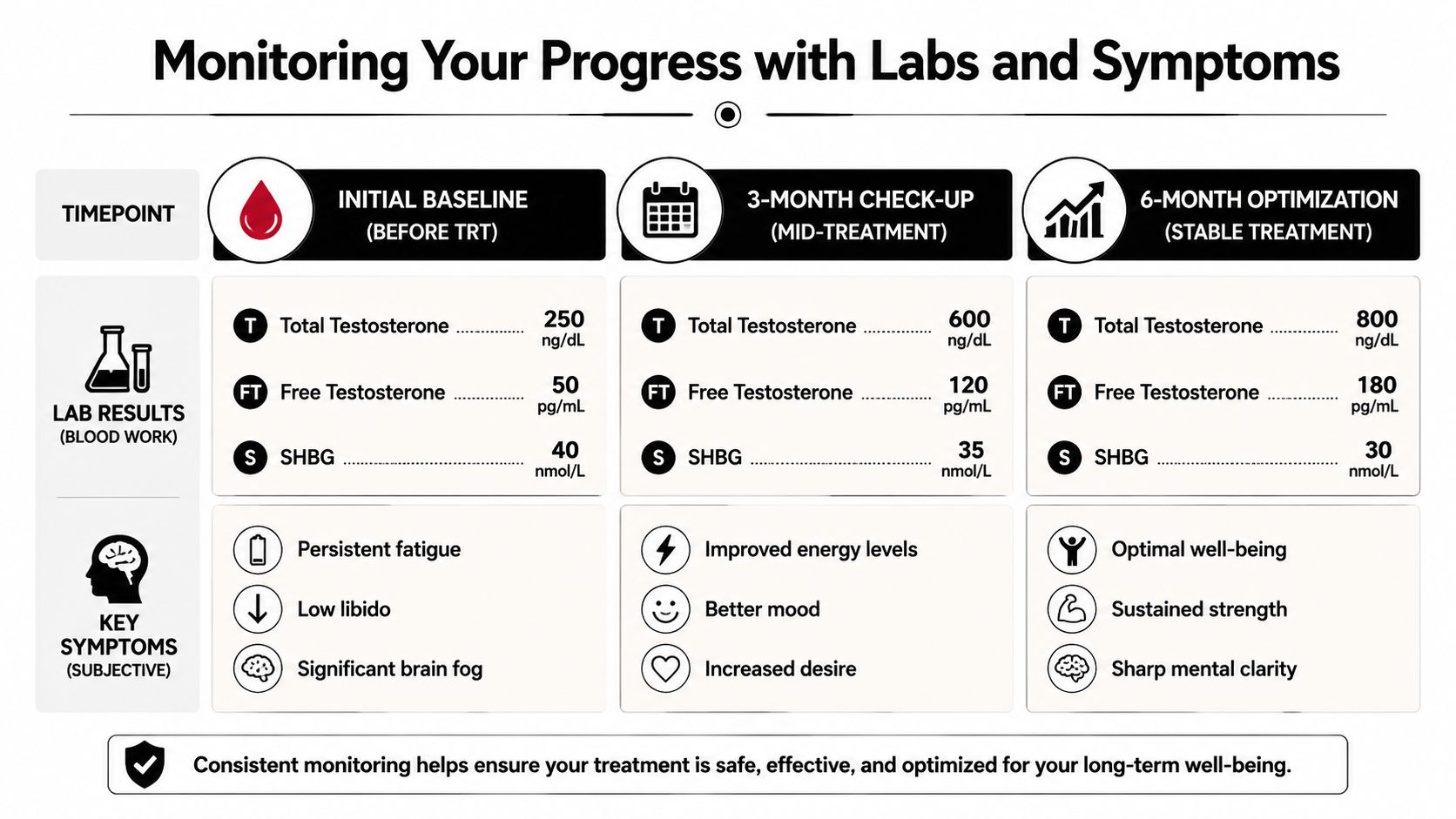
The chart above is an example, not a template every man should chase. Good TRT care is more like adjusting the thermostat in a real house than maxing out a single dial. The goal is a steady, livable setting where symptom relief, tolerability, and safety line up.
Why dose changes are part of the process
Early adjustments are routine. They do not mean the starting plan was careless. They mean the plan was honest about the fact that bodies respond differently.
A clinician may change the dose or schedule for several practical reasons:
- Symptoms improved, but not consistently: You have better days, but the benefit fades before the next injection.
- You feel a rise and fall during the week: That pattern can point to timing or frequency issues rather than a simple need for more testosterone.
- Side effects begin to show up: Acne, fluid retention, irritability, or sleep disruption can mean the current setup needs refinement.
- The blood draw does not match the injection timing: A lab taken at a different point in the cycle can make a reasonable protocol look worse or better than it really is.
This is why consistency matters so much. Use the same injection days. Get follow-up labs at a repeatable point after the injection. Keep notes short enough that you will use them.
A useful symptom log does not need to be complicated. Rate energy, libido, erection quality, mood, sleep, and recovery once a week. If fertility is part of your planning, bring that up early too, because TRT can affect sperm production and the treatment plan may need to change. A plain-language review of that issue is here: guide on whether TRT can affect fertility.
Patients often assume more is better. In practice, pushing the dose too fast can raise costs, create side effects, and make follow-up harder to interpret. A steady telemedicine model helps because it makes regular check-ins, lab review, and measured dose changes financially realistic over time.
The men who do well long term usually follow the same pattern. They stay consistent, report symptoms clearly, and let the protocol settle before chasing another change. That is how the “after” becomes stable enough to keep.
Navigating Potential Side Effects and Risks Safely
A responsible discussion of testosterone cypionate before and after has to include the less glamorous part. Some men do notice side effects. Most of the time, those issues are manageable when the treatment is supervised and the response is monitored.
The mistake is treating side effects as either proof that TRT is dangerous or proof that they should be ignored. Neither is smart.
Common issues you might notice
Some men notice acne, oilier skin, mild fluid retention, or injection-site irritation. Others notice mood shifts if hormone levels swing too high or too unevenly across the week. Some side effects reflect the dose itself. Others reflect the body's adjustment to a new hormonal pattern.
A separate concern is fertility. Men who may want children shouldn't assume testosterone therapy is neutral in that area. If fertility matters now or might matter later, that needs to be discussed before treatment starts, and a patient-friendly overview of that topic is available in this guide on whether TRT can affect fertility.
A good clinician also keeps an eye on broader safety markers over time. That includes issues such as hematocrit and other relevant labs, rather than focusing only on testosterone levels.
What good management looks like
The safest path is not “never have a side effect.” It's “recognize it early, understand why it may be happening, and adjust thoughtfully.”
That usually involves some combination of:
- Dose review: Too much testosterone for your physiology can create problems you don't need.
- Schedule review: Sometimes the issue is not the total dose, but how it's spaced.
- Lab interpretation: Numbers help explain whether symptoms fit the biology.
- Lifestyle cleanup: Alcohol, poor sleep, untreated sleep apnea, and high stress can amplify problems.
Here's what doesn't work. Self-adjusting every few days. Chasing internet advice. Treating every symptom like it requires another medication. Adding complexity too quickly often makes the picture harder to interpret.
Side effects are easiest to manage when you catch them as trends, not after they become a crisis.
In experienced hands, testosterone cypionate is usually managed as an ongoing clinical relationship, not a one-time prescription. That's the right mindset. You want steady symptom relief, not a reckless hormone spike.
How to Start TRT Affordably and Correctly
A common starting point looks like this. A man has symptoms, low labs, and a genuine reason to consider treatment, but he hesitates because he has also seen expensive clinic plans, vague monthly fees, and programs that add medications before they have even adjusted the testosterone dose.
That concern is reasonable.
Good TRT has to work medically and financially. If follow-up is hard to access, costs keep changing, or every issue leads to another add-on, adherence usually suffers. Testosterone cypionate before and after results are shaped by that reality just as much as by the prescription itself.
In practice, patients ask a practical question: “Can I stay on this plan for the long haul?” That is the right question. TRT is usually a steady process of evaluation, dose refinement, and monitoring, not a one-time purchase.
How to compare care models
Start with the structure of care, not the branding. The goal is a clinic model that makes monitoring straightforward and treatment sustainable.
You want clear answers to these points:
| What to compare | Why it matters |
|---|---|
| What is included in the fee | Medication, supplies, visits, and shipping should be easy to understand before you start |
| How labs are handled | Follow-up testing should be scheduled and reviewed, not left to the patient to figure out alone |
| Whether dose changes are supported | Dose adjustment is a normal part of TRT, especially in the first several months |
| How medication and supplies are delivered | Convenience improves consistency, and consistency matters with hormone therapy |
| How easy clinician access is | Early questions are easier to fix than delayed problems |
Cost matters because TRT works best when a patient can maintain it. I tell patients to be cautious with any plan that looks inexpensive at first but becomes expensive once labs, follow-ups, supplies, or refill logistics are added back in. A transparent telemedicine model can solve a lot of that, especially for men with busy schedules or limited local options.
For men comparing options, reviewing TRT pricing and what is included is a practical way to judge whether a plan is realistic over time. The value of telemedicine is not hype. It is access, predictable follow-up, and less disruption to work and family life, provided the clinic still manages labs, symptoms, and safety markers carefully.

Questions worth asking before you commit
Ask direct questions before you sign up. A good clinic should answer them plainly.
- What exactly am I paying for? Medication, supplies, consultations, and shipping should all be spelled out.
- How are follow-up labs ordered and reviewed? You want a defined process with actual clinician interpretation.
- What happens if I feel somewhat better, but not fully better? The answer should involve reassessment, not guesswork or instant add-ons.
- How are side effects handled? Dose and injection schedule changes should be part of the plan.
- Can you take over care if I already have recent labs or I am already on TRT? Continuity matters.
I also advise patients to ask how often the clinic changes protocols. Good TRT is usually simple. If a program pushes frequent changes, multiple extra medications, or aggressive promises in the first few weeks, that is often a sign of poor process rather than advanced care.
A sustainable plan usually produces better long-term outcomes than an impressive-sounding one. The right start is straightforward. Confirm the diagnosis carefully. Choose a provider who follows symptoms and safety labs. Use a care model you can continue without financial strain. Then give treatment enough time to work before judging your before and after.