

The strongest modern safety data on testosterone and heart disease starts with a result that would have been hard to imagine a decade ago. In the 2023 TRAVERSE trial, 5,198 men with hypogonadism and preexisting cardiovascular disease or high cardiovascular risk received testosterone replacement or placebo, and testosterone was noninferior to placebo for major adverse cardiac events, meaning it did not increase heart attack, stroke, or cardiovascular death risk in that setting (NEJM TRAVERSE trial). That finding does not erase every caution around testosterone therapy, but it does force a cleaner question, whether low testosterone is a marker of poor health, or whether testosterone treatment itself changes cardiovascular risk in a meaningful way.
Table of Contents
- What the TRAVERSE Trial Actually Changed
- How Testosterone Interacts With the Cardiovascular System
- Low Testosterone as a Marker of Heart Risk
- Reading the TRT Safety Studies in Order
- What Current Guidelines Actually Recommend
- Reducing Cardiovascular Risk While on TRT
- Who Is a Good Candidate and What Remains Unknown
What the TRAVERSE Trial Actually Changed
TRAVERSE matters because it answered the question with the design that matters most, a large randomized trial in men who resemble many TRT patients seen in practice. It enrolled men with hypogonadism plus either established cardiovascular disease or high cardiovascular risk, then compared testosterone replacement with placebo over a mean 22 months of follow-up (NEJM TRAVERSE trial). That is a very different evidence base from the older pattern of small trials, retrospective studies, and headlines built on mixed populations.
What noninferior means in plain language
Noninferior does not mean testosterone reduced events. It means the trial did not find evidence that testosterone was worse than placebo for the main cardiovascular safety endpoint in that setting. For clinicians, that distinction matters because TRT has always had two separate questions attached to it, whether it helps symptoms, and whether it creates unacceptable cardiac risk.
The result is especially important because it came from the population most likely to worry prescribers, men with substantial baseline cardiovascular risk. TRAVERSE does not prove that every formulation, dose, or patient profile is interchangeable, but it does anchor the modern discussion around randomized evidence instead of fear-driven extrapolation.
Practical rule: if a patient asks whether TRT automatically raises heart attack or stroke risk, TRAVERSE gives you a defensible answer, not in properly selected hypogonadal men studied under trial conditions.
That is why the trial reset the conversation. Before TRAVERSE, clinicians had to balance symptom relief against an unsettled safety signal. After TRAVERSE, the burden shifts toward careful patient selection, monitoring, and deciding whether a man has documented hypogonadism rather than just a low number on a lab slip.
The most important takeaway is narrow but powerful. In men like those enrolled in TRAVERSE, TRT did not show an excess of major cardiovascular events over the trial's follow-up window (NEJM TRAVERSE trial). That does not settle every edge case, but it does remove the idea that cardiovascular harm is the default expectation.
How Testosterone Interacts With the Cardiovascular System
Testosterone is not a single-switch hormone, and the cardiovascular system does not respond in a single direction. The cleanest way to think about it is through the hypothalamic-pituitary-gonadal, or HPG, axis, which behaves like a thermostat. When exogenous testosterone goes up, the body senses that rise and suppresses upstream signals, especially luteinizing hormone and follicle-stimulating hormone, which is one reason TRT can reduce endogenous production.
Direct vessel effects and why they matter clinically
Testosterone also acts on the vasculature. Androgen receptors are present in endothelial and smooth muscle cells, so the hormone can influence vascular tone, nitric oxide signaling, and vasodilation. Clinically, that means a headline about testosterone should never be read in isolation from blood pressure, endothelial function, or symptoms that reflect vascular change.
The metabolic layer is just as important. Low testosterone often travels with visceral fat, insulin resistance, and dyslipidemia, which makes it hard to separate hormone biology from the cardiometabolic profile that surrounds it (review of cohort evidence). That is one reason testosterone can look harmful, neutral, or even favorable depending on who is studied.
The hematologic effect is the one prescribers monitor most closely. TRT can raise hematocrit, and that is the mechanism most tied to real-world thrombosis concern. If hematocrit climbs, the issue is no longer abstract hormone physiology, it is a practical safety signal that can change a dosing plan.
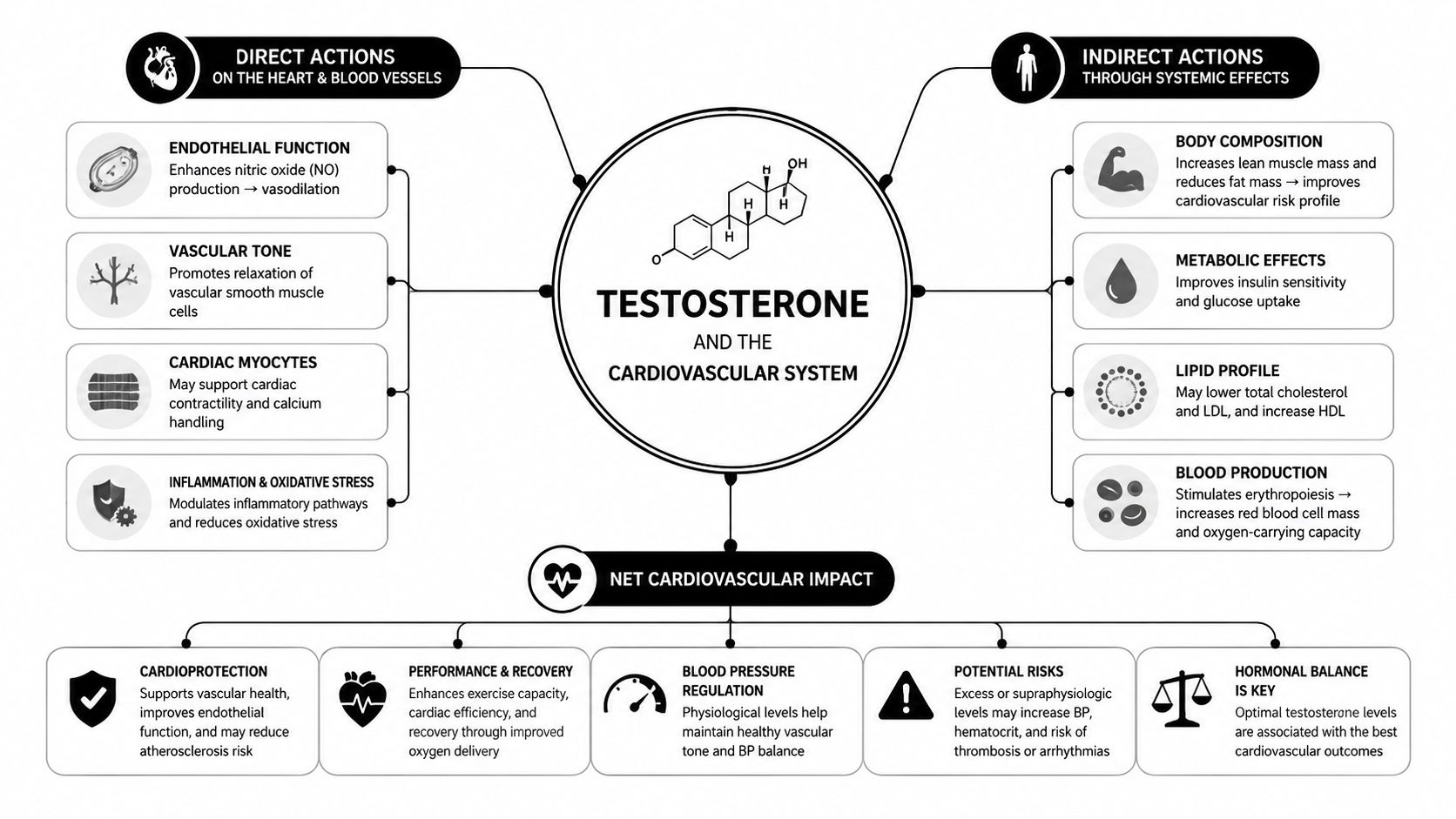
The clinical implication of each pathway
A useful reading habit is to match each mechanism to a bedside question.
Blood vessel biology asks whether the patient's blood pressure and endothelial function are stable.
Metabolic biology asks whether the low testosterone is part of a broader insulin-resistant state.
Hematologic biology asks whether TRT is pushing red cell mass too far.
That framework prevents a common mistake, treating all testosterone signals as though they point in the same direction. They don't. The hormone can be one piece of vascular biology, one piece of metabolic health, and one piece of treatment risk, depending on the patient and the context.
Low Testosterone as a Marker of Heart Risk
Low endogenous testosterone is often a marker of worse cardiometabolic health, and the literature is more consistent on that point than on any simple causal claim. In a prospective study of elderly men summarized in a 2021 review, those in the lowest quartile of total testosterone had a 40% higher 20-year mortality risk than men with higher testosterone, with a hazard ratio of 1.40 and a 95% CI of 1.14 to 1.71 (2021 review of cohort data). That is a substantial signal, but it is a mortality signal, not proof that raising testosterone fixes the underlying problem.
Mortality risk is not the same as a heart attack mechanism
This distinction gets lost constantly in public discussion. Cohort-level literature has found associations between low baseline testosterone and higher all-cause mortality, and pooled data also reported higher mortality below 7.4 nmol/L, or 213 ng/dL, and higher cardiovascular mortality below 5.3 nmol/L, or 153 ng/dL (2021 review of cohort data). At the same time, the same literature has also found no association in some analyses between baseline testosterone and incident cardiovascular events or cardiovascular death, which tells you the signal is not uniform.
That inconsistency is the clue. Low testosterone may be tracking body composition, chronic disease burden, inflammation, inactivity, or sleep disruption more than it is independently causing plaque rupture or stroke. In other words, the hormone can be a useful biomarker without being the entire mechanism.
A striking example comes from the Tsimane population. In physically active men with very low obesity and clinical heart disease, higher testosterone was positively associated with coronary artery calcium, while in sedentary urban men low testosterone tracked with coronary heart disease (AHA review on bidirectionality). That contrast makes one point very clearly, the testosterone-heart disease relationship depends on context, including body composition and lifestyle.
So the safest interpretation is not that low testosterone is “good” or “bad” in isolation. It is often a signal that something upstream is wrong. That is the part clinicians should act on, because treating the lab value without understanding the metabolic setting can easily miss the cardiovascular problem.
Reading the TRT Safety Studies in Order
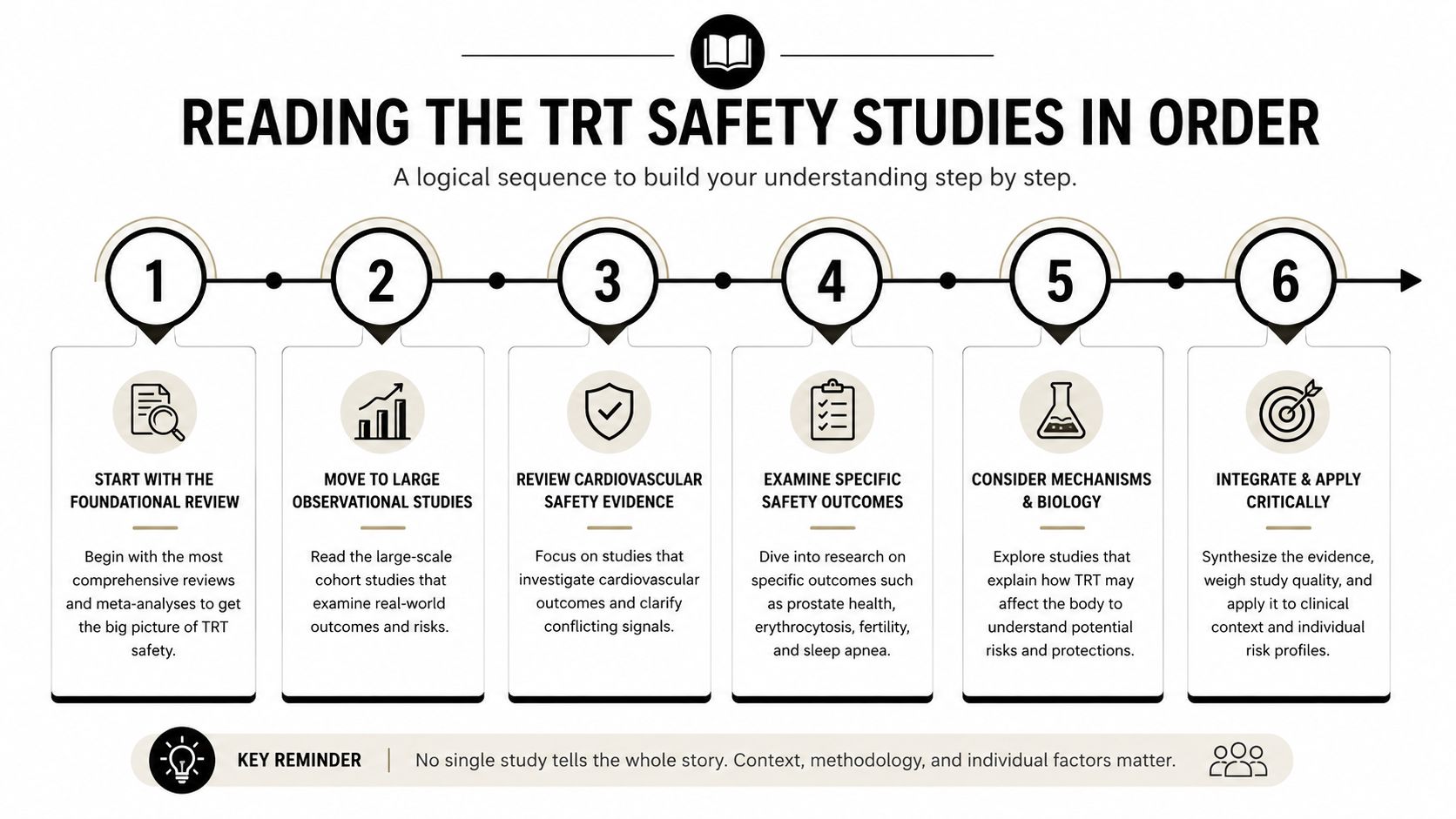
The TRT safety story makes more sense when you read it chronologically. The early concern came from observational signals and small trials in older, frailer men, which could suggest harm but could not reliably separate testosterone from comorbidity, frailty, or selection bias. Later, a 2024 meta-analysis of 30 randomized controlled trials found no statistically significant difference between TRT and placebo for any CVD events, myocardial infarction, stroke, all-cause mortality, or CVD mortality (2024 meta-analysis).
Why older signals looked so confusing
Older meta-analyses disagreed because they mixed formulations, doses, baseline risks, and follow-up periods. That matters. An injectable regimen, a transdermal regimen, a frail older cohort, and a younger symptomatic hypogonadal cohort are not interchangeable populations, even when the word “testosterone” is the same.
The clinical point is that pooled evidence can only be as clean as the trials inside it. If some studies are underpowered, short, or focused on non-cardiac outcomes, the safety signal becomes noisy. That is why the 2024 synthesis is useful, but still not the final word for every patient type.
Why TRAVERSE sits at the center of the timeline
TRAVERSE is different because it was built to address cardiovascular safety directly in a large randomized design, and it did so in men with baseline cardiovascular risk that makes the results clinically relevant (NEJM TRAVERSE trial). Put plainly, it answered the question older studies could only hint at.
The best way to read the timeline is this. Observational data suggested low testosterone often clusters with worse health. Small and mixed trials created concern about TRT safety. The 2024 meta-analysis and TRAVERSE then moved the field toward a more stable position, no excess MI or stroke signal in the randomized evidence base overall, while still leaving room for formulation-specific and patient-specific caution (2024 meta-analysis, NEJM TRAVERSE trial).
If you need a practical secondary reference while sorting through claims, the clinical workflow and transfer process described at Cost Plus TRT is a useful example of how a TRT program can structure evaluation before treatment rather than after problems appear.
What Current Guidelines Actually Recommend
Guideline-concordant TRT is narrower than many cash-clinic ads suggest. The central requirement is confirmed hypogonadism, not just a low-normal value, and treatment belongs in men who have symptoms plus biochemical evidence. The caution increases if a man has recent cardiovascular instability, because the evidence base is strongest in more stable patients and less reassuring in the immediate aftermath of an event.
What a serious pre-treatment workup looks like
A careful clinic should document more than the testosterone result itself. It should confirm low total and free testosterone on two morning draws, then check hematocrit, lipid profile, blood pressure, glycemic status, and a cardiovascular history that includes prior MI, stroke, DVT, and sleep apnea.
That checklist matters because the risk is not only whether testosterone is low, it is whether the whole patient profile makes TRT reasonable. A man with severe untreated sleep apnea and rising hematocrit is not the same candidate as a man with stable symptoms, documented deficiency, and controlled cardiovascular risk.
The same principle applies to shared decision-making. A clinician should explain what TRT can plausibly improve, what it cannot promise, and where the evidence is still incomplete. Men who are offered treatment without this discussion are not being managed to guideline standards.
Where counseling should be direct
If a clinic does not ask about prior vascular events, clotting history, sleep apnea, and serial lab monitoring, it is skipping the parts of care that keep TRT from becoming guesswork.
The practical difference between good care and weak care is often the paper trail. Good care shows symptom documentation, lab confirmation, and follow-up planning. Weak care starts with a prescription and hopes the rest sorts itself out.
The endocrine and urologic consensus is not that TRT is risk-free. It is that properly diagnosed men can be treated, but only with the kind of screening and follow-up that makes the cardiovascular conversation real rather than rhetorical. For common patient questions about treatment logistics and transfer pathways, the clinic's TRT FAQ gives an example of how those discussions can be organized before therapy begins.
Reducing Cardiovascular Risk While on TRT
The safest TRT plan is not “take testosterone and hope.” It is a monitored treatment strategy that keeps levels therapeutic, watches for hematologic drift, and treats the metabolic conditions that usually coexist with low testosterone in the first place. The goal is to avoid supraphysiologic dosing, because that is where a lot of casual TRT practice becomes unnecessarily risky.
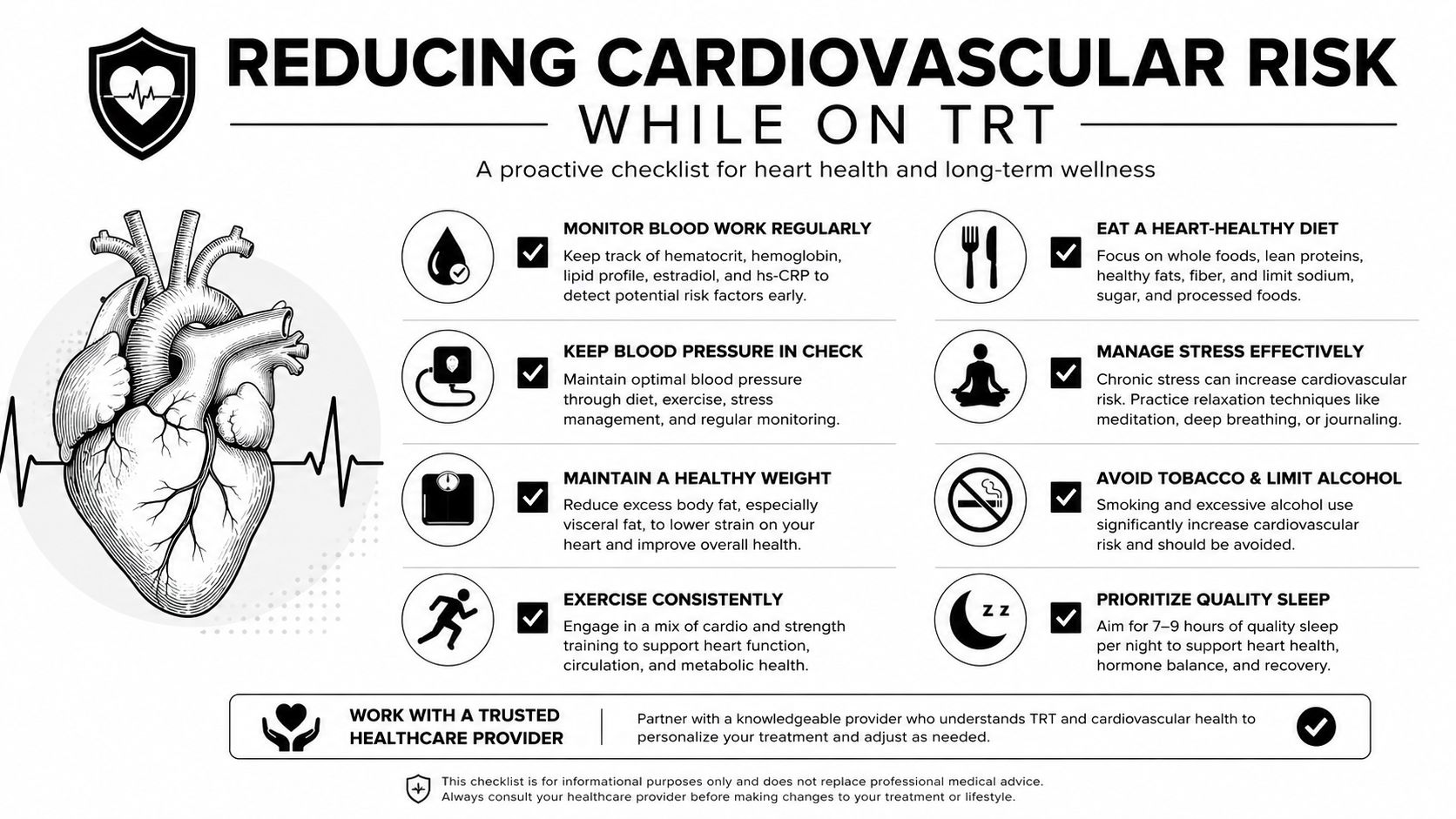
What to monitor and why
Hematocrit deserves the closest attention, because a TRT-related rise in red cell mass is one of the clearest actionable safety issues. If it is climbing, the response is not denial, it is dose adjustment, schedule changes, or other management based on the treating clinician's protocol.
Sleep apnea also matters because untreated obstructive sleep apnea can compound the same polycythemia concern. If a patient snores loudly, wakes unrefreshed, or already has a diagnosis, it should stay on the risk checklist rather than being treated as a separate problem.
The metabolic piece should be addressed in parallel, not as an afterthought. Resistance training, weight management, blood pressure control, and lipid management do more than “support testosterone,” they target the upstream cardiometabolic environment that often drives low testosterone in the first place.
What a risk-stratified plan looks like in practice
- Keep dosing conservative: aim for therapeutic replacement, not performance-level exposure.
- Track blood counts on schedule: repeat hematocrit at regular follow-up, then act if it rises.
- Review cardiovascular history every visit: prior MI, stroke, DVT, or worsening symptoms should change the plan.
- Treat sleep disorders seriously: untreated apnea can magnify risk and muddy the lab picture.
- Use lifestyle therapy as part of TRT, not beside it: lifting, weight control, and blood pressure work improve the underlying terrain.
A casual protocol often misses one of those steps. A careful protocol uses all of them, because cardiovascular risk is not determined by testosterone alone. It reflects the interaction between hormone replacement, baseline health, and how closely the prescriber follows the patient after treatment starts.
One practical option for men who want structured telemedicine with transparent pricing is Cost Plus TRT, which provides testosterone replacement therapy with online physician oversight and home delivery. That model still needs the same medical screening and follow-up, but it shows what a more organized care pathway can look like compared with a loose, ad hoc prescription.
Who Is a Good Candidate and What Remains Unknown
The reasonable candidate is the man with confirmed symptomatic hypogonadism and cardiovascular risk that is stable, understood, and monitored. The poor candidate is the man with a recent MI or stroke, uncontrolled polycythemia, untreated severe sleep apnea, or a hormone-driven cancer history. Those distinctions are where the evidence matters most, because the trial data are reassuring in selected men, not universal permission for everyone.

What still deserves caution
Three questions remain open. First, follow-up beyond the 22-month TRAVERSE window is still limited for a therapy many men may use longer than that. Second, the cardiovascular profile of transdermal versus injectable testosterone still needs cleaner comparative data. Third, men with borderline low levels but without classical hypogonadism remain a gray zone, because the benefit-risk balance is much less certain there.
The right conclusion is not that TRT is harmless. It is that the strongest modern randomized evidence does not show excess major cardiovascular harm in appropriately selected men, while the observational literature still reminds us that low testosterone often reflects broader cardiometabolic risk rather than acting as a stand-alone disease driver (NEJM TRAVERSE trial, 2024 meta-analysis, 2021 cohort review). That is the balance a prescriber should hold.
For men weighing treatment, the most useful question is not “Is testosterone good or bad for the heart?” It is “Is this man a properly diagnosed candidate, and can we monitor the variables that change risk?” That framing is more honest, and it matches the literature better than blanket approval or blanket fear.
If you're deciding whether TRT is appropriate for you, start with a clinician who documents symptoms, confirms labs correctly, and tracks cardiovascular risk as part of the plan. Cost Plus TRT offers telemedicine-based TRT with transparent pricing and ongoing physician oversight, which can be a practical route for men who want structured care instead of guesswork.