
Are you sure low testosterone is the reason tadalafil isn't working, or are you treating two different problems as if they were one? That question matters more than whether testosterone and Cialis can be taken together. Testosterone replacement therapy and tadalafil act on different parts of sexual function, so combining them can make sense for a specific subgroup, but adding testosterone isn't automatically an upgrade for every man with erectile dysfunction.
A man in his 40s or 50s may notice softer erections, less frequent morning erections, lower energy, or reduced sexual interest. He may have already received generic tadalafil through telehealth and experienced inconsistent results. Those symptoms can point toward hypogonadism, but they can also reflect vascular disease, diabetes, obesity, medication effects, sleep problems, relationship stress, performance anxiety, or several causes at once.
The safest framework is diagnostic. First, establish whether testosterone deficiency is present and clinically relevant. Then assess how tadalafil was used, whether it helped at all, and whether another factor is limiting the response. From there, the appropriate path might be tadalafil alone, testosterone therapy for confirmed hypogonadism, or combination treatment under medical supervision. Men looking for treatment options can review prescription ED medications and tadalafil options, but medication selection should follow evaluation rather than replace it.
Table of Contents
- Why Men Ask About Testosterone and Cialis Together
- How Testosterone and Tadalafil Actually Work
- What the Clinical Evidence on Combination Therapy Shows
- Choosing the Right Path for Your Situation
- Prescribing, Dosing, and Safety Monitoring in Practice
- How a Telemedicine TRT Clinic Handles This End to End
- Common Misconceptions and Smart Next Steps
Why Men Ask About Testosterone and Cialis Together
Men usually ask about this combination after a treatment has produced a partial result. Tadalafil may improve firmness but not desire. It may work on some occasions and fail on others. A man may also feel tired, lose morning erections, or notice changes in mood and body composition, then reasonably wonder whether hormones are the missing piece.
That reasoning is understandable, but an erection depends on several systems working together. Blood vessels must expand, nerves must transmit signals, penile smooth muscle must relax, sexual interest must be present, and the brain must allow arousal to continue. Anxiety, relationship tension, poor sleep, metabolic illness, and cardiovascular risk can interfere even when a prescription is technically appropriate.
Two treatments, different targets
Tadalafil, the active ingredient in Cialis, primarily supports the blood-flow side of an erection. It doesn't create desire or correct testosterone deficiency. It helps the erection pathway respond more effectively to sexual stimulation.
Testosterone therapy addresses documented androgen deficiency. Testosterone can influence libido and the biological environment needed for erectile response, but it isn't an instant erection medicine. A man with normal testosterone and isolated vascular ED may gain little from adding it.
The central mistake is treating “not enough erection” as proof of “not enough testosterone.” Testosterone deficiency is a substantial men's-health issue, but measured prevalence varies considerably because studies use different populations, laboratory thresholds, and definitions. A 2021 review of testosterone deficiency and its prevalence reported estimates ranging from 10% to 40% globally, with rates rising sharply after age 45 to 50. A separate guideline review found estimates ranging from 2% to 77%, illustrating why one low laboratory value isn't enough to establish the diagnosis.
Practical rule: Don't decide on combination therapy from symptoms alone. Match symptoms with properly collected laboratory results and a clear history of PDE5-inhibitor response.
The question, then, isn't “Is the stack stronger?” It's “Is low testosterone the bottleneck?” That distinction determines whether adding TRT is rational, unnecessary, or potentially distracting from a more important cause.
How Testosterone and Tadalafil Actually Work
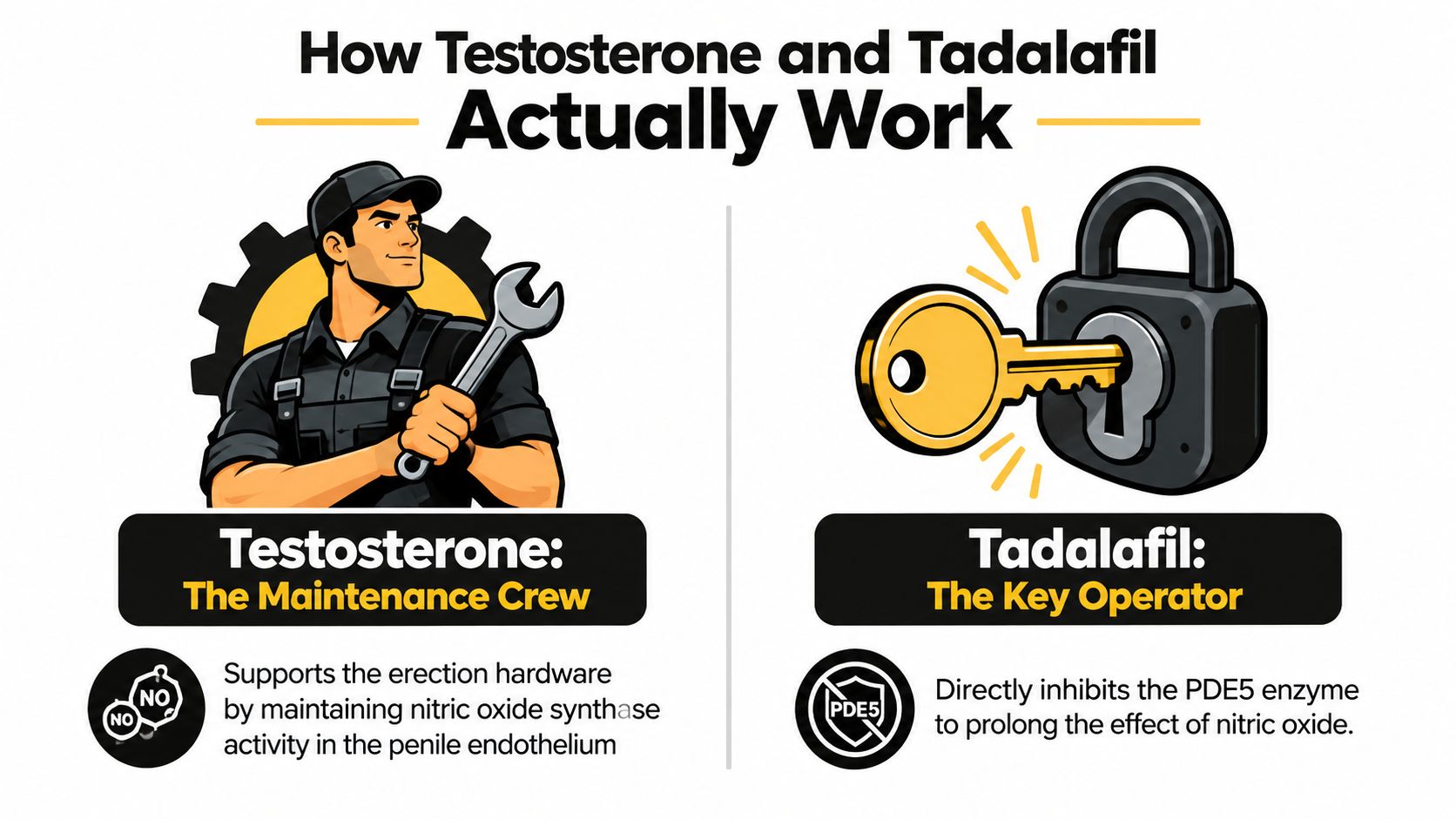
Could low testosterone be the bottleneck, rather than a lack of medication? The answer depends on which part of the erection process is failing. Testosterone supports sexual desire, arousal signaling, smooth-muscle responsiveness, and nitric oxide activity in penile tissue. When androgen levels are clearly low, the physical structures may be intact while the response to sexual stimulation is weaker or less reliable.
Testosterone production follows the hypothalamic-pituitary-gonadal axis, or HPG axis. The hypothalamus signals the pituitary, the pituitary signals the testes, and Leydig cells in the testes produce testosterone. External testosterone changes that feedback loop. The brain senses the added hormone and reduces upstream signals, which can suppress natural testosterone and sperm production. Fertility should therefore be discussed before TRT. Men seeking treatment information can review TRT options and clinical support.
Tadalafil acts later in the process. Sexual stimulation prompts nerves to release nitric oxide, which helps create cyclic guanosine monophosphate, or cGMP. That chemical relaxes penile smooth muscle and allows blood to enter. PDE5 breaks cGMP down. Tadalafil inhibits PDE5, so cGMP remains active longer and the smooth muscle can stay relaxed.
Why the mechanisms can complement each other
A useful comparison is a car with two separate problems. Testosterone can help restore the driver's interest and the system's readiness. Tadalafil helps keep the blood-flow signal active after sexual stimulation begins. If low testosterone is reducing libido or limiting responsiveness, correcting it may make tadalafil more useful. If testosterone is normal, extra testosterone may not address vascular disease, nerve problems, medication effects, or psychological factors.
Tadalafil is often chosen for flexibility because its action lasts longer than that of some other PDE5 inhibitors. Its half-life is roughly 17.5 hours, with an efficacy window of roughly 36 hours, as described in the regulatory history and clinical development summary for Cialis describing tadalafil's duration and approval timeline. This does not mean a continuous erection. Sexual stimulation is still required, and the medicine supports the response during that period.
The medicines address different stages of the same process. Combining them makes physiological sense when both low androgen activity and impaired erectile signaling need treatment. It is unnecessary when low testosterone is not present or is not the factor limiting erectile function.
What the Clinical Evidence on Combination Therapy Shows
Does adding testosterone make Cialis work better for every man with erectile dysfunction? The evidence points to a narrower question. The issue is whether low testosterone is the bottleneck. If it is not, stacking treatments may add monitoring and risk without addressing the cause.
Tadalafil has a well-established role as a standalone ED treatment. Cialis received U.S. FDA approval on November 21, 2003, after sildenafil. The FDA later approved 2.5 mg and 5 mg once-daily tadalafil in January 2008, giving tadalafil the first daily-dose indication for ED among PDE5 inhibitors in the United States. Clinical development data reported successful intercourse attempts in about 75% of men taking 20 mg tadalafil, compared with roughly 32% taking placebo, as summarized in the Cialis regulatory and development record.
Those results support tadalafil by itself. They do not show that testosterone belongs in every ED prescription.
Testosterone alone has a narrower role
TRT can improve sexual symptoms in men with genuine hypogonadism, particularly when reduced libido and erectile problems occur alongside consistently low testosterone. The response is less predictable when testosterone is normal or only mildly borderline. TRT also works gradually, rather than like an on-demand ED tablet.
The clearest combination signal appears in men with documented low testosterone who respond inadequately to a PDE5 inhibitor. In a controlled study of transdermal testosterone plus tadalafil, adding testosterone improved erectile function after tadalafil alone had failed. A review of 14 combination studies found the benefit signal was strongest in men with testosterone below about 300 ng/dL, or approximately 10.4 nmol/L, as reported in the review of testosterone and PDE5-inhibitor combination therapy.
The clinical logic is straightforward. Low androgen activity may reduce responsiveness to the PDE5 pathway. Testosterone may restore that responsiveness, rather than provide a second independent erection treatment. That distinction helps identify who may qualify for combination therapy.
What the evidence doesn't prove
A study of tadalafil 5 mg once daily for three months in some men with metabolic syndrome reported mean testosterone rising from 3.6 ± 0.5 to 5.2 ± 0.3 and IIEF scores improving from 11.3 ± 1.9 to 19 ± 0.8. The findings, reported in the tadalafil study indexed by PubMed, do not establish that tadalafil should replace TRT in men with hypogonadism. They also do not prove that every man with metabolic symptoms needs hormonal treatment.
A separate integrated analysis found that low baseline total testosterone did not meaningfully reduce tadalafil 5 mg efficacy compared with placebo in men with LUTS/BPH and ED. Tadalafil therefore remains useful for many men regardless of gonadal status. The possible add-on benefit of testosterone is concentrated in a narrower group, particularly men with substantial deficiency and persistent ED after an adequate PDE5 trial.
| Treatment | Best Candidate | Onset | Evidence Strength |
|---|---|---|---|
| Tadalafil alone | Men with ED who can use a PDE5 inhibitor safely | Relatively prompt, with a long efficacy window | Strong for many men with ED |
| TRT alone | Men with symptoms and confirmed hypogonadism, especially when libido is reduced | Gradual, not an on-demand effect | Strongest for documented deficiency and sexual symptoms |
| TRT plus tadalafil | Hypogonadal men whose ED persists despite PDE5-inhibitor treatment | Tadalafil supports near-term response while TRT addresses the androgen deficit over time | Most supportive in PDE5 nonresponders with low testosterone |
Long-term cardiovascular outcomes, prostate safety beyond the studied follow-up periods, and benefits in men with normal testosterone remain areas for clinical judgment. The evidence supports selecting the combination for the right bottleneck, not routinely stacking two drugs.
Choosing the Right Path for Your Situation
Start with the bottleneck. A man with confirmed hypogonadism, reduced sexual symptoms, and poor response to tadalafil has a different problem from a man with normal testosterone and anxiety during intercourse. Both may describe “Cialis not working,” but the next clinical move shouldn't be the same.
Testosterone deficiency requires symptoms plus laboratory evidence. The measured value matters, but so do the timing of the blood draw, repeat testing, relevant medications, obesity, sleep, illness, and whether the symptoms fit the result. A single borderline result should prompt clarification rather than an automatic prescription.
Four common decision branches
| Patient Profile | First-Line Option | Add or Switch When... | Combination Justified? |
|---|---|---|---|
| Confirmed hypogonadism with persistent ED after tadalafil | Evaluate and treat the testosterone deficiency while reviewing tadalafil use | Response remains incomplete after the PDE5 trial and other causes are assessed | Often reasonable under supervision |
| Borderline testosterone with mixed symptoms | Repeat appropriate testing and investigate sleep, weight, medications, and metabolic health | Results remain low and symptoms persist after reversible factors are addressed | Possible, but not automatic |
| Normal testosterone with poor tadalafil response | Review dose, timing, arousal, medical conditions, and cardiovascular risk | Another cause is identified or tadalafil is unsuitable | Usually not justified solely for ED |
| Mild or situational psychogenic ED | Address anxiety, communication, and sexual context while reviewing medication use | Symptoms persist across settings or physical signs emerge | Usually not the first move |
European guidance is direct on one important point: testosterone therapy shouldn't be used in eugonadal men, and it should be first-line treatment for mild ED only when hypogonadism is present. The same guidance supports considering testosterone in hypogonadal men who don't respond to PDE5 inhibitors, while recent sexual-medicine consensus guidance says TRT shouldn't be ED monotherapy except in men with clearly documented hypogonadism. These recommendations appear in the 2025 European Association of Urology guideline.
Other factors change the decision. Diabetes, obesity, cardiovascular disease, pelvic surgery, neurological disease, sleep disorders, and relationship stress can all affect erectile response. A partner's expectations and the circumstances in which erections fail can also distinguish a medication problem from an arousal or anxiety problem.
Before discussing a combination, ask yourself two practical questions: Do I have recent morning testosterone results, ideally interpreted with symptoms? And can I describe clearly whether tadalafil helped, failed completely, or worked inconsistently? If you can't answer either, testing and history are the next steps.
Prescribing, Dosing, and Safety Monitoring in Practice
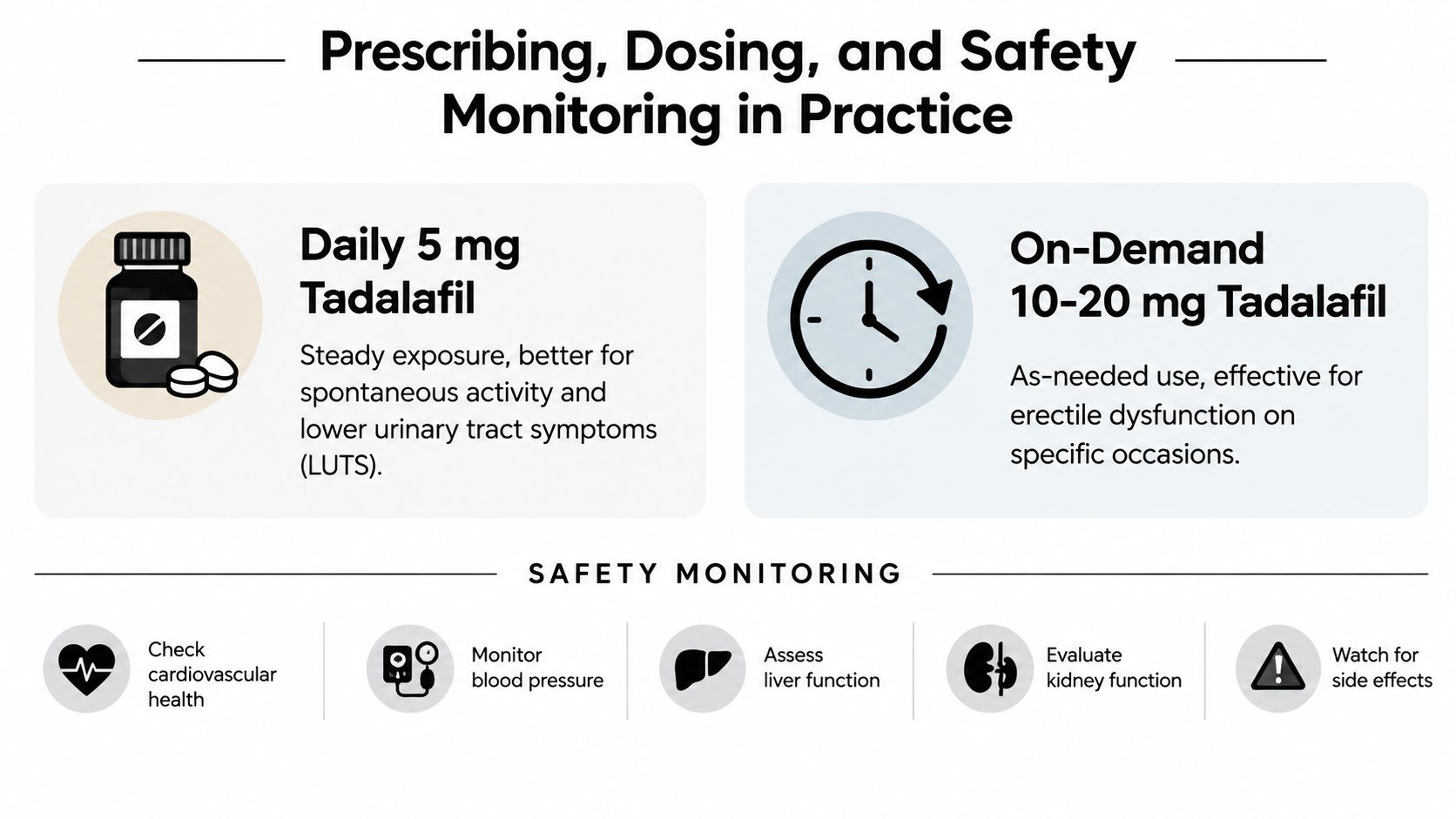
Could the treatment plan fit the man's sexual pattern while addressing the condition limiting erections? Tadalafil should be chosen around frequency, predictability, medical history, and other medicines. 5 mg daily may suit men who want spontaneity or who also have lower urinary tract symptoms. 10 mg or 20 mg on demand may fit less predictable sexual activity. Kidney and liver function, side effects, and clinician guidance determine which regimen is appropriate.
Tadalafil can remain effective for roughly 36 hours, although sexual stimulation is still required. A longer window does not mean continuous erections. Taking more than prescribed will not correct absent arousal, severe vascular disease, incorrect use, or a psychological barrier.
TRT requires a separate safety plan
TRT may be given through injections, transdermal gels, or subcutaneous pellets. Each route changes hormone fluctuations, convenience, skin-transfer precautions, injection technique, and dose adjustments. The clinical goal is symptom improvement with testosterone in an appropriate range, not the highest possible result.
Monitoring begins with baseline assessment and continues through follow-up laboratory review. Depending on the patient, clinicians may check total and free testosterone, SHBG, CBC with hematocrit, PSA, estradiol, lipids, liver markers, and other relevant tests. The schedule depends on the product, individual risks, and local clinical practice.
Hematocrit needs close attention. Recent guidance recommends checking response at 3 months, 6 months, 12 months, and then yearly, with dose reduction or interruption if hematocrit rises above 0.54, as detailed in the recent review of testosterone treatment and monitoring. Other interventions may be appropriate in particular clinical situations.
Interaction checks come first
Tadalafil must not be combined with nitrates because the combination can cause a dangerous fall in blood pressure. Alpha-blockers may also increase hypotension risk, and tadalafil should not be used with riociguat. Before prescribing, a clinician should review every prescription, recreational drug, supplement, and cardiovascular diagnosis.
TRT adds a separate concern: treatment-related erythrocytosis may matter more in men with cardiovascular or clotting risks. Headache, dizziness, chest pain, fainting, prolonged erection, or sudden vision or hearing changes require urgent medical attention. Self-adjusting the dose is not a safe response.
Safety checkpoint: If treatment is not working, do not take a larger dose or add another drug without clinical review. Confirm correct use, contraindications, the diagnosis, and the reason for nonresponse first.
How a Telemedicine TRT Clinic Handles This End to End
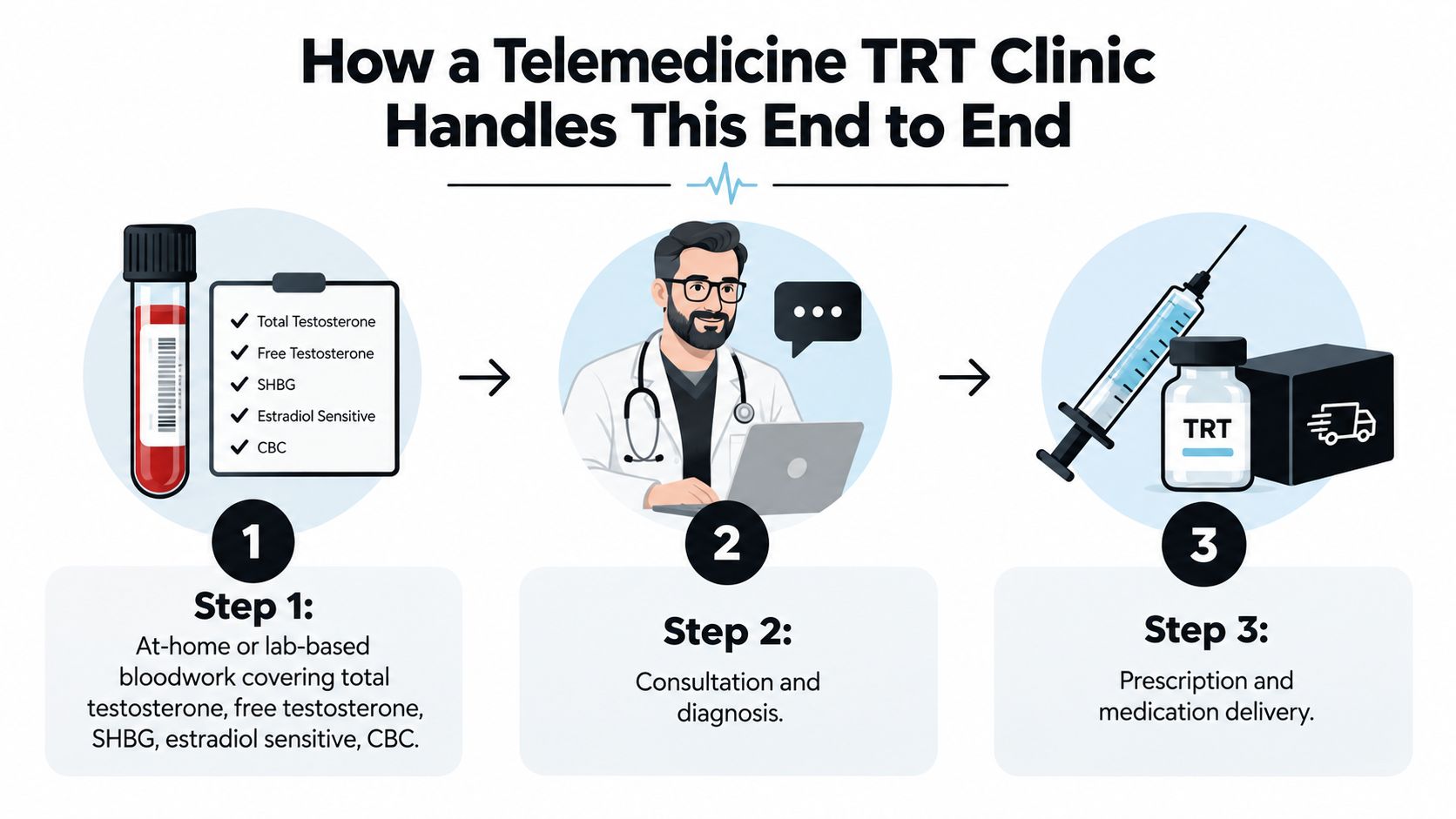
Could a telemedicine visit tell you whether testosterone is the missing piece, rather than adding another medication? A responsible pathway starts with that question. The patient completes at-home or laboratory bloodwork, and the clinician interprets the results alongside symptoms. Testing may include total and free testosterone, SHBG, sensitive estradiol, CBC with hematocrit, PSA, CMP, lipids, and, when indicated, thyroid testing.
A lab panel is evidence, not a diagnosis. The clinician must decide whether the symptoms match the results, whether illness or testing conditions affected the measurement, and whether another problem better explains the complaint. The review should also cover fertility goals, prostate history, sleep, medications, cardiovascular symptoms, and previous ED treatment.
The consultation turns results into a plan
A useful video consultation goes beyond asking, “Do you have ED?” The clinician may ask whether erections fail during masturbation, whether morning erections continue, how sexual desire has changed, whether tadalafil was taken correctly, and whether it helped at all. A partial response suggests that the erectile pathway is functioning but limited. Complete nonresponse points toward a wider assessment rather than an automatic dose increase.
If hypogonadism is confirmed, the clinician explains the TRT route and monitoring requirements. If ED remains a separate concern, tadalafil may be prescribed daily or as needed. The two treatments have different jobs. TRT addresses androgen deficiency, while tadalafil supports the erectile-response pathway. The combination makes sense only when low testosterone is a confirmed bottleneck and the patient has a separate reason to use tadalafil.
Follow-up determines whether remote care remains safe and useful. The clinic should review symptoms, side effects, adherence, blood-pressure concerns, laboratory results, and dose changes. The supplied workflow describes repeat labs around six weeks, followed by closer follow-up until treatment is stable. Current guidance also supports response assessment at 3, 6 to 12 months, and yearly, with timing adapted to the patient rather than applied as a fixed rule.
Cost Plus TRT provides online clinician consultations, laboratory coordination or result uploads, testosterone cypionate through its TRT program, and ED medications including tadalafil and sildenafil. Its telemedicine model illustrates how testing, prescribing, delivery, and follow-up can be coordinated. It does not replace in-person cardiology or urology care when red flags or complex examination needs are present. Men reviewing its process can see Cost Plus TRT's telemedicine TRT process.
Telemedicine can make repeated follow-up easier for patients who have difficulty attending clinic visits. Chest pain, suspected serious cardiovascular disease, abnormal prostate findings, priapism, or complex examination needs require in-person evaluation.
Common Misconceptions and Smart Next Steps
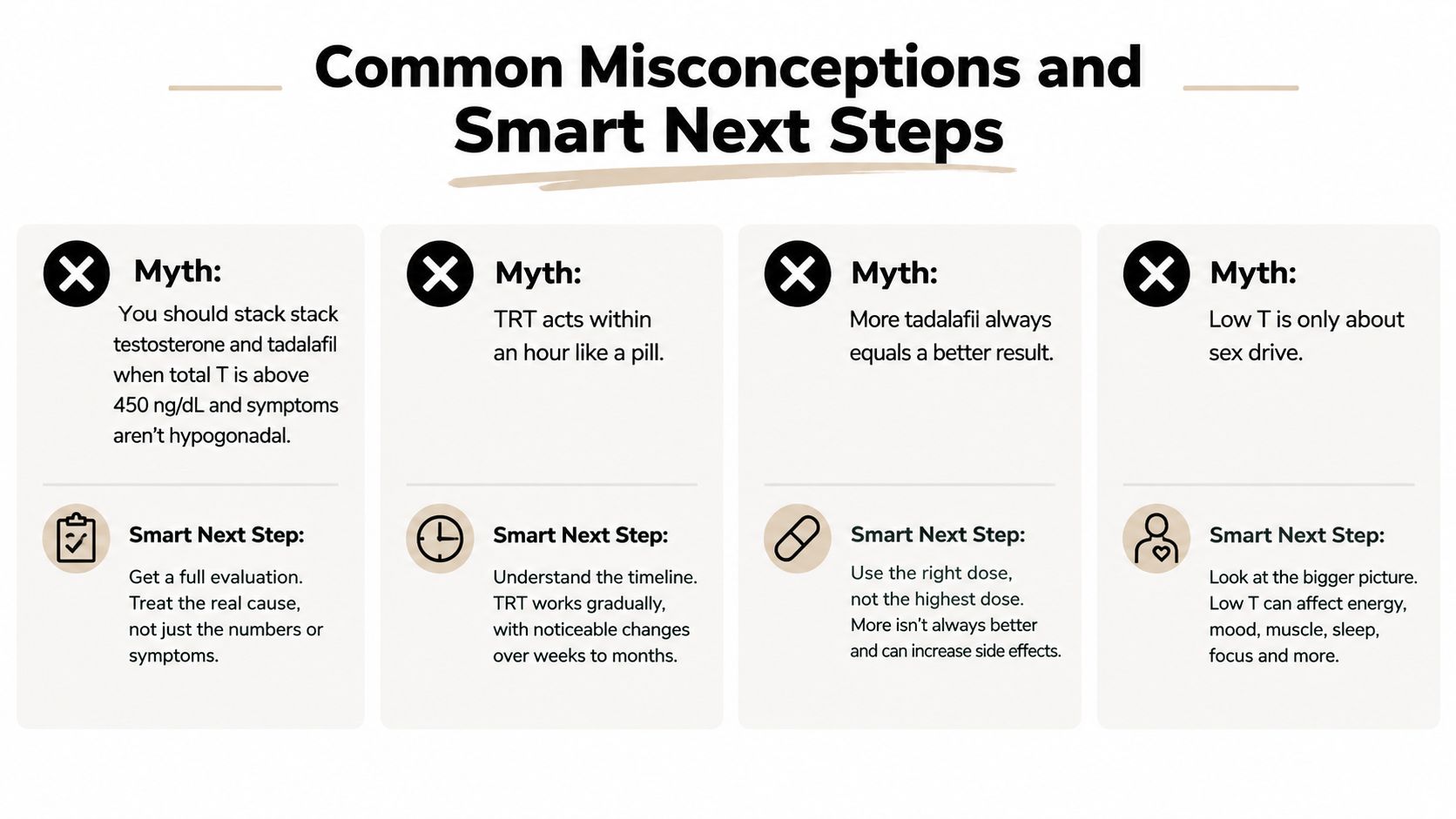
Myth one: “If tadalafil is inconsistent, testosterone must be the answer.” Testosterone is relevant when symptoms accompany confirmed deficiency. A man with normal testosterone may have endothelial dysfunction, medication-related ED, anxiety, diabetes, sleep apnea, or another cause that TRT won't correct.
Myth two: “TRT should work within an hour.” Tadalafil can support an erection during a relatively near-term window. TRT works by changing an underlying hormonal state, so its clinical effect should be assessed over time, not judged like an on-demand tablet.
Myth three: “More tadalafil fixes nonresponse.” Higher exposure can increase adverse effects without addressing incorrect timing, insufficient stimulation, vascular disease, nerve injury, or performance anxiety. Never escalate or combine ED medicines without a prescriber's direction.
Myth four: “More testosterone is better.” The goal is symptom improvement with safe monitoring, not an arbitrarily high laboratory value. TRT also suppresses endogenous production and can affect fertility, a concern explained in this guide to TRT and fertility.
A practical checklist
- Confirm the diagnosis: Discuss symptoms and appropriate morning testosterone testing with a clinician. Don't label yourself hypogonadal from fatigue alone.
- Review tadalafil use: Record the prescribed dose, timing, sexual stimulation, food or alcohol context, and whether the result was partial or absent.
- Check safety first: Review nitrates, riociguat, alpha-blockers, cardiovascular symptoms, blood pressure, and other medicines before changing treatment.
- Set a review point: If TRT is prescribed, agree on when symptoms and laboratory markers will be reassessed. Don't judge the treatment by a single day.
- Choose in-person care when needed: Seek evaluation for chest pain, exertional symptoms, fainting, priapism history, concerning prostate findings, or abnormal PSA.
The right question isn't whether testosterone and Cialis sound like a powerful combination. It's whether your testing and treatment history show that low testosterone is limiting the response to tadalafil. If that bottleneck isn't present, adding TRT may add monitoring and risk without solving the problem.
Cost Plus TRT provides clinician-supervised TRT evaluations, laboratory coordination, follow-up care, and tadalafil options for eligible patients whose symptoms suggest a connected hormone and erectile-function concern. Visit Cost Plus TRT to complete the questionnaire and arrange a consultation so your treatment plan starts with appropriate testing rather than guesswork.