
You're probably here because you saw chewable ED medication online and had the same reaction many men do. Interest first, then suspicion. Is this just Cialis in a different shape? Is it faster? Is it safe, or is it one of those internet health products that sounds modern but gets sloppy once you look closely?
Those are the right questions.
Chewable tadalafil isn't automatically better than a standard tablet, and it isn't automatically worse. It's a drug delivery format with real formulation differences, real regulatory nuances, and real trade-offs that matter more than the marketing language. For some men, it's a practical option because it's easy to take, doesn't require water, and fits telemedicine well. For others, a conventional tablet is simpler and more predictable because it comes through the standard retail prescription pathway.
The key is to separate three issues that often get blurred together online: how tadalafil works, how a chewable is made, and how to get it safely. If you understand those three, you can make a smart decision and avoid most of the common mistakes.
Table of Contents
- Introduction to Chewable Tadalafil
- How Tadalafil Chewables Work in Your Body
- Dosing Onset and Duration
- Chewables vs Tablets Which Tadalafil Is Right for You
- Safety Profile Side Effects and Drug Interactions
- How to Get Tadalafil Chewables Safely Through Telemedicine
- Frequently Asked Questions by Patients
- Can I cut a chewable tadalafil tablet in half
- Does chewable mean it works instantly
- Do I need water or an empty stomach
- Is the long duration caused by the chewable format
- Are chewables always FDA-approved
- What do they usually taste like
- Is chewable tadalafil better for men who hate pills
- Is insurance likely to cover it
Introduction to Chewable Tadalafil
A common telemedicine scenario looks like this. A man has used standard tadalafil before, sees a chewable option online, and wants to know whether it is the same drug in a different form or a different product with looser standards. That is the right question to ask first.
Tadalafil chewables are tablets made to be chewed before swallowing instead of taken whole with water. The active ingredient is still tadalafil, a medication with a long clinical track record in other approved forms. What feels new is usually the formulation and dispensing pathway, not the molecule itself.
For patients, that difference matters more than the marketing language. Many chewable tadalafil products in the United States are compounded, which means a pharmacy prepares the medication in a customized dosage form rather than dispensing a standard mass-manufactured retail tablet. Compounding can be appropriate. It also means quality depends on the prescribing process, the pharmacy's standards, and whether the formulation is made consistently from batch to batch.
That is why I tell patients not to judge a chewable only by convenience claims or flavor options. The useful questions are more concrete.
- Is this a standard FDA-approved manufactured product, or a compounded chewable?
- Was the prescription written after a real medication review and health history?
- Is the pharmacy identified, licensed, and willing to tell you what strength and formulation you are receiving?
- If someone says it is “bioequivalent,” do they explain what evidence supports that claim?
“Bioequivalent” has a specific meaning in drug regulation. It does not mean two products merely contain the same active ingredient. For a patient, it means the body is exposed to the drug in a closely comparable way. That point becomes important with chewables, because a different formulation can change how a dose breaks apart, dissolves, and is absorbed. Some products are designed carefully. Others are little more than a customized dosage form built around tadalafil powder and excipients.
Patients also tend to overestimate how different the experience will be. A chewable does not turn tadalafil into an instant-on medication, and it does not bypass the need for proper absorption. In many cases, the main advantages are easier administration, no need for water, and a formulation some men find more acceptable than swallowing a standard tablet.
What patients usually get wrong
The first mistake is assuming all chewables are interchangeable. They are not. With compounded products, variation in taste, texture, hardness, and dose uniformity can affect whether the medication is easy to take and whether the experience feels consistent from refill to refill.
The second mistake is assuming “chewable” means “faster” in every case. Sometimes a formulation is built to improve disintegration. Sometimes it offers a different way to take the same medication. Those are not the same thing.
The third mistake is treating telemedicine prescribing as proof of product quality. A legitimate telemedicine process can make access easier. It does not replace the need to confirm who prescribed the medication, which pharmacy filled it, and whether the product is compounded or commercially manufactured.
What matters when choosing one
The practical decision points are straightforward:
- Administration fit: Chewables can make sense for men who dislike swallowing pills or want a water-free option.
- Formulation transparency: You should know whether the product is compounded and what pharmacy is making it.
- Evidence standard: If a company implies the chewable performs the same as a conventional tablet, ask what that statement is based on.
- Medication review: Tadalafil still needs the same screening for nitrates, alpha-blockers, blood pressure effects, and other relevant medications.
- Consistency: A product that is pleasant to chew but inconsistently dosed is a poor trade.
For the right patient, chewable tadalafil can be a reasonable option. The safe choice depends less on novelty and more on understanding what you are being prescribed, how it is made, and whether the clinical review behind it was done carefully.
How Tadalafil Chewables Work in Your Body
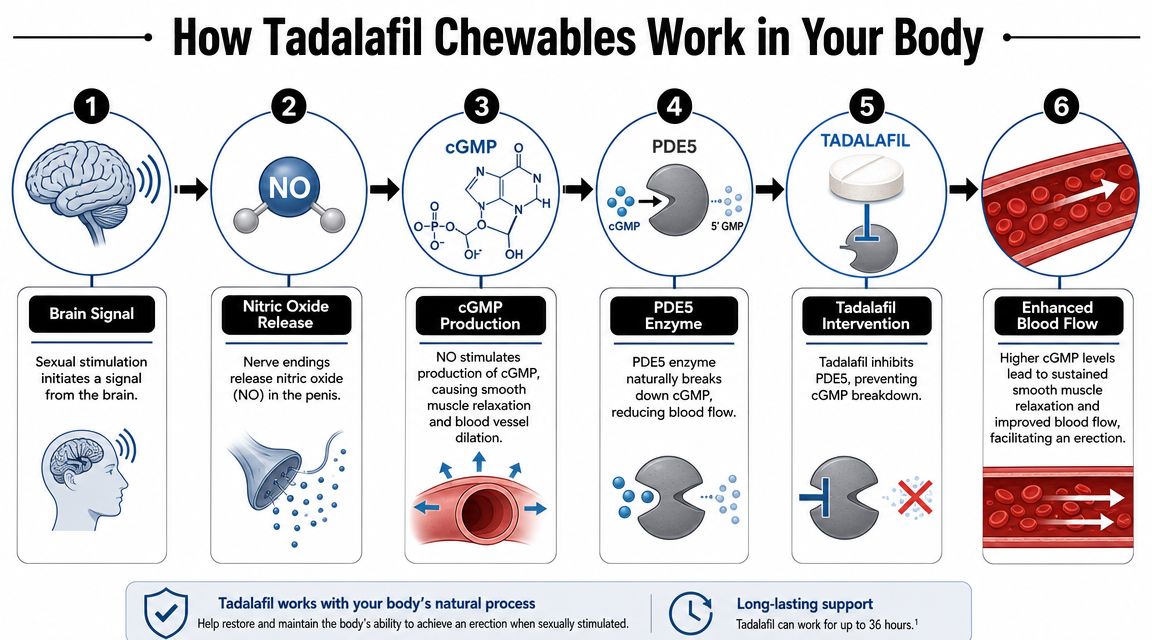
Tadalafil belongs to the PDE5 inhibitor family. The simple version is that it helps your body keep the blood-flow signal around long enough to support an erection when sexual stimulation is present. It doesn't create desire, and it doesn't force an erection on its own.
Think of it as a lock-and-key system with a cleanup crew. Sexual stimulation starts the signal. Your body produces chemical messengers that relax smooth muscle and open blood vessels in penile tissue. PDE5 is one of the enzymes that breaks that signal down. Tadalafil blocks that enzyme, so the signal lasts longer and blood flow improves.
Why the chewable format exists
The more interesting part is the formulation. Tadalafil is a BCS class II drug, meaning it has poor water solubility and high permeability. In plain English, once the drug is dissolved, your body can absorb it well. The challenge is getting it dissolved efficiently in the first place. That's why chewable and self-nanoemulsifying designs are used to speed up disintegration and dissolution, which are the rate-limiting steps for tadalafil absorption (peer-reviewed formulation study on tadalafil delivery design).
That's a pharmaceutical engineering problem, not just a convenience feature.
A good chewable formulation aims to do several things at once:
- Break apart reliably when chewed
- Disperse the drug well so dissolution starts efficiently
- Mask taste enough that patients chew it fully
- Deliver a consistent dose from tablet to tablet
If any one of those pieces is weak, the patient experience suffers. That's why “chewable” by itself tells you very little about quality.
What chewing changes and what it doesn't
Chewing changes the physical handling of the tablet. It can improve breakdown of the tablet matrix before swallowing. That can help the dissolution process. What it doesn't do is magically turn tadalafil into a totally different drug.
A chewable can change how the dose is presented to the body. It does not change tadalafil's core pharmacology.
That's where some of the hype goes off track. Men read “chewable” and assume “works instantly.” That's not how to think about it. The better framing is this: the formulation may improve the route from tablet to dissolved drug, but the clinical effect still depends on the same tadalafil molecule doing the same PDE5 inhibition job.
Why this matters for real patients
For men using telemedicine, chewables can make practical sense because they're easy to take discreetly and don't require water. For men who hate swallowing pills, that can be enough reason. For others, the value is less about convenience and more about getting a dosage form that's easier to use consistently.
Consistency matters more than novelty. A medication you can take correctly every time is usually better than one that looks more traditional but sits unused.
Dosing Onset and Duration
The first practical point is straightforward. Chewable tadalafil is available in 5 mg, 10 mg, and 20 mg strengths, and the labeled product instructions state it should be chewed completely, can be taken with or without food or water, and should not be split because that can lead to under-dosing or over-dosing (FDA chewable tadalafil label).

How to think about timing
Independent drug references note a median time to peak concentration of about 2 hours in healthy adults, and consumer health reporting commonly describes using chewable ED tablets at least 30 minutes before anticipated sexual activity while tadalafil's effect can last up to 36 hours because of the drug itself, not the chewable format (FDA medical review discussing marketed chewable strengths and use patterns).
That means there are two different timing concepts patients often confuse:
| Timing concept | What it means in real life |
|---|---|
| Initial window | When you might reasonably start expecting benefit after taking a dose |
| Peak exposure | When blood levels tend to be highest |
| Duration | How long tadalafil can continue supporting erectile function |
You don't need to micromanage those numbers, but you do need the right mental model. Tadalafil isn't a race. It's a long-window medication.
Daily use versus as-needed use
Most men fit into one of two camps.
- As-needed users want flexibility. They don't want a daily medication, and they prefer taking tadalafil before sexual activity.
- Daily users care more about spontaneity and predictability. They'd rather maintain a steady routine than plan around individual encounters.
No single approach is superior. The right choice depends on how often you have sex, how predictable your schedule is, how sensitive you are to side effects, and whether you also have urinary symptoms consistent with BPH.
If you're having sex often enough that you're repeatedly planning doses, daily tadalafil may be the cleaner strategy. If your use is occasional, as-needed dosing usually makes more sense.
Food and real-world convenience
One practical strength of tadalafil is that food isn't a major obstacle. The available labeling indicates a high-fat meal has no significant effect on absorption, so most men don't need to engineer their meal timing around a chewable dose, which is quite useful. It means fewer moving parts, especially for men using telemedicine prescriptions in everyday life rather than treating the medication like a carefully staged event.
What doesn't work well is taking it casually without understanding the long effect window. If you get side effects, or if another medication becomes relevant later that day or the next day, tadalafil may still be active. That long duration is a benefit when you want flexibility. It's a drawback when you want the drug out of your system quickly.
Chewables vs Tablets Which Tadalafil Is Right for You
A common telemedicine scenario goes like this. A man wants tadalafil, sees a chewable option online, and assumes it is the same medication in a more convenient form. Sometimes that is a fair assumption. Sometimes it is not.
The right choice usually comes down to two questions. Do you want a standard, retail-manufactured tablet, or are you comfortable with a compounded format? And do you care more about familiar pharmacy standardization, or about ease of use and discretion?
Chewables and standard tablets can both be reasonable choices. The difference is not just how you take them. The bigger issue is how the product is made, how consistent the dosing is from batch to batch, and what evidence stands behind that specific version.
What bioequivalent means for patients
Patients often hear bioequivalent and assume it means identical in every practical sense. That is not the standard.
For a chewable tadalafil product, bioequivalence means the body is exposed to a similar amount of drug over time compared with the reference tablet. In plain terms, the formulation performs close enough to the original product that clinicians would expect similar clinical effect for most patients. It does not mean the taste, inactive ingredients, dissolution pattern, or manufacturing pathway are identical.
That distinction matters because many chewable tadalafil products used through U.S. telemedicine are compounded, not mass-manufactured retail prescriptions. A compounded chewable may still be a reasonable option, but it has not automatically gone through the same approval path as a branded or generic tablet dispensed at a retail pharmacy.
Patients need to be careful. "Chewable tadalafil" is a category label, not a quality guarantee.
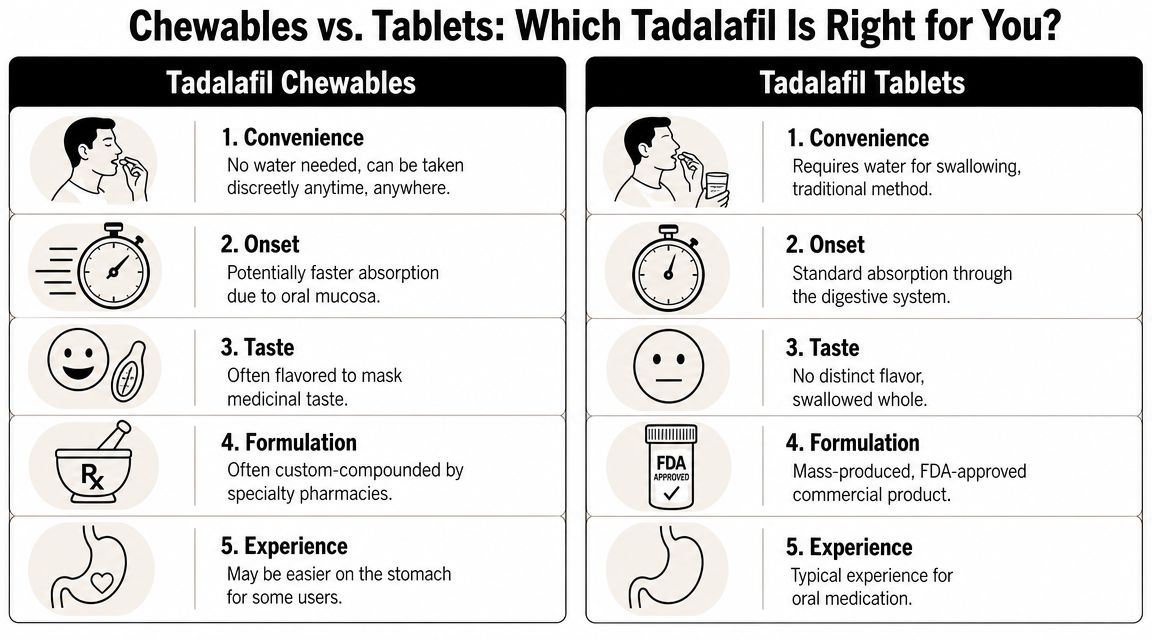
Here is the practical comparison:
| Decision factor | Chewables | Tablets |
|---|---|---|
| Taking the dose | Easy without water | Standard swallow-whole routine |
| Formulation pathway | Often compounded for telemedicine dispensing | Usually retail-manufactured and pharmacy-dispensed |
| Dose consistency confidence | Depends heavily on the compounding pharmacy and quality controls | Usually higher confidence in standardized retail production |
| Patient preference | Good for pill aversion, travel, or discretion | Good for men who want a conventional prescription workflow |
For men comparing ED medication formats and access options, Cost Plus TRT shows one example of a clinic offering tadalafil in chewable and capsule forms rather than only one route.
Who tends to prefer each format
Chewables tend to fit men who care about convenience, dislike swallowing pills, or use telemedicine as their main care model. I also see them work well for men who are more likely to skip a dose if the process feels awkward or too medicalized.
Tablets tend to fit men who want the most familiar prescription path. They are often the better match for patients who are skeptical of compounded medications, want a product they can fill at a standard pharmacy, or trust a conventional dosage form more.
Neither preference is irrational. It is a trade-off.
A chewable can be easier to use, but ease of use does not replace formulation quality. A retail tablet can feel more standardized, but that does not make it automatically better for every patient. The better option is the one you will use correctly and the one you understand well enough to trust.
That is the practical standard I use in clinic. If a patient wants chewables, I want him to know whether he is getting a compounded product, who is dispensing it, and what safeguards are in place. If he wants tablets, I want him to know he is choosing familiarity and standardization, not necessarily a stronger medication.
Safety Profile Side Effects and Drug Interactions
Men often fixate on the classic warning about nitrates, and that warning is important. But in practice, the more common clinic conversation is about polypharmacy. The patient isn't just taking tadalafil. He may also be on blood pressure medication, an alpha-blocker, TRT, or treatment for diabetes and cardiometabolic disease.
A recent expert review highlighted the practical issue clearly. For men with comorbidities, the central safety question is managing tadalafil's long half-life alongside medications such as antihypertensives or alpha-blockers. Nitrate co-use remains the most severe concern, but the more common real-world issue is adjusting dose or timing to manage additive blood pressure effects (expert review on tadalafil use and misuse considerations).
The interaction that matters most
If you use nitrates for chest pain, tadalafil is the wrong medication to combine with them. That isn't a gray-zone issue. It's the major contraindication patients need to remember.
The reason tadalafil deserves extra respect here is duration. If a man takes tadalafil and later needs nitrate therapy, the timing problem can extend beyond the same evening because tadalafil can remain active for a long window.
Tell every clinician you see that you've taken tadalafil recently if chest pain or emergency care comes up. Don't assume it's obvious or irrelevant.
The everyday medication issues I pay more attention to
In ordinary practice, I spend more time discussing these situations:
- Blood pressure medications: The combination may be acceptable, but some men feel lightheaded when treatment starts or when doses are adjusted.
- Alpha-blockers: The issue is often timing and additive blood pressure lowering, not automatic incompatibility.
- TRT and men's health regimens: Tadalafil doesn't become unsafe just because a man is on TRT, but the full medication list still matters.
- Daily versus as-needed use: A long-acting drug can be convenient, but if side effects bother you, that same long action may become annoying.
The most common side effects men report with tadalafil generally include headache, flushing, back pain, and similar dose-related effects seen across the class. The important practical point is not to panic if mild symptoms show up, but also not to keep pushing through a regimen that clearly doesn't fit.
What works best from a safety standpoint
A few habits reduce problems quickly:
- Bring a full medication list: Include heart medications, blood pressure drugs, supplements, and anything taken only occasionally.
- Start with the right dose strategy: Men often overshoot because they assume stronger is better.
- Don't improvise with leftovers: Switching between daily and as-needed patterns without guidance creates confusion.
- Pay attention to blood pressure symptoms: Dizziness, unusual weakness, or near-fainting deserve follow-up.
What doesn't work is buying a chewable online, treating it as casual because it tastes better or looks simpler, and skipping the medication review. The format may feel lighter. The pharmacology is still real.
How to Get Tadalafil Chewables Safely Through Telemedicine
Many patients misunderstand that in the United States, a lot of chewable ED medications are compounded, not mass-manufactured FDA-approved retail products. Independent coverage has noted that many chewable ED tablets are created at compounding pharmacies, and that makes the legitimacy of the prescribing clinic and the pharmacy itself the most important safety question for patients (WebMD overview of chewable ED medications and compounding status).
That doesn't mean telemedicine is unsafe. It means you need to judge the process correctly.
What a legitimate process looks like
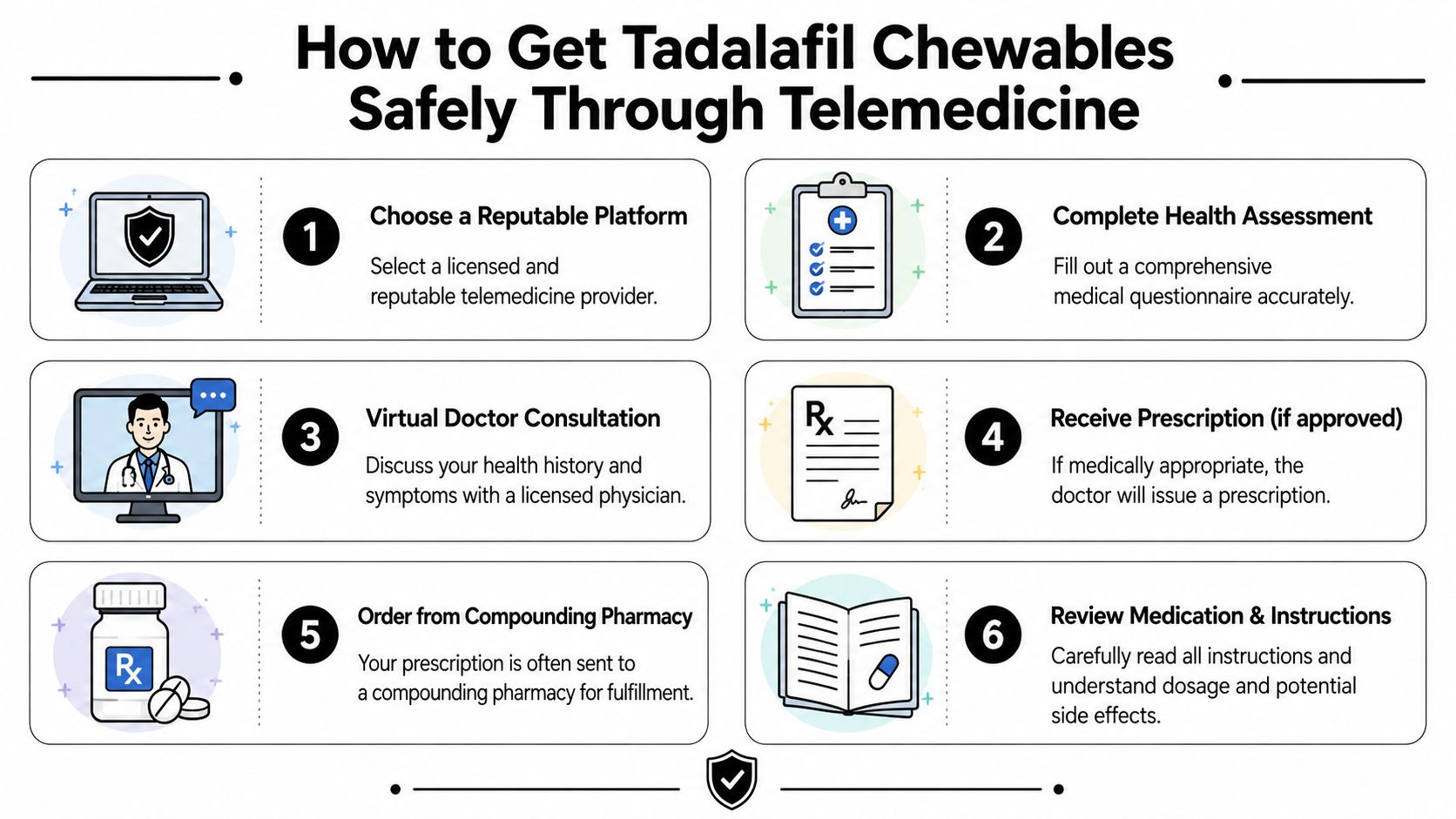
A proper telemedicine pathway usually looks like this:
- You complete a real medical intake. That includes medication history, cardiovascular history, and ED symptoms.
- A licensed clinician reviews the case. Sometimes asynchronously, sometimes by video or messaging, depending on the platform and state rules.
- You're approved only if appropriate. Not every patient should receive tadalafil, and not every patient should receive the chewable format.
- The prescription goes to a compounding pharmacy when applicable. That's the point where formulation quality matters.
- You receive instructions that are specific. How to chew it, when to use it, what not to combine it with, and what symptoms should trigger follow-up.
If you want to see the kind of patient disclosures a legitimate online care process should include, review a clinic's telehealth consent information before ordering.
Red flags that should stop you immediately
The internet makes bad medication channels look polished. A clean website proves almost nothing.
Watch for these warning signs:
- No prescription required: That's the fastest disqualifier.
- No medication review: If nobody asks about nitrates, heart history, or blood pressure drugs, leave.
- Wild promises about instant onset: That's usually marketing outrunning pharmacology.
- Unclear pharmacy source: You should know whether a licensed U.S. pharmacy is involved.
- Dose instructions that sound casual: ED medication should not be sold like candy or supplements.
Green flags worth looking for
The better services usually share a few traits:
- A licensed prescriber is clearly identified
- The clinic explains whether the product is compounded
- Instructions are explicit about chewing completely and avoiding unsafe combinations
- Support is available if side effects or dosing questions come up
- Pricing and fulfillment are understandable before checkout
The safest telemedicine experience is boring in the best way. Clear intake, clear approval criteria, clear pharmacy path, clear instructions.
What doesn't work is choosing the slickest ad. Choose the most transparent process.
Frequently Asked Questions by Patients
Can I cut a chewable tadalafil tablet in half
Usually, no. Labeled chewable tadalafil instructions state the tablets should not be split because that can lead to under-dosing or over-dosing. With compounded products, dose uniformity matters even more in practical terms. If you think your dose is too strong, the answer is to ask for a different prescribed strength, not to start cutting tablets.
Does chewable mean it works instantly
No. Chewing may help the tablet break down, but tadalafil still needs to be absorbed systemically. Men should think of it as an easier-to-take oral format, not an instant-on medication.
Do I need water or an empty stomach
Chewable tadalafil can be taken with or without food or water based on labeled instructions for the chewable product discussed earlier. For most men, that makes use simpler and less scripted.
Is the long duration caused by the chewable format
No. The long effect window is a property of tadalafil itself, not a special extension created by chewing the tablet.
Are chewables always FDA-approved
No. Many U.S. chewable ED products are compounded rather than sold as standard FDA-approved retail drugs. That's why the clinic and pharmacy matter so much.
What do they usually taste like
That depends on the compounding pharmacy. Many are flavored to make full chewing easier, which is practical because a tablet that tastes bad often gets swallowed too quickly or used inconsistently.
Is chewable tadalafil better for men who hate pills
Often, yes. If swallowing pills is your main problem, chewables can solve a real adherence issue. If your main concern is maximum regulatory standardization through a conventional retail pathway, a standard tablet may fit better.
Is insurance likely to cover it
Coverage varies, but compounded medications often create more coverage friction than standard retail prescriptions. Patients should ask before ordering and not assume telemedicine fulfillment works like a neighborhood pharmacy benefit.
If you want more general answers about online men's health treatment logistics, the Cost Plus TRT FAQ page covers common patient questions about care pathways and prescriptions.
If you're considering tadalafil chewables and want a medically supervised route, Cost Plus TRT offers telemedicine-based men's health care that includes tadalafil chewable tablets among its ED treatment options. The right next step is a proper medication review, not guesswork.