
Most advice on subcutaneous vs intramuscular testosterone starts with the wrong assumption, that intramuscular is the “real” TRT shot and subcutaneous is the compromise. In actual practice, the route matters less as a badge of tradition and more as a question of absorption, injection depth, body habitus, and whether the medication ends up where you intended. For men managing TRT at home, that difference changes comfort, consistency, and how easy it is to stay on treatment long term.
| Factor | Subcutaneous (SubQ) | Intramuscular (IM) |
|---|---|---|
| Tissue target | Fat layer under the skin | Muscle tissue |
| Absorption pattern | Slower, steadier | Faster, higher peaks |
| Typical volume tolerance | Generally limited to 2 mL (University of Nottingham nursing guidance) | Better suited to larger volumes |
| Needle size | Smaller needles, often 27 to 30 gauge for TRT cypionate (University of Nottingham nursing guidance) | Larger needles, commonly used for deeper delivery |
| Home use | Easier for many patients | Often harder to self-administer |
| Practical TRT fit | Good for smaller, repeated doses | Useful when a deeper depot or larger volume is needed |
Table of Contents
- Why Intramuscular Is No Longer the Default for TRT
- How Subcutaneous and Intramuscular Injections Work in the Body
- Comparing Needle Size, Pain, and Injection-Site Reactions
- Why Intended Intramuscular Injections Often Miss the Muscle
- Practical Guide to Needle Selection and Injection Technique
- Dosing Differences and Pharmacokinetic Outcomes
- Choosing the Right Route for Your TRT Protocol
Why Intramuscular Is No Longer the Default for TRT
For decades, men were taught that testosterone belonged in the muscle. That made sense when clinic workflows, training habits, and patient expectations were built around intramuscular injection, but the default has shifted because home TRT has shifted. Telemedicine care has pushed the question away from “what was always done” and toward “what can a patient do safely, consistently, and comfortably at home.”
The practical case for subcutaneous testosterone is straightforward. It uses a smaller needle, smaller injection volumes, and it's often easier for patients to self-administer without help. The University of Nottingham's clinical guidance notes that SC delivery is generally limited to about 2 mL and that testosterone cypionate may maintain therapeutic levels for 7 to 10 days with 0.25 to 0.5 mL injections using 27 to 30 gauge needles (University of Nottingham nursing guidance).
The modern TRT decision is about usability, not ritual
A 2024 comparative summary describes the current debate well, subcutaneous testosterone can achieve broadly comparable serum testosterone concentrations to intramuscular administration while often improving tolerability and patient preference (comparative guide). That's important because many men don't need a dramatic pharmacologic distinction, they need a route they can repeat without dreading every injection.
Practical rule: if the route makes the patient avoid doses, the “theoretically standard” route is not working.
That's why many telemedicine TRT programs now treat subcutaneous injection as a front-line option, not a consolation prize. The best route is the one the patient can maintain, and for a lot of men at home, that's no longer intramuscular.
How Subcutaneous and Intramuscular Injections Work in the Body
Subcutaneous and intramuscular injections enter different tissue layers, and that's the whole reason their behavior differs. Subcutaneous tissue is the fat layer just under the skin, while muscle sits deeper and is much more vascular. Testosterone cypionate is usually an oil-based depot, so the body has to pull it out of that depot before it reaches circulation.
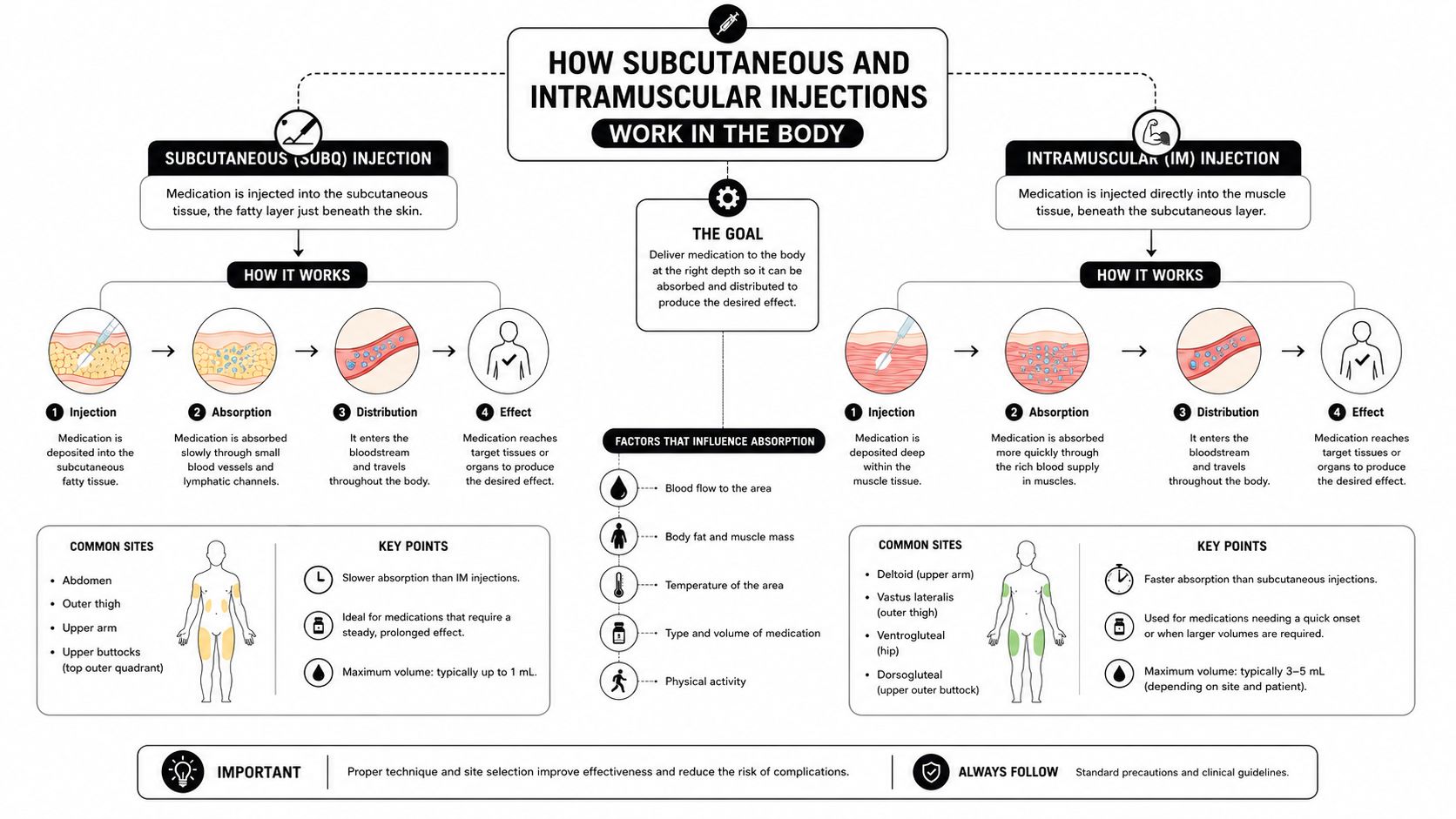
With IM injection, the oil is placed into muscle, where the richer blood supply tends to move it into the bloodstream faster. With SC injection, the medication sits in fat, where uptake is slower and more gradual. The University of Nottingham guidance describes SC absorption as slower, about 1 to 2 mL per hour, while IM is faster and tends to produce higher peaks more quickly (University of Nottingham nursing guidance).
Why the same drug behaves differently in different tissue
This route difference changes the shape of the hormone curve, not just the injection experience. IM tends to create a sharper peak and then a faster decline, which can matter if a patient is sensitive to fluctuations. SC tends to smooth that curve out, which is one reason many men on TRT find weekly or split dosing easier to live with.
For testosterone therapy, the route is really a question of how much the patient values speed of absorption versus steadiness of exposure. In practical terms, IM is better suited to situations where a rapid, higher peak is desirable, while SC often fits patients who want consistent day-to-day management. That's why route selection should be tied to the dosing plan, not treated like a separate technical detail.
If a patient's goal is predictable home dosing, the route that reduces variability often wins even before the first lab draw.
Comparing Needle Size, Pain, and Injection-Site Reactions
The practical difference starts with what the patient has to manage at home. Subcutaneous injections usually use shorter, thinner needles and smaller volumes, so they feel less intimidating for many men starting TRT at home. Intramuscular injections need enough needle length to reach muscle, and that extra depth is part of why they can feel more invasive and harder to self-administer with confidence.
| Factor | Subcutaneous (SubQ) | Intramuscular (IM) |
|---|---|---|
| Needle size | Smaller, commonly 27 to 30 gauge for TRT cypionate (University of Nottingham nursing guidance) | Longer, thicker needle needed to reach muscle |
| Typical volume | Usually smaller doses, often 0.25 to 0.5 mL for testosterone cypionate in practical TRT use | Better suited to larger depot volumes |
| Pain experience | Often more tolerable for self-injection | Often more soreness after injection |
| Local reactions | Injection-site reactions reported in 8% to 12% of SC patients in one summary (PMC review) | Injection-site reactions reported in 15% to 25% of IM patients in the same summary |
| Cost and supplies | Lower material costs by an estimated 20% to 30% because it uses smaller needles and syringes (PMC review) | Usually higher supply burden |
The pain difference is not just about needle gauge. It also depends on what the needle has to pass through, and how much confidence the patient has with the technique. A shorter SC needle stays in a shallow tissue plane, while IM has to travel through skin and fat before it reaches the target. For a man injecting himself at home, that practical difference can matter as much as the medication itself.
Body habitus changes the answer even more. A slimmer patient may reach muscle more easily, while a patient with more subcutaneous tissue may find that an intended IM shot is harder to place where he expects it to land. That is one reason home TRT often favors the route that is easier to repeat consistently, not just the route that looks better on paper.
This TRT FAQ page is useful if you want a clinic-level overview of practical injection questions. The route that gives you fewer local reactions, less dread, and a technique you can repeat cleanly usually improves adherence, and adherence is what keeps TRT working.
Why Intended Intramuscular Injections Often Miss the Muscle
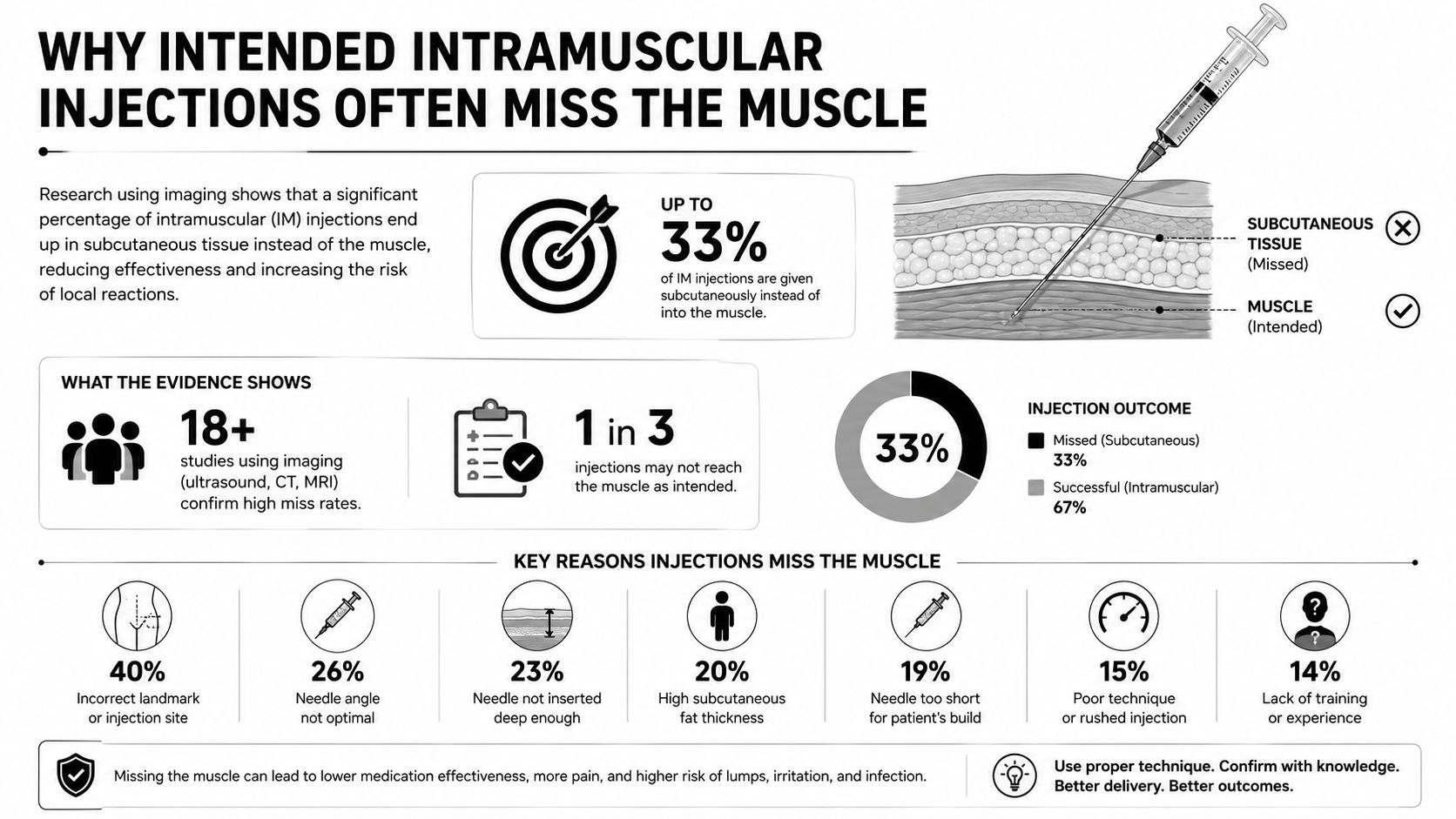
The core issue in the subcutaneous vs intramuscular debate is that “intended IM” and “actual IM” are often different things. A narrative review found that intended gluteal IM injections succeed only 32% to 52% of the time, so a large share of injections do not reach the layer the injector thinks they reached (PMC review).
Body habitus changes the answer more than commonly assumed
The same review reported that patients with successful IM injections had mean subcutaneous tissue thickness of 13.6 mm, while unsuccessful cases averaged 36.2 mm (PMC review). That gap explains why a needle that reaches muscle in one man can stop short in another. Body composition is not a small variable here. It determines whether the dose enters muscle or ends up functionally subcutaneous.
For TRT, that difference matters because the patient may expect one absorption pattern while the body is processing something else. Testosterone cypionate is oil-based and volume-limited, so depth and tissue thickness change how the medication spreads after the injection. Men with more subcutaneous tissue around the gluteal area are the ones most likely to run into this mismatch, especially if they are trying to self-inject at home.
A shot can look correct on paper and still land in the wrong layer if needle length and tissue thickness do not match.
Route choice should be individualized instead of automatic. If the goal is repeatable home administration, the route that is easier to place correctly may produce the more reliable real-world result, even if tradition still points elsewhere. For men who want a straightforward clinic-backed plan for home TRT, this practical TRT start page is a useful place to begin.
Practical Guide to Needle Selection and Injection Technique
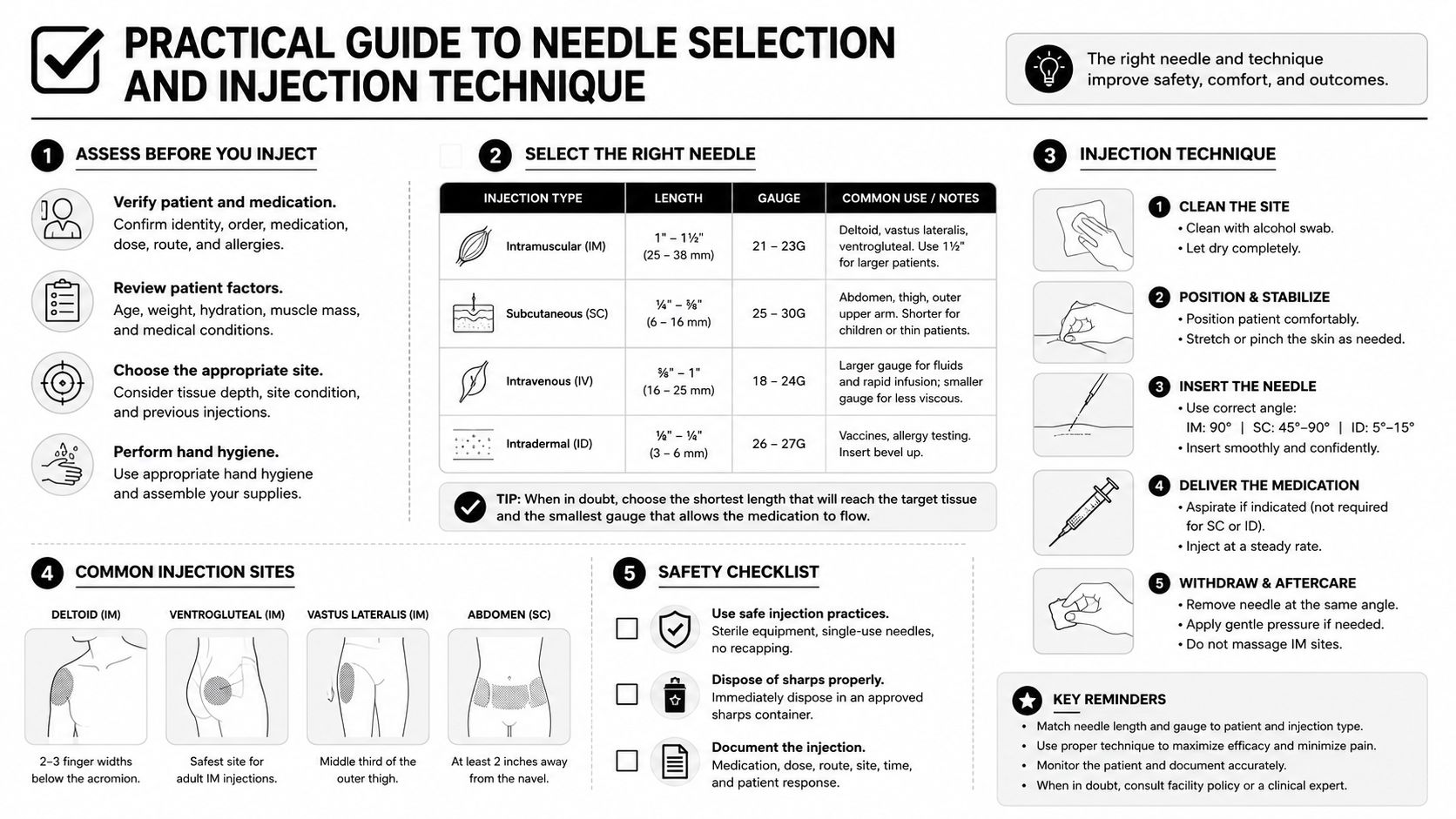
Needle choice should follow the route, the body type, and the volume being injected. For subcutaneous testosterone cypionate, the practical setup usually means a short, thin needle, often in the 27 to 30 gauge range, with small volumes such as 0.25 to 0.5 mL. For intramuscular injection, the needle has to be long enough to reach muscle consistently, and that becomes harder when there is more subcutaneous tissue over the intended site.
Site choice and angle matter more than commonly recognized
Common SC sites include the abdomen, thigh, and flank area. Common IM sites include the gluteal region, thigh, and deltoid. The angle also matters, SC is often taught at a shallow angle, while IM is typically placed at 90 degrees when the tissue depth and needle length support it (IWK Nova Scotia Health guidance).
A few practical points matter at home:
- Match needle length to tissue depth: a short SC needle is meant for fat, not muscle, and a needle that's too short for IM can leave the dose in the wrong plane.
- Rotate sites consistently: repeated use of the same spot can create local irritation and scar tissue.
- Inject slowly: oil-based testosterone does better when it has time to disperse instead of being forced in quickly.
- Stop if resistance feels unusual: pressure can signal that the needle angle, site, or depth isn't right.
For a patient who wants clinician support for home TRT setup, Cost Plus TRT's start page can be used to begin a telemedicine evaluation and match route, dose, and supplies to the realities of self-injection.
The practical problem is not just picking a route on paper. It is matching needle length, site, and angle to the tissue in front of you, because the same plan can land correctly in one body and miss in another.
For men who self-inject, the goal is not just getting the medication out of the syringe. It is getting it into the right tissue with the least friction, the least uncertainty, and the least chance of needing to troubleshoot every week.
Dosing Differences and Pharmacokinetic Outcomes
Route choice changes dosing because it changes bioavailability and the shape of the testosterone curve. One peer-reviewed pharmacokinetic comparison of testosterone cypionate found that subcutaneous dosing produced an AUC0-t of 398 ± 155 ng/mL/min versus 696 ± 168 ng/mL/min for IM, with p < 0.001 (PMC pharmacokinetic study). The same study found maximum serum concentration of 2.2 ± 1.4 ng/mL for SC versus 11 ± 3.2 ng/mL for IM, again with p < 0.001 (PMC pharmacokinetic study).
What those numbers mean in real TRT practice
Those figures show why IM can feel more dramatic early after the shot, while SC often feels flatter. The same study reported calculated bioavailability of 50 ± 19% for SC and 95 ± 21% for IM (PMC pharmacokinetic study). That does not mean SC is ineffective, it means the body is handling the same medication differently, and the dose may need to be adjusted to reach the same testosterone level.
A separate 2019 study of 232 men found that SC dosing required 30% lower doses than IM to achieve the same testosterone levels, which is a good reminder that the route can change the dose requirement itself (University of Nottingham nursing guidance).
Clinical takeaway: if a patient switches routes, labs should be interpreted as a route change, not just a dose change.
That matters in telemedicine because patients often assume the same milligram dose will behave the same way regardless of injection depth. It won't. A patient switching from IM to SC, or the other way around, should expect the provider to review symptoms and follow-up labs rather than guessing from the old prescription alone. The route can change peak levels, troughs, and the dose needed to land in range.
Choosing the Right Route for Your TRT Protocol
The right route depends on what gets in the way of adherence. If a man travels often, wants easier home administration, or dislikes deeper injections, subcutaneous TRT usually makes more sense. If he needs a larger single dose, strongly prefers less frequent injections, or has already been stable on IM, intramuscular can still be the better fit.
A simple decision framework
- Choose SC first if the patient wants smaller needles, less local soreness, and a route that is easier to repeat at home.
- Choose IM first if the patient and clinician need a larger depot or want a deeper injection approach with a more traditional schedule.
- Reconsider the route if the patient is missing doses, getting local reactions, or struggling to self-inject reliably.
- Base the switch on body habitus, because the wrong needle length can turn an intended IM shot into something else entirely.
That's where telemedicine really helps. A clinician can look at the patient's lab history, injection comfort, and tissue depth, then decide whether to stay with IM, move to SC, or adjust the dose after a route switch. Cost Plus TRT offers that kind of physician-guided TRT care with testosterone cypionate, labs, and home shipping through its telemedicine model, which fits men who need a route decision made around real-world use rather than tradition (Cost Plus TRT TRT page).
The safest rule is also the most practical one. Pick the route that your body can absorb predictably and that you can keep using without fighting the process every week.
If you're deciding between subcutaneous and intramuscular TRT, Cost Plus TRT can help you match the route, needle size, and dosing plan to how you inject at home. Visit Cost Plus TRT to start a telemedicine evaluation, review your labs, and get a clinician-guided plan built around the route that fits your life.