
A lot of men end up in the same frustrating spot. They start testosterone replacement therapy, the lab numbers improve, and yet they still wake up tired, foggy, irritable, or uninterested in sex. Their partner says they snore hard. They may even stop breathing for stretches at night. By morning, they feel like they barely slept.
That disconnect matters. If you're chasing better energy and libido through hormones alone, but your sleep is broken every night, you may be treating one part of the problem while missing the driver underneath it. In clinic, this is one of the most important reasons to step back and ask whether the issue is really “low T,” or whether sleep apnea is blunting the hormonal recovery that should happen overnight.
This is especially relevant for men already exploring TRT treatment options. Testosterone is not produced in a vacuum. Your brain, pituitary, testes, oxygen levels, and sleep architecture all have to work together. If obstructive sleep apnea keeps interrupting that system, you can have a decent-looking morning testosterone result and still feel unwell.
The practical takeaway is simple. When TRT isn't delivering the expected result, don't just assume the dose is wrong. Look at your sleep, your breathing, and the pattern of your symptoms.
Table of Contents
- Introduction When TRT Is Not Enough
- The Vicious Cycle How Sleep Apnea and Low T Fuel Each Other
- Red Flags Symptoms of Sleep Apnea to Watch for on TRT
- Getting Answers How to Get Screened and Diagnosed for OSA
- TRT with Sleep Apnea A Critical Guide to Safe Management
- Coordinating Your Care with a Telemedicine Clinic
- Frequently Asked Questions About TRT and Sleep Apnea
- Can sleep apnea make testosterone problems look worse than they are
- If I treat sleep apnea, will I automatically come off TRT
- Should I avoid TRT if I snore
- I'm already on TRT and still exhausted. What should I ask my clinician
- Can a telemedicine clinic help with this or do I need in-person care only
Introduction When TRT Is Not Enough
A common story goes like this. A man does the right things. He gets evaluated for low testosterone, starts treatment, follows instructions, and expects his energy and libido to come back. Instead, he still crashes in the afternoon, wakes with a dry mouth or headache, and hears from his partner that the snoring has gotten worse.
That's the point where many men focus harder on the testosterone dose. Sometimes the underlying issue is that the body never gets the uninterrupted sleep it needs to produce and regulate hormones properly. Sleep apnea can subtly interfere with the overnight hormone pattern that supports recovery, sexual function, mood, and motivation.
The important shift is to stop thinking only in terms of “low testosterone” and start thinking in terms of sleep apnea and testosterone as one connected system. If breathing repeatedly cuts into deep sleep, the hormone signal that should build overnight gets disrupted. You may still get a morning blood draw that looks acceptable. You may still be on TRT. But the way you feel can remain far behind the lab report.
Clinical reality: A normal or improved testosterone number doesn't rule out a sleep problem. It may simply mean the test didn't capture what happened during the night.
Men often blame themselves for this. They assume treatment “isn't working” because they're not responding well enough, or because they need more testosterone. Usually, the better question is whether the foundation is stable. If sleep is fragmented and oxygen drops overnight, the body stays under stress.
That's why persistent symptoms on TRT should trigger a broader look, not just another prescription adjustment.
The Vicious Cycle How Sleep Apnea and Low T Fuel Each Other
The link between sleep apnea and testosterone isn't just about whether the final blood level is high or low. It's about timing, and timing is where a lot of men get misled.
Why the night matters more than most men realize
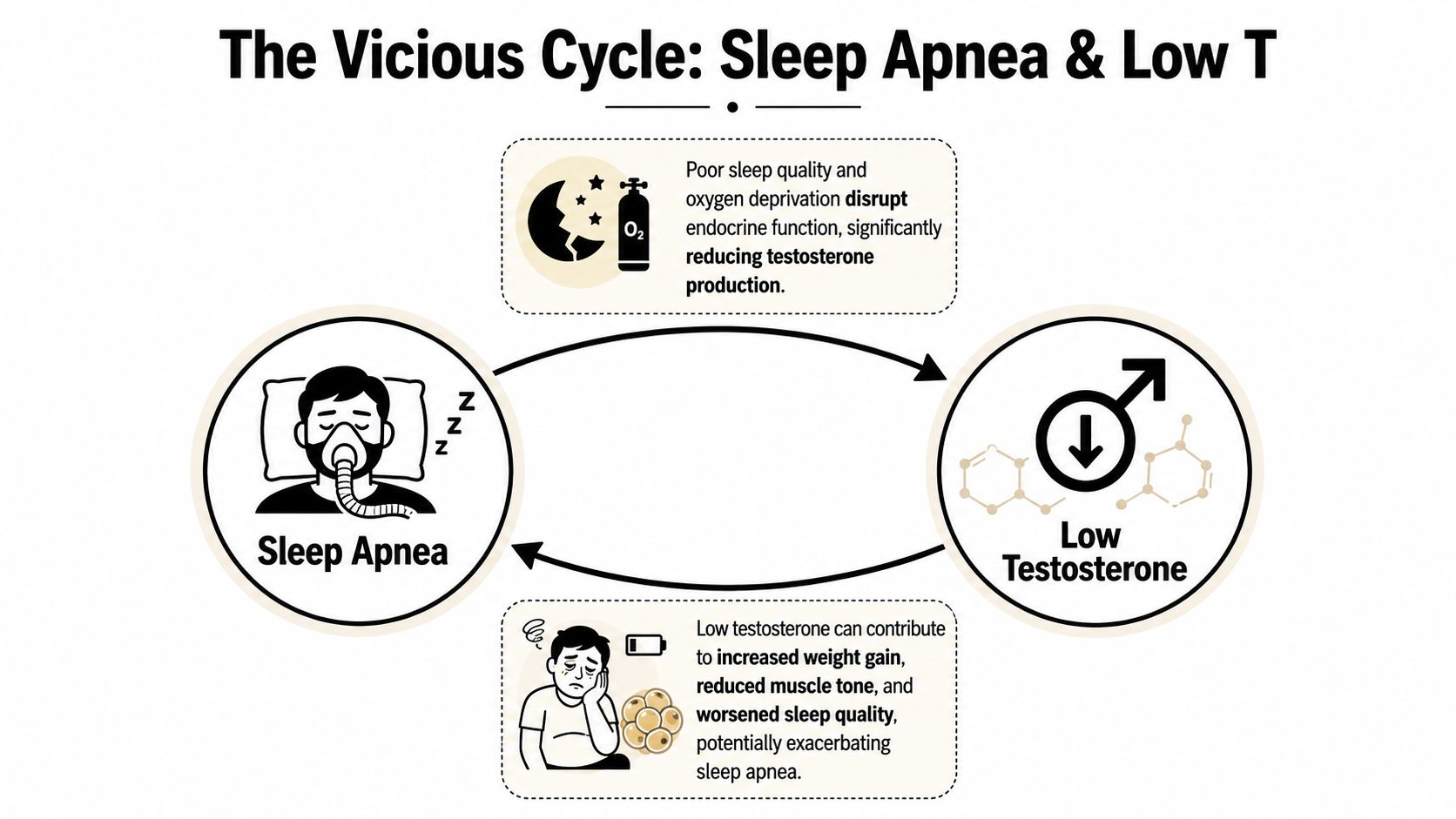
Testosterone has a rhythm. The body doesn't produce it in the same way all day long. During sleep, especially after at least 3 hours of uninterrupted deep sleep, testosterone normally rises and reaches an important overnight peak. Obstructive sleep apnea interferes with that process by repeatedly breaking sleep and lowering oxygen, which can blunt this nocturnal testosterone surge, as discussed in this PubMed summary on OSA and androgen patterns.
That detail explains a lot of confusing cases. A man can have a “normal” morning testosterone result and still feel depleted because the nightly rise that supports recovery and libido never happened the way it should have. In other words, he may not have a simple all-day hormone deficiency. He may have a nighttime hormone disruption.
A useful analogy is a factory that relies on its night shift to do the most delicate work. If the power keeps cutting out and the supervisor gets interrupted every few minutes, the building still opens in the morning, but the important overnight production never happened. Sleep apnea does something similar to endocrine function.
Later in the night, the practical effect shows up as symptoms:
- Poor recovery: You slept for enough hours on paper, but your body didn't get steady restorative sleep.
- Low libido despite treatment: The hormone environment may be disrupted even when a morning lab result looks acceptable.
- Mental fog: Repeated arousals and oxygen drops affect more than breathing. They affect how restored you feel.
This section's video gives a patient-friendly overview of that relationship.
How low testosterone can feed the problem back
The relationship can also run the other way. When testosterone is low, some men lose muscle mass, gain fat more easily, and notice a general drop in physical resilience. That can make sleep apnea harder to manage, especially if weight gain collects around the neck and torso or if overall conditioning declines.
This doesn't mean low testosterone directly causes sleep apnea in every case. It means the two problems often reinforce each other. A man sleeps poorly, testosterone signaling worsens, body composition shifts, and sleep quality slides further.
If you only treat one side of that cycle, the other side may keep driving symptoms.
That's why isolated fixes often disappoint. Men increase TRT and still feel tired. Or they start sleep apnea treatment and expect their hormone symptoms to vanish completely. Some do feel much better with one intervention. Many need both problems addressed on their own terms.
Red Flags Symptoms of Sleep Apnea to Watch for on TRT
If you're on TRT and still don't feel right, symptom pattern matters more than people think. Some clues point away from “I need a different testosterone dose” and toward “my breathing may be disrupted all night.”
Symptoms that deserve a second look
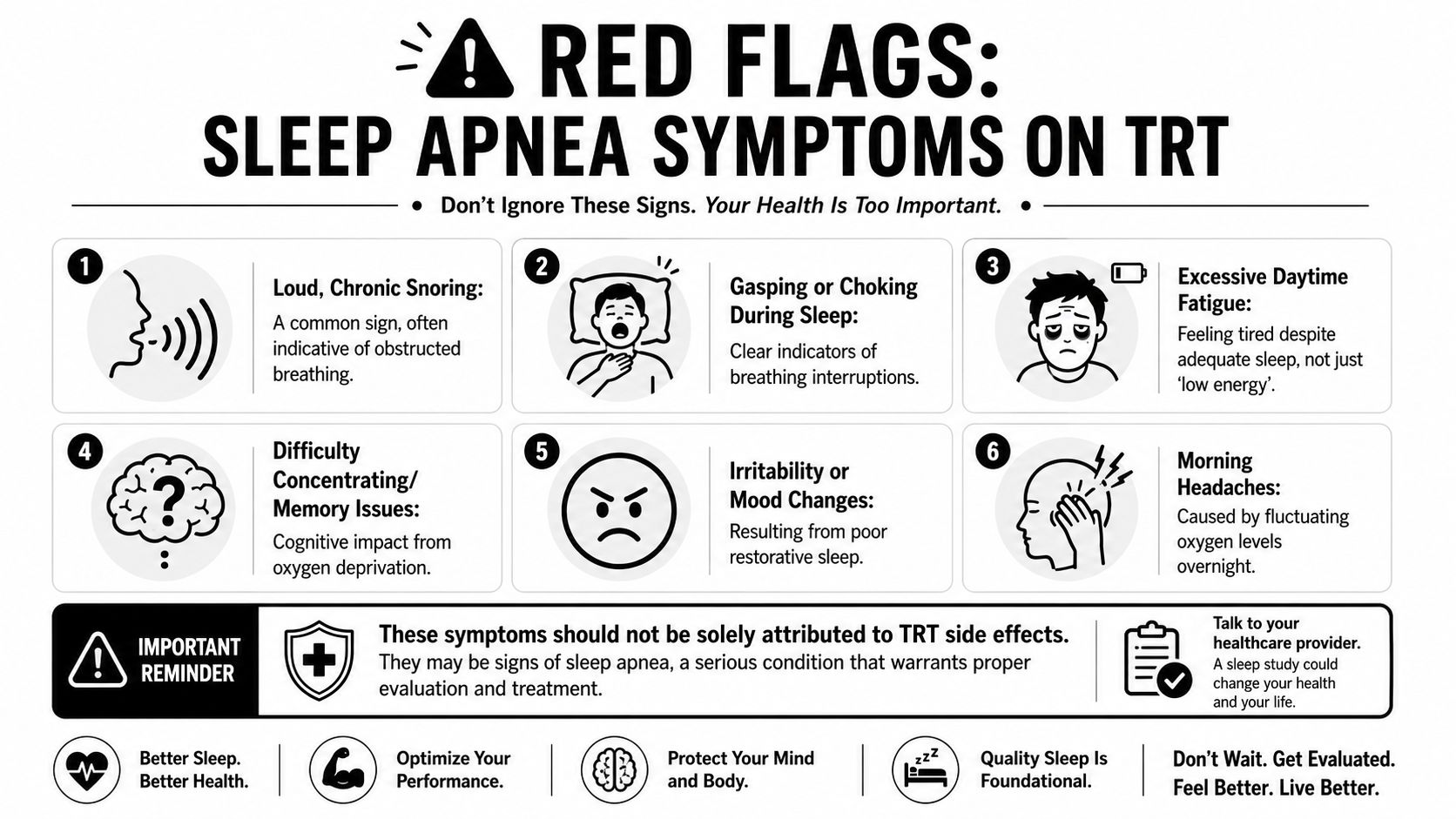
Use this as a practical checklist:
- Loud snoring that others notice: Snoring alone doesn't confirm sleep apnea, but chronic loud snoring should never be ignored.
- Gasping, choking, or witnessed pauses in breathing: If a partner notices this, take it seriously.
- Morning headaches: These can show up when breathing and oxygen levels are unstable overnight.
- Persistent daytime sleepiness: If TRT improved your labs but not your alertness, that's a clue.
- Brain fog or poor concentration: Men often describe this as feeling flat, slow, or mentally unrefreshed.
- Mood changes: Irritability, short temper, and low motivation can come from fragmented sleep just as much as hormone issues can.
- Dry mouth on waking: Mouth breathing and snoring often travel together.
- Blood pressure that's hard to control: This belongs in the broader clinical picture, especially when paired with snoring and fatigue.
One evidence-based reason to take symptoms seriously is that more severe OSA is associated with greater testosterone suppression. In men with severe OSA, total and free testosterone were significantly lower than in controls, with a standardized mean difference of -1.21 in the analysis reported in Andrology.
When symptom timing tells you something useful
The timing of symptoms can help you sort out what's going on.
| Symptom pattern | What it suggests |
|---|---|
| Worse in the morning | Think about overnight breathing, oxygen drops, mouth breathing, or repeated arousals |
| Afternoon crash despite TRT | Consider poor sleep quality rather than assuming the dose is too low |
| Partner reports worsening snoring after starting TRT | Bring it up promptly with your clinician |
| Libido improved less than expected | Don't assume the issue is only testosterone level |
Don't write off these symptoms as “just getting older” or “my TRT isn't dialed in yet.” The pattern often tells the story before the lab work does.
Getting Answers How to Get Screened and Diagnosed for OSA
A lot of men delay testing because they think it's complicated, expensive, or uncomfortable. In reality, the first step is usually just a good screening conversation.
Start with a screening conversation
If you suspect sleep apnea, bring specific observations to your clinician:
- What your partner sees: snoring, pauses, gasping, restlessness
- What you feel in the morning: headache, dry mouth, grogginess, unrefreshing sleep
- What happens during the day: fatigue, drowsiness, poor focus, low stamina
- What changed after TRT, if applicable: improved labs but ongoing exhaustion, or new snoring symptoms
Many clinicians use a structured screen such as STOP-BANG to organize risk. The value of a questionnaire isn't that it gives a diagnosis. It helps determine whether your symptoms, body habitus, blood pressure history, and sleep pattern justify formal testing.
A concise note on your phone is often enough to make the visit more productive. Write down bedtime, wake time, naps, snoring reports, and whether you've ever awakened choking or short of breath.
Home testing versus lab testing
There are two main pathways.
Home sleep apnea testing is often the simpler entry point. You sleep in your own bed with portable equipment that tracks breathing-related signals. It's convenient and usually easier for men who travel, work long hours, or want to avoid a sleep lab.
In-lab polysomnography is more detailed. It's done overnight in a monitored setting and gives a fuller picture of sleep stages, breathing, and other physiologic patterns. It's often the better fit when the case is more complex, symptoms don't match a simple presentation, or another sleep disorder may be part of the picture.
Here's the practical difference:
| Test type | Best use |
|---|---|
| Home sleep apnea test | Straightforward suspicion of obstructive sleep apnea, convenience matters |
| In-lab polysomnography | Complex symptoms, unclear picture, or need for broader sleep evaluation |
What I tell patients: Don't get stuck choosing the perfect test before you start. The bigger mistake is waiting months while symptoms continue.
Once the diagnosis is made, treatment decisions become much clearer. Without testing, men tend to guess. With testing, you can match the treatment to the problem.
TRT with Sleep Apnea A Critical Guide to Safe Management
Safety is paramount in this context. If sleep apnea is present, TRT has to be managed with care rather than treated as a separate issue.
If you have diagnosed sleep apnea and want TRT
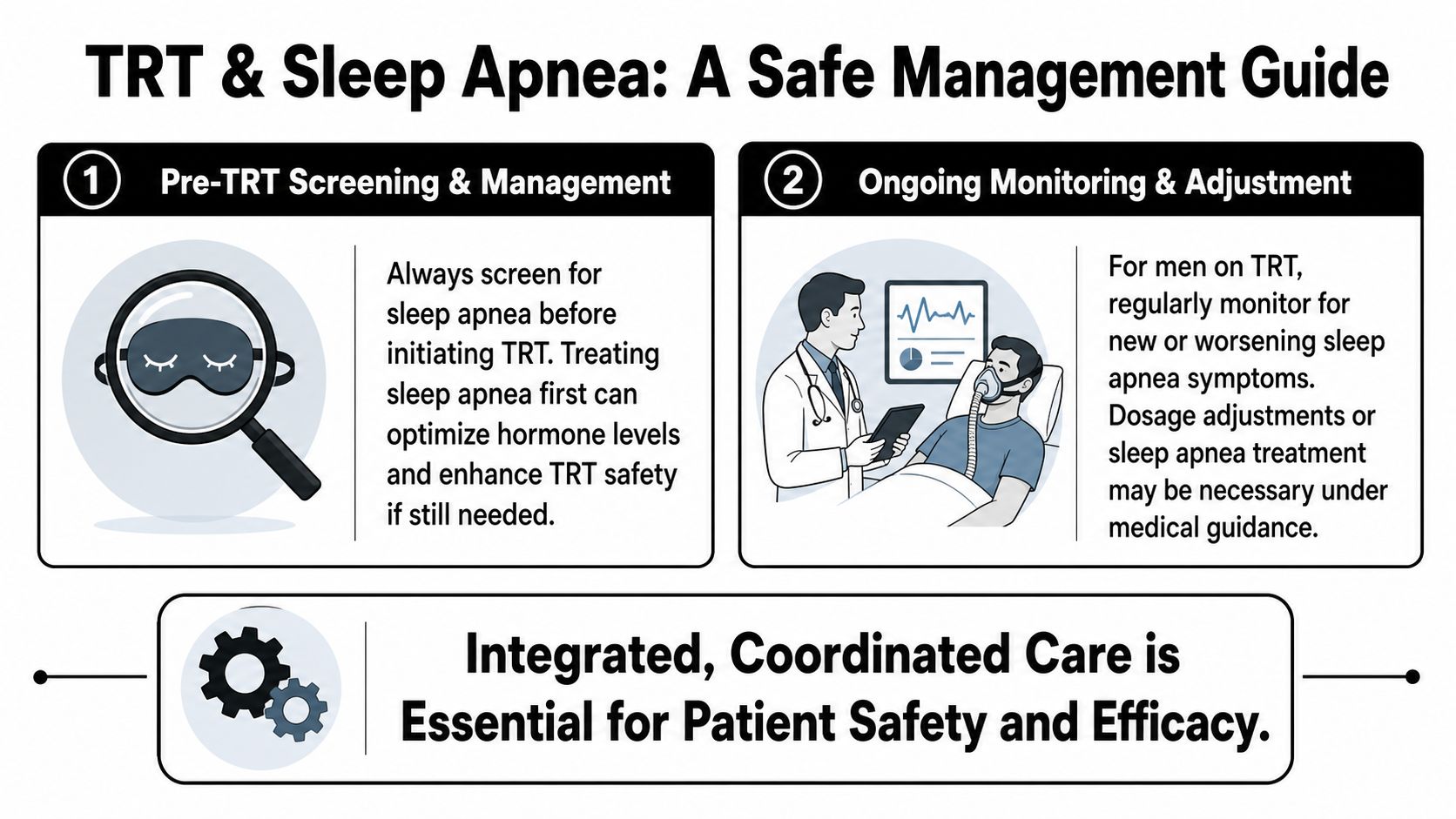
The safest approach is usually to address the sleep apnea first, especially if symptoms are significant or the condition appears severe. That doesn't mean testosterone therapy is automatically off the table. It means the airway and breathing issue shouldn't be ignored while hormones are being adjusted.
This caution exists for a reason. Clinical guidance notes that testosterone can worsen airway collapsibility and reduce ventilatory drive, so TRT should be avoided in men with severe untreated OSA, and men should be screened for OSA symptoms before and after starting therapy, as outlined in this review on OSA and testosterone therapy.
That's the trade-off many articles miss. A man may indeed need TRT. He may also have a sleep disorder that makes TRT riskier if it's untreated.
If you started TRT and then symptoms showed up
Men already on TRT need to watch for changes that suggest sleep apnea was either unrecognized before treatment or became more obvious afterward.
Pay attention if you notice:
- Snoring that got louder or more frequent
- New reports of pauses in breathing
- Worsening sleep quality despite stable TRT
- Morning headaches, unexplained fatigue, or daytime sleepiness
- A sense that treatment helped some symptoms but left the exhaustion untouched
That doesn't always mean TRT caused the problem. It does mean you shouldn't keep escalating treatment without checking the airway side of the equation.
What works and what doesn't
Here's the practical summary:
| Situation | Better move | Less useful move |
|---|---|---|
| Suspected OSA before TRT | Screen and test first | Starting TRT blindly |
| Treated OSA but ongoing low T symptoms | Reassess hormones and symptoms directly | Assuming CPAP will fix testosterone by itself |
| Fatigue on TRT with snoring | Evaluate for sleep apnea | Repeated dose changes without sleep review |
One key point from the evidence is that CPAP does not reliably raise serum total testosterone. A meta-analysis found a neutral effect, with a mean difference of 1.08 nmol/l (95% CI -0.48 to 2.64; p = 0.18) in the review linked above. That means treating sleep apnea is often essential for safety and symptom control, but it may not fully correct hypogonadism on its own.
Treating sleep apnea and treating low testosterone are related decisions, but they aren't interchangeable treatments.
For some men, the right plan is both. Treat the sleep apnea well. Then reassess symptoms, labs, and whether TRT is still needed, already appropriate, or needs adjustment.
Coordinating Your Care with a Telemedicine Clinic
Sleep apnea and testosterone become much harder to manage when care is split across disconnected visits. One doctor reviews hormones. Another handles snoring. The patient ends up carrying the whole story from office to office.

Why fragmented care creates problems
The biggest risk in fragmented care isn't just inconvenience. It's missed pattern recognition.
A man tells one clinic he's tired and has low libido. He tells another he snores and wakes with headaches. If those details never get pulled together, he may receive partial treatment for both problems and still feel poorly. That's how men end up with “normal” paperwork and abnormal daily function.
Telemedicine can help when the clinic takes a broad men's health view rather than treating testosterone as a standalone product. The right intake process asks about snoring, daytime fatigue, blood pressure, weight changes, medication use, and partner-observed breathing issues. Follow-up should also revisit those questions after treatment starts.
What good coordination looks like
Good coordinated care usually includes a few specific habits:
- Screening before treatment: Men with possible sleep apnea should be identified early.
- Symptom review after starting TRT: New snoring, poor sleep, or persistent fatigue shouldn't be brushed aside.
- Clear referral path: If OSA is suspected, the clinic should direct you toward testing and sleep specialist input when needed.
- Shared decision-making: Hormone treatment should be adjusted in the context of sleep quality, not in isolation.
If you want a practical starting point, the easiest move is to begin with a clinic that already understands this overlap and has an efficient online intake process for men getting started.
A good TRT clinic doesn't just ask whether your testosterone is low. It asks why you still feel bad.
That question prevents a lot of wasted time.
Frequently Asked Questions About TRT and Sleep Apnea
Can sleep apnea make testosterone problems look worse than they are
Yes. That's one of the most important clinical patterns here. Because sleep apnea can blunt the nightly testosterone rise while leaving some daytime measures less obviously abnormal, a morning lab test may not tell the full story. Symptoms can be more severe than the lab result suggests.
If I treat sleep apnea, will I automatically come off TRT
Not necessarily. Some men feel substantially better once sleep apnea is treated, especially if sleep fragmentation was a major driver of fatigue and low libido. But treatment of OSA doesn't reliably restore testosterone in every man, so hormone symptoms may still need separate evaluation.
Should I avoid TRT if I snore
Not automatically. Snoring is a reason to ask better questions, not to panic. If snoring is loud, chronic, or paired with gasping, witnessed apneas, morning headaches, or severe daytime fatigue, get screened before assuming TRT is straightforward.
I'm already on TRT and still exhausted. What should I ask my clinician
Ask whether your symptoms could reflect undiagnosed obstructive sleep apnea. Bring details, not generalities. Note snoring, partner observations, how rested you feel on waking, whether you get headaches, and whether your energy problem is worst in the morning or all day.
Can a telemedicine clinic help with this or do I need in-person care only
A good telemedicine clinic can screen for risk, monitor symptoms over time, coordinate lab review, and tell you when formal sleep testing is appropriate. If you want to understand how that process usually works, review the clinic's patient FAQ page before your consult.
If you're dealing with stubborn fatigue, low libido, or poor results on testosterone therapy, don't assume the answer is always more TRT. Cost Plus TRT helps men evaluate the full picture, including symptoms that may point to sleep apnea, so treatment decisions are safer, clearer, and better matched to how you feel.