

If you're reading about sildenafil vs tadalafil, you're probably not looking for a chemistry lesson. You want to know which one fits your life.
Most men asking this question are deciding between two very different experiences. One option is better if sex is usually planned and timing doesn't bother you. The other works better if you want a wider window, less pressure, and fewer logistics. That difference matters more than most comparison pages admit.
I explain it this way in practice. ED treatment isn't just about getting an erection. It's about restoring confidence without making intimacy feel scheduled, awkward, or medicalized. For some men, sildenafil is the straightforward answer. For others, tadalafil is the better fit because it changes the rhythm of treatment, not just the duration.
Both medications are established prescription options for erectile dysfunction. Both belong to the same medication family. Both can work very well when they're matched to the right patient and used correctly. If you're also comparing access, formulation, and convenience, it's worth reviewing the broader ED medication options available through telemedicine so you understand what a modern treatment plan can look like.
Table of Contents
- Introduction Choosing Your ED Treatment
- Sildenafil vs Tadalafil A Side-by-Side Comparison
- The Critical Difference Onset and Duration of Action
- Dosing Options Efficacy and Patient Preference
- Navigating Side Effects Safety and Interactions
- Real-World Cost Access and Telemedicine
- Making Your Choice Scenarios and Recommendations
Introduction Choosing Your ED Treatment
Choosing between Sildenafil and Tadalafil usually starts with a simple question: "Which one works better?" In real life, that isn't quite the right question.
The better question is this: Which medication works better for the way you live? If intimacy tends to happen on a schedule, a shorter-acting medication may be perfectly reasonable. If you want flexibility across a full day or even a weekend, the answer often changes.
What men usually care about most
In the exam room, the same practical concerns come up again and again:
- Timing: How far in advance do you need to think about it?
- Pressure: Does taking the pill create a countdown feeling?
- Meals and social plans: Will dinner or drinks interfere with the result?
- Frequency: Are you looking for occasional help or something that supports a more spontaneous sex life?
- Side effects: Are you more likely to be bothered by flushing, muscle aches, or back pain?
Those questions matter because the two drugs solve different problems.
The short version
Sildenafil is the classic on-demand option. Many men like it because it's direct, familiar, and tied to a shorter window.
Tadalafil lasts much longer and can also be prescribed as a daily medication. That gives it a very different role. Instead of planning around sex, some men use it to stay ready without having to think about timing each time.
Clinical reality: The "best" ED medication is usually the one that fits your relationship pattern, schedule, tolerance for planning, and side effect profile.
Sildenafil vs Tadalafil A Side-by-Side Comparison
For a quick read, this table captures the main trade-offs.
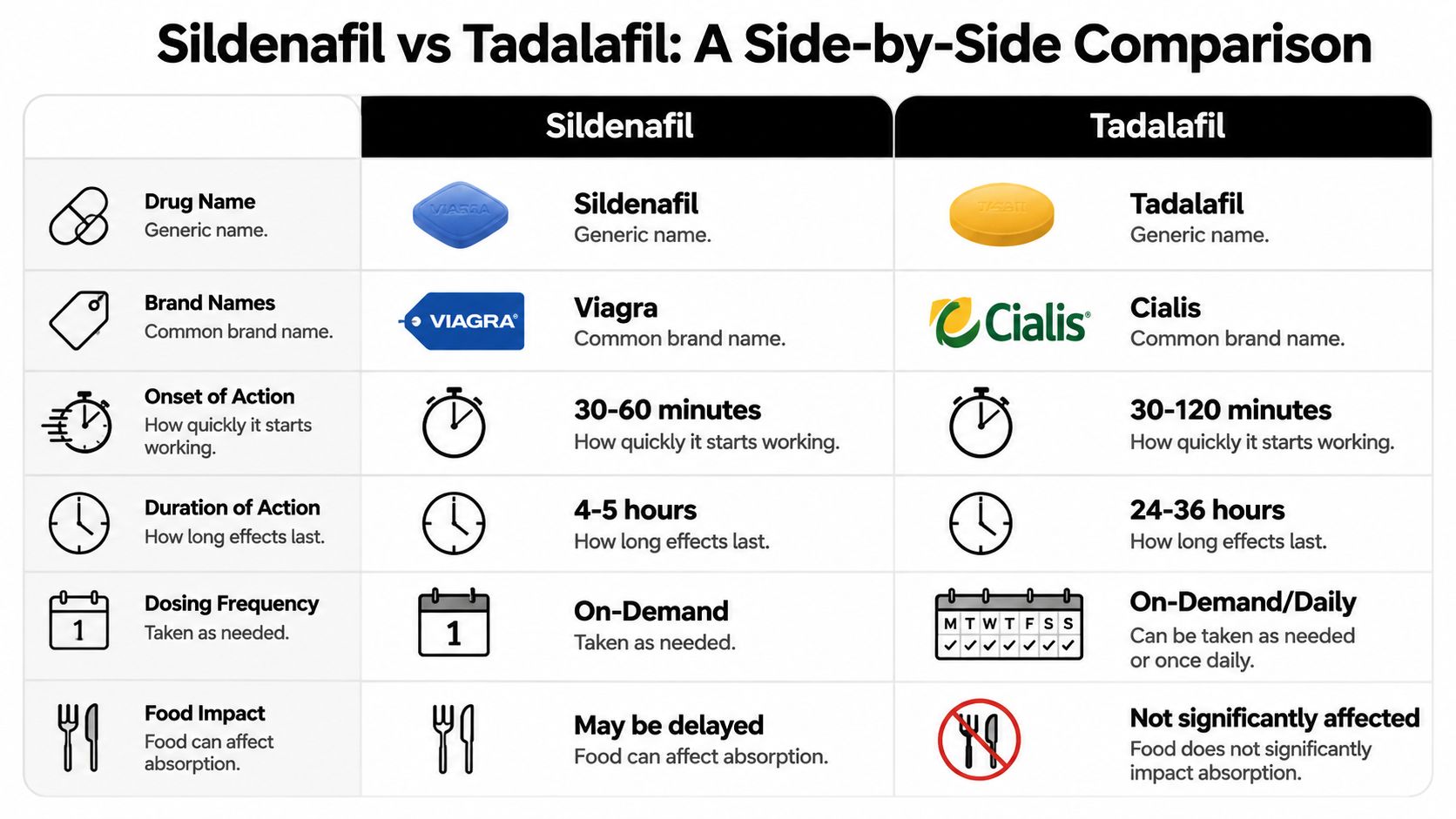
| Feature | Sildenafil | Tadalafil |
|---|---|---|
| Generic name | Sildenafil | Tadalafil |
| Common brand name | Viagra | Cialis |
| Onset | 30 to 60 minutes | 30 to 120 minutes |
| Duration | 4 to 5 hours | 24 to 36 hours |
| Dosing style | On-demand | On-demand or daily |
| Food impact | May be delayed by food | Not significantly affected |
| Side effect tendency | Flushing is more common | Back pain and myalgia are more common |
| Best lifestyle fit | Planned use | Flexibility and spontaneity |
What the table means in practice
The comparison isn't just about a stopwatch. Sildenafil tends to work best when you don't mind planning. You take it for a specific occasion, allow enough lead time, and try not to make the timing harder with a heavy meal.
Tadalafil changes the experience more than people expect. Because it lasts much longer, men often feel less pressure to make everything happen inside a narrow window. That can reduce performance anxiety in day-to-day life, even before you talk about formal study results.
Where men usually make the wrong choice
A common mistake is choosing based only on brand familiarity. Another is assuming longer duration always means better treatment.
That isn't true. Some men don't want a medication active in their system for that long. Others love the flexibility. Some care about meal timing. Others care more about whether they can stop thinking about the clock.
Choose based on your routine, not the marketing nickname.
The Critical Difference Onset and Duration of Action
A common real-world scenario is this. A man takes sildenafil after a late dinner, expects it to work on cue, then finds the timing feels off and the moment starts to feel scheduled. Another man takes tadalafil earlier in the weekend and stops watching the clock. Same goal, very different experience.
How the timing feels in real life
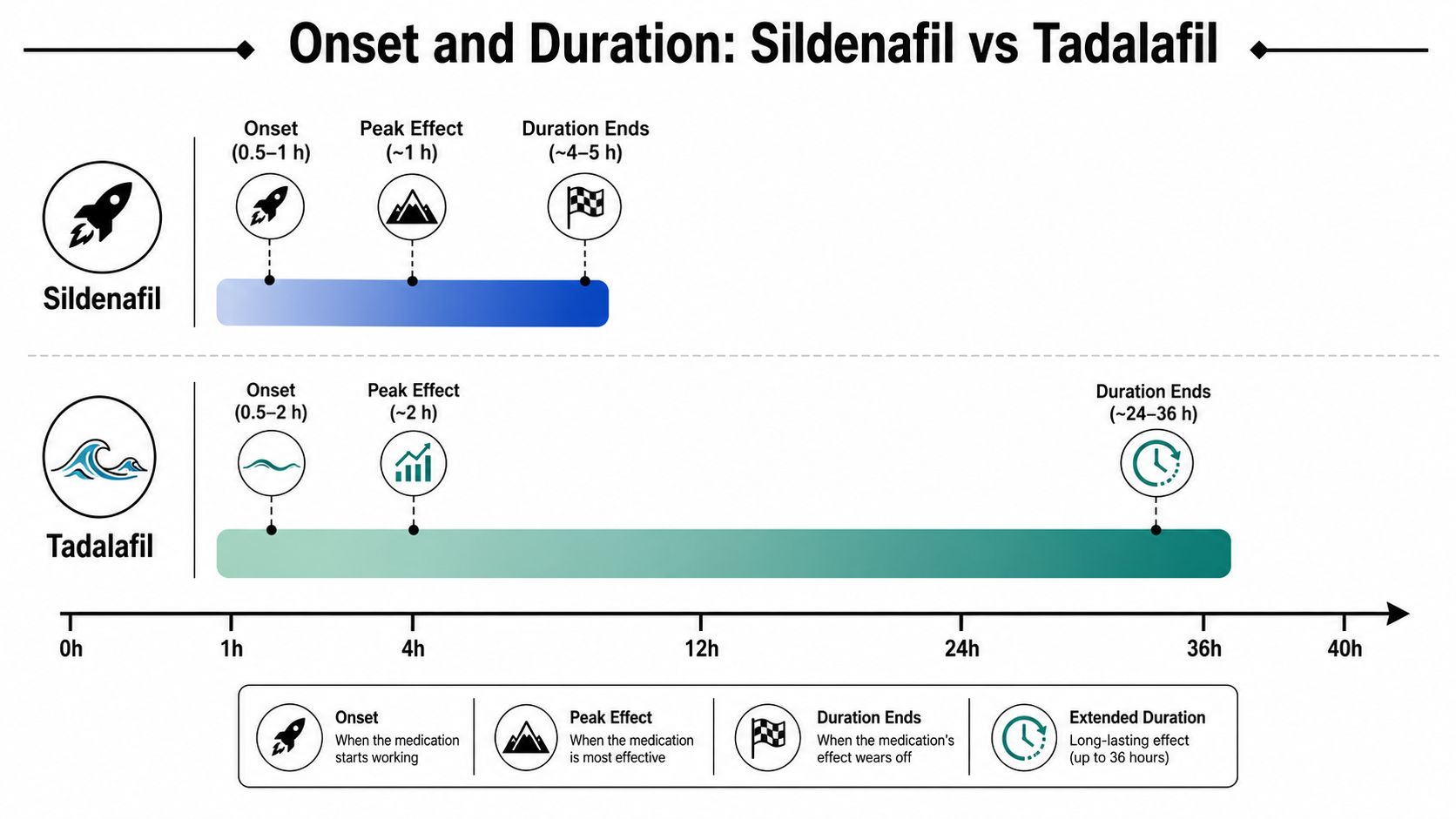
Sildenafil usually suits men who are comfortable planning ahead. You take it for a specific window, and that window is relatively contained. In practice, that can work well for date nights, predictable routines, or men who prefer a medication that is not active well into the next day.
Tadalafil gives a longer period of responsiveness. You still need sexual stimulation, but the timing is less rigid. That difference matters for couples dealing with real life variables such as childcare, shift work, travel, fatigue, or anxiety that builds when sex starts to feel scheduled.
The longer duration also changes how the medication feels psychologically. Men with performance anxiety, depression, or high stress often do better when they are not trying to match intimacy to a narrow dosing window. Less clock-watching can reduce pressure, even if the erection response itself is similar.
What duration actually means
Duration does not mean a continuous erection. It means the drug remains active long enough to support erectile response during that period.
That distinction matters in clinic. Some men hear "36 hours" and assume tadalafil is stronger in every situation. It is not. It is longer-acting. For the right patient, that is a major advantage. For another patient, it means a longer exposure to effects they may not want, including headache, nasal congestion, or muscle aches that can linger longer because the drug stays in the system longer.
A useful visual summary is below.
What the clinical comparison showed
A head-to-head trial published in Nature found that tadalafil maintained substantially better erectile response in the later post-dose period than sildenafil, which fits what many patients notice in practice in this Nature study comparing post-dose erectile function response.
For men on TRT, this can be especially relevant. Testosterone may improve libido without fully fixing erection quality. In that setting, a longer-acting PDE5 inhibitor can fit better if sexual interest returns but the timing of sex is not predictable. On the other hand, men who are testing whether they need ED medication at all, or who want the lowest-impact trial of treatment, often prefer sildenafil first because the experience is more contained.
Practical rule: Choose tadalafil if flexibility is the priority. Choose sildenafil if you want a shorter, more predictable treatment window.
Dosing Options Efficacy and Patient Preference
For many men, the decision is not which pill is "stronger." It is which dosing style fits their relationship, schedule, and tolerance for planning.

On-demand use versus daily use
Sildenafil is usually an on-demand medication. It suits men who want treatment for specific occasions and prefer not to take a pill every day.
Tadalafil can be used that way too, but its daily dosing option changes the conversation. It may be prescribed daily at low doses or taken as needed at higher doses, as described in this tadalafil versus sildenafil clinical overview. That gives patients a practical choice between a scheduled routine and an event-based approach.
The difference matters in ordinary life. Some men are comfortable planning sex. Others dislike the feeling that intimacy starts with checking the clock, avoiding a heavy meal, or deciding whether tonight is worth using a dose.
Who tends to prefer daily tadalafil
Daily tadalafil tends to work well for a few specific groups:
- Men having sex more than occasionally: A daily regimen can be simpler than repeating the same pre-sex routine several times a week.
- Couples who want less planning: Removing the dosing step often makes intimacy feel more natural.
- Men on TRT: Testosterone can improve desire before it fully improves erection quality. In that setting, a daily PDE5 inhibitor often matches the return of libido better than an as-needed pill.
- Men with both ED and urinary symptoms: Daily tadalafil may make more sense when one prescription can address more than one problem.
I often see this in clinic with men who are already managing TRT, antidepressants, blood pressure treatment, or shift-work fatigue. They are not asking for another complicated protocol. They want something they can use consistently without turning sex into a task.
What efficacy means in practice
Both drugs can work very well. Patient preference usually comes down to reliability within a chosen routine, not just headline response rates.
Daily tadalafil often gets higher satisfaction from men who value spontaneity or have sex often enough that repeated on-demand dosing becomes annoying. Sildenafil often remains a good first choice for men who want a lower-commitment trial, have sex less often, or prefer to limit medication exposure to a narrower window.
That distinction also matters for men with depression or anxiety. If sexual activity already carries performance pressure, an on-demand pill can either help by giving structure or make things worse by creating a countdown. Daily tadalafil can reduce that mental load for some patients. Others prefer sildenafil because they want a medication they can use selectively while they sort out whether mood, relationship stress, sleep, or an SSRI is driving the problem.
Patient preference is usually about routine, not brand loyalty
In practice, the pattern is pretty consistent:
- A man who wants treatment only on selected nights often prefers sildenafil.
- A man who dislikes timing sex around medication often prefers tadalafil.
- A man trying to keep costs down through telemedicine may choose based on the cheapest effective dosing strategy, which is not always the same as choosing by duration alone.
- A man taking several medications already may prefer the option that creates the fewest extra decisions.
If a patient says, "I want sex to feel less medical," tadalafil often fits better. If he says, "I only want to use something when I need it," sildenafil usually makes more sense.
Navigating Side Effects Safety and Interactions
Side effects matter less in theory than they do at 10 p.m. on a night you planned to have sex. The practical question is simple. Which drug fits your body, your medication list, and your routine with the least hassle and the lowest risk?
Common side effects and how they differ
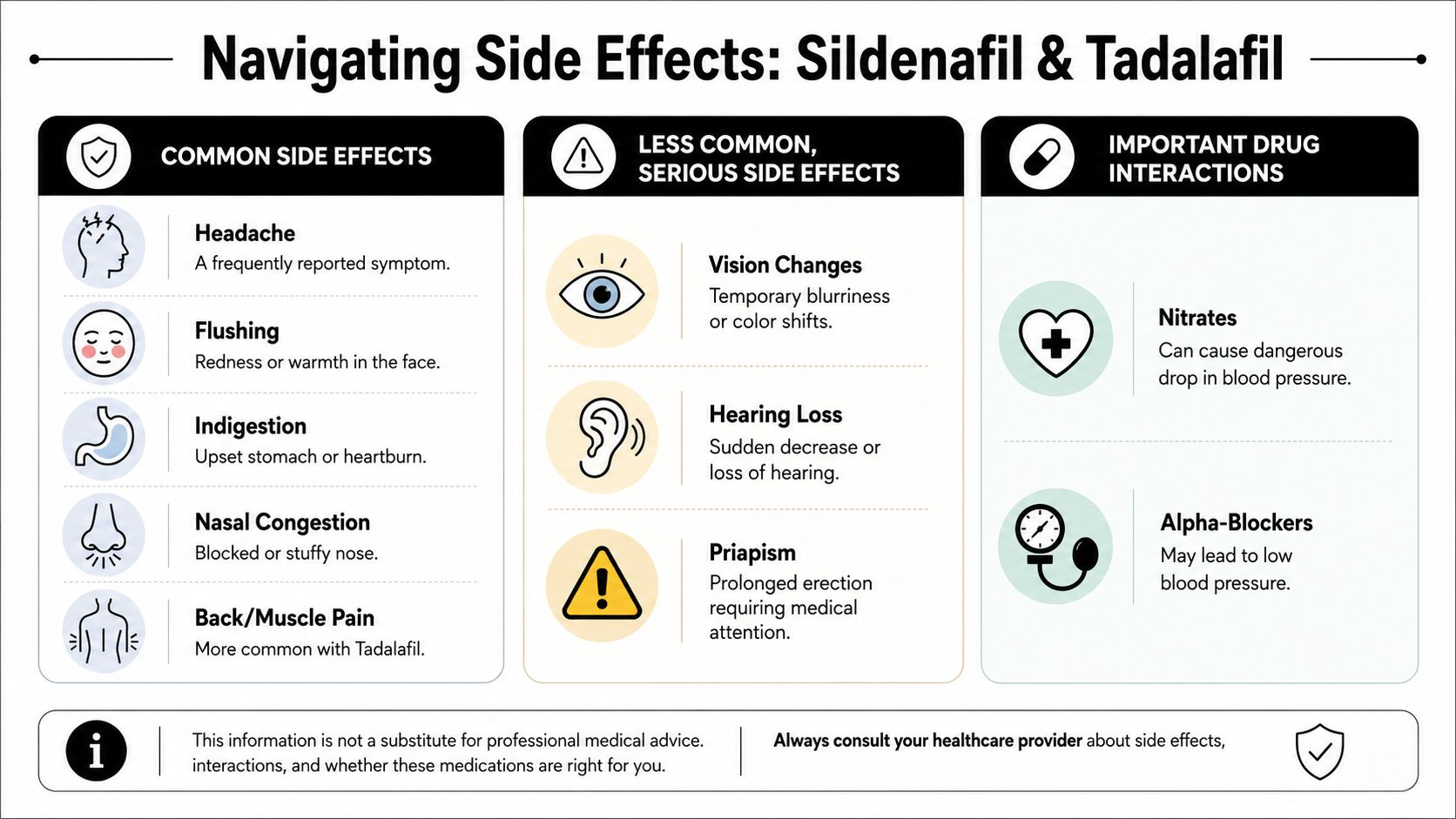
Sildenafil and tadalafil are both PDE5 inhibitors, so the overlap is substantial. Headache, flushing, nasal congestion, indigestion, and lightheadedness are the complaints I hear most often in clinic.
The difference is usually in the pattern, not the severity. Sildenafil more often bothers men who dislike facial flushing or a brief "pressure in the head" feeling. Tadalafil more often causes muscle aches or low back discomfort, which can be more noticeable the next day because the drug stays in the system longer.
That trade-off changes the right choice for some patients. A man who has a physically demanding job, lifts regularly, or is already dealing with back pain may find tadalafil more annoying than its longer window is worth. A man who hates the flushed, congested feeling some men get with sildenafil may prefer tadalafil even if the onset is less predictable for him.
Food, alcohol, sleep, and hydration also change the experience. Heavy alcohol use increases the chance of dizziness and can make either drug feel less reliable. Poor sleep, large meals, and high stress do not create a drug interaction, but they often worsen the situation men blame on the medication.
Serious symptoms need prompt care
Most side effects are nuisance issues. A few are not. Get urgent medical care for any of the following:
- An erection lasting more than 4 hours
- Sudden vision loss or major vision change
- Sudden hearing loss or a sharp drop in hearing
- Chest pain, fainting, or severe dizziness after taking the medication
Stop the drug until you have been evaluated. Do not keep testing lower or higher doses at home if something serious happened once.
Interactions that change prescribing
The nitrate interaction is the one every patient needs to know. If you use nitroglycerin or any nitrate medication for chest pain or heart disease, sildenafil and tadalafil may be unsafe because the combination can drop blood pressure to a dangerous level.
Alpha-blockers need more nuance. Men taking tamsulosin, doxazosin, or similar medications for urinary symptoms or blood pressure may still be able to use a PDE5 inhibitor, but dose selection and timing matter. This is especially common in men over 50 who are managing both ED and BPH.
This is also where comorbidities matter. Men with depression or anxiety are often taking SSRIs, SNRIs, trazodone, or other psychoactive medications. Those drugs do not usually create the same hard stop as nitrates, but they can change libido, orgasm, arousal, blood pressure, and overall sexual response. If a patient says, "the pill works sometimes but sex still feels flat," I look at the antidepressant list before I blame the ED drug.
Men on TRT are another group worth separating out. Testosterone therapy does not create a routine drug interaction with sildenafil or tadalafil, and many men use them together. The practical issue is expectation. If erectile function is still weak despite normalized testosterone, the next step is usually to review estradiol, hematocrit, sleep, alcohol intake, blood pressure, and medication timing, not just keep increasing the PDE5 dose. Patients comparing ongoing care options should also look at clear TRT and men's health pricing before committing to a long-term plan.
Do not combine them on your own
Some men try to stack sildenafil and tadalafil after a disappointing result with one pill. I do not recommend that without physician guidance.
A urology discussion on combined use explains why the idea is not automatically irrational, but safe use depends on dose, timing, cardiovascular risk, and the rest of the medication list, not guesswork at home in this review of combination sildenafil and tadalafil use.
If one agent is underperforming, the usual fixes are more boring and more effective. Check whether the dose was adequate, whether the pill was taken correctly, whether anxiety or alcohol interfered, and whether an underlying issue such as diabetes, vascular disease, depression, or poor sleep is doing more of the damage than the prescription itself.
Real-World Cost Access and Telemedicine
The medication choice isn't only about pharmacology. Access changes adherence. If getting treatment feels expensive, inconvenient, or embarrassing, many men delay care or use the medication inconsistently.
Generics changed the conversation
Brand-name recognition still drives a lot of online searches, but in practice most men should be thinking about generic sildenafil and generic tadalafil. That's usually where treatment becomes more sustainable.
The practical advantage isn't just lower pharmacy cost. It's the ability to tailor the form and plan to the patient's routine. Some men prefer capsules. Others prefer chewables or troches because they find them easier to take or simpler to keep on hand.
Telemedicine changed how men start treatment
A modern telemedicine workflow solves several old barriers at once:
- Privacy: You don't have to sit in a waiting room to discuss ED.
- Convenience: Consults, prescribing, and follow-up can happen from home.
- Consistency: It's easier to stay on treatment when refills and communication are straightforward.
- Price visibility: Transparent pricing makes comparison much easier than the old retail model.
If you're comparing ongoing care options, review a clinic's transparent treatment pricing and service structure before you commit. The best setup is one you can maintain.
What works and what doesn't
What works is a system that makes the medication easy to obtain, easy to refill, and easy to adjust with clinician input.
What doesn't work is relying on inconsistent online sellers, mystery formulations, or unmonitored dose changes. ED treatment succeeds when access is simple and medically supervised. Men stay with treatment longer when the process feels normal, not burdensome.
Making Your Choice Scenarios and Recommendations
Most men don't need a winner. They need a match.
Sildenafil often fits these patients
If your sex life is fairly predictable, or you prefer taking medication only when needed, sildenafil is often the cleaner choice. It can also make sense if you want a shorter treatment window and don't like the idea of a medication lingering much longer than the specific occasion.
This is often the better fit for what I'd call the planner.
Tadalafil often fits these patients
If you want more freedom around timing, tadalafil usually has the edge. It's especially useful for men who don't want intimacy tied to a countdown, men in established relationships, and men on TRT who feel libido has improved but want more consistent erectile support.
It's also the medication I think about first for the spontaneous partner and for men with BPH symptoms who may benefit from a daily approach.
The depression and mood angle matters
One important patient group gets overlooked in most consumer comparisons: men dealing with ED alongside depressive symptoms.
A 2024 study found that daily tadalafil significantly improved penetration ability and reduced depression symptoms compared with on-demand sildenafil, and it recommended tadalafil specifically for men with co-morbid depressive symptoms in this study on comparative efficacy and mood-related outcomes.
That doesn't mean tadalafil is an antidepressant. It means treatment choice may matter more when mood, pressure, and relationship strain are all part of the picture.
If oral medication isn't the full answer
Some men respond only partially to pills, or want another option for specific situations. In those cases, it's reasonable to discuss alternatives such as PT-141 peptide therapy for sexual health support with a clinician rather than forcing higher doses or mixing drugs on your own.
The right choice is the one you can use safely, consistently, and with less mental friction in your actual life.
If you're weighing sildenafil vs tadalafil and want physician-guided treatment without the usual clinic hassle, Cost Plus TRT offers telemedicine-based men's health care with transparent pricing, home delivery, and access to ED medication options alongside TRT and related therapies.