
You've probably had this moment already. You finish a routine testosterone injection, feel around the area a day or two later, and notice a small firm spot that wasn't there before. It may be a little tender. It may feel rubbery, or like a knot under the skin. Your first thought is usually one of two things: “Did I mess up the injection?” or “Is this going to affect my TRT?”
Most of the time, this is a manageable injection-site issue, not a crisis. But it does deserve attention, especially if you've been injecting for months or years. Men on TRT often get generic advice borrowed from insulin education, and some of it applies. Some of it doesn't. Testosterone therapy brings its own practical questions about IM vs. SubQ, oil-based medication, injection frequency, and whether a lumpy area can change how reliably your dose absorbs.
Table of Contents
- The Common Concern with Injectable Therapy
- How to Recognize Scar Tissue and Why It Forms
- The Foundation of Prevention Proper Injection Technique
- Building Your Site Rotation Master Plan
- At-Home Therapies for Existing Lumps and Bumps
- When to See Your Doctor Medical Treatments and Red Flags
The Common Concern with Injectable Therapy
A common TRT scenario goes like this. A man starts out rotating well, then gets busy and falls into a pattern. Same glute. Same delt. Same side of the abdomen for SubQ shots because it's quick and familiar. A few weeks later, he notices a knot that seems to linger longer after each injection.
That knot may be scar tissue from injections, or it may be a fatty thickened area called lipohypertrophy. In plain terms, repeated shots can change the tissue under the skin. Sometimes the area feels dense and ropy. Sometimes it feels soft and rubbery. Either way, the tissue is no longer behaving like healthy, undisturbed tissue.
This matters for more than comfort. When injection sites get overused, absorption can become less predictable. For men on testosterone, that can translate into common complaints I hear most often: a site that keeps getting irritated, injections that seem to sting more than they used to, and results that feel less steady than expected.
Practical rule: If a spot has become your “easy” or “go-to” site, it's probably the first place to audit.
This isn't the same thing as an infection. Infection usually brings more obvious warning signs such as spreading redness, warmth, drainage, or feeling unwell. Scar tissue and lipohypertrophy are usually slower, quieter problems. They build over time.
If you're already on testosterone replacement therapy through a telemedicine clinic, it's worth treating injection-site health as part of the therapy itself, not as an afterthought. Good technique and rotation protect the consistency of the treatment you're already paying attention to.
How to Recognize Scar Tissue and Why It Forms
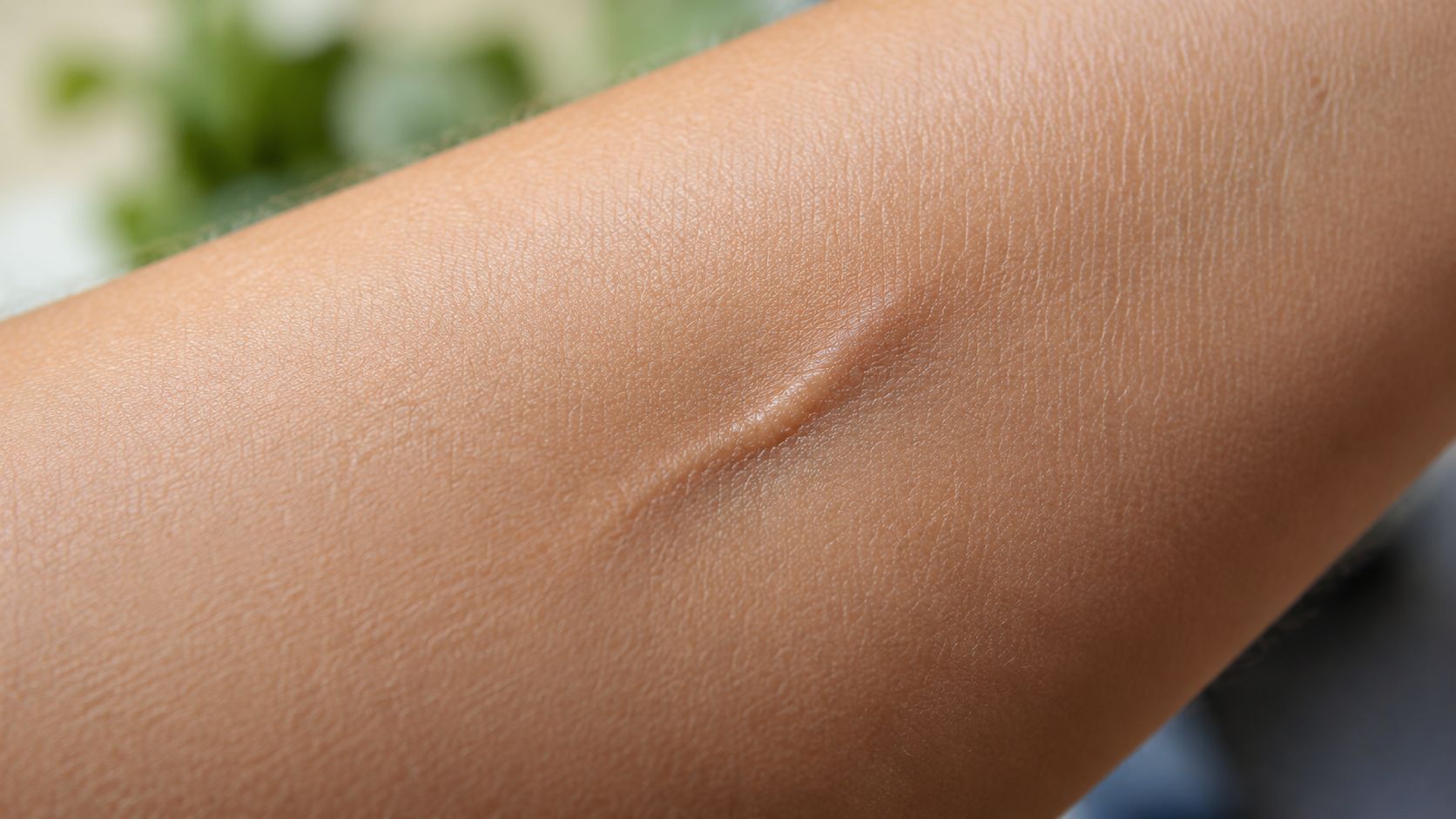
Some men describe it as a marble under the skin. Others say it feels like a cord, a knot, or a patch that's just tougher to push through with the needle. Those descriptions are useful, because the texture often tells you what kind of tissue change you're dealing with.
What the lump usually feels like
Fibrosis, which is the scar tissue side of the problem, often feels firmer. It may seem nodular, tight, or resistant when you inject into it. Men doing IM testosterone sometimes notice this first as unusual pressure during the shot, or a site that stays sore longer than usual.
Lipohypertrophy tends to feel different. It's often more rubbery or padded, like the tissue has thickened. It can still be lumpy, but not always in a sharply defined way.
A simple self-check helps:
- Run your fingertips over both sides and compare one side to the other.
- Notice texture changes such as firmness, rope-like bands, or a rubbery pad.
- Pay attention during injection if the needle meets unusual resistance.
- Watch what happens after the shot if one site repeatedly becomes more swollen, more tender, or slower to settle down than the others.
Why TRT patients should care
Each injection is a small, controlled injury. When you repeat that injury in the same area, your body keeps trying to repair it. A peer-reviewed review on injection-site fibrosis describes this as a chronic wound-healing problem driven by repeated minor trauma. The same review notes that there's no established preventive treatment beyond site rotation, and practical guidance includes giving a site 5 to 7 days of rest between uses.
In insulin users, this isn't rare. WebMD's review of lipohypertrophy notes it has been reported in up to 62% of people with type 1 or type 2 diabetes, and that it's described as twice as common in people using medium- or long-acting insulin compared with short-acting insulin. That same clinical guidance matters because medication placed into altered tissue may be absorbed poorly, and affected areas should be avoided for at least two to three months while they heal. In some cases, healing takes months or even years.
TRT isn't insulin, but the tissue response to repeated puncture is still relevant. If you keep injecting testosterone into lumpy, fibrotic, or thickened tissue, you're choosing the least reliable patch of real estate you have.
The Foundation of Prevention Proper Injection Technique
A lot of men think prevention starts with rotation alone. Rotation matters most over the long run, but the way you perform each individual injection still affects how much tissue trauma you create.
Match the needle to the route
TRT patients often switch between intramuscular and subcutaneous protocols, and the mechanics aren't interchangeable.
For IM injections, the goal is to reach muscle cleanly without excessive movement, repeated poking, or forcing an awkward angle. For SubQ injections, the goal is controlled placement into the fatty layer under the skin, not too shallow and not buried into irritated tissue from the last shot.
What usually causes trouble is not some dramatic mistake. It's the accumulation of small habits:
- Using the same exact site repeatedly because it's easy to reach
- Pushing through a dense old spot because “it worked last time”
- Changing angles mid-injection after the needle is already in
- Using a dull needle after unnecessary extra handling or repeated passes
If your protocol includes other injectables alongside TRT, keep the mechanics distinct. Men who also use physician-supervised peptide therapies often develop bad habits by treating every injection the same way. They're not the same. Oil-based testosterone in muscle doesn't behave the way a small-volume SubQ shot does.
Reduce tissue trauma during the injection
The cleanest injection is usually the least eventful one. Set up the site, insert decisively, keep your hand steady, and inject in a slow controlled way instead of jamming the plunger.
Afterward, don't turn post-shot care into more irritation.
- Use gentle pressure: A clean cotton pad or gauze with light pressure is enough if there's a tiny bit of spotting.
- Skip aggressive rubbing: Vigorous massage right after the shot can make an already irritated site angrier.
- Respect a site that hurt more than usual: If one area burned, resisted, or felt unusually tight, don't return to it on your next cycle.
- Keep notes if needed: If one delt or one side of the glute repeatedly gives you trouble, write it down. Memory gets unreliable once injections become routine.
A “tough” site is not a badge of experience. It's usually feedback.
One more point specific to testosterone. Men often blame the medication when the issue is the tissue. If a shot feels inconsistent from one week to the next, don't assume the vial changed. Check whether your technique or site selection did.
Building Your Site Rotation Master Plan
Most men don't need a more complex injection routine. They need a more deliberate one. Rotation works best when you stop thinking in terms of one preferred spot and start thinking in terms of multiple zones that each get real recovery time.
Think in zones not in one favorite spot
A Cleveland Clinic guide on lipohypertrophy gives the most useful practical rule here. The best-supported prevention strategy is site rotation, because repeated injections in the same area can create lipohypertrophy and fibrosis that interfere with absorption. It also advises avoiding affected areas for at least 2 to 3 months until they normalize, spacing injection sites at least a finger-width apart, and changing sites each time.
For men on TRT, that means building a map.
For SubQ testosterone, common zones include:
- Lower abdomen, avoiding a previously irritated patch
- Love handle or flank area
- Upper outer thigh fat, if your clinician has shown you the technique
For IM testosterone, common zones include:
- Left glute
- Right glute
- Left ventrogluteal area
- Right ventrogluteal area
- Left delt
- Right delt
The mistake is clustering shots inside one small circle and calling it rotation. That's not rotation. That's repeated injury with minor variation.
A sample rotation you can actually follow
If you inject twice weekly, use a schedule simple enough to maintain without guessing. Here's a sample structure.
| Week | First Injection (e.g., Monday) | Second Injection (e.g., Thursday) |
|---|---|---|
| Week 1 | Left ventrogluteal | Right ventrogluteal |
| Week 2 | Left delt | Right delt |
| Week 3 | Left glute | Right glute |
| Week 4 | Left ventrogluteal, different point from Week 1 | Right ventrogluteal, different point from Week 1 |
That table is a framework, not a rigid prescription. If you use SubQ instead of IM, apply the same principle across abdominal and flank zones. The key is that each injection lands in a different point within a broader region, not on top of the last one.
A few rules make rotation easier to follow:
- Retire problem sites early: If a spot is lumpy, dense, or repeatedly sore, pull it out of circulation.
- Use a phone note or body map: Men are often surprised by how quickly they lose track once life gets busy.
- Don't chase convenience: The site you can reach fastest is often the one you overuse.
- Return only when the tissue feels normal again: If a spot still feels thickened, it isn't ready.
Done well, rotation protects comfort, preserves tissue quality, and helps keep your testosterone delivery more consistent over the long term.
At-Home Therapies for Existing Lumps and Bumps
Once you already have a lump, the first step is simple. Stop injecting into it. Men lose time by trying to “work around” a problem area while still using the same zone.
What to do first
Give the area a real break. The earlier review on injection-site fibrosis described above recommends 5 to 7 days of rest between uses of a site, and in real-world practice an established lumpy area often needs much longer before it feels normal again. What matters is not the calendar alone. What matters is whether the tissue has softened and settled.
Supportive care can help, but it doesn't replace rotation. There's no established preventive treatment beyond site rotation in the review literature linked earlier, which is why the home plan should stay grounded and boring rather than aggressive and experimental.
Leave the area alone long enough for healing to happen. Most setbacks come from returning too soon.
A short visual guide can help if you want a quick refresher:
Supportive care that can help
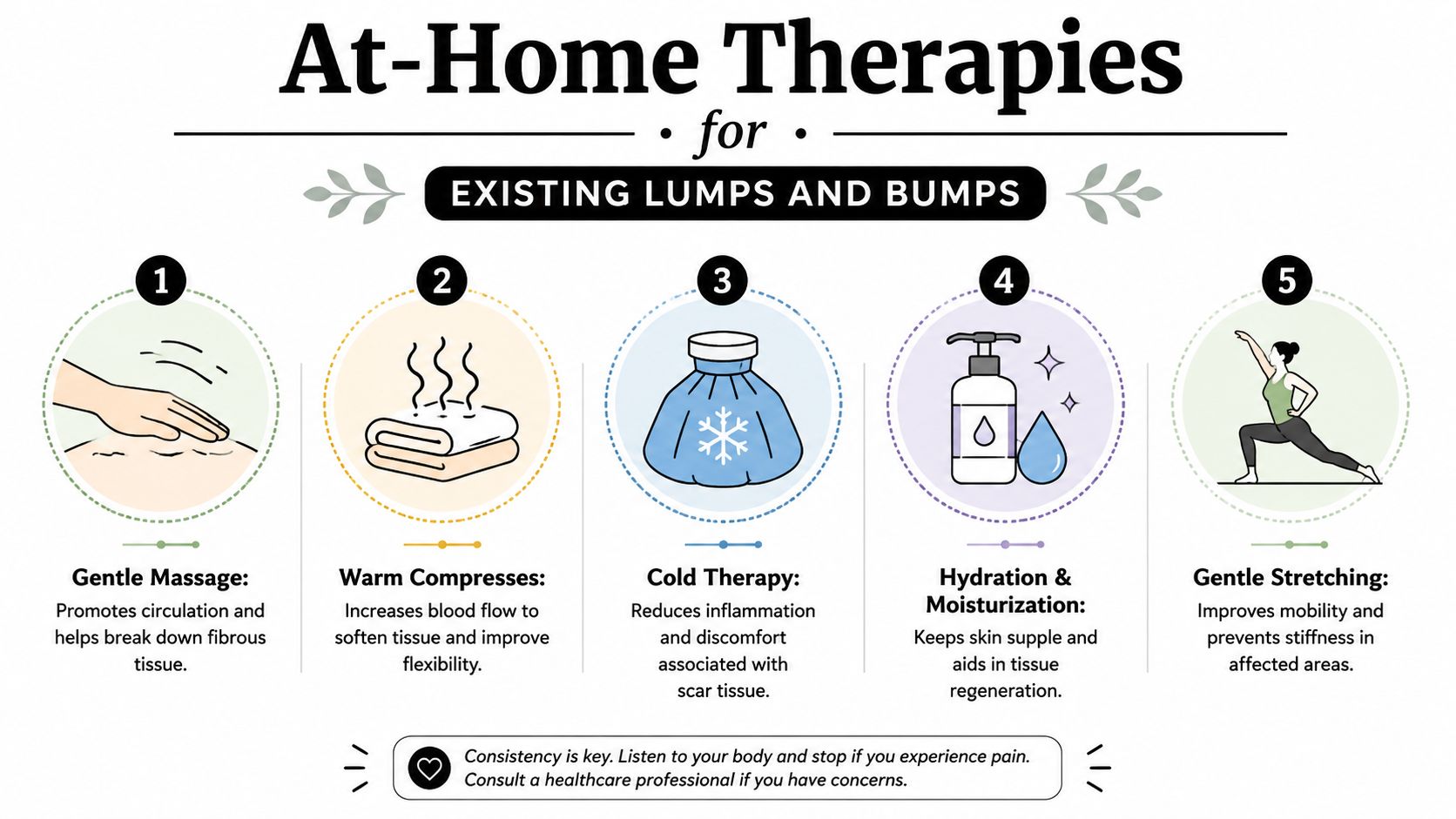
At home, I prefer a conservative approach. You're trying to calm tissue down, improve comfort, and avoid adding more irritation.
- Gentle warmth: A warm compress can make a tight area feel less stiff and may help you tolerate the healing phase more comfortably.
- Light massage only if it isn't painful: Think soft circular pressure, not deep tissue work. If the area gets more irritated afterward, back off.
- Cold for soreness: If a recent injection site is inflamed or achy, brief cold therapy can help with comfort.
- Moisturized, healthy skin: Dry, irritated skin isn't the main problem, but keeping the surface healthy helps avoid extra friction and picking.
- Normal movement: Gentle stretching and regular activity can keep the area from feeling guarded or tight.
What doesn't work well is overreaction. Don't dig into the lump with aggressive massage tools. Don't keep testing the area by injecting “just nearby.” Don't assume every topical product marketed for scars belongs on an irritated injection site.
A useful home check is whether the tissue is becoming less noticeable, less tender, and less resistant over time. If it is, keep rotating away from it and stay patient. If it isn't changing, or it's getting more painful, that's the point to escalate.
When to See Your Doctor Medical Treatments and Red Flags
Most injection-site lumps improve with time, smarter technique, and disciplined rotation. Some don't. That's when it helps to stop self-managing and have someone assess the tissue.
Red flags that need medical review
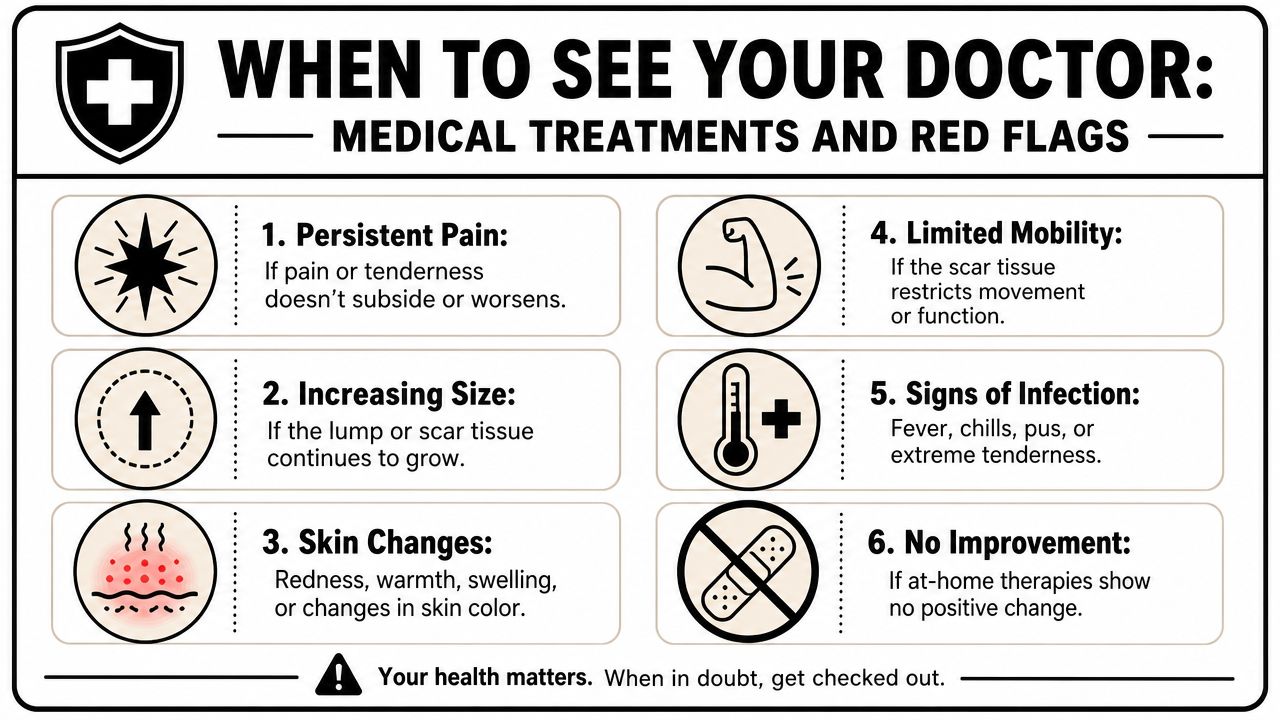
Get evaluated if you notice any of the following:
- Persistent pain: The area stays tender or becomes more painful instead of settling down.
- Increasing size: The lump keeps enlarging rather than flattening or softening.
- Skin changes: Redness, warmth, swelling, or unusual discoloration develops over the site.
- Restricted movement: The tissue starts to interfere with normal use of the shoulder, hip, or nearby muscle group.
- Signs of infection: Fever, chills, pus, or marked tenderness deserve prompt medical attention.
- No improvement: You've rested the area and changed technique, but the site remains abnormal.
Treatments your clinician may offer
For true raised scars such as hypertrophic scars and keloids, intralesional corticosteroid injection is a standard first-line treatment. A clinical summary on cortisone injections for scar tissue notes that clinicians commonly inject triamcinolone acetonide directly into the scar, and that improvement often takes multiple sessions spaced weeks apart rather than one treatment. The same summary cites a 70% to 80% positive response rate overall, while other reviews it discusses report improvement in up to 50% to 100% of keloid cases depending on regimen and follow-up.
That treatment is useful, but it's not something to self-diagnose your way into. Not every post-injection lump is a scar that should be injected. Some are overused sites that need rest. Some are inflammatory reactions. Some need to be examined because they don't fit the usual pattern.
If you're not sure what you're dealing with, ask. A quick message or visit is better than months of injecting around a worsening site. If you need individualized guidance, reach out through the Cost Plus TRT contact page.
If you're dealing with scar tissue from injections, recurring lumps, or sites that just don't feel right anymore, Cost Plus TRT can help you review your technique, rotation plan, and treatment options with a licensed provider. The goal isn't just to keep you injecting. It's to keep your therapy comfortable, consistent, and sustainable over the long run.