
You've booked a Quest appointment because you're tired, your recovery feels poor, or your sexual function has changed. You may already be comparing testosterone replacement therapy clinics, and the next question seems simple: which testosterone test should you order? It matters more than most men realize. The assay, collection time, supplement use, specimen handling, and follow-up testing can all affect whether the result helps a clinician or creates another round of uncertainty.
A Quest Diagnostics testosterone test isn't one single product. Quest offers total testosterone testing by immunoassay, free and bioavailable testosterone panels, and a higher-precision LC-MS/MS pathway. The right choice depends on whether you're obtaining an initial measurement, confirming a potentially low result, investigating symptoms that don't match total testosterone, or monitoring treatment.
Table of Contents
- Choosing the Right Quest Diagnostics Testosterone Test
- Preparing for Your Blood Draw to Avoid Invalid Results
- Scheduling and Completing Your Quest Visit
- Understanding Immunoassay Versus LC-MS/MS Testing
- Interpreting Your Results and Planning Next Steps
- Uploading Quest Results to Cost Plus TRT
Choosing the Right Quest Diagnostics Testosterone Test
A man booking his first Quest visit may search “testosterone” and select the first result. That can provide a basic measurement, but the order should match the clinical decision ahead: screening, confirmation, evaluation of a mismatch between symptoms and total testosterone, or treatment monitoring.
Quest lists Testosterone, Total, Males (Adult), Immunoassay as test code 873, with CPT code 84403. The adult male reference range shown for total testosterone is 250 to 827 ng/dL in the Quest test directory. That interval helps with interpretation, but it does not establish hypogonadism on its own.
Quest also lists Testosterone, Free, Bioavailable and Total, Males (Adult), Immunoassay. The panel uses the same adult male total testosterone interval and requires a 2 mL serum sample collected in a red-top tube without gel, according to the Quest panel details. Confirm the specimen requirements when ordering, because an incorrect tube can delay testing or require a redraw.
Match the test to the clinical question
For a straightforward first measurement, a clinician may order total testosterone. Free testosterone can add useful information when total testosterone is near the lower end of the laboratory interval or when sex hormone-binding globulin, known as SHBG, may be abnormal. Quest identifies free testosterone measurement as guideline-indicated in those circumstances (Quest guidance on hypogonadism and low testosterone).
If hypogonadism is suspected and the result is low or borderline, ask whether Total Testosterone LC-MS/MS is the better confirmatory order. Quest states that its LC-MS/MS assay is certified through the CDC Laboratory/Manufacturer Hormone Standardization Program, known as HoSt, and is the Endocrine Society-recommended assay for healthy men older than age 18.
| Test Name | Test Code | Best For |
|---|---|---|
| Testosterone, Total, Males, Adult, Immunoassay | 873 | An initial total testosterone measurement when a clinician has selected immunoassay |
| Testosterone, Free, Bioavailable and Total, Males, Adult, Immunoassay | Quest panel listing | Borderline total testosterone or suspected SHBG-related interpretation issues |
| Total Testosterone LC-MS/MS | Quest LC-MS/MS pathway | Confirmatory or higher-precision evaluation, particularly with low-concentration or borderline results |
A free testosterone panel does not replace total testosterone automatically. It adds context, while interpretation still depends on symptoms, medical history, collection timing, and repeat testing when indicated. Choose the order that answers the provider's question and can be repeated consistently if treatment begins.
Preparing for Your Blood Draw to Avoid Invalid Results
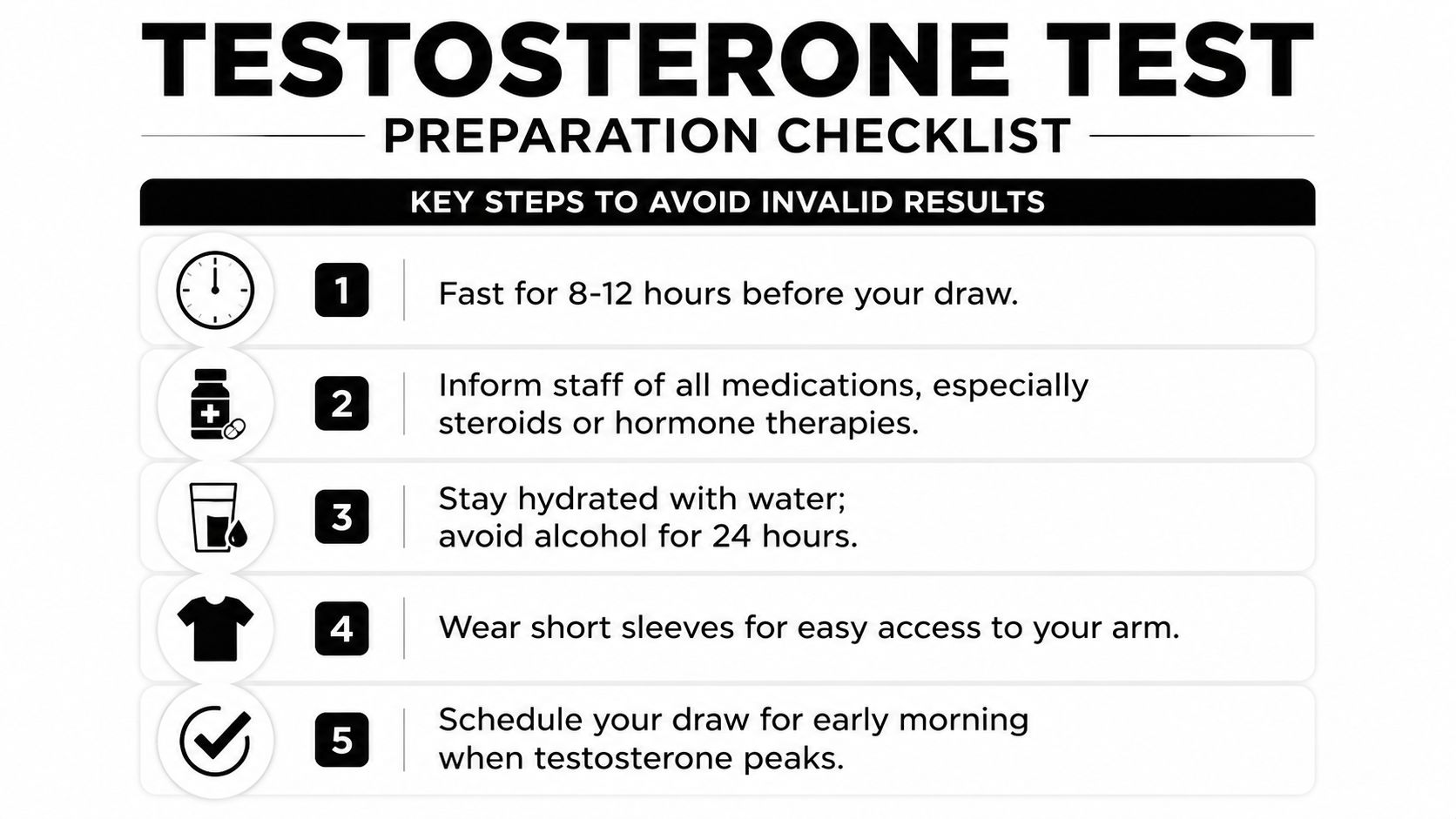
Timing is the first operational detail to control. Testosterone follows a daily pattern, so Quest's adult immunoassay protocol recommends two morning specimens on different days, ideally between 8:00 and 10:00 a.m. (Quest male reproductive testing guide). An afternoon appointment may produce a number that can't be compared fairly with a properly timed morning result.
Quest also notes that a low testosterone result should be confirmed with a second 8 a.m. measurement before treatment (Quest hypogonadism guidance). One abnormal result is a reason to verify the finding, not an automatic instruction to start therapy.
The preparation details patients miss
Biotin deserves special attention. Quest warns that biotin can interfere with results in either direction, making a result falsely high or falsely low. The guidance says to hold standard daily biotin for at least 8 hours before the draw, while mega-dose products require at least 72 hours (Quest specimen and preparation guide). Tell the ordering clinician and phlebotomist about biotin, multivitamins, hair and nail products, sports supplements, hormone medications, and prescribed drugs. Don't stop a prescribed medication without medical advice.
Quest's immunoassay protocol prefers serum, requires a minimum volume of 0.5 mL, and lists stability of 5 days at room temperature, 7 days refrigerated, and 21 days frozen (Quest specimen handling guide). Those are laboratory handling conditions, not permission to delay collection or transport yourself. The collection site and laboratory manage separation and storage.
Practical rule: If your appointment is in the afternoon, or you took a high-dose biotin product recently, reschedule or contact the ordering clinician before accepting a result that may be difficult to interpret.
Use the preparation instructions attached to your specific order. If you're using a telemedicine clinic, review its requirements through the Cost Plus TRT FAQ before you schedule, especially if the clinic requires additional safety labs alongside testosterone.
Scheduling and Completing Your Quest Visit
Start with the order, not the appointment. Confirm that the clinician requested the intended Quest assay, that the order is still active, and that the collection window fits the required morning timing. A convenient location isn't useful if you book a late appointment and then need to repeat the test.
Quest's patient workflow generally involves selecting a patient service center, bringing identification and the order information, checking in, and providing the requested specimen. Tell staff about hormone therapy, anabolic steroid exposure, supplements, and medications. A result without that context may be technically valid but clinically misleading.

Plan for access and billing
Results appear through the Quest patient portal when processing is complete, although timing can vary by assay, location, and whether the specimen requires additional laboratory work. Download the complete report rather than sending only a screenshot of the testosterone line. The report should show the test name, result, units, reference interval, collection date, and collection time.
Before the draw, ask whether the order is being billed to insurance or handled as self-pay. Your final responsibility can depend on the order, coverage, network status, location, and the specific tests included. If price transparency matters, confirm the expected charge before collection and retain the receipt or billing documentation.
A clean digital record also makes telemedicine review easier. Save the original Quest PDF with an identifiable filename, such as your name and collection date, and avoid cropping out the laboratory reference range. If you're beginning an online intake, start the Cost Plus TRT process only after you know which documents the provider requests.
This short video can help set expectations for the patient-service-center experience:
Understanding Immunoassay Versus LC-MS/MS Testing
The practical difference between immunoassay and LC-MS/MS is how specifically the laboratory identifies testosterone, particularly when concentrations are low or other steroid compounds are present.
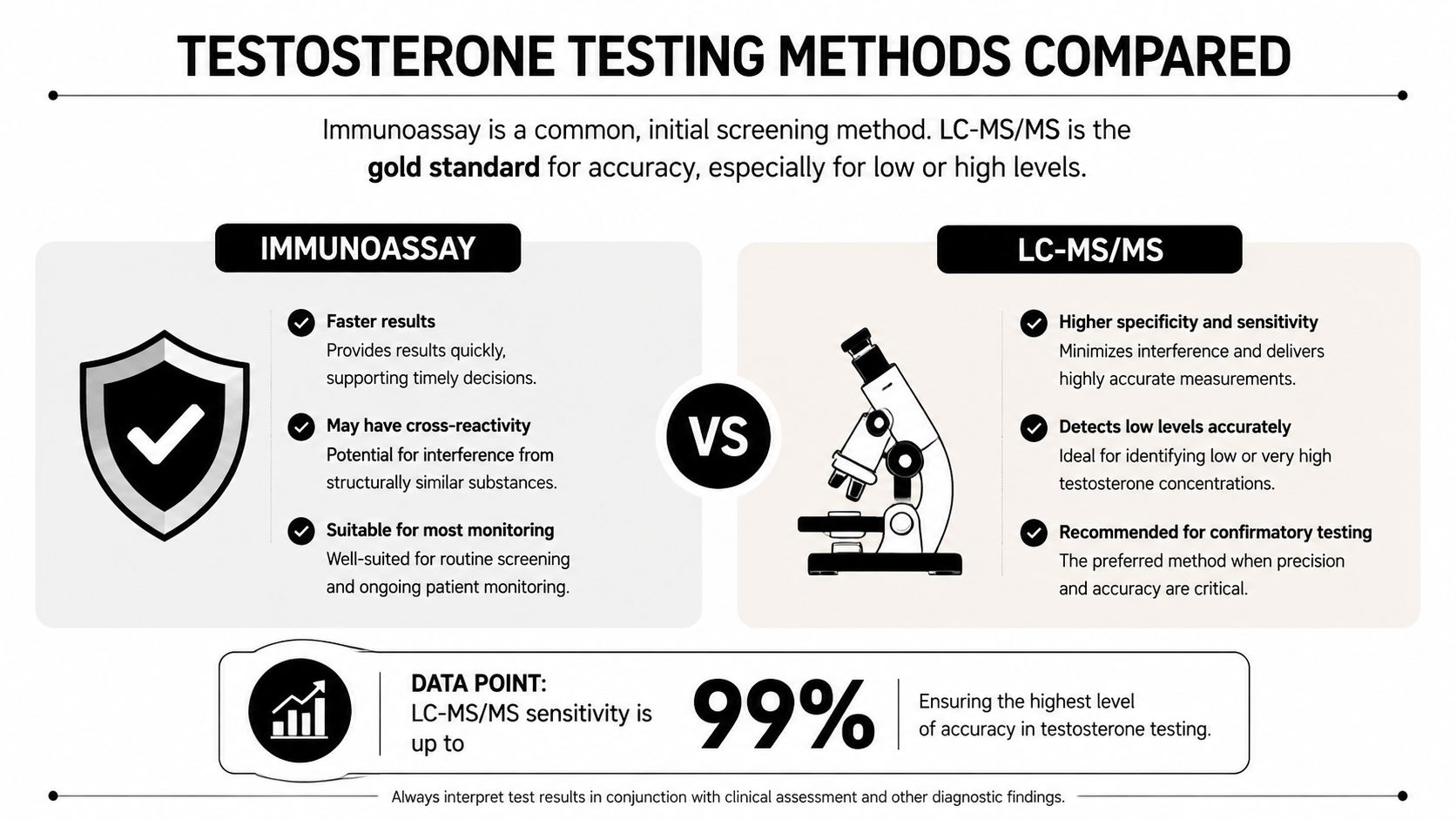
Immunoassay is widely used and can be appropriate for many initial measurements and monitoring situations. Its limitation is that structurally similar compounds may interact with the test system, creating cross-reactivity. That doesn't mean every immunoassay result is wrong. It means the method may be less useful when the clinical decision depends on a low or borderline concentration.
Quest reports that its Total Testosterone LC-MS/MS assay has an analytical measurement range of 1.0 to 2,000.0 ng/dL and shows no cross-reactivity with 30 testosterone-related steroid compounds (Quest laboratory support for hypogonadism). Those technical characteristics explain why clinicians often prefer mass spectrometry when suspected hypogonadism produces a result near the lower limit or when an immunoassay result doesn't fit the patient.
Choose consistency when monitoring treatment
Quest identifies its LC-MS/MS testosterone assay as CDC HoSt-certified and aligned with Endocrine Society guidance for adult men (Quest's assay information). That makes it a strong option when the clinician needs a more specific measurement, but technical superiority isn't the only consideration. Cost, availability, turnaround, the ordering provider's protocol, and the ability to use the same method for future measurements all matter.
Quest states that results generally remain within an acceptable margin when the same sample is tested at other reference laboratories or repeated with different technologies, but the company also recognizes assay-to-assay variation. For TRT monitoring, changing methods, laboratories, draw timing, or the interval after an injection can make a trend difficult to interpret (Quest laboratory support for hypogonadism).
Assay choice is a clinical decision, not a consumer accuracy contest. Use the method your clinician can interpret and reproduce, especially when a treatment decision rests on a borderline value.
The specimen process matters here too. Quest recommends serum, red-top tube processing, or rapid separation from an SST for relevant MS-based testing. Prompt serum separation, appropriate storage, and avoiding rejected specimens are as important as selecting the assay.
Interpreting Your Results and Planning Next Steps
Quest lists the adult male total testosterone reference interval as 250 to 827 ng/dL for its adult immunoassay listing (Quest adult testosterone test). Treat that interval as a starting point for discussion, not a standalone diagnosis. The same number can mean different things depending on collection time, symptoms, medications, body composition, illness, and whether the sample was obtained before or during TRT.
Quest's clinical guidance says hypogonadism requires unequivocally and consistently low serum testosterone together with an appropriate clinical picture. It also says routine screening of the general population isn't recommended, because symptoms overlap with other conditions, including cardiovascular disease (Quest testosterone clinical guidance).
When the number and symptoms disagree
A borderline result deserves context rather than an immediate prescription. Ask whether the morning measurement should be repeated and whether free or bioavailable testosterone, SHBG, estradiol, prolactin, or related markers could clarify the situation. Quest specifically describes multi-marker evaluation as useful when total testosterone is near the lower limit or SHBG abnormalities are suspected (Quest guidance on hypogonadism).
A low result can also reflect an operational problem. Quest's TRT monitoring FAQ identifies draw timing, adherence, dose, formulation, and absorption as possible explanations when treatment results don't match expectations (Quest testosterone testing guidance). Before concluding that a laboratory failed, review when the sample was drawn relative to the medication, whether doses were taken as prescribed, and whether the formulation changed.
Bring the complete report to the clinician who will make the treatment decision. A useful appointment focuses on the pattern across appropriately collected tests, your symptoms, other health conditions, fertility goals, and treatment risks. For men considering therapy, TRT treatment evaluation should be based on clinician review rather than a single isolated number.
Uploading Quest Results to Cost Plus TRT
After Quest releases your report, sign in to the Quest patient portal and open the completed testosterone result. Download the full report as a PDF, preserving the collection date, collection time, units, reference interval, assay name, and any accompanying laboratory results. Don't upload a cropped image that shows only the testosterone value.
Next, open the clinic's intake or transfer workflow and attach the PDF where requested. If you're already receiving TRT, include relevant recent monitoring records and medication details so the reviewing physician can evaluate the result in relation to your current dose and timing. A provider may still request new testing if the report is incomplete, too old for the clinic's protocol, collected at the wrong time, or missing safety markers.
After submission, a licensed clinician reviews the information during the telemedicine process. If treatment is medically appropriate and approved, Cost Plus TRT coordinates the prescription and shipping process described by the clinic. Men transferring care should not assume that every outside result will be accepted automatically. Upload the original Quest report first, then let the provider determine whether another draw is necessary.
Keep your own copies in a secure folder. Record the assay, collection time, medication timing, and dose for future comparisons. That documentation helps your clinician distinguish a genuine treatment issue from a timing, adherence, absorption, or assay variation problem.
Cost Plus TRT offers online physician evaluation for men considering TRT, including a workflow for Quest blood draws and uploaded lab results. Lab orders, review of recent results, and provider visits are part of one $119 monthly plan. Visit Cost Plus TRT to review the intake and get started.