

You got the lab work back. Testosterone looks “fine,” or at least better than it used to. Maybe you're already on TRT. Maybe your total testosterone improved, yet your libido still isn't right, your energy is flat, erections are unreliable, and you don't feel like the version of yourself you expected treatment to restore.
That situation is common in practice. It's also where many men get stuck.
The missing piece is often prolactin. Most men know testosterone, estradiol, and maybe SHBG. Far fewer realize that prolactin can interfere with the entire hormone command chain that drives sexual function, mood, and energy. When prolactin is high, a man can have symptoms that look exactly like low testosterone. In some cases, he can even have “normal” testosterone on paper and still feel off because the upstream signaling is impaired.
For men considering TRT, or already using it, this matters because the next step isn't always “increase the dose.” Sometimes the right move is to stop chasing testosterone numbers and investigate why the system is being suppressed in the first place.
Table of Contents
- Introduction The Hidden Player in Men's Health
- The Hormonal See-Saw How Prolactin and Testosterone Interact
- Symptoms When High Prolactin Disrupts Your System
- Common Causes of Elevated Prolactin in Men
- Interpreting Your Lab Results and Diagnostic Path
- Treatment Options and Integrating with TRT
- Your Action Plan A Q&A for Patients
Introduction The Hidden Player in Men's Health
A typical version of this problem looks like this. A man starts TRT because he has low energy, reduced drive, and a fading sex life. A few months later, his follow-up labs suggest he should feel better, but he doesn't. He's frustrated, and the reflex response is often to change the testosterone dose, switch injection frequency, or add another medication.
Sometimes that helps. Sometimes it misses the actual issue.

High prolactin is one of the most overlooked reasons a man continues to feel hypogonadal even after “fixing” testosterone on paper. The prolactin and testosterone relationship is practical, not academic. If prolactin is high, it can blunt the brain's signal to the testes and disrupt sexual function in ways that don't always show up neatly in a single testosterone value.
That changes what comes next. If the problem is prolactin excess, more testosterone may only partially mask the symptoms while the root cause keeps driving them.
Practical rule: When libido, energy, or sexual function don't improve the way they should, don't assume the answer is always more TRT. Check whether the upstream hormone signals are being blocked.
The important shift is this. Once prolactin enters the conversation, the question isn't just “What's your testosterone?” The better question is “Why is the system underperforming, and what's the most direct way to correct it?”
For some men, that leads to medication review. For others, it leads to thyroid workup, repeat testing, or pituitary imaging. And for a smaller but important group, it leads to treatment of a prolactinoma rather than immediate escalation of TRT.
The Hormonal See-Saw How Prolactin and Testosterone Interact
A man can have a testosterone result that looks acceptable on paper and still feel flat, sexually off, and unfocused. One common reason is high prolactin interfering upstream, before the testes ever get a clean signal to produce testosterone normally.
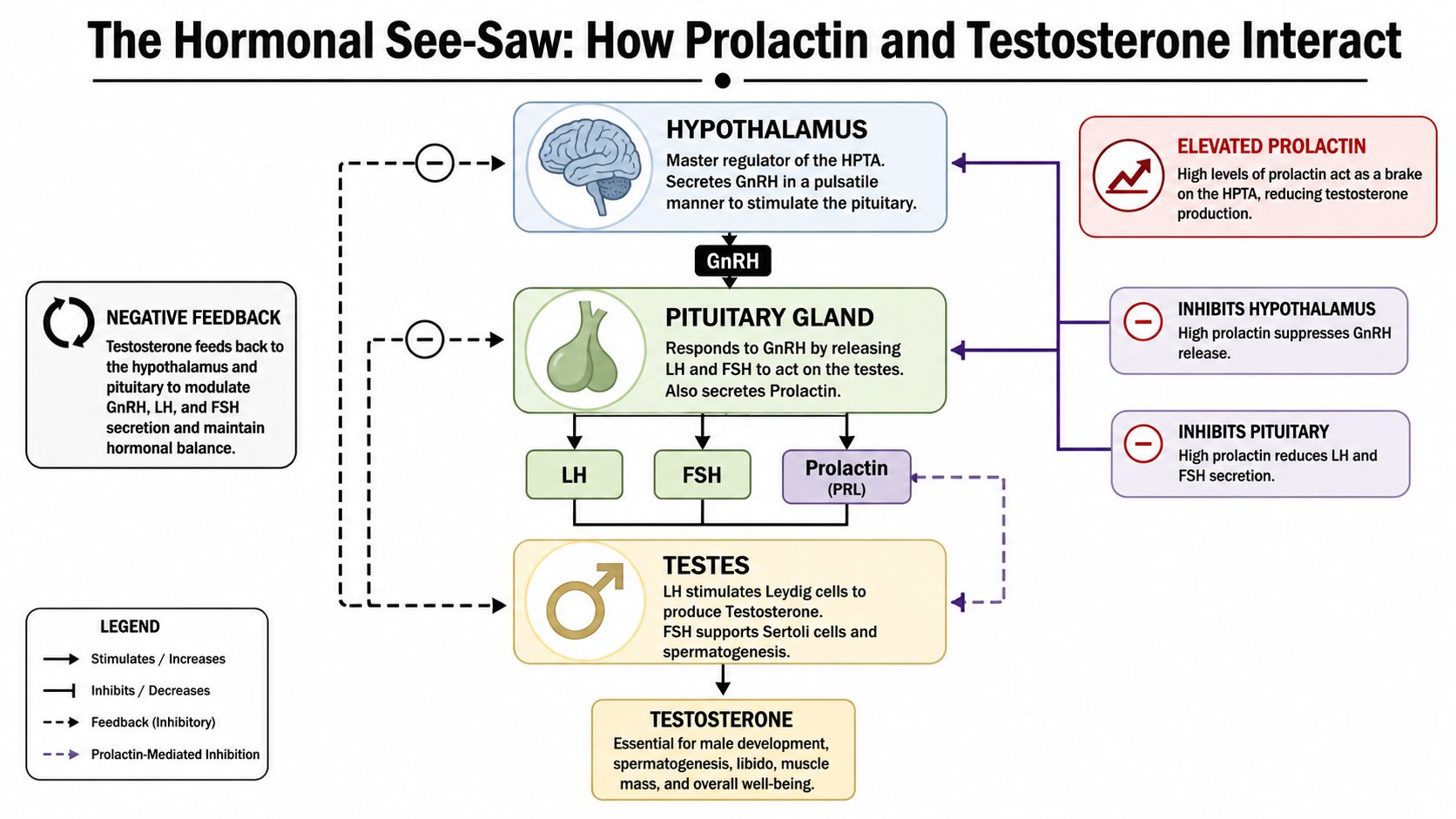
How the HPTA controls testosterone output
The hypothalamic-pituitary-testicular axis, or HPTA, is the signaling pathway that runs testosterone production.
The hypothalamus releases GnRH. The pituitary responds with LH and FSH. The testes, especially the Leydig cells, respond to LH by making testosterone. If the signal starts weak or gets interrupted in the middle, output falls. That can show up as low testosterone, low libido, fertility problems, or a man on TRT who still says, "I don't feel right."
I usually explain it as a three-part system. Brain, pituitary, testes. If the first two are being suppressed, the third cannot fully do its job.
That distinction guides treatment.
A quick visual helps:
Where prolactin interferes
Prolactin can suppress GnRH release from the hypothalamus. Once that happens, LH and FSH output tends to drop, and the testes receive less stimulation to produce testosterone and support sperm production. In plain terms, prolactin can turn down the signal before testosterone is ever made.
That is why high prolactin and low testosterone often travel together. It is also why a total testosterone value by itself can miss the problem. A man may have borderline levels, fluctuating levels, or replacement levels on TRT, yet still have persistent sexual symptoms if prolactin remains high.
High prolactin is not just a side finding. In some men, it is a direct cause of central hypogonadism.
This is the practical fork in the road for clinicians and patients. Low testosterone from primary testicular failure follows one path. Low testosterone from pituitary or hypothalamic suppression, including prolactin excess, follows another. In the second group, correcting prolactin may improve endogenous testosterone production, sexual function, and fertility potential without immediately escalating TRT.
For men considering TRT, or already using it, the next step is not always "increase the dose." The better question is whether prolactin is blocking the system and changing the treatment plan. Sometimes the right move is repeat morning labs. Sometimes it is reviewing medications that raise prolactin. Sometimes it is checking thyroid function or ordering pituitary imaging. And sometimes it is treating a prolactinoma first, then deciding whether TRT is still needed.
That is the part many men miss. Testosterone is the output. Prolactin can be the brake.
Symptoms When High Prolactin Disrupts Your System
Most men don't walk into clinic saying, “I think my prolactin is high.” They say their sex drive disappeared, they're tired, they feel mentally dull, or they're on TRT and still not getting the result they expected.
What men usually notice first
The most common pattern is reduced libido. That's often the earliest clue. Erections may become less reliable, orgasm can feel muted, and sexual interest drops even when relationship factors haven't changed.
Fatigue is common too. Not just sleepiness, but a sense that motivation and physical drive are lower than they used to be. Some men also report mood flattening, irritability, or a general loss of sharpness.
Other men notice body changes that push the conversation toward hormones, such as breast tenderness or enlargement. Some present because fertility has become an issue. Others are already trying to solve erectile symptoms and end up learning that the root problem may not be blood flow alone. Men who are sorting through erection concerns often need a broader evaluation than a prescription alone, especially if low libido is part of the picture. That's one reason a more complete review of ED medication options and related men's health treatment can be useful alongside hormone testing.
Why normal testosterone doesn't always settle the question
A normal testosterone result doesn't always end the workup. That point matters more than most men have been told.
The Journal of the Endocrine Society article discussing prolactin screening in men with low libido and normal testosterone makes this especially clear. It notes that men with prolactin-secreting adenomas can improve after prolactin normalization even when baseline testosterone is normal, particularly when testosterone and LH are low-normal.
That fits what clinicians see. A man may be told, “Your testosterone is in range,” while the underlying problem is a signal problem upstream. In plain terms, the number may be acceptable, but the hormonal context isn't.
If a man has low libido with “normal” testosterone, prolactin deserves a seat at the table.
This is one of the biggest practical mistakes in men's health. Dismissing symptoms because a single testosterone value lands inside the lab range can delay diagnosis and keep men stuck in the wrong treatment plan.
Common Causes of Elevated Prolactin in Men
High prolactin isn't a diagnosis by itself. It's a finding that needs context. The useful question is always, “What's driving it?”
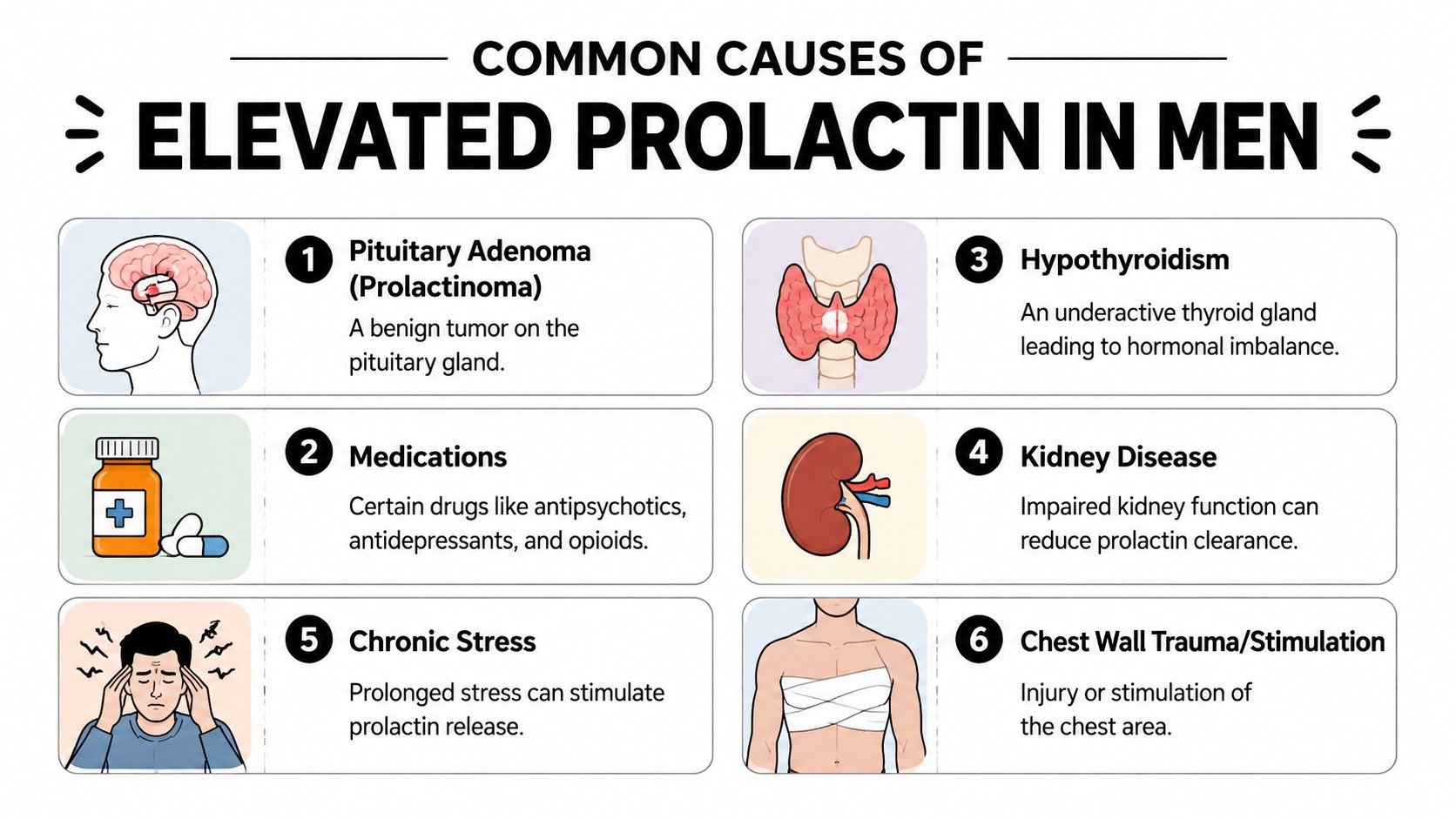
The major buckets to review
In practice, the causes usually fall into a few categories.
- Pituitary adenoma: The classic cause is a prolactinoma, which is a benign pituitary tumor that secretes prolactin.
- Medication effects: Certain prescription drugs can raise prolactin. The medication list matters more than many patients realize.
- Medical conditions: Thyroid disease, kidney disease, and other systemic issues can contribute.
- Physiologic triggers: Stress, poor sleep, pain, and chest wall stimulation or trauma can push levels upward.
Those categories aren't equally likely in every man, but they create a useful structure for the workup.
What deserves a closer look at your visit
The history should be specific, not rushed. I want to know what symptoms came first, whether headaches or visual changes are present, what medications were added before symptoms began, and whether fertility still matters.
A practical review often includes these checkpoints:
- Prescription review: Antipsychotics, some antidepressants, opioids, and other medications can push prolactin up.
- Thyroid clues: Cold intolerance, constipation, dry skin, and slowed metabolism can point toward hypothyroidism.
- Kidney history: Impaired clearance can change hormone handling.
- Stress load: Hard training, poor recovery, sleep disruption, and psychological stress can affect prolactin.
- Neurologic symptoms: Headaches or visual complaints raise the importance of imaging and specialist input.
Not every increased level means a pituitary tumor. That's important because men often jump to the worst-case scenario after one abnormal result. On the other hand, not every increase is “just stress” either.
A short comparison helps:
| Cause category | Why it matters clinically |
|---|---|
| Pituitary source | May need imaging and targeted treatment |
| Medication-related | May improve after a prescribing review |
| Secondary medical cause | Requires treatment of the underlying condition |
| Temporary physiologic rise | May normalize on repeat testing |
A useful prolactin workup starts with the same discipline as any good diagnosis. Confirm the abnormality, review the medication list, and look for the cause before choosing treatment.
That's where many men save time. The diagnostic path becomes much cleaner when the visit isn't focused only on testosterone.
Interpreting Your Lab Results and Diagnostic Path
A common scenario in clinic looks like this. A man on TRT, or considering it, gets a lab report with high prolactin circled in red and assumes the next step is either a pituitary MRI or a testosterone dose change. Usually, neither decision should be made from one isolated number.
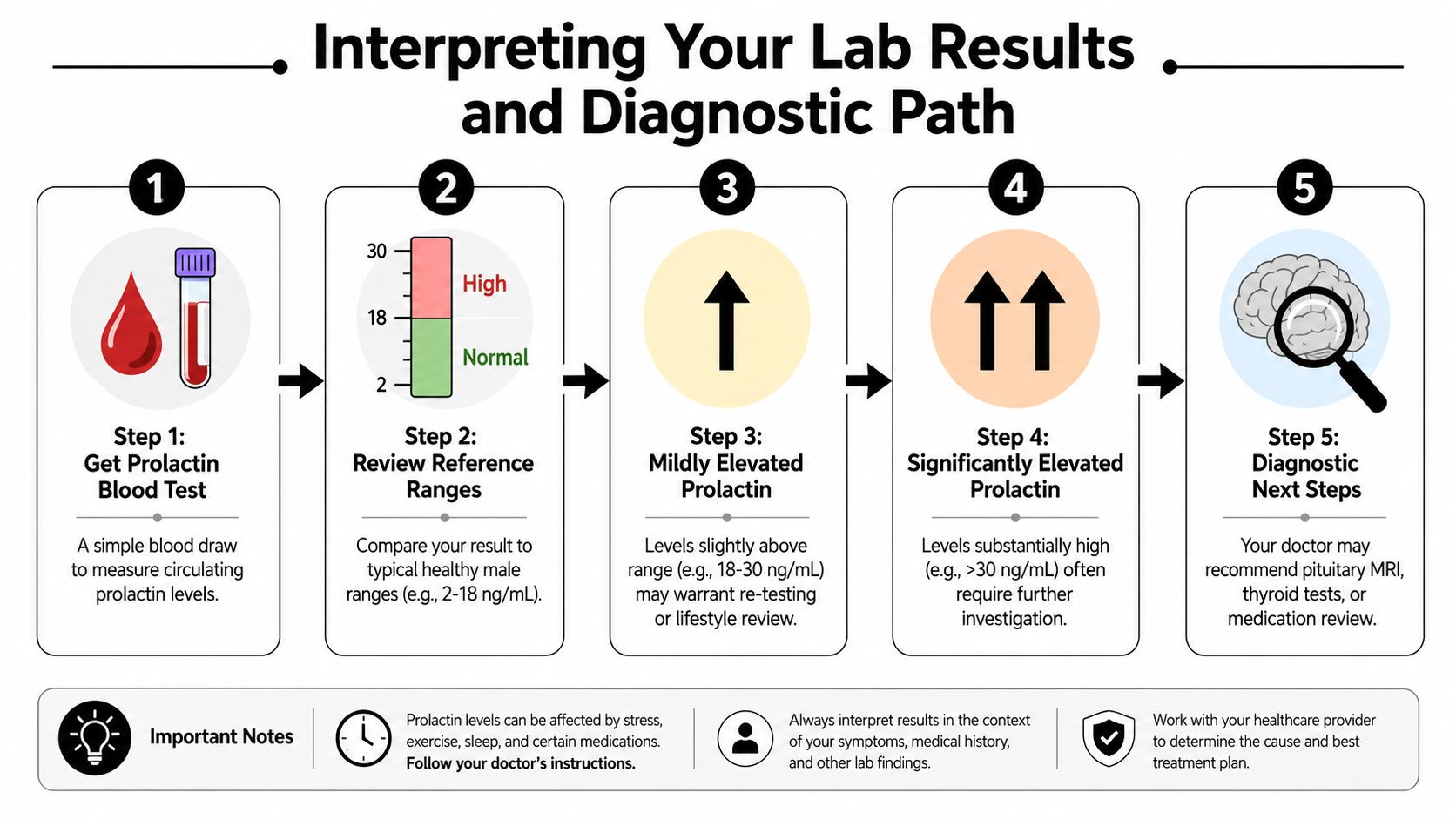
A high prolactin result is a starting point
Prolactin has to be interpreted as part of a pattern. I want to know whether the result was mildly abnormal or clearly high, whether symptoms fit the lab, and whether the rest of the axis supports a central problem. One result can be distorted by stress, poor sleep, recent sex, nipple stimulation, illness, or a blood draw done under rushed conditions.
The first practical move is often a repeat morning prolactin under calmer conditions, along with the rest of the relevant panel. For men being evaluated for low testosterone, or for men already on TRT with ongoing symptoms, that usually means:
- Prolactin
- Total testosterone
- LH and FSH
- TSH and free T4
- Medication and supplement review
That panel helps sort out where the signal is breaking down. If testosterone is low and LH and FSH are not appropriately rising, the problem may be upstream at the hypothalamus or pituitary level. If gonadotropins are high, the pattern points more toward primary testicular failure, and prolactin may be a side issue rather than the driver.
One lab detail gets missed often. Macroprolactin can raise the reported prolactin level without causing the same biologic effect as active monomeric prolactin. If the number looks concerning but the symptoms and the rest of the labs do not match, asking the lab to assess for macroprolactin can prevent unnecessary imaging and treatment.
Reading prolactin in the context of TRT
TRT changes the question. In a man not yet on testosterone, high prolactin may explain why the HPTA is under-signaling in the first place. In a man already on TRT, prolactin still matters, but for a different reason. It can explain why libido, erectile quality, mood, or fertility remain poor even when serum testosterone looks "adequate" on paper.
Clinicians should note that a normal or high-normal testosterone level on TRT does not rule out a prolactin problem. TRT can replace the downstream hormone while the upstream suppressor is still active. That distinction matters because increasing testosterone may improve numbers without addressing headaches, sexual dysfunction, infertility, or a pituitary lesion that still needs attention.
When imaging enters the picture
Pituitary MRI is usually driven by the full clinical picture, not by anxiety after one abnormal result. I consider imaging more seriously when prolactin remains high on repeat testing, when the pattern suggests central suppression, or when neurologic symptoms such as headaches or visual change are present.
A practical framework looks like this:
- Mild, isolated elevation with no clear symptoms: Repeat the test correctly before labeling it disease.
- Persistent elevation plus low testosterone with low or inappropriately normal LH/FSH: Look harder for a central cause.
- Marked elevation or concerning neurologic symptoms: Move faster toward pituitary imaging and endocrinology input.
- Man on TRT with persistent sexual symptoms despite adequate testosterone levels: Do not assume the TRT plan is the whole answer. Reassess prolactin and the pituitary signal.
The trade-off is straightforward. Order MRI too early and many men end up paying for imaging that does not change management. Wait too long and you can miss a treatable pituitary disorder while continuing to adjust TRT around the wrong problem.
A practical decision tree
In clinic, I usually work through prolactin findings in this order:
- Confirm the result. Repeat prolactin if the elevation is modest or the draw conditions were poor.
- Match the lab to symptoms. Low libido, erectile dysfunction, infertility, gynecomastia, headaches, and low energy increase the likelihood that the result matters.
- Read the rest of the axis. Testosterone, LH, and FSH show whether the pituitary is sending the right signal.
- Check reversible causes. Medications, hypothyroidism, kidney disease, and physiologic stress can all change the interpretation.
- Decide whether the next step is observation, more lab clarification, MRI, or specialist referral.
That sequence saves time.
It also helps answer the question patients usually ask next. Should TRT be started, continued, adjusted, or paused while the prolactin workup is happening? The answer depends on severity, symptoms, fertility goals, and how strongly the labs suggest a central suppressive process.
Treatment Options and Integrating with TRT
A common clinical scenario looks like this. A man starts TRT because his testosterone is low, his total T improves, and he still has low libido, erectile dysfunction, or infertility concerns. If prolactin is high in that setting, the next move is not automatically more testosterone. The job is to decide whether prolactin is the main suppressor, a contributing factor, or an incidental finding that does not explain the whole picture.
Treat the driver first
Treatment follows the cause.
If a medication is pushing prolactin up, the first step is often to review whether that drug can be reduced, changed, or replaced with the prescribing clinician. If hypothyroidism is present, correct the thyroid problem. If a prolactinoma is confirmed, dopamine agonist therapy such as cabergoline is usually the starting point because it can lower prolactin, improve pituitary signaling, and often reduce tumor burden.
That sequence matters because prolactin sits upstream of testosterone production. The pituitary works like a control panel for the testes. If prolactin is interfering with the control signal, adding more testosterone can improve labs while the original problem remains untreated. In some men, once prolactin is brought back into range, testosterone production and sexual function improve enough that long-term TRT is no longer necessary. In others, recovery is incomplete and testosterone treatment still makes sense.
Deciding when TRT fits
I usually separate these decisions into three groups.
1. Newly diagnosed high prolactin with low testosterone, not yet on TRT.
Start by treating the prolactin problem when the elevation is clear and clinically meaningful. This is especially important if fertility matters. TRT can suppress sperm production, so using it before you know whether the pituitary problem is reversible can create an avoidable second problem.
2. Already on TRT, symptoms still persist.
Do not assume the dose needs to go up. If testosterone levels are adequate but libido, erections, orgasm quality, or energy are still poor, prolactin deserves another look. Men can have acceptable serum testosterone and still feel poorly if the pituitary issue has not been addressed.
3. High prolactin is corrected, but hypogonadal symptoms remain.
That is the point where TRT becomes a more straightforward discussion. If repeat labs still show low testosterone and the clinical picture fits, replacement may be reasonable after the prolactin workup and treatment are handled properly.
For men comparing options, this overview of TRT evaluation and treatment planning can help frame the conversation, but it should sit after the prolactin issue is defined, not instead of it.
The real trade-offs in practice
Starting TRT too early can mask the reason testosterone was low in the first place. Waiting too long can leave a symptomatic man under-treated while the workup drags on.
The right middle ground is practical. If prolactin is only mildly high and the cause is unclear, repeat the lab and clarify the diagnosis before committing to indefinite testosterone. If prolactin is clearly abnormal, symptoms are significant, or pituitary disease is likely, treat that problem directly and then reassess testosterone, sexual function, and fertility goals. If a man is already on TRT, continue or adjust it based on symptoms and labs, but do not let TRT distract from a correctable prolactin disorder.
That is how this decision tree works in real life. Fix what is driving the suppression. Recheck the axis. Then decide whether testosterone is still treatment, or only a temporary patch.
Your Action Plan A Q&A for Patients
Common questions
Can I start TRT if my prolactin is high?
Sometimes, but it usually shouldn't be the first reflex. If prolactin is clearly high, the smarter move is often to identify the cause and treat that first. Otherwise you may partially cover the problem while missing the reason it started.
How quickly will I feel better after treating high prolactin?
That depends on the cause and the degree of suppression. Some men improve noticeably once prolactin is normalized and the axis starts working better again. Others need more time, especially if symptoms have been present for a while or multiple issues are involved.
If I'm already on TRT and still have low libido, should I check prolactin?
Yes, especially if your testosterone looks acceptable but your symptoms don't match the lab. Persistent low libido is one of the clearest reasons to look upstream.
Can high prolactin affect fertility?
Yes. Because prolactin can suppress the signals that regulate testicular function, it can interfere with fertility as well as testosterone production. Men who still want children should bring that up early. If you're weighing TRT and fertility at the same time, it helps to understand how TRT can affect fertility planning.
What lifestyle changes help?
Lifestyle won't cure every cause, but it matters. Better sleep, lower stress load, smarter recovery from training, and a careful medication review all help the workup make sense. Lifestyle is support, not a substitute for diagnosis.
What should I ask my clinician next?
Ask three direct questions. Was the prolactin result confirmed? What is the likely cause? Should we treat prolactin first before starting or changing TRT?
If you're dealing with low libido, fatigue, ED, or TRT that isn't delivering the expected result, Cost Plus TRT offers physician-guided men's health care through telemedicine with transparent pricing, lab flexibility, and treatment options that can help you sort out whether testosterone, prolactin, or both need attention.