

You're probably here because the promises around peptide therapy sound familiar. Better recovery. Leaner body composition. More energy. Better sleep. Maybe improved libido or skin. And if you're already on TRT, or thinking about it, the key question isn't whether peptide therapy benefits exist. It's which benefits are relevant to your goal, which ones overlap with testosterone treatment, and which ones are mostly marketing.
That distinction matters. In men's health, I see people waste time when they treat every symptom with the same tool. Low testosterone, poor sleep, excess body fat, hard training, old injuries, and stress can all produce similar complaints. If you pick the wrong therapy, you may still “do something” without solving the problem.
Peptides can be useful. They are not magic. They are also not just a wellness fad. The practical value is in matching the peptide to the job, understanding what results are realistic, and knowing when TRT, peptides, or a combination makes sense.
Table of Contents
- What Are Peptides and How Do They Work
- Key Peptide Therapy Benefits Explained
- Peptide Therapy for Men on TRT
- What to Expect with Physician-Supervised Therapy
- Safety Side Effects and Who Is a Good Candidate
- Frequently Asked Questions About Peptide Therapy
- How to Start with Cost Plus TRT
What Are Peptides and How Do They Work
Think targeted signaling not broad hormone replacement
Peptides are short chains of amino acids that act like highly specific biological messengers. The easiest way to understand them is this: testosterone is closer to a master key, while many peptides are closer to a single key cut for a single lock.
A peptide binds to a receptor and tells a cell or tissue to do something specific. Depending on the peptide, that message might be closer to “release more growth hormone,” “support collagen activity,” or “help coordinate tissue repair.” That's why peptide therapy benefits can look so different from one product to another. The category is broad, but each peptide has a narrower job.
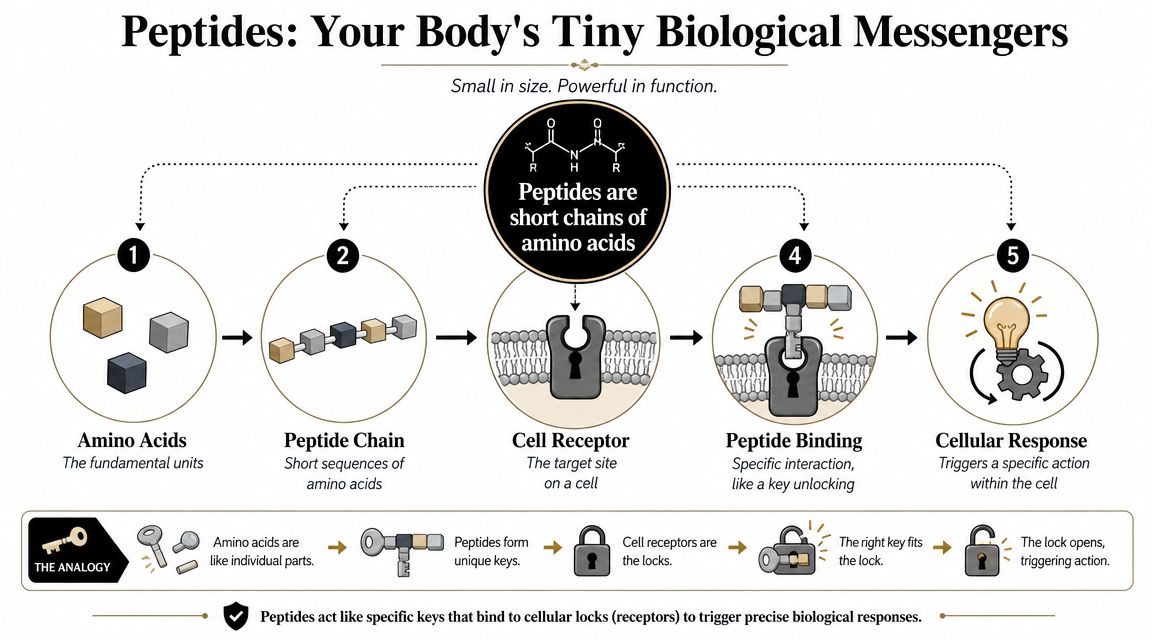
This is also why I tell patients not to lump all peptides together. Saying “I want peptide therapy” is like saying “I want medication.” It doesn't tell me the target. Recovery, body composition, libido, skin quality, and hormone signaling are not the same clinical problem.
For men comparing options, a detailed look at physician-supervised peptide treatments helps frame that peptide therapy is really a collection of targeted tools, not one single intervention.
Why this matters clinically
Peptides have a real medical and pharmaceutical background. A 2022 NIH/PMC review on therapeutic peptides notes that peptides have favorable tissue penetration and high affinity for receptors, and reports more than 200 peptides in clinical development and another 600 in preclinical trials. That matters because it places peptide therapy in a serious research pipeline rather than a passing trend.
Practical rule: The more specific the goal, the more useful peptide therapy becomes. The vaguer the promise, the less confidence you should have.
The upside of peptides is precision. The limitation is the same thing. They usually don't fix a broad hormonal deficiency by themselves. If a man's main issue is true low testosterone, using a peptide because it sounds “more natural” often leads to partial improvement at best.
Key Peptide Therapy Benefits Explained
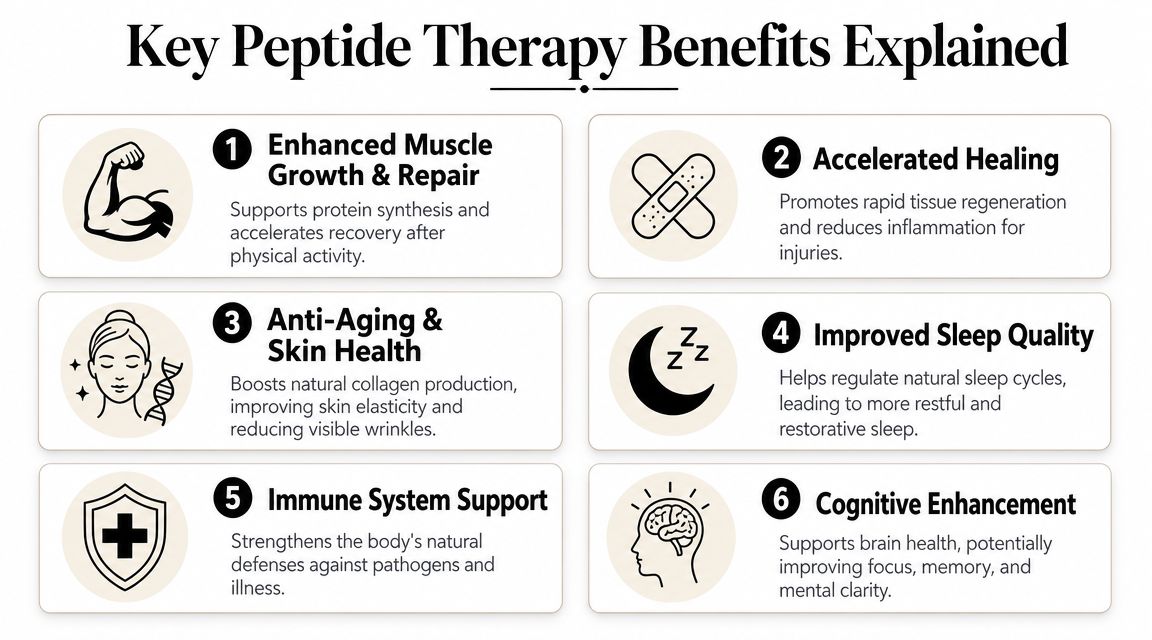
Not all peptide therapy benefits carry the same level of support. The strongest practical conversations usually fall into three buckets: recovery, growth hormone-related body composition support, and skin or collagen-related restoration.
Recovery and connective tissue support
If your problem is slow recovery, nagging joint discomfort, repetitive strain, or a body that never quite feels repaired, peptide-based approaches can be appealing. The cleanest human evidence in the material provided points to collagen peptide supplementation rather than broad “healing peptide” claims.
A 2025 NIH/PMC review on collagen peptide supplementation reported that 10 to 20 g/day for 6 to 9 months produced significant improvements in pain, activities of daily living, and mental and physical health in long-term use. That tells you something important. Recovery-related benefits often depend on dose, duration, and the type of tissue problem. This is not an overnight fix.
In practice, that means recovery peptides work best as adjuncts. They may support rehab, training adjustment, sleep improvement, and nutrition. They don't replace those basics.
Body composition and performance support
Often, men learn about sermorelin, CJC-1295, and ipamorelin. These are generally discussed as growth hormone secretagogues, meaning they stimulate the body's own growth hormone release instead of replacing testosterone.
A clinical overview of growth hormone secretagogues notes that agents such as sermorelin and ipamorelin increase downstream IGF-1 signaling and can support lean mass, recovery, and connective tissue repair. The most realistic expectation is gradual improvement in recovery, training tolerance, and body composition, especially when paired with resistance training, solid sleep, and adequate protein intake.
That mechanism is different from direct hormone replacement. If you're looking into energy support more broadly, some men also explore NAD+ therapy options in physician-guided care, though that serves a different role than growth hormone signaling peptides.
If a peptide works through signaling, your routine still matters. Poor sleep, inconsistent training, and low protein intake can blunt the result.
Skin and restorative benefits
Some peptide therapy benefits are much more cosmetic and restorative than metabolic. Skin-focused peptides such as GHK-Cu are positioned differently from growth hormone secretagogues. Their use-case is tied to collagen production, elasticity, and fine lines.
A review of cosmetic peptide evidence notes that peptide ingredients can improve collagen synthesis, skin elasticity, wrinkle depth, and wound healing in cosmetic studies, with examples such as Copper Tripeptide-1 and GHK-Cu showing measurable wrinkle reduction and improved appearance. That's meaningful, but it's a different endpoint than fat loss or libido.
What doesn't hold up as well
Patients need a filter; many clinics package peptide therapy as a universal answer for immunity, longevity, metabolism, and anti-aging. The evidence is not equally strong across those claims.
- Better-supported claims: skin quality, collagen-related outcomes, selected recovery applications, and growth hormone pathway support
- More theoretical or under-tested claims: broad longevity promises, sweeping immune claims, and generalized anti-aging language
- Most realistic result pattern: gradual, goal-specific change rather than a dramatic whole-body transformation
Peptide Therapy for Men on TRT
If you're already on TRT, this is the section that matters most. The overlap between peptide therapy benefits and TRT benefits is real, which is why marketing often gets messy.
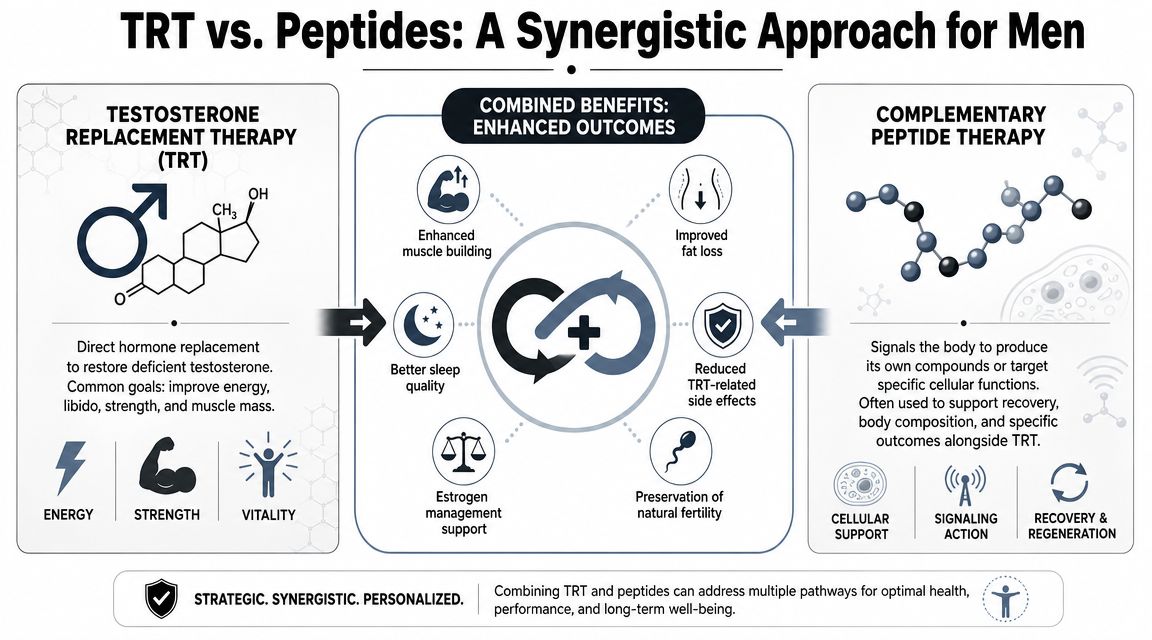
A men's health overview on peptide therapy and TRT overlap notes that peptides that stimulate growth hormone can improve body composition, recovery, and energy, which are also common goals for men with low testosterone. The useful takeaway is simple: peptides can complement TRT, but they are not a substitute for correcting hormonal deficiency.
Here's a straightforward decision framework.
When peptides make sense instead of TRT
Peptides may be the better fit when your testosterone status isn't the main issue.
Examples include:
- Targeted recovery goals: nagging connective tissue issues, slow post-training recovery, or chronic wear-and-tear complaints
- Skin or restorative goals: collagen support, elasticity, or visible aging concerns
- Narrow symptom clusters: a patient wants a focused intervention rather than full hormone replacement
If a man has normal testosterone but wants help with recovery or tissue quality, TRT is usually the wrong tool. A targeted peptide plan can make more sense.
Later in the decision process, men who want sexual-health support may also ask about PT-141 in supervised treatment, which addresses a different problem than low testosterone or recovery-focused peptides.
When peptides work well with TRT
This is often the most practical middle ground. TRT handles testosterone deficiency. Peptides may help address a second lane, such as recovery, training tolerance, or a separate sexual-health goal.
That combination can make sense when:
- Testosterone symptoms improved, but recovery still lags
- Body composition progress is slower than expected despite good TRT management
- The goal isn't just libido or energy, but also connective tissue or sleep-related recovery
A lot of men assume adding more therapies always means better results. It doesn't. The right combination is useful when each therapy has a different role.
Here's a good checkpoint before adding peptides:
| Question | If yes | If no |
|---|---|---|
| Are classic low-T symptoms still the main problem? | Reassess TRT candidacy or TRT management first | Consider whether peptide goals are more targeted |
| Is the complaint mainly recovery or tissue-related? | Peptides may be a reasonable adjunct | Another diagnosis may be more likely |
| Are sleep, training, and nutrition already in order? | You're more likely to notice peptide effects | Fix the basics first |
A related discussion many men find useful is this physician perspective on combined care:
When TRT alone is the better first move
If you have clear symptoms of hypogonadism and your labs support it, TRT usually deserves priority over peptide therapy. That includes men whose main complaints are low libido, low morning drive, reduced spontaneous erections, low motivation, or declining strength tied to testosterone deficiency.
Treat the primary deficit first. Add targeted therapies only when a separate problem remains.
Peptides can help refine outcomes. They usually shouldn't distract from the main diagnosis.
What to Expect with Physician-Supervised Therapy
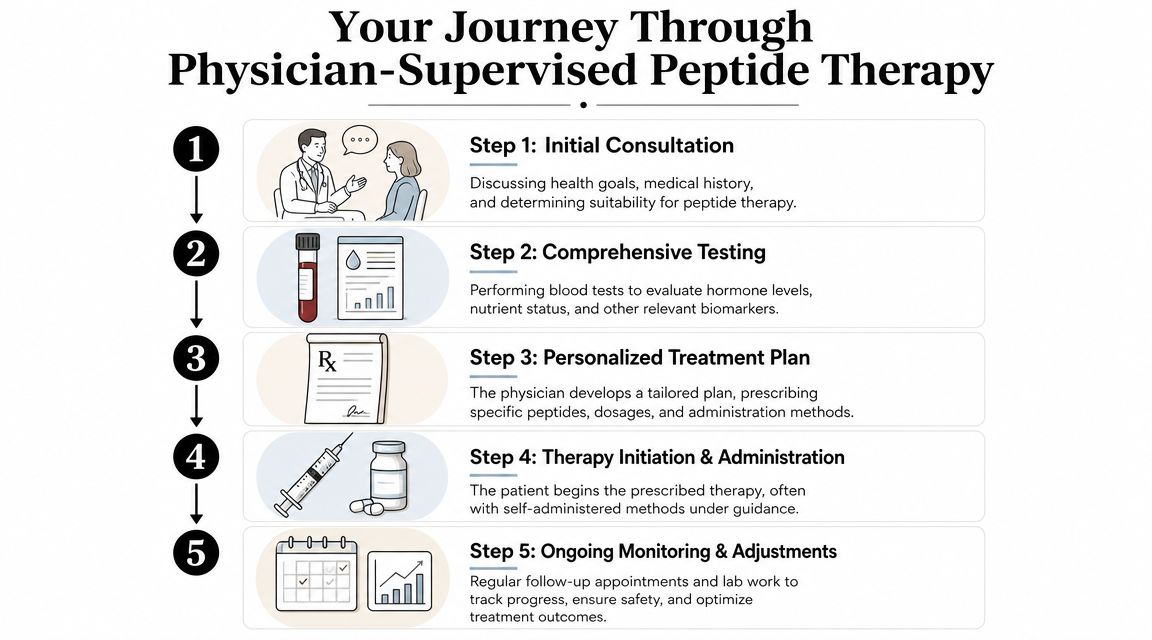
A good peptide program should feel boring in the best way. It should be structured, personalized, and easy to follow. The process matters because peptide therapy only makes sense when the treatment matches the problem.
The evaluation phase
The first step is a medical review of your goals, symptoms, training load, sleep, medications, and existing conditions, during which a clinician sorts out whether you're chasing recovery support, growth hormone signaling support, a sexual-health treatment, cosmetic restoration, or something else entirely.
Lab work often helps, especially if you're also evaluating testosterone status or trying to understand whether fatigue and body composition complaints are hormonal. In telemedicine settings, men often use recent labs if they're current enough, or they complete fresh testing before treatment starts.
A useful evaluation usually answers these questions:
- What are you trying to change: libido, recovery, body composition, skin quality, sleep, or another symptom
- What has already been tried: TRT, ED medication, training changes, nutrition, physical therapy
- What is the likely bottleneck: deficiency, recovery demand, tissue wear, or a mismatch between expectations and biology
Starting treatment and monitoring response
Once a peptide is selected, the physician decides dose, route, and follow-up timing. Some therapies are taken by injection. Others may have different delivery formats depending on the product and indication.
What patients often want to know is when they'll feel something. The honest answer is that peptide therapy benefits are usually gradual and goal-specific. A man using a growth hormone secretagogue won't experience the same timeline as someone using a therapy aimed at sexual function or a collagen-related endpoint.
Monitoring matters for two reasons:
- Safety. Even when side effects are generally mild, someone needs to watch response and tolerability.
- Fit. If the peptide doesn't address the actual problem, no dose adjustment will magically make it the right therapy.
Good supervision doesn't just ask, “Are you taking it?” It asks, “Is the original reason for using it still the right one?”
One practical note. If you're using telemedicine, look for a clinic that reviews symptoms and labs in the context of your actual goals, not a menu-style checkout flow. In this category, process quality matters almost as much as the medication itself.
Safety Side Effects and Who Is a Good Candidate
A common scenario in clinic is a man on TRT who feels better overall but still has one nagging problem. Recovery is slow. A tendon keeps getting irritated. Sleep is decent, but not restorative. That is the point where peptide therapy may be worth discussing. It is also the point where bad marketing causes the most confusion.
Safety starts with matching the treatment to the problem. Peptides are not a general upgrade for male health. They are targeted tools. If the goal is vague, the risk is not only side effects. The bigger risk is spending time and money on a therapy that was never likely to solve the main issue.
Common trade-offs
In supervised care, side effects are often manageable and specific to the compound being used. Injection site irritation is one of the more common complaints with injectable therapies. Some men also find that the inconvenience of frequent dosing becomes a significant downside, especially if the expected benefit is modest.
That matters more than people think.
A treatment can be medically reasonable and still be the wrong fit for a patient who hates injections, travels often, or wants a broad result from a narrow therapy. I tell patients to judge peptides the same way they would judge physical therapy or TRT adjustments. If the effort is real, the goal should be clear.
Another trade-off is uncertainty. Some peptides have a more practical role for recovery, sexual-health support, or tissue-related goals. Others are surrounded by claims that run far ahead of what is proven in real patients. The farther a clinic leans into anti-aging language, the more careful a patient should be.
Who tends to be a good candidate
The best candidate usually has a defined problem, realistic expectations, and a reason not to rely on TRT alone.
That often includes:
- Men on TRT who still have one unresolved target such as recovery, soft-tissue support, or another peptide-specific issue
- Men dealing with training or rehab bottlenecks after sleep, programming, nutrition, and basic hormone issues have already been addressed
- Men pursuing cosmetic or restorative goals such as skin quality or collagen support, who understand those outcomes are narrower than hormone replacement
The pattern is simple. The narrower the goal, the easier it is to judge whether the therapy is helping.
Who should slow down first
Some men need a better workup before adding anything.
- Men with symptoms that still point to untreated low testosterone: if the core problem is hormone deficiency, peptides usually do not replace proper evaluation and treatment
- Men hoping for whole-body anti-aging effects: that expectation leads to disappointment more often than benefit
- Men with several vague symptoms at once: fatigue, low libido, poor sleep, mood changes, and weight gain can come from low testosterone, sleep apnea, stress, medication effects, poor recovery, or other medical issues
Clinical judgment matters most. If a man is already on TRT and doing well, adding a peptide can make sense when there is a separate, measurable target. If a man is not yet diagnosed and is trying to use peptides to avoid a real endocrine evaluation, that is usually the wrong order.
Good candidates are not the men who want the longest list of benefits. Good candidates are the men who can answer one question clearly. What problem are we trying to solve, and how will we know if this worked?
Frequently Asked Questions About Peptide Therapy
| Question | Answer Summary |
|---|---|
| Are peptides the same as TRT? | No. TRT replaces testosterone directly. Peptides usually signal the body to perform a more specific task. |
| Can peptides replace TRT? | Sometimes they may be useful for a targeted goal, but they generally aren't a substitute when the main issue is testosterone deficiency. |
| Are peptide therapy benefits immediate? | Usually not. Most benefits build gradually and depend on the peptide, the goal, and whether lifestyle basics are in place. |
| Do all peptides help with muscle gain and fat loss? | No. Benefits are peptide-specific. Some are discussed for growth hormone signaling, while others are used for skin, recovery, or sexual-health goals. |
| Are side effects always severe? | Not typically. In supervised care, side effects are often mild, but that doesn't make monitoring optional. |
| Is peptide therapy useful if I already feel good on TRT? | It can be, but only if there's a separate unresolved target such as recovery, connective tissue support, or another specific goal. |
| Do I need to cycle on and off peptides? | That depends on the peptide, the indication, and physician guidance. There isn't one universal rule for every compound. |
The common thread in these questions is that peptide therapy works best when the goal is narrow and measurable. If your plan sounds broad, vague, or stacked with too many therapies at once, that's a sign to slow down.
A useful rule is this: if you can't clearly explain what symptom you're treating and how you'll judge success, you probably aren't ready to start.
How to Start with Cost Plus TRT
If you want to explore peptide therapy in a practical way, start with an actual clinical decision, not a shopping list. The first step is to clarify whether your main issue is low testosterone, recovery, body composition, sexual function, or a skin and restorative goal.
For telemedicine, keep the process simple:
- Complete the intake questionnaire.
- Upload recent labs if you have them, or arrange testing if needed.
- Meet with a licensed physician online.
- Review whether TRT, a peptide, or a combined plan matches the problem.
- Start treatment only if the expected outcome is clear and measurable.
Cost Plus TRT is one telemedicine option that provides TRT and selected men's health therapies with a transparent cost-plus model, online physician visits, and the ability to use existing labs when appropriate. That setup can be useful for men who want convenience without guessing their way through treatment selection.
The best next step isn't committing to a peptide. It's getting clear on the right therapy first.
If you're weighing peptide therapy against TRT, or wondering whether they should be combined, talk with a physician who can sort the goal from the hype. Cost Plus TRT offers a straightforward way to review symptoms, labs, and treatment options with licensed medical guidance before you decide.