
Most advice about oxytocin spray starts in the wrong place. It treats oxytocin like a shortcut to romance, confidence, or instant sexual chemistry. That framing is catchy, but it isn't very useful for men trying to solve a real clinical problem.
In practice, Oxytocin spray is better understood as an investigational neurohormonal tool. It doesn't fit neatly into the same category as tadalafil, and it shouldn't be discussed like an over-the-counter libido hack. For some men, the interest is less about the pop-culture idea of a “love hormone” and more about whether changing brain signaling could help with arousal, orgasm quality, connection, or sexual response in ways that blood-flow drugs alone don't address.
That distinction matters. Men's sexual function isn't purely mechanical. Erections involve vascular function, but they also depend on arousal, attention, anxiety level, relationship context, and how the brain processes reward and stimulation. That is why some men respond well to standard ED treatment and still say something feels off.
Table of Contents
- Beyond the Hype What Is Oxytocin Spray Really
- How Intranasal Oxytocin Works in the Body
- Reviewing the Clinical Evidence for Men
- Safety Profile and Regulatory Status
- Comparing Oxytocin with Tadalafil and Combo Therapy
- How to Discuss Oxytocin with Your Telemedicine Provider
Beyond the Hype What Is Oxytocin Spray Really
The “love hormone” label oversimplifies what oxytocin spray is and what it isn't. Oxytocin is a peptide hormone with real physiologic roles, but clinical use of intranasal oxytocin sits in a much narrower lane than social media suggests. It isn't a guaranteed way to feel bonded, more confident, or more sexually responsive.
For men, the serious interest comes from a different question. Can changing oxytocin signaling alter parts of sexual experience that don't respond well to a standard erection medication alone? That includes areas like arousal, emotional engagement, sexual satisfaction, and in some cases the subjective quality of intimacy.
Some clinics also discuss oxytocin alongside other physician-supervised peptide therapies, which makes sense conceptually. But oxytocin deserves its own caution label. It has research interest, not settled mainstream status.
Practical rule: If someone markets oxytocin spray as a universal attraction, libido, or ED fix, they're skipping the hard part of the discussion.
The better way to think about it is this. Oxytocin spray targets signaling, not just hydraulics. That can make it appealing in men's health, especially when a patient says, “I can sometimes get an erection, but desire, connection, or satisfaction still feels blunted.”
There is also a real trade-off. The mechanism is interesting, but the evidence is not clean enough to promise a predictable outcome. Some men may notice meaningful changes. Others may feel little difference. That gap between theory and consistency is exactly why this treatment needs a measured, clinical conversation instead of hype.
How Intranasal Oxytocin Works in the Body
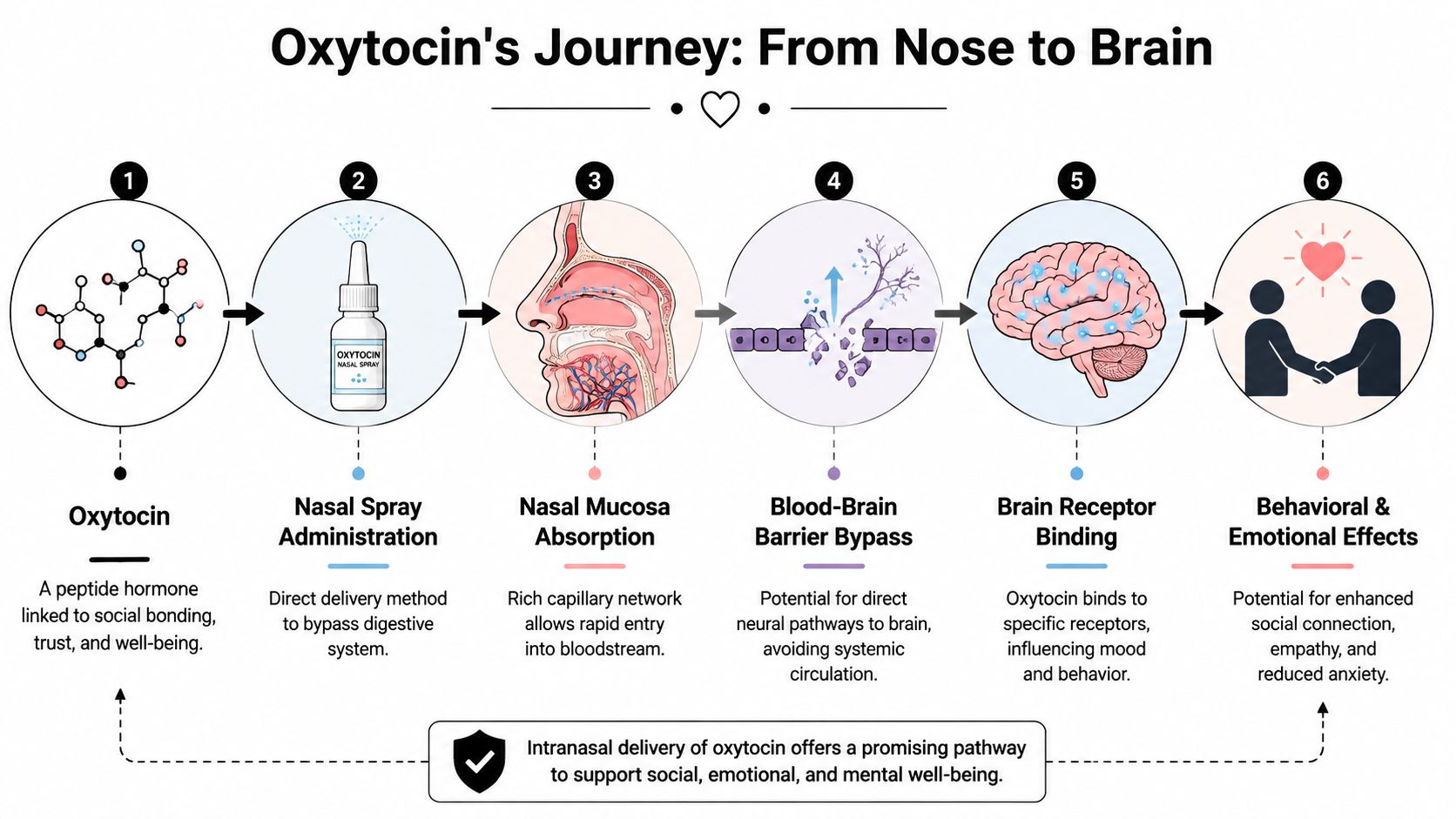
Oxytocin only has a plausible clinical role if it can reach the right targets in a usable amount. That is why intranasal delivery gets attention. As a peptide, oxytocin is broken down in the digestive tract, so an oral pill is a poor fit for this drug.
Why the nose matters
The goal of a nasal spray is practical. Deliver the medication through the nasal cavity, avoid gut breakdown, and improve the chance that some of it influences central nervous system signaling. That does not mean every spray works the same way, or that enough drug reliably reaches the brain to create a meaningful sexual effect in every patient.
Delivery method matters more than many patients realize.
A published abstract for a newer intranasal oxytocin formulation (PMID 35067719) reported higher brain bioavailability than Syntocinon in an animal comparison, and the same publication described a dose-response signal in a multicenter crossover study in autism spectrum disorder. That is not evidence for erectile dysfunction treatment. It does support a narrower, clinically relevant point. Device design, formulation, and dosing can change whether intranasal oxytocin has a realistic chance of producing central effects.
That trade-off matters in practice. Patients often hear "oxytocin spray" and assume the category is uniform. It is not. Compounded products, research formulations, and legacy branded sprays may differ in concentration, spray characteristics, absorption, and quality control.
What it may influence sexually
In men's health, oxytocin is being explored less for penile blood flow and more for signaling tied to arousal, reward, emotional salience, and subjective sexual experience. That distinction matters. A man can have partial erectile function yet still describe sex as flat, disconnected, or less rewarding than it used to feel.
Those complaints point in a different direction than classic vascular ED.
Potential areas of interest include:
- Mental arousal: Some men describe low engagement rather than a pure erection problem.
- Subjective sexual reward: The issue may be pleasure, intensity, or orgasmic quality.
- Context sensitivity: Relationship stress, anxiety, and emotional closeness may shape response more than they do with a PDE5 inhibitor.
Oxytocin is better viewed as a signaling therapy under investigation, not a replacement for standard erection medication.
I discuss it that way with patients. If the main problem is poor rigidity from vascular disease, a nasal peptide is unlikely to outperform established treatment. If the presentation is mixed, with blunted desire, low responsiveness, performance anxiety, or reduced sense of connection during sex, the mechanism becomes more relevant. The science is interesting. The clinical response is still variable, which is why formulation choice, expectations, and physician supervision matter.
Reviewing the Clinical Evidence for Men
The research story on oxytocin spray is broad, active, and still unsettled. That's the honest answer. There is enough published work to take it seriously, but not enough consistent clinical effect to treat it like a standard solution.
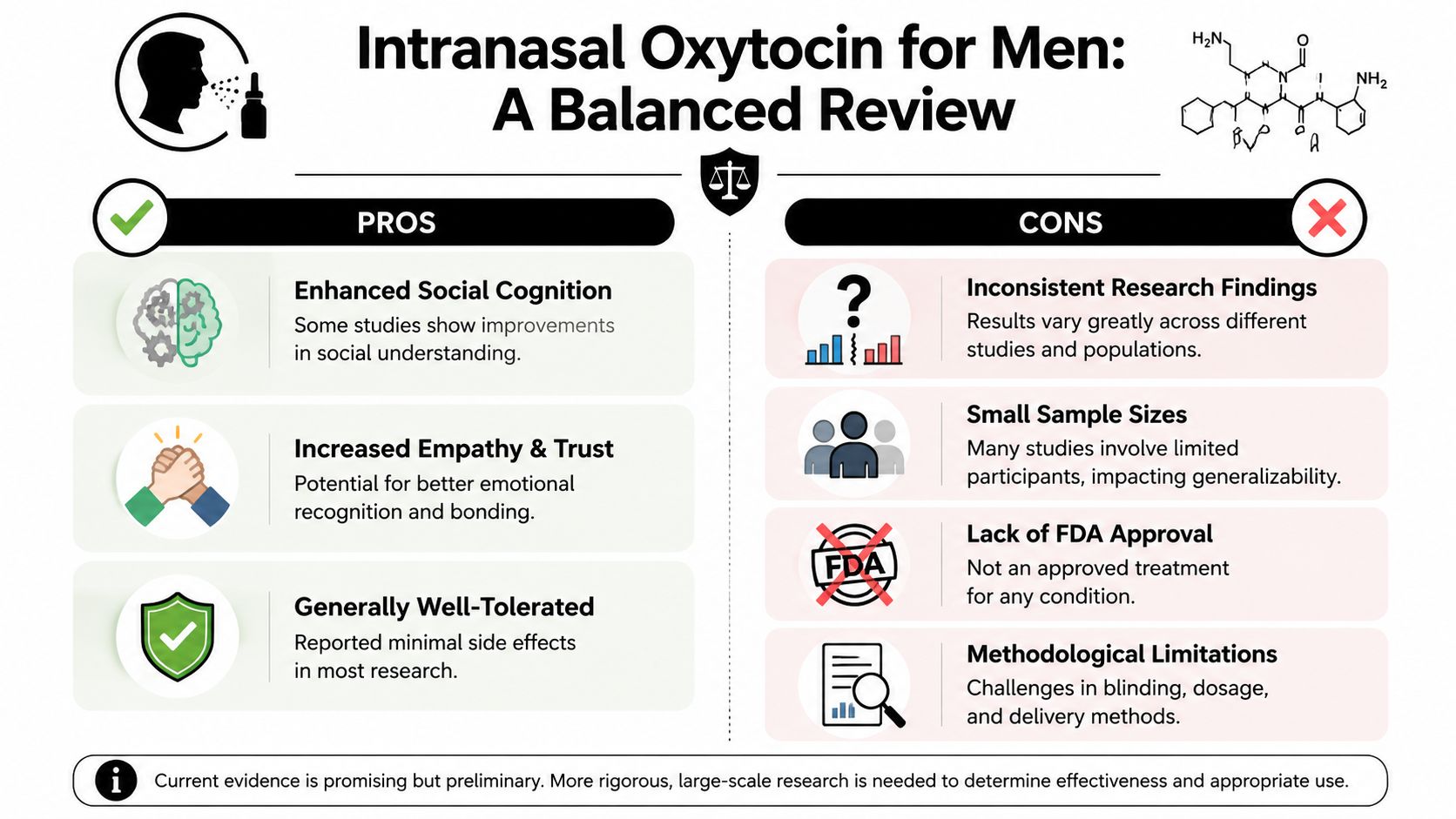
A major review summarized on a clinical information page covered 38 randomized controlled trials with over 1,500 participants and found that intranasal oxytocin was generally well tolerated. In that summary, studied doses commonly fell between 18 and 40 IU, and other research on the same page reported no major problems at doses up to 24 to 72 IU. The same source also notes a double-blind placebo-controlled trial in 50 male adolescents aged 12 to 18 with autism that found no significant improvement in social behavior after 8 weeks.
What the broader research says
That combination of findings is exactly why I describe oxytocin spray as promising but inconsistent. The safety profile in research has been reassuring overall, yet efficacy hasn't lined up in a simple, reproducible way.
For men's health, that has two implications.
First, a positive mechanism doesn't automatically translate into a dependable bedside result. Oxytocin has plausible relevance to intimacy, social processing, and sexual experience. But plausible isn't the same as proven.
Second, men often come to this treatment with the wrong expectation. They assume that if oxytocin is linked to bonding or pleasure, it should predictably improve libido, erections, or orgasm. Research doesn't support that kind of certainty.
Why the results stay mixed
The inconsistency isn't random. It likely reflects several real-world issues:
- Different target problems: Some studies focus on social behavior, some on emotional processing, some on sexual function, and those aren't interchangeable.
- Different spray systems: Delivery quality matters, as discussed earlier.
- Different patient populations: A man with performance anxiety isn't the same as a man with vascular ED or low testosterone.
- Different endpoints: Improvement in connection or satisfaction may not look like improvement on a classic ED measure.
This is one reason “works” and “doesn't work” are both too blunt. A patient may not notice stronger erections but may report a different sense of engagement, reduced inhibition, or improved partner connection. Another patient may notice nothing meaningful at all.
How I frame this for patients
I don't present oxytocin spray as first-line ED care. I present it as a selective add-on or alternative consideration when the clinical picture suggests the brain side of sexual response deserves attention.
That usually means the patient profile matters more than the marketing.
| Clinical question | Why it matters for oxytocin spray |
|---|---|
| Is the problem mainly erection rigidity? | Oxytocin is less likely to be the main tool. |
| Is the problem low arousal or muted satisfaction? | Oxytocin may be more relevant. |
| Are anxiety, context, or connection part of the complaint? | Response may depend heavily on those factors. |
| Has standard ED treatment helped only partially? | Combination thinking may make more sense. |
A useful oxytocin candidate often isn't the man with a purely mechanical problem. It's the man whose symptoms cross mental, relational, and sexual domains.
That doesn't make it fringe. It makes it selective. And selective treatments need better screening, better counseling, and tighter expectations than trendy ones usually get.
Safety Profile and Regulatory Status
The biggest practical mistake with oxytocin spray is assuming that "natural hormone" means low stakes. It doesn't. Intranasal oxytocin is not FDA-approved for any condition, so any use for men's sexual symptoms sits in off-label territory and usually depends on a compounding pharmacy rather than a standard retail prescription.
A compounding reference on intranasal oxytocin notes that the spray has been explored in research and clinical contexts, including sexual satisfaction. It also notes that prolonged use may carry minimal antidiuretic effects. That point rarely makes it into marketing language, but it belongs in a real consent discussion.
What FDA status means in real life
For patients, "not FDA-approved" means there is no labeled indication, no standardized commercial product for this use, and less certainty around dose, consistency, and long-term follow-up than men are used to with conventional ED medication. That does not make oxytocin spray illegitimate. It does mean the quality of the prescribing process matters more.
That is also why I steer men away from random online sellers. With a compounded nasal hormone, small details matter. Concentration, spray device, storage, dosing instructions, timing, and the reason for prescribing all affect whether the treatment is sensible or sloppy.
A careful prescribing discussion should cover four things:
- Nasal tolerability: Some men get irritation, dryness, or dislike the spray itself.
- Whole-body effects: Oxytocin is a hormone, so safety review should go beyond the nose.
- Response variability: Some patients notice a change in arousal or connection. Others notice nothing useful.
- Monitoring: Follow-up should address side effects, benefit, and whether continued use still makes clinical sense.
A short review of the practical issues helps:
The better question is not, "Can I get oxytocin spray?" The better question is, "Am I a reasonable candidate, and is there a safer standard option that fits my goal better?"
For men using telemedicine, there are legitimate clinical pathways. Some clinics, including Cost Plus TRT, prescribe oxytocin nasal spray within a supervised men's health workflow alongside more established ED medication treatment options. That still requires individualized screening, informed consent, and realistic expectations.
Comparing Oxytocin with Tadalafil and Combo Therapy
Men often ask which option is better. In clinic, that question usually needs to be narrowed first. Oxytocin spray and tadalafil target different parts of sexual function, so the right choice depends on what is failing.
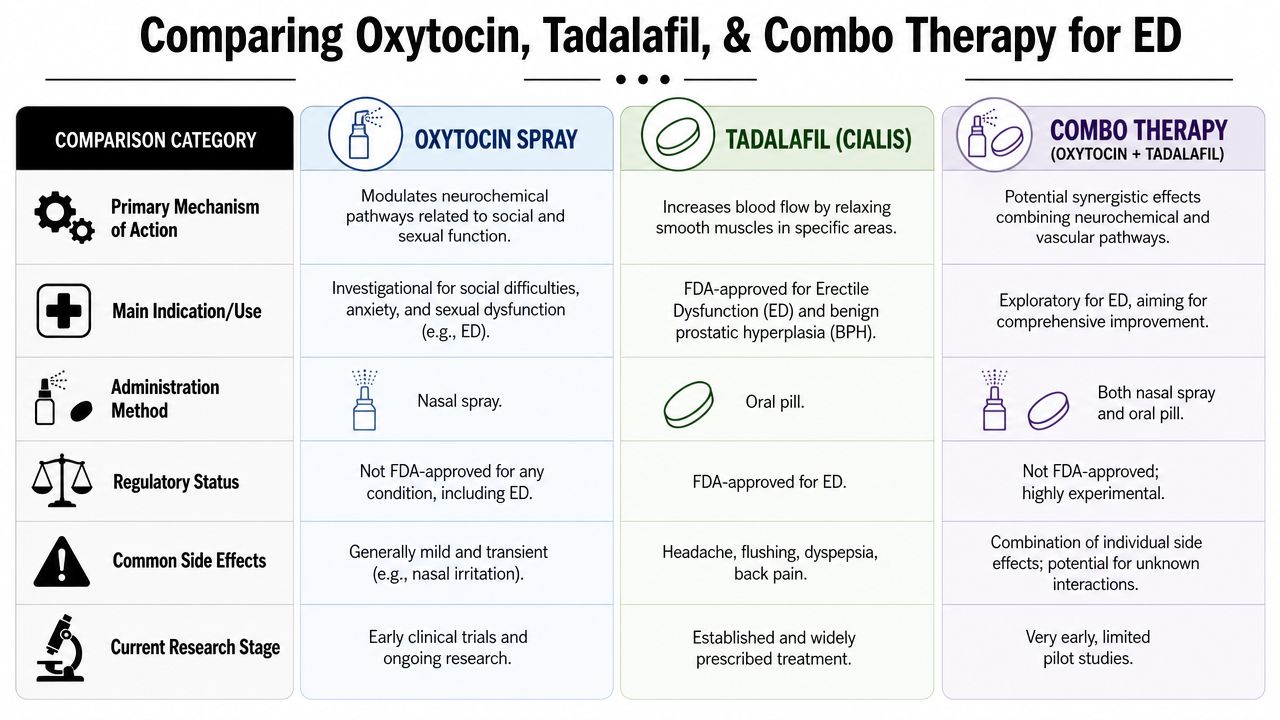
Tadalafil is established treatment for erection firmness and staying power. Oxytocin is a more experimental option that may matter more for arousal, sexual engagement, and the subjective side of sex. That distinction matters because many men describe every bedroom problem as ED, even when the main complaint is low desire, blunted pleasure, or feeling mentally disconnected during sex.
Different tools for different problems
If the goal is a stronger, more dependable erection, tadalafil usually fits the complaint more directly. If erections are inconsistent but the bigger issue is low arousal, reduced enjoyment, or a mismatch between mental interest and physical response, oxytocin becomes more relevant.
That does not make oxytocin more powerful. It makes it more selective, and less proven.
A practical way to separate them:
- Tadalafil: Primarily helps the vascular mechanics of erections.
- Oxytocin spray: Investigational for the neurochemical and experiential side of sexual response.
- Combination therapy: Sometimes considered when symptoms involve both erection mechanics and arousal or engagement.
A practical side-by-side view
| Treatment | Best fit | Main limitation |
|---|---|---|
| Oxytocin spray | Men whose symptoms include arousal, connection, satisfaction, or mental engagement issues | Evidence is inconsistent, and it is not FDA-approved for this use |
| Tadalafil | Men with a more classic problem with erection rigidity or maintenance | It does not directly treat low desire, relationship strain, or reduced sexual reward |
| Combined approach | Men with mixed symptoms affecting both mental and vascular domains | More complexity, more follow-up, and less certainty than standard ED treatment alone |
History matters here. A man may say he has ED when the main issue is low libido, anxiety, delayed arousal, or reduced subjective pleasure. Another may have straightforward vascular erectile dysfunction and should start with proven therapy. Before reaching for a novel spray, many men should review standard ED medication treatment options and decide whether the problem is primarily mechanical, psychological, hormonal, or relational.
When combination therapy makes sense
Using both treatments can be reasonable in selected cases. The logic is straightforward. One treatment may improve blood flow and erection quality, while the other may affect arousal or sexual experience.
Still, clinicians should be careful not to oversell that idea. A plausible combination is not the same as a validated protocol. I frame combo therapy as a trial for carefully chosen patients, not as an automatic upgrade from tadalafil alone.
The trade-off is simple. Combination treatment may fit men with mixed symptoms better, but it also adds more variables. If a patient improves, it can be harder to tell which part helped. If he develops side effects or gets no benefit, the plan becomes harder to simplify.
My usual approach is practical. Define the main symptom first. If the problem is erection reliability, start with the standard option. If the story includes both weak erections and a flat or disconnected sexual response, a broader discussion may be appropriate.
How to Discuss Oxytocin with Your Telemedicine Provider
The strongest oxytocin consultation starts with precision. Don't tell your clinician only that “sex isn't working.” Explain which part isn't working.
What to bring to the visit
Useful details often include:
- Your main symptom: Is it low desire, weaker erections, poor maintenance, blunted orgasm, or emotional disconnection during sex?
- What you've already tried: Mention tadalafil, sildenafil, testosterone therapy, counseling, or lifestyle changes if applicable.
- Pattern and context: Some men notice problems only with a partner, only under stress, or even only when expectations are high.
- Your treatment goal: Better rigidity is a different goal from better arousal or improved satisfaction.
A good telemedicine discussion should also include caution. A clinical-trial listing summary discussing current uncertainty around intranasal oxytocin notes that expert opinion remains careful, with the APA observing that oxytocin's effects can be context-dependent and may even enhance negative social cues in some settings. The same source notes that most researchers do not recommend self-treatment because of unresolved unknowns.
What a good consultation should sound like
You want a clinician who can sort symptoms, not just fill requests. That means asking whether oxytocin makes sense for your profile, whether standard ED care should come first, and how follow-up would work if you try it.
Bring these questions into the appointment:
- “Am I dealing with ED, low libido, or both?”
- “Would a vascular treatment alone make more sense first?”
- “What outcome would tell us oxytocin is helping?”
- “How will we handle side effects or no response?”
- “Is my relationship context or anxiety level likely to change the result?”
If you're using telemedicine, review the clinic's telehealth consent process before the visit so you understand the practical rules around prescribing, follow-up, and treatment limits.
The right goal isn't getting oxytocin spray approved. The right goal is getting the correct diagnosis and then choosing the least complicated treatment that fits it.
If you're exploring oxytocin spray as part of a broader men's health or ED plan, Cost Plus TRT is one telemedicine option to discuss prescription pathways, standard ED therapies, and whether a more experimental approach belongs in your care at all.