
If testosterone is normal and blood flow is treated, why do some men still say sex feels flat, connection feels forced, or desire seems disconnected from performance?
That question is where interest in Oxytocin nasal spray for men usually starts. Men don't go looking for oxytocin because they want a hormone trivia lesson. They want to know whether it can help with erections, libido, emotional connection, stress, appetite, or the sense that something is still missing even after starting TRT or using sildenafil or tadalafil.
Oxytocin gets marketed as the “love hormone,” which is catchy and incomplete. In practice, it sits in a gray zone between legitimate clinical interest and aggressive wellness marketing. Some uses are promising. Some are still experimental. Some claims are ahead of the evidence.
The most useful way to think about oxytocin isn't as one treatment with one effect. It's better understood by outcome. Sexual function is one category. Social bonding and stress response are another. Appetite and metabolic effects are a third. Those buckets don't have the same level of evidence, and mixing them together is where confusion starts.
For men already on TRT or considering ED treatment, that distinction matters. If you expect oxytocin to work like tadalafil, you'll likely be disappointed. If you use it with a more realistic goal, under medical supervision, it may fit into a broader men's health plan.
Table of Contents
- Introduction The Truth About the Love Hormone
- What Is Oxytocin and How Does Nasal Spray Work
- The Clinical Evidence for Oxytocin in Men
- Dosing Formulations and Proper Administration
- Safety Side Effects and Key Interactions
- How to Get Oxytocin Prescribed Legally and Safely
- Actionable Questions to Ask Your Clinician
Introduction The Truth About the Love Hormone
Calling oxytocin the “love hormone” makes it sound simple. It isn't. The nickname comes from its connection to bonding, touch, trust, and social behavior, but that doesn't mean a nasal spray turns into a reliable treatment for every problem involving intimacy.
Men usually arrive with one of three hopes. They want better sexual response. They want to feel calmer and more connected with a partner. Or they've read that oxytocin may influence appetite and metabolic health, which is especially interesting for men already dealing with weight changes, insulin resistance, or body composition issues around low testosterone.
Those are very different goals, and they shouldn't be lumped together.
Clinical reality: Oxytocin is not a substitute for fixing low testosterone, poor sleep, relationship strain, medication side effects, vascular ED, or untreated anxiety.
That's why I'm cautious with the hype. If a man has erectile dysfunction caused by weak penile blood flow, oxytocin isn't the same kind of tool as a PDE5 medication. If he has low libido because estradiol is off, sleep is poor, and stress is high, oxytocin may not solve the main problem. If his complaint is “I can get an erection but don't feel present, interested, or connected,” the discussion becomes more nuanced.
The practical question isn't whether oxytocin sounds interesting. It's whether the specific outcome you want is supported by human data. That's where most online content falls short. It tends to promise one broad emotional and sexual upgrade, when the evidence is more selective than that.
What Is Oxytocin and How Does Nasal Spray Work
What oxytocin actually does
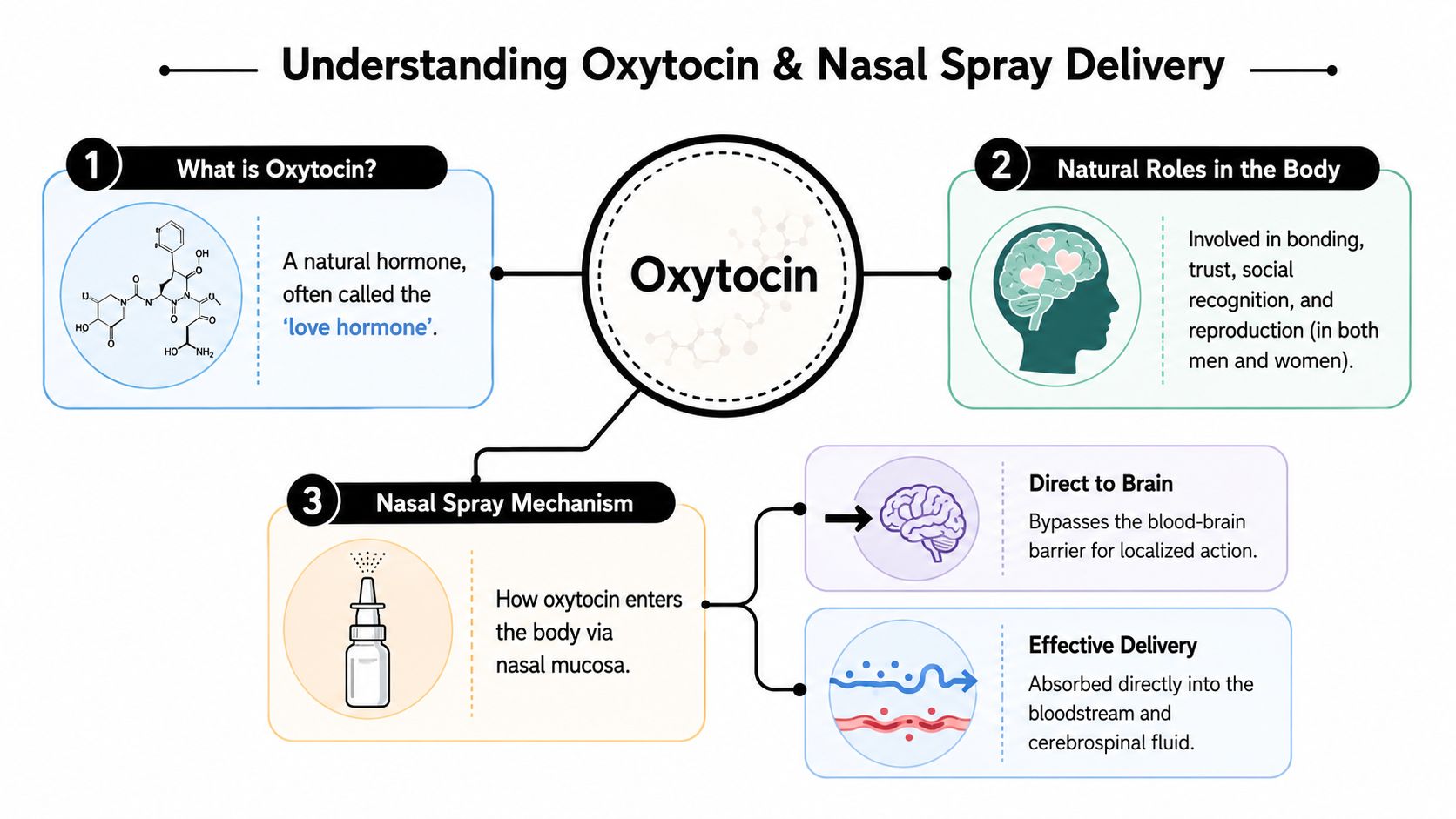
Oxytocin is a hormone and signaling molecule your body already makes. In plain terms, it helps regulate social recognition, bonding, stress responses, and reproductive physiology. That applies to both men and women, even though public discussion often oversimplifies it into romance and cuddling.
For men, the useful way to think about oxytocin is as a modulator, not a brute-force driver. Testosterone is more like the engine involved in sexual interest and androgen-dependent function. PDE5 drugs help with blood flow mechanics. Oxytocin is closer to the communication layer. It may influence how the brain processes closeness, salience, comfort, and certain reward signals.
That's why some men are interested in it when erections are technically possible but sex still feels emotionally blunted or mentally effortful.
Men who are already exploring physician-guided peptide options often first encounter oxytocin through broader peptide therapy offerings, but it's important to separate curiosity from evidence.
Why the nasal route gets attention
The nasal route matters because oxytocin doesn't fit the “just take a pill” model well. Intranasal delivery is used because it can create a relatively fast signal. A practical analogy is a side entrance versus the crowded front gate. Oral delivery has to survive digestion and first-pass metabolism. Nasal delivery uses the nasal mucosa, which is why clinicians and researchers have focused on it.
One pharmacokinetic report cited by a compounding pharmacy found plasma oxytocin increased from 20.8 ± 5.9 pg/mL at baseline to 41.1 ± 19.9 pg/mL 15 minutes after administration, which supports the idea that intranasal use can produce a relatively rapid systemic signal when speed matters (Harbor Compounding on intranasal oxytocin).
That doesn't prove a guaranteed sexual or emotional outcome. It helps explain why nasal spray is the preferred format in practice.
A fast delivery route doesn't mean a predictable result. It means the treatment can act on a timescale that makes real-world use practical.
The Clinical Evidence for Oxytocin in Men
The strongest way to assess Oxytocin nasal spray for men is to stop asking, “Does it work?” and instead ask, “For what outcome?”
Libido and sexual function
This is the area where marketing usually outruns evidence. Men often assume oxytocin should help erections, desire, orgasm quality, or relationship intimacy in a straightforward way. Human evidence doesn't support that kind of certainty.
A review-style source focused on this gap notes that current human data on oxytocin for erectile dysfunction is inconsistent, and much of the public discussion blends basic science, theory, and promotional claims rather than clean clinical proof. The same source also points out that men searching for answers often want practical guidance on sexual performance and partner connection, while the evidence base remains mixed and not established as a standard treatment (review discussion of oxytocin evidence gaps in men).
That's the key point. Oxytocin is not an established first-line treatment for erectile dysfunction. It also shouldn't be framed as a replacement for testosterone management, relationship counseling, or standard ED therapy.
If a man already has a solid TRT plan and still feels a mismatch between physical readiness and emotional engagement, oxytocin may be discussed as an adjunct. In that setting, it's closer to an experiment in careful symptom targeting than a guaranteed fix. Men also sometimes ask how it compares with agents aimed more directly at arousal and sexual response, such as PT-141 in peptide-based sexual health care. That comparison matters because these therapies don't work through the same pathway and shouldn't be treated as interchangeable.
Mood anxiety and social connection
Oxytocin remains intriguing but still not settled. There's enough biologic plausibility to explain why men feel drawn to the idea. If oxytocin influences bonding, trust, and social processing, it makes sense that some clinicians and patients would wonder whether it could help with emotional distance, relational tension, or stress-related intimacy problems.
The problem is that plausibility is not the same as a dependable treatment effect.
Some men report that intimacy problems are less about erection mechanics and more about being mentally elsewhere, tense, or disconnected. That's a real complaint, especially in high-stress professionals. But in clinic, I'd still ask harder questions first. Is sleep poor? Is alcohol use blunting emotional presence? Is anxiety untreated? Is the relationship under strain? Are SSRI side effects in the picture? Those issues commonly produce the exact symptoms men hope oxytocin will fix.
Practical filter: If the main problem is relationship conflict, chronic stress, or depression, a nasal spray may play a small supporting role at best. It won't replace addressing the cause.
For that reason, oxytocin fits best in this category as experimental and selective, not standard.
Appetite and metabolic health
The human data provides more concrete evidence. One better-known study in healthy men found that a single dose of oxytocin nasal spray reduced next-meal intake. Participants ate 122 fewer calories on average and 9 grams less fat than after placebo, with both findings reported as statistically significant at P=.03. The same report also noted improved insulin sensitivity and no serious side effects (Endocrinology Advisor summary of the male appetite study).
That does not mean oxytocin is a proven weight-loss drug for men. It does mean the appetite and metabolic side of the story has a more specific human signal than the sexual-function marketing usually acknowledges.
Here's the simplest summary:
| Potential Benefit | Level of Evidence | Key Takeaway |
|---|---|---|
| Sexual function | Mixed and inconsistent in humans | Not an established ED treatment |
| Mood and social connection | Experimental | Interesting, but outcome depends heavily on context |
| Appetite and metabolic effects | More concrete human signal | The most clearly supported short-term effect in men |
For men on TRT, that distinction matters. If your concern is fat loss, appetite, or metabolic support, the conversation may be different than if your goal is stronger erections or a dramatic libido increase.
Dosing Formulations and Proper Administration
What men are usually prescribed
In compounded practice, intranasal oxytocin is commonly dispensed in 10 mL multidose bottles at 50 IU/mL or 100 IU/mL. A frequently studied regimen is one 0.1 mL metered spray per nostril, which is about 10 IU total, given 30 to 45 minutes before the desired effect. Clinicians may adjust in 5 to 10 IU increments based on tolerability and response (Empower Pharmacy's oxytocin nasal spray overview).
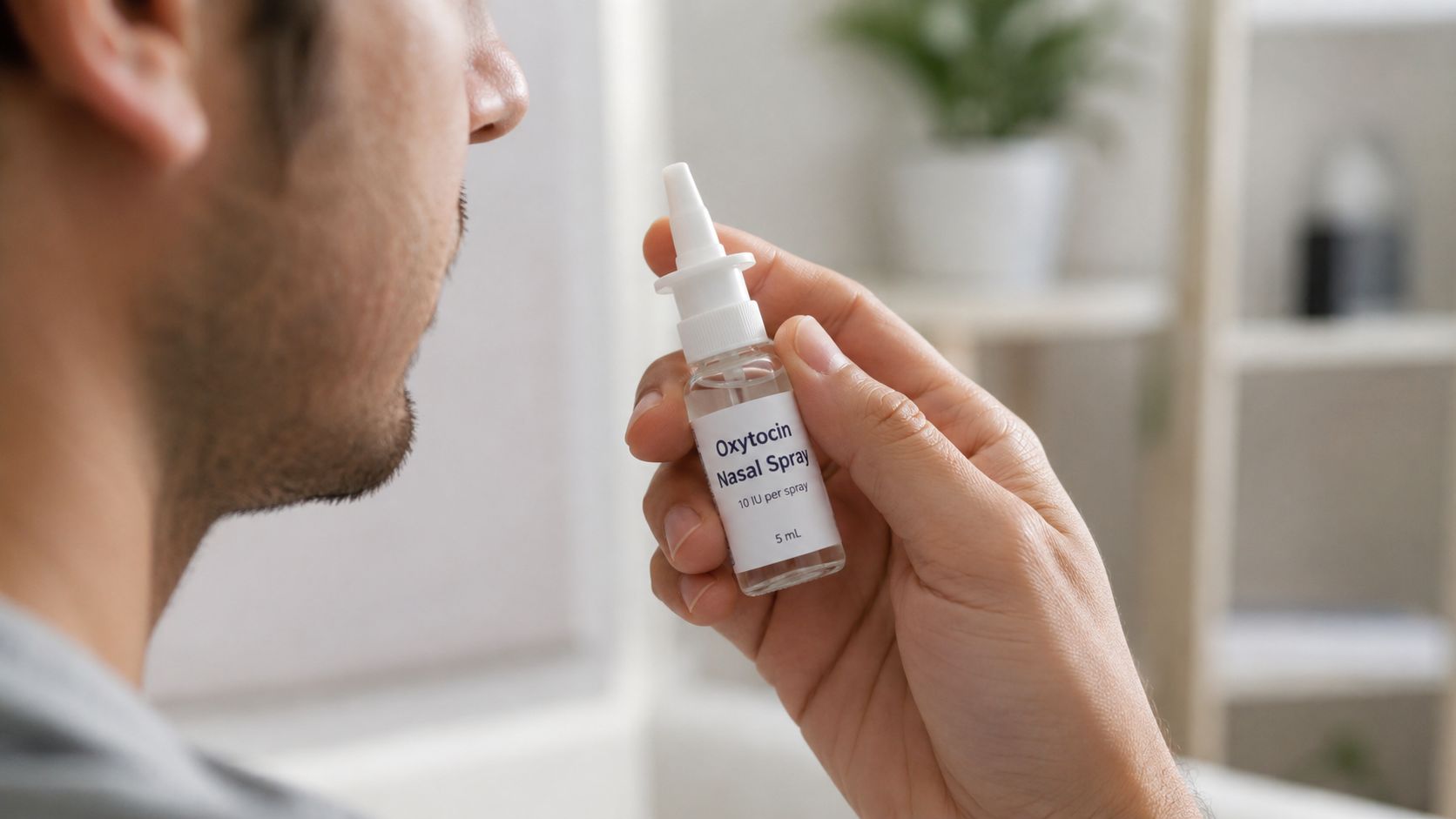
That dosing language matters because men often hear broad phrases like “take a few sprays” without knowing what concentration the bottle contains. A metered spray only means something when the formulation is known.
Two practical mistakes show up often. First, men assume more is better. Second, they judge the effect after one hurried use, usually with poor technique and unrealistic expectations.
How to use a metered nasal spray correctly
Good administration is simple, but it needs to be deliberate.
- Prime the device if instructed. Compounded sprays may have slightly different handling instructions depending on the bottle and pump.
- Gently clear the nose first. If the nasal passages are blocked, absorption can be less reliable.
- Keep the head neutral or slightly forward. Don't tilt back like you're trying to send the spray down the throat.
- Aim slightly outward, not straight at the septum. That usually feels better and may reduce irritation.
- Use a light inhale. Sniffing too hard can pull the medication away from the target area.
- Repeat in the other nostril if prescribed. Follow the exact metered regimen rather than improvising.
A short visual can help if you've never used a metered nasal medication before:
Don't evaluate the spray by whether you “feel” something dramatic right away. The useful question is whether the targeted outcome changes over repeated, properly supervised use.
If you're already on TRT or PDE5 medication, administration discipline matters even more. You want to know what each treatment is doing, not create a fog of overlapping variables.
Safety Side Effects and Key Interactions
What short term safety looks like
The short-term safety profile is more reassuring than many people expect, but that doesn't mean unsupervised use is a good idea. A review of 38 controlled studies found that short-term intranasal oxytocin use at 18 to 40 IU was generally well tolerated, with no strong signal of adverse effects distinguishable from placebo. The same review discussed another cited study in older men in which 24 IU twice daily for 4 weeks was safe and did not increase adverse events or show clinically significant differences in cardiovascular or physiologic safety measures (PMC review of intranasal oxytocin safety).
That's encouraging, but it needs context. “Generally well tolerated” in controlled research is not the same thing as “safe for everyone under any circumstances.” Real patients bring more complexity. They may be on TRT, PDE5 drugs, antidepressants, blood pressure medications, stimulants, alcohol, or multiple compounded therapies.
Men also tend to underestimate how much goal mismatch creates perceived side effects. If someone expects oxytocin to produce a strong aphrodisiac effect and it doesn't, he may keep escalating or combining treatments too casually. That's not a chemistry problem. It's a supervision problem.
TRT PDE5 medications and real world caution
For men on TRT, the main issue isn't a famous documented oxytocin-TRT conflict. It's clinical clarity. Testosterone affects androgen status, libido, mood, and body composition. Oxytocin acts in a different lane. If you start both close together, it gets harder to tell what helped, what didn't, and whether a symptom relates to one treatment or the overall plan.
For men taking sildenafil or tadalafil, the same common-sense caution applies. Oxytocin is not a direct substitute for blood-flow support, and combining therapies should be supervised when sexual function, cardiovascular status, and symptom interpretation overlap.
A practical framework:
- If erections are weak or inconsistent: Fix vascular and hormonal issues first.
- If erections are good but intimacy feels emotionally muted: Oxytocin may be a more reasonable discussion.
- If anxiety, burnout, or relationship strain dominate: Address those drivers directly instead of expecting a hormone spray to carry the load.
When oxytocin is used well, it's usually part of a structured plan. When it's used poorly, it becomes another add-on that muddies the picture.
How to Get Oxytocin Prescribed Legally and Safely
Why it usually comes from a compounding pharmacy
Oxytocin nasal spray is typically prescribed off-label for these kinds of men's health goals and commonly filled through a compounding pharmacy rather than purchased as a standard retail product for libido or ED. That's why access usually starts with a clinician who understands the indication, the limits of the evidence, and the practical questions around formulation and follow-up.
That's also why online advice can be misleading. Men often find a mix of promotional blog posts, supplement-style promises, and vague “anti-aging” claims. A legitimate process should include a real medical history, a discussion of your current medications, and a specific treatment target.
What a legitimate access path looks like
Telemedicine has made this easier, but convenience shouldn't lower the standard. The basic sequence should look like this:
- Medical review first: A licensed clinician should review symptoms, goals, and current treatment use.
- Clear indication: “I want to feel more connected” is a starting point, not a prescription by itself.
- Compounding and shipping: If prescribed, the medication is usually prepared by a compounding pharmacy and shipped with instructions.
- Follow-up: Response should be reviewed against the original goal, not judged vaguely.
If you're using a telehealth clinic, read the paperwork carefully, including the platform's telehealth consent process. That's not just admin language. It tells you how care, prescribing, communication, and pharmacy fulfillment are handled.
A legal path should feel medical, not secretive. If a seller skips evaluation and jumps straight to fulfillment, that's a warning sign.
Actionable Questions to Ask Your Clinician
A good consultation should be specific. If you ask vague questions, you'll often get vague answers back. Bring clear goals and ask your clinician to define success before you start.
Use questions like these:
- Am I trying to solve the right problem? Ask whether your symptoms fit hormonal, vascular, psychological, relational, or metabolic causes.
- What outcome are we targeting first? Libido, erection quality, emotional connection, stress response, and appetite are not the same endpoint.
- How would this fit with my TRT plan? If you're already on testosterone, ask how the clinician will separate oxytocin effects from testosterone-related changes.
- What about my ED medication? If you use sildenafil or tadalafil, ask whether timing or symptom tracking should change.
- What should tell us it's not working? You want stop rules, not just start instructions.
- Who is filling it and what concentration am I receiving? Compounded sprays vary, so the exact bottle matters.
- What are the alternatives? Sometimes the better move is adjusting TRT, improving sleep, changing an antidepressant strategy, using a PDE5 medication correctly, or addressing relationship stress directly.
The men who do best with therapies like this usually treat the appointment as a working session, not a shopping trip. That approach protects you from hype and gives you a much better chance of using the right treatment for the right reason.
If you're exploring oxytocin nasal spray alongside TRT or ED treatment, Cost Plus TRT is one telemedicine option that evaluates men's health concerns online and offers physician-supervised access to TRT, ED medications, and related therapies through a prescription-based process.