
Most advice on oxytocin nasal spray is too simple to be useful. Men hear “love hormone,” assume they'll feel warmer, calmer, more connected, and maybe even better sexually. That framing misses the core issue. Oxytocin nasal spray experience isn't predictable in the way people want it to be.
In practice, the better question isn't “Does it work?” It's who seems to respond, in what setting, for which goal, and with what trade-offs. That matters even more for men already managing hormone therapy, sexual performance concerns, stress, or relationship strain. A situational therapy can be helpful. It can also disappoint if you expect it to create intimacy, erase anxiety, or fix a low-connection relationship by chemistry alone.
A lot of men who look into peptides start in the same place: they want something that might improve mood, intimacy, or social ease without adding another heavy daily medication. That's a reasonable instinct, and it's part of why interest in peptide therapies for men's health keeps growing. But oxytocin deserves a more careful standard than internet hype gives it.
Table of Contents
- Beyond the Hype of the Love Hormone
- What Is Oxytocin and How Nasal Sprays Work
- The Reported Subjective Experience
- Dosing Onset and Duration in Research
- Safety Side Effects and Medical Interactions
- How to Discuss Oxytocin with Your Doctor
- Frequently Asked Questions About Oxytocin Nasal Spray
Beyond the Hype of the Love Hormone
Calling oxytocin the “love hormone” sounds catchy, but it sets men up for the wrong expectation. It suggests a clean emotional upgrade. Take the spray, feel bonded, feel calm, feel close. The research picture is much messier.
One of the biggest unresolved questions is whether intranasal oxytocin improves the everyday outcomes people care about, such as calm, connection, or social confidence, because the evidence remains mixed and context-dependent, and even supportive sources describe the effect as short-lived and typically used as needed rather than daily, as discussed in this PTSD treatment perspective on intranasal oxytocin.
That single point changes the whole conversation. If a therapy is context-sensitive and short-acting, then your setting, expectations, baseline psychology, and reason for using it all matter. A man using it before a difficult social event is asking a different question than a man hoping it will revive detached intimacy in a strained relationship. Those are not the same use cases, and they shouldn't be discussed as if they are.
Clinical reality: Oxytocin isn't a reliable shortcut to closeness. It appears to act more like a social amplifier in some situations than a guaranteed “connection” switch.
Men often want a yes-or-no answer. The more honest answer is conditional.
- It may fit when the goal is situational support around connection, stress, or intimacy.
- It may not fit if you want a durable daily effect.
- It may backfire if you expect chemistry to override relationship conflict, poor sleep, active anxiety, or performance pressure.
That's the lens I'd use for any oxytocin nasal spray experience. Less mythology. More decision-making.
What Is Oxytocin and How Nasal Sprays Work
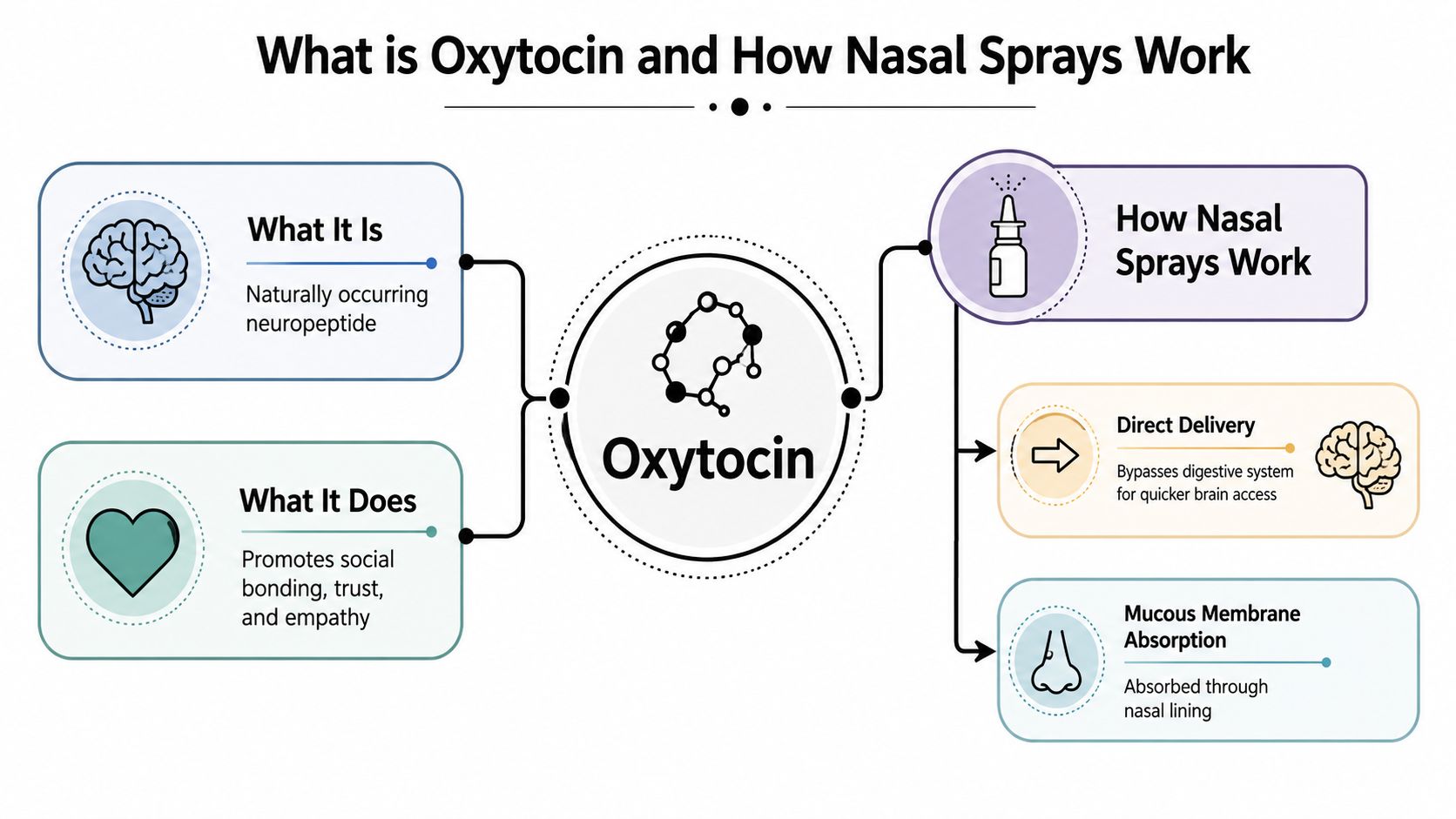
Oxytocin is a naturally occurring neuropeptide. People usually associate it with childbirth and breastfeeding, but that narrow description leaves out how broadly it's discussed in social behavior, emotional signaling, and bonding. Men produce oxytocin too. The relevant question for men isn't whether they “have” oxytocin. It's whether changing oxytocin signaling through a nasal spray meaningfully alters real-world experience in a useful way.
The delivery route is part of why this therapy gets attention. Oral oxytocin isn't the practical route people discuss for central nervous system effects. Intranasal delivery is used because the nasal cavity offers a more direct path for absorption than the digestive tract, and that's why many clinicians and researchers think of it as a faster route when they want short-term effects.
The nasal route matters
A simple way to explain it is this: the nose can function like a back door toward brain access, at least compared with swallowing a pill and hoping for a meaningful central effect. That doesn't mean every spray creates a strong brain effect in every person. It means the route is plausible for a fast, situational intervention.
Research cited by Harbor Compounding notes that intranasal oxytocin shows systemic absorption, with plasma levels rising from 20.8 ± 5.9 pg/mL at baseline to 41.1 ± 19.9 pg/mL at 15 minutes after administration, and that commonly compounded strengths include 20 IU and 30 IU per spray in addition to clinical dosing ranges around 24–32 IU daily in some settings, as summarized in this overview of intranasal oxytocin pharmacokinetics and compounding strengths.
That rapid rise helps explain why men who do notice an effect usually aren't talking about something that unfolds slowly over a full day. They're talking about something they may notice within a relatively short window.
What this does and doesn't mean
Fast absorption doesn't guarantee a better subjective response. It only explains why the therapy is framed as rapid-onset and variable.
A few practical points matter here:
| Question | Practical answer |
|---|---|
| Why a spray instead of a pill | The nasal route is used because it's a more plausible way to produce short-onset effects relevant to social or emotional experience. |
| Why responses vary | Absorption is only one piece. Baseline mood, relationship context, stress, and expectations all shape the final experience. |
| Why compounded strengths matter | Different spray strengths can make real-world use less intuitive unless a physician gives clear instructions tied to the specific bottle. |
A nasal spray can change delivery speed. It can't make a context-dependent therapy become context-free.
That distinction helps men avoid a common mistake. They focus on the bottle and ignore the setting.
The Reported Subjective Experience
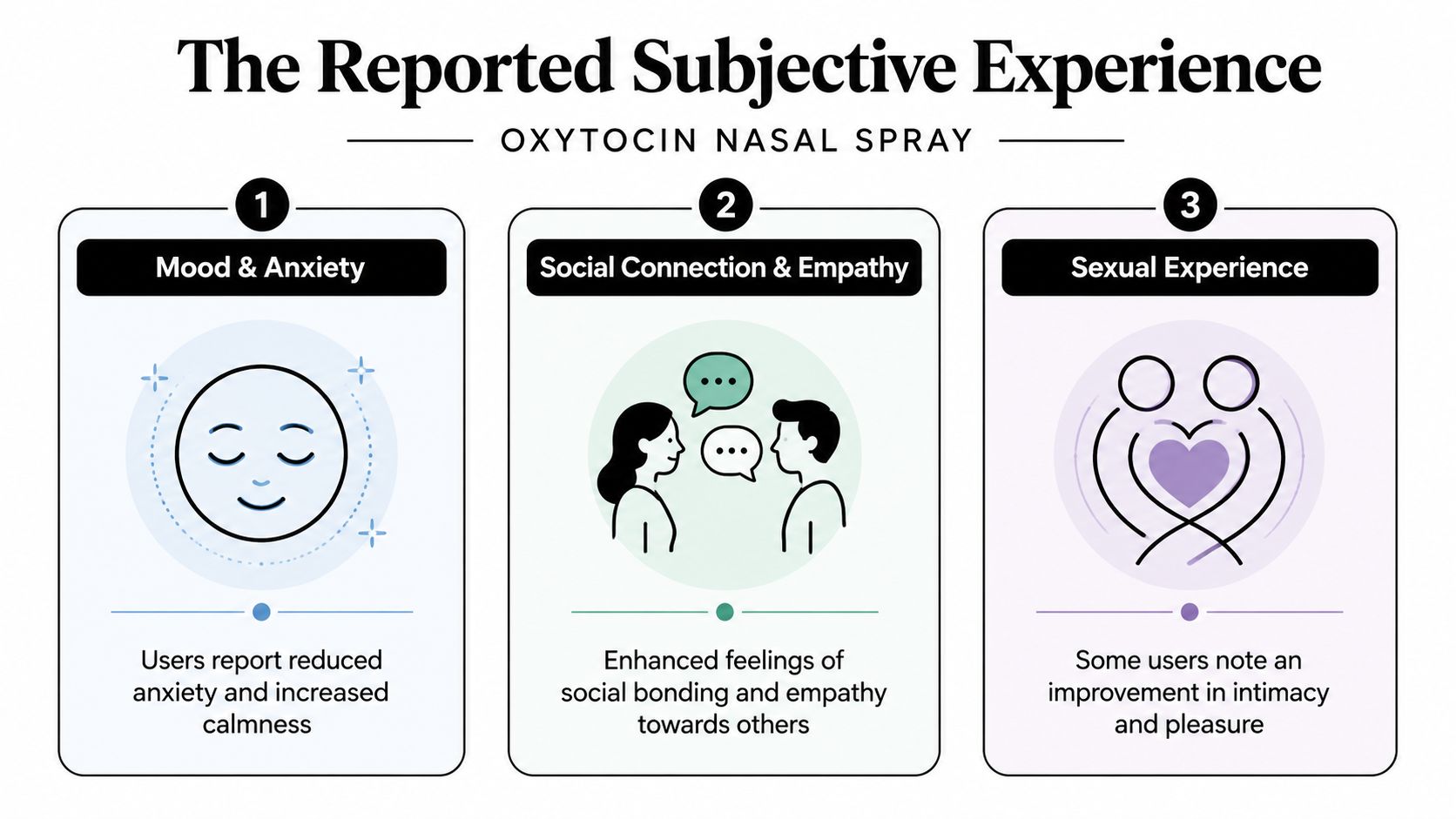
The most useful way to think about oxytocin nasal spray experience is by domain. Men usually care about three: calm, connection, and sexual experience. The problem is that the same spray can feel helpful in one domain and neutral, confusing, or even counterproductive in another.
Clinical evidence doesn't support a uniform effect. Trials suggest response varies by age, treatment duration, and subgroup, with some groups showing benefits while others don't, which is why intranasal oxytocin is better understood as a context-sensitive neuromodulator than a consistent symptom treatment, as described in this review of oxytocin studies across populations and outcomes.
Mood and anxiety
Some men describe a softer internal state. Less guarded. Less keyed up. A little easier to stay present. That kind of report fits the general interest in oxytocin for anxiety-adjacent experiences, but I'd be careful about overselling it.
This isn't the same as taking a sedative. Most men aren't describing a blunt calming effect. They're describing a subtle shift in social tension or emotional friction. If your anxiety is heavily cognitive, trauma-linked, sleep-deprived, or tied to high sympathetic arousal, the effect may be limited or hard to distinguish from expectation.
A practical mistake is using oxytocin as if it should overpower stress biology. It usually won't. If a man is overcaffeinated, underslept, distracted, and going into a high-stakes interaction, any benefit may get buried.
Here's a brief overview before going deeper:
| Domain | What men may hope for | What often limits the effect |
|---|---|---|
| Mood | Feeling calmer or less tense | Baseline anxiety, poor sleep, expectation effects |
| Social | Easier eye contact, openness, warmth | Relationship conflict, mistrust, awkward environment |
| Sexual | More intimacy or connection during sex | Performance anxiety, low desire, unresolved couple dynamics |
Later in the section, it helps to hear the discussion in plain language:
Social connection and empathy
It's around reported outcomes that the hype gets strongest and the nuance matters most. Men may report easier conversation, more eye contact, or a greater sense of emotional access. That sounds attractive, especially for men who feel socially flat, defensive, or detached.
But connection is interactive. The spray doesn't create trust in a vacuum. If the social environment feels warm and safe, the experience may feel positive. If the environment feels threatening, critical, or emotionally loaded, the same man may not feel “more loving.” He may feel more exposed, more alert to cues, or just unchanged.
Social enhancement is not the same as social safety. If the setting is wrong, a pro-connection drug effect may not feel good.
This is why some men say the spray helped on a date or during a difficult conversation, while others say they felt nothing useful at all. Those reports can both be true.
Sexual effects and relationship context
Men asking about oxytocin are often not really asking about oxytocin. They're asking whether it can improve intimacy, reduce emotional distance, or make sex feel more connected. Sometimes that's the right frame. Sometimes it isn't.
If the main issue is erectile rigidity, oxytocin isn't the primary tool. If the main issue is desire mismatch, resentment, poor communication, or performance fear, oxytocin may do little unless the broader problem is addressed. In some cases, men report a more affectionate or emotionally present experience. In others, there's no meaningful difference.
That's why I'd treat it as a possible adjunct in the right patient, not a stand-alone answer.
Dosing Onset and Duration in Research
Men usually want a practical timeline. That's where the literature is more useful than broad marketing language.
A neutral source notes that most patients report subjective effects within 15–45 minutes after intranasal administration, with effects typically lasting 1–3 hours, which is why it's often used as needed rather than as a standing daily medication, especially around social events, intimate situations, or periods of increased stress, according to this clinical overview of oxytocin nasal spray timing and tolerability.
What the timing means in real life
This profile tells you what oxytocin is and what it isn't.
It's not an all-day mood stabilizer. It's not the kind of therapy most men should imagine taking in the morning and “feeling all day.” It behaves more like a short-window intervention. If a man is going to notice anything, he'll usually be looking for it in a specific use window.
That has several practical implications:
- Plan around the event: If the goal is support for a conversation, date, or stressful social setting, timing matters more than routine.
- Don't judge it too early: If you use it and assess it immediately, you may miss the intended window.
- Don't assume longer is better: Chasing an all-evening or all-day effect can lead men to use the product with the wrong expectation.
Why this usually isn't framed as an all-day medication
The short duration is one reason many clinicians think of it as PRN. A PRN therapy can be useful when symptoms are situational. It's less compelling if your goal is a stable baseline change in mood, attachment, or confidence.
Practical rule: If you need the effect to be constant, oxytocin nasal spray is probably the wrong therapy to build your plan around.
That doesn't make it unhelpful. It just puts it in the right category. Men do better with it when they treat it as a specific tool for a specific moment, not as an emotional replacement therapy.
Safety Side Effects and Medical Interactions
The biggest mistake I see is treating oxytocin as harmless because it's naturally occurring. Natural molecules can still cause side effects. They can still create the wrong effect in the wrong patient. They can still complicate decision-making when someone is already on TRT, PDE5 inhibitors, sleep medications, or psychiatric treatment.
A frequently repeated line is that oxytocin is “well tolerated.” Sometimes that's true in a narrow trial sense. It's not the same as saying risk-free.
The side effects men tend to hear about
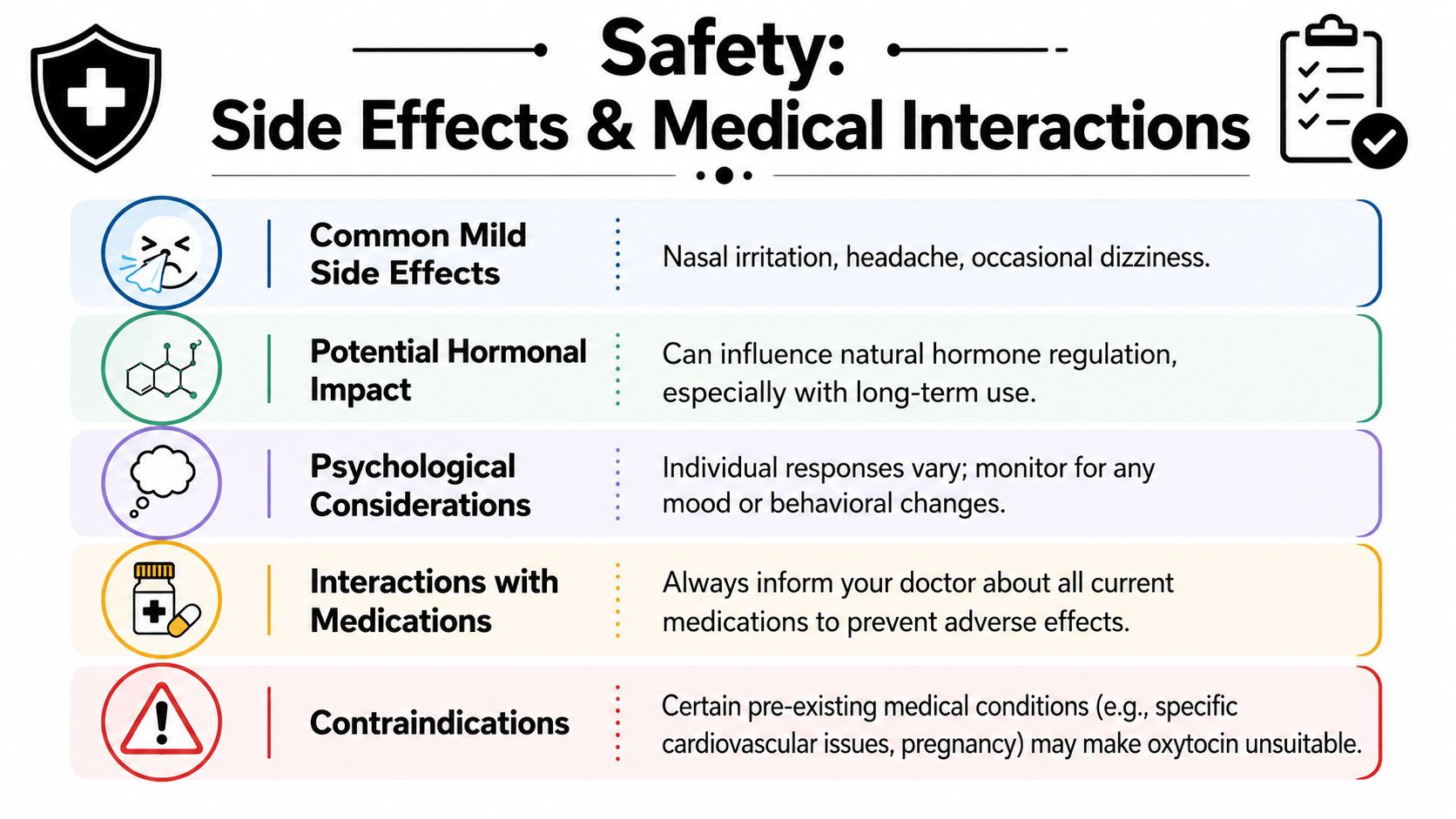
The common consumer version of the safety discussion is short: maybe some nasal irritation, maybe a mild headache, maybe nothing notable. That's incomplete.
The randomized data cited earlier also reported no serious adverse events linked to oxytocin in one study, and mild spray-related issues such as nasal discomfort and rhinorrhoea were among the commonly reported side effects. That's reassuring as far as it goes. It just doesn't settle the broader question of repeated use across more varied populations.
The side effects men often don't hear about
A 2025 systematic review of intranasal oxytocin safety in older adults found mostly mild adverse events and low dropout rates, but it also documented insomnia, agitation, hypersexual behavior, and some cardiovascular changes in certain studies, which is why “well tolerated” should be read as nuanced rather than simplistic, as reported in this systematic review of intranasal oxytocin safety in older adults.
That matters for men because the actual-world user is often not a young, healthy volunteer in a tightly controlled study. He may be middle-aged, sleep-deprived, on TRT, using tadalafil, managing blood pressure, or dealing with anxiety and relationship stress at the same time.
Watch for changes that are easy to dismiss early:
- Sleep disruption: Trouble falling asleep after use, especially if taken later in the day.
- Behavioral activation: Feeling more keyed up, impulsive, or unusually driven rather than more relaxed.
- Sexual disinhibition: A shift that feels less like healthy intimacy and more like loss of control.
- Mood volatility: Irritability, agitation, or feeling emotionally “off” after the expected window.
If a man says, “It's not making me calmer, it's making me weird,” I take that seriously. That's a reason to stop and reassess, not push through.
Special considerations with TRT and ED medications
There isn't a clean, simple rule that says oxytocin should or shouldn't be combined with TRT or ED medication. The practical issue is interpretation.
If a man is on testosterone and feels more confident, more sexual, or more energized, then adds oxytocin, it becomes easy to misread what is doing what. The same problem applies with tadalafil or sildenafil. Better erections can improve confidence and intimacy on their own. Oxytocin may then get credit for a response that's really coming from improved sexual function, reduced anxiety, or relationship relief.
The reverse problem also happens. A man takes oxytocin with a PDE5 inhibitor, expects an unusually powerful experience, and then feels disappointed because the emotional side doesn't match the erection response.
For men already in supervised care, medication review matters. If you're exploring peptide therapy options, one physician-supervised route is prescription oxytocin peptide therapy. The key point isn't the brand. It's that a prescriber should know the full stack of what you're taking and what effect you're trying to create.
How to Discuss Oxytocin with Your Doctor
If you bring up oxytocin, don't lead with “I heard it helps bonding.” Lead with the problem you want solved. That makes the conversation medically useful.

Bring a goal not just curiosity
A good consult starts with specifics. Say whether the issue is social anxiety before events, emotional disconnection during intimacy, trouble relaxing with a partner, or a sense of flatness despite normal erectile function. Those are different clinical pictures.
Also be honest about the rest of your treatment plan. Your doctor should know about TRT, tadalafil, sildenafil, psychiatric medications, sleep aids, alcohol use, and any history of agitation or impulsive behavior. The goal is to avoid a vague trial that produces vague results.
Ask questions that change decisions
Useful questions include:
- How would you define success for me with this therapy?
- Should I treat this as occasional use or something else?
- What side effects should make me stop immediately?
- How would we separate oxytocin effects from TRT or ED medication effects?
- What kind of follow-up do you want after I start?
Avoid buying from unregulated online sellers. With a compounded nasal spray, the details matter. You want a legitimate prescription pathway, a clear formulation, and dosing instructions tied to that exact product.
Frequently Asked Questions About Oxytocin Nasal Spray
Can men use it every day
Some studies have used repeated dosing schedules, but that doesn't mean daily use is automatically the right real-world strategy for most men. The broader pattern in how it's discussed clinically is more situational than continuous. If the reason you want it is event-based, social, or intimacy-specific, PRN use usually makes more sense than treating it like a daily foundation therapy.
Daily use also raises a better safety question: not just “Can I?” but “What happens to sleep, mood, behavior, and usefulness over time?” That's where physician follow-up matters.
Will it show up on a drug test
Routine workplace drug tests are generally designed around standard substances of abuse, not around this kind of prescribed peptide therapy. But men shouldn't rely on internet reassurance alone. If testing has legal, occupational, or athletic implications, ask the testing program or your physician directly and document your prescription status where appropriate.
Is oxytocin mainly for women
No. That idea comes from oxytocin's well-known role in labor and breastfeeding, but the molecule is relevant to men too. The question isn't male versus female. The question is whether a given man in a specific context is likely to benefit.
A widely cited review noted that early studies suggested intranasal oxytocin could increase trust and empathy, but other research found it can sometimes reduce trust or amplify negative social cues depending on context, which is why environment and expectation matter so much, as discussed in this APA-linked review of oxytocin's mixed social effects.
If you still have practical questions about treatment options, monitoring, and telemedicine logistics, the Cost Plus TRT FAQ page is a reasonable next stop.
If you're considering oxytocin nasal spray as part of a broader men's health plan, Cost Plus TRT offers physician-supervised telemedicine care for TRT, ED treatment, and related peptide therapies. The right use case for oxytocin is narrow enough that it's worth discussing with a clinician, not guessing from social media.