
If erection problems, low desire, or a flat sense of connection are showing up in your sex life, is the issue always blood flow or testosterone?
Not necessarily. In men's health, some symptoms sit at the intersection of physiology, mood, stress, arousal, and relationship dynamics. That's why oxytocin nasal spray keeps coming up in telemedicine conversations. It's often marketed online as a “bonding spray” or a shortcut to better intimacy. That framing is too simplistic.
Used carefully, oxytocin nasal spray is better understood as an investigational, compounded therapy that may help in selected situations, especially when sexual function has a strong psychological, emotional, or situational component. It is not a universal fix for erectile dysfunction. It is not a substitute for evaluating testosterone, cardiovascular health, sleep, medications, mental health, and relationship stress. But for the right patient, under physician supervision, it can be a thoughtful adjunct.
Table of Contents
- What Is Oxytocin Nasal Spray?
- How Oxytocin Affects the Brain and Body
- Clinical Evidence for Therapeutic Uses
- Oxytocin Compared to Other ED and Peptide Therapies
- Safety Profile Side Effects and Contraindications
- How to Get an Oxytocin Nasal Spray Prescription
- Frequently Asked Questions from Patients
What Is Oxytocin Nasal Spray?
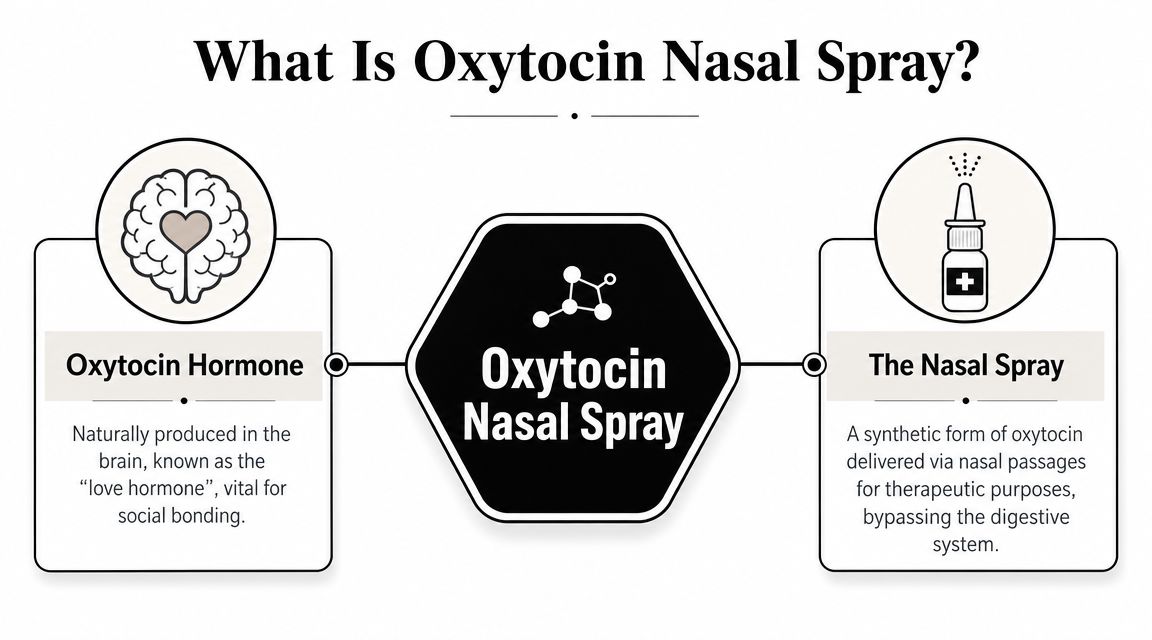
Oxytocin is a naturally occurring hormone and neuropeptide produced in the hypothalamus. It is commonly referred to as “the bonding hormone,” which is fair as a starting point, but incomplete. In clinical practice, the more important point is that oxytocin affects social signaling, emotional salience, and certain aspects of arousal and intimacy.
Oxytocin nasal spray is not a wellness gimmick or a supplement aisle product. It's a prescription compounded medication designed as a delivery system for a synthetic version of oxytocin. That distinction matters because the route of delivery is a major part of why clinicians consider it at all.
Why the nasal route matters
Compounding references describe nasal delivery as a way to help oxytocin reach central nervous system targets through olfactory and trigeminal pathways, rather than relying only on peripheral circulation. In practice, compounded products are often dispensed in 10 mL bottles at 50 IU/mL or 100 IU/mL, and a common starting regimen is one 0.1 mL metered spray per nostril, about 10 IU total, given 30 to 45 minutes before the intended effect according to Empower Pharmacy's oxytocin nasal spray compounding reference.
That's the practical difference between “oxytocin” as a concept and “oxytocin nasal spray” as a treatment. The spray format is trying to solve a drug delivery problem.
What patients often misunderstand
Men often come in expecting one of two things. Either they think oxytocin will behave like tadalafil and directly create an erection, or they think it will reliably make them feel euphoric, romantic, and effortless in every social setting. Neither is a realistic expectation.
Clinical reality: Oxytocin nasal spray is better viewed as a targeted adjunct for selected symptoms, not a universal sex or mood enhancer.
For men's health, the most sensible use case is usually narrower. Think of the patient whose erection quality drops when anxiety rises, whose libido is blunted by stress and disconnection, or whose sexual response is present physically but inconsistent emotionally. In that setting, the central effects may matter more than a simple blood-flow intervention alone.
How Oxytocin Affects the Brain and Body
Oxytocin gets oversimplified as a trust chemical. The actual picture is less romantic and more clinically useful. It appears to influence social recognition, emotional processing, attention to cues, and anxiety-related responses, which is why it has drawn interest in psychiatry, behavioral medicine, and sexual medicine.
For men, that matters because sexual function isn't only mechanical. Desire, arousal, confidence, responsiveness to a partner, and the ability to stay mentally engaged all shape sexual performance.
Why the nasal route matters
The best pharmacokinetic data we have show that intranasal oxytocin can act quickly. One cited study reported plasma oxytocin rising from 20.8 ± 5.9 pg/mL at baseline to 41.1 ± 19.9 pg/mL after 15 minutes, with peak exposure occurring in about 15 to 45 minutes and an apparent half-life of roughly 30 minutes, as summarized by Harbor Compounding's review of intranasal oxytocin.
That timing lines up with how many clinicians think about practical use. It's not something you take and forget about all day. It's a time-limited intervention that has to be matched to the symptom window.
If you're exploring physician-supervised options in this category, broader peptide therapy discussions can be useful because they frame where oxytocin fits among other centrally acting compounds.
What that can mean for sexual function
In the right context, men may describe effects such as feeling more present, less socially tense, or more emotionally engaged with a partner. Those changes can matter when erection problems are worsened by performance pressure, overthinking, or a sense of distance during intimacy.
What oxytocin usually does not do is replace a vascular treatment when the primary problem is blood flow. It also doesn't guarantee desire if the underlying issue is depression, poor sleep, medication side effects, relationship conflict, or untreated low testosterone.
A practical way to consider this:
- Best fit: Men with a meaningful psychogenic, relational, or situational component to sexual symptoms.
- Less likely to help alone: Men whose main issue is clearly vascular ED.
- Unreliable use case: Men expecting a dramatic mood shift or instant confidence boost.
Some men notice a subtle shift in ease and connection rather than a dramatic physical sensation. That's often a more realistic benchmark than chasing a “felt” effect.
The body side matters too. Oxytocin is a peptide, and peptide therapies tend to be less forgiving when the delivery method, timing, or adherence is off. Small differences in administration can change the experience enough that some patients think a therapy “doesn't work” when the real issue is mismatched timing or inconsistent use.
Clinical Evidence for Therapeutic Uses
The biggest mistake I see is treating oxytocin nasal spray as if one positive theory automatically means broad clinical benefit. That's not how the evidence reads. The data remain mixed, indication-specific, and highly dependent on protocol.
For men's health, there's enough rationale to justify careful interest. There isn't enough evidence to sell it as a cure-all.

Where it may fit in men's health
The practical use in sexual medicine is usually as an adjunct, not a standalone replacement for established treatments. In clinic, that means considering it when a man has some combination of the following:
- Performance anxiety: Erections are better in low-pressure settings and worse when anticipation builds.
- Relational disconnect: Libido and responsiveness seem tied to emotional closeness.
- Incomplete response to standard ED meds: Blood-flow support helps, but the sexual experience still feels flat or inhibited.
- Difficulty with arousal rather than pure rigidity: The problem starts earlier than erection quality itself.
That's also why some compounded protocols pair oxytocin with medications like tadalafil. The logic is straightforward. One therapy may support the vascular side of sexual function, while the other may target the central and relational side. That combination can make sense clinically, but it still requires individualized judgment.
Where the evidence is still unsettled
The broader research context is a useful reality check. A 2022 multicentre crossover trial of a higher-bioavailability intranasal oxytocin product in autism found that the primary outcome improved only in the per-protocol analysis, not in the full analysis set, and none of the secondary outcomes improved significantly overall, as reported in the PubMed record for that autism trial.
That doesn't mean oxytocin “doesn't work.” It means results are sensitive to who takes it, how they take it, and what outcome you're measuring.
A related point comes from clinical work outside men's health. A double-blind randomized trial in early psychosis found that extended oxytocin nasal spray combined with social cognition training did not beat placebo on primary or secondary outcomes, although exploratory analyses suggested that greater spray use correlated with reductions in negative symptoms within the oxytocin arm, according to the University of Washington patient guide and related clinical summary. That's a reminder that delivery variables and adherence can materially affect what a trial shows.
What works in practice: Matching the therapy to a narrow symptom pattern and using it with a defined purpose tends to be more sensible than using it for vague goals like “better confidence” or “more charisma.”
What this means for sexual function claims
Online content often makes three promises that current evidence doesn't justify.
| Common claim | More accurate clinical interpretation |
|---|---|
| Oxytocin is an ED treatment | It may help selected men when psychogenic or relational factors are prominent, but it is not a universal ED treatment |
| Oxytocin reliably improves trust and connection | Effects appear context-dependent and can vary widely by patient and situation |
| Oxytocin is a broad fix for social dysfunction | Research remains mixed, with ongoing uncertainty around ideal dosing, formulation, and patient selection |
For an informed patient, that's good news. It narrows the question. Instead of asking, “Is oxytocin good for men?” ask, “Is my symptom pattern one that oxytocin is reasonably designed to address?”
Oxytocin Compared to Other ED and Peptide Therapies
When men compare treatments, they usually put everything in one bucket labeled “sexual performance.” That bucket is too broad. Different therapies target different failure points.
What each therapy is trying to fix
Tadalafil and sildenafil are mainly about hemodynamics. They help the erection pathway by improving blood-flow conditions. If a man has adequate desire and stimulation but struggles with rigidity or consistency, that's often the right lane.
Oxytocin nasal spray sits in a different lane. It's usually considered when the bottleneck looks more central. Reduced intimacy, anticipatory anxiety, social inhibition, or a sense of emotional detachment during sex.
PT-141 is also different. It's discussed as a centrally acting arousal peptide, not a standard blood-flow medication. Patients who've already learned that vascular support alone doesn't tell the whole story often ask about it. If you want a clinical overview of that option, this PT-141 peptide therapy page explains how it's positioned in men's health care.
Injected oxytocin deserves a quick mention because patients occasionally assume an injection must be “stronger.” Stronger isn't the right question here. For central nervous system goals, the rationale for nasal delivery is precisely that it's designed to reach pathways that peripheral dosing doesn't reliably target.
Therapy Comparison Oxytocin vs Tadalafil vs PT-141
| Therapy | Mechanism of Action | Primary Benefit | Administration | Onset Time |
|---|---|---|---|---|
| Oxytocin nasal spray | Central neuropeptide signaling related to social and emotional processing | Selected cases involving intimacy, situational arousal, or psychogenic overlay | Intranasal spray | Time-limited and typically planned around the intended symptom window |
| Tadalafil | PDE5 inhibition affecting blood flow | Erectile rigidity and reliability | Oral medication | Varies by patient and regimen |
| PT-141 | Central arousal pathway modulation | Arousal-focused support in selected patients | Peptide therapy | Varies by formulation and patient response |
Here's the practical takeaway. If your erections are weak despite strong desire, tadalafil may be the more logical first move. If the issue is “I can get partly there, but stress, disconnection, or overthinking kills the moment,” oxytocin may deserve discussion. If libido and arousal are the main complaint, a clinician may consider whether a different centrally acting option is more appropriate.
No single therapy owns the whole problem. Good prescribing starts by identifying which layer of sexual function is breaking down.
Safety Profile Side Effects and Contraindications
For a compounded, investigational therapy, oxytocin nasal spray has a more reassuring short-term safety picture than many patients expect. That said, reassuring doesn't mean casual. It still needs a medical screen, a legitimate prescription, and realistic follow-up.
What short-term safety looks like
A large systematic review summarized in pharmacy sources covered 38 randomized controlled trials and more than 1,500 participants. In that review, short-term intranasal oxytocin at typical doses of 18 to 40 IU produced no reliable side effects distinguishable from placebo, according to the Mochi Health summary of oxytocin nasal spray evidence.
That's the strongest broad safety reassurance available in the verified data. It supports physician-supervised short-term use as generally well tolerated.
Clinically, the side effects that do show up tend to be mild and short-lived:
- Nasal symptoms: Irritation, burning, or runny nose can happen because the medication is delivered locally.
- Headache: Some patients notice this early, especially when they're learning whether the dose suits them.
- Light systemic effects: Dizziness, flushing, palpitations, or mild nausea can occur infrequently.
Who needs extra caution
A mild side effect profile does not mean everyone is a candidate.
Researchers and clinicians don't recommend self-experimentation with oxytocin, especially when products come from unregulated sellers and dosing accuracy is uncertain.
Use extra caution if any of the following apply:
- You're buying online without a prescription. The biggest risk may be product quality, not oxytocin itself.
- You have an unclear diagnosis. If erection problems are new, worsening, or accompanied by other symptoms, you need a proper workup first.
- You expect it to replace foundational care. It won't fix uncontrolled anxiety, major relationship strain, severe sleep deprivation, medication-related dysfunction, or endocrine problems by itself.
- You've had troublesome reactions to intranasal medications before. Local tolerability matters with this route.
A useful rule in men's health is simple. If a therapy sounds too easy for a complex sexual symptom, slow down and verify the diagnosis. Oxytocin can be appropriate. It just shouldn't be used as a shortcut around evaluation.
How to Get an Oxytocin Nasal Spray Prescription
Most patients hit the same point of confusion. They search for oxytocin nasal spray, see a mix of telemedicine clinics, supplement-style language, and compounding references, then wonder why it isn't sitting at the local retail pharmacy beside standard ED meds.
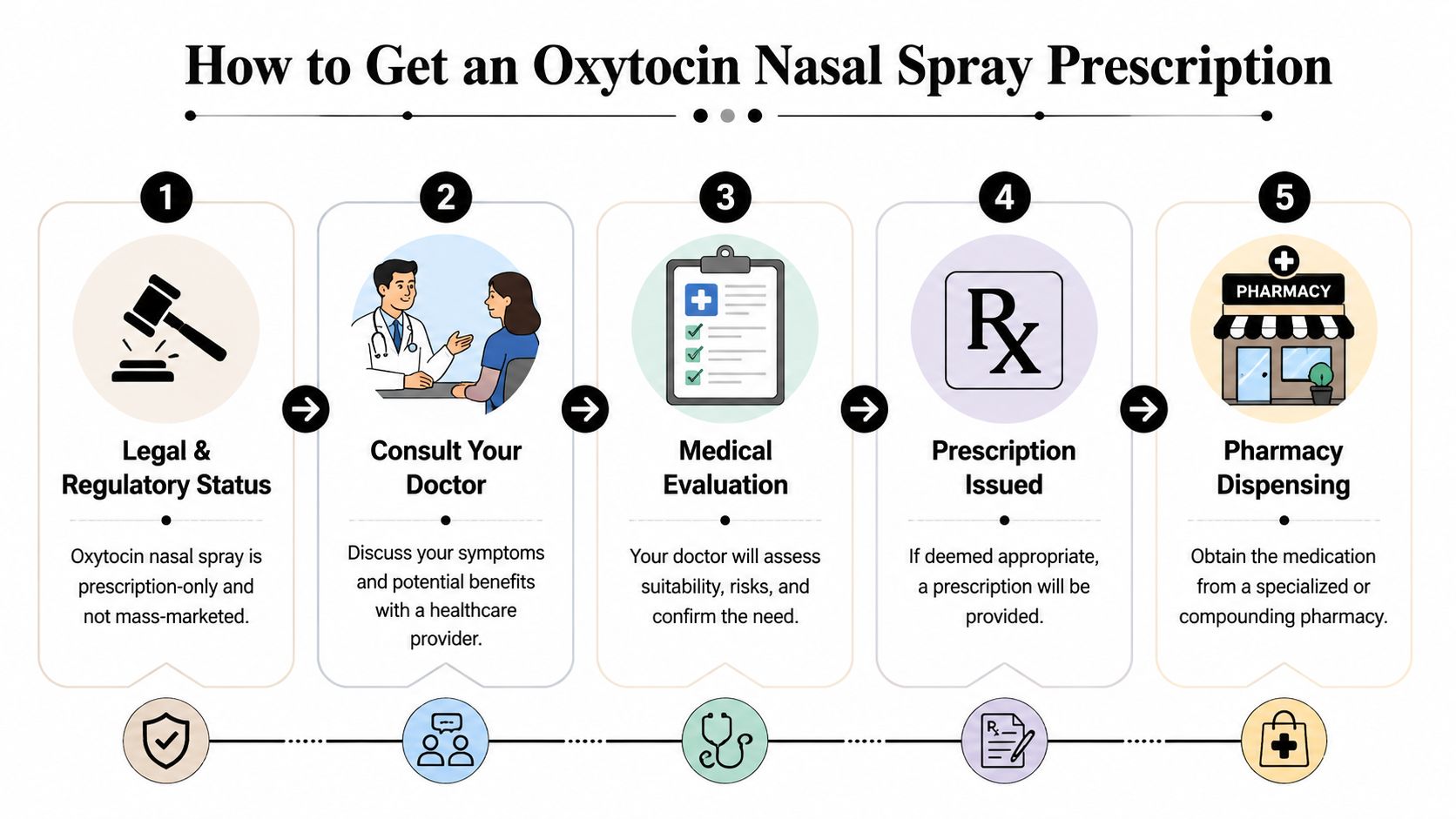
The answer is that oxytocin nasal spray is typically obtained as a compounded prescription medication, not a mass-market product with a standard one-size-fits-all commercial format.
Why you can't treat it like an over-the-counter product
Clinicians use oxytocin selectively because the evidence is mixed, the goals are indication-specific, and dosing often needs to be matched to timing and tolerability. That's not a good fit for generic self-directed use.
A legitimate process usually starts with symptom clarification. Is this erectile dysfunction, low libido, delayed arousal, performance anxiety, low testosterone, medication side effects, depression, or relationship strain? Sometimes it's more than one.
What a legitimate telemedicine process looks like
The practical steps are straightforward:
- Start with a medical consultation. A licensed clinician reviews your symptoms, medication list, health history, and treatment goals.
- Define the target problem clearly. “I want better sex” is too vague. “My erections fall apart when anxiety spikes” is actionable.
- Review alternatives first. Many men need sleep, testosterone evaluation, PDE5 therapy, relationship work, or anxiety treatment before oxytocin makes sense.
- If appropriate, use a prescription compounding pathway. That's where clinics that offer physician-supervised peptide care may come in. One example is Cost Plus TRT's oxytocin therapy page, which describes access through telemedicine and compounding.
- Follow up based on response, not hype. The question isn't whether you “felt something.” The question is whether your target symptom improved in a meaningful way.
Some patients like seeing the process visually before they book a consult.
The safest route is boring on purpose. Evaluation first, prescription second, compounding pharmacy third, reassessment after actual use.
Frequently Asked Questions from Patients
How should I time it for intimacy
The practical timing depends on the prescription and instructions from your clinician. In compounded-use references, dosing is often planned before the intended effect window rather than taken casually at random points in the day. For men using it around intimacy, that usually means being intentional with timing and not waiting until the moment has already become stressful.
If your clinician gives a pre-event protocol, follow that exactly. Don't improvise extra sprays because you're anxious about performance.
Can I use it with TRT or ED medication
Often, that question is less about safety than about strategy. TRT, tadalafil, sildenafil, and oxytocin can address very different layers of the same complaint. TRT may support hormone-related symptoms. PDE5 inhibitors target erection physiology. Oxytocin may be considered when emotional engagement, situational anxiety, or relational factors are playing a major role.
The right answer depends on the complete picture. Men on multiple therapies should tell the prescribing clinician exactly what they're already taking, including over-the-counter products and any compounded medications from other clinics.
What does it feel like when it's working
Many men expect a dramatic sensation. That's usually the wrong benchmark. A better description is often subtle: less internal tension, easier engagement with a partner, less mental interference, or a smoother transition into arousal.
If you're chasing a sudden rush, you may miss the meaningful effect. The more useful question is whether the specific problem you were treating improved.
How should I store the spray
Follow the pharmacy label and the specific storage instructions that come with the compounded product. Compounded medications can vary in handling requirements, and stability matters with peptides. If anything about the bottle, spray pattern, or storage instructions seems off, call the dispensing pharmacy before using it.
What should I tell my prescribing clinician after I try it
Be specific. Report timing, dose used, side effects, whether intimacy felt easier, whether erection quality changed, and whether the experience was meaningfully different from baseline. “Didn't work” is less helpful than “I used it as directed, tolerated it well, but the main issue remained erection firmness.”
That kind of feedback helps your clinician decide whether to adjust the plan, combine therapies differently, or move on to a better-fit treatment.
If you're sorting through low libido, erectile symptoms, or intimacy issues and want a physician-guided evaluation rather than internet hype, Cost Plus TRT offers telemedicine care for TRT, ED treatment, and related men's health therapies. The right plan starts with identifying whether your issue is hormonal, vascular, psychological, relational, or some combination of the four.