
You're already doing some of the right things. Maybe you started TRT because your testosterone was low, or you're considering it because your energy, drive, and recovery don't feel like they used to. Yet a lot of men notice something frustrating. Testosterone can help, but it doesn't always fix the whole picture. You may still feel mentally flat, slow to recover after training, or less resilient after poor sleep, alcohol, stress, or a hard work stretch.
That's where people start hearing about NAD plus peptide therapy.
The term is a little confusing. NAD+ is not a peptide. It's a coenzyme involved in cellular energy production. Peptides are signaling molecules that tell the body to do something more specific, such as support recovery, libido, or growth-hormone-related pathways. Used together, they can make sense for men on TRT because they address two different layers of the same problem. Hormones may improve the signal from the top down. NAD+ may help support the energy capacity at the cellular level so the body can respond better.
Table of Contents
- An Introduction to NAD Plus Peptide Therapy
- What Is NAD and Why Does It Matter for Men's Health
- How NAD Works Synergistically with Peptide Therapies
- NAD Administration Methods Compared
- Expected Outcomes and Potential Side Effects
- NAD Therapy vs Other Peptides at Cost Plus TRT
- How to Start NAD Therapy with Cost Plus TRT
- Frequently Asked Questions about NAD Therapy
An Introduction to NAD Plus Peptide Therapy
When men ask about NAD plus peptide therapy, they're usually not asking for a chemistry lesson. They want to know whether it can help them feel sharper, recover faster, and get more out of TRT without adding random treatments that don't move the needle.
That's the practical way to think about it.
NAD+ helps cells turn fuel into usable energy. Peptides send more targeted biological instructions. In men's health, that combination can be useful when a patient has both broad symptoms and specific goals. Broad symptoms include fatigue, inconsistent focus, and that “running on fumes” feeling. Specific goals include better sleep-related recovery, improved training tolerance, or stronger libido support.
A lot of online content treats this like a generic anti-aging stack. That misses the point. For a man on TRT, the key question is whether his body has enough cellular support to respond well to the hormone environment he's trying to optimize.
Practical rule: If testosterone is the hormone layer, NAD+ is often part of the energy layer underneath it.
The best use of NAD plus peptide therapy isn't to throw more treatments at vague symptoms. It's to match the therapy to the pattern. Men who do well with this approach usually have a reason for it. They're not just chasing novelty. They want steadier energy, cleaner recovery, and a plan that fits real life.
What Is NAD and Why Does It Matter for Men's Health
A common TRT scenario looks like this. Testosterone levels improve on paper, libido is better than before, but energy still drops in the afternoon, workouts cost more to recover from, and one poor night of sleep throws off the next day. In that setting, I start thinking beyond hormones alone.
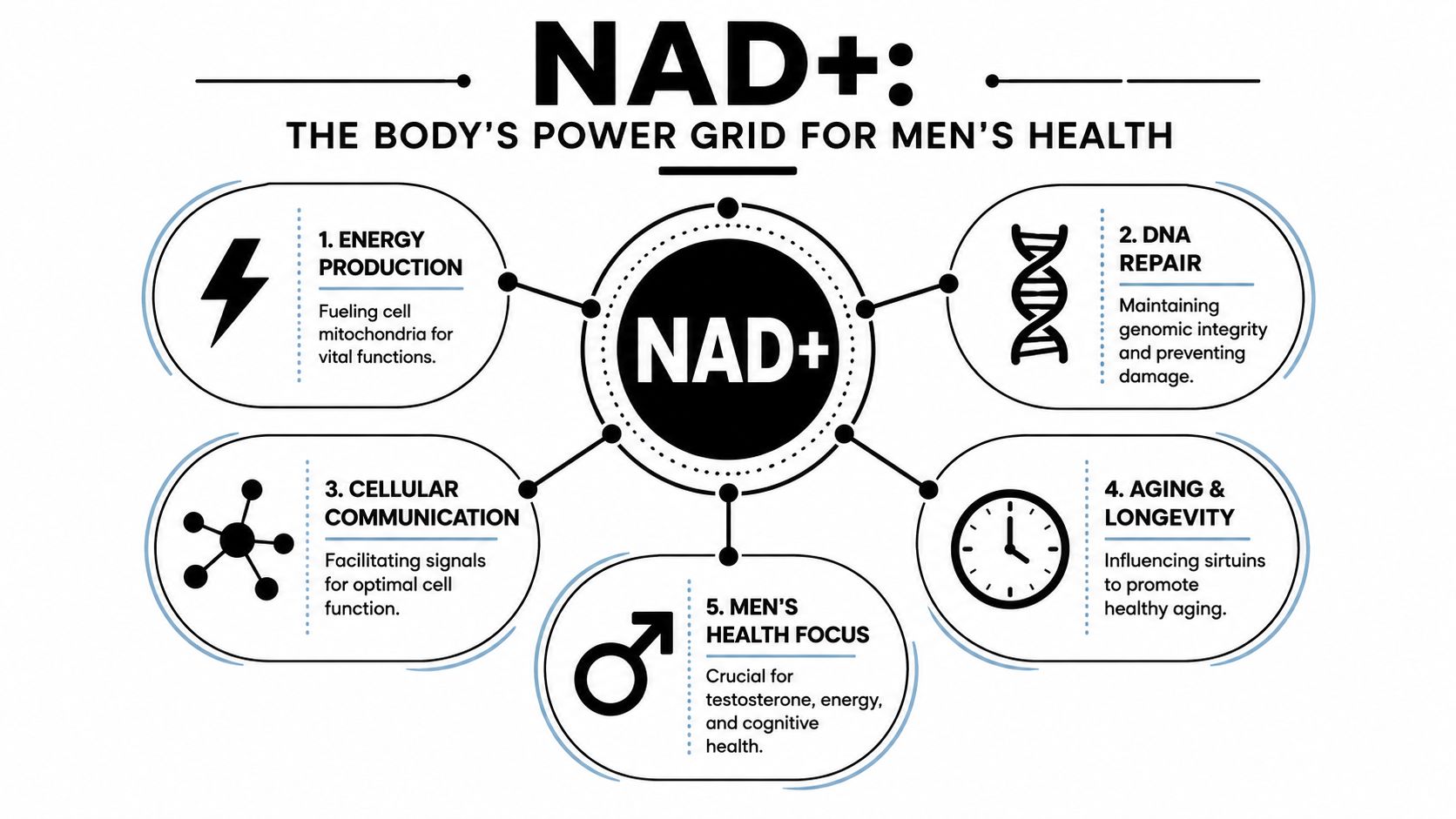
NAD+ stands for nicotinamide adenine dinucleotide. It is a coenzyme every cell uses to help turn food into usable energy, especially inside the mitochondria. It also supports repair systems that deal with everyday cellular wear and tear.
The cellular power grid analogy
NAD+ works like part of the power grid for your cells.
You can have enough calories, enough protein, and even well-managed testosterone, but cells still need the chemical tools to convert that input into output. NAD+ is one of those tools. It participates in energy production and helps supply enzymes involved in DNA repair and metabolic regulation.
That matters in men's health because low cellular output rarely shows up as one isolated complaint. Men usually describe a pattern. Physical stamina feels less reliable. Mental sharpness comes and goes. Recovery takes longer than it should.
For men already on TRT, that distinction matters. Testosterone can improve the hormonal environment, but it does not replace the cell-level machinery required to produce steady energy and recover well. That is one reason some men feel only partly better after starting TRT. The hormone signal is better, but the energy side is still underperforming.
Why this matters in real life
NAD+ levels tend to decline with age, and lower NAD+ status has been linked with several age-related problems in human research. The practical takeaway is straightforward. As men get older, the body often becomes less forgiving under stress, poor sleep, hard training, and high work demand.
In clinic, that often sounds like this:
- TRT helped, but energy still feels uneven. Morning drive is decent, then performance drops later in the day.
- Libido is improved, but not consistent. Interest is better, yet resilience and follow-through are not where the patient expected.
- Recovery is slower than the training plan requires. He can still lift and work, but the bounce-back is missing.
- Stress tolerance is lower. A busy week or bad sleep hits harder than it used to.
This does not mean NAD+ is a cure-all, and it does not mean every man on TRT needs it. It means NAD+ belongs in the conversation when symptoms suggest the body has enough hormonal support but still lacks steady metabolic support.
NAD+ also helps power enzymes such as sirtuins and PARPs, which are involved in repair and cellular maintenance. Clinically, that is why I frame it as foundation work, not stimulation. Stimulants can make a tired system feel more awake for a few hours. Better cellular support aims to help the system produce and use energy more effectively in the first place.
Men considering a broader plan often look at peptide therapy options for recovery, libido, and performance alongside NAD+, especially if TRT has fixed part of the problem but not the full picture.
Men often expect one hormone change to solve every symptom. In practice, better results usually come from matching the hormone plan to the energy, recovery, and repair demands underneath it.
How NAD Works Synergistically with Peptide Therapies
A common TRT scenario goes like this. Testosterone levels are better, libido has improved some, but energy still runs unevenly and recovery lags behind training. In that setting, adding another peptide without addressing cellular energy often leads to mixed results.
The phrase NAD plus peptide is useful because each therapy handles a different part of the job. NAD+ helps cells produce and use energy efficiently. Peptides send specific instructions, such as repair, recovery, appetite control, sexual signaling, or growth-hormone-related support.
In practice, I explain it like this to men on TRT. Testosterone can improve the hormonal environment. A peptide can press on a targeted pathway. NAD+ helps the cell pay the energy bill required to respond well to both. If that energy side is lagging, the signal may be clear but the result still feels underwhelming.
That pattern shows up most often in men who are already doing several things right. They are taking TRT consistently, sleeping reasonably well, training hard enough to need recovery, and still describing afternoon drop-off, flat exercise capacity, or sex drive that is better than before but not reliable. The issue is not always “more hormone.” Often it is better support for how the body turns fuel into usable output.
Where this fits with TRT
TRT and NAD+ do not compete. They address different bottlenecks.
TRT increases hormone availability. NAD+ supports the metabolic machinery that lets tissues keep up with the demands created by training, work stress, sexual activity, and recovery. Peptides can then be used with more intention, based on the symptom that remains.
A practical way to view the stack is:
- TRT sets the hormonal baseline. This is the foundation for men with clinically low testosterone.
- NAD+ supports cellular energy and repair. This matters when the patient still feels drained or slow to bounce back.
- Peptides target a remaining problem. That might be recovery, body composition, erectile support, or appetite regulation, depending on the peptide selected.
The trade-off is that stacking therapies only makes sense when each one has a defined purpose. If a man on TRT still has poor sleep, high alcohol intake, untreated sleep apnea, or a chaotic training plan, adding NAD+ and peptides will not fully compensate for those issues. On the other hand, if the basics are solid and progress still feels incomplete, combining NAD+ with physician-supervised peptide therapies for recovery, libido, and performance can be a more rational next step than randomly adding another signal molecule.
A short explainer is helpful here if you want to visualize the difference between energy support and signaling support.
If TRT improved your numbers but not your consistency, NAD+ may help the body respond to peptide and hormone therapy with better energy, steadier libido, and more reliable recovery.
NAD Administration Methods Compared
A man can be doing well on TRT, add peptides for recovery or body composition, and still ask the same practical question. What is the best way to take NAD+ without turning treatment into another part-time job?
The answer depends on what problem you are trying to solve.
If the goal is a faster, more noticeable push in energy or mental stamina, IV therapy is the most intensive option. It delivers NAD+ directly and tends to appeal to men who want a supervised clinic experience. The trade-off is time. Infusions can take hours, scheduling is less flexible, and some men will not stay consistent with a treatment that competes with work, travel, and family life.
Subcutaneous NAD+ sits in the middle. For many men on TRT, this is the method that makes the most clinical sense because it is easier to fit into a real routine. Dosing can be adjusted more gradually, home use is possible after proper instruction, and the overall experience is usually more manageable than repeated infusions. That matters if the broader plan already includes testosterone, labs, and possibly another peptide.
Oral and sublingual precursors such as NR or NMN are the simplest place to start. They are easy to take and require the least effort day to day. The limitation is response strength and consistency. Some men feel a clear benefit, while others, especially those looking for stronger support with training recovery, libido, or afternoon energy while on TRT, find that precursors do not move the needle enough.
Comparison of NAD+ Administration Methods
| Method | How it fits in practice | Convenience | Typical cost pattern | Time commitment |
|---|---|---|---|---|
| IV infusion | Best for men who want direct delivery and close supervision | Lowest convenience | Usually the most expensive per session | Highest |
| Subcutaneous injection | Best balance of control, consistency, and home use | High after training | Often more practical than recurring infusions | Moderate to low |
| Oral or sublingual precursors | Easiest entry point, but less predictable clinically | Highest | Usually lowest barrier to start | Low |
A few real-world patterns show up repeatedly in practice:
- IV NAD+ fits men who want an aggressive start and do not mind clinic visits.
- Subcutaneous NAD+ fits men who want steady support that can live alongside TRT and peptide therapy without adding much friction.
- Oral precursors fit men who prioritize simplicity or want a lower-commitment trial before considering injections.
For men already on TRT, I usually frame the choice around adherence, not theory. The best method is the one you will keep doing long enough to judge whether energy, libido, and recovery improve. In telemedicine care, that often makes subcutaneous dosing the most practical option.
Expected Outcomes and Potential Side Effects
A common TRT scenario goes like this. Testosterone levels are better, labs look cleaner, libido has improved some, but energy still fades by mid-afternoon and recovery is inconsistent. That is often where NAD+ earns its place. In the right patient, it can make hormone therapy feel more complete by supporting the cellular side of energy production rather than changing hormone levels directly.
The first improvements are usually subtle but useful. Men often report steadier daytime energy, better mental stamina, and less of the heavy, drained feeling after training. For men on TRT, that matters because better mitochondrial support can make it easier to benefit from the hormonal improvements they are already paying for. If libido is still lagging, NAD+ can also help by improving overall energy and resilience, which are often part of the sexual health picture even when testosterone is already optimized.
I usually set expectations carefully. A good response feels like better baseline function. Workouts recover more cleanly. Afternoon focus holds up longer. Sleep debt, travel, and stressful weeks may feel less punishing. Men looking for the same kind of immediate effect they got when low testosterone was first corrected are often disappointed if nobody explains that upfront.
The timeline also matters. Some men notice a difference quickly. Others need a few weeks of consistent use before it is clear whether NAD+ is helping. That is especially true when NAD+ is paired with TRT and another peptide, because the goal is not a jolt. The goal is a more stable system.
Combination therapy can be useful here. A man on TRT who also uses Sermorelin therapy for recovery and sleep support may find that NAD+ fills a different gap by supporting energy handling and day-to-day resilience. Those therapies do not do the same job, which is why the right combination can outperform raising one dose or adding more testosterone.
Side effects are usually manageable, but they are real. The most common problems in practice are flushing, nausea, stomach upset, headache, lightheadedness, and injection-site irritation. Men who start too aggressively are more likely to feel rough early on, especially with injectable or infusion-based protocols.
A practical plan lowers that risk:
- Start with a conservative dose if you tend to react strongly to supplements or injections.
- Increase gradually instead of chasing a fast result.
- Keep hydration, food intake, and sleep in good order, because poor basics make side effects more noticeable.
- Reassess if you feel worse rather than assuming you need to push through.
There are trade-offs. Faster, more aggressive protocols may produce quicker feedback, but they also create more friction and more side effects. Slower titration is less exciting, yet it is often the better choice for men who want NAD+ to fit alongside TRT without turning treatment into another stressor.
What NAD+ does not do is compensate for poor TRT management, inadequate sleep, heavy alcohol use, or overtraining. It works best as a support layer. In men who are already doing the basics well, that added support can translate into better energy, more reliable libido, and smoother recovery.
NAD Therapy vs Other Peptides at Cost Plus TRT
A common scenario in clinic is a man who has his TRT dialed in on paper, yet still says, “My labs look better than I feel.” Energy is inconsistent. Recovery lags. Libido improves, but not as much as expected. That is usually the point where it helps to separate NAD+ from peptide therapy, because they are not interchangeable.
Different tools for different jobs
NAD+ therapy supports the metabolic side of the equation. In practical terms, it helps cells make and use energy more efficiently, which is why the conversation usually centers on stamina, mental sharpness, and how well a man bounces back from training, work stress, and poor sleep. For men on TRT, that matters. Testosterone can improve drive and body composition, but it does not automatically fix the “wired but tired” pattern many men describe.
Sermorelin works in a narrower lane. It is used to stimulate growth hormone signaling, so the expected benefits are more often tied to sleep quality, recovery, and body composition changes over time. Men exploring Sermorelin peptide therapy are usually trying to improve a specific bottleneck rather than overall cellular energy.
PT-141 is narrower still. It is generally used for sexual desire and arousal. If a man on TRT says, “My testosterone level is fine, but my libido still feels unreliable,” that is a different clinical problem from low energy or poor recovery.
When combination therapy makes sense
The best results often come from matching the treatment to the pattern.
- Choose NAD+ when the complaint is broad. Low energy, flat motivation, slower recovery, or a general sense that TRT helped but did not fully restore day-to-day performance.
- Choose a targeted peptide when one issue stands out. Libido, sleep-related recovery, or body composition goals.
- Use both when a man has improved hormone levels but still has a second limiting factor.
That combination can be useful for men on TRT. NAD+ supports the energy supply. A peptide can address the specific function that still feels off. In real-world care, that often translates to better training consistency, more reliable sexual function, and fewer days where a patient feels like his hormones are “working” only on paper.
The trade-off is complexity. More therapies can mean more cost, more injections, and more variables to monitor. That is why the goal is not to stack treatments aggressively. The goal is to choose the smallest plan that solves the actual problem.
How to Start NAD Therapy with Cost Plus TRT
Starting treatment should feel organized, not mysterious. Most men want a straightforward process with clear next steps and physician oversight.
What the process usually looks like
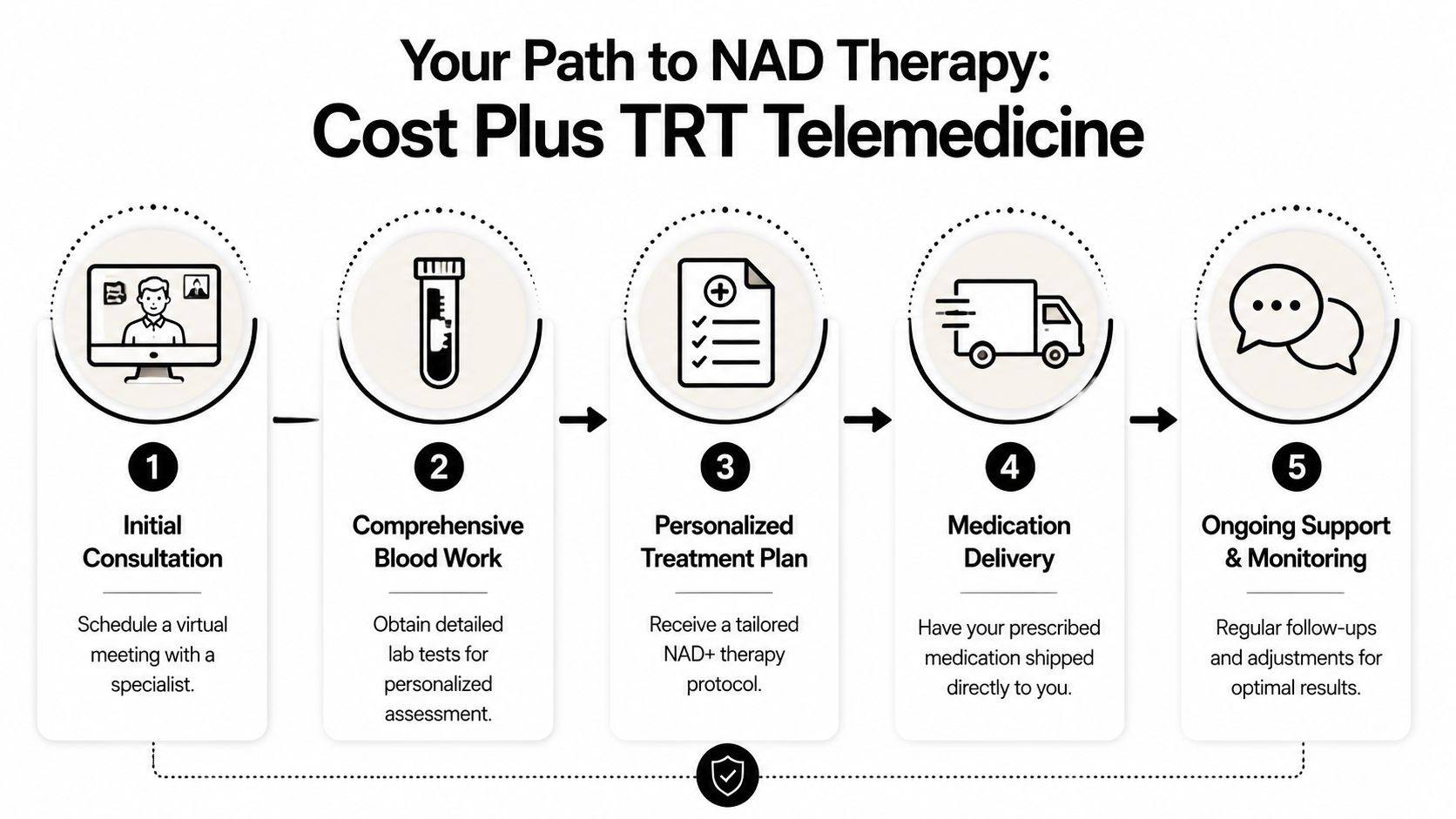
The telemedicine path is usually simple:
- Complete intake and request a consultation. You'll outline symptoms, goals, medications, and relevant history.
- Meet with a licensed physician online. The collective clinical picture holds significance; fatigue, libido changes, TRT history, sleep, training load, and recovery all shape the plan.
- Review labs. Some patients upload recent labs. Others schedule new testing first.
- Receive a personalized protocol. Route, dose, and whether to pair NAD+ with a peptide depend on the clinical picture.
- Have medication shipped for home use if approved. The plan should include instructions, supplies, and follow-up.
Many men also want to know the practical side before they commit. Current pricing details matter because treatment adherence is better when the plan fits both the physiology and the budget.
What makes a good candidate
The men who usually ask the best questions are often the best candidates. They're not looking for a magic fix. They're looking for a rational next step.
Good candidates often include men who:
- still feel underpowered despite TRT progress
- have broad fatigue rather than one isolated symptom
- want a home-based option instead of infusion appointments
- are willing to track response and adjust based on real outcomes
The right protocol should feel sustainable. If a plan only works in theory, it won't work for long.
Frequently Asked Questions about NAD Therapy
Is NAD therapy safe
Under physician supervision, NAD+ therapy is generally approached by starting conservatively and adjusting based on tolerability, goals, and response. The main issues clinicians watch for are side effects related to route and dose, such as flushing, nausea, or injection-site irritation. Safety improves when treatment is individualized instead of copied from generic online protocols.
How much does treatment cost
Pricing depends on the medication format, whether labs are already available, and whether the plan includes additional therapies such as TRT or other peptides. The important question isn't just the monthly price. Ask what's included, how follow-up is handled, and whether supplies and clinician oversight are part of the package.
How are injections scheduled
That depends on the route and the treatment goal. Some men use a steady home-based schedule with subcutaneous dosing. Others may start with a more structured phase and then adjust. The schedule should fit your work, travel, training, and tolerance, not just a template.
Should every man on TRT add NAD and peptides
No. Some men do well on TRT alone. Others need lifestyle cleanup before another therapy makes sense. NAD plus peptide therapy is most useful when symptoms point to both a foundational energy issue and a more targeted problem, such as recovery or libido. More treatment isn't always better. Better matching is better.
If you're on TRT, considering TRT, or trying to figure out whether NAD plus peptide therapy fits your symptoms, Cost Plus TRT offers telemedicine evaluation, physician review, and home-delivered men's health treatment options with transparent pricing.