
Most at-home NAD+ injection programs cost $150 to $400 per month, while clinic IV drips run $250 to $1,500 per session. The lower headline price of injections can still become a substantial annual expense once loading doses, supplies, clinician oversight, laboratory work, and shipping are included.
That difference surprises many men who first ask about NAD injections price. They see a vial advertised at a modest amount, then discover that the actual treatment plan includes sterile supplies, pharmacy compounding, medical review, and recurring fulfillment. The active ingredient matters, but it isn't the whole bill.
NAD+ also sits in an evidence-sensitive category. A human pharmacokinetic pilot has examined IV administration, but larger outcome trials for many consumer goals haven't established that a more expensive delivery route produces better results. The sensible question isn't, “What does NAD cost?” It's, “What am I paying for, and does each part serve a clinical purpose?”
Table of Contents
- What NAD Injections Cost in 2026
- How NAD+ Therapy Works and Why Injections Sit in the Middle
- The Five Cost Drivers Behind Every NAD Injection Price
- Comparing Telehealth, Local Clinics, and IV Drip Centers
- Does Paying More for NAD Get You Better Results
- Your Real First-Year Cost of NAD Injections
- Practical Ways to Lower Your NAD+ Injection Bill
What NAD Injections Cost in 2026
At-home NAD+ injections generally run $150 to $400 monthly, while clinic IV therapy can cost $250 to $1,500 per session. Those figures reflect different buying models, from telehealth programs and pharmacy fulfillment to supervised infusions. Current comparisons include the 2026 NAD+ price comparison and the NAD therapy cost index.
The market has three practical tiers:
| Delivery Method | Monthly Cost Range | Typical Use Case |
|---|---|---|
| Oral precursors such as NMN or NR | About $40 to $120 | Daily, needle-free supplementation |
| Subcutaneous or intramuscular injections | $150 to $400 | Home protocols with prescribed dosing |
| Clinic-administered IV infusions | $250 to $1,500 per session | Supervised, time-intensive infusion protocols |
Oral precursors cost less because they do not require sterile compounding, injection equipment, or a clinician-administered visit. Injections sit between oral products and IV therapy. Their price can include prescription access, pharmacy preparation, supplies, and clinical oversight, while avoiding the chair time and facility charges of an IV suite.
IV therapy uses one session as its pricing unit, rather than one month. Repeated infusions can therefore exceed the apparent monthly cost of an injection program. Some telehealth packages in the cited pricing roundup fall near $190, $199, $235, $299, and $395 per month, depending on dose and supply size.
Practical rule: Compare the route, dose, refill quantity, supplies, and clinical support together. A vial-only price does not match a delivered monthly protocol.
Pharmacy-only pricing also differs from bundled care. A vial may look inexpensive before shipping, supplies, compounding, and medical review are added, as described in this NAD injection pricing overview. For a broader reference point on transparent medical-care pricing, review the Cost Plus TRT pricing model. Its structure is a benchmark, not proof that every NAD+ provider includes the same services.
How NAD+ Therapy Works and Why Injections Sit in the Middle
NAD+, or nicotinamide adenine dinucleotide, is a coenzyme found in every cell. Mitochondria use it to help convert nutrients into usable cellular energy, while NAD+-dependent enzymes participate in processes related to stress response and DNA repair. Human NAD+ biology is complex, and the clinical evidence for consumer wellness claims remains limited, but the molecule itself is central to cellular metabolism.
Circulating and tissue NAD+ availability can change with aging, metabolic disease, and chronic inflammation. One mechanism discussed in the clinical background is increased activity of CD38, an enzyme that consumes NAD+. That biological explanation is not the same as proof that an injection will reverse fatigue, improve cognition, or slow aging. A prescriber still has to assess the symptom, the underlying condition, and whether NAD+ is an appropriate intervention.
Three routes, three trade-offs
Oral NMN and NR are precursors, not NAD+ itself. The digestive system and liver process an oral product before its components reach circulation and tissue. Oral dosing is convenient and avoids needles, but the amount and route of conversion differ from one person to another.
Subcutaneous injections place the medication into fatty tissue, while intramuscular injections place it into muscle. Both avoid the digestive route and offer a controlled dose without requiring a clinic chair. They still involve prescription handling, sterile technique, storage, disposal, and clinician instructions.
IV infusion puts the preparation directly into the bloodstream. That can create higher circulating exposure in a single treatment, but it also requires venous access, clinical monitoring, and a slow administration process. The route is more infrastructure-heavy, which explains much of the price difference.
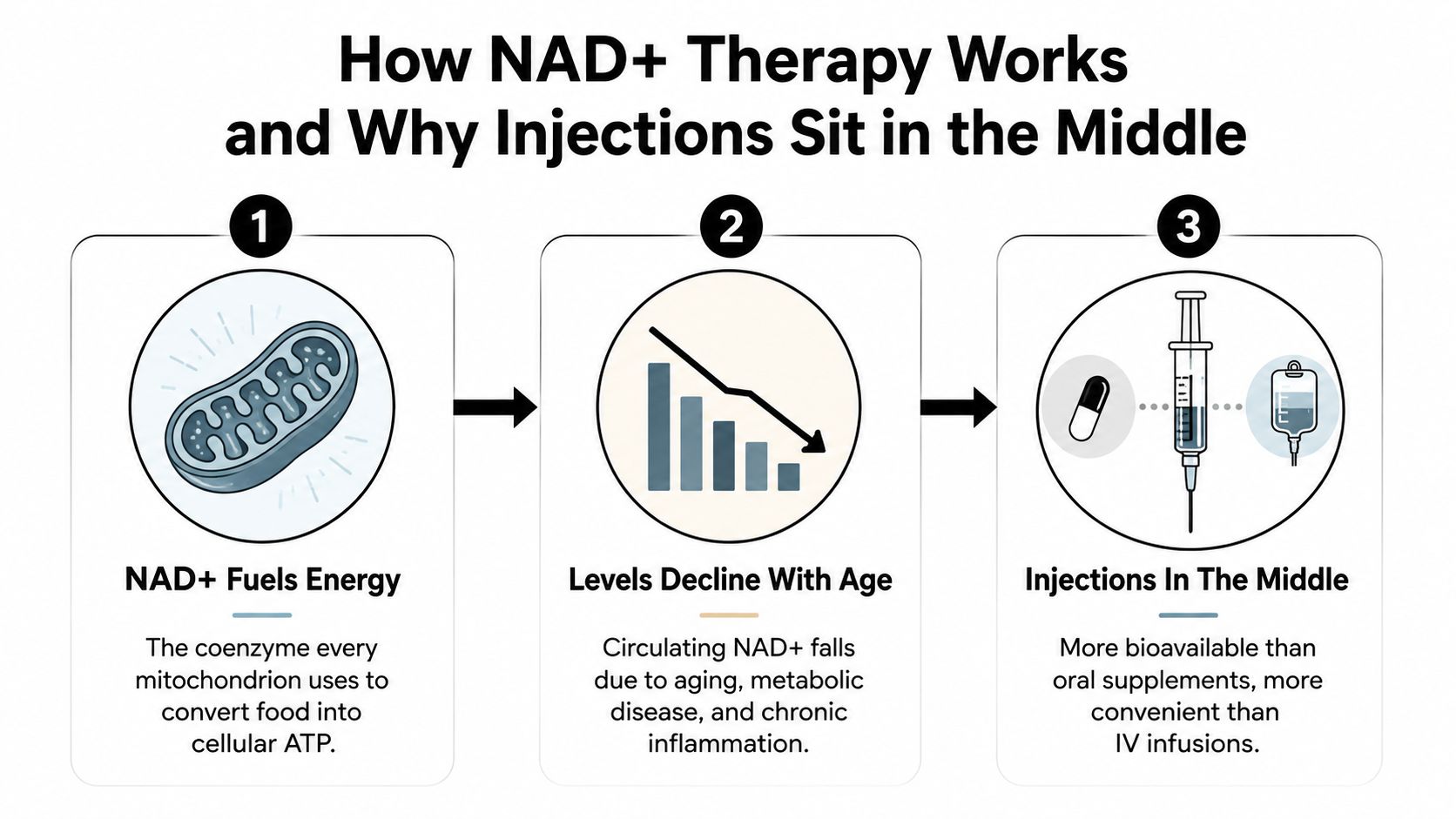
The practical position of injections is straightforward: more involved than a capsule, less resource-intensive than an IV infusion. That middle position doesn't automatically make injections superior. It makes them a different compromise between convenience, exposure, supervision, and recurring cost.
For additional visual context on NAD+ therapy, watch this overview:
The Five Cost Drivers Behind Every NAD Injection Price
The price on a telehealth checkout page usually reflects several separate expenses. The most important variable is dose in milligrams. A larger prescribed amount requires more active ingredient, more frequent refills, or a larger vial. The injectable NAD+ cost breakdown shows why vial size changes the effective price per milligram, with larger fills generally lowering the per-milligram cost.
Dose and concentration
A concentrated vial can reduce packaging and handling costs, but concentration changes injection volume and technique. A lower-concentration preparation may require more liquid for the same prescribed amount, while a higher-concentration product can reduce volume. The prescriber and pharmacy, not the patient, should determine whether a concentration is appropriate.
The supply bundle is another hidden line item. Needles, syringes, alcohol swabs, a sharps container, bacteriostatic water, and temperature-controlled packaging may be included in one plan or billed separately. A vial-only quote can therefore look cheaper than a complete home protocol.
Oversight, compounding, and delivery
Clinician oversight may include an initial evaluation, prescription review, dose instructions, messaging, and follow-up appointments. Pharmacy compounding adds preparation, quality processes, labeling, and fulfillment. Shipping then completes the transaction, with expedited or temperature-sensitive delivery increasing the total.
| Cost Driver | Typical Range | Impact on Monthly Bill |
|---|---|---|
| Active ingredient and dose | Varies by vial size and prescribed amount | Higher doses and smaller fills usually cost more per month |
| Vial concentration | Varies by formulation | Changes injection volume, vial usage, and refill frequency |
| Supplies | Bundled or itemized | Adds equipment needed for safe home administration |
| Clinical oversight | Included or separately billed | Raises the cost when consults and follow-ups aren't bundled |
| Compounding and shipping | Varies by pharmacy and delivery method | Affects the delivered price beyond the vial itself |
What I tell patients: Ask for the delivered monthly price, not the advertised vial price. The delivered figure is the one that affects your budget.
This is similar to comparing testosterone treatment costs. The TRT cost guide illustrates why medication, supplies, laboratory requirements, and provider care should be evaluated as one package. With NAD+, the same discipline prevents a low pharmacy quote from being mistaken for the full treatment cost.
Comparing Telehealth, Local Clinics, and IV Drip Centers
The right channel depends on how much hands-on care you need and how often you can attend appointments. Telehealth is usually the simplest model for a man who can self-administer after instruction. A local clinic may be preferable when technique, dose changes, or in-person assessment require more support. IV centers suit patients who specifically want supervised infusion, but the time and session-based billing can dominate the budget.
| Channel | Monthly Cost | Clinical Oversight | Convenience |
|---|---|---|---|
| Telehealth injections | $150 to $400 | Remote prescribing, instructions, and messaging support | Home administration and shipped supplies |
| Local injection clinic | About $200 to $500 once consults are added | In-person instruction and easier face-to-face adjustments | Requires travel but offers direct support |
| IV drip center | $250 to $1,500 per session | Clinician-administered infusion and observation | Appointment-dependent and time-intensive |
Telehealth programs commonly bundle the vial, supplies, consultation, and a defined period of support. The trade-off is that nobody is physically present while you inject at home. That isn't a problem for every patient, but it makes clear instructions and a responsive prescriber important.
Local clinics can justify a higher recurring price when they provide practical injection training, review symptoms in person, and manage adjustments directly. They may also bundle laboratory testing or add-on therapies, so ask which services are required and which are optional.
IV centers charge by treatment session. The NAD IV cost analysis highlights the difficulty of comparing a per-shot price with a monthly home program. Intensive IV protocols can reach $6,000 to $18,000 in the first year, depending on the number of sessions and the protocol structure. That isn't a universal bill, but it demonstrates why the loading phase matters more than the promotional first session.
A consent document should explain the route, expected monitoring, risks, alternatives, and what happens if symptoms occur. Patients should read the provider's telehealth consent information before treating remote care as interchangeable with an in-person visit.
Does Paying More for NAD Get You Better Results
A higher price doesn't prove a better clinical result. IV therapy may produce higher peak plasma exposure than subcutaneous or intramuscular injections, yet current evidence does not establish that the most expensive route delivers better outcomes for fatigue, metabolic health, or healthy-aging goals.
The evidence has a clear limitation. A small human pharmacokinetic pilot examined IV NAD+ administration, but it was not designed to prove improvements in energy, cognition, body composition, or longevity. The review of NAD IV costs and evidence highlights the pricing gap: IV therapy can cost $250 to $1,500 per session, while evidence for broad consumer outcomes remains limited.
That does not make every NAD+ protocol ineffective. It means buyers should separate pharmacokinetics, the way a substance moves through the body, from clinical efficacy, whether patients experience a meaningful benefit. A higher blood level may interest researchers without justifying a higher charge.
What deserves attention
The prescribed dose matters, as does consistent administration. Adherence often determines practical value because an expensive protocol that gets skipped cannot outperform a more affordable plan followed correctly. These factors may affect results more than a premium clinic interior, branded packaging, or a bundled concierge experience.
Compounded vials, clinical staffing, infusion equipment, and longer appointments create legitimate expenses. They do not automatically provide a measurable bioavailability advantage over every injectable alternative. The prescriber should explain why a route fits your goals, what monitoring it requires, and which part of the fee covers medication versus professional service.
A useful test: If a provider cannot explain what the extra charge buys, treat the premium as a marketing cost until the clinical rationale is clear.
Men considering NAD+ should ask about safety, prescription oversight, formulation quality, and alternatives. Compounded products are not FDA-reviewed for safety, efficacy, or quality before distribution in the same manner as approved commercial drugs. Prescriber evaluation and reputable pharmacy sourcing therefore matter regardless of whether treatment is delivered at home, in a clinic, or through an IV center.
Your Real First-Year Cost of NAD Injections
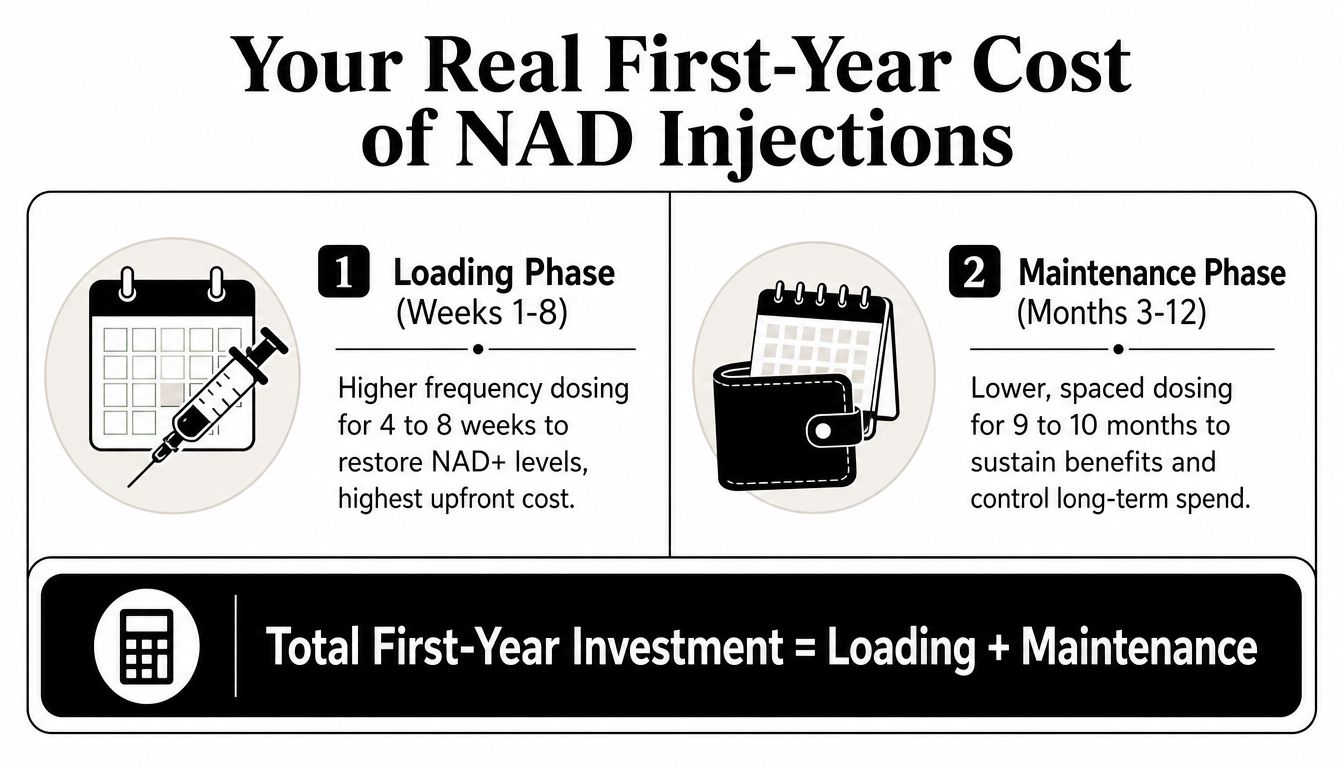
The first-year bill is rarely twelve identical monthly charges. Most protocols start with a loading phase lasting four to eight weeks, then move into nine to ten months of maintenance. Because the pricing framework has already been covered earlier, budget for the full treatment cycle rather than multiplying one advertised month by twelve.
A useful estimate separates medication from services and logistics:
- Loading phase: More frequent dosing can raise the first refill and consume supplies faster.
- Maintenance phase: Spaced dosing may lower the medication requirement after the initial protocol.
- Initial evaluation: The prescriber reviews medical history, medications, goals, and candidacy.
- Follow-up care: Tolerance, side effects, or symptom changes may require additional contact.
- Laboratory work: Baseline or follow-up testing may be requested according to your health profile.
- Home supplies: Syringes, needles, alcohol swabs, bacteriostatic water, and sharps disposal add to the bill.
- Shipping: Temperature-sensitive handling or expedited delivery can change the delivered total.
A realistic channel comparison
Telehealth injections carry a documented first-year estimate of $2,400 to $4,800, depending on dose, loading intensity, bundled services, and refill pricing. A local clinic prescribing injections can reach $3,000 to $6,500 after in-person consultations and visits are included.
IV protocols sit in a higher cost category. Their documented first-year range reaches $6,000 to $18,000, largely because loading requires repeated clinic-administered sessions instead of recurring home shipments. The premium often pays for chair time, staff, facility overhead, and scheduled administration, not for more active ingredient. A comparison of NAD IV and injection pricing can help separate those delivery costs.
| First-Year Component | Why It Changes the Total |
|---|---|
| Loading medication | Higher frequency can raise early spending |
| Maintenance medication | Dose and vial size determine recurring cost |
| Consults and follow-ups | May be bundled or charged separately |
| Labs | Requirements vary with health history and provider policy |
| Supplies | Necessary for safe home administration |
| Shipping | Delivery speed and handling affect the final charge |
The common budgeting error is anchoring on the first month. Ask for the loading price, maintenance price, refill cadence, required labs, shipping terms, and cancellation rules in writing. A provider should make the complete first-year commitment calculable before you pay for a multi-month plan.
Practical Ways to Lower Your NAD+ Injection Bill
The largest savings usually come from choosing a different delivery model, not from negotiating over one vial. Compare the full service first, then examine packaging, laboratory fees, and shipping.
Seven levers worth checking
Compare IV with home injections: Moving from clinic IV therapy to a telehealth subcutaneous protocol may reduce recurring costs. The route must fit your treatment plan, so make the change only after the prescriber reviews it.
Request an annual package quote: Some providers discount monthly pricing when you commit for a longer period. Ask for cancellation terms, refill timing, and the total commitment in writing. A lower monthly figure is not a saving if unused medication or fees remain payable.
Ask about transparent cost-plus fulfillment: Cost Plus TRT offers physician-supervised NAD+ injectable therapy through telehealth. Review Cost Plus TRT as one option, then compare the complete delivered price, consultation access, refill process, and shipping with other providers.
Compare concentration and vial size: A higher concentration can reduce injection volume and packaging waste when it matches the prescribed dose. Do not change concentration yourself. Ask whether the pharmacy can dispense a formulation that fits the prescription efficiently.
Use independent laboratory access: If the provider accepts outside results, ask whether Quest Diagnostics or LabCorp can replace in-clinic testing. The actual saving depends on the required tests, insurance coverage, and cash-pay rate.
Separate treatment from add-ons: B12, glutathione, and other bundled products may have no role in your plan unless a clinician identifies a specific reason to use them. Removing an optional product lowers the bill without changing the NAD+ dose.
Batch fulfillment: A longer prescription period may reduce repeated shipping charges when the prescriber, pharmacy, and applicable rules allow it. Confirm storage requirements and beyond-use dates before requesting larger shipments.
| Lever | Typical Annual Savings | Effort Level |
|---|---|---|
| Change from IV to home injections | $1,800 to $3,600 | Moderate, requires clinical review |
| Negotiate an annual package | 15% to 25% of monthly pricing | Moderate |
| Compare cost-plus telehealth options | Varies by program | Low |
| Optimize vial concentration | Varies by prescription | Moderate |
| Use outside laboratory testing | Varies by test and payer | Moderate |
| Remove optional add-ons | Varies by bundle | Low |
| Batch shipping | Varies by fulfillment terms | Low |
The practical target is total cost per clinically appropriate month, rather than the lowest advertised number. A cheap vial can become expensive if instructions are unclear, shipping is unreliable, or prescriber access is limited. Before enrolling, request an itemized quote covering loading, maintenance, dose changes, missed shipments, side effects, labs, supplies, and cancellation.
Ask how the provider handles a dose adjustment and whether a refill can be paused. Those details affect the first-year bill more than a small headline discount. Compare the amount you will pay, the support included, and the clinical oversight attached to the prescription.