
The most important fact about “methylene blue peptide” is that it isn't a peptide at all. That mismatch matters, because it changes how you should think about safety, sourcing, and whether this belongs in a DIY wellness stack or a physician's treatment plan.
Interest in methylene blue has expanded because researchers are exploring its redox and mitochondrial effects, but the evidence is still limited and mixed. In practice, that means two things can be true at once: the compound is scientifically interesting, and it still deserves a cautious, medical approach rather than biohacker improvisation.
Table of Contents
- What Is Methylene Blue and Why Is It Not a Peptide
- The Cellular Science Behind Methylene Blue's Effects
- Potential Benefits vs Clinical Evidence for Men's Health
- Safe Administration Dosing and Critical Drug Interactions
- How to Get Supervised Methylene Blue at Cost Plus TRT
- Frequently Asked Questions About Methylene Blue
What Is Methylene Blue and Why Is It Not a Peptide
The term “methylene blue peptide” starts with a category error. Methylene blue is not a peptide. It is a synthetic phenothiazine dye with a long medical history that began well before the current wave of longevity marketing, as outlined in Harvard Health's review of methylene blue.
That difference matters in clinic. Peptides are short chains of amino acids. Methylene blue is a small synthetic drug with different chemistry, different prescribing considerations, and different safety concerns. Grouping it with peptide therapies may sound harmless, but it encourages supplement-style thinking around a medication that deserves proper screening.
Why the peptide label keeps showing up
The label usually comes from shared audience interest, not shared structure. Methylene blue is often discussed in the same online circles as peptides because people are looking at energy, cognition, recovery, and performance. Those conversations blur categories that medicine keeps separate for good reason.
Here is the practical distinction:
- Peptides are amino-acid based compounds used for signaling or targeted therapeutic effects.
- Methylene blue is a synthetic prescription drug with its own pharmacology and interaction profile.
- Shared use cases in online discussions do not make them the same class of therapy.
Clinical reality: I correct the label early because patients who assume methylene blue is “basically a peptide” often underestimate its risks, especially drug interactions.
Its approved medical use
Its current FDA-approved role is acquired methemoglobinemia, a disorder in which hemoglobin cannot carry oxygen normally. In that setting, methylene blue serves as a redox medication to help restore hemoglobin function.
That approved use is the right frame for understanding the drug. It is a legitimate medical therapy with a defined clinical purpose. It is not a general wellness compound, and it should not be treated like a casual add-on from a supplement stack.
Why this distinction matters in practice
The biohacker narrative presents challenges. Once methylene blue gets mislabeled as a peptide, patients may assume it is broadly safe, lightly regulated, or reasonable to self-dose. None of those assumptions are reliable.
A safer way to look at it is below:
| Category | Methylene Blue |
|---|---|
| Structure | Synthetic phenothiazine dye |
| Original use | Dye, later adapted for medical use |
| Medical status | Prescription drug with narrow approved use |
| Popular interest | Cognitive, mitochondrial, and performance discussions |
| Safe use mindset | Physician evaluation first |
The bottom line is simple. Methylene blue belongs in the prescription-therapy category, with attention to screening, formulation, dosing, and interactions. Responsible use starts with physician supervision, not DIY experimentation.
The Cellular Science Behind Methylene Blue's Effects
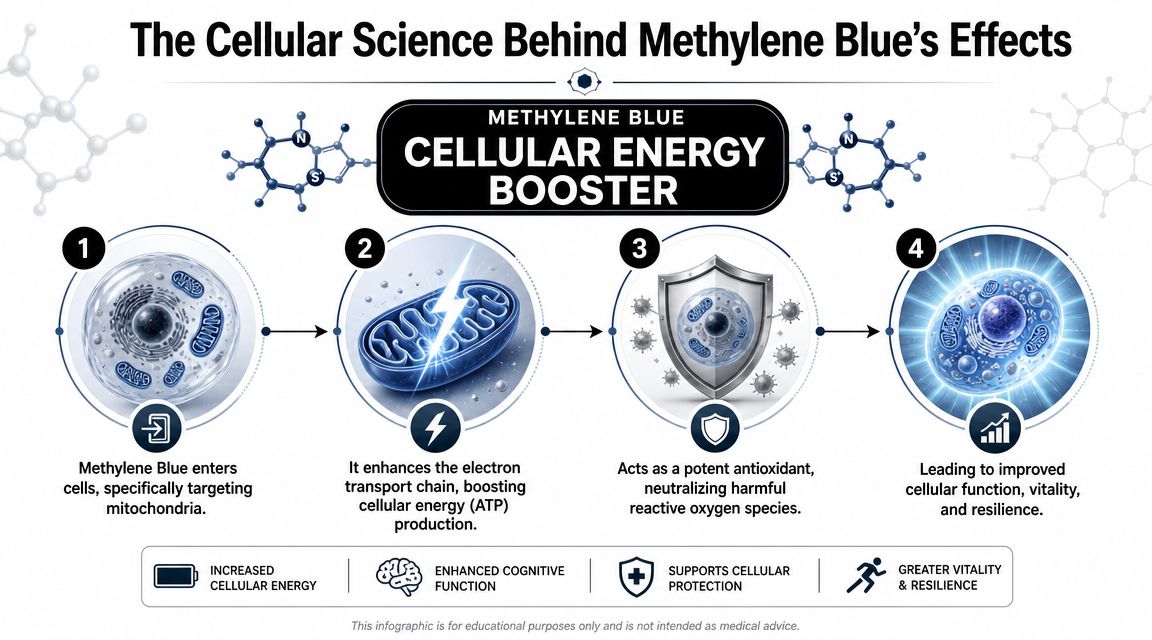
What makes methylene blue interesting isn't the name. It's the way researchers think it may interact with mitochondria, the part of the cell responsible for energy production.
Chemically, methylene blue is a synthetic dye with the molecular formula C16H18ClN3S, and its proposed relevance comes from its ability to act as an alternative electron carrier in mitochondria, potentially bypassing impaired Complexes I to III to support ATP synthesis. The important limitation is that this mechanism remains largely preclinical, as outlined in Superpower's methylene blue overview.
The mitochondrial bypass idea
The easiest way to understand the theory is to picture a traffic jam in a city. Normal energy production depends on electrons moving through a sequence of mitochondrial steps. If that flow slows down, the cell may produce energy less efficiently.
Methylene blue is being studied as a kind of alternate route. The idea is that it may help shuttle electrons when the usual path is less efficient, which could support ATP production under certain conditions.
That possibility explains why people talk about it in relation to:
- Mental energy, where mitochondrial demand is high
- Aging biology, where redox balance becomes more relevant
- Cellular resilience, especially under metabolic stress
Why the science is promising but not settled
Online discussions frequently lose focus when a plausible mechanism is confused with a proven clinical outcome.
Researchers are interested in methylene blue because redox-active molecules can influence cellular signaling, oxidative balance, and mitochondrial performance. That makes it a worthwhile subject of study. It does not mean clinicians can promise sharper memory, better stamina, or durable anti-aging effects in routine practice.
A good mechanism can justify research. It can't replace human evidence.
What tends to work conceptually and what doesn't
What works is using the mitochondrial theory as a screening lens. If a patient asks why methylene blue is even on the table, the answer is that its redox behavior may matter in high-energy tissues, especially the brain.
What doesn't work is treating that mechanism as settled fact. The mitochondrial story is one reason for interest, not a shortcut to clinical certainty.
A practical way to hold both ideas at once:
- The mechanism is biologically credible.
- The strongest claims still outrun the evidence.
- Any use outside standard indications needs supervision and restraint.
That is why methylene blue often ends up in “peptide-adjacent” conversations. It sits near that world because people are trying to optimize cellular function. It doesn't belong there structurally, and it doesn't deserve the casual attitude that often comes with that market.
Potential Benefits vs Clinical Evidence for Men's Health
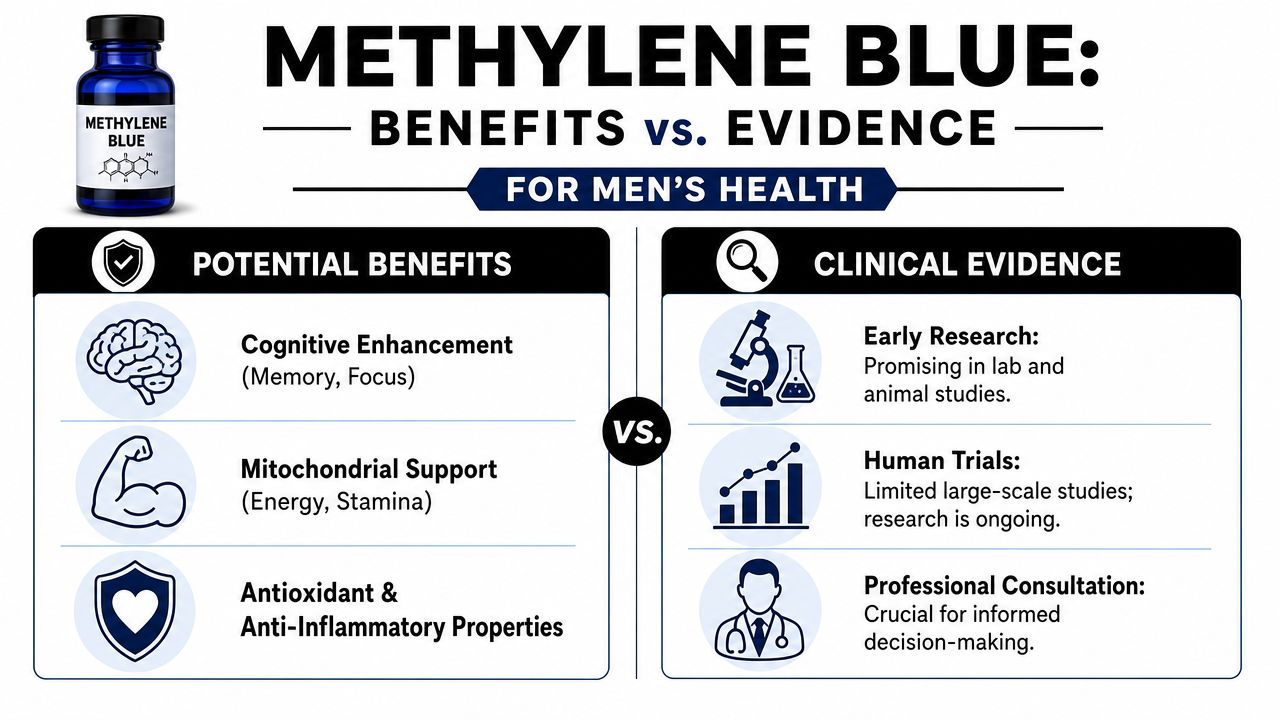
Men usually bring up methylene blue for a simple reason. They want better brain function, steadier energy, or some protection against decline as they age. Those goals are reasonable. The problem is that online discussion often treats methylene blue like a wellness stack ingredient, while the actual medical evidence is narrower and less settled.
The research interest is legitimate. The clinical claims need restraint. A review in the NIH/PMC literature discusses methylene blue in relation to age-related conditions such as neurodegeneration, memory loss, and skin aging, while also making clear that the evidence remains limited and heterogeneous. That is the right frame for patients and prescribers alike. Interest does not equal proof, and a long medical history does not automatically translate into routine use for men who want cognitive or longevity benefits. See this NIH/PMC review on methylene blue and age-related conditions.
Where patient interest usually centers
In practice, the same themes come up repeatedly.
- Cognitive performance: questions about memory, attention, mental stamina, or clarity
- Energy production: interest in whether mitochondrial effects could translate into better daily function
- Brain aging: concern about preserving cognition over time rather than chasing an immediate boost
Those are appropriate topics for a clinical conversation. They are poor reasons for self-experimentation.
What the evidence actually supports
The most accurate summary is straightforward. Methylene blue has real pharmacology, active areas of research, and limited clinical support for the wellness-style outcomes often advertised to men.
I usually explain it this way:
| Claim area | Current status |
|---|---|
| FDA-approved routine use for wellness | No |
| Scientific interest in mitochondrial effects | Yes |
| Ongoing interest in cognitive and age-related applications | Yes |
| Broad clinical proof for anti-aging use | No |
| Safe for casual self-use | No |
That distinction matters because two different errors are common. Some patients dismiss methylene blue entirely once they see exaggerated marketing. Others assume the marketing must be partly true because the drug has recognized medical uses. Both reactions miss the point. A drug can be medically legitimate and still have weak evidence for the specific outcome a patient wants.
How I frame it clinically
Men with brain fog, low motivation, or reduced mental stamina often hope methylene blue will solve a problem that has never been properly worked up. In real practice, that is rarely the best starting point.
A better sequence is to address sleep quality, testosterone status, cardiometabolic health, medication effects, alcohol use, mood disorders, and obstructive sleep apnea risk before considering a therapy like this. If those factors are still unresolved, methylene blue tends to distract from more likely causes.
Practical rule: Consider methylene blue only after the common, higher-yield drivers of poor energy or cognitive symptoms have been assessed and treated.
That approach protects patients from wasted effort and preventable risk.
Where caution is justified
The current evidence does support continued interest. It does not support treating methylene blue as a proven performance enhancer, memory drug, or anti-aging protocol for routine male health optimization.
Anecdotes are part of the noise here. Patients read reports of sharper focus or better endurance and assume they have found a shortcut. In medicine, anecdotes can raise a question worth studying. They cannot establish safety, proper candidate selection, dose strategy, or expected benefit.
For men interested in cognition or healthy aging, methylene blue fits into a familiar category. It is promising, medically real, and still incomplete from an evidence standpoint. That is exactly why physician supervision matters.
Safe Administration Dosing and Critical Drug Interactions
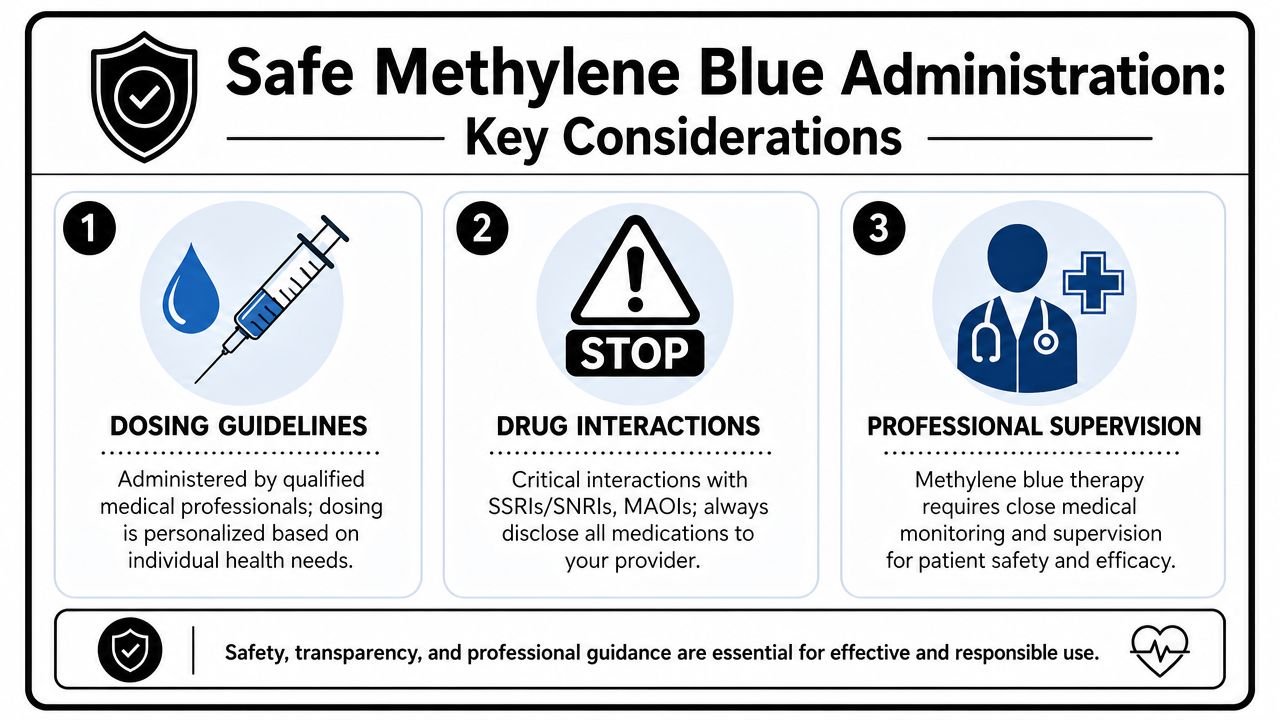
Methylene blue should be handled like a prescription drug with meaningful interaction risk, not like a casual wellness add-on. The biggest safety mistakes usually come from two failures. No one performs a full medication review, and the patient gets a vague dosing plan with no follow-up.
The most important concern is serotonin toxicity. The FDA-approved ProvayBlue labeling carries a boxed warning about serotonin syndrome when methylene blue is used with serotonergic medications. That warning alone should stop any DIY approach.
Why physician oversight matters
In practice, the first question is rarely, “What dose should we use?” It is, “Is this patient even a safe candidate?” A man taking an SSRI, SNRI, trazodone, certain migraine drugs, linezolid, stimulant combinations, or other serotonergic agents may face a risk profile that makes methylene blue inappropriate or requires a very careful prescribing decision.
Dose matters too. Methylene blue has dose-dependent effects, and that is one reason internet protocols are a poor substitute for clinical care. At lower doses, some clinicians use it cautiously in selected patients. At higher doses, the risk picture changes, including a shift away from the favorable redox effects often cited in wellness marketing.
That trade-off matters. A patient looking for possible cognitive or energy benefit can quickly lose the margin of safety if dosing is imprecise or if the product source is unreliable.
Screening points that should happen before prescribing
A responsible intake should cover more than a quick symptom history. At minimum, the prescriber should review:
- Current medications and supplements: SSRIs, SNRIs, MAO-related drugs, trazodone, certain pain medications, stimulant stacks, and other serotonergic or interacting agents all deserve review.
- Reason for treatment: The goal should be specific enough to judge whether the expected benefit justifies the risk.
- Source and formulation: Pharmaceutical or properly compounded prescription product is the standard. Industrial, aquarium, or marketplace products should not be used.
- Medical history: G6PD deficiency and other clinical factors may affect safety and candidacy.
- Monitoring plan: The patient should know what side effects to watch for, when to stop, and when follow-up is required.
If the medication list is incomplete, the product source is uncertain, or the dosing plan is guesswork, methylene blue should not be started.
A brief safety summary makes the priorities clear:
| Safety issue | Why it matters |
|---|---|
| Serotonergic drug use | Can increase the risk of serotonin syndrome |
| Poor dose control | Can change the benefit-risk profile |
| Non-medical sourcing | Can introduce contamination, potency, and labeling problems |
| Self-prescribing | Skips interaction screening and follow-up |
Here is a useful clinical overview before going further:
Routes, dosing, and real-world administration
Route of administration depends on the formulation, treatment setting, and prescribing objective. Oral use is common in outpatient care. Some clinicians may use compounded preparations in selected cases. The route matters less than the process used to choose it.
I would not treat methylene blue like a supplement protocol that can be copied from a forum thread. Prescribing should account for indication, concurrent medications, baseline health issues, and a clear plan for what would count as benefit, intolerance, or a reason to stop.
Patients who want a physician-led option should look for a clinic that treats this as a medication review and monitoring issue, not a retail purchase. One example is a supervised methylene blue prescribing program built around clinician screening rather than self-experimentation.
What usually works is conservative patient selection, verified product quality, and scheduled follow-up. What causes problems is casual dose escalation, incomplete medication disclosure, and product sourcing from unverified sellers.
How to Get Supervised Methylene Blue at Cost Plus TRT
Once a patient decides to explore methylene blue, the right next step isn't hunting for online drops or industrial powder. It's finding a clinician who will treat it like a medication, review the full medication list, and decide whether the risk-benefit profile makes sense.
One telemedicine option for supervised prescribing is Cost Plus TRT's methylene blue program, which places methylene blue inside a physician-led workflow rather than a retail supplement model.

What a responsible intake process should include
No matter which clinic a patient uses, the basic process should be structured. In my view, a responsible methylene blue intake should include:
- A clear symptom review so the clinician understands whether the request is about cognition, energy, or another concern.
- A medication reconciliation with special attention to serotonergic drugs and other potential interaction issues.
- A discussion of evidence limits so the patient understands what is theoretical, what is off-label, and what is approved.
- A sourcing plan that relies on prescription-quality material rather than internet marketplace products.
- A follow-up plan for tolerance, adverse effects, and whether the therapy should continue at all.
If a clinic skips those steps, that's a warning sign.
What patients should ask before starting
Patients often focus on where to get methylene blue. A better first question is whether the prescriber has a process for using it safely.
Ask questions like these:
- How do you screen for drug interactions?
- What type of product do you prescribe or compound?
- How do you decide whether someone is a candidate?
- What side effects or problems should stop treatment?
- How will follow-up happen after prescribing?
Those questions quickly separate a medical program from a hype-driven sales funnel.
Good methylene blue care starts with disqualifying the wrong candidates, not rushing to approve the eager ones.
What the patient experience should feel like
The experience should feel careful, not frictionless. Fast access is fine. Casual access is not.
A legitimate clinic should make space for nuance. Some men are reasonable candidates for a supervised trial. Others are taking medications or have circumstances that make methylene blue a poor fit. Good care includes both outcomes.
That matters because the actual value of physician-supervised therapy isn't just getting the prescription. It's getting the judgment that comes before and after the prescription.
Frequently Asked Questions About Methylene Blue
Patients usually leave with the same cluster of practical questions. The answers are straightforward when you keep the safety framework in place.
Common questions patients ask
| Question | Answer |
|---|---|
| Is methylene blue actually a peptide? | No. It's a synthetic phenothiazine dye, not a peptide. |
| Why do people call it a methylene blue peptide? | Mostly because it gets discussed alongside peptides in performance and longevity circles. That's a marketing or community label, not a chemical one. |
| Can I buy methylene blue online without a prescription? | You may find products online, but that doesn't make them appropriate for human use. Methylene blue should be physician-supervised because sourcing, interactions, and dosing all matter. |
| Is it FDA-approved for energy, memory, or anti-aging? | No. Its FDA-approved modern indication is acquired methemoglobinemia. |
| Why is physician review so important? | Because methylene blue has meaningful drug interaction concerns, including a boxed warning related to serotonin syndrome with serotonergic drugs. |
| Is more always better with methylene blue? | No. Higher dosing can change the risk profile, and at higher levels it can shift toward pro-oxidant effects. |
| Is industrial or non-medical grade acceptable if it's cheaper? | No. Authoritative sources emphasize that industrial-grade material should not be used in humans or animals. |
| What kind of follow-up should I expect? | A real treatment plan should include medication review, dosing rationale, product-quality control, and ongoing monitoring for benefit or side effects. |
A few final practical clarifications
Some patients worry about whether methylene blue is “natural enough” to be safe. That's the wrong standard. Many safe and useful medications are synthetic. The right standards are indication, quality, interactions, and supervision.
Others assume that because methylene blue has been around for a long time, it must be easy to use casually. That also misses the point. Old drugs can still be potent, interaction-heavy, and poorly suited to self-prescribing.
For broader patient questions about telemedicine treatment workflows, prescription policies, and common treatment logistics, the clinic patient FAQ page is a useful place to start.
The bottom line is simple. Methylene blue deserves respect. It may have a place in carefully supervised care, but it should never be treated like a novelty compound pulled from an online trend cycle.
If you want to explore whether methylene blue fits your situation, Cost Plus TRT offers physician-supervised telemedicine care with medication review, prescribing oversight, and prescription fulfillment through a structured clinical process.