

Most advice about male enhancement cream gets the category wrong on purpose. Some products are real topical erectile dysfunction treatments with clinical backing, while others are penis-enlargement creams that Mayo Clinic says have little scientific support, usually do not work, and can even damage the penis (Mayo Clinic). If a seller blurs that line, the product is usually trying to hide weak evidence behind bold marketing.
The distinction matters because men aren't just buying a tube of cream, they're buying a promise. In my experience, the men who get burned most often are the ones who wanted better erections, but ended up with a product marketed as a size solution, a stamina booster, or a natural shortcut. Those are different claims, and they do not belong in the same conversation.
Table of Contents
- Two Very Different Products Share One Name
- How Topical ED Creams Work
- The Evidence Gap Between Prescription and Over-the-Counter Options
- Safety Concerns and Red Flags to Watch For
- Topical Creams Versus Pills and Testosterone Therapy
- When to Skip the Cream and See a Doctor
- Your Next Steps Toward Real Solutions
Two Very Different Products Share One Name
The phrase male enhancement cream gets used for two categories that should not be confused. One category is topical erectile dysfunction treatment, where the goal is to support blood flow and erection quality. The other is penis-enlargement cream, where the claim is usually permanent size gain, which credible evidence does not support.
That difference is not semantic, it changes everything. A man looking for a better erection might be evaluating a legitimate medical option. A man looking for bigger size is often being sold an unproven product with no realistic path to the result he wants.
What each product is actually trying to do
Topical ED creams aim to improve erection response for a specific sexual event. The best-known prescription example is alprostadil cream, which showed clinical efficacy in phase II and III trials and reached up to 83% global efficacy at the 300 μg dose in men with severe ED, compared with 26% for placebo (PMC review). That is a medical treatment logic, not a cosmetic one.
Penis-enlargement creams usually promise larger size, better girth, or more confidence without procedures. The problem is that the evidence base does not support those claims. Mayo Clinic's guidance is blunt, most advertised nonsurgical enlargement methods do not work, and some can cause harm (Mayo Clinic).
The supplement market benefits when those two categories stay blurred. If a buyer assumes every cream is basically the same, it becomes easier to sell a speculative product at a premium price.
The question to ask before buying anything
Ask one thing first, “Is this meant to improve erection function, or is it claiming permanent enlargement?” If the answer is enlargement, the evidence problem is serious. If the answer is erection support, the next question is whether the product has actual clinical backing or just a polished label.
A practical filter helps here.
- If the product avoids naming its active ingredient, treat that as a warning sign.
- If it promises permanent size increase, assume the claim is unsupported unless a clinician can point to credible evidence.
- If it sounds like a supplement but behaves like a drug, be careful. That's where the worst confusion lives.
Practical rule: the more a product depends on vague wording, the less likely it is to solve the problem you actually have.
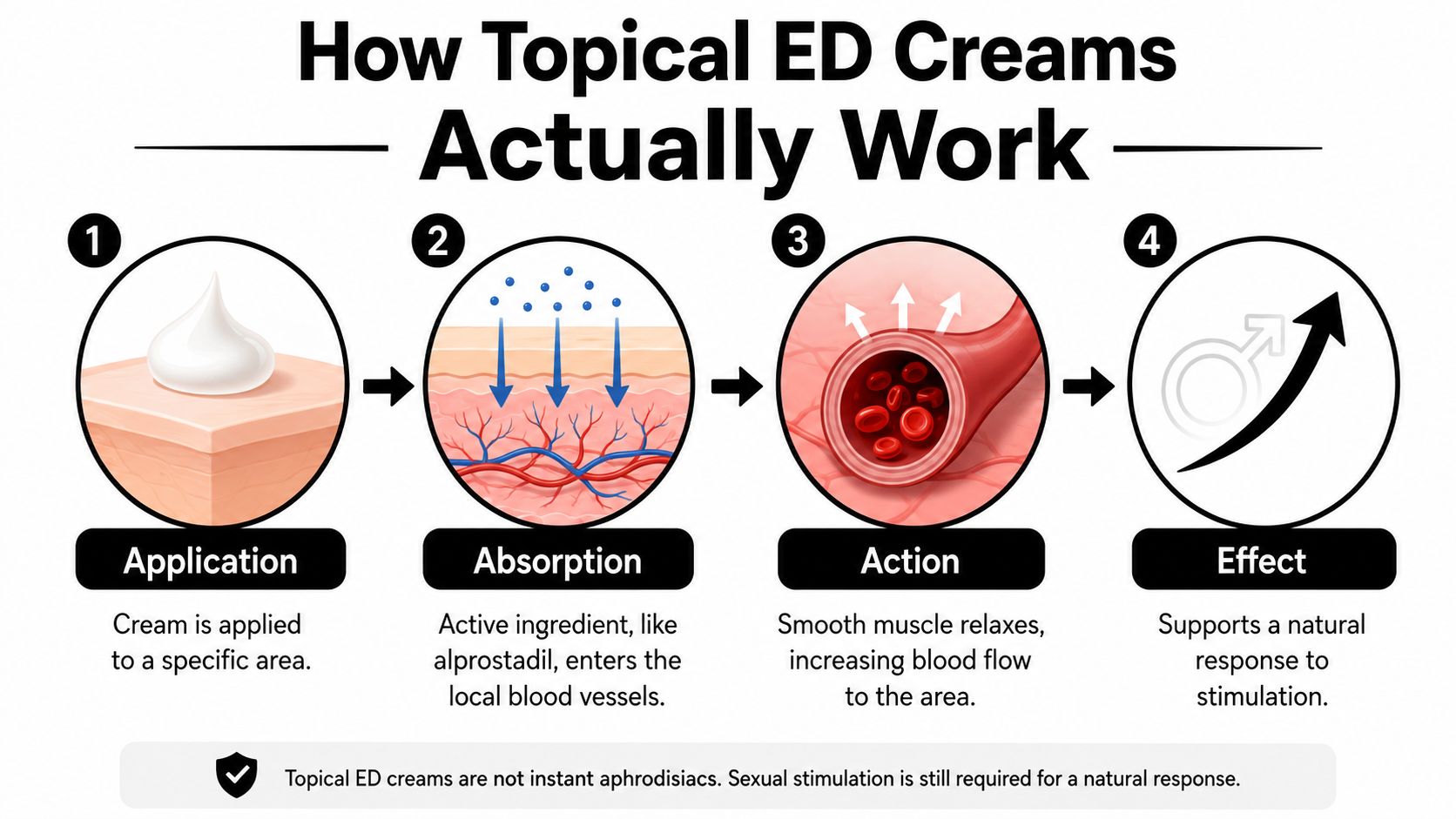
How Topical ED Creams Work
With alprostadil, the active ingredient promotes blood flow in the target area, which can support erection quality when stimulation is present (PMC review). The value of that local action is simple, some men want a treatment aimed at erection response without adding more whole-body exposure than necessary.
Why localized delivery matters
Oral ED medications act systemically, which works well for many men, but others prefer a treatment that stays more focused. Clinical reviews note that topical alprostadil can be a useful alternative for men who cannot tolerate systemic side effects from oral PDE5 inhibitors, including some men taking alpha-blockers, antihypertensives, or nitrates (PMC review). That does not make it the best option for everyone, it means the trade-off is different.
The practical appeal is easy to understand. You apply the product where it is needed, and the effect is intended to stay local. For some patients, that feels more discreet and easier to time than a pill taken hours in advance.
What users should realistically expect
A topical ED product is not a “make anything happen” cream. Recent consumer-facing coverage notes that some topical products may help mild to moderate ED, and that Eroxon can work in about 10 to 20 minutes, but the research base is still limited and only a small number of products are science-backed (PMC review). Speed and specificity matter more here than broad promises.
That makes topical treatment a fit for on-demand support. A man who wants a localized option for occasional use may find it appealing. A man expecting it to create a permanently stronger sex drive, larger size, or hormonal reset is asking it to do a job it was never designed to do.
Topical ED treatment can be a reasonable choice when the goal is an erection response, not a body change.
The Evidence Gap Between Prescription and Over-the-Counter Options
Prescription topical ED treatment and over-the-counter enhancement creams sit in different evidence classes. One has been tested in clinical settings. The other often survives on marketing language and product pages.
| Clinical Evidence Comparison | Prescription Topical ED | OTC Enhancement Creams |
|---|---|---|
| Evidence base | Phase II and III clinical trials for alprostadil cream | Often little or no peer-reviewed clinical evidence |
| Main claim | Improve erection response | Usually implies better performance, size, or confidence |
| Safety reporting | Systemic adverse events reported in 3% of treated patients, with mostly mild or moderate local effects | Safety often described vaguely or not at all |
| Ingredient clarity | Active ingredient is identified | Proprietary blends and vague formulations are common |
| Expectation setting | On-demand erectile support | Frequently oversized promises, especially around size |
| Buyer risk | Lower, when used under medical guidance | Higher, especially when claims outrun evidence |
Price does not fix an evidence problem. A low-cost tube can still do nothing useful, and an expensive one can still rest on weak claims. In this market, the cheapest mistake is often the one that costs the least up front and the most in disappointment.
What the clinical record shows
The first widely studied prescription topical option for ED was alprostadil cream. In the review cited above, it achieved up to 83% global efficacy at the 300 μg dose in men with severe ED, compared with 26% for placebo, and systemic adverse events were reported in only 3% of treated patients. PMC review
That is a medically defined treatment with known effects and known limits. OTC creams usually do not offer that kind of transparency. If a product will not name the active ingredient, will not point to controlled data, and will not explain who it is for, the buyer carries the risk while the brand keeps the ambiguity. The gap is wide enough to matter at the bedside and at the checkout cart.
For men thinking about testosterone support, a real consultation matters more than a bottle with a bold label. A clinician can sort out whether low energy, reduced libido, or erection trouble points toward hormone testing, ED treatment, or a different problem entirely, and a legitimate TRT evaluation belongs in that discussion when symptoms fit.
Safety Concerns and Red Flags to Watch For
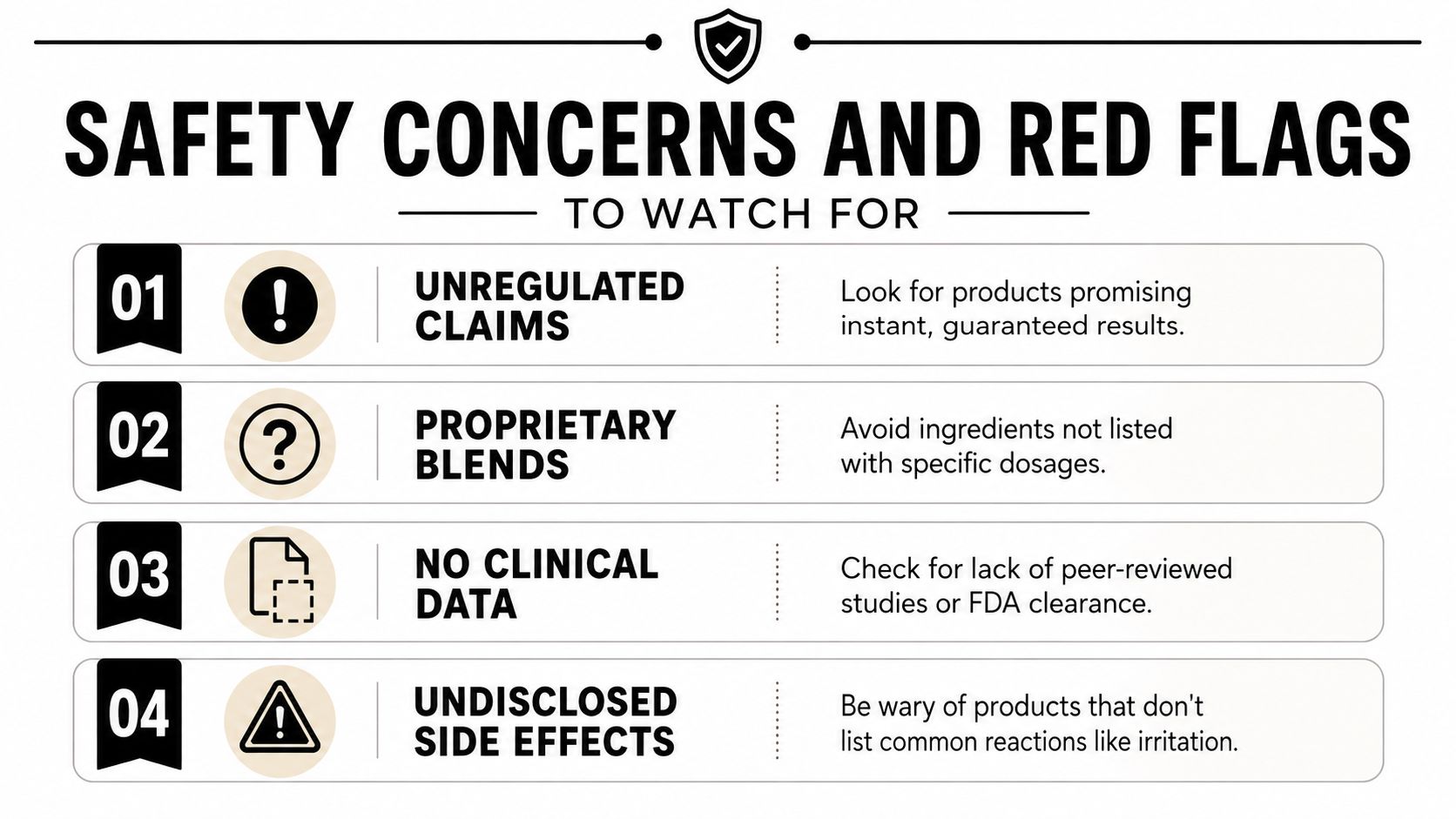
The biggest safety issue with male enhancement cream is not simple irritation. It is the gap between what the label suggests and what the formula can realistically do. Mayo Clinic warns that many marketed enlargement methods do not work and that some can damage the penis (Mayo Clinic). That matters because a product can look harmless on paper and still cause harm when a man buys into the wrong promise.
Red flags that should stop the purchase
If a product checks any of these boxes, I would be cautious:
- Permanent size increase claims. That is the clearest sign the seller is selling fantasy instead of evidence.
- No ingredient list. If you cannot see exactly what is inside, you cannot judge risk or quality.
- Proprietary blends with no doses. That makes the formula hard to evaluate and impossible to compare.
- Promises without medical review. If the brand discourages consultation, scrutiny usually hurts the pitch.
The risk rises when a man already takes blood-pressure medication, uses nitrates, or has cardiovascular disease. Some topical ED treatments may be reasonable for selected patients, but that choice belongs in a medical conversation, not a checkout cart. As noted earlier, the clinical literature on prescription topical options is much more defined than the average over-the-counter cream.
What side effects look like
Clinical topical ED studies describe local reactions that are usually mild or moderate and limited in duration. That is not the same as risk-free. It means the known safety profile is more manageable than many men expect, but only when the product is a studied treatment with clear instructions.
Real therapies tell you what is in the tube, what reactions are expected, and who should avoid them. Weak products hide behind vague wording and leave the buyer to guess. That lack of visibility is often the warning sign, because if a company will not be specific about ingredients or use cases, there is usually a reason.
Topical Creams Versus Pills and Testosterone Therapy
Topical treatment isn't automatically the best choice, it's just the right choice for some men. The decision usually comes down to how quickly you want it to work, how you feel about systemic exposure, and whether the problem is erectile function or something deeper.
Where each option fits
Topical creams are best understood as on-demand, localized support. They may appeal to men who want a fast, discreet option and who'd rather avoid taking a pill. They're also useful when oral medication side effects or drug interactions make a pill a less comfortable first choice.
Pills such as sildenafil and tadalafil remain the more familiar route for many patients. They're systemic, which is an advantage for some men and a drawback for others. If you're comparing convenience, a pill is simple. If you're comparing localized exposure, a cream may feel more targeted.
Testosterone therapy is different again. It is not a direct erection treatment for every man, and it belongs in the conversation when symptoms point toward low testosterone rather than isolated erection difficulty. If the issue is hormonal, a cream meant for erections won't fix that root cause.
How to think about the trade-off
The wrong choice usually happens when a man matches the wrong problem to the wrong tool. A topical cream won't replace hormone evaluation. A testosterone prescription won't necessarily create an immediate on-demand erection response. A pill may work well, but it isn't ideal for every health profile.
If the symptom pattern has changed, the treatment choice should change too.
That's why the smartest comparison isn't just “which works,” it's “which works for this specific cause.” The right answer depends on whether the complaint is performance, timing, sensitivity to side effects, or hormone-related fatigue and loss of drive.
When to Skip the Cream and See a Doctor
If erections have become less reliable, don't treat that as a branding problem. Treat it as a medical question. Erectile dysfunction can be linked to vascular health, medication effects, diabetes, sleep issues, and hormonal imbalance, so buying a cream first can delay the diagnosis.
Signs that self-treatment is the wrong first move
Consider medical evaluation before any product if any of these apply:
- The change was sudden. That can point to a medication issue, circulation problem, or another medical trigger.
- You also have low energy, low libido, or mood changes. That pattern can suggest a broader hormonal or health issue.
- You take nitrates, blood-pressure drugs, or multiple prescriptions. Interaction risk matters.
- The product history is already disappointing. Repeated failure is a reason to stop guessing.
If you want a topical option, it still helps to know what problem you're trying to solve. A cream for erection support is not the same as a treatment for size concerns, and neither one replaces a proper workup when symptoms have changed.
Practical rule: if the problem is new, persistent, or paired with other health symptoms, get evaluated before you buy another product.
Bring a list of medications, a brief timeline of symptoms, and any prior lab work to a telemedicine visit or in-person appointment. That gives a clinician enough context to separate a product problem from a health problem much faster.
Your Next Steps Toward Real Solutions
The takeaway is simple, topical ED creams and penis-enlargement creams are not the same product. One category has clinical backing for erection support. The other is mostly marketing, and the evidence for permanent size change is not there.
If you're ready to stop guessing, start with a proper medical review and ask whether your symptoms fit a topical option, a pill, or hormone evaluation. If you want a clinician-guided path, start here and come prepared with your symptoms, medications, and any past labs. That keeps the conversation focused on the problem you have, not the one a label is trying to sell.
If you want a physician-supervised way to sort out erections, hormone issues, and the difference between real treatment and empty marketing, Cost Plus TRT offers telemedicine care with transparent pricing and prescription options. It's a practical next step if you want answers instead of another bottle on the bathroom shelf.