

Most men should think about low t treatment cost as roughly $100 to $300 per month in real life, even though the medication itself is often much cheaper. Generic injectable testosterone commonly runs $30 to $100 per month out of pocket, while the final bill rises when clinics add consults, lab work, follow-up fees, shipping, and bundled programs.
If you're reading clinic websites and still can't figure out what you'll pay, you're not missing something. Most TRT pricing is hard to compare because one clinic shows only medication, another shows a membership fee, and a third rolls everything into a package without telling you what's inside. That's where men get frustrated, and that's also where they overpay.
A clear price starts with one question: what exactly is included? If you separate the cost of evaluation, labs, medication, supplies, and monitoring, the fog lifts fast. Once you do that, you can tell the difference between reasonable care and a clinic that hides margin inside a "simple monthly plan."
Table of Contents
- Why Is Finding a Clear TRT Cost So Hard?
- Deconstructing the Total Cost of TRT
- What You Can Expect to Pay for Low T Treatment
- Choosing Your Care Model In-Person Clinic vs Telehealth
- Medication Costs Explained Injections Gels and Pellets
- Navigating Insurance Coverage and Hidden Fees
- A Practical Guide to Saving Money on TRT
Why Is Finding a Clear TRT Cost So Hard?
A man calls one clinic and asks, "What does TRT cost?" He gets told the monthly fee. Then he learns labs are separate. Then follow-ups are separate. Then supplies are separate. Then shipping is separate. By the end of the conversation, the price he thought he heard wasn't the price at all.
That happens because TRT isn't one item on a shelf. It's a treatment process. Clinics can package that process in completely different ways, which makes comparison difficult even when every website claims to be transparent.
Some offices quote the doctor visit first because that feels medically proper. Some lead with the drug cost because it looks affordable. Some push a bundle because it sounds easier. If you don't get an itemized breakdown, you can't tell whether you're paying for necessary care or for administrative overhead dressed up as convenience.
Most of the confusion around low t treatment cost comes from pricing models, not from the medication itself.
When a patient asks me what TRT costs, the right answer isn't one number. It's a short checklist of line items and a discussion about delivery method, lab timing, and how often follow-up is needed. Without that, you're comparing apples to mystery boxes.
A good clinic should be able to tell you, in plain English, what is included before you commit. If you want to see how one transparent treatment pathway is described, review the TRT care details at Cost Plus TRT and compare that structure to any quote you're considering.
Deconstructing the Total Cost of TRT
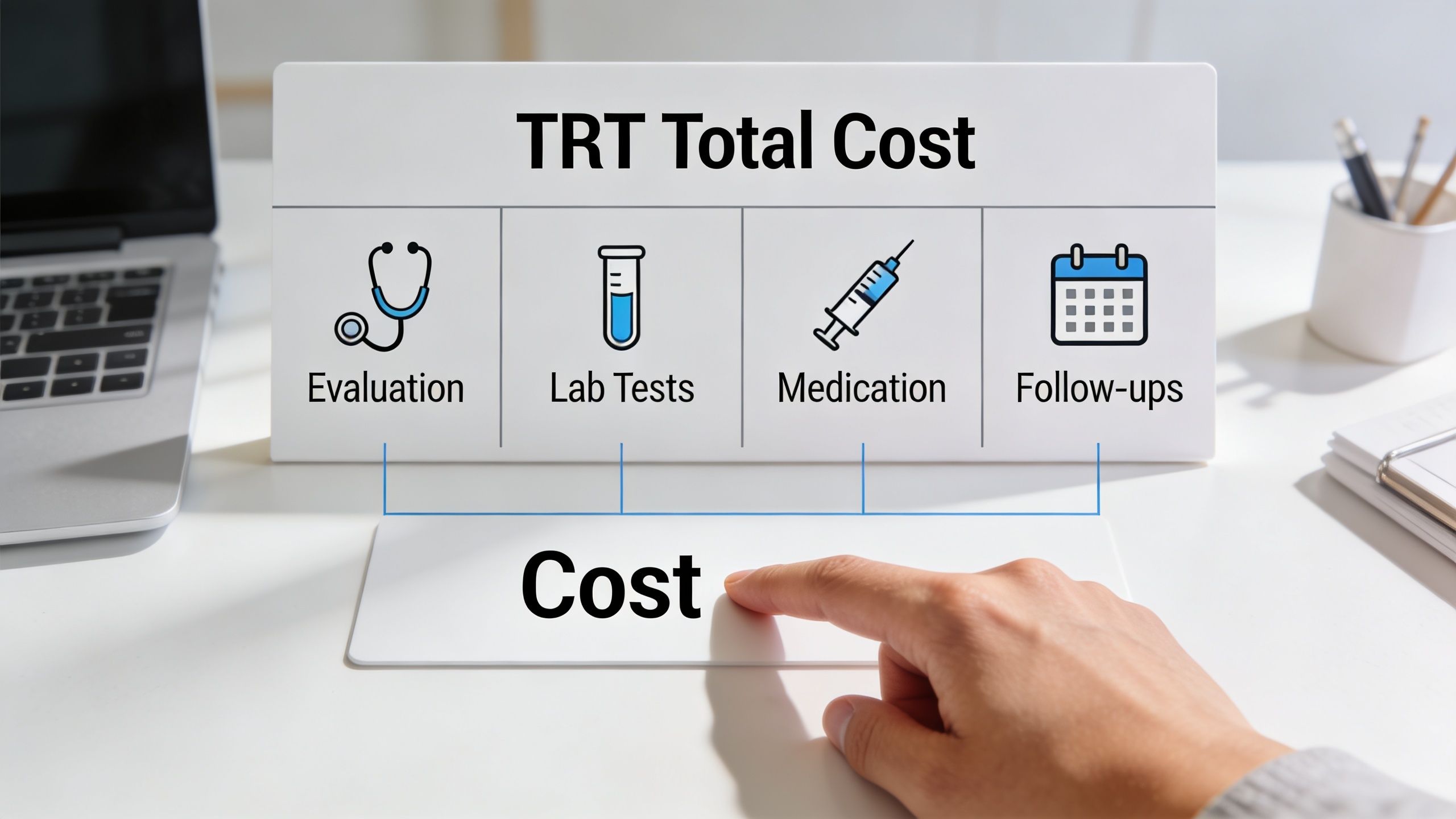
TRT makes more sense financially when you break it into parts. I tell patients to stop asking only, "How much is testosterone?" and start asking, "What are all the costs required to treat low testosterone safely?"
Evaluation is the entry point
The first cost is the initial medical evaluation. During this stage, a clinician reviews symptoms, history, prior treatment, fertility goals, and whether TRT is even the right option. Cheap care that skips this step often becomes expensive later because the treatment plan wasn't built carefully from the start.
An evaluation also affects downstream cost. A patient who's already on a stable injection protocol usually needs a simpler financial path than a patient starting from scratch with no recent records and no lab work.
Labs are not optional
The second cost is laboratory testing. Patients sometimes treat labs like an add-on, but they are part of the actual treatment. You need objective data before starting, and you need follow-up data to monitor response and safety.
Clinics hide lab cost in different ways:
- Bundled labs: Convenient, but sometimes hard to price-check.
- Outside lab orders: More flexible, but the patient has to ask what panel is required.
- Bring-your-own labs: Often cheaper if your recent results are usable.
Practical rule: If a clinic quotes a low monthly price but can't explain the lab process clearly, assume the real total cost is higher than the headline number.
Medication and supplies are only one piece
The third cost is medication and injection supplies. This is the part patients focus on first, and it matters, but it isn't the whole bill. The vial, syringes, needles, alcohol pads, shipping, and pharmacy handling can all be priced separately or rolled into one plan.
This is also where cost varies most by formulation. Generic injections are usually the financial baseline. Gels, creams, patches, oral products, and pellets tend to move the total cost up because the drug itself costs more or the delivery process is more complex.
Monitoring is ongoing care
The fourth cost is follow-up care and monitoring. TRT isn't a one-time prescription. You need periodic review of symptoms, dose response, and lab results. Some clinics include follow-up visits. Others charge each one separately. That difference changes affordability more than many patients expect.
A useful mental model is this:
| Cost component | What it covers | Why it matters |
|---|---|---|
| Initial evaluation | History, symptoms, treatment plan | Determines whether TRT fits you |
| Lab testing | Baseline and monitoring labs | Supports safe prescribing |
| Medication and supplies | Testosterone plus administration items | Drives recurring monthly spend |
| Follow-up care | Review, dose adjustment, ongoing oversight | Prevents surprise charges and sloppy care |
Once you use that checklist, pricing gets much easier to judge. A low quote that excludes two of these four categories usually isn't low. It's incomplete.
What You Can Expect to Pay for Low T Treatment
The fastest way to judge a TRT quote is to separate the core medication cost from the care model cost. Medication can be straightforward. Clinic billing often isn't.
The medication baseline matters most
For men paying out of pocket in the U.S., injectable generic testosterone cypionate typically ranges from about $30 to $100 per month, while branded gels such as AndroGel can cost $200 to $500 per month, and pellets often exceed $600 to $1,000 per 90-day insertion, according to this pricing guide on testosterone treatment options.
That single comparison tells you a lot. If a clinic pushes a premium delivery method without a clear medical reason, your low t treatment cost can climb quickly even before labs and visits are added.
In practical terms, injections usually create the lowest financial starting point. Gels may appeal to men who dislike needles. Pellets may appeal to men who want fewer dosing events. But cost-conscious patients should understand that those preferences often come with a meaningful price premium.
Where the rest of the bill comes from
After medication, the total bill depends on how the clinic structures care. Common line items include:
- Initial consult fee: Some clinics bill this once, others bury it in a package.
- Lab panel charges: These may be billed before treatment, during follow-up, or both.
- Follow-up visit fees: Sometimes included, sometimes billed each time.
- Supplies and shipping: Often omitted from headline pricing.
- Administrative or membership charges: These additional costs can make "affordable" plans expensive.
A quote becomes useful only when those items are named. If a clinic says, "TRT starts low," that doesn't help you budget. If they say, "Medication is one price, labs are separate, follow-up is included," now you can compare.
Here's a simple way to read pricing pages:
| What you see first | What to ask next |
|---|---|
| Monthly medication price | Does this include supplies and shipping? |
| Monthly membership fee | Are visits and prescribing included? |
| All-in package | Which labs are included, and how often? |
| Insurance accepted | What happens if labs or medication aren't covered? |
If you want a benchmark for a structured, itemized approach, review the current TRT pricing breakdown at Cost Plus TRT. Use it the same way you'd use any other clinic's pricing page. Not as marketing copy, but as a checklist for what should be disclosed upfront.
A fair TRT quote isn't just lower. It's easier to audit.
Patients usually feel calmer once they realize they don't need the cheapest headline number. They need the most predictable total cost.
Choosing Your Care Model In-Person Clinic vs Telehealth
Where you get care changes what you pay, how often you travel, and how much billing friction you deal with.

What in-person care does well
Traditional care usually means a urologist, primary care office, endocrinology practice, or local men's health clinic. The strengths are obvious. You can sit with someone face to face, ask questions in real time, and in some cases do labs or injections through the same office.
That model can work well for men who already prefer local care or who have a more complicated medical picture. The trade-off is that office-based practices carry more physical overhead, and patients often feel that in the final bill. Some local clinics also rely on bundled pricing that isn't fully itemized.
A local clinic isn't automatically expensive, and telehealth isn't automatically cheap. The difference comes down to disclosure. If an in-person clinic gives you a clear list of evaluation costs, labs, medication, and follow-ups, it's much easier to judge fairly.
Why telehealth often feels simpler
Telehealth tends to reduce friction for working adults. You don't lose time commuting, you can often upload labs, and medication may ship directly to your home. That convenience matters, especially for men who stay consistent when care fits their schedule.
A separate issue is consent and logistics. If you're comparing remote care options, it's useful to read how a provider explains remote treatment rules, medication handling, and patient responsibilities in a document like this telehealth consent information.
Telehealth clinics often provide a financial advantage through transparent pricing. Many remote providers prioritize direct-pay models over traditional office workflows. This structure is helpful, but only if the monthly rate includes the specific services you require.
For a closer look at how telemedicine discussions often frame this choice, watch this short overview:
A simple comparison helps:
| Care model | Common strengths | Common trade-offs |
|---|---|---|
| In-person clinic | Face-to-face visits, local testing, familiar setting | Travel time, variable overhead, less predictable packaging |
| Telehealth | Convenience, home delivery, easier scheduling | Requires comfort with remote care and digital communication |
If your main priority is low t treatment cost, focus less on the setting and more on whether the clinic explains the full cost of care without prompting.
Medication Costs Explained Injections Gels and Pellets
Most long-term TRT spending is shaped by one decision: which medication format you use. Patients often think the doctor visit drives the cost. Over time, the delivery method usually matters more.
Injections usually set the affordability floor
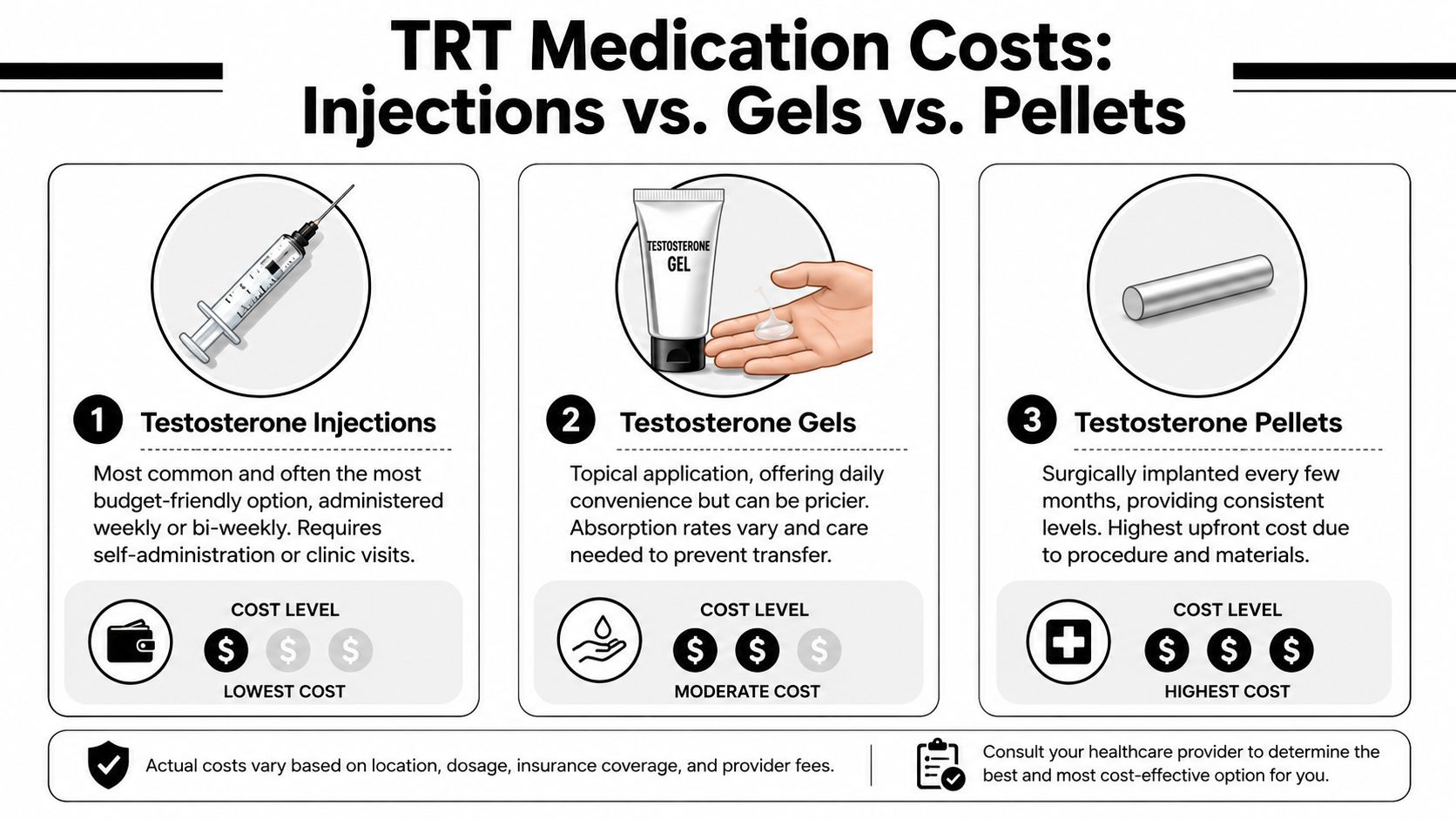
Across providers, injections are consistently the cheapest option at $20 to $150 per month, averaging $40 to $100, while gels and creams run $200 to $600 per month, patches run $200 to $600 per month, and pellets run $500 to $2,000 every 3 to 6 months, excluding labs and monitoring that add $300 to $500 per year, based on this TRT delivery method cost comparison.
For cost-conscious patients, that pricing hierarchy is the starting point. Generic injectable testosterone cypionate usually wins on pure affordability. It also fits well with clinics that use straightforward pharmacy-plus-care pricing.
The trade-off is practical, not mysterious. You have to self-inject or arrange administration, and some men do not like that. But from a budgeting standpoint, injections are hard to beat.
Gels trade convenience for higher recurring cost
Gels and creams are attractive because they avoid needles and fit a daily routine. For some patients, that convenience improves adherence. For others, daily application becomes annoying, especially if they're managing workouts, showers, family contact, or travel.
Financially, gels are rarely the value option. You pay more month after month, and the higher recurring medication cost can overshadow any convenience benefit if your main concern is affordability.
If your goal is controlling long-term TRT cost, start by asking whether a more expensive delivery method is medically necessary or simply more marketable.
Pellets bundle medication with a procedure
Pellets appeal to men who want fewer dosing decisions. The attraction is understandable. A procedure every few months can sound easier than weekly or biweekly injections.
But pellets usually combine a premium drug format with an in-office procedure, and that changes the economics. You aren't just buying testosterone. You're buying insertion, materials, and procedure-based care. That's why pellet-based treatment often lands at the high end of the TRT cost spectrum.
Here's the practical ranking most patients end up using:
- Injections for the lowest recurring medication cost.
- Gels or creams for needle-free convenience at a higher monthly cost.
- Pellets for less frequent dosing but the highest upfront treatment expense.
This doesn't mean one format is universally right. It means the financial trade-off should be explicit before you start.
Navigating Insurance Coverage and Hidden Fees
Insurance can reduce TRT cost for some men, but it rarely makes pricing simple. One part may be covered while another part isn't. Medication may be on formulary while labs fall to deductible. A clinic may accept insurance for visits but use a cash-pay process for the treatment program itself.

Insurance can help but it rarely makes pricing simple
The hardest part for patients isn't just whether insurance pays. It's what insurance applies to. A plan might help with generic injections and still leave you paying separately for visits, repeat labs, or a clinic program fee.
From a health-system perspective, TRT isn't automatically poor value. A published analysis found that in men under 75 years, supplemental testosterone therapy was broadly cost-effective, with 10-year excess treatment costs of about £2,306 to £3,269 per patient compared with no treatment, according to the PubMed cost-effectiveness analysis of testosterone therapy. The practical disconnect is that something can be cost-effective clinically and still feel administratively difficult to access.
That is why patients should ask their insurer very specific questions. Not "Do you cover TRT?" Ask whether they cover the medication, the labs, the office visits, and the monitoring frequency tied to the prescription.
Hidden fees that deserve a hard question
Some of the most frustrating TRT bills aren't from testosterone. They're from the surrounding business model.
Watch for these warning signs:
- Mandatory memberships: A monthly charge that exists even when medication and labs are billed separately.
- Opaque lab billing: The clinic says labs are required but won't tell you how they're ordered or priced.
- Premium formulation steering: Expensive products are presented as the default before lower-cost options are discussed.
- Supply markups: Needles, syringes, or shipping appear later as separate charges.
- Frequent paid check-ins: Follow-ups are scheduled in a way that feels more financial than clinical.
Ask for an itemized list before you start. If the clinic can't provide one, you don't have a pricing problem. You have a trust problem.
A clean TRT quote should let you answer four questions quickly: what am I paying today, what am I paying monthly, what is billed separately, and what triggers extra charges?
A Practical Guide to Saving Money on TRT
Affordable TRT usually comes from a handful of decisions made early. The men who keep costs under control aren't cutting corners. They're choosing a simpler medication path, asking better billing questions, and avoiding clinics that monetize confusion.
A simple cost control checklist
Use this framework when comparing options:
- Start with generic injections: If there's no clear medical reason to avoid them, they usually create the lowest medication cost.
- Ask for the all-in monthly reality: Include medication, supplies, shipping, follow-ups, and required monitoring.
- Use recent labs when allowed: If a clinic accepts outside or recent lab work, that can reduce upfront duplication.
- Avoid vague memberships: If the monthly fee doesn't tell you exactly what's included, keep digging.
- Compare care models, not just prices: A slightly higher clear price can be cheaper than a low teaser price with add-ons.
- Use pre-tax health funds when available: HSAs and FSAs can soften out-of-pocket cost if your plan allows eligible expenses.
There are also situations where a flat, transparent model makes sense. For example, Cost Plus TRT charges $119 a month, month to month, with lab work, provider visits, testosterone cypionate, injection supplies, and shipping included.
The broader lesson matters more than any one provider. Predictable care usually comes from transparent pricing, generic medication, and a clinic that separates medical necessity from upselling. That's the combination that keeps low t treatment cost manageable over the long run.
If you want a clearer path to affordable TRT, Cost Plus TRT offers a telemedicine model built around transparent pricing rather than hidden add-ons. You can review whether their approach fits your situation, especially if you're already on treatment and want a more predictable monthly cost.