
You wake up tired even after a full night in bed. Your workouts feel flat. Sex is still possible, but your interest is lower and morning erections aren't as consistent as they used to be. You wonder whether this is stress, aging, bad sleep, extra weight, or something hormonal.
That's where many men get stuck.
Low T symptoms rarely arrive as one dramatic sign. They usually show up as a pattern of changes that build over time. The confusion is that many of those same changes can also come from depression, sleep apnea, obesity, medication effects, diabetes, or plain old burnout. A symptom checklist by itself can push you toward the wrong conclusion.
The useful question isn't “Do I have one symptom that appears on the internet?” It's “Do my symptoms form a cluster that fits testosterone deficiency?”
That distinction matters because research and clinical guidelines don't diagnose low testosterone from symptoms alone. A major population study found that symptomatic androgen deficiency had a crude prevalence of 5.6% in men ages 30 to 79, while individual symptoms were much more common. In that same study, low libido appeared in 12%, erectile dysfunction in 16%, and two or more nonspecific symptoms in 20%. The point is simple. Common symptoms aren't the same as a confirmed syndrome. You can review those findings in the Journal of Clinical Endocrinology and Metabolism study on symptomatic androgen deficiency.
Table of Contents
- Introduction to Low T Symptoms and Why Patterns Matter
- Understanding Testosterone and How Low Levels Develop
- Core Low T Symptoms Grouped by Body System
- Common Causes and Conditions That Mimic Low T
- How Low T Is Diagnosed With Labs and Thresholds
- When to Seek Care and Exploring Treatment Pathways
- Key Takeaways on Low T Symptoms and Next Steps
Introduction to Low T Symptoms and Why Patterns Matter
A man in his forties might say, “I'm not falling apart. I just don't feel like myself.” That's often the right way to describe the early concern. He still goes to work, still gets through the week, still functions. But something has shifted. Recovery after exercise takes longer. Desire is down. Focus is off. He's less patient, less driven, and more likely to brush it all off as a rough season.
The problem is that low T symptoms are both real and overlapping. Reduced libido means one thing clinically. Fatigue means something far broader. Put those together with fewer morning erections, declining strength, and increasing body fat, and the picture becomes more meaningful. Put fatigue together with poor sleep and work stress, and the picture may point somewhere else.
Why checklists create panic
A symptom list online can make almost anyone think they have low testosterone. That happens because many symptoms connected to testosterone are common in modern life.
Consider two different men:
- Man A: Lower libido, fewer spontaneous erections, less sexual activity, reduced strength, and more abdominal fat.
- Man B: Tired, irritable, unfocused, sleeping poorly, and stressed.
Both deserve attention. But the first pattern is more suggestive of testosterone deficiency. The second pattern could be hormonal, but it could just as easily reflect sleep debt, depression, overwork, medication effects, or metabolic problems.
Practical rule: The more your symptoms cluster around sexual function and body composition changes, the more useful formal testosterone testing becomes.
What actually helps
Instead of treating low T symptoms like a yes-or-no checklist, it helps to think like a clinician. Look for symptom clusters. Notice what's changed over weeks or months, not just after one bad stretch. Track whether the changes are steady, worsening, or tied to sleep, alcohol, stress, illness, or weight gain.
That calmer, pattern-based approach usually leads to better decisions. It also helps you avoid swinging between denial and overreaction.
Understanding Testosterone and How Low Levels Develop
Testosterone works less like a single on-off switch and more like part of a signaling network. That helps explain why low testosterone can be hard to recognize from symptoms alone. If the signal weakens, changes may show up in sexual function, body composition, recovery, mood, or concentration. If the signal stays intact, the same symptoms may come from something else entirely.
The hormone thermostat
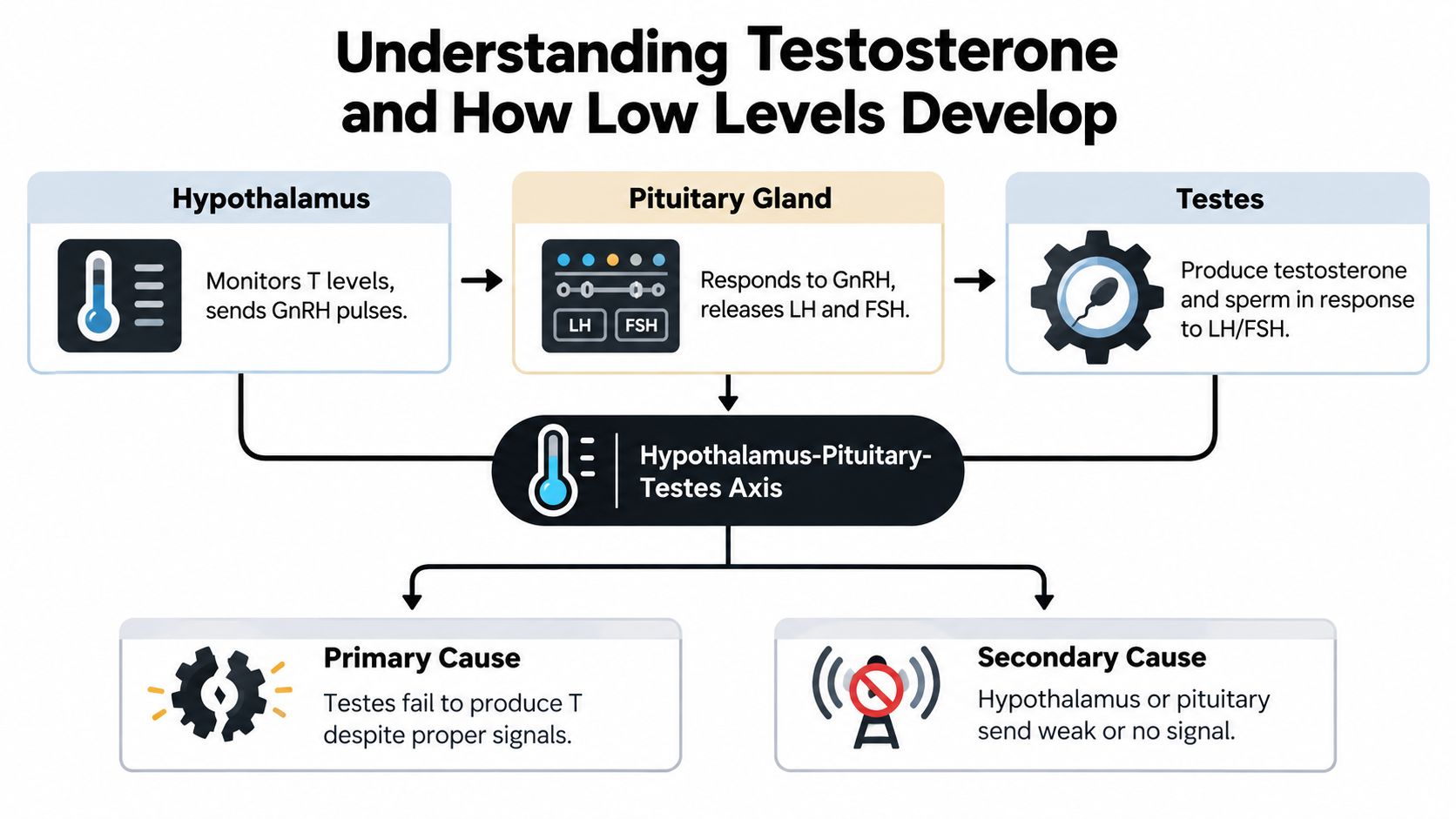
The body regulates testosterone through a feedback loop that works much like a home thermostat. The hypothalamus in the brain sends the first signal. The pituitary gland relays that message. The testes respond by making testosterone and supporting sperm production. As levels rise or fall, the brain adjusts the next round of signaling.
Problems can develop at different points in that loop. If the testes are not producing enough testosterone despite strong signals from the brain, clinicians call that primary hypogonadism. If the hypothalamus or pituitary is not sending enough signal, that is secondary hypogonadism. Some men have a mixed picture, especially with aging, obesity, chronic illness, or certain medications affecting more than one part of the system.
Why low levels develop
Low testosterone does not always appear suddenly. In many men, it develops gradually as the signaling system becomes less reliable or the testes become less responsive. Weight gain, poor sleep, untreated sleep apnea, long-term opioid use, heavy alcohol use, major illness, pituitary disorders, testicular injury, and some genetic conditions can all play a role.
That matters because the cause affects the pattern.
A man whose testes are not working well may have clearly low lab values even when the brain is trying hard to compensate. A man with obesity or sleep apnea may have borderline or fluctuating levels because the brain-testes signaling loop is being disrupted. Those are different situations, and they should not be handled as if they are the same problem.
Why symptoms and labs need to match
Many men get tripped up here. A low lab value by itself does not automatically mean testosterone deficiency is the right diagnosis. Lab values move from day to day, and symptoms like fatigue, low mood, and poor focus overlap heavily with stress, depression, medication effects, and sleep problems.
Clinicians usually look for two things together. First, a symptom pattern that fits. Second, low testosterone on two separate morning blood tests before any treatment decision is made. That repeat testing helps sort out a true hormone problem from a temporary dip after poor sleep, illness, calorie restriction, or a rough week.
As noted in the population study cited earlier, fewer men have the combination of low levels plus the right symptom pattern than low levels alone. That is why pattern recognition matters so much. The goal is not to chase one tired blood test result. The goal is to identify when the whole picture points to androgen deficiency.
Core Low T Symptoms Grouped by Body System
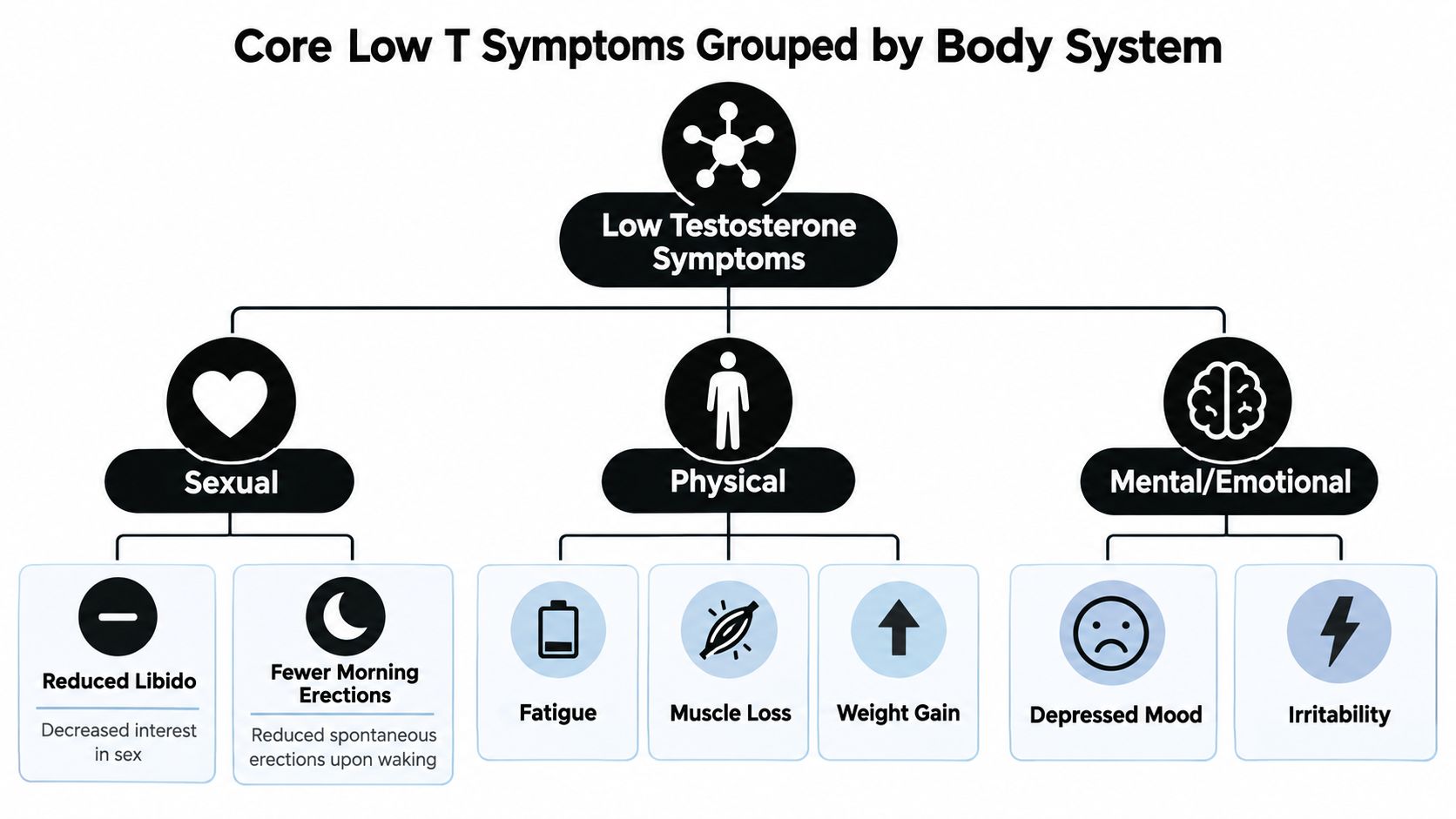
When men search for low T symptoms, they usually find a long, jumbled list. That's not very helpful. A better approach is to group symptoms by body system and then ask which clusters carry the most signal.
Sexual symptoms often carry the strongest signal
Sexual symptoms tend to be more useful than vague fatigue alone. Endocrine guidance lists reduced libido, erectile dysfunction, and loss of spontaneous erections among the key features that should raise suspicion for hypogonadism, as described in the Endocrine Society patient guidance on male hypogonadism.
What does that look like in plain language?
- Lower sex drive: You're less interested in sex than you used to be, and it feels like a genuine drop, not just a busy week.
- Fewer morning or nocturnal erections: This often gets overlooked, but it's a useful clue because it's less tied to performance anxiety.
- Erectile changes: Erections may be less reliable, less firm, or harder to maintain.
If erectile issues are part of the picture, some men also explore physician-guided ED medications while the broader hormone evaluation is being sorted out. That's different from assuming every erection problem is caused by testosterone.
The strongest symptom pattern is usually not “I'm tired.” It's a combination of lower libido, fewer spontaneous erections, reduced sexual activity, and parallel physical changes.
Physical symptoms reflect testosterone's anabolic role
Expert review literature describes a more predictive pattern that includes decreased muscle strength, increased adiposity, and low bone mass, especially when these appear alongside sexual symptoms. That clinical summary appears in the review on diagnosis and treatment considerations for male hypogonadism.
Common physical changes include:
- Reduced muscle mass or strength: You can still work out, but your baseline feels lower.
- More body fat: Especially when it seems easier to gain fat and harder to maintain prior body composition.
- Reduced endurance or recovery: Workouts and long days may feel harder to bounce back from.
- Bone concerns: Low bone mass or fractures can matter, though they aren't usually what prompts the first search online.
Mental and systemic symptoms matter, but they're less specific
Men with low testosterone may also notice:
- Lower energy
- Poor concentration
- Irritability
- Depressed mood
- Sleep disruption
- Hot flashes when testosterone is very low
These symptoms are real. They just aren't specific. A bad stretch of sleep, chronic stress, depression, alcohol use, and several medical conditions can create a very similar picture.
A simple way to rank symptoms
Here's the practical hierarchy:
| Symptom pattern | How clinically useful it tends to be |
|---|---|
| Lower libido plus fewer morning erections | More suggestive of low testosterone |
| Sexual symptoms plus strength loss or increased body fat | More suggestive still |
| Fatigue alone | Nonspecific |
| Mood changes alone | Nonspecific |
| Poor concentration alone | Nonspecific |
That's why pattern recognition matters. One symptom can mislead you. A cluster tells a better story.
Common Causes and Conditions That Mimic Low T
A man can have low T symptoms for at least three different reasons. His testes may not be producing enough testosterone. The signaling from the brain to the testes may be disrupted. Or he may have another condition that creates a similar symptom pattern without testosterone deficiency being the main driver.

Primary and secondary causes
Clinicians often separate causes into two buckets.
Primary causes start in the testes. The brain may send the proper signals, but the testes don't produce enough testosterone.
Secondary causes start higher up. The hypothalamus or pituitary doesn't send strong enough signals, so the testes never get a clear instruction to produce testosterone normally.
That distinction matters because two men can have similar symptoms for very different biological reasons.
The common look-alikes
Recent clinical guidance points out an underserved issue in public discussion. Symptoms such as fatigue, mood change, concentration problems, sleep disturbance, reduced endurance, and body composition changes are common but nonspecific, and often overlap with obesity, depression, sleep apnea, medication effects, diabetes, or aging. That point is laid out clearly in the BPAC clinical discussion on testosterone and diagnosis.
Here are some of the most common mimics:
- Obesity: Can overlap heavily with low energy, reduced libido, and body composition changes.
- Diabetes or metabolic disease: May affect energy, sexual function, and overall vitality.
- Sleep apnea or chronic sleep loss: Often causes fatigue, low drive, poor concentration, and erectile issues.
- Depression: Can lower motivation, mood, libido, and energy.
- Medication effects: Some medicines can blunt sexual function or change energy and mood.
- Stress and burnout: These can look hormonal from the outside, even when the root issue is behavioral or psychological.
When the pattern deserves a closer look
One clue that should raise suspicion is erectile dysfunction that doesn't respond well to PDE5 inhibitors, especially when it appears alongside lower libido, fewer spontaneous erections, or metabolic disease. That doesn't prove low testosterone, but it makes objective testing more worthwhile.
A lot of men aren't really asking, “Is my testosterone low?” They're asking, “Why don't I feel like myself anymore?” That broader question usually leads to better care.
The takeaway is simple. Similar symptoms can come from very different causes. That's exactly why experienced clinicians don't diagnose low testosterone from internet symptom lists.
How Low T Is Diagnosed With Labs and Thresholds
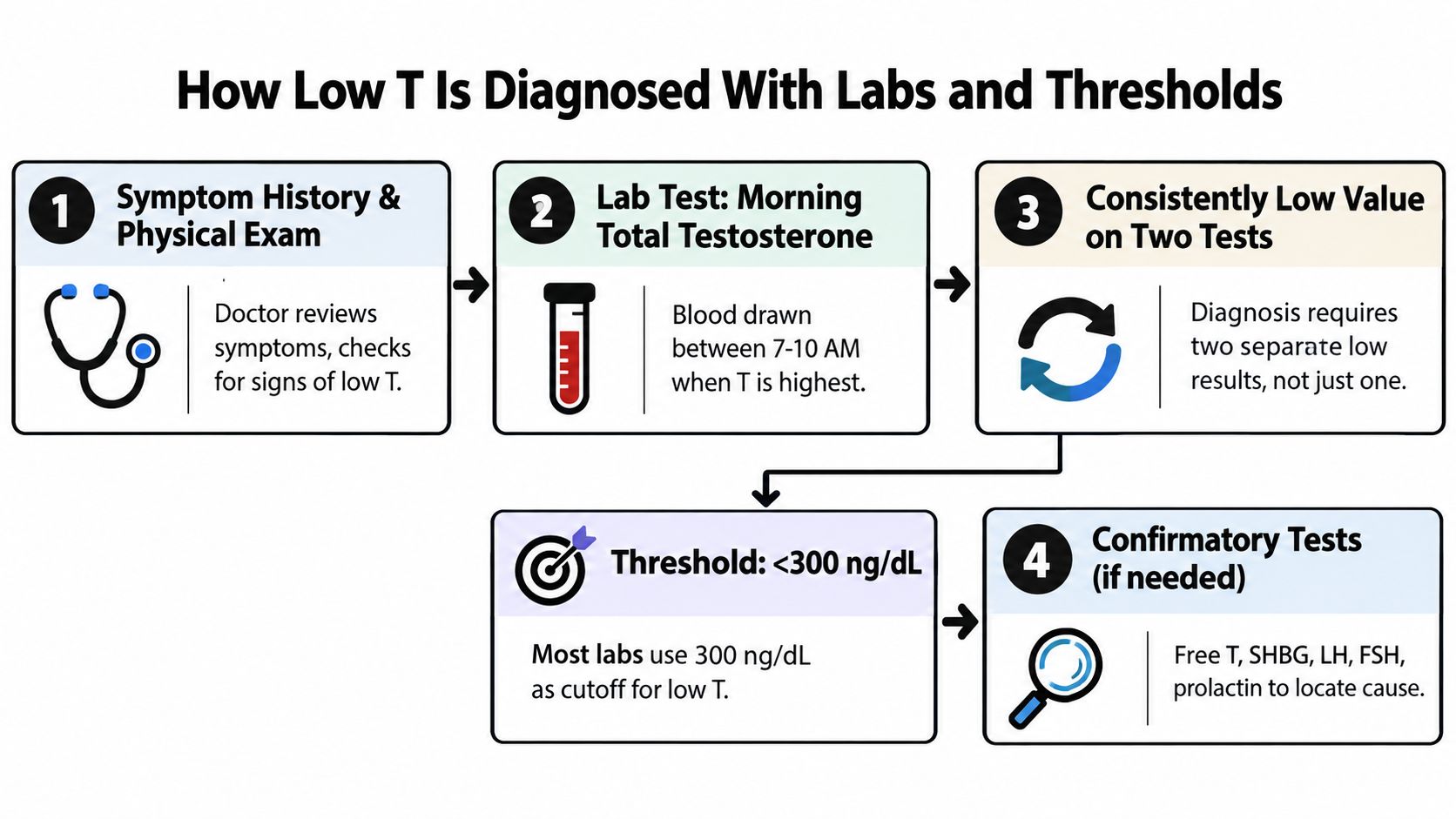
The diagnosis starts with a story, not a syringe. A clinician listens for the symptom pattern, reviews medical history, asks about sleep, weight change, medications, sexual function, mood, fertility goals, and sometimes examines for physical signs that fit androgen deficiency.
Then the lab work begins.
Why one test isn't enough
This is one of the most important rules in the entire topic. European Association of Urology guidance states that male hypogonadism diagnosis requires persistent symptoms of androgen deficiency together with consistently low morning serum total testosterone levels on two or more occasions using a reliable assay, as outlined in the EAU guideline on male hypogonadism.
That means:
- Symptoms must fit
- Testing should be done in the morning
- The result has to be low more than once
- The assay needs to be reliable
A single afternoon number can mislead you. So can a borderline result drawn when you're sick, sleep deprived, or tested under poor conditions.
What men often misunderstand about thresholds
Many men want a simple cutoff that answers everything. Real clinical practice is messier than that.
Guidelines agree on the basic principle of symptom plus repeat low morning testosterone, but threshold details can vary across organizations. That's why clinicians don't usually make treatment decisions from one isolated value or one symptom complaint. They interpret the whole picture.
How to prepare for a useful appointment
If you're getting evaluated, bring a concise symptom history. A notes app works fine.
- Track sexual changes: libido, morning erections, erectile reliability
- Note physical shifts: strength, recovery, body fat, endurance
- Record timing: when the symptoms started, whether they fluctuate, and whether sleep or stress changes them
- List medications and supplements: especially anything that may affect hormones or sexual function
- Mention fertility plans: this can change treatment discussions substantially
If you want a telemedicine route after proper evaluation, some clinics streamline the process through online intake, physician review, and lab coordination. Men looking into that option can review the Cost Plus TRT start process as one example of how remote evaluation is typically organized.
Bottom line: Symptoms can start the conversation. Repeat morning labs are what keep that conversation medically grounded.
When to Seek Care and Exploring Treatment Pathways
You don't need to panic if you suspect low testosterone, but you also don't need to sit on persistent symptoms for months hoping they'll disappear. If the pattern has stayed present, especially if it includes libido changes, fewer spontaneous erections, declining strength, or bothersome fatigue that isn't explained by obvious lifestyle factors, it's reasonable to seek care.
What to bring into the visit
A good visit is easier when you're specific.
Bring a short record of your symptoms, any prior testosterone labs, your medication list, and a sense of your goals. Some men mainly want answers. Others want help with libido, erections, energy, or body composition. Those goals shape the conversation.
Comparing your next options
Not every man with suspected low T needs the same path. Sometimes the first move is sleep evaluation or weight management. Sometimes the key issue is depression, diabetes, or medication review. When low testosterone is confirmed, testosterone replacement therapy may enter the discussion.
Here's a practical side-by-side view:
| Pathway | Best For | Lab Approach | Follow Up |
|---|---|---|---|
| Lifestyle and root-cause workup | Men with nonspecific symptoms, poor sleep, weight gain, stress, or possible mimics | Standard medical evaluation, often broader than testosterone alone | Usually centers on symptom review and reassessment after changes |
| Focused endocrine or urology evaluation | Men with a stronger symptom cluster or concerning history | Repeat morning testosterone with clinician-directed follow-up testing as needed | Ongoing review of diagnosis, cause, and treatment fit |
| TRT discussion after confirmed deficiency | Men with compatible symptoms and repeatedly low morning testosterone | Baseline labs plus monitoring determined by the treating clinician | Regular follow-up to assess response, side effects, and goals |
| Telemedicine TRT pathway | Men who prefer remote care after appropriate screening and lab review | May use uploaded recent labs or labs arranged through a partner draw site | Online physician follow-up and medication management |
How telemedicine fits in
Telemedicine can be a practical option for men who want evaluation and treatment management without repeated in-person visits. Cost Plus TRT offers physician-supervised TRT care, accepts recent labs or coordinates labs through Quest Diagnostics, and ships approved medication to the home. Men who want to compare that route can review its TRT care pathway.
That doesn't replace the need for proper diagnosis. It just changes how care is delivered.
Times to move sooner
Don't wait too long if symptoms are persistent and affecting quality of life, sexual function, or emotional well-being. It's also smart to seek care sooner if symptoms are paired with infertility concerns, marked sexual changes, or a broader decline that doesn't fit a temporary rough patch.
Key Takeaways on Low T Symptoms and Next Steps
A common scenario goes like this: a man feels more tired, less motivated, and less like himself, then starts wondering whether testosterone is the whole explanation. The clearer question is whether the symptoms form a repeatable pattern that fits hormone deficiency, or a mixed picture that could just as easily come from poor sleep, stress, weight gain, medications, or mood strain.
Here is the short recap. Low T becomes more likely when symptoms line up in a consistent cluster and morning lab results are low on two separate days before any treatment decision is made.
What helps at this point is a simple record you can bring to a visit. Hormone symptoms are a little like hearing a faint engine noise. One vague sound is hard to place. A short log makes the pattern easier to recognize.
For 2 weeks, track:
- Libido: better, same, or lower than your usual baseline
- Morning erections: present, reduced, or absent
- Energy and strength: note workouts, physical stamina, or whether daily tasks feel heavier
- Sleep hours and sleep quality: especially snoring, awakenings, or unrefreshing sleep
- Body changes: waistline, weight shifts, or loss of muscle tone
- Mood and focus: irritability, low mood, or brain fog
- Alcohol, new medications, or major stress: brief notes only
That kind of snapshot gives a clinician something more useful than a general feeling of being off. It also helps separate persistent hormone-related change from a short rough stretch.
If your notes show an ongoing pattern, ask for a structured evaluation rather than guessing from symptoms alone. Cost Plus TRT offers telemedicine evaluation, lab coordination or bring-your-own-labs options, and physician-supervised TRT care for eligible patients. It can be a practical option if you want to confirm whether your low T symptoms reflect actual deficiency before making any treatment decision.