
You may be here because something feels off, but not dramatic enough to call an emergency. You're getting through the day, yet your energy is flat. Your workouts don't produce what they used to. Your sex drive is lower, your focus is worse, and your patience is thinner than it used to be. A lot of men describe it the same way: “I just don't feel like myself.”
That feeling matters. Sometimes it's stress, sleep debt, burnout, weight gain, depression, medication effects, or a mix of all of them. Sometimes low testosterone is part of the picture. Low testosterone, also called male hypogonadism, is a real medical condition. It's measurable, it's treatable, and it's not a character flaw.
Doctors generally consider adults to have low testosterone below 300 ng/dL, and levels can decline by about 1% per year starting in the late 30s, according to Cleveland Clinic's overview of low testosterone. The same clinical overview notes a peer-reviewed review finding global prevalence ranging from 10% to 40%, with U.S. prevalence in middle-aged to elderly men reported at 24% to 39%.
Table of Contents
- Is This Just Getting Older or Is It Something More
- Recognizing the Common Symptoms of Low Testosterone
- What Causes Low Testosterone Levels in Men
- How Doctors Diagnose Low T and Read Lab Results
- A Complete Guide to Low Testosterone Treatment Options
- Affordable TRT Is Now Accessible Through Telemedicine
- Your Next Steps for Taking Control of Your Health
- Frequently Asked Questions About Low T and TRT
Is This Just Getting Older or Is It Something More
Men often assume there are only two explanations for feeling worse: aging or laziness. Neither is a useful diagnosis. If your energy, libido, motivation, strength, or recovery have changed in a sustained way, you need a medical explanation, not self-criticism.
Normal aging does change hormone levels over time. But low T in men isn't just “what happens” and something you should accept without asking questions. When symptoms stack up and stick around, it's reasonable to investigate.
A practical way to think about it is this:
- Occasional bad days happen to everyone.
- A rough month can come from stress, poor sleep, overwork, grief, or illness.
- A persistent pattern deserves evaluation, especially when sexual symptoms and physical decline show up together.
Practical rule: If you've felt below baseline for long enough that the people close to you notice, it's time to stop guessing and get labs.
Low testosterone can affect more than sex drive. It can shape body composition, exercise recovery, concentration, mood, and confidence. It also overlaps with common problems like sleep apnea, insulin resistance, obesity, and chronic stress. That's why a good evaluation looks at the whole person, not just one number on one lab report.
The right approach is straightforward. Start with symptoms. Confirm with proper blood work. Look for root causes. Then choose the least burdensome treatment that fits your goals, schedule, fertility plans, and budget.
Recognizing the Common Symptoms of Low Testosterone
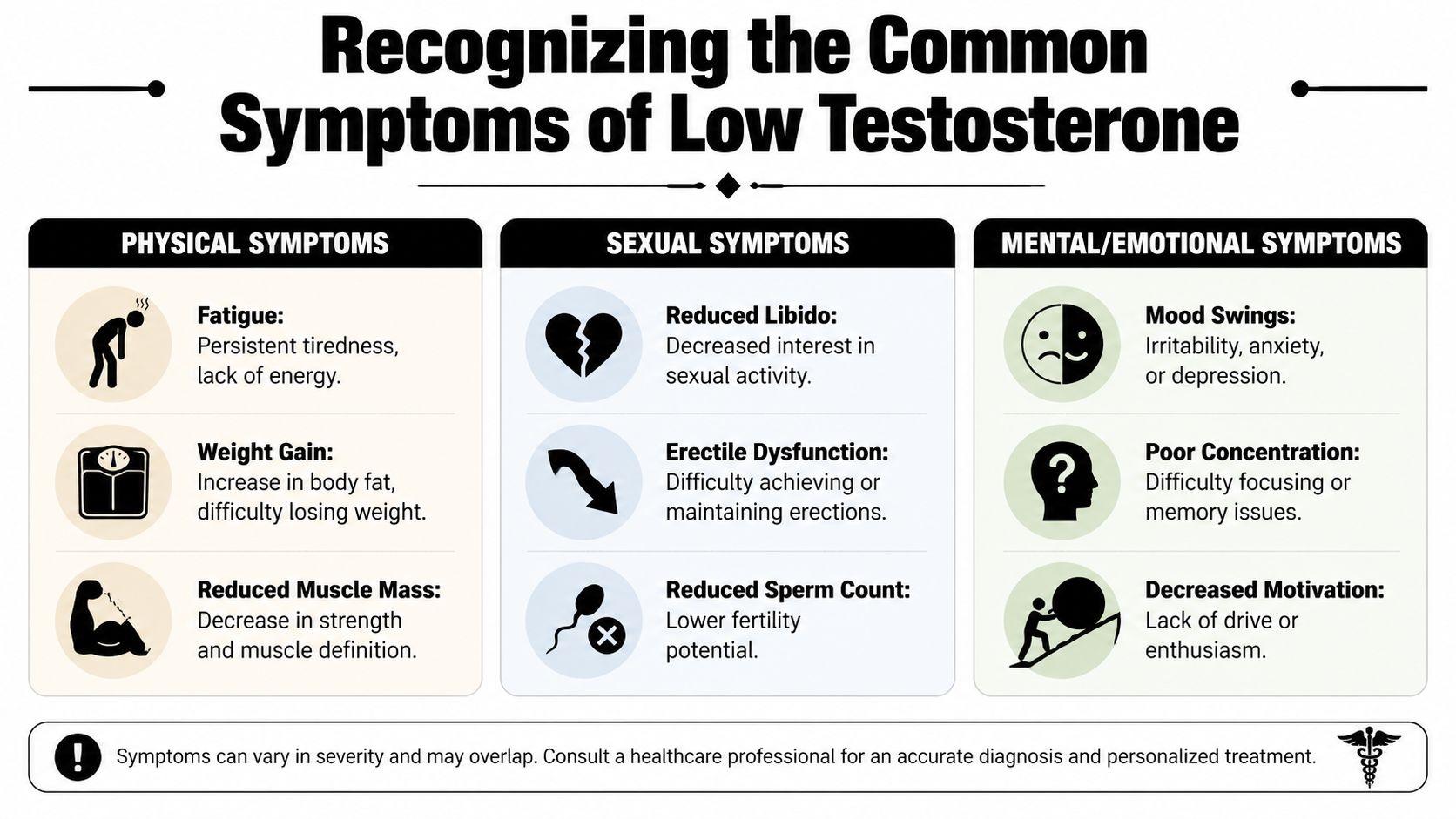
Low testosterone rarely announces itself with one single symptom. It usually shows up as a cluster. Testosterone acts more like your body's operating system than one isolated switch. When it's low, multiple systems run slower at the same time.
Another analogy I use with patients is fuel quality in an engine. If the fuel is poor, the car may still run, but acceleration drops, performance gets inconsistent, and small problems become more obvious. That's how low T in men often feels in daily life.
Physical symptoms
The physical side is usually what men notice first. You may feel tired even after a full night in bed. Workouts feel flat. You lose strength more easily and gain fat more easily. Some men say they can still exercise, but the “return on effort” is gone.
Common physical complaints include:
- Fatigue: Not simple sleepiness, but a steady lack of drive and physical reserve.
- Reduced muscle mass or strength: Lifts stall, recovery drags, and muscle definition fades.
- Higher body fat: Especially when your habits haven't changed much, but your body composition has.
- Lower exercise tolerance: You can still train, but everything feels harder than it should.
Sexual symptoms
Sexual symptoms are often the clearest clue that testosterone may be involved. Libido usually changes before men say the word “hormones” out loud. Erectile issues can also appear, though erections are influenced by blood flow, sleep, stress, medications, and relationship factors too.
Watch for:
- Lower libido: Less interest in sex, less spontaneous desire, less mental engagement.
- Erectile difficulties: Trouble achieving or maintaining erections, especially if this is new.
- Fertility concerns: Some men notice changes while trying to conceive, though fertility needs a separate workup.
Low libido plus fatigue plus reduced training response is a pattern worth taking seriously.
Mental and emotional symptoms
The mental side of low T is often underappreciated. Men may not say “I feel hormonally off.” They usually say they feel dull, flat, less resilient, or oddly irritable.
This can show up as:
- Brain fog: Slower recall, weaker focus, mental fatigue.
- Lower motivation: The desire to initiate work, exercise, or sex drops.
- Mood changes: Irritability, apathy, and a sense that your emotional baseline has shifted.
These symptoms do not automatically mean low testosterone. They do mean you shouldn't dismiss what your body is telling you.
What Causes Low Testosterone Levels in Men
Low testosterone has more than one pathway. In simple terms, the problem can start in the testes or higher up in the signaling system between the brain and the testes.
Primary and secondary causes
Primary hypogonadism means the testes aren't producing enough testosterone despite receiving the signal to do so. Secondary hypogonadism means the brain's signaling system isn't sending the right message strongly enough. Both can produce similar symptoms, but the cause matters because treatment decisions may change.
Doctors sort this out by combining symptoms, testosterone levels, and other hormone tests such as LH and FSH. That distinction helps identify whether replacement makes sense, whether stimulation of natural production is worth considering, or whether another medical issue needs attention first.
Modern contributors that show up every day
In practice, many men don't have one dramatic cause. They have a pileup of common health stressors:
- Higher body fat: Excess body fat is strongly associated with lower testosterone.
- Poor sleep: Chronic sleep restriction and untreated sleep apnea can drag hormone health down.
- Chronic stress: Ongoing stress often reduces recovery, worsens sleep, and flattens libido.
- Metabolic problems: Insulin resistance and related conditions often travel with low testosterone.
- Medication effects or illness: Some drugs and medical conditions can suppress hormone production.
A common misconception is that this is only an older man's issue. It isn't. A U.S. national database study of adolescent and young adult males found testosterone deficiency prevalence of 20%, and mean total testosterone levels declined significantly from the 1999 to 2000 NHANES cycle to the 2011 to 2016 cycles even after adjusting for confounders. That study also found higher BMI was associated with lower total testosterone, but the downward trend remained significant even among men with normal BMI, which suggests the issue is broader than obesity alone.
That matters clinically. If a man in his 20s, 30s, or 40s has symptoms, I don't dismiss him because of his age. I also don't assume testosterone is the only answer. The right question is: what's driving the symptoms, and what can we fix?
How Doctors Diagnose Low T and Read Lab Results
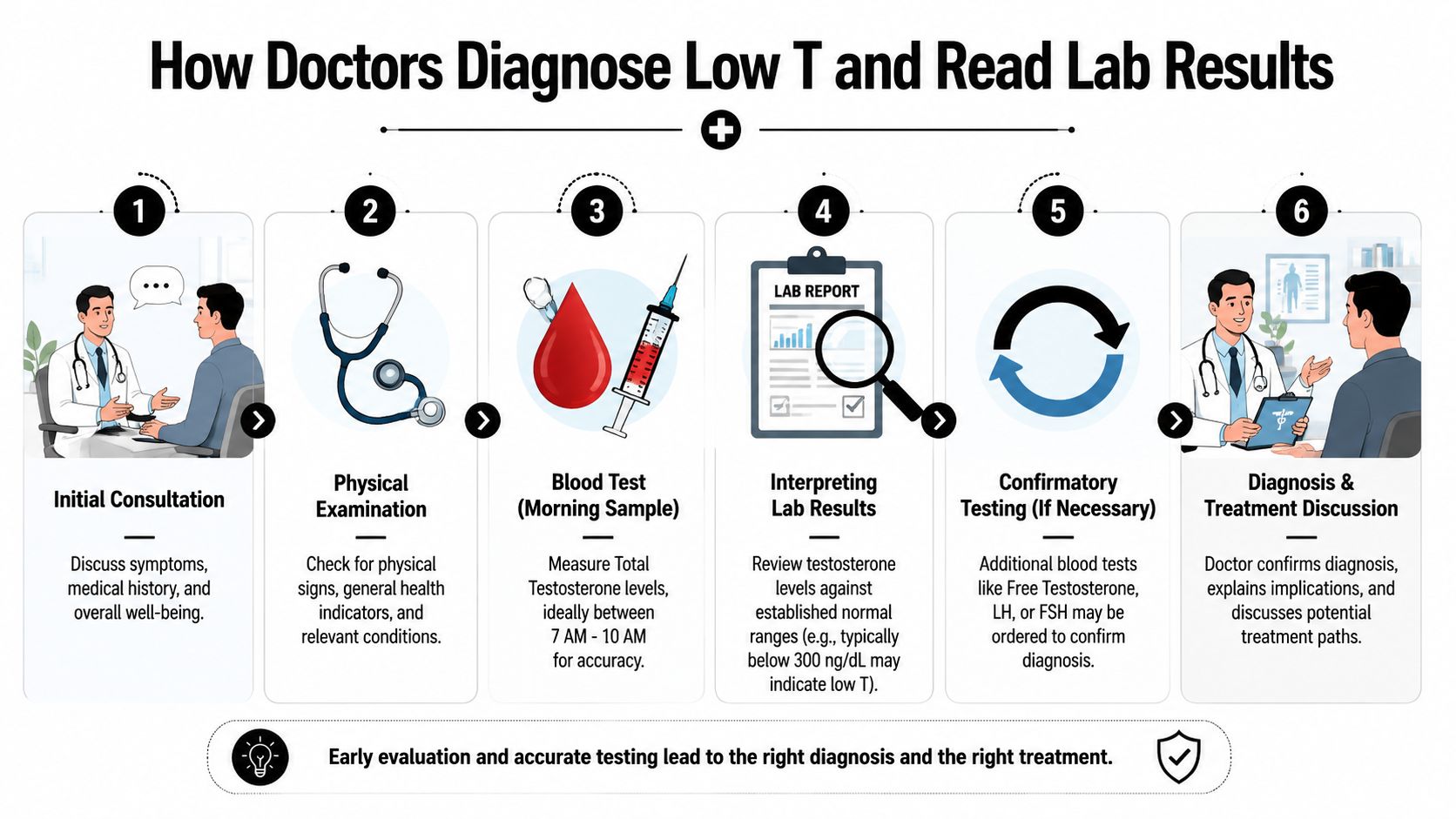
Diagnosis should be boring, methodical, and clear. If it feels rushed or salesy, that's a red flag. A proper low testosterone evaluation starts with symptoms and medical history, then moves to targeted blood work.
What the workup usually includes
Most doctors begin with a conversation about energy, sexual function, sleep, exercise, weight changes, medications, fertility goals, and any symptoms that could point to another diagnosis. Then they order labs.
Typical labs often include:
- Total testosterone: The main screening number.
- Free testosterone: Useful when total testosterone doesn't match the symptom picture.
- LH and FSH: These help determine whether the issue is more likely primary or secondary.
- Additional labs as needed: Depending on your history, a clinician may look at related markers to rule in or rule out other causes.
Morning testing matters because testosterone follows a daily rhythm. A sample drawn early in the day is usually more reliable than one drawn later, especially in younger men.
Why one number doesn't tell the whole story
The common cutoff many clinicians use is 300 ng/dL. That's useful, but it's not the full story. Men get into trouble when they treat “reference range” as the same thing as “healthy for this patient.”
A Wolters Kluwer summary of a Journal of Urology-derived analysis reported age-specific lower limits ranging from 409 ng/dL at age 20 to 24 to 350 ng/dL at age 40 to 44. That's substantially higher than the traditional universal threshold. In real-world terms, a younger symptomatic man can have a testosterone level near 300 ng/dL, be told it's “normal,” and still have a clinically meaningful problem.
Don't let one lab flag settle the issue by itself. Symptoms, age, timing of the blood draw, and the rest of the hormone picture all matter.
What a good interpretation sounds like
A thoughtful doctor doesn't just say yes or no. He or she asks questions like these:
- Do the symptoms match testosterone deficiency?
- Was the blood draw timed properly?
- Was the result confirmed when appropriate?
- Do LH and FSH suggest a testicular problem or a signaling problem?
- Are sleep, weight, stress, or medications contributing?
- Does the patient want to preserve fertility?
That's how low T in men should be diagnosed. Not by a quiz. Not by marketing. By a clinical pattern backed by labs.
A Complete Guide to Low Testosterone Treatment Options
Treatment should match the cause, the symptom burden, and the patient's goals. Some men need better sleep, weight loss, and treatment for sleep apnea. Some need medication that preserves fertility. Some are appropriate candidates for testosterone replacement therapy. A lot of frustration comes from choosing the right therapy for the wrong patient.
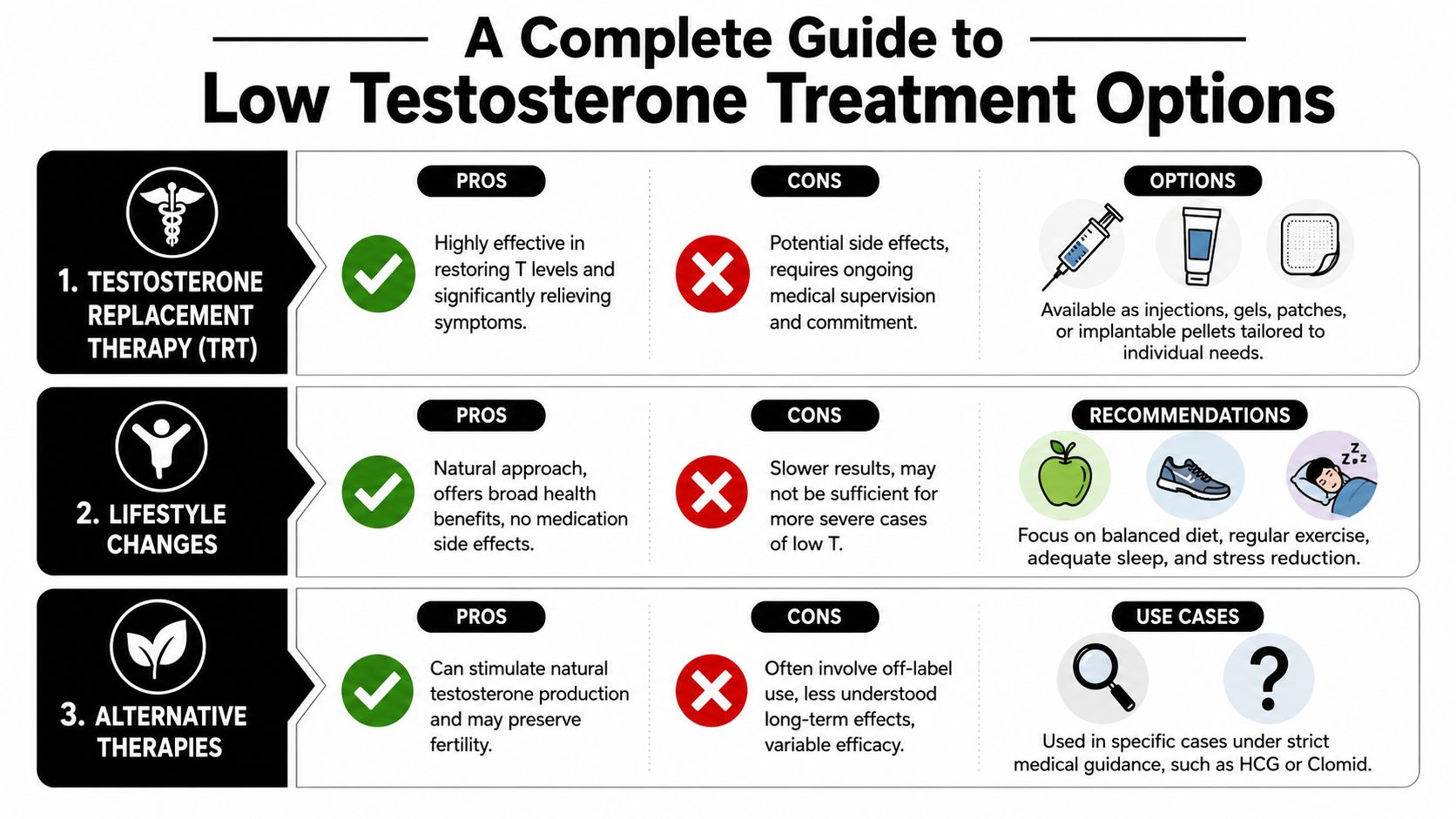
| Treatment | How It Works | Best For | Pros | Cons | Estimated Monthly Cost |
|---|---|---|---|---|---|
| Lifestyle changes | Improves sleep, body composition, recovery, and metabolic health | Men with mild symptoms or major lifestyle contributors | Supports overall health, no prescription required, can improve many root causes | Slower, less predictable, may not fully correct true deficiency | Varies |
| Clomiphene or similar approaches | Stimulates the body's own hormone signaling in selected cases | Men who may want symptom relief while preserving fertility | Can support endogenous production, may avoid direct testosterone replacement | Not right for every case, response varies, needs supervision | Varies |
| hCG-based treatment | Supports testicular stimulation in selected patients | Men focused on fertility preservation or specific clinical scenarios | Useful in the right patient, may be combined with other plans | More complex management, not a universal solution | Varies |
| TRT injections | Replaces testosterone directly with scheduled dosing | Men with confirmed deficiency who want a reliable, scalable option | Common, practical, adjustable | Requires monitoring, may affect fertility, involves ongoing treatment | Varies |
| TRT gels or creams | Replaces testosterone through skin absorption | Men who prefer to avoid injections | Needle-free, easy to use for some patients | Daily application, transfer concerns, absorption can vary | Varies |
| Pellets | Long-acting implanted testosterone | Men who want less frequent dosing visits | Fewer dosing decisions between placements | Procedure-based, less flexible if dose needs adjustment | Varies |
Lifestyle changes that matter
Lifestyle work is not fake treatment. It's foundational. If your sleep is poor, your weight is climbing, and stress is running your life, any hormone plan will work worse.
The highest-yield habits are usually the least glamorous:
- Protect sleep: If you snore heavily, wake unrefreshed, or feel exhausted despite enough time in bed, get evaluated for sleep apnea.
- Lift consistently: Resistance training supports body composition and metabolic health.
- Reduce excess body fat: This can improve the hormone environment even before medication enters the picture.
- Stop chasing extremes: Crash diets, overtraining, and heavy alcohol use often make the picture worse.
For some men, that's enough. For others, it improves the baseline but doesn't fully resolve symptoms or labs.
Medications that stimulate your own production
Clomiphene and hCG come up often in men who want to preserve fertility. These aren't the same as TRT. They aim to stimulate the body's own production rather than replace testosterone from the outside.
That distinction matters. Men who may want children soon should raise fertility goals early, not after treatment has already started. If that's your situation, read this plain-language discussion on whether TRT can affect fertility.
If fertility is a live issue, your treatment plan should reflect that from day one.
These medications can be helpful in selected patients, but they're not magic. Some men respond well. Some don't. Some feel better on paper than they do in real life.
TRT options and trade-offs
TRT means testosterone replacement therapy. It can be very effective when the diagnosis is solid and expectations are realistic. The goal is not to chase a feeling or build a superhero version of yourself. The goal is to restore a deficient state and relieve symptoms while monitoring safety.
The main delivery methods each have trade-offs:
- Injections: Usually the most practical option for many men. Dosing is adjustable and monitoring is straightforward.
- Gels or creams: Convenient for men who dislike needles, but absorption can vary and skin transfer requires care.
- Pellets: Attractive to men who want less frequent dosing decisions, though they're less flexible if the dose needs adjustment.
What doesn't work well? Casual self-diagnosis. Buying hormones without supervision. Switching doses constantly because of internet advice. Good TRT is boring in the right way. Consistent medication, lab monitoring, symptom tracking, and course correction when needed.
Affordable TRT Is Now Accessible Through Telemedicine
The old barriers were simple: too expensive, too inconvenient, too embarrassing, or too hard to fit into a workweek. Telemedicine has changed that for a lot of men.
A modern online clinic can handle symptom review, lab coordination, physician visits, treatment planning, follow-up, and medication delivery without requiring repeated in-person office visits. For busy professionals, fathers, shift workers, and men who live far from experienced prescribers, that convenience isn't a luxury. It's often the difference between getting care and putting it off for another year.
How virtual TRT care usually works
The process is usually straightforward:
- You complete an intake. Symptoms, history, medications, and goals.
- You provide labs or order them. Some clinics accept recent labs. Others coordinate new testing.
- You meet with a licensed physician online. The doctor reviews whether treatment is appropriate.
- Medication is prescribed if approved. Ongoing monitoring follows.
This model also improves privacy. Men who avoid care because they don't want repeated waiting-room visits often find telemedicine much easier to stick with.
Another practical advantage is pricing clarity. Many men are surprised by how confusing traditional clinic costs can become once visits, medication, supplies, and follow-up are separated into different charges. A transparent pricing model is easier to budget for, especially if you're paying out of pocket. If cost is your main concern, review this breakdown of how much TRT can cost.
Where telemedicine helps most
Telemedicine isn't the right fit for every medical problem, but it works well for ongoing hormone management when the clinic is physician-supervised and uses proper lab follow-up.
One example is Cost Plus TRT, a telemedicine clinic that offers transparent cost-plus pricing for TRT and related men's health care. Its one plan is $119 a month, month to month, with lab work, provider visits, testosterone cypionate, injection supplies, and shipping included.
Here's a closer look at how the virtual model works in practice:
The key point is broader than one clinic. Men no longer have to choose between doing nothing and navigating a fragmented, expensive system. If you have symptoms, a demanding schedule, and limited patience for hidden fees, telemedicine has made low T care much more reachable.
Your Next Steps for Taking Control of Your Health
If you suspect low T in men is part of your story, keep the next move simple.
First, stop guessing. Symptoms alone are not enough. Get proper labs and have them interpreted in context.
Second, look at the whole picture. Sleep, body composition, stress, medications, and fertility goals all influence what the right treatment should be. The right answer isn't always TRT, and it isn't always “just live healthier.” It depends on what the workup shows.
Third, choose a care model you'll follow through with. The best treatment plan fails if it's too expensive, too inconvenient, or too confusing to maintain. If you want to discuss symptoms, labs, or treatment options with a licensed clinician, you can request a consultation through Cost Plus TRT.
You don't need to commit to a lifetime plan today. You just need clarity. Once you know what your labs and symptoms are really saying, good decisions get much easier.
Frequently Asked Questions About Low T and TRT
If I start TRT, do I have to stay on it forever
Not automatically, but you should treat it like a serious long-term therapy, not a casual trial. TRT replaces testosterone. If you stop, your levels may fall again and symptoms can return. Whether it makes sense to continue depends on why you started, how you respond, whether side effects occur, and whether another approach would better match your goals.
Can I raise testosterone naturally without medication
Sometimes, yes. If poor sleep, excess body fat, heavy stress, low activity, or untreated sleep apnea are major drivers, lifestyle and medical correction can meaningfully improve the situation. But natural improvement has limits. Men with clear, persistent deficiency often need more than lifestyle work alone.
What's the real difference between an online TRT clinic and a local doctor
The best local doctors and the best online clinics both use history, labs, and follow-up to make decisions. The practical difference is often logistics. Telemedicine can reduce travel, waiting-room time, and pharmacy friction. A local doctor may be preferable if you have a more complicated medical picture or want all your care under one roof. Quality depends more on the clinical process than the building.
Are there side effects or trade-offs with TRT
Yes. There are always trade-offs. TRT requires monitoring, and it may affect fertility. Dose, delivery method, your baseline health, and follow-up quality all matter. The safe way to think about TRT is not “good” or “bad.” It's “appropriate for this patient, or not.”
What's the biggest mistake men make when they suspect low testosterone
They wait too long, then try to shortcut the process. Some ignore symptoms for years. Others chase internet advice and focus on one lab number with no clinical context. The better move is simple: get evaluated properly, then choose treatment based on diagnosis, goals, convenience, and cost.
If you want a simple, private way to review your symptoms, labs, and treatment options, Cost Plus TRT offers physician-supervised telemedicine care built around transparent pricing and home delivery.