
Some men land on a low T clinic website after months of brushing symptoms aside. Energy is down, workouts feel flat, sex drive isn't what it used to be, and the usual fixes like more sleep, less stress, or another cup of coffee haven't changed much. What makes this confusing is that the problem often feels vague. You don't feel acutely sick. You just don't feel like yourself.
That uncertainty is exactly why clinic choice matters. A good low T clinic doesn't just sell testosterone. It runs a structured medical process, explains what you're paying for, and helps you decide whether an in-person model or telemedicine model is right for your life. That business model affects everything that follows, including convenience, lab logistics, follow-up burden, safety, and total cost.
Table of Contents
- Is It Just Me or Is Something Off?
- What a Low T Clinic Actually Does
- The First Step Diagnosis and Lab Testing
- Comparing Care Models In-Person vs Telemedicine Clinics
- How to Choose a Trustworthy Low T Clinic
- Understanding TRT Costs and How to Save Money
- Your Next Steps A Checklist for Getting Started
Is It Just Me or Is Something Off?
A lot of men don't start with the words “low testosterone.” They start with a feeling that something is off. They're more tired than they should be. Motivation has slipped. Recovery in the gym takes longer. Libido is lower. Stamina isn't where it was.
Those symptoms are common enough that it's easy to dismiss them as aging, work stress, bad sleep, or just a rough stretch. Sometimes that's true. Sometimes it isn't.
Testosterone deficiency is common enough to support an entire specialty care market. A review in Translational Andrology and Urology reports that the global prevalence ranges from 10% to 40%, with a notable increase in men aged 45 to 50 years, and among middle-aged to elderly men in the United States, reported prevalence is 24% to 39% according to the peer-reviewed review on testosterone deficiency prevalence.
That doesn't mean every tired or stressed man has low testosterone. It does mean you're not unusual for asking the question.
Many men wait too long because their symptoms don't seem dramatic enough to justify a medical visit. Subtle symptoms still deserve a proper workup.
What matters next is getting out of the self-diagnosis loop. The useful question isn't “Do I feel older?” It's “What is causing these symptoms, and what kind of clinic will help me find out without wasting money or pushing treatment I may not need?”
A low T clinic can be helpful if it follows real medical standards. It can also be frustrating if it oversimplifies the problem, hides costs, or treats testosterone like a retail product. That's where the clinic's care model starts to matter as much as the medication itself.
What a Low T Clinic Actually Does
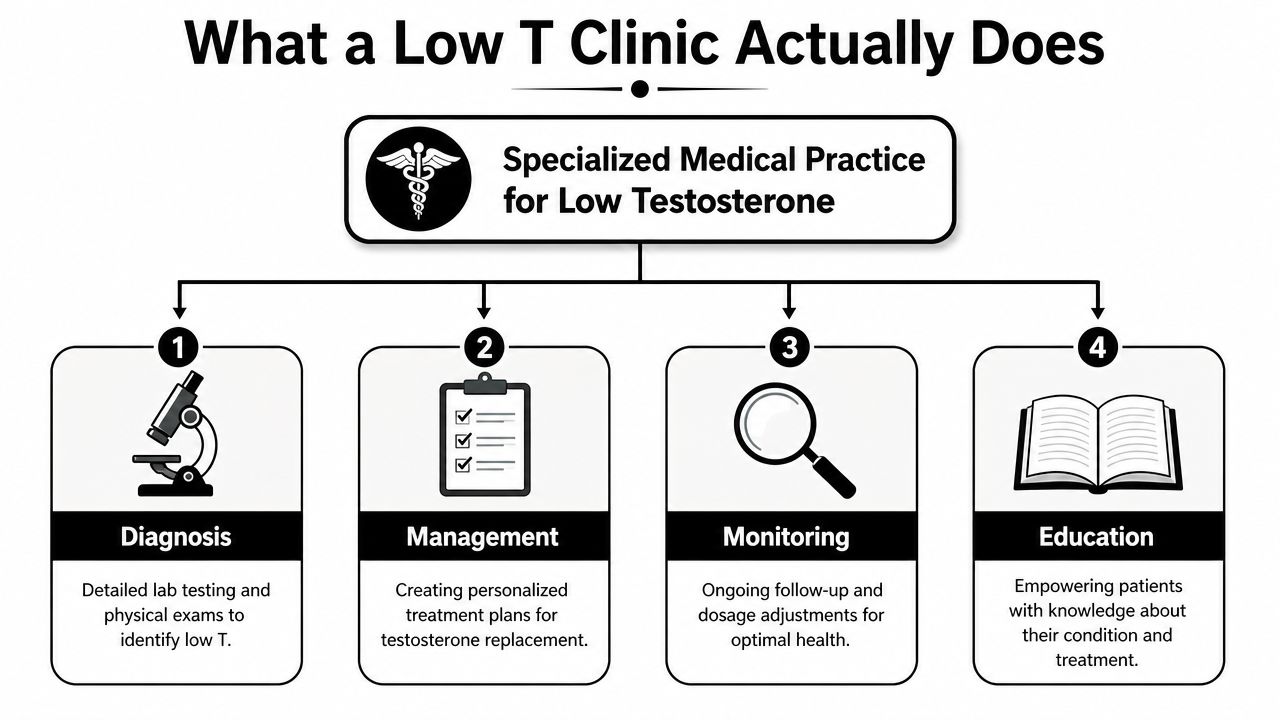
A real low T clinic is a medical practice focused on diagnosing and managing hypogonadism. The clinic should review symptoms, confirm the diagnosis with labs, build an individualized treatment plan, and monitor the patient over time. That core workflow is described in the clinical overview of low testosterone clinic care.
The clinic is there to diagnose, not just dispense
The first job is evaluation. That means a symptom review, medical history, medication review, and hormone testing. A serious clinic doesn't jump from “I'm tired” to “Here's your prescription.”
After diagnosis comes management. That includes choosing whether TRT is appropriate, discussing treatment format, setting expectations, and planning follow-up. Some clinics also address related men's health concerns, but the center of the visit should still be clinical decision-making, not upselling.
Here's the simplest way to think about the workflow:
- Consultation first: The clinician should ask about symptoms, goals, prior treatment, medical history, and factors that may affect testosterone or treatment safety.
- Objective confirmation: Labs should support the diagnosis rather than serving as a formality.
- Treatment planning: Dosing, delivery method, and follow-up schedule should be individualized.
- Monitoring over time: Good clinics adjust treatment based on response, labs, and side effects.
A practical example of a telemedicine-first option is Cost Plus TRT's online TRT care model, which describes provider visits, lab options, and prescription fulfillment as part of a remote care pathway.
The care model shapes the patient experience
Two clinics can prescribe the same medication and still deliver a very different experience. That difference usually comes from the business model.
An in-person clinic often wraps the care around office visits, in-house staff, and facility overhead. A telemedicine clinic builds the process around remote consults, outside lab coordination, shipment, and digital follow-up. Neither model is automatically better. But they create different kinds of friction.
Practical rule: If a clinic can't clearly explain what happens before treatment, during treatment, and at follow-up, you're not evaluating a medical system. You're evaluating a sales funnel.
That's why “what services do they offer?” isn't the most useful first question. “How do they deliver care, and what does that model make easier or harder for me?” is usually the better one.
The First Step Diagnosis and Lab Testing
A good low T evaluation should answer two questions before anyone talks about prescriptions. Is testosterone clinically low, and is testosterone the right explanation for the symptoms?
What low testosterone means in practice
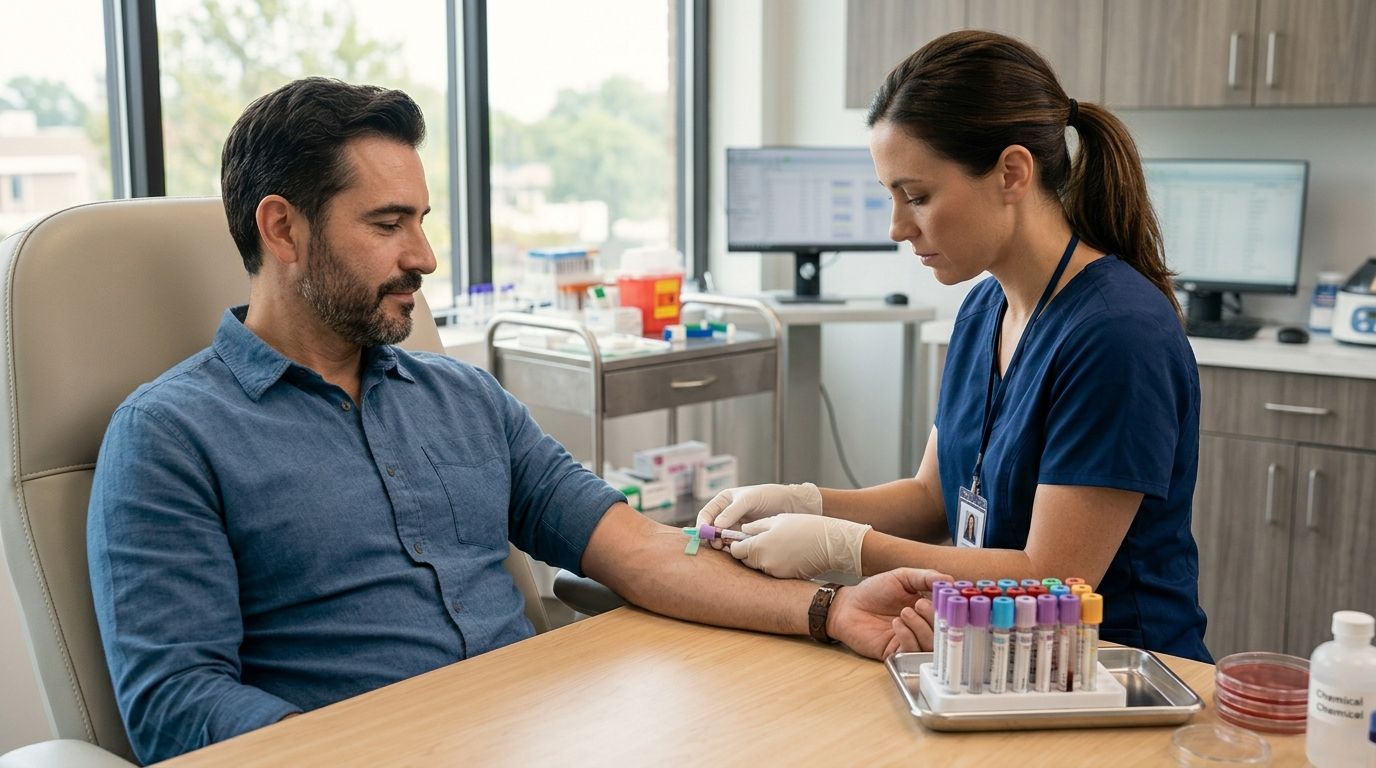
Clinical guidelines from the American Urological Association use a total testosterone level below 300 ng/dL as a reasonable cutoff for low testosterone, but the lab value has to fit the patient. Symptoms still matter.
That point gets missed in many clinic sales pitches. Fatigue, low sex drive, reduced exercise tolerance, and lower mood can occur with testosterone deficiency, but they also overlap with sleep apnea, depression, chronic stress, weight gain, medication side effects, thyroid disease, and poor sleep habits. A clinic that treats every tired patient with TRT is not saving time. It is increasing the chance of wasted money and a poor result.
This is also where the clinic's business model starts to show. Some practices build enough time into the first visit to review symptoms, past medical history, fertility plans, and medication use. Others keep the intake short and rely on a narrow lab panel because speed helps conversions. Patients usually feel that difference before treatment starts.
Why timing and repeat testing matter
Testosterone should usually be measured in the morning, and low results often need confirmation. The Endocrine Society guideline on testosterone therapy recommends confirming the diagnosis with repeat morning testing because testosterone levels can vary from day to day.
That matters for cost as much as accuracy. A clinic that skips repeat testing may look cheaper upfront, but a fast diagnosis can lead to months of medication, follow-up visits, and lab fees built on a weak starting point. A clinic that orders every possible test without explaining why can create the opposite problem. Higher intake costs with little added value.
Patients should know what they are paying for before the first blood draw. If a telemedicine clinic uses outside labs, the consent and workflow should be clear from the start, including how testing and follow-up are handled through telehealth consent and care coordination.
A careful clinic should be able to answer these questions in plain English:
| Question | Why it matters |
|---|---|
| Was the lab drawn in the morning? | Testosterone changes over the course of the day. |
| Was a low result repeated when appropriate? | One abnormal value may not reflect the usual level. |
| Do the symptoms fit the lab findings? | Treatment decisions should match both the history and the labs. |
| Were other causes considered? | Treating the wrong problem costs time, money, and trust. |
| What is included in the initial price? | Some clinics bundle labs and visits, while others bill each step separately. |
The best diagnostic process is not the fastest one. It is the one that gives a clear answer, explains the trade-offs, and shows the true cost before ongoing treatment begins.
Comparing Care Models In-Person vs Telemedicine Clinics
The biggest practical choice most patients make isn't the medication. It's the care model. That choice determines how often you travel, how labs are handled, how quickly medication reaches you, and how transparent the total cost feels from month to month.
When in-person care makes sense
An office-based clinic can work well for men who want face-to-face interaction, prefer staff-administered injections, or feel more confident when a clinician can examine them directly. For some patients, that physical setting improves trust and makes follow-up easier to remember.
The trade-off is friction. In-person care usually means travel time, fixed schedules, waiting rooms, and more overhead built into the practice. Even when the medical care is solid, the business model can make simple things feel cumbersome.
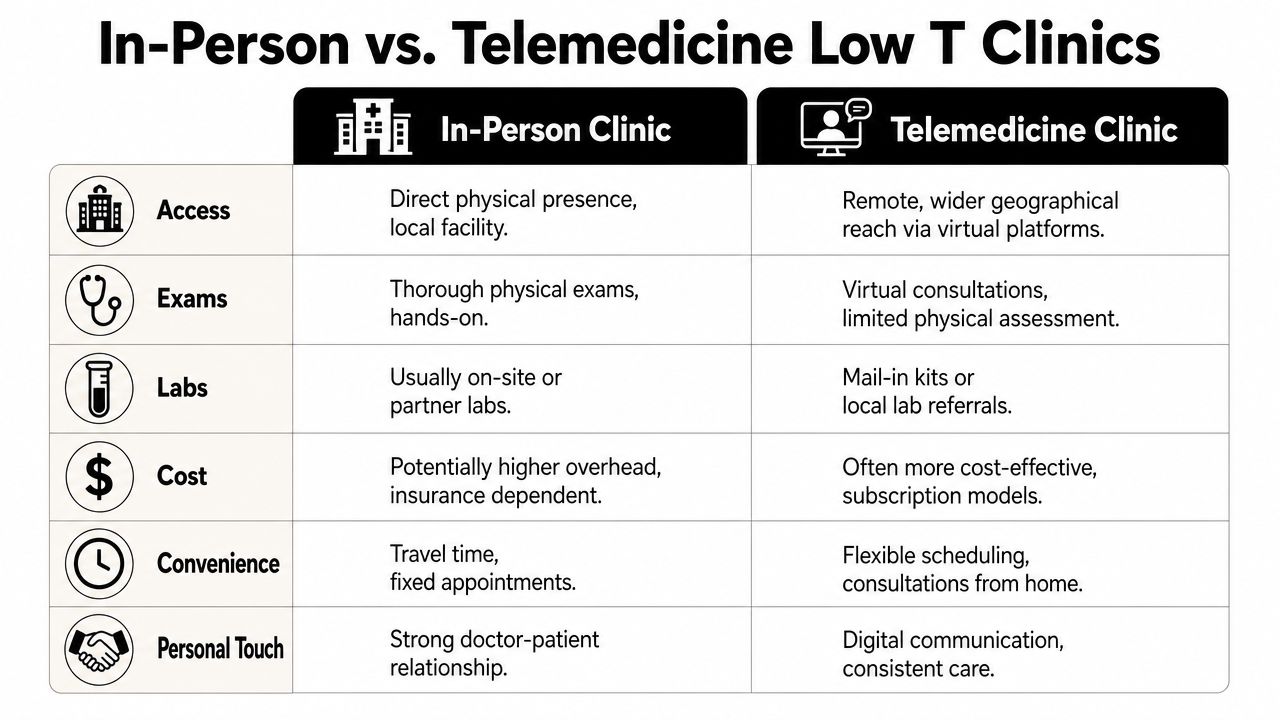
Here's a side-by-side view:
| Feature | In-person clinic | Telemedicine clinic |
|---|---|---|
| Appointments | On-site visits | Remote video or online visits |
| Medication access | Often picked up or administered locally | Often shipped to the home |
| Convenience | Lower for busy schedules | Higher for men who travel or work long hours |
| Hands-on care | Stronger physical presence | More limited physical assessment |
| Cost structure | Often shaped by office overhead | Often shaped by operational efficiency |
For readers who want to hear a general discussion of remote treatment logistics and consent issues, this telehealth consent resource for TRT care is one example of how telemedicine clinics explain that process.
A short visual summary helps:
When telemedicine is the better fit
Telehealth has changed low T care because it removes a lot of recurring hassle. Some established TRT programs offer at-home treatment delivery with ongoing remote monitoring for as low as $105 per month, according to the Low T Center telehealth TRT model. That figure doesn't tell you everything about total cost, but it does show how the model can reduce access barriers.
Telemedicine is usually the better fit for men who:
- Value time savings: No routine drive across town for every check-in.
- Prefer privacy: Home delivery is more discreet than frequent clinic visits.
- Want predictable logistics: Remote follow-up often works better for repeat care.
- Can manage self-administration: Some treatment plans require comfort with home injections or other self-directed steps.
Convenience is real, but convenience doesn't replace medical rigor. A remote clinic still needs proper labs, follow-up, and clear communication.
Telemedicine works best when the clinic is organized. If the lab process is confusing, provider access is poor, or refill rules are unclear, the convenience advantage disappears quickly.
How to Choose a Trustworthy Low T Clinic
A trustworthy low T clinic doesn't just make treatment available. It makes treatment appropriate. That starts with differential diagnosis.
Symptoms associated with low testosterone can overlap with obesity, sleep apnea, depression, medication side effects, and other reversible causes, and guidance summarized in this discussion of low T diagnosis and root-cause evaluation emphasizes that clinics should evaluate those possibilities before initiating testosterone therapy. That point gets missed constantly in marketing.
Green flags worth paying for
If you're comparing clinics, look for operational honesty as much as clinical language. A good clinic should tell you what they require before prescribing, what follow-up looks like, and what happens if your symptoms point in another direction.
Strong signs include:
- A real workup: The clinic asks about sleep, weight, medications, mood, and medical history instead of treating fatigue as automatic proof of low T.
- Clear lab standards: They explain how diagnosis is confirmed and when repeat testing is needed.
- Monitoring expectations upfront: You know what follow-up will involve before you start.
- Transparent pricing language: The clinic can separate consults, medication, labs, shipping, and follow-up instead of burying everything in vague membership terms.
- Fertility and safety discussion: If a clinic never brings up fertility, hematocrit, sleep apnea, or what happens if you stop treatment, that's a problem.
Red flags that should make you walk away
Some low T clinics are built more like retail funnels than medical practices. They rely on urgency, oversimplified symptom lists, and all-in-one monthly pricing that sounds easy until you need clarification.
Watch for these patterns:
- Symptoms-only prescribing: If the clinic is ready to start TRT before proper labs and review, leave.
- One-size-fits-all dosing: Men respond differently. Cookie-cutter plans are a warning sign.
- Minimal discussion of alternatives: If the clinic never explores whether another condition could be driving symptoms, it may be steering every patient toward the same answer.
- Convenience-only messaging: Fast access matters, but not at the expense of diagnosis and follow-up.
- Evasive answers about total cost: If you can't tell what you'll pay for labs, medication, follow-up, or shipping, you'll probably learn the hard way later.
A clinic earns trust when it's willing to say, “You may not need TRT yet. We need to rule out other causes first.”
That answer can feel disappointing in the moment, but it's often the most medically responsible answer.
There's also a business lesson here. Clinics that profit mainly from keeping men on indefinite treatment may have less incentive to slow down the initial decision. That doesn't mean every subscription clinic is careless. It does mean you should pay attention to whether the clinic's revenue model pushes speed over judgment.
Understanding TRT Costs and How to Save Money
Most men asking about a low T clinic are really asking two financial questions. “What will this cost me each month?” and “What am I buying for that monthly number?”
Those are not the same question.
What you are actually paying for
TRT pricing usually combines several moving parts. Depending on the clinic, you may be paying for consultation time, lab coordination, medication, injection supplies, shipping, and follow-up access. Some clinics bundle these into a monthly fee. Others split them apart.
That means a low advertised treatment price can still become expensive if the clinic adds separate charges later. The reverse can also be true. A slightly higher monthly figure may be simpler and more predictable if it includes the recurring essentials.
When you compare clinics, ask for this breakdown in writing:
- Provider costs: Initial consults, follow-up visits, or membership fees.
- Medication costs: What drug is included, in what form, and how refills work.
- Lab costs: Whether labs are included, billed separately, or handled through outside insurance.
- Operational costs: Shipping, supplies, administrative fees, and refill processing.
A pricing page like Cost Plus TRT's published pricing overview shows the type of line-item transparency patients should look for when comparing telemedicine options.
How to reduce cost without cutting corners
The best way to save money is to reduce waste, not to skip safety steps.
A few practical ways to do that:
- Use recent labs when allowed: Some clinics accept outside lab work if it meets their requirements.
- Ask whether insurance can cover lab work: Even if the clinic itself is cash-pay, outside labs may be handled separately.
- Choose a model that fits your schedule: If office visits create missed work, travel cost, and frequent delays, the “cheaper” clinic may not be cheaper in real life.
- Avoid vague subscriptions: If you can't tell what is included, assume you'll eventually pay extra for something important.
The mistake I see most often is choosing based on the first monthly number shown on a homepage. The better comparison is total cost over time, paired with how much friction the clinic adds to your routine.
Your Next Steps A Checklist for Getting Started
If you think a low T clinic may be worth exploring, keep the first steps simple and concrete.
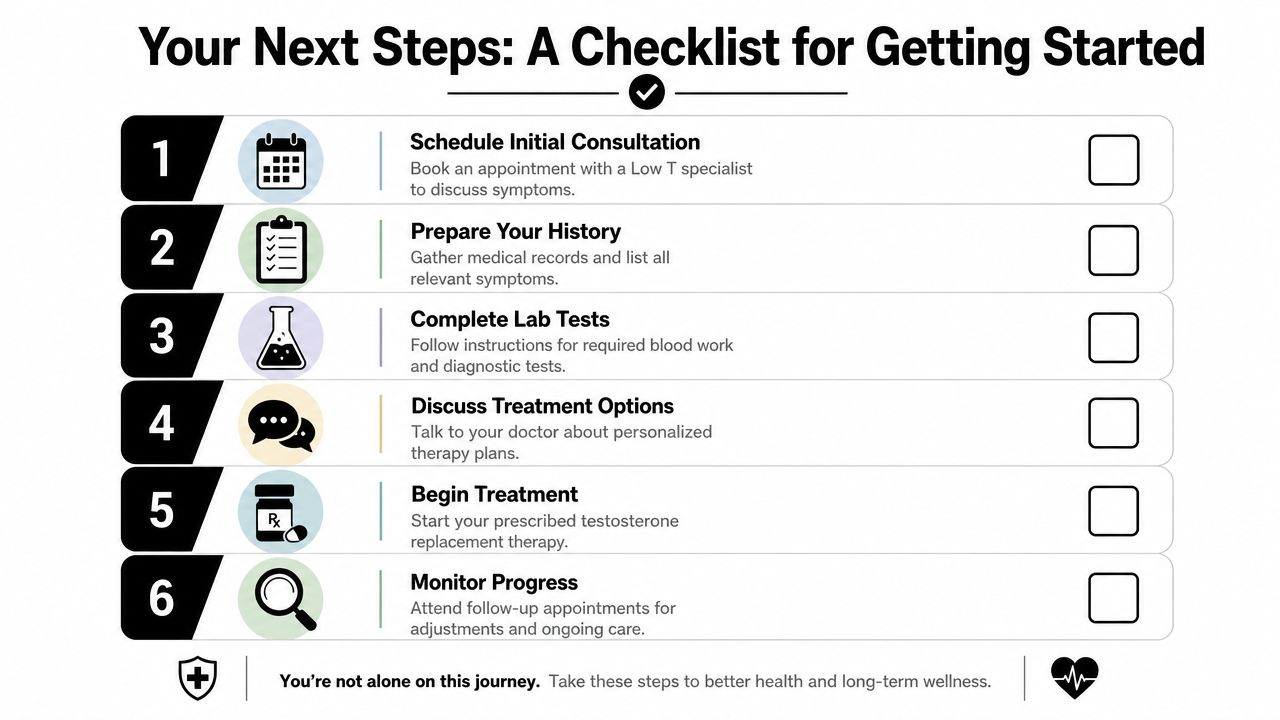
Start with your symptoms. Write down what has changed, how long it has been going on, and what matters most to you. Energy, libido, recovery, mood, motivation, and stamina are all worth noting.
Then narrow your clinic list using care model and pricing transparency first. If you know you won't keep up with repeated office visits, don't choose an in-person setup because it feels more traditional. If you want hands-on care and don't like managing treatment from home, don't pick telemedicine just because the monthly number looks lower.
Use this shortlist before your first visit:
- Confirm the diagnostic process: Ask how the clinic confirms low testosterone before prescribing.
- Ask what is included in the price: Medication, supplies, shipping, provider follow-up, and lab handling should all be clear.
- Review the follow-up model: Know how often you'll check in and how dose changes are handled.
- Bring your medical context: Current medications, sleep issues, weight changes, prior lab work, and past TRT use all matter.
- Ask about safety and fertility: Don't leave without understanding the trade-offs.
- Choose the model you'll commit to: Adherence is easier when the process fits real life.
The right clinic should make the process feel clearer, not more confusing. If you leave the consultation with more pressure than clarity, keep looking.
If you want a telemedicine option with transparent line-item pricing, Cost Plus TRT offers online physician-supervised TRT care, lab handling options, and shipped medication for eligible patients. It's one model to compare against local in-person clinics if your priority is lower treatment friction and clearer monthly costs.