

You started TRT, your testosterone numbers improved, and some things got better. Libido picked up. Energy came back. Training felt more productive. Then the next question showed up fast: what about sleep, recovery, body composition, and that feeling that you're still not quite where you want to be?
That's usually when men start looking at growth hormone peptides and run into the same fork in the road: Ipamorelin or Sermorelin. Both sit in the same general category, but they're not interchangeable. They signal through different pathways, they tend to feel different in practice, and they suit different goals.
Most online comparisons oversimplify this choice. They say one is “better for fat loss” and the other is “better for anti-aging,” then move on. That leaves out two questions patients frequently ask in clinic. First, how quickly do you really notice anything? Second, does stacking them produce a true synergy, or just more complexity?
Table of Contents
- Starting TRT Was Just the Beginning
- How Peptides Work to Boost Growth Hormone
- Sermorelin A Profile for Long-Term Vitality
- Ipamorelin A Profile for Targeted Performance
- Ipamorelin vs Sermorelin Side by Side
- How to Choose the Right Peptide for Your Goals
- Starting Peptide Therapy Safely Online
Starting TRT Was Just the Beginning
For a lot of men, TRT fixes the obvious deficiency but doesn't solve everything downstream. You may still want better sleep, faster training recovery, more consistent body composition progress, or a stronger sense of day-to-day resilience. That's where growth hormone secretagogues enter the conversation.

The confusion starts because Ipamorelin and Sermorelin both aim to increase growth hormone release, but they do it differently. If your main goal is sleep quality and long-range vitality, one tends to make more sense. If your main goal is recovery, training support, or a more targeted push, the other often becomes more attractive.
The real decision after TRT
Once testosterone is optimized, the next step shouldn't be random add-ons. It should be matching therapy to the problem in front of you.
A useful way to think about Ipamorelin vs Sermorelin is this:
- If your goal is broader restoration, you're usually looking for a peptide that works in a way that tracks closely with natural signaling.
- If your goal is a more noticeable short-term feel, you're usually drawn to a peptide that creates a stronger targeted growth hormone pulse.
- If you want guaranteed timelines for fat loss or recovery, the evidence is thinner than most marketing suggests.
The men who do best with peptide therapy usually aren't chasing hype. They have a clear goal, realistic expectations, and a physician who treats peptides as one tool, not magic.
Where patients usually get misled
The usual mistake is treating these peptides like stronger versions of TRT. They're not. They're different tools for a different axis.
Another mistake is assuming faster subjective feedback always means better long-term fit. Sometimes it does. Sometimes it just means the peptide's signaling style is easier to notice early.
How Peptides Work to Boost Growth Hormone
If you're going to compare these two properly, you need to separate growth hormone stimulation from growth hormone replacement. That distinction matters more than is commonly understood.
Why endogenous stimulation matters
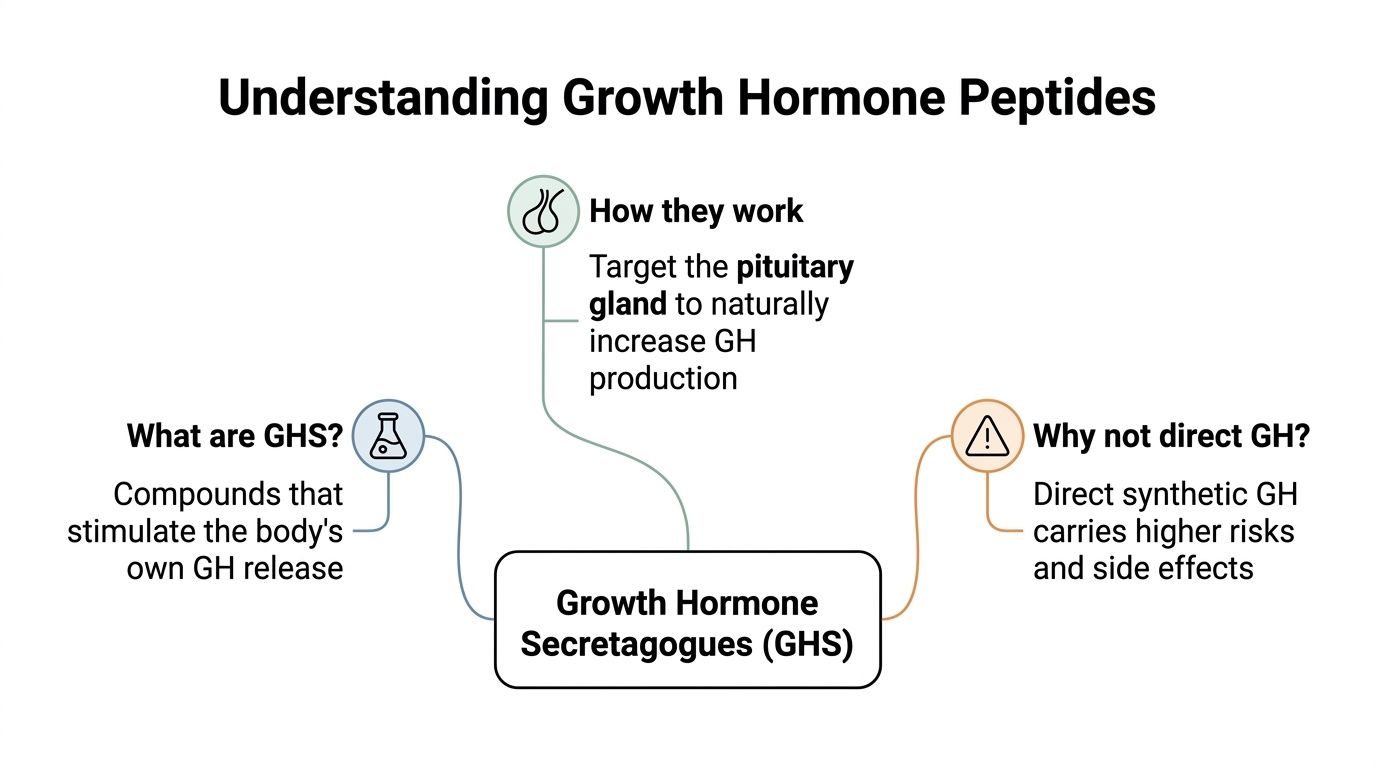
Your body already has a built-in rhythm for growth hormone release. Peptides like Sermorelin and Ipamorelin are used to stimulate that existing system rather than replace it outright with synthetic HGH.
That difference is one reason many clinicians prefer secretagogues when the goal is a more physiologic approach. In the case of Ipamorelin, available data describe it as selective and note that it stimulates endogenous growth hormone production while preserving natural feedback mechanisms such as somatostatin, which may carry fewer risks than direct HGH replacement, as discussed in this review of Sermorelin and Ipamorelin.
If you're browsing broader options in this category, a physician-supervised peptide therapy overview can help clarify what belongs in a legitimate treatment plan and what doesn't.
Two receptors, two styles of signaling
Sermorelin works through the GHRH receptor. Think of it as leaning into the body's native “release growth hormone” instruction. That's one reason it often appeals to men who want a steadier, more restorative feel.
Ipamorelin works through the ghrelin receptor pathway. It's still a growth hormone secretagogue, but it uses a different key to press the same endocrine system.
That receptor difference explains a lot of what patients notice in real life:
- Sermorelin often fits men who care most about sleep, gradual body composition support, and long-term consistency.
- Ipamorelin often fits men who want a cleaner, more performance-oriented signal.
- Neither peptide should be treated like a shortcut around sleep, nutrition, training quality, or recovery habits.
Practical rule: If you don't understand which receptor pathway a peptide targets, you're not ready to compare protocols yet.
The mechanism matters because it shapes both expectations and trade-offs. These peptides live in the same neighborhood, but they don't behave like clones.
Sermorelin A Profile for Long-Term Vitality
Sermorelin usually makes the most sense for the patient who wants steady improvement instead of a quick jolt. It acts on the GHRH pathway, which is part of why it often feels more aligned with the body's native rhythm rather than like a hard push.
Where Sermorelin fits best
Sermorelin has a strong evidence base for sleep improvement and steady long-term hormone signaling, and it tends to deliver benefits more gradually, typically over weeks 4 to 8, because it works with the body's natural rhythms over time, according to this Sermorelin versus Ipamorelin review.
That gradual profile is exactly why some men do very well on it. They're not looking for a dramatic early shift. They want better sleep architecture, better recovery capacity over time, and a more sustainable approach to vitality.
Clinical data also indicate that longer-term Sermorelin treatment leads to significant increases in GH and IGF-1 levels alongside measurable improvement in lean body mass, with body weight and fat remaining unchanged in the cited hypogonadal population. In plain terms, it's not a “melt fat fast” peptide. It's better framed as a slow rebuild tool.
What usually frustrates impatient patients
The same feature that makes Sermorelin appealing also makes some men quit too early. It doesn't always give rapid reinforcement. If you're the kind of patient who wants to feel something clear and early, Sermorelin can seem underwhelming at first.
That doesn't mean it isn't working. It means the fit may be wrong for your expectations.
A few practical realities matter here:
- Best use case: Men who prioritize sleep quality, recovery depth, and broader anti-aging support.
- Less ideal use case: Men chasing rapid fat-loss feedback before a deadline.
- Tolerance: It's generally well tolerated, with mild side effects such as injection site irritation, mild headache, and transient flushing described as self-limiting in the available source.
Sermorelin was previously marketed as Geref and is now primarily available through compounding rather than as an FDA-approved commercial product, as noted in this Sermorelin treatment page.
Sermorelin is often the better answer for the man who wants his treatment to feel natural, even if that means waiting longer to notice the payoff.
Ipamorelin A Profile for Targeted Performance
Ipamorelin tends to attract men who care less about a gentle ramp and more about targeted, noticeable support. In practice, that usually means training recovery, sleep quality, and body composition momentum.
Why Ipamorelin attracts performance-focused men
Available clinical discussion indicates that patients typically report noticeable improvements in sleep quality, energy, and recovery speed with Ipamorelin within weeks 1 to 4, while Sermorelin benefits tend to emerge more gradually over time due to alignment with natural physiological rhythms, as summarized in this clinical review on growth hormone secretagogues.
That faster subjective response is why Ipamorelin often becomes the front-runner for men who are already training hard and want something they can feel sooner. It's also one reason it's commonly favored when the goal is athletic performance or a faster body composition push.
Another practical advantage is selectivity. Ipamorelin has clinically demonstrated selectivity with minimal impact on cortisol and prolactin, and the Raun et al. study described in the verified source reported no significant elevation of either hormone even at 200 times the effective GH-releasing dose. The same source also notes an approximate 2 to 3 hour half-life and no significant adverse effects compared with placebo in post-surgical patients, aside from minor issues such as temporary injection site redness or mild headache.
What it does well and what it does not prove
Hence, honest counseling matters. Ipamorelin often gets framed as the “fat loss peptide” or the “recovery peptide.” That shorthand is useful, but it can oversell certainty.
What it does well:
- Subjective early feedback: Men often notice sleep, energy, and recovery changes sooner.
- Targeted signaling: Its selectivity is one of its strongest clinical selling points.
- Performance fit: It's commonly chosen when training quality and turnaround matter.
What it does not prove:
- It does not come with clean week-by-week human data showing exactly when fat mass drops or recovery markers improve.
- It does not replace disciplined sleep, food quality, and programming.
- It does not mean every patient should expect the same pace of results.
If your expectations are realistic, Ipamorelin can be a very practical option. If your expectations come from peptide marketing, disappointment is more likely.
Ipamorelin vs Sermorelin Side by Side
Quick comparison table
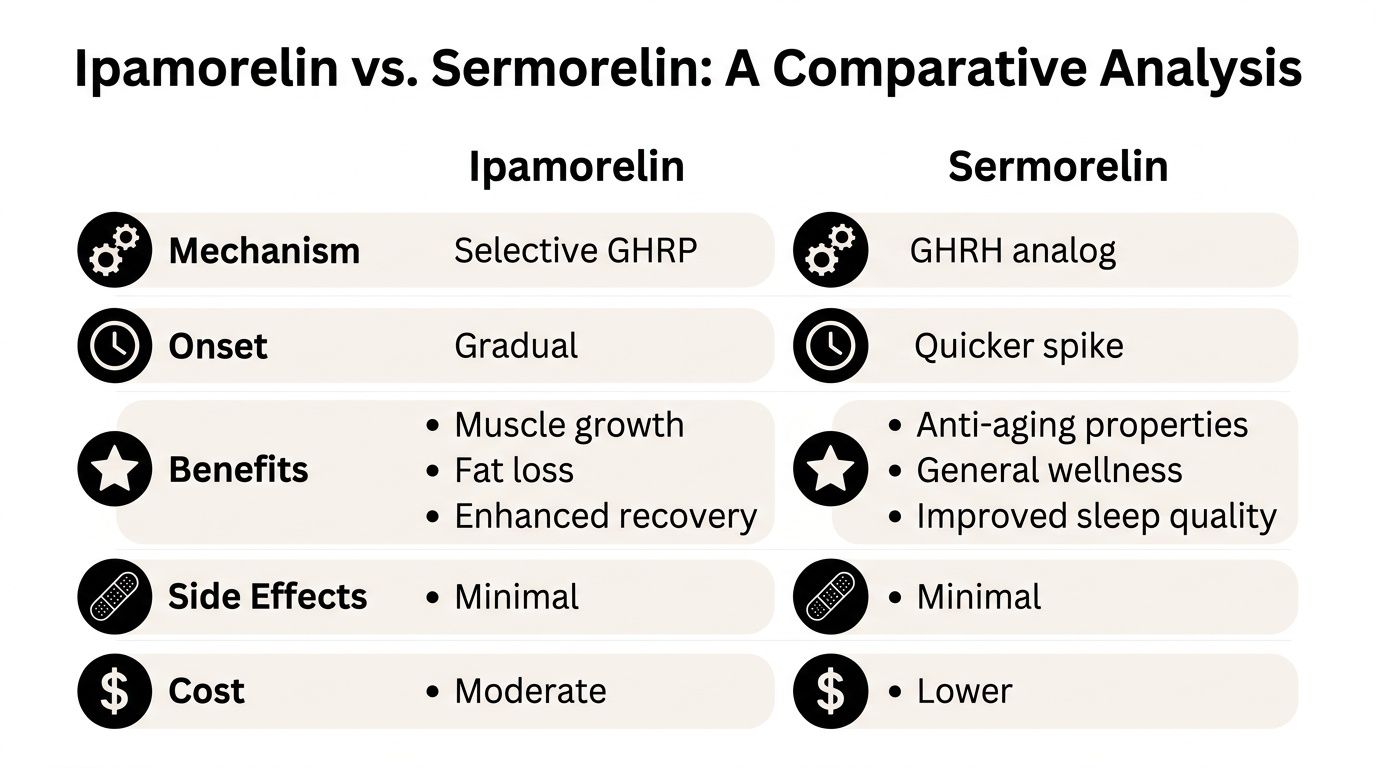
| Factor | Sermorelin | Ipamorelin |
|---|---|---|
| Primary pathway | GHRH receptor | Ghrelin receptor pathway |
| General style | Steady, rhythm-aligned signaling | More targeted GH pulse stimulation |
| Typical early feel | Gradual | Often noticed sooner |
| Best fit | Sleep, long-term vitality, broader restoration | Recovery, performance support, body composition focus |
| Onset expectation | Often more apparent over weeks 4 to 8 | Patient-reported changes often within weeks 1 to 4 |
| Tolerability | Generally well tolerated, mild self-limited side effects reported | Generally well tolerated, minor side effects reported |
| Commercial status | Previously marketed as Geref, now primarily compounded | Discussed mainly in physician-supervised peptide use, not as direct HGH replacement |
The practical differences that matter
If you strip away the marketing language, the Ipamorelin vs Sermorelin decision usually comes down to three things: how fast you want feedback, what your primary outcome is, and how much you value physiologic pacing versus targeted stimulation.
Sermorelin is usually the more natural-feeling option for men who want to support sleep and long-term vitality. Ipamorelin is usually the sharper tool for men who want to push recovery and notice changes earlier.
The most important difference isn't that one is “stronger.” It's that they ask the pituitary to respond in different ways.
A lot of men also want an exact timeline. They ask when fat loss starts, when soreness improves, or when body composition visibly changes. That's where the literature gets frustrating. While sources often claim Ipamorelin offers faster recovery and body composition support and Sermorelin works more gradually, no published studies provide week-by-week metrics on fat mass reduction, lean mass gain, or recovery markers, according to this analysis of the evidence gap around peptide timelines.
That matters because it changes how I'd counsel a patient. I wouldn't promise a defined week for visible fat loss on either peptide. I would say this instead:
- Use early subjective changes carefully. Better sleep or better training feel is useful, but it isn't the same as objective proof.
- Track the right markers. Body composition photos, waist trend, sleep quality, training recovery, and lab follow-up matter more than hype.
- Don't compare yourself to anecdotes. One patient's “I felt it fast” doesn't create a clinical timeline.
If a clinic promises a precise body-fat or recovery timeline from either peptide, they're speaking with more certainty than the evidence supports.
Another difference is strategic fit. Sermorelin is often the better long game. Ipamorelin is often the better short-to-medium game. Neither should be selected because someone on social media called it the “best peptide stack.”
How to Choose the Right Peptide for Your Goals
A good peptide choice starts with your actual priority, not with what sounds advanced. Most men considering these therapies fall into a few recognizable profiles.
Best fit scenarios
The man on TRT who still sleeps poorly: Sermorelin usually deserves the first look. Its profile fits the patient who wants better restorative sleep and a steadier long-term vitality strategy.
The hard-training patient who wants faster recovery: Ipamorelin often makes more sense. If your training volume is high and you care about quicker subjective feedback, its profile is usually more aligned with that goal.
The patient chasing rapid visible fat loss: Regarding this, I'd slow the conversation down. Ipamorelin may be the more reasonable option if body composition is the main focus, but neither peptide comes with hard week-by-week fat-loss data. If a man wants a guaranteed visible transformation on a deadline, he's asking these tools to do something the evidence doesn't define clearly.
The older patient focused on longevity habits: Sermorelin often fits best when the goal is broad support and the patient is willing to be patient.
Here's the simplest decision frame:
- Choose Sermorelin when the main target is sleep, gradual improvement, and sustained signaling.
- Choose Ipamorelin when the main target is recovery, performance support, and earlier subjective changes.
- Choose neither yet if your sleep, training load, nutrition, or TRT protocol still isn't dialed in.
Should you stack Sermorelin and Ipamorelin
This is the question most comparison articles avoid. Mechanistically, there's a real reason people ask it.
Peer-reviewed mechanisms described in the verified source show that Sermorelin increases cAMP signaling, while Ipamorelin triggers phospholipase C and intracellular calcium surges, suggesting that dual-pathway activation could produce a larger and more sustained GH pulse than either alone. But that same source is clear that clinical data on combination protocols remains sparse, as outlined in this discussion of stacking theory and evidence limits.
That means the theory is stronger than the outcomes data.
In practice, that leads to a cautious position:
- Stacking isn't automatically smarter. Two pathways don't guarantee a better real-world outcome for your specific goal.
- Combination therapy may be reasonable in select cases. It can make sense when a clinician has a clear rationale and a clear monitoring plan.
- It should not be the default starting point. If you haven't even learned how you respond to one peptide, stacking usually adds noise before it adds clarity.
If monotherapy hasn't been given a fair, monitored trial, stacking usually creates more confusion than insight.
The best use of a stack is not “more is better.” It's “this patient has a defined goal, a reason to target both pathways, and someone competent following the response.”
Starting Peptide Therapy Safely Online
Telemedicine has made peptide therapy much easier to access, but convenience only helps if the process is medically clean. The safest route is still straightforward: evaluate the problem, review the history, confirm appropriateness, prescribe only when it makes sense, then monitor response.
What the process usually looks like
Most legitimate online care follows the same basic sequence:
- Intake first: You complete a health questionnaire and outline goals, symptoms, and current treatment history.
- Physician review next: A licensed clinician reviews labs, medications, and whether peptide therapy is suitable for the case.
- Prescription only if appropriate: If approved, the medication is prescribed through proper channels and shipped to your home.
- Follow-up matters: Treatment should include reassessment, not just automatic refills.
Before starting, patients should also understand the legal and clinical disclosures involved in remote treatment, including the terms outlined in a formal telehealth consent process.
What to avoid
The biggest red flags are easy to spot:
- DIY dosing culture: If a seller treats these peptides like supplements, leave.
- One-size-fits-all stacks: Good medicine starts with your goal and your labs, not a canned protocol.
- No monitoring plan: If nobody explains how success or side effects will be tracked, that isn't real endocrine care.
Online treatment can be safe and efficient. It just needs to be physician-supervised, goal-specific, and grounded in honest expectations.
If you're on TRT and trying to decide whether Sermorelin, Ipamorelin, or a more customized peptide plan fits your goals, Cost Plus TRT offers physician-supervised men's health care through a convenient telemedicine model. It's a practical option for men who want transparent treatment, home delivery, and real clinical oversight instead of guesswork.